
Few things in the automotive world stop traffic quite like a supercar raising its doors skyward. It’s theatrical. It’s dramatic. And honestly? It never gets old.
But here’s the thing most people get wrong: not every upward-opening door is a “Lambo door.” Scissor doors, butterfly doors, and gullwing doors are three completely different mechanisms—and lumping them together is a fast way to lose credibility at any car meet.
More interesting than the flex factor, though, is why scissor doors exist in the first place. They weren’t dreamed up for showmanship. They were engineered to solve a real problem—getting in and out of cars that were too wide, too low, and too blind to use normal doors. The story behind them involves one of the greatest automotive designers who ever lived, a legacy that spans five decades, and a bizarre pop-culture moment in the early 2000s that put “Lambo doors” on Honda Civics.
Let’s get into all of it.
Not All Upward-Opening Doors Are the Same
To the casual observer, any door that swings up is a “Lambo door.” To anyone who actually knows cars, that’s a painful misuse of terminology. Here’s how they actually differ:
- Scissor Doors — The ones we’re focused on. They rotate strictly upward on a single, fixed pivot point near the base of the A-pillar. The door swings vertically, parallel to the car’s body—like a blade on a pair of scissors.
- Butterfly Doors — Hinged at two points (the A-pillar and the roofline), these swing outward first, then upward, exposing the entire door sill. Think McLaren F1, Ferrari Enzo, or Porsche 911 GT1.
- Gullwing Doors — Hinged at the roofline only, opening straight up like a seagull’s wings. The Mercedes-Benz 300 SL and DeLorean DMC-12 are the classic examples.
- Dihedral Synchro-Helix Actuation — A proprietary system pioneered by Christian von Koenigsegg. The door sweeps outward and pivots 90 degrees forward in a synchronized motion. It’s as complex as the name suggests.
Each one looks different, moves differently, and solves different engineering challenges. Now that we’ve cleared that up, let’s talk about where the scissor door actually came from.
How Marcello Gandini Invented the Scissor Door (Out of Necessity)
The scissor door wasn’t born out of vanity. It was born out of absolute mechanical need.
By the late 1960s, car design was going through a radical shift. Engines were moving behind the driver. Chassis were getting devastatingly wide and absurdly low to the ground. And conventional swing doors? They were becoming a logistical nightmare—hitting curbs, needing huge clearance arcs, and making it nearly impossible to get out in tight spaces.
Enter Marcello Gandini, the legendary designer at Gruppo Bertone. In 1968, Gandini designed the Alfa Romeo Carabo concept car, built on the Alfa Romeo 33 Stradale chassis. The Carabo had such an extreme wedge-shaped profile that normal doors simply wouldn’t work. On top of that, the dramatically sloped rear end and tiny greenhouse meant the driver had virtually zero rearward visibility.
Gandini’s fix was elegant. Attach the door to a single rotational hinge at the front. This let the driver open the door fully, sit on the wide sill, and physically look backward while reversing. When Gandini later designed the Lamborghini Countach in the 1970s, he carried that exact solution into production. And just like that, the “Lambo door” was born.
Every Factory-Equipped Scissor Door Car (The Full Database)
Surprisingly few production cars have ever come with true scissor doors from the factory. Here’s the complete list:
| Make/Model | Production Years | Engine/Horsepower | Base MSRP / Current Value |
| Lamborghini Countach | 1974–1990 | 3.9L – 5.2L Nat-Asp V12 / 370–455 hp | ~$52,000 / $500k – $1M+ |
| Vector W8 | 1989–1993 | 6.0L Twin-Turbo V8 / 625 hp | ~$450,000 / $1.5M+ |
| Bugatti EB110 | 1991–1995 | 3.5L Quad-Turbo V12 / 553–603 hp | ~$350,000 / $2M – $3.5M |
| Lamborghini Diablo | 1990–2001 | 5.7L – 6.0L Nat-Asp V12 / 485–595 hp | ~$240,000 / $200k – $500k |
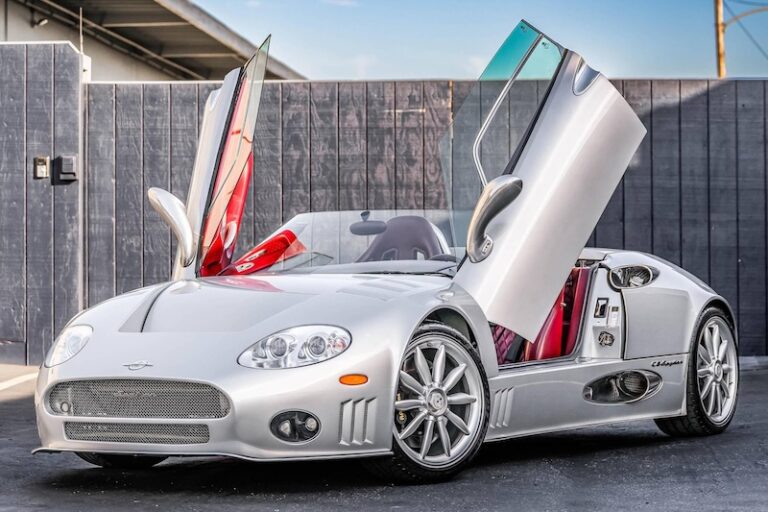
| Spyker C8 | 2000–Present | 4.2L Nat-Asp V8 / 400 hp | ~$200,000 / $250k – $400k |
| Lamborghini Murciélago | 2001–2010 | 6.2L – 6.5L Nat-Asp V12 / 572–661 hp | ~$320,000 / $250k – $600k+ |
| Lamborghini Aventador | 2011–2022 | 6.5L Nat-Asp V12 / 690–770 hp | ~$400,000 / $350k – $800k+ |
| Lamborghini Revuelto | 2023–Present | 6.5L V12 + 3 E-Motors / 1,001 hp | ~$608,000 / $608k+ |
Notice a pattern? Lamborghini dominates—and that’s intentional. They’ve deliberately reserved true scissor doors exclusively for their flagship V12 models, keeping conventional doors on V10 and V8 cars to preserve the hierarchy.
The Cars That Made Scissor Doors Legendary
Lamborghini Countach — The One That Started It All
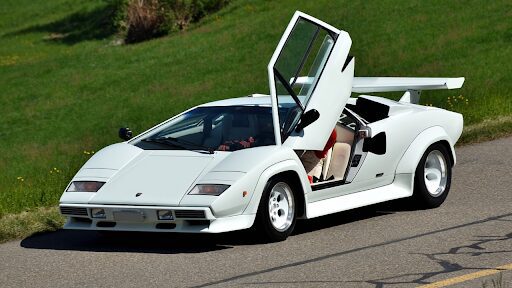
The LP400 debuted and nobody had ever seen anything like it. Tubular spaceframe chassis. Aggressively angular aluminum body. And those doors—they weren’t optional design flair. They were mandatory.
The Countach’s lateral radiators and massive tubular sills made standard swing doors physically impossible. Scissor doors were the only solution that worked. And the image of a Countach driver perched on the sill, looking backward to reverse because there was zero rear visibility? That became one of the most romanticized mechanical rituals in automotive history.
Bugatti EB110 — The Forgotten Masterpiece
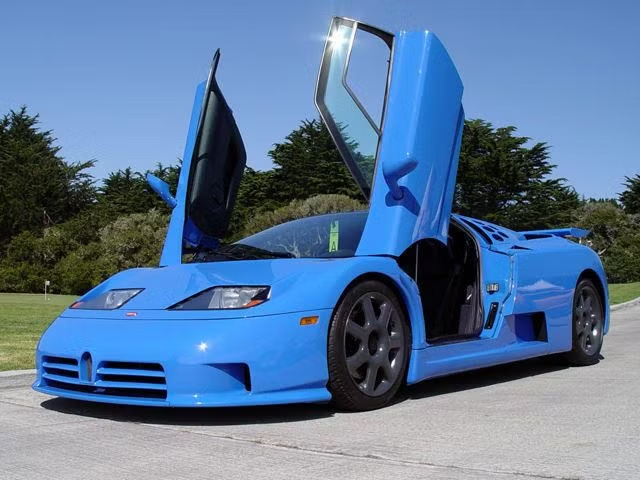
The EB110 tends to get overshadowed by its Veyron successor, which is a shame. Romano Artioli’s creation was a technological powerhouse in the early 1990s—its carbon-fiber monocoque chassis was built by Aérospatiale, the same company that made the Concorde.
That construction demanded exceptionally thick sills for structural rigidity. Scissor doors solved the ingress problem over those massive sills while also giving the EB110 enough visual drama to compete with the Lamborghini Diablo. It’s the only production Bugatti that’s ever used this door design.
Vector W8 — An Aerospace Fever Dream on Wheels
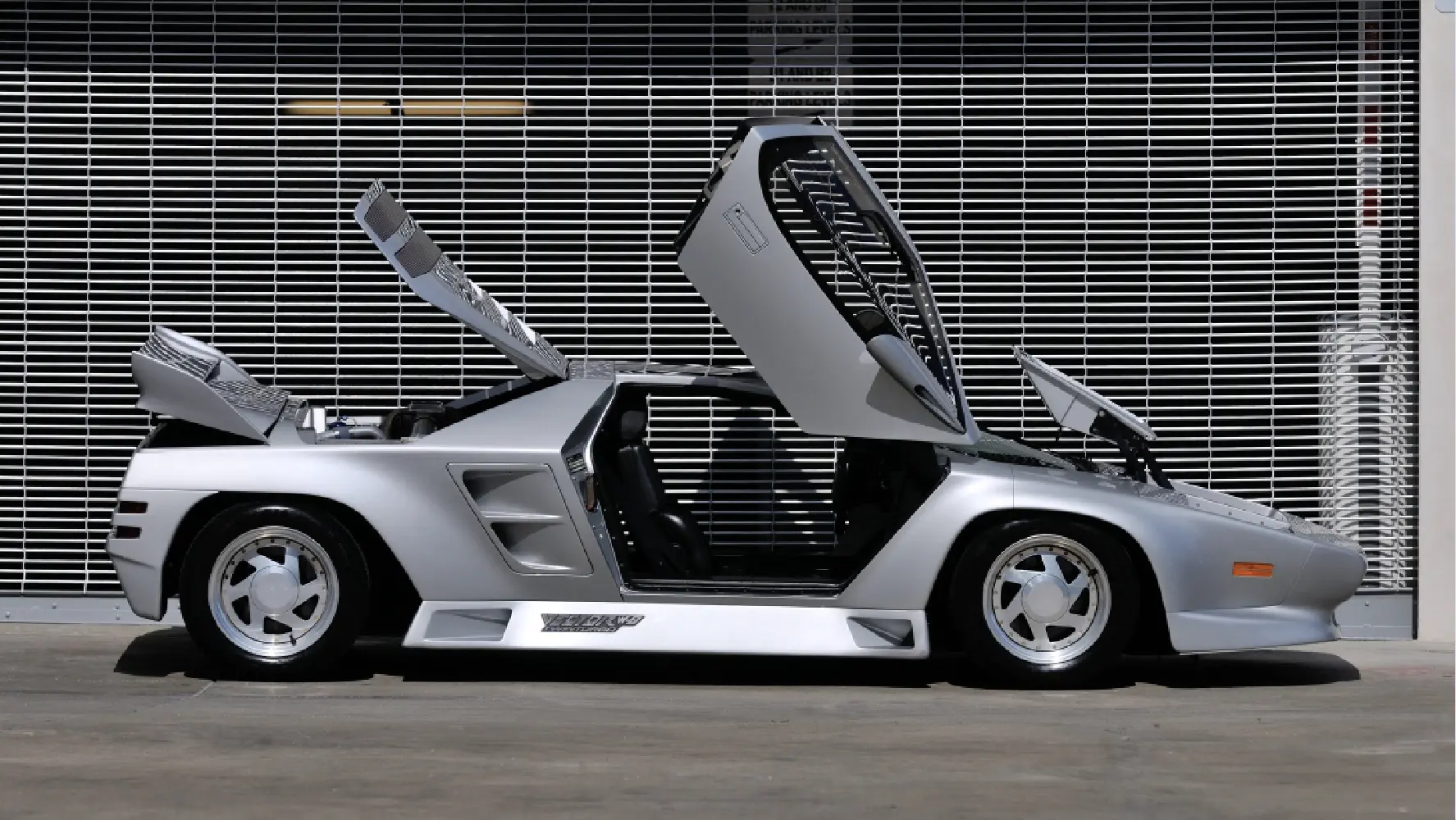
Jerry Wiegert’s all-American creation took the wedge design concept and cranked it to eleven. Twin-turbocharged V8, fighter-jet interior, and a silhouette that looked like a grounded F-117 Nighthawk.
Wiegert chose scissor doors to amplify that aviation aesthetic. Were they mechanically complex and ergonomically punishing? Absolutely. But they completed the W8’s unapologetic cyberpunk look. You couldn’t imagine this car with regular doors—it would ruin the whole vibe.
The Lamborghini V12 Bloodline — Diablo Through Revuelto
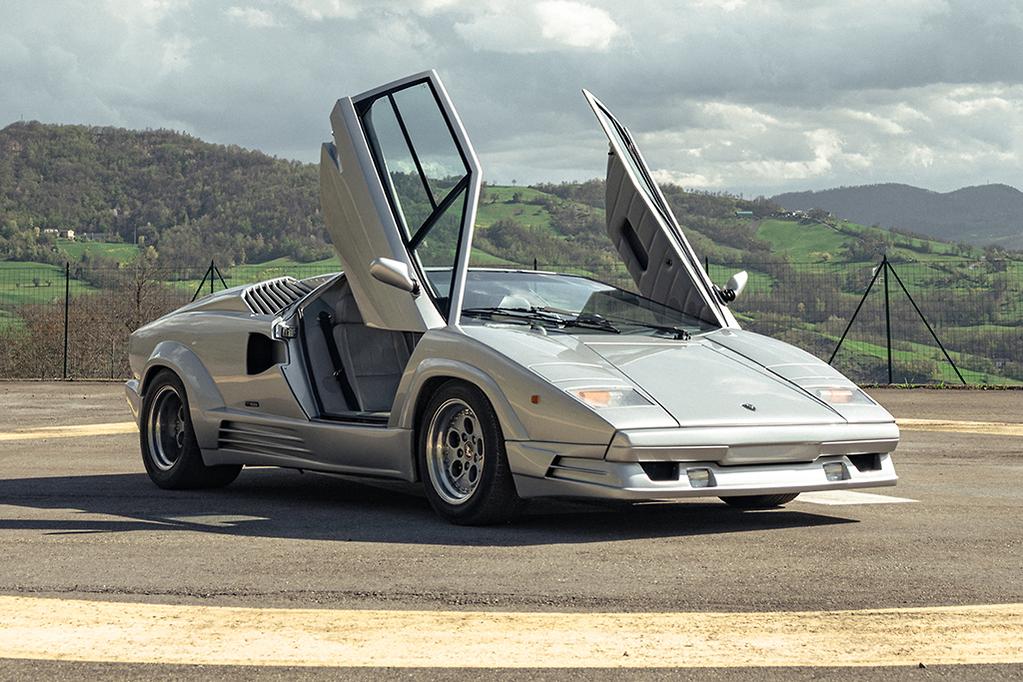
When Chrysler took over Lamborghini and tasked Gandini (and later Tom Gale) with designing the Diablo, dropping the scissor doors was never even discussed. They’d become the brand’s definitive signature.
The Diablo refined the mechanism with heavier gas struts and better weather sealing. That tradition then evolved through the Luc Donckerwolke-designed Murciélago, the Filippo Perini-penned Aventador, and into today’s hybrid Revuelto. It’s a direct mechanical lineage spanning over 50 years—and Lamborghini guards it carefully by only putting scissor doors on the V12 flagship.
Spyker C8 — Steampunk Meets Aviation
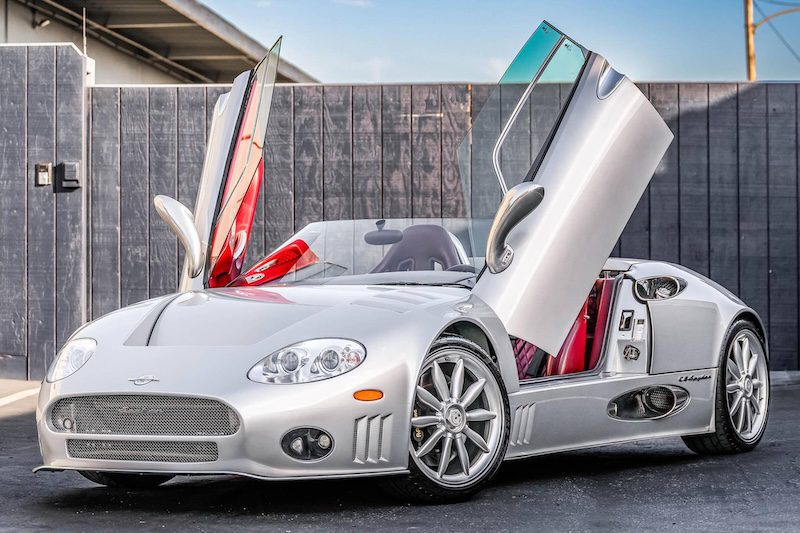
This one’s a wild card. The Dutch-built Spyker C8 is a rolling piece of art—steampunk aesthetics mixed with aviation heritage. Spyker calls their doors “swan wings,” though kinematically they function as single-pivot scissor/dihedral hybrids.
The doors sweep straight up via a beautifully exposed machined billet aluminum hinge. The choice was purely about visual theater, paying homage to the spinning propellers and vintage aircraft DNA embedded in the Spyker brand. No engineering necessity here—just pure, unapologetic style.
The Early 2000s “Lambo Door” Craze (And Why It Died)
If you lived through the early 2000s tuner boom, you saw this firsthand. Fueled by MTV’s Pimp My Ride, the Fast & Furious franchise, and Need for Speed: Underground 2, the desire for “Lambo doors” trickled down from Italian supercars to everyday sedans.
Companies like Vertical Doors Inc. engineered bolt-on hinge kits that required removing the front fenders to install a dual-axis pivot. The door would open slightly outward first, then pivot vertically to clear the A-pillar. Suddenly, Honda Civics, Chrysler 300Cs, and Cadillac Escalades were raising their doors to the sky. It became a defining hallmark of the DUB Magazine era—a status symbol for urban car culture and show-car point scoring.
Today? The tuning world has swung hard toward functional aero and OEM+ purity. Aftermarket Lambo doors are mostly viewed with millennial nostalgia or playfully roasted by track-day purists as dead weight. But love them or hate them, their impact on mainstream car customization is undeniable.
The Real-World Trade-Offs of Living With Scissor Doors
Scissor doors look incredible at a car show. Living with them daily is a different conversation entirely. Here’s the honest breakdown:
| The Upside | The Downside |
| Tight parking is no problem. An 80-inch-wide supercar can fit in surprisingly narrow spaces because the doors need virtually zero horizontal clearance. | Rollover = trapped. If the car lands on its roof, the doors can’t open. Modern cars like the Aventador use explosive pyrotechnic bolts to blow the hinges in a crash. |
| Unmatched visual impact. Nothing announces an ultra-exotic’s arrival like scissor doors. It’s instant curb appeal and brand hierarchy in one motion. | Low ceilings are the enemy. Underground parking garages and low-clearance lifts become nerve-wracking. One miscalculation and you’re shattering carbon fiber on a concrete beam. |
| The “Countach reverse.” With no rear visibility, drivers can sit on the sill, look behind them, and actually reverse safely. It’s iconic for a reason. | Gas struts wear out. A heavy, glass-laden door resting entirely on hydraulic struts puts immense strain on those parts. When a strut fails, the door drops like a guillotine. |
| Design freedom. Eliminating traditional door swing paths lets designers carve deeper body-side intakes and wider structural carbon sills. | Getting out gracefully takes practice. Sliding over a foot-wide sill under a diagonally slanted door requires actual core strength. First-timers rarely look elegant doing it. |
The scissor door was never a gimmick. It was—and still is—an elegant analog solution to an exotic problem. Marcello Gandini didn’t just design a door mechanism. He created a mechanical event—one that’s captivated car enthusiasts for over half a century and shows no signs of losing its power.