
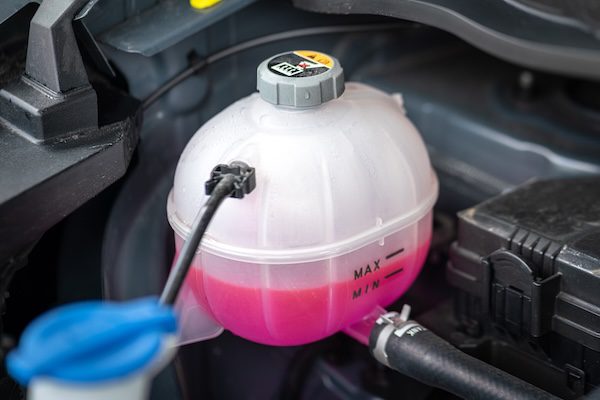
Your coolant is only as good as the water you mix it with. A lot of people don’t give this a second thought. They grab whatever’s handy, twist the cap off the radiator, and pour it in. But the type of water you use has a direct impact on whether your cooling system lasts 10 years or starts corroding in 10 months.
So what should you actually use? Let’s cut through the confusion and get into the details that matter.
The Short Answer That Could Save Your Engine
Use distilled water. If you can’t find distilled, high-quality de-ionized (DI) water is a close second. Don’t use tap water. Not from the garden hose, not from the kitchen faucet, not from your refrigerator filter.
It seems like such a small decision. You’re just mixing water with antifreeze, right? But that “small decision” can lead to scale buildup inside your radiator, corrosion eating through your heater core, and coolant additives burning out years before they should. What starts as a $1.29 jug of distilled water you skipped can turn into a $1,500 repair bill. That’s not an exaggeration.
Distilled, De-ionized, or Tap: What’s Actually in Each One?
If you want to understand why some engines develop cooling problems early while others run clean for 200,000 miles, the water going into the system is a big piece of the puzzle. The water you mix with coolant isn’t just there to add volume. Its chemical makeup affects heat transfer, corrosion rates, and how long the coolant’s protective additives stay active.
Here’s how the three main options stack up.
Tap Water: The Worst Dollar You’ll Ever “Save”
Tap water looks clean enough sitting in a glass. But it’s far from pure H2O. Depending on where you live, your tap water could be loaded with dissolved minerals and treatment chemicals that have no business being inside an engine.
Here’s what’s typically floating around in tap water:
- Calcium and magnesium: The minerals responsible for hard-water scale. If you’ve ever seen white crusty buildup on a showerhead, that’s what these do. Now picture that happening inside your radiator passages.
- Chlorides and fluorides: Corrosive ions that accelerate oxidation on metal surfaces. They’re fine in your drinking water at regulated levels, but they’re not fine sitting against aluminum engine components at 200°F for months on end.
- High TDS (Total Dissolved Solids): This is a measurement of all the dissolved organic and inorganic material in the water. The higher the TDS, the more “stuff” is in there that shouldn’t be in your cooling system.
The exact mineral content varies wildly by region. Water in Phoenix, Arizona is notoriously hard. Water in Portland, Oregon is relatively soft. But even “soft” tap water contains enough dissolved minerals to cause problems over time. There’s no municipal water supply anywhere that produces water clean enough for engine cooling.
Distilled Water: The Gold Standard for a Reason
Distilled water is made through a straightforward process: water gets boiled into steam, and that steam is collected and condensed back into liquid in a clean container. The minerals, bacteria, and other contaminants don’t evaporate with the water, so they get left behind.
- How it works: Physical separation through evaporation and condensation. It’s the same principle nature uses in the water cycle, just controlled in a lab or factory setting.
- What you get: Chemically neutral water with virtually zero mineral content. TDS is typically below 5 parts per million. Bacteria, viruses, and inorganic minerals are effectively eliminated.
This is why every major coolant manufacturer recommends distilled water for mixing. It’s clean, predictable, and chemically boring in the best possible way. It won’t react with your coolant’s additive package, it won’t leave mineral deposits on metal surfaces, and it won’t turn your cooling system into a science experiment.
It’s also incredibly cheap and available everywhere. You can pick up a gallon at any grocery store, pharmacy, or gas station for around $1 to $2. Compared to what a radiator replacement costs, that’s practically free insurance.
De-ionized Water: A Strong Runner-Up
De-ionized water, often labeled as DI water, takes a different approach to purification. Instead of boiling the water, the process pushes it through special ion-exchange resins that chemically strip out charged contaminants.
- How it works: Cation resins swap hydrogen ions for positively charged contaminants (like calcium and magnesium). Anion resins swap hydroxyl ions for negatively charged contaminants (like chlorides and sulfates). What comes out the other side is water with extremely low electrical conductivity.
- What you get: Very pure water that’s free of the ions responsible for scale and corrosion.
There’s one technical wrinkle worth knowing about. In its pure state, DI water is sometimes described as “aggressive” or “hungry” because it actively wants to absorb minerals from its surroundings. In theory, that means it could leach material from metal surfaces if left on its own.
But here’s the thing: you’re not putting pure DI water into your engine. You’re mixing it with glycol-based coolant that contains corrosion inhibitors. Once those additives are in the mix, the water stabilizes completely. So in practice, high-quality DI water works great for coolant mixing. Distilled still gets the slight edge for being universally available and having a simpler purification process, but DI water is solidly in the safe zone.
How Tap Water Quietly Wrecks Your Cooling System From the Inside
Using tap water in your coolant isn’t just a suboptimal choice. It actively kicks off chemical processes that damage your engine’s internal surfaces. And the really frustrating part? You typically won’t notice anything is wrong until the damage is already done and the repair bill is staring you in the face.
Scale Buildup Acts Like Insulation on Your Engine’s Hot Spots
When tap water containing calcium and magnesium flows through an engine that’s running at normal operating temperatures (often exceeding 200°F or 93°C), those minerals start falling out of solution. They precipitate onto the hottest metal surfaces, forming a layer of calcium carbonate scale.
Here’s what makes this so dangerous: scale is an insulator. A layer just 1.5 mm thick provides the same insulating effect as 3 inches of cast iron. That’s a startling ratio. It means heat can’t transfer from the metal into the coolant the way it’s supposed to.
The result? Localized overheating in the cylinder head, even while your temperature gauge reads perfectly normal. That hidden overheating can cause nucleate boiling (tiny steam bubbles forming on the metal surface), warped cylinder heads, and in severe cases, cracked engine blocks. You can be driving around thinking everything’s fine while scale is slowly cooking your engine from the inside.
Your Cooling System Becomes a Low-Voltage Battery
This one catches a lot of people off guard. A typical cooling system contains multiple types of metal: cast iron in the engine block, aluminum in the cylinder heads or radiator, copper or brass in the heater core, and possibly lead solder in older systems. These dissimilar metals are all connected by the coolant flowing between them.
Now add tap water full of dissolved ions, and you’ve accidentally created something very similar to a battery. The ions make the coolant electrically conductive, which means stray electrical current from bad grounds or static buildup can travel through the fluid. When that current flows between dissimilar metals, it strips electrons from the less noble metal in the pair. This process is called galvanic corrosion, and it’s devastating to aluminum components.
Aluminum radiators and heater cores are usually the first casualties. The corrosion shows up as pinholes that seem to appear out of nowhere, internal pitting that restricts flow, or sudden leaks that dump coolant everywhere. You’ve probably heard someone say “my radiator just started leaking for no reason.” In many of those cases, there was a reason. It was the water.
Distilled water helps prevent this because it has extremely low electrical conductivity. Instead of acting as a conductive soup, it behaves more like an insulator, which is exactly what you want between those dissimilar metals.
Tap Water Burns Through Your Coolant’s Protective Additives
Every modern coolant formulation, whether it’s IAT (Inorganic Acid Technology), OAT (Organic Acid Technology), or HOAT (Hybrid Organic Acid Technology), contains an additive package designed to protect metal surfaces and maintain a stable pH level inside the cooling system. These additives are the chemical armor that keeps corrosion in check.
When you pour in tap water loaded with calcium and magnesium, those minerals immediately start reacting with the phosphates and silicates in the coolant’s additive package. The additives get consumed neutralizing the mineral content of the tap water instead of doing their actual job, which is protecting your engine.
The practical effect is dramatic. Coolant that’s engineered to last five years can start behaving like it’s six months old the moment it mixes with mineral-heavy tap water. The protection drops, the pH drifts, and corrosion gets a head start. So if you’ve ever wondered how a cooling system develops corrosion “even though the coolant was brand new,” depleted additives from bad water is one of the most common explanations.
Head-to-Head: How Each Water Type Stacks Up
| Water Type | Mineral Content (Hardness) | Conductivity (Electrolysis Risk) | Additive Compatibility | Suitability Rating (0-10) |
| Tap Water | HIGH (Ca, Mg, Cl) | HIGH (Dangerous) | POOR (Depletes additives) | 0 |
| Filtered/Fridge Water | MODERATE | MODERATE | LOW | 2 |
| De-ionized (DI) | NONE | VERY LOW | EXCELLENT | 9.5 |
| Distilled | NONE | VERY LOW | EXCELLENT | 10 |
The takeaway is pretty clear. Distilled water is the best option. High-quality DI water is right behind it. Tap water and filtered refrigerator water aren’t even in the same conversation when engine protection is on the line.
One thing people sometimes ask about is bottled drinking water. Don’t use that either. Most bottled water still contains added minerals for taste (“electrolytes for flavor” on the label is marketing speak for dissolved minerals). It’s cleaner than tap water, sure, but it’s nowhere near clean enough for your cooling system.
Stranded With No Distilled Water? Here’s What to Do
Real life doesn’t always cooperate with best practices. A hose blows on the highway, coolant sprays everywhere, and you’re on the shoulder with nothing but a half-empty water bottle from the gas station you passed 20 miles back. What then?
In an emergency, use whatever water you have. Tap water, bottled drinking water, even creek water if that’s all there is. Running an engine with tap water in the cooling system for a short time is infinitely better than running it with no coolant at all. An overheated engine can warp heads, blow gaskets, and seize in minutes. Tap water won’t do that kind of damage in the time it takes you to limp to a repair shop or get home.
But once the emergency is over, fix it immediately. Don’t drive around for weeks thinking “I’ll get to it eventually.” Here’s the right sequence:
- Drain the entire cooling system. Don’t just top it off with the right stuff. Get the tap water out completely.
- Flush the system with a chemical flush agent. This helps dissolve any mineral deposits that may have already started forming on internal surfaces.
- Refill with the correct OEM-spec coolant concentrate mixed with distilled water. Use the ratio your owner’s manual specifies, which is typically 50/50.
Here’s a sobering detail to keep in mind: leaving tap water in a modern aluminum engine for even 30 days can initiate the electrolysis process. That’s not years. That’s one month. So the clock starts ticking the moment that tap water enters the system.
The Right Way to Mix Coolant (Most People Get This Wrong)
Even if you’re using the right water, how you mix it matters more than most people realize.
Don’t pour coolant concentrate into the radiator and then chase it with water. Don’t pour water in first and then add concentrate on top. Both methods leave you with an uneven mixture circulating through the engine, which means some areas get too much glycol (reduced heat transfer) and other areas get too much water (reduced freeze protection).
Instead, pre-mix the coolant and distilled water in a clean separate container before pouring it into the radiator. A clean bucket or an empty gallon jug works fine. This ensures a uniform 50/50 blend enters the engine block from the start.
Why does this matter? Because slugs of pure water moving through the system can cause localized freezing-point issues in cold weather. And slugs of pure concentrated antifreeze actually transfer heat less efficiently than a proper 50/50 mix. Pure antifreeze has a lower specific heat capacity than a 50/50 blend, which seems counterintuitive but it’s true. The mix outperforms both extremes.
If math isn’t your thing or you don’t want to deal with mixing at all, pre-mixed coolant is sold at every auto parts store. It’s already blended with distilled or DI water at the factory, so you just pour it straight in. It costs a little more per gallon than concentrate, but it eliminates the guesswork entirely.
One Dollar of Prevention, Thousands in Protection
Regardless of what kind of car you drive, what type of coolant it uses, or how old the engine is, the recommendation is the same: use distilled water every single time you add or mix coolant. It offers excellent heat-transfer properties, it’s chemically neutral, it has extremely low electrical conductivity, and it plays nicely with every coolant chemistry on the market.
A gallon of distilled water costs less than a cup of coffee. A new radiator costs $300 to $800. A heater core replacement can run $500 to $1,200 because of the labor involved in tearing apart the dashboard. A warped cylinder head? You’re looking at $1,500 or more. Every one of those repairs can trace its origin back to contaminated coolant, and contaminated coolant very often traces back to the wrong water.
Tap water belongs in your kitchen sink. Keep it out of your cooling system.