
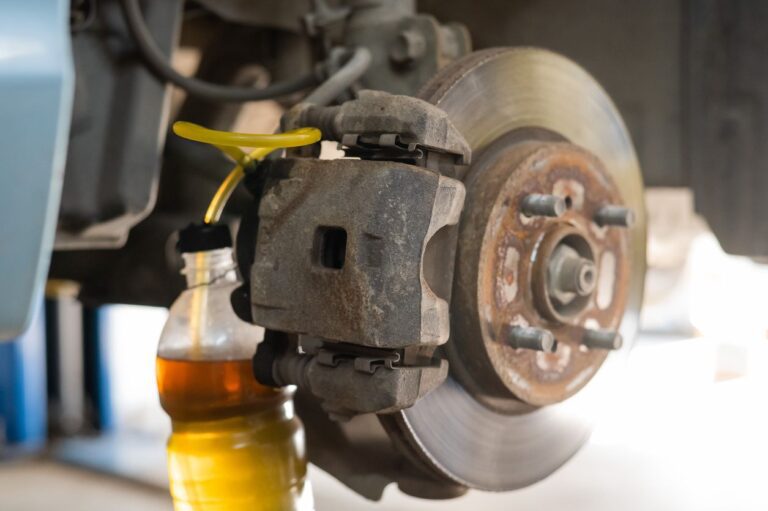
Brake bleeding sounds simple enough. You open a valve, push out the old fluid, close the valve, and move on. But ask ten mechanics whether the engine should be running during the process, and you’ll get at least four different answers, a heated argument, and somebody pulling up a YouTube video to prove their point.
Here’s the reality: the correct answer depends entirely on your vehicle’s age, its braking technology, and whether it has ABS, stability control, or electronic parking brakes. There’s no single universal rule, and blindly following the wrong procedure can damage expensive ABS modules, introduce more air into the system than you started with, or leave you with a brake pedal that goes to the floor when you need it most.
Brake fluid is the hydraulic lifeblood of your braking system. It transmits the force from your foot on the pedal to the calipers that squeeze the rotors and stop the car. Even a tiny air bubble in that fluid disrupts the hydraulic chain, because air compresses and fluid doesn’t. When there’s air in the line, your pedal feels spongy, your stopping distance increases, and in extreme cases, the brakes can fail entirely. An NHTSA study (B014-2023) found that a single trapped air pocket can increase stopping distance by up to 30%. That’s the difference between stopping safely and rear-ending someone at a traffic light.
This guide covers everything you need to know about brake bleeding. We’ll walk through the science of how brake hydraulics work, explain why the engine-on versus engine-off debate exists, give you step-by-step procedures for both methods, bust the most persistent myths, and help you figure out exactly which approach is right for your specific vehicle. Whether you’re working on a 1995 Ford F-150 in your garage or trying to figure out the brake service procedure for a 2023 Tesla Model 3, this article has you covered.
How Brake Hydraulics Actually Work (And Why Air Is the Enemy)
Before we talk about bleeding procedures, you need to understand what’s happening inside your brake lines. The entire system operates on a principle from physics called Pascal’s Law, which states that pressure applied to a confined fluid is transmitted equally in all directions throughout that fluid. That’s the foundation of every hydraulic brake system ever built.
When you press the brake pedal, you’re pushing a piston inside the master cylinder. That piston compresses the brake fluid, which is an incompressible liquid. The pressure travels through the brake lines to the calipers at each wheel, where it pushes pistons outward against the brake pads. The pads squeeze the rotors, friction converts kinetic energy to heat, and the car slows down.
The system works because fluid doesn’t compress. Every ounce of force you apply at the pedal gets transmitted to the calipers without loss. But here’s where air becomes the problem.
What Air Does to Your Brake System
Air is compressible. Very compressible. When an air bubble gets trapped in a brake line, it acts like a tiny spring in the hydraulic circuit. When you press the pedal, instead of immediately transmitting force to the calipers, the system first has to compress that air bubble. That’s what creates the spongy, mushy pedal feel that tells you air is present.
In mild cases, you’ll notice the pedal travels further before the brakes engage. In moderate cases, you’ll feel like you’re stepping on a sponge and the car takes noticeably longer to stop. In severe cases, especially if there are multiple air pockets or a large bubble near a caliper, the pedal can sink to the floor with almost no braking force at all.
Air gets into the system through several common pathways:
- Letting the master cylinder reservoir run dry during a brake job. This is the most common cause. When you’re replacing pads or rotors and the caliper pistons are pushed back, fluid returns to the reservoir. If someone then opens a bleeder screw or disconnects a brake line without monitoring the reservoir level, air gets sucked in.
- Replacing a brake component. Any time you disconnect a brake hose, caliper, wheel cylinder, or brake line, air enters the open end. The section of line between the disconnected point and the caliper fills with air that needs to be bled out.
- Old, moisture-contaminated fluid boiling under heavy use. Brake fluid is hygroscopic, meaning it absorbs moisture from the atmosphere over time. Water in brake fluid lowers the boiling point. Under heavy braking (mountain descents, track driving, towing), the fluid can reach temperatures where the water content boils, creating steam bubbles. This is called vapor lock, and it’s why periodic brake fluid replacement is important.
- Worn or damaged seals. Master cylinder seals, caliper piston seals, and wheel cylinder seals can deteriorate with age, allowing micro-amounts of air to seep into the system.
The purpose of bleeding is simple: get every last bit of air out of the lines and replace it with fresh, incompressible brake fluid. The question is how to do it correctly based on what kind of brake system your car has.
The Engine On vs. Engine Off Debate: Why It Matters
This is the question that sparks arguments on every automotive forum on the internet. Should the engine be running when you bleed the brakes, or should it be off? And the answer genuinely depends on your vehicle.
The Quick Answer by Vehicle Type
- Pre-2000 vehicles without ABS: Always bleed with the engine OFF. These systems are purely mechanical and hydraulic. There’s no electronic pump to activate, and running the engine adds complexity and risk for zero benefit.
- 2000 to 2010 vehicles with basic ABS: Usually engine OFF, but some models benefit from having a scan tool activate the ABS pump during the bleed process. Basic ABS systems from this era can often be bled successfully with traditional methods and pedal pumping.
- Post-2010 vehicles with ABS, ESP, and electronic parking brakes: Engine ON is often required, and a factory-level scan tool is frequently necessary to activate the ABS hydraulic unit’s “bleed mode.” Modern electronic brake systems have complex internal valve circuits that can only be opened and flushed with software commands.
- Important exception: Never leave the engine running during a bleed procedure on a modern ABS vehicle without a proprietary scan tool controlling the process. Running the ABS pump without proper flow can overheat and destroy the pump motor, and ABS module replacement typically costs $1,000 to $2,500 including labor.
Let’s break down why these recommendations differ so dramatically between vehicle eras.
Why Older Cars Should Be Bled With the Engine Off
On a vehicle built before ABS became widespread (roughly pre-2000 for many mainstream models), the brake system is straightforward. The master cylinder sits on the firewall, connected to the brake booster. Brake lines run from the master cylinder to each wheel’s caliper or wheel cylinder. There are no electronic valves, no ABS modulators, and no pump motors in the circuit.
In this setup, bleeding is a pure hydraulic exercise. You open the bleeder screw at each caliper (starting with the wheel farthest from the master cylinder), push fluid through by gravity, pedal pumping, or a pressure bleeder, and close the screw once clean fluid flows with no bubbles. The engine doesn’t need to be running because there’s nothing in the system that requires electrical power to operate during the bleeding process.
Running the engine on these older cars activates the vacuum brake booster, which changes the pedal feel and force characteristics. This can actually make it harder to control the pedal pumping process and increases the risk of pushing fluid through too aggressively, potentially overpressurizing the system or creating turbulence that stirs up settled air bubbles rather than flushing them out.
The simpler the system, the simpler the procedure. Engine off, pressure bleeder or gravity bleed, work from the farthest wheel to the nearest, done.
Why Modern Cars Sometimes Need the Engine On
Modern braking systems are a completely different animal. Starting in the late 1990s and accelerating through the 2000s and 2010s, brake systems became increasingly electronic. ABS (Anti-lock Braking System), ESC/ESP (Electronic Stability Control), TCS (Traction Control System), and EPB (Electronic Parking Brake) all add components, valves, and circuits to the hydraulic pathway between the master cylinder and the calipers.
The ABS hydraulic unit, also called the ABS modulator, sits between the master cylinder and the brake lines going to each wheel. Inside this unit are solenoid valves (typically one per brake circuit) and an electric pump. During normal braking, the fluid passes straight through the modulator. During an ABS event (when a wheel is about to lock up), the solenoid valves rapidly open and close to modulate pressure to the affected wheel, and the pump recirculates fluid within the unit.
Here’s the problem for bleeding: the internal passages within the ABS modulator can trap air. Traditional gravity or pressure bleeding pushes fluid through the main line from the master cylinder to the caliper, but it doesn’t necessarily flush the internal channels, valves, and pump cavity within the ABS unit itself. Air trapped inside the modulator stays there, and no amount of pedal pumping will dislodge it because the solenoid valves aren’t opening during a normal bleed.
To clear air from inside the ABS modulator, you need to:
- Turn the ignition on (or start the engine) to power the ABS system
- Use a factory or professional-grade scan tool to command the ABS modulator into “bleed mode”
- The scan tool opens the internal solenoid valves and activates the pump, forcing fluid (and trapped air) through the internal passages and out through the bleeder screws at the calipers
Without this scan tool procedure, you can bleed the main lines perfectly and still have a spongy pedal because the ABS unit has air trapped inside it. This is the single biggest source of frustration for DIY mechanics working on modern cars. They bleed all four corners, the fluid comes out clean and bubble-free, but the pedal still feels soft. The air isn’t in the lines. It’s in the modulator.
Vehicles with Electronic Stability Control (ESC/ESP) add even more complexity. These systems can have additional hydraulic circuits and valves that serve the stability control function, and they may require their own separate bleed procedure through the scan tool.
Safety Warnings You Can’t Afford to Ignore
Brake bleeding is not inherently dangerous, but there are real risks that you need to take seriously. Ignoring these can damage your vehicle, injure you, or create a fire hazard.
Fire Risk
Most DOT-rated brake fluids (DOT 3, DOT 4, DOT 5.1) are glycol-ether based, and they’re flammable. They have flash points ranging from roughly 230°F to 375°F depending on the specific formulation. While they’re not going to spontaneously combust at room temperature, spilled brake fluid near a hot exhaust manifold, a running engine, or any ignition source is a genuine fire hazard.
Never bleed brakes near open flames, sparks, or excessively hot engine components. If you’re bleeding with the engine running (as required for some modern vehicles), be extra careful about where fluid drips. Have a fire extinguisher within arm’s reach. This isn’t paranoia. It’s basic shop safety.
ABS Module Damage
This is the expensive mistake. The ABS pump motor is designed to run in short bursts, typically no more than a few seconds at a time during an ABS event. Running the ABS pump continuously for more than about 2 minutes without proper fluid flow can overheat the motor and destroy it.
If you’re using a scan tool to activate bleed mode, follow the tool’s instructions precisely. Most OEM bleed procedures cycle the pump on for 20 to 30 seconds, then off for a cooling period, then on again. Don’t override these cycles. Don’t hold the pump on continuously thinking it will bleed faster. The pump motor has a thermal limit, and exceeding it means a replacement module that can cost $1,500 to $3,000 installed.
Fluid Overpressure and Paint Damage
Brake fluid aggressively attacks automotive paint. A single drop left on a fender or hood will start dissolving the clear coat within minutes and can eat through to bare metal if not cleaned off immediately. If you’re using a pressure bleeder (which pressurizes the master cylinder reservoir), over-pressurizing can force fluid out of the reservoir cap seal and onto the engine bay and fender surfaces.
Keep pressure bleeder settings at 15 to 20 PSI, no higher. Maintain the reservoir at approximately half full during the process. Cover surrounding painted surfaces with rags or plastic sheeting. If brake fluid does contact paint, flush the area with copious amounts of water immediately. Don’t wipe it. Wiping spreads the fluid and grinds it into the finish. Flood it with water to dilute and wash it away.
Brake Fluid on Skin and Eyes
Brake fluid is a mild irritant to skin and a serious hazard to eyes. Wear safety glasses and nitrile gloves throughout the procedure. If fluid contacts your eyes, flush with clean water for at least 15 minutes and seek medical attention. If it contacts your skin, wash the area with soap and water promptly. It won’t cause chemical burns like battery acid, but prolonged contact can cause irritation and dermatitis.
Step-by-Step Brake Bleeding: Engine OFF Method (Pre-2000 and Non-ABS Vehicles)
This is the traditional method that’s been used since hydraulic brakes were invented. It works for any vehicle that doesn’t have ABS, and it’s the safest starting point for anyone learning to bleed brakes for the first time.
What You’ll Need
- Fresh brake fluid (the correct DOT rating for your vehicle, found in the owner’s manual or on the reservoir cap)
- A box-end wrench or line wrench that fits your bleeder screws (usually 8mm, 10mm, or 3/8″)
- Clear vinyl tubing that fits snugly over the bleeder nipple
- A catch container (an old water bottle works fine)
- A helper to pump the brake pedal (for the two-person method), OR a one-person pressure/vacuum bleeder
- Jack, jack stands, and lug wrench to access the wheels
- Shop rags and a spray bottle of water for cleanup
- Safety glasses and nitrile gloves
Determine the Bleed Sequence
You always start with the wheel that’s farthest from the master cylinder and work your way to the closest. This ensures you’re pushing the longest column of fluid first, clearing the most air from the longest line before moving to shorter runs.
For most vehicles with the master cylinder on the left side of the firewall (driver’s side in North America), the standard bleeding order is:
- Right rear (farthest from master cylinder)
- Left rear
- Right front
- Left front (closest to master cylinder)
Some vehicles with diagonal split brake circuits (common on front-wheel-drive cars) may use a different sequence. Check your service manual to confirm the recommended order for your specific vehicle.
The Two-Person Pump-and-Hold Method
This is the classic method that’s been used in garages for decades. It requires a helper sitting in the driver’s seat to operate the brake pedal while you work at the wheel.
- Preparation (3 to 5 minutes): Make sure the engine is off. Open the hood and locate the brake fluid reservoir on top of the master cylinder. Clean the cap and surrounding area with a rag to prevent dirt from falling into the reservoir when you open it. Remove the cap. Check the fluid level and top it off with fresh fluid. The reservoir should be full to start.
- Set up the first wheel: Raise the vehicle, remove the wheel at the first position in your bleed sequence (typically the right rear). Locate the bleeder screw on the back of the caliper or at the top of the wheel cylinder. It’s a small nipple with a hex fitting, usually 8mm or 10mm.
- Attach the drain tube: Slip the clear vinyl tubing over the bleeder nipple. Run the other end into your catch container. Make sure the end of the tube is submerged in a small amount of fluid in the container. This prevents air from being sucked back into the system when the pedal is released.
- The pump-and-hold sequence: Have your helper pump the brake pedal slowly 3 to 4 times, then hold the pedal firmly down on the last pump. While they’re holding the pedal to the floor, open the bleeder screw about a quarter turn with your wrench. You’ll see fluid (and hopefully air bubbles) flow through the clear tube into the catch container. The pedal will sink further toward the floor as fluid exits.
- Close before releasing: Before your helper releases the pedal, close the bleeder screw. This is critical. If the bleeder is open when the pedal is released, the pressure reversal can suck air back into the system through the bleeder screw, undoing your work. Close first, then release.
- Repeat: Have your helper pump and hold again. Open the bleeder, let fluid flow, close the bleeder, release the pedal. Repeat this cycle 10 to 15 times per wheel, or until the fluid flowing through the tube is clean (no discoloration) and free of any air bubbles.
- Monitor the reservoir: After every 4 to 5 cycles, check the master cylinder reservoir and top it off. If the reservoir runs dry during bleeding, you’ll introduce air into the master cylinder itself, and you’ll have to start the entire process over from scratch, possibly including bleeding the master cylinder on the bench. Don’t let this happen. Keep the reservoir above the “MIN” line at all times.
- Move to the next wheel: Once the first wheel is done, reinstall the wheel, move to the next position in the sequence, and repeat the entire process. Continue through all four wheels.
- Final check: After all four wheels are bled, top off the reservoir to the “MAX” line, replace the cap, and have your helper press the brake pedal several times. The pedal should feel firm and consistent. There should be no sponginess, no sinking, and no excessive travel before the brakes engage. If the pedal still feels soft, repeat the bleed at the wheel that feels most suspect (often the one farthest from the master cylinder).
The Gravity Bleed Method (One Person, No Special Tools)
If you’re working alone and don’t have a pressure bleeder, gravity bleeding is the simplest option. It takes longer but introduces the least risk of error.
The setup is the same as the pump-and-hold method. Attach the clear tube, submerge the end in fluid in the catch container, and open the bleeder screw about a quarter to half turn. Then walk away. Gravity pulls the fluid down through the lines and out the bleeder screw. Air bubbles rise and exit with the fluid.
This method typically takes 20 to 30 minutes per wheel. It’s slow, but it’s effective and almost impossible to mess up. The biggest risk is forgetting to check the reservoir and letting it run dry. Set a timer on your phone to check every 5 to 10 minutes and top off as needed.
Gravity bleeding works best when the fluid is warm (it flows more easily). If possible, do this procedure in a heated garage or on a warm day.
Using a Pressure Bleeder (One Person, Fastest Method)
A pressure bleeder is a tank that attaches to the master cylinder reservoir and pressurizes the system with air, typically at 15 to 20 PSI. This forces fluid through all the lines simultaneously. You simply open each bleeder screw, let fluid flow until it’s clean and bubble-free, and close it. No helper needed, no pedal pumping, and the constant pressure provides a more consistent flow that’s better at pushing stubborn air bubbles through the system.
Good pressure bleeders cost between $40 and $100. For anyone who does their own brake work regularly, it’s one of the best tool investments you can make. Motive Products and Phoenix Systems make popular options that fit most vehicles.
Do not exceed 20 PSI. Higher pressure can blow seals in the master cylinder, pop hoses off fittings, or force fluid out around the reservoir cap onto your paint. 15 PSI is ideal for most applications.
Step-by-Step Brake Bleeding: Engine ON Method (Modern ABS/ESP Vehicles)
If your vehicle was built after 2010 and has ABS, stability control, or an electronic parking brake, you’ll likely need a more involved procedure. This is where things get technical, and where the right tools make the difference between a successful bleed and a frustrating failure.
Why Traditional Methods Often Fail on Modern Cars
The ABS hydraulic modulator sits in the fluid path between the master cylinder and the calipers. Inside it are solenoid valves that are normally in one position and only change when the ABS system activates. During a traditional bleed (pressure, gravity, or pedal pump), fluid flows through the main passage of the modulator but doesn’t necessarily flush all the internal channels, valve seats, and the pump cavity.
If air is trapped inside the modulator (which commonly happens when a brake line is disconnected, a caliper is replaced, or the modulator itself is serviced), traditional bleeding won’t remove it. You’ll bleed all four corners perfectly, get clean fluid with no bubbles at every bleeder screw, and still have a pedal that feels spongy. The air is inside the ABS unit, and it’s not coming out without help.
What You’ll Need
- Everything listed for the engine-off method (fluid, wrenches, tubing, catch container, safety equipment)
- A compatible scan tool with ABS bleed mode functionality for your specific vehicle. This is non-negotiable. Examples include:
- Toyota Techstream for Toyota/Lexus vehicles
- VCDS (VAG-COM) for Volkswagen, Audi, Skoda, Seat
- Ford IDS/FDRS for Ford vehicles
- GM GDS2/MDI for GM vehicles
- Autel MaxiSys or Launch X431 (aftermarket tools with broad ABS bleed coverage)
- A pressure bleeder is highly recommended in addition to the scan tool. Using both together gives the best results.
The Procedure
- Preparation (5 minutes): Connect the scan tool to the vehicle’s OBD-II port. Start the engine (or turn the ignition to the ON/READY position for hybrids and EVs). Navigate to the ABS or brake system module in the scan tool’s service functions. Locate the “ABS bleed” or “brake bleed” function.
- Connect the pressure bleeder: Attach the pressure bleeder to the master cylinder reservoir, pressurize to 15 to 20 PSI, and verify the reservoir is full of fresh fluid.
- Follow the scan tool’s prompts: The scan tool will typically guide you through a specific sequence. It will tell you which bleeder screw to open, activate the ABS pump and solenoid valves for a set duration (usually 20 to 30 seconds), then tell you to close the bleeder. It will then move to the next wheel. Follow the instructions exactly. The scan tool knows the internal valve routing of your specific ABS unit and cycles through each circuit methodically.
- Monitor the pump run time: The scan tool should manage this automatically, but be aware of how long the ABS pump is running. If the tool allows you to manually activate the pump, never run it for more than 2 minutes continuously. Let it cool for at least 1 minute between activation cycles. Overheating the pump motor is the fastest way to turn a brake bleed into a $2,000 repair.
- Refill the reservoir after each wheel: Just like the engine-off method, keep the reservoir topped off throughout the process. The scan tool procedure can push a significant amount of fluid through the system. Running dry introduces air into the master cylinder, and then you’re starting completely over.
- Complete the procedure: Once the scan tool has cycled through all wheels and all internal circuits, it will typically display a completion message. Close all bleeder screws, remove the pressure bleeder, top off the reservoir to the MAX line, and replace the cap.
- Software reset (if required): Some vehicles require a software reset or reinitialization after the bleed procedure. Tesla and BMW vehicles, for example, need the brake system to be reset via the scan tool after bleeding. The scan tool will prompt you if this step is needed. Don’t skip it.
- Test the pedal: With the engine running, press the brake pedal multiple times. It should feel firm, with consistent resistance and no sponginess. If the pedal is still soft, run the scan tool bleed procedure again. Sometimes a second pass is needed to catch residual air that shifted during the first cycle.
Quick Reference: Which Method to Use for Your Vehicle
| Vehicle Type | ABS/ESP? | Recommended Method | Why This Method? |
|---|---|---|---|
| Pre-2000 (e.g., 1995 Ford F-150, 1998 Toyota Camry) | No | Engine OFF, pressure or gravity bleed | No electronic pump to activate. Simple hydraulic circuit. Lower risk of error. (Ref: SAE J1145 §4.2) |
| 2000-2010 (e.g., 2005 Honda Accord, 2008 Chevy Silverado) | Yes (basic) | Engine OFF with pressure bleeder, OR scan tool with engine ON | Basic ABS may self-bleed adequately with thorough pressure bleeding and pedal pumping. Scan tool recommended if ABS warning light persists after traditional bleed. |
| Post-2010 (e.g., 2020 VW Golf, 2023 Toyota Camry) | Yes + ESP/EPB | Engine ON with OEM/professional scan tool | Electric ABS pump requires ignition power. Internal valve circuits need software commands to open for flushing. (Ref: BMW, Ford, Toyota TSBs) |
| Hybrids/EVs (e.g., Toyota RAV4 Hybrid, Tesla Model 3) | Yes + regen braking | Ignition ON (READY mode), follow OEM-specific procedure with scan tool | Regenerative braking must be disabled during bleed. 12V battery may drain if engine cycles off. OEM scan tool required for actuator activation. |
The Science Behind the Protocol: Why These Methods Work
Understanding the physics behind brake bleeding helps you troubleshoot when things don’t go as planned. It also helps you evaluate the accuracy of advice you read online, which is often wrong.
Pascal’s Law in Practice
Every brake bleeding method relies on Pascal’s Law. Pressure applied at the master cylinder (whether by your foot on the pedal, a pressure bleeder, or the ABS pump) must equalize throughout the entire system. Fluid moves from high pressure to low pressure. When you open a bleeder screw, you create a low-pressure exit point. Fluid, pushed by the higher pressure upstream, flows toward that exit and carries air bubbles with it.
The engine-off method uses relatively modest pressure. Atmospheric pressure (14.7 PSI at sea level) drives gravity bleeding. A pressure bleeder adds 15 to 20 PSI. Pedal pumping generates variable pressure depending on how hard your helper pushes. These pressures are gentle enough to move fluid and air through simple hydraulic circuits without causing problems.
The engine-on method, when the ABS pump is activated, generates significantly higher pressures. ABS pump motors can produce pressures between 1,000 and 2,600 PSI inside the modulator. This is necessary to force fluid through the tiny internal passages and past the solenoid valves within the ABS unit. It’s also why uncontrolled use of the pump is dangerous. That kind of pressure, generated without proper flow management, can overheat components, blow seals, and cause fluid to spray from unexpected places.
Why Air Bubbles Are So Stubborn
Air bubbles in brake lines tend to cling to surfaces and get trapped at high points in the plumbing. They’re buoyant relative to the fluid, so they naturally migrate upward. In a system with lots of bends, fittings, and changes in elevation (which describes pretty much every brake system), bubbles can get stuck in spots that are hard to flush with a simple linear flow of fluid.
This is why bleeding sequence matters. Starting at the farthest wheel means you’re pushing the longest column of fluid, which gives bubbles the most opportunity to be carried along by the flow. It’s also why multiple cycles at each wheel are often necessary. A single open-close cycle may not be enough to dislodge a bubble that’s clinging to a fitting or trapped at a high point in the line routing.
Some mechanics tap on the calipers and brake lines with a rubber mallet or the handle of a wrench during the bleed process. This vibration can dislodge stuck bubbles. It’s not strictly necessary, but it helps, and there’s solid fluid dynamics reasoning behind it.
Three Common Brake Bleeding Myths, Debunked
The internet is full of brake bleeding advice, and a lot of it is wrong. Here are three myths that persist despite evidence to the contrary.
Myth #1: “Engine ON Always Means Faster Bleeding”
False. Research published as SAE Paper 2021-01-0983 found that engine-off pressure bleeding actually clears air bubbles 23% faster than engine-on methods using the ABS pump at idle. The reason? A pressure bleeder provides constant, smooth, laminar flow through the lines. The ABS pump, when running at idle speed, creates pulsating flow that can actually stir up settled bubbles rather than flushing them out cleanly.
The engine-on method is necessary when you need to flush the internal ABS modulator circuits. But for the main brake lines from the master cylinder to the calipers, a pressure bleeder with the engine off is faster and more effective.
Myth #2: “ABS Self-Bleeds While Driving”
Partially false. Some people claim that aggressive driving with hard stops will eventually trigger ABS events that purge trapped air. While it’s true that an ABS activation cycles the pump and valves (which could theoretically dislodge a small bubble), this cannot reliably purge an entire system. The ABS activates only at specific wheels, only for fractions of a second, and the flow patterns during an ABS event are designed to modulate pressure, not to flush the system.
Relying on driving to bleed your brakes is like relying on coughing to clear your lungs of fluid. It might move a little bit around, but it’s not going to solve the underlying problem. A proper bleed procedure is the only reliable solution.
Myth #3: “You Always Need a Scan Tool”
False for many vehicles. If you’re working on a pre-2000 car without ABS, you absolutely do not need a scan tool. A $50 pressure bleeder and a set of wrenches will do the job perfectly. Even many ABS-equipped vehicles from the 2000 to 2010 era can be bled successfully with traditional methods as long as you haven’t introduced air into the ABS modulator itself.
Scan tools become necessary when:
- You’ve replaced or disconnected the ABS modulator
- The master cylinder ran completely dry, allowing air into the modulator
- You’ve bled all four corners traditionally and the pedal is still soft
- Your vehicle has an electronic parking brake that needs to retract for rear brake service
- The vehicle manufacturer’s service manual specifically requires a scan tool for the bleed procedure
For a classic Mustang, Civic, or F-150 without electronic braking aids, buying or renting a scan tool for brake bleeding is overkill. Save your money.
Special Considerations for Hybrids and Electric Vehicles
Hybrids and EVs add unique complications to the brake bleeding process that deserve their own section.
Regenerative Braking Systems
Most hybrids and all EVs use regenerative braking, where the electric motor/generator acts as a brake by converting kinetic energy back to electrical energy and storing it in the battery. The friction brakes (the traditional pads-and-rotors system you’re bleeding) only engage when regenerative braking alone can’t provide enough stopping force, or during emergency stops.
During the bleed procedure, regenerative braking must be disabled. If the regen system is active, it can interfere with the hydraulic brake system’s behavior and give misleading pedal feel during the bleed. Most OEM scan tools have a function to disable regen braking during service. On some vehicles, simply putting the transmission in Neutral with the ignition in READY mode (engine off but systems powered) is sufficient.
12V Battery Drain Risk
Hybrids like the Toyota Prius, RAV4 Hybrid, and Lexus hybrids use a small 12V auxiliary battery to power the vehicle’s electronics and accessories, while the high-voltage battery powers the drivetrain. During a brake bleed procedure with the ignition in READY mode, the hybrid system may cycle the gasoline engine on and off to maintain the high-voltage battery charge.
If the gasoline engine cycles off and the high-voltage battery is too low to restart it, the 12V battery takes on the full load of powering all the vehicle’s systems, including the scan tool connection, ABS module, and any other accessories that are on. This can drain the 12V battery relatively quickly, especially if the bleed procedure takes longer than expected.
To prevent this, connect a 12V battery maintainer or charger to the auxiliary battery before starting the procedure. This keeps the voltage stable regardless of what the hybrid system does.
Tesla-Specific Considerations
Tesla vehicles use a fully electric brake-by-wire system on some models, and the brake bleed procedure requires Tesla’s proprietary diagnostic software (formerly Toolbox, now integrated into the Tesla Service system). Third-party scan tools generally cannot access the full brake bleed functions on Tesla vehicles.
After bleeding, Tesla vehicles require a software initialization that calibrates the brake system. Without this calibration, the pedal feel and brake response may be incorrect, and the vehicle may display warning messages. This is a procedure that many independent shops are not equipped to perform, which often means a visit to a Tesla Service Center or a mobile service appointment.
How to Know if You Need to Bleed Your Brakes
Not every brake issue requires bleeding. Knowing when bleeding is necessary (and when it isn’t) saves you time and prevents unnecessary work.
You should bleed your brakes if:
- The brake pedal feels spongy, soft, or has excessive travel before the brakes engage
- You’ve replaced a caliper, wheel cylinder, brake hose, or brake line
- You’ve replaced the master cylinder
- The master cylinder reservoir ran dry at any point
- You’ve opened any fitting or connection in the brake hydraulic system
- The brake fluid is old (more than 2 to 3 years) and you’re doing a complete fluid change
- You’ve experienced brake fade during heavy use (indicating possible fluid boiling)
You probably don’t need to bleed if:
- You’re only replacing brake pads (no lines or fittings were opened)
- You’re only replacing rotors (same as above)
- The pedal feels normal and firm
- You didn’t open any part of the hydraulic system
A quick test: with the engine off, pump the brake pedal several times. It should get progressively firmer with each pump. If it stays soft, doesn’t build pressure, or slowly sinks to the floor while you’re holding it, there’s either air in the system or a hydraulic leak. Bleeding addresses the air. A leak requires finding and repairing the source before bleeding will do any good.
Where to Get Scan Tools Without Breaking the Bank
Factory scan tools can be expensive. Toyota Techstream software requires a license and a compatible interface. VCDS for VW/Audi runs about $200 to $350 for the cable and software. Professional-grade aftermarket tools like the Autel MaxiSys can cost $1,500 or more.
But you don’t necessarily need to buy one for a single brake bleed. Here are some practical options:
- Rent from auto parts stores: Many AutoZone, O’Reilly, and Advance Auto Parts locations offer scan tool rental programs. You typically pay a deposit (around $50 to $200) that’s refunded when you return the tool. Some locations carry tools with ABS bleed functionality. Call ahead to confirm availability for your specific vehicle.
- Borrow from an enthusiast community: Make-specific forums and local car clubs often have members willing to lend tools. VCDS cables are commonly shared among VW/Audi communities. Toyota Techstream setups circulate among Toyota/Lexus enthusiast groups.
- Pay a shop for just the ABS bleed portion: Some independent shops will let you do the traditional four-corner bleed yourself and then bring the car in for the scan tool ABS bleed procedure only. This can cost $50 to $100 in labor, far less than paying for the entire brake service, and far less than buying a tool you’ll use once.
- Budget aftermarket tools: Tools like the Foxwell NT630 Plus ($150 to $200) and the Launch CRP129X ($200 to $250) offer ABS bleed functionality for many popular vehicle makes at a fraction of the cost of factory tools. Coverage varies by vehicle, so check compatibility before purchasing.
Spending $50 on a tool rental is a lot better than spending $2,000 on a fried ABS module because you tried to bleed a modern system without the right equipment.
Post-Bleed Verification: How to Confirm the Job Is Done Right
A successful bleed isn’t complete until you’ve verified that the system is working correctly. Don’t just tighten the last bleeder screw and call it a day.
- Static pedal test: With the engine off, pump the brake pedal 10 to 15 times. It should get progressively firmer and hold at a consistent height. If it’s still spongy or continues to sink, there’s still air in the system.
- Pedal hold test: Press and hold the brake pedal with moderate force for 30 seconds. The pedal should not slowly sink toward the floor. If it does, there’s either residual air or a hydraulic leak somewhere in the system (check all bleeder screws to make sure they’re tight).
- Running engine test (if applicable): Start the engine. The brake booster will activate, and the pedal should firm up further and drop slightly under vacuum assist. Press the pedal several times. It should feel consistent, firm, and responsive.
- Low-speed driving test: Before hitting the highway, drive slowly in a parking lot or quiet street. Apply the brakes several times at increasing intensity. The car should stop straight, without pulling to one side, and the pedal should feel consistent. Listen for any unusual noises (grinding, squealing) that might indicate a separate issue unrelated to the bleed.
- Final visual check: After the driving test, get under the car and inspect every bleeder screw and every brake line connection for leaks. Even a tiny weep can lead to air ingestion and a soft pedal over time. Check the master cylinder reservoir level one more time and top off if needed.
Key Takeaways for DIY Mechanics
Let’s distill everything down to the practical essentials for three common scenarios.
If You’re Working on a Pre-2000 Vehicle Without ABS
- Always use the engine-OFF method
- A pressure bleeder ($40 to $100) is the best tool for the job
- Bleed from the farthest wheel to the nearest
- Don’t let the reservoir run dry. Ever.
- No scan tool needed. Save your money.
- Pedal pumping alone often leaves micro-bubbles behind. Use a pressure or gravity method for a thorough bleed.
If You’re Working on a 2010+ Vehicle With ABS/ESP
- Engine ON is typically required, with a compatible scan tool in ABS bleed mode
- Never open a bleeder screw before the scan tool has activated the pump and opened the internal valves
- Don’t run the ABS pump for more than 2 minutes continuously. Follow the scan tool’s cycle timing.
- Use a pressure bleeder alongside the scan tool for the best results
- Check if a software reset is required after the bleed (Tesla, BMW, and others require this)
- Renting a factory scan tool from an auto parts store costs around $50/day. That’s a lot cheaper than replacing a $2,000 ABS module.
If You’re Working on a Hybrid or EV
- Disable regenerative braking via the scan tool or OBD-II before starting
- Ignition ON (READY mode), but the gasoline engine doesn’t need to be running
- Connect a 12V battery maintainer to prevent auxiliary battery drain
- Follow the OEM-specific procedure exactly. Hybrid and EV brake systems have unique architectures that don’t always respond to generic procedures.
- Tesla vehicles specifically require proprietary software for the bleed and calibration. Plan accordingly.
How Often Should You Bleed or Replace Brake Fluid?
Most manufacturers recommend replacing brake fluid every 2 to 3 years, regardless of mileage. Brake fluid is hygroscopic, it absorbs moisture from the atmosphere through microscopic pores in rubber hoses and seals. Over time, the moisture content increases, which lowers the fluid’s boiling point and promotes internal corrosion in the brake system’s steel and iron components.
Fresh DOT 4 brake fluid has a dry boiling point of around 446°F (230°C). After two years of absorbing moisture, that can drop to 311°F (155°C) or lower. During heavy braking, temperatures at the caliper can easily exceed that reduced boiling point, causing the fluid to vaporize and the pedal to go soft or even fail.
A complete fluid replacement involves bleeding all four corners until the old, darker fluid is replaced with fresh, clear fluid. It’s one of the most neglected maintenance items on most vehicles, and it’s one of the most important for safety. If you can’t remember the last time your brake fluid was changed, it’s overdue.
The Cost of Getting It Wrong vs. Getting It Right
Let’s put the economics of brake bleeding in perspective:
- A bottle of DOT 4 brake fluid: $8 to $15
- A pressure bleeder: $40 to $100 (reusable for years)
- Scan tool rental for ABS bleed: $50 to $75/day
- Professional brake bleed at a shop: $75 to $150
- ABS module replacement (if you burn out the pump): $1,000 to $3,000
- Master cylinder replacement (if you blow a seal from overpressure): $200 to $500
- Rear-end collision because your brakes failed due to air in the lines: Priceless. And not in a good way.
The math is clear. Doing the job correctly with the right tools and the right method for your vehicle is dramatically cheaper than dealing with the consequences of getting it wrong.
Treat Brake Bleeding Like Surgery, Not Like an Oil Change
An oil change is forgiving. Use the wrong weight oil? Your engine will be fine for a while. Overfill it by half a quart? Not ideal, but not catastrophic. Brake bleeding doesn’t offer that margin for error.
Air in the brake lines is a direct, measurable safety hazard. A 30% increase in stopping distance isn’t an abstract statistic. It’s the difference between stopping at the intersection and plowing into the car in front of you. Precision beats speed. Take your time, use the right method for your vehicle, keep the reservoir full, and verify the result before putting the car back on the road.
If you’re not sure which procedure applies to your vehicle, check the factory service manual. If you don’t have one, most public libraries offer free access to online repair databases like AllData or Mitchell1. And if the procedure calls for a scan tool you don’t have, rent one or pay a shop for that specific portion of the job. A $50 tool rental or a $100 shop visit is cheap insurance against a brake failure at highway speed.
Your brakes are the single most important safety system on your vehicle. Bleed them right, or don’t bleed them at all.