
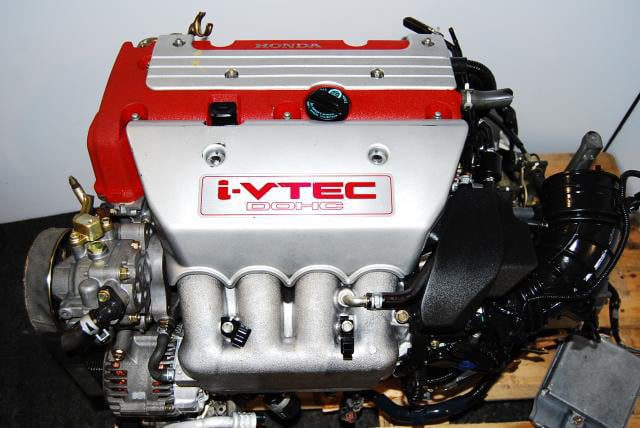
If you are a Honda fan, you have probably heard the names K20A and K20Z thrown around in car communities, forums, and engine swap discussions. And if you are like most people, you might not be entirely sure what sets these two apart. They share the same family name, the same displacement, and a whole lot of the same DNA. But they are not the same engine, and the differences matter, especially if you are shopping for a swap, building a project car, or just trying to understand what is sitting under your hood.
Let us break it all down in plain language.
A Quick Background on the Honda K Series
Honda introduced the K series engine lineup in 2001, and it was a big deal. These four-cylinder, four-stroke engines were designed to replace the beloved B series, which had powered iconic Hondas like the Integra Type R and the Civic Si through the 1990s. Big shoes to fill.
But the K series delivered. It came packed with features that were genuinely impressive for the time:
- DOHC (Dual Overhead Cam) valve trains for better breathing and higher rev potential
- Roller rockers on the cylinder heads to reduce internal friction and improve efficiency
- A distributorless ignition system for more precise spark timing
- An ECU-controlled ignition system that reads sensor input in real time to optimize performance
The K series also combined two of Honda’s signature technologies: VTEC (Variable Valve Timing and Lift Electronic Control) and VTC (Variable Timing Control). Together, these systems let the engine behave differently depending on what you are asking of it, docile and fuel-efficient at low revs, aggressive and powerful when you push it.
Out of the entire K series lineup, two engines stand out from the crowd: the K20A and the K20Z. These are the engines Honda enthusiasts talk about most, debate the loudest, and swap the most frequently into project builds.
But here is the thing. A lot of people treat them like they are interchangeable. They are not. Let us get into why.
What Is the K20A Engine?
The K20A was the engine that started it all. Honda rolled it out in 2001, making it the first K series engine to hit the market. It was originally developed for the Japanese domestic market (JDM), which is worth noting because JDM-spec K20As are often tuned to a higher performance level than their North American counterparts.
This is a naturally aspirated engine. That means no turbocharger, no supercharger. The engine breathes on its own and makes power the old-fashioned way, by spinning to high RPM and using aggressive cam timing to push air and fuel through efficiently.
And when it comes to spinning high, the K20A is exceptional. In its most powerful stock configuration, it produces 221 horsepower at 8,000 RPM and 159 lb-ft of torque. Those are remarkable numbers for a 2.0-liter naturally aspirated engine, and they are achieved through a combination of engineering details that Honda got exactly right:
- High compression pistons that squeeze the air-fuel mixture more tightly before ignition
- A more rigid crankshaft that reduces flex at high RPM and improves power delivery
- An improved 4-2-1 exhaust header that optimizes exhaust scavenging at high engine speeds
- A PRC intake manifold designed to improve airflow at the top of the rev range
- A 54mm exhaust system for better flow
- Dual valve springs for more reliable valve control at high RPM
The K20A is the engine for people who love revving. It rewards you when you push it. Bury your foot in it and hold it past 6,000 RPM, and it absolutely comes alive. Below that, it is more reserved. That is just the nature of a high-revving naturally aspirated engine.
Which Cars Came with the K20A?
- 2002 to 2005 Honda Civic Si
- 2002 to 2006 Acura RSX
- 2002 to 2005 Honda Civic SiR
- 2003 to 2006 Honda Civic 2.0 i-VTEC
- 2003 to 2005 Honda Civic Type S
What Is the K20Z Engine?
The K20Z came later, arriving in 2005 and staying in production through 2015. Think of it as Honda’s evolution of the K20 concept, refined and reconfigured for a different purpose.
The most important thing to understand about the K20Z is that it is turbocharged. That single fact changes everything about how this engine behaves, how it makes power, and what kind of driving experience it delivers.
In stock form, the K20Z puts out 210 horsepower at 7,800 RPM and 194 lb-ft of torque at 6,200 RPM. On paper, it actually makes slightly less peak horsepower than the K20A. But that torque number tells a very different story.
194 lb-ft of torque, available much lower in the rev range, means the K20Z feels strong and responsive from the moment you press the accelerator. You do not have to rev it into the stratosphere to get it moving. That low-end and mid-range power delivery makes it feel more accessible in everyday driving conditions, particularly in traffic, on highway on-ramps, and whenever you need power quickly without building up RPM first.
The K20Z is technically a modified version of the K20A. Honda made several targeted changes:
- A modified intake system to better feed the turbocharger
- More aggressive camshaft profiles optimized for forced induction
- A new exhaust manifold design that is more compact and integrates with the turbo setup to improve spool-up speed
- The same PRB intake manifold carried over from the K20A family
- Variable valve lift on the exhaust camshaft only, rather than on both cams like the K20A
The K20Z also retains Honda’s VTEC and VTC technology, but the variable timing is applied only on the intake side. This is a deliberate design choice that works in concert with the turbocharger to deliver broad, usable power across the RPM range rather than a narrow peak at the top.
Which Cars Came with the K20Z?
- 2007 to 2009 Honda CR-V
- 2008 to 2012 Honda Accord
- 2009 to 2010 Acura TSX
- 2013 to 2015 Acura ILX
K20A vs K20Z: Where They Are the Same
Before getting into the differences, it is worth appreciating how much these two engines share. They are genuinely close relatives, and that is part of what makes comparing them interesting.
Both engines share these characteristics:
- Four-cylinder, four-stroke configuration
- 2.0-liter displacement
- Honda K series engine family
- Combination of VTEC and VTC technology
- Open-deck aluminum block construction (lighter than cast iron and handles heat more efficiently)
- Piston oil squirters for cooling and lubrication under high load
- Forged crankshafts for strength and durability
- Classification as genuine performance engines, not economy powerplants
The open-deck aluminum block is worth mentioning specifically. Cast iron blocks are heavy and hold heat longer. The aluminum open-deck design in both K20 variants saves weight and dissipates heat more effectively, which contributes to their reputation for reliability. It is also one reason why these engines respond well to tuning. They can handle increased power without the block becoming the weakest link.
K20A vs K20Z: Where They Actually Differ
This is where the real comparison begins.
| Feature | K20A | K20Z |
|---|---|---|
| Year introduced | 2001 | 2005 |
| Induction type | Naturally aspirated | Turbocharged |
| Peak horsepower (stock) | 221 HP at 8,000 RPM | 210 HP at 7,800 RPM |
| Peak torque (stock) | 159 lb-ft | 194 lb-ft at 6,200 RPM |
| Power delivery character | Narrow high-RPM power band | Broad power across the rev range |
| Low-end torque | Limited | Strong |
| Variable valve lift | Both intake and exhaust cams | Exhaust camshaft only |
| Exhaust manifold | Standard design | Compact integrated design for faster turbo spool |
| Variable timing (VTC) | Applied on intake side | Applied on intake side |
| Camshaft profiles | Aggressive high-rev tuning | Optimized for forced induction |
Looking at that table, a few things jump out immediately.
The K20A makes more peak horsepower, but the K20Z makes significantly more torque. In everyday driving, torque is often what you actually feel. Torque is what pushes you back in your seat when you accelerate from a stop. Torque is what makes the car feel effortless at 60 mph when you need to overtake someone. The K20Z’s turbocharged setup gives it a torque advantage that makes it feel stronger in real-world conditions, even though it technically peaks lower on the horsepower scale.
The K20A rewards high-RPM driving. If you are on a track, if you love the experience of holding an engine at 7,000 RPM and feeling the VTEC crossover kick in, the K20A is your engine. It is pure, mechanical, and satisfying in a way that naturally aspirated high-revving engines uniquely are. The powerband is narrower, but at the top of that band, it is electric.
The K20Z is more versatile. Because the turbo fills in the low and mid-range torque, you do not have to work the engine as hard to get good acceleration. This makes the K20Z more comfortable to live with in daily driving situations, and it also means tuners have a lot of headroom to work with. Want more power? Turn up the boost. The bottom end is already built to take it.
The exhaust manifold design is a meaningful difference. The K20Z’s compact integrated exhaust manifold keeps the exhaust gases hotter and moves them to the turbocharger faster, which reduces turbo lag. This engineering detail directly contributes to the K20Z’s stronger low-end response.
Which One Is Better to Tune?
This is the question every engine swap enthusiast eventually asks, and the honest answer is: it depends on what you want to build.
The K20A has a huge naturally aspirated tuning community behind it. Aftermarket support is enormous. You can source camshafts, intake manifolds, headers, ECU tunes, and internal components from dozens of suppliers. With the right combination of parts, a built K20A can push well north of 300 horsepower while still running on regular pump fuel. It is a linear, predictable build with no turbo system to manage.
If you are building a dedicated track car, a time attack machine, or simply want the pure experience of a screaming naturally aspirated engine, the K20A is hard to beat. The power delivery is smooth, the response is immediate, and there is no turbo lag to manage through corners.
The K20Z has a head start when it comes to forced induction. It already has a turbocharger. The foundation is there. If your goal is maximum power on a moderate budget, starting with a turbocharged platform and simply upgrading the turbo, intercooler, and fuel system is often more cost-effective than building a high-power naturally aspirated setup from scratch.
With supporting modifications, a K20Z can produce 400 horsepower or more without touching the internals. Push further with forged internals, a bigger turbo, and a proper tune, and you are in genuinely serious power territory from a 2.0-liter engine.
The trade-off is complexity. A turbocharged build has more parts, more potential failure points, and more variables to manage. Boost pressure, intercooler efficiency, blow-off valve behavior, and wastegate tuning all factor into how the engine performs and how reliably it does so. A well-built turbo setup is completely manageable, but it requires more knowledge and attention than a naturally aspirated build.
Reliability: How Do They Hold Up Over Time?
Both engines have earned strong reputations for reliability, and that reputation is well-deserved. Honda built the K series to last, and with proper maintenance, both the K20A and K20Z have logged hundreds of thousands of miles in real-world use.
That said, a few things are worth knowing.
The K20A’s reliability is largely dependent on oil changes and keeping the VTEC system clean. VTEC relies on oil pressure to activate. Dirty oil, low oil, or oil that is overdue for a change can cause the VTEC solenoid to stick or respond slowly. Keep clean oil in a K20A and it will reward you with a long, trouble-free life.
The K20Z adds the complexity of a turbocharger to that equation. Turbos live and die by oil quality and oil change intervals. The turbocharger on a K20Z spins at extremely high speeds and is cooled and lubricated by engine oil. Let the oil get dirty or run it low, and you are putting the turbo at risk. Letting the engine idle for a minute or two before shutting it down after hard driving (often called a “cool-down lap”) helps prevent heat soak from damaging the turbo bearings.
Neither engine is particularly fragile. But the K20Z asks a little more of the owner when it comes to maintenance discipline, simply because there are more components that depend on clean oil and proper temperatures.
What the Numbers Feel Like in the Real World
Numbers on a spec sheet are one thing. What these engines actually feel like to drive is another conversation entirely.
Imagine driving a K20A-powered Civic Si. At low RPM, the car feels responsive but not explosive. It pulls cleanly, it is easy to manage in traffic, and it does not demand anything dramatic from you. Then you push past 5,500 RPM. The cam profile shifts, the intake note sharpens, and the engine surges forward with an intensity that catches you off guard if you are not expecting it. That is VTEC doing what it was designed to do. The last 2,500 RPM of the rev range feel like a different engine entirely, and that is exactly the point.
Now imagine the same scenario in a K20Z-equipped Accord. The engine feels more substantial from a lower RPM. When you press the accelerator at 3,000 RPM, it responds with authority rather than building to a peak. The turbo fills in the gaps that a naturally aspirated engine leaves at low speed. It does not have that dramatic second-wind character that the K20A delivers, but it does not need it. It is already making strong, linear power from a point where the K20A is still warming up to the task.
Neither experience is objectively better. They are genuinely different, and the one you prefer says something about what kind of driver you are.
A Simple Way to Think About It
If you love the experience of a high-revving, naturally aspirated engine and you are willing to use the full RPM range to access the power, the K20A is your engine.
If you want strong, usable power across a broad range of RPM, easier access to big power with a turbo upgrade, and a driving character that suits daily use as well as spirited driving, the K20Z is your answer.
Both engines are legitimate, both are well-supported by the aftermarket, and both have proven themselves over decades of real-world use. The “better” one is simply whichever one fits what you are building and how you like to drive.
If you are on the fence, ask yourself one question: do you want to chase the redline, or do you want power that is always there when you reach for it?