
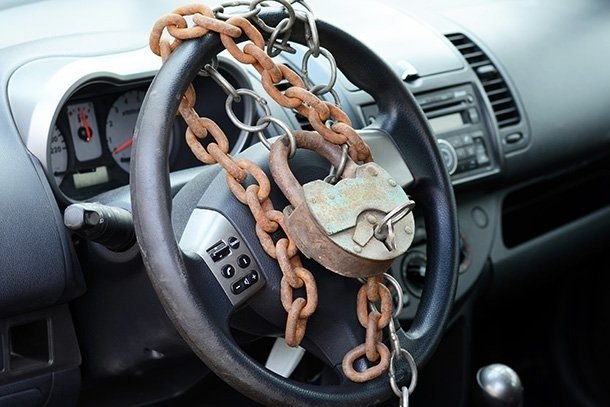

Vehicle theft has evolved. Today’s thieves don’t rely only on brute force—they exploit speed, distraction, and sometimes surprisingly simple gaps in routine. That’s why a steering wheel lock still matters: it adds a highly visible, time-consuming obstacle that forces a thief to make a risky choice—either spend extra minutes fighting a hardened device in public view or move on to an easier target.
Increase your safety with the best steering wheel locks as you drive your car this year and going forward. Modern manufacturing and improved lock cores have pushed these tools far beyond the flimsy “bar locks” of the past. Now you can find options built from alloy steel, reinforced aluminum, multi-segment designs, and even combination-based systems that eliminate keys entirely. The advantages are practical: steering wheel locks discourage opportunists, slow down determined criminals, and visibly communicate that your vehicle is protected.
If you’re serious about protecting your car, you want a locking mechanism that isn’t easily defeated with a quick cut, a simple pry, or a common attack technique. In other words, you should be shopping for a steering wheel lock with strong materials, a reliable locking system, and a design that fits your vehicle correctly. Below, I’ll walk you through top-rated options, explain what makes each one effective, and show you what to look for so you can buy with confidence rather than guesswork.
What are steering wheel locks?
Steering wheel locks are physical anti-theft devices designed to prevent the steering wheel from turning normally. Once installed, the wheel becomes restricted, awkward to rotate, or completely immobilized—making it extremely difficult to drive the vehicle away. From a professional security perspective, the greatest value of a steering wheel lock is that it adds time and noise to the theft attempt while increasing visibility. Those three factors (time, noise, visibility) are exactly what thieves try to minimize.
These tools are commonly used as a front-line deterrent, especially when you park in public lots, apartment complexes, street parking zones, or anywhere you can’t directly supervise your vehicle. Even in a garage or driveway, a lock can be worth it—because many thefts happen when criminals test doors at night and capitalize on quick opportunities.
Because many steering wheel locks are on the market, selecting the right one can feel confusing. The best strategy is to match the device to your risk level and daily habits: do you want something fast to install, something that locks both pedal and wheel, a tire clamp for trailers, or a lock with an alarm? Below, you’ll find thoroughly explained options that cover those needs.
How to think about steering wheel lock security (an expert framework)
Before we get into the product list, it helps to understand what a steering wheel lock can—and cannot—do. No mechanical device is “theft-proof.” The goal is to make theft impractical by raising the effort and risk beyond what a thief is willing to accept. When I evaluate a steering wheel lock, I look at five real-world factors:
- Attack resistance: How well does it resist cutting, prying, drilling, and leverage attacks?
- Time penalty: How long does it realistically take to defeat with common tools?
- Visibility: Does it advertise “this car is protected” from several meters away?
- Fit and user behavior: Does it install quickly and correctly on your vehicle so you’ll actually use it every time?
- Layering potential: Does it pair well with other security layers like alarms, immobilizers, trackers, or pedal locks?
Keep that framework in mind as you review the options below—because “best” depends on your vehicle type, your parking environment, and how much friction (installation time) you’re willing to tolerate.
1. The Club 1010T Original Club Steering Wheel Lock

The Club 1010T is one of the most recognizable steering wheel locks on the road—and that recognition is part of its strength. Visibility is a deterrent, and this model is designed to be seen quickly through a windshield. Built from alloy steel, it emphasizes durability and everyday practicality: install it, remove it, and repeat without babying the hardware.
From a security standpoint, the Club 1010T focuses on being a high-friction obstacle. It’s designed to install fast (important, because a device you “sometimes use” becomes a device you effectively don’t have). The self-locking action lets you snap it into place quickly, which is ideal for short stops—fuel stations, convenience stores, school pickup lines—where drivers often skip security because they expect to be gone for “only a minute.”
The manufacturer promotes resistance to sawing, prying, hammering, and Freon-style attacks. While no consumer steering wheel lock is invincible against professional tools, models like this are valuable because they change the thief’s timeline. If a thief has to cut, pry, or fight the lock, they’re creating noise and drawing attention—exactly what they don’t want.
Fitment is broad: this lock is commonly used on cars, SUVs, vans, and light trucks. If you share vehicles in a household, universal fit is a huge advantage—you can move it between vehicles instead of buying multiple units.
Pros
- Fast, intuitive installation—easy to use consistently even when you’re in a rush
- Solid steel hooks add strength at critical contact points
- High-visibility deterrent that can discourage “quick attempt” thieves
- Broad compatibility: cars, light trucks, vans, and SUVs
- Self-locking design operates with a single pull
Cons
- Like many consumer locks, the cylinder can be a target for drilling with the right tools
- Determined thieves may attempt to cut through the device using a saw
- In some reported scenarios, thieves bypass the lock by stealing the vehicle anyway and dealing with the lock later
2. Winner International The Club CL303 Pedal to Steering Wheel Lock

The Club CL303 is widely known as a pedal-to-steering-wheel lock, and its design philosophy is simple: restrict both steering and pedal operation in one device. When installed correctly, it links the steering wheel to the brake or clutch pedal, making it difficult to steer and difficult to drive—even if a thief manages to start the vehicle.
One reason this category is popular is that it changes the “bypass options” available to a thief. With a basic steering wheel bar, a criminal may attempt to cut the wheel rim (especially on older or softer steering wheel materials) and slip the lock off. Pedal-to-wheel locks complicate that approach because the device also anchors to the pedal, increasing the awkwardness of removal and raising the time penalty.
Value is part of the appeal. This model is often priced accessibly, so it’s a realistic purchase for drivers who want a visible deterrent but don’t want to spend heavily. The bright finish also plays a security role: it is meant to be obvious through glass, signaling that the vehicle will take effort to steal.
Practical note from experience: pedal-to-wheel locks must be installed with attention to steering wheel position and pedal placement. Many “this lock failed” stories are really “this lock was installed in a way that left room for movement.” If you choose this model, make your installation consistent, and test it with firm pressure before you walk away.
Pros
- Anchors steering wheel to brake or clutch pedal to limit both steering and driving
- High-visibility finish can deter opportunistic thieves
- Compatible with many vehicle types: cars, vans, trucks, and SUVs
- Tempered steel build aims for durability under common attack methods
- Quick setup—often under 30 seconds once you learn your routine
Cons
- If the steering wheel isn’t positioned properly before locking, a thief may find extra play that helps removal—installation discipline matters
3. Monojoy Car Steering wheel Lock

The Monojoy steering wheel lock is positioned as a budget-friendly anti-theft solution, but it includes a few practical touches that matter in day-to-day ownership. For starters, it typically ships with three keys. That may sound like a small detail, but it reduces a common point of failure: losing a key or having the “only spare” disappear at exactly the wrong time.
In form, it follows the extendable/retractable bar style that many drivers like because it’s straightforward: expand to fit, lock in place, and the steering wheel becomes difficult to rotate. Users often praise devices in this category because they feel intuitive—no complicated alignment steps, no pairing, no batteries, no setup beyond locking and unlocking.
From an expert viewpoint, the key is to treat this as a deterrent and delay tool. If your parking situation is moderate-risk (work parking lot, residential neighborhood, shopping centers), a solid bar lock can be a very rational choice. It’s also useful when you travel and leave a vehicle at a hotel, airport parking, or unfamiliar location—because it signals that stealing your car is not going to be quick.
Fitment is described as broad, but as with many locks, some truck steering wheel shapes and sizes can create compatibility issues. Measure your steering wheel diameter and consider spoke placement before purchasing if you drive a larger vehicle.
Pros
- Strong visual deterrent—easy to spot through the windshield
- Three keys included for better redundancy and household sharing
- Self-locking action helps you secure the vehicle quickly
- Extendable/retractable design supports a range of steering wheel positions
- Durable build for everyday use and frequent locking/unlocking
- Works well as a “high-visibility” layer on premium vehicles when paired with other security
- Simple to place at different angles depending on your steering wheel spokes
Cons
- May not fit every truck steering wheel design or oversized wheel diameter
4. The Club 900 Steering Wheel Lock
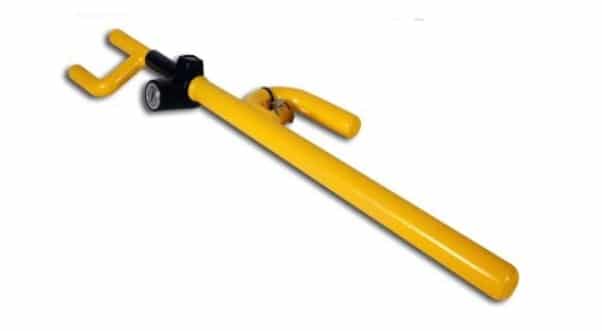
The Club 900 is a classic, straightforward steering wheel lock designed for drivers who want a recognizable deterrent without complexity. It’s often seen in a bright yellow finish (with other color options available), and that visual presence is not accidental: thieves prefer stealth, and bold color forces attention.
Construction is typically described as tempered steel with a powder-coated finish. Powder coating is not just cosmetic—it can help reduce corrosion and improve the device’s ability to handle years of handling, trunk storage, heat, and grime. While no coating makes a lock indestructible, it does contribute to long-term usability, which matters if you’re buying this as a routine daily security habit.
In real-world use, the Club 900 works best as an “every stop” lock: quick errands, overnight street parking, or any time you want to make your vehicle look irritating to steal. It’s also a smart option for households that prioritize simplicity—if a device requires too many steps, someone eventually stops using it. A simple lock often gets used more consistently than a complicated one, which can make it more effective overall.
That said, it’s important to set expectations. This model is primarily a visible deterrent and a delay tool. If you live in a high-risk area or drive a theft-targeted model, you’ll want to layer it with additional protections (for example, a quality alarm, OBD port protection, or a tracker). Security works best as a system, not a single product.
Pros
- Highly visible—bright color is designed to be noticed quickly
- Simple design encourages consistent daily use
- Universal application for many cars, trucks, and vans
- Can discourage unauthorized use even by acquaintances or casual “joyride” attempts
Cons
- Some users report the overall quality may not match heavier-duty competitors
- May feel small on certain steering wheel thicknesses or shapes, affecting fit
5. VaygWay Tire Clamp Wheel lock

Not every anti-theft strategy should focus only on the steering wheel. For certain vehicles—especially trailers, some SUVs, and situations involving towing risk—a tire clamp (often called a boot) can be the most obvious and effective deterrent. The VaygWay Tire Clamp Wheel Lock is designed as a metal boot stabilizer and wheel chock-style device that physically blocks wheel rotation.
From a security engineering perspective, wheel clamps work because they attack the problem at the most basic level: even if someone gains entry and starts the vehicle, the wheel can’t rotate normally, and movement becomes difficult and conspicuous. For trailers, the advantage is even bigger: clamping a wheel can discourage a thief from towing it away quickly.
This model uses bright red and yellow coloring for visibility. That visual “warning” is essential because it reduces the chance of casual tampering and increases the chance a thief simply walks away. It typically comes with two keys designed to be difficult to duplicate casually, which adds a layer of control over who can remove it.
Realistically, you should think of this as a strong deterrent rather than an absolute guarantee. Determined thieves can defeat almost any consumer device with enough time and the right tools. However, the goal is to make your vehicle or trailer a poor choice compared to the next target—especially in shared storage lots, campgrounds, construction sites, and roadside parking areas.
Pros
- Very visible design (red/yellow) signals “high effort required” to thieves
- Quick to install and remove once you’re familiar with the clamp positioning
- Lightweight enough for older users or anyone who wants minimal strain
- Two keys included; designed to reduce easy copying
- Provides peace of mind for travel, storage lots, and trailer parking scenarios
Cons
- Using two clamps on one vehicle/trailer can discourage thieves more effectively than one
- Fitment varies—some wheel sizes or designs may not be compatible
6. Turnart Steering Wheel Lock

If you’ve ever worried about losing keys—or you manage a vehicle shared among family members, staff, or multiple drivers—the Turnart Steering Wheel Lock offers a different approach: a password-based locking system. That means no physical keys to misplace, no key copies floating around, and no panic moment when you realize your spare key isn’t where you thought it was.
The most important point here is not novelty; it’s control. Key-based systems introduce two common security issues: (1) the key can be lost or stolen and (2) the key can be duplicated. A combination-style lock reduces both risks—provided you choose a strong code and keep it private. The unit advertises a password combination capacity up to 100,000, which, while not equivalent to high-end safe locks, is still a meaningful obstacle for casual attacks.
Build materials are typically listed as aluminum, alloy steel, and rubber. In practical terms, rubber or protective contact surfaces matter because many drivers stop using devices that scratch steering wheels. A lock that damages your interior becomes a lock you “forget” to install. So protective materials aren’t just comfort—they support consistent usage, and consistent usage is what creates real security benefit.
This model is also marketed for heavy-duty trucks, cars, and vans. The trade-off is weight: combination mechanisms and robust bodies can be heavier than simpler bar locks. If you’re comfortable with a slightly heavier device in exchange for keyless convenience, this is a compelling category.
Pros
- No keys required—ideal for drivers who misplace keys or manage shared vehicles
- Large combination space helps reduce the risk of casual “try and guess” attempts
- Strong material mix (aluminum/alloy steel/rubber) designed for durability and reduced steering wheel wear
- Full mechanical structure—no charging routines or app dependencies
- Quick lock/unlock once your code routine is established
- Multi-vehicle usability, including larger vehicles in many cases
- Strong deterrent profile due to distinctive design
Cons
- Heavier than many basic steering wheel locks, which may matter for daily carry
7. Vechom Steering Wheel Lock

The Vechom Steering Wheel Lock belongs to a category that blends mechanical security with active deterrence. What makes it stand out is the inclusion of an alarm system—a feature that changes the thief’s experience immediately. Instead of quietly cutting or prying, tampering can trigger noise and attention, which dramatically increases perceived risk.
One of the most effective deterrents in vehicle security is early attention. Many thieves operate on speed: they want to enter, start, and leave within moments. An alarm interrupts that rhythm and can cause abandonment of the attempt—especially in places like apartment parking lots, busy streets, or commercial areas with foot traffic. This model also features a visible indication that it is armed, including a flashing red light. That’s important because deterrence works best when it’s obvious before the thief touches anything.
The unit is described as using a unique multi-segment design and a T-lock mechanism, intended to improve anti-theft resistance. The general idea is to create multiple difficult-to-cut zones so that a thief can’t simply make one cut and remove the lock. In practical terms, anything that increases the number of steps required to defeat the lock increases the chance the thief gives up.
This is also the kind of device where correct placement matters. Using the steering wheel spokes properly can improve stability and reduce the “wiggle room” a thief might exploit. If you choose an alarmed steering wheel lock, treat installation as part of the security system: place it consistently, arm it properly, and test its stability before walking away.
Pros
- Alarm system adds an attention-grabbing deterrent to physical security
- Visible flashing indicator signals the vehicle is protected before tampering begins
- Multi-segment structure can increase the time required to cut or defeat the lock
- T-lock design aims to improve resistance and reduce bypass methods
- Strong material build intended to resist force-based attacks
- For many theft scenarios, the added time (potentially up to 45 minutes in ideal conditions) is more than a thief can risk
Cons
- Best performance depends on using the steering wheel spokes correctly during installation
- Take care when removing it to avoid interior scuffs or awkward handling
8. RoadGive Car Steering Wheel Lock

The RoadGive Car Steering Wheel Lock is positioned as a reasonably priced, heavy-duty option with a few thoughtful extras. One standout is the inclusion of three keys, which is genuinely useful because it reduces the “single point of failure” many owners face when only two keys are provided. If you share your car with a spouse, family member, or colleague, that extra key can prevent a lot of unnecessary stress.
Material choice matters, and RoadGive highlights high-quality round steel and aluminum with a polished finish. In practice, round steel can make certain prying or cutting angles more difficult than flat profiles, depending on the attack. Aluminum can reduce weight while still supporting rigidity, though the exact security performance depends on thickness and design geometry.
Another practical feature is adjustability. Adjustable anti-theft bars are beneficial because they help achieve a tighter fit—less slack means less movement, and less movement makes a lock harder to manipulate. If you’ve ever used a poorly fitting lock that rattled or shifted, you know how quickly annoyance can lead to inconsistent use. A well-adjusted lock tends to get used more often, which improves your real protection.
Finally, this device is described as having additional utility in emergencies, such as helping break glass. While you should always prioritize proper emergency tools (and understand safe escape techniques), it’s helpful when a security device doubles as a safety aid—especially for drivers who spend a lot of time on the road.
Pros
- Adjustable bar helps improve fit and reduces steering wheel movement
- Foam handle helps protect your steering wheel from scratches and scuffs
- Resists common attacks such as prying, sawing, hammering, and Freon-style methods (as described)
- Designed to complicate theft attempts—even for experienced thieves
- Multi-purpose potential, including emergency utility features
- Three keys included for better redundancy
- Strong value proposition for budget-conscious buyers
Cons
- None at this moment
9. Dodomes Steering Wheel Lock

The Dodomes Steering Wheel Lock is designed for drivers who want a sturdy build with added functionality. It’s commonly described as using materials that will not rust, which is a meaningful benefit if you live in humid climates, near the coast, or simply prefer a device that won’t degrade after being stored in a trunk through seasonal changes.
Like several of the stronger options in this guide, it’s positioned to resist sawing, prying, and hammering—three of the most common mechanical attacks used on consumer anti-theft devices. The point is not that the lock is unbreakable; the point is to make the attempt so inconvenient that it’s no longer worth the risk. When thieves encounter resistance, they often move to the next vehicle, especially when working in public spaces.
One feature that increases its security value is that it can lock more than just the steering wheel: the design is described as also locking the brake. That creates a layered restriction—steering is limited, and braking operation is restricted, making it harder to drive away even if the ignition is compromised. For manual-transmission drivers or anyone worried about “push-and-go” theft attempts, limiting pedal operation can be a meaningful advantage.
It’s also described as useful as a self-defense tool or window breaker in emergencies. While I always recommend purpose-built escape tools and training for emergency scenarios, multi-function devices can provide backup value—especially if you already keep it within reach.
Pros
- Adjustable fit supports use on many vehicles
- Locks both steering wheel and brake for extra anti-theft restriction
- Heavy-duty steel and aluminum build designed to resist destruction
- Multi-function potential (including emergency utility features)
- Easy to install and remove with a consistent routine
Cons
- May not be compatible with certain SUV layouts or pedal/steering configurations
- Highly skilled thieves with professional tools may still be able to cut through (a risk shared by most consumer locks)
10. Aysum Car Steering Wheel Lock

The Aysum Car Steering Wheel Lock is another budget-friendly choice that aims to deliver strong everyday value without adding complexity. It generally includes three keys and uses a mix of aluminum, metal, and zinc materials to balance durability and weight. For many drivers, lighter locks are more likely to be used daily because they’re easier to store, carry, and handle.
This model is described as having been upgraded to deter thieves more effectively than earlier versions. In practical terms, upgrades in this category often involve improved lock cores, reinforced connection points, thicker materials, or better anti-scratch surfaces—features that can raise resistance against quick attacks and extend the useful life of the device.
Where it fits best is in common parking situations: street parking, driveways, garages, workplace lots, and shopping centers. It’s adjustable, which is helpful if you own multiple vehicles or if you want to ensure a snug fit on your specific steering wheel shape. Keep in mind, however, that “adjustable” does not guarantee universal compatibility. Steering wheels vary in thickness, spoke layout, and diameter, and that can affect how confidently the lock seats.
As with any steering wheel lock, correct placement is key: you want minimal slack, and you want the device oriented in a way that makes steering awkward and prevents easy repositioning.
Pros
- Adjustable design can accommodate different vehicles with proper measurement
- Multi-purpose design intentions, useful for everyday protection routines
- Durable materials intended to withstand repeated use
- Easy to operate—encourages consistent installation
- Strong budget value for drivers who want visible deterrence without overspending
Cons
- Despite adjustability, it won’t fit every vehicle configuration perfectly
Steering wheel locks vs. modern theft techniques (what to know today)
Many drivers ask a fair question: “Do steering wheel locks still work if thieves can clone key fobs or exploit keyless entry?” The answer is yes—because steering wheel locks address a different part of the theft chain. Electronic attacks focus on starting the vehicle; steering wheel locks focus on driving it away quickly and quietly.
Even if a thief gains entry and starts the engine, a steering wheel lock forces them into a messy choice: attempt removal on-site (time + noise + visibility) or try moving the vehicle awkwardly (risking immediate attention). Many theft crews are not looking for a fight; they’re looking for speed and predictability.
For best results, pair a steering wheel lock with at least one additional layer:
- A visible deterrent: steering wheel lock (you’re doing this already)
- An invisible layer: tracker, kill switch, or immobilizer (something they don’t see until it’s too late)
- A procedural habit: lock doors, avoid leaving valuables, park under lights, and don’t leave spare keys inside
Most important features of steering wheel locks
Buying the right steering wheel lock is easier when you know exactly what you’re optimizing for. In professional terms, you’re balancing security strength with usability. A lock that is extremely strong but annoying to install may sit in your trunk. A lock that installs quickly but is flimsy may not add meaningful resistance. The best device is the one you will use consistently and that imposes a real time penalty on an attacker.
Here are the most important features to look for, rearranged in a more practical order—from “non-negotiable” to “nice to have”:
- Solid construction and attack resistance: prioritize hardened or tempered steel, reinforced joints, and robust contact points.
- A locking mechanism worth trusting: choose locks with strong cylinders or well-designed combination systems that resist casual picking/drilling.
- Correct fit for your vehicle: the best lock is useless if it leaves too much slack or doesn’t seat correctly on your steering wheel or spokes.
- Ease of use: fast installation matters because consistency is everything. If it takes too long, you’ll skip it.
- High visibility (design that signals deterrence): bold colors and obvious placement can prevent an attempt before it begins.
- Protective grip surfaces: foam, rubber, and coatings reduce steering wheel damage and increase the chance you’ll keep using the lock long term.
- Practical extras that match your life: spare keys, alarm indicators, pedal attachments, or multi-function emergency features can add real value.
Installation tips that dramatically improve real-world protection
Steering wheel locks fail most often because of inconsistent or sloppy installation. A well-installed mid-range lock can outperform a premium lock that’s installed poorly. Use the tips below to maximize effectiveness:
- Minimize slack: adjust the lock so it fits tightly. Extra movement gives a thief room to pry or reposition.
- Use steering wheel spokes when possible: many locks stabilize better when braced against spokes rather than smooth rim sections.
- Angle for inconvenience: position the bar so it interferes with the dashboard or driver space, making rotation awkward.
- Lock it every time: theft is opportunistic. “Quick stops” are exactly when thieves succeed.
- Keep keys separate from the car: don’t store the steering lock keys on the same ring as a valet key you leave inside the vehicle.
- Inspect monthly: check for loose parts, worn coatings, and sticky locking cylinders—small issues reduce performance.
Common mistakes to avoid
In security consulting, I see the same mistakes repeatedly. Avoid these and your steering wheel lock becomes far more effective:
- Buying based on price alone: budget locks can work, but only if the lock core and joints are decent and the fit is correct.
- Ignoring compatibility: steering wheel thickness, wheel diameter, spoke design, and pedal layout (for pedal locks) all matter.
- Assuming “visible” means “invincible”: visibility deters, but it’s most powerful when layered with an alarm, immobilizer, or tracker.
- Leaving the device in the back seat: if a thief can see you own a lock but didn’t install it, you’re advertising inconsistency.
- Using the lock as your only defense in high-risk areas: if your area sees frequent theft, consider additional measures.
Conclusion
No matter what your vehicle looks like—car, van, truck, SUV, or trailer—an effective steering wheel locking mechanism can significantly reduce your theft risk by adding a visible barrier and an inconvenient delay. You might feel like you don’t need one if you’re always near your vehicle, but realistically, no driver can maintain full-time supervision. Theft is opportunistic, and it often happens during routine moments: a quick stop, an overnight street park, or a brief distraction.
The smartest approach is to choose a lock that matches your lifestyle and environment, install it correctly every time, and treat it as one layer in a broader security plan. Focus on strong construction, a trustworthy locking mechanism, a proper fit, and a design you’ll actually use consistently. While choosing the right product can feel time-consuming, the comparison above is designed to make your decision easier—and to help you pick a lock you’ll feel confident using every day.