
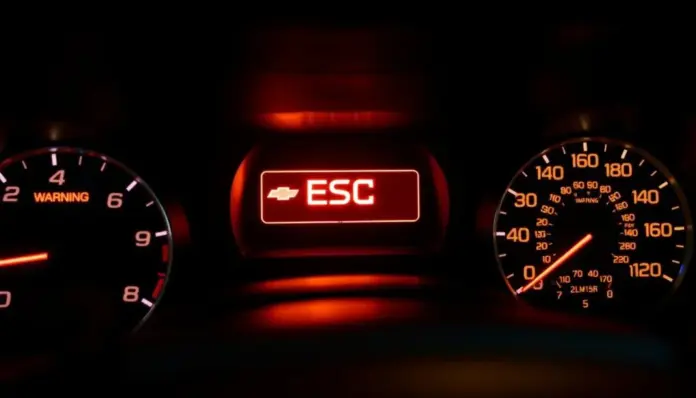
Ever noticed the “Service ESC” light illuminate on your Chevy Silverado’s instrument cluster and felt your stomach drop a little? That reaction is completely normal—dashboard warnings are designed to get your attention. The good news is that this particular alert usually isn’t a “shut it off immediately” message. Instead, it’s your truck’s way of telling you that it has detected a concern within the Electronic Stability Control system (ESC), one of the most valuable safety technologies built into modern Silverados.
ESC exists for one main purpose: helping you keep the vehicle pointed where you intend to go, especially when traction is limited or when a sudden maneuver threatens stability. On dry pavement during calm driving, you may never feel ESC work at all. But in rain, snow, gravel, emergency lane changes, or hard cornering, ESC can step in quickly—often faster than a human can react—to reduce the likelihood of a skid, spin, or loss of directional control.
So if your Silverado displays “Service ESC,” the right approach is calm, methodical, and safety-first understand what the warning means, identify likely causes, perform a few smart checks, and then diagnose the fault properly (or have a professional do so) before it becomes a bigger issue. Think of this message as an early warning that helps you protect your passengers, your truck, and everyone else sharing the road.
Curious about what triggers the “Service ESC” light and what you should do next? Below is a detailed, practical guide written from an expert perspective, designed to help you understand this safety system in plain language. You’ll learn how ESC works in your Chevy Silverado, why the warning comes on, what symptoms to watch for, how to scan codes, which components commonly fail, what to do if the light appears mid-drive, and how recalls and known issues may relate to your exact model year.
Understanding the Service ESC Light
The Service ESC light on your Chevy Silverado is more than just another dashboard icon. It is a targeted alert that the vehicle’s computer has detected a fault, abnormal reading, or communication problem affecting the Electronic Stability Control system. Because ESC is deeply integrated with other systems, especially Anti-lock Braking (ABS) and traction control an ESC warning can sometimes appear alongside other indicators or drivability changes.
At a high level, your Silverado’s ESC continuously compares “what you are asking the truck to do” (via steering input and accelerator position) with “what the truck is actually doing” (via wheel speed and body-motion sensors). If those two don’t match such as when the rear end begins to step out on a slick surface, the system can selectively brake individual wheels and/or reduce engine torque to restore stability. The moment the system can no longer trust a sensor input or actuator response, it may disable some or all of ESC functionality and request service.
It’s important to understand that “Service ESC” is not a diagnosis by itself. It’s a symptom, an umbrella message. The actual cause can range from something simple (like a low battery event that caused a temporary voltage drop) to something more specific (like a failing wheel speed sensor, a steering angle sensor issue, wiring damage, or an ABS module fault). That’s why your next step should always be focused on proper troubleshooting, not guesswork.
The Role of Electronic Stability Control
Electronic Stability Control (ESC) is one of the most impactful safety advancements in modern vehicles, including your Chevy Silverado. While traction control primarily helps limit wheel spin during acceleration, ESC goes a step further: it helps control the vehicle’s yaw (its tendency to rotate or spin) and lateral stability during turning or abrupt maneuvers.
In practical terms, ESC is designed to help prevent scenarios like these:
Oversteer: The rear of the truck starts sliding outward in a corner (common on slick roads or when accelerating while turning). ESC may brake an individual wheel and reduce engine power to help bring the rear back in line.
Understeer: The truck pushes wide in a turn (front tires lose grip, vehicle doesn’t turn as much as commanded). ESC can brake specific wheels and adjust torque to help rotate the vehicle back toward the intended path.
ESC works by monitoring your steering and vehicle motion in real time. When the system detects that the Silverado is deviating from your intended direction, it can apply brake pressure to individual wheels and modify engine power to help stabilize the vehicle. This is why ESC is closely tied to the ABS hydraulic control system: it uses the same ability to modulate brake pressure rapidly and precisely.
The system uses several sensors to function properly:
- Steering angle sensor
- Wheel speed sensors
- Yaw rate sensor
These sensors allow the ESC to react quickly to changes in your driving conditions. If any sensor reports implausible data or stops communicating altogether, the control module may disable ESC to avoid making incorrect corrections. That’s a key point: sometimes the system disables itself not because the truck is unstable, but because it cannot reliably “see” what the truck is doing.
Just as importantly, ESC is not magic. It does not create traction where none exists. If your tires are worn, improperly inflated, or not suited to the conditions (for example, all-season tires on ice), ESC has less grip to work with. It can help you stay composed, but it cannot override the laws of physics. That’s why a Service ESC warning deserves attention because you may be losing one of the vehicle’s strongest safety layers during a time you need it most.
What Does the Service ESC Light Mean?
When you see the Service ESC light on your dashboard, it means there’s a problem with your truck’s stability control system. The warning may appear as a steady indicator, a message in the driver information center, or it may coincide with a traction-control icon. Whether the light is steady or flashing can matter: a flashing stability/traction icon often indicates the system is actively intervening, while a steady “Service” message usually indicates a fault or that the system has been disabled.
A lit Service ESC light doesn’t always mean the system has failed completely. Sometimes it is temporarily disabled due to a sensor reading that is out of range, a brief voltage drop, or a condition that causes conflicting data (like a wheel sensor packed with ice). However, it should always be treated as a real warning and not something to ignore, because ESC is a safety system and the vehicle is telling you it cannot guarantee normal operation.
Depending on the underlying cause, you might notice secondary symptoms such as:
- Reduced traction control (you may feel more wheel spin than usual)
- Less stability in turns (especially on wet, icy, or gravel roads)
- The ABS light may also be on (because the systems share sensors and modules)
It’s best to have your Silverado checked soon when this light appears. Driving without ESC can be less safe, especially in bad weather or at highway speeds. If the ESC warning appears together with brake warnings, reduced engine power messages, or steering assist warnings, treat it as a higher priority and minimize driving until you can diagnose it.
One nuance many owners overlook: ESC warnings can be triggered by seemingly unrelated electrical or communication issues. Modern Silverados rely on multiple control modules “talking” over vehicle networks. A low-voltage episode, corrosion at a connector, or damage to a harness near a wheel well can create intermittent faults. Intermittent faults are frustrating, but they are still meaningful, because they often become permanent failures over time.
Common Triggers for the ESC Warning Light
Several issues can cause your Service ESC light to turn on. Below are some of the most common triggers seen on the Chevy Silverado platform, along with the “why” behind each one so you can make sense of the diagnosis.
- Faulty wheel speed sensors: These sensors feed wheel rotation data to the ABS/ESC module. If one sensor drops out, reports an erratic signal, or reads differently than the others under similar conditions, ESC may be disabled because the module can’t reliably detect slip.
- Steering angle sensor problems: ESC needs to know where you intend to go. The steering angle sensor indicates steering wheel position and rate. If it is wrongly calibrated or failing, ESC may interpret normal driving as a stability event or it may not intervene when it should.
- Low battery voltage: Stability control modules are sensitive to power and communication stability. A weak battery, failing alternator, or poor battery connections can create voltage dips that trigger warning lights and store fault codes.
- Wiring issues: Damaged harnesses, loose connectors, water intrusion, or corrosion can disrupt the signal path between sensors and modules. Wheel-speed wiring near hubs and suspension components is especially vulnerable due to movement, debris, and road salt.
- ABS system faults: Since ESC and ABS work together (and often share the same module), a fault in one can affect the other. A hydraulic modulator problem, internal module fault, or brake pressure sensor issue can all cascade into ESC warnings.
Other less-obvious triggers can include mismatched tire sizes, significantly uneven tire wear, non-OE wheel/tire setups, or a spare tire that’s not the same rolling diameter. ESC uses wheel speed comparisons. If one tire is effectively “taller” or “shorter,” the system may interpret the speed difference as slip or a sensor issue.
After any suspension or alignment work, it’s also possible for steering angle calibration to be needed. Many vehicles can recalibrate automatically after some driving, but not always particularly if a sensor is already borderline. In those cases, a scan tool procedure may be required.
Troubleshooting ESC Issues
When your Chevy Silverado’s ESC light comes on, it’s time to take action with a clear plan. Quick, sensible troubleshooting can sometimes resolve a temporary issue, and when it doesn’t, it can still help you gather the information needed for an accurate repair. The goal is twofold: keep the truck safe to drive and avoid replacing parts blindly.
From an expert standpoint, the most effective strategy is to start with simple checks (things that cost nothing and take minutes), then move to code reading, then component-level diagnosis if needed. ESC is a system-of-systems; you’re looking for the root cause, not just the warning itself.
Initial Steps When the ESC Light Comes On
First, pull over safely when conditions allow and take a breath. If the truck is braking normally, steering normally, and there are no urgent red brake warnings, you can usually proceed cautiously to a safe location. Then consider these initial steps.
1) Restart the vehicle. Turn the engine off, wait 15 – 30 seconds, and restart your truck. This can sometimes clear a temporary fault, especially if the trigger was momentary (like a brief sensor dropout or low-voltage event). If the light immediately returns, you’re likely dealing with an active fault.
2) Check tire pressure and tire condition. Uneven or low pressure can affect wheel speed readings and traction behavior. If one tire is significantly low, it can rotate at a different rate than the others and confuse ESC logic. While tire pressure alone isn’t the most common cause of a Service ESC warning, it’s quick to verify and worth correcting immediately.
3) Look for obvious wheel area issues. Next, inspect the wheels and tires for anything that could interfere with sensor readings: heavy mud, packed snow/ice, or debris around the hub area. Wheel speed sensors are located near each wheel hub. If a sensor or its tone ring (depending on design) is contaminated or damaged, the signal may become erratic.
4) Consider current driving conditions. If you’re in snowy or icy conditions, the ESC might be working overtime. It’s also possible for packed snow to interfere with wheel speed sensor signal quality. If you can safely do so, drive slowly on a clear, dry road for a short distance and see if the light turns off. If the warning persists on dry pavement, treat it as a true malfunction rather than a “conditions-related” warning.
5) Check the brakes and brake fluid level. Brake-related concerns can trigger ESC issues because ESC depends on controlled brake application. Check your brake fluid reservoir level (do this on level ground). Low brake fluid can be a sign of pad wear or a leak. Also look for any signs of leaks around wheels or under the vehicle. If you suspect a brake system issue, prioritize safety and professional inspection.
6) Note any other warnings or behavior changes. Write down what you observe: Is ABS light on? Is traction control light on? Do you have reduced engine power? Does steering assist feel different? These details help narrow the problem quickly. Many Silverado ESC faults are interconnected with ABS and power steering systems depending on model year and configuration.
If you’re comfortable with basic DIY checks, you can also verify battery terminals are tight and free of corrosion. A surprising number of stability-system complaints trace back to poor electrical connections, especially after a battery replacement or after long exposure to winter road salt.
Diagnostic Tools and Reading Error Codes
To move from “warning light” to “real diagnosis,” you’ll need fault codes. The fastest way to obtain them is an OBD-II scanner. Many auto parts stores sell affordable scanners, and some lend them out. For stability control faults, an advanced scanner that can access ABS/ESC modules (not just generic engine codes) is ideal, but even basic tools can sometimes reveal clues.
Plug the scanner into your truck’s diagnostic port (commonly under the dashboard on the driver’s side). Turn the ignition on and follow the scanner’s prompts to read codes. On many vehicles, ESC/ABS-related faults are stored as chassis codes, often starting with the letter “C.”
Common codes include:
- C0035: Left Front Wheel Speed Sensor Circuit
- C0040: Right Front Wheel Speed Sensor Circuit
- C0045: Left Rear Wheel Speed Sensor Circuit
- C0050: Right Rear Wheel Speed Sensor Circuit
Once you pull codes, don’t rush to order parts based only on the code description. A code that says “sensor circuit” may be the sensor itself, but it can also be the wiring, the connector, the tone ring, or even the module. The code is the starting point, not the verdict.
A practical next step is to view live data (if your scanner supports it). Look at wheel speed readings from all four wheels while driving slowly in a safe area. A failing sensor may drop to zero intermittently, spike unrealistically, or lag behind the others. This is one of the most reliable ways to confirm the fault corner without swapping parts.
After reading the codes, clear them and see if the ESC light comes back on. If it does, you likely have an active fault. If it does not return, keep monitoring—intermittent faults can return later, especially in wet conditions or after hitting bumps. If the warning returns repeatedly, it’s time to fix the underlying issue rather than repeatedly clearing codes.
If your scanner can’t access ABS/ESC modules, a professional scan at a shop or dealer may be necessary. In many ESC-related cases, the most valuable information comes from module-specific codes, freeze-frame data (conditions when the fault set), and network communication diagnostics. Features commonly available on professional-level tools.
Common ESC Component Failures
The Electronic Stability Control (ESC) system in your Chevy Silverado relies on multiple components working together: sensors to measure vehicle behavior, wiring and connectors to transmit data, control modules to calculate interventions, and brake/engine actuators to carry out corrections. When a single piece in that chain fails or even becomes inconsistent the system may illuminate the “Service ESC” warning to alert you that stability support may be reduced.
Below are the most common component-level issues that trigger ESC warnings on the Silverado, along with how they typically present and what a competent diagnosis looks like. The goal is to help you understand what you’re paying for if you take it to a shop, or what you should verify if you’re diagnosing it yourself.
Wheel Speed Sensors and ESC
Wheel speed sensors are foundational to your Silverado’s ESC system. They measure the rotational speed of each wheel and provide that information to the ABS/ESC control module. ESC uses these readings to detect wheel slip, compare left-to-right behavior, and determine whether the vehicle is following the intended path.
When a wheel speed sensor fails or becomes unreliable, the module may lose confidence in what the vehicle is doing. That can disable ABS, traction control, and ESC as a group, or it can degrade functionality depending on the fault and model. Because these sensors live in harsh environments, near heat, water, road debris, and corrosion. They are among the most common triggers for stability warnings.
Defective wheel speed sensors are a common cause of ESC issues. You might notice:
- Uneven braking or braking that feels less predictable on slick surfaces
- ABS not working right (ABS light may illuminate, or ABS may not activate during hard braking)
- Speedometer acting up (less common, but possible on certain configurations)
To fix this, the faulty sensor or related wiring must be repaired or replaced. While the part itself is often relatively affordable, the key is correct identification. The “bad sensor” is not always the wheel named in the code if the problem is wiring-related or if the fault is intermittent. A careful technician will inspect the harness routing, check connector pins for corrosion or moisture, verify sensor resistance (if applicable), and confirm signal integrity while rotating the wheel or road-testing with live data.
Also note: sometimes the issue isn’t the sensor at all, but the signal target (tone ring/encoder) that the sensor reads. If the ring is cracked, rusted, packed with debris, or damaged during bearing/hub work, the sensor may output erratic readings that look like sensor failure. This is why it’s smart to inspect the hub area and consider recent repair history when diagnosing a wheel speed code.
Steering Angle Sensor Issues
Your Silverado’s steering angle sensor is the system’s “intent sensor.” It tells the ESC module which direction you’re commanding the truck to go and how quickly you are turning the wheel. ESC compares that intent to actual vehicle motion (yaw and lateral acceleration). If intent and motion don’t match, ESC intervenes. But if the steering angle sensor is wrong, the system’s math is wrong.
When a steering angle sensor fails, becomes miscalibrated, or develops a dead spot, your truck may not correctly interpret straight-ahead driving versus cornering. In some cases, ESC may intervene unexpectedly; in others, it may shut down and display a service message because the input is implausible.
Signs of a bad steering angle sensor include:
- ESC light coming on (sometimes after turning or after a steering event)
- Steering feeling “off” or the steering wheel not centered after an alignment (though this can also be alignment-related)
- Traction control acting up or stability interventions that seem poorly timed
Checking the steering angle sensor is smart if you see the “Service ESC” message. On many vehicles, steering angle sensors can be recalibrated with a capable scan tool after alignment work, battery disconnects, or module replacements. Calibration is often less expensive than replacement, so the correct approach is: verify codes, verify live steering angle data (especially straight-ahead), and perform calibration if indicated before replacing the sensor.
This part can be pricey to replace, so make sure it’s really the problem before buying a new one. In expert diagnostics, a steering angle fault is confirmed by comparing commanded steering with sensor output consistency, checking for related network codes, and ruling out low-voltage events that can temporarily cause sensor plausibility faults.
ABS Module and Traction Control System Failures
The ABS module (often integrated with the electronic brake control module and hydraulic modulator) functions as the “command center” for several stability-related features. It receives sensor inputs (wheel speed, yaw rate, brake pressure, steering angle depending on design), runs calculations, and commands brake pressure changes at individual wheels. Because traction control and ESC rely on the ABS module’s ability to modulate brake pressure, faults in this area can trigger multiple warnings at once.
When the ABS module, hydraulic unit, or supporting sensors fail, you might see a combination of warnings such as ABS, traction control, and Service ESC. In some cases, you may also notice braking changes (for example, ABS not activating), or you may feel the brake pedal behave differently during certain conditions. While base braking usually still functions, safety features that depend on rapid modulation may be reduced or unavailable.
Traction control system failures often show up as:
- Traction control light staying on or “Traction Control Off” messages that appear unexpectedly
- Wheel spin that seems easier to trigger, particularly when accelerating on wet pavement
- ABS/ESC warnings appearing together, especially after hitting bumps or driving in heavy rain
- Intermittent warnings that come and go, pointing to wiring, connector, or module communication issues
These issues can be dangerous, especially in bad weather. If you suspect ABS or traction control problems, get your truck checked out right away. An expert inspection will typically include module code retrieval, power/ground verification, communication network checks, and evaluation of sensor signals. In some cases, software updates can resolve known logic or communication problems so a dealer or well-equipped shop can be valuable here.
Fixing these can be expensive, but it’s crucial for your safety. Don’t ignore these warning signs they’re there to protect you. If multiple lights are on and you notice braking behavior changes, avoid aggressive driving, increase following distance, and schedule diagnosis as soon as possible.
One more professional insight: because ESC is integrated with many other systems, a “module failure” should be diagnosed carefully. A weak battery, poor ground, damaged harness, or water intrusion can mimic a failing module. Before replacing high-cost components, it’s wise to confirm stable voltage supply, clean grounds, and connector integrity.
Handling ESC Malfunctions While Driving
When your Chevy Silverado’s ESC acts up, knowing how to respond in real time can make a meaningful difference. The key is to avoid sudden inputs and to prioritize stability and predictability over speed. In many cases, the truck will still drive normally, but your electronic safety net may be partially reduced, so you must compensate with conservative driving habits until the issue is corrected.
From a safety engineering standpoint, ESC is most valuable precisely when drivers are most stressed: unexpected obstacles, slick surfaces, abrupt maneuvers, and emergency braking. If the system is compromised, your best “tool” becomes your own smoothness: gentle steering, controlled braking, and disciplined speed management.
What to Do if the ESC Light Comes On Mid-Drive
If you see the ESC light pop up while driving, don’t panic. Reduce your speed gradually and avoid sharp steering inputs. This light means your truck’s stability control may not be working properly or may be disabled due to a fault condition.
Check whether you feel any changes in how your Silverado handles. Are you experiencing understeer (pushing wide) or oversteer (rear stepping out)? Do you notice wheel spin or reduced confidence under braking? These can be signs that ESC/traction control support is limited, but they can also be signs of poor road conditions—either way, slower and smoother is safer.
If it’s safe, pull over to a secure spot such as a parking lot or wide shoulder. Turn off your engine and restart it. Sometimes, this can reset the system if the fault was temporary. If you’re in a situation where stopping is unsafe (busy highway, poor visibility), continue carefully to the nearest safe area.
If the light stays on, it’s best to get your truck checked soon. Drive cautiously to your nearest service center or to a location where you can scan for codes. Avoid towing heavy loads, aggressive acceleration, or high-speed cornering until you know whether ABS and traction control are also affected.
Also watch for other warnings. If you see a red brake warning, a “Brake System Failure” message, or you experience a clear loss of braking performance, stop driving and seek assistance immediately. While Service ESC alone often indicates a stability-system fault rather than base brake failure, combinations of warnings can indicate a higher-risk situation.
Driving on Slippery Roads and in Deep Snow
In slippery conditions, ESC becomes especially valuable because traction margins are small. If ESC is not working or if you’re unsure whether it’s fully available you should assume the truck will behave more like an older vehicle without electronic stability aids. That doesn’t mean you can’t drive; it means you need to reduce the demands you place on the tires.
When driving on icy or wet roads:
- Slow down more than usual and avoid “rushing” turns or merges
- Increase your following distance so you can brake gently rather than abruptly
- Avoid sudden movements with steering or brakes (smooth inputs help maintain grip)
In deep snow, your truck might struggle more without ESC because wheel slip and yaw changes can happen quickly. Here’s what to do:
- Use gentle, steady pressure on the gas to avoid spinning tires and digging in
- Steer smoothly to avoid skids, and keep momentum without excessive speed
- If you start to slide, look and steer where you want to go and avoid over-correcting
Remember, even with ESC, your tires are your main grip on the road. Good winter tires can make a big difference in tough conditions. If you regularly drive in snow and ice, the combination of proper tires, correct tire pressure, and a healthy ESC/ABS system is what gives you the best safety margin.
Finally, be aware that some drivers intentionally disable traction control in certain low-speed snow situations to allow controlled wheel spin. That may help you “rock out” of deep snow, but it’s not the same as losing ESC due to a fault. If you have a Service ESC warning, you may not have the ability to choose how the system behaves—so keep your approach conservative and plan extra time for stops and turns.
Recalls and Known Issues
Chevy Silverado owners should also be aware of recalls and known issues that can involve the Electronic Stability Control (ESC) system or related components. Recalls matter because they can provide a no-cost fix that directly resolves warnings like “Service ESC,” especially when the root cause is software logic, module behavior, or a known defect pattern.
As a best practice, if you see repeated stability or braking warnings, check whether your truck has any open recalls. You can typically do this by contacting a dealer with your VIN (Vehicle Identification Number). When recalls are involved, the repair is performed according to manufacturer procedures and is generally completed at no charge.
Notable Chevy Recalls Involving the ESC System
The ESC system in Chevy vehicles has been the subject of several recalls. In 2020, GM issued a recall for brake system malfunctions that could trigger ESC warnings. This affected multiple models, including the 2019 Silverado. While the exact details depend on build configuration and production range, the key takeaway is that brake control module behavior can influence ESC operation and warnings.
If you see a “Service ESC” message on your dashboard, it might be related to this recall. The remedy described for this type of issue commonly involves updating the electronic brake control module software, improving how the system detects faults or manages certain braking events. If your truck is included, the update is performed at no cost to you.
Another recall affected 2019-2020 Silverados and discussed overlapping concerns involving power steering and ESC issues. Owners reported symptoms such as sudden loss of power steering assist along with ESC warnings. Because modern steering systems and stability control can share data and diagnostics pathways, a fault in one area may cause warnings in another, even if the driver experiences the steering concern first.
If your Silverado displays both steering-related warnings and Service ESC at the same time, treat it as urgent. Reduced steering assist can dramatically increase steering effort at low speeds and can surprise drivers during parking maneuvers or turns, especially if it occurs suddenly.
Chevy Silverado Specific ESC Concerns
Your Silverado might show ESC problems in various ways, and the “Service ESC” warning is one of the most common. Because the warning can be triggered by different subsystems, it’s helpful to recognize common patterns reported by owners and technicians so you can communicate symptoms clearly during diagnosis.
Some 2022 Silverado owners have reported ESC warnings along with reduced engine power. In certain cases, the truck’s top speed becomes limited to about 43 mph. When a vehicle limits power or speed, it is usually entering a protective mode designed to reduce risk while a fault is present. This can happen if the system detects a serious issue in brake control, throttle management, or stability logic that it cannot safely resolve during driving.
ESC issues can also be caused by:
- Faulty steering angle sensors (incorrect intent input leads to ESC plausibility faults)
- Brake pedal switch problems (the system needs accurate brake-apply status for stability and traction logic)
- Wheel speed sensor issues (loss of accurate wheel data is one of the fastest ways to disable ESC)
If you’re experiencing ESC problems, it’s best to have your Silverado checked by a dealer or a qualified shop with the ability to scan ABS/ESC modules and perform calibrations. They can diagnose the exact cause, confirm whether your vehicle is affected by any campaigns, and apply any necessary repairs or recall updates using the proper procedures.
From an expert perspective, the most important thing you can do as an owner is provide clear information: when the warning appears (cold start, after rain, during turns, after hitting bumps), what other lights appear, whether the issue is intermittent, and whether any recent work was done (tires, alignment, brakes, battery replacement, hub/bearing service). These clues often shorten diagnostic time significantly.

