
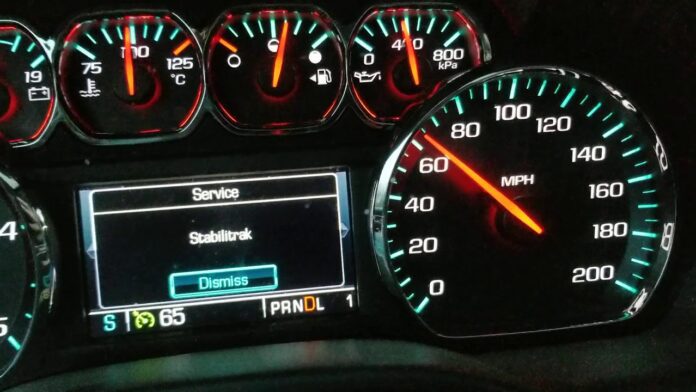
You’re driving your Chevy Silverado and suddenly the “Service StabiliTrak” message lights up on the dash. Not exactly the kind of notification you want to see, especially if you have no idea what StabiliTrak actually does or how serious the problem might be.
That message means something’s off with your Silverado’s stability control system, the one that keeps your truck from sliding, skidding, or losing control in sketchy driving conditions. The good news is it’s not always a major repair. Sometimes it’s a sensor glitch. Other times, it’s pointing to something that genuinely needs attention.
Let’s break down what’s going on, what’s likely causing it, and how to deal with it, whether you’re a DIY type or prefer handing it off to a mechanic.
What StabiliTrak Actually Does in Your Silverado
StabiliTrak is GM’s version of Electronic Stability Control (ESC). In plain terms, it’s the system that helps keep your truck going where you point it, especially when conditions try to convince your wheels otherwise.
Picture this: you’re taking a curve on a rain-soaked road and the rear end starts to slide. StabiliTrak detects that slide, applies brakes to specific wheels, and dials back engine power to straighten you out. All of this happens in a fraction of a second, usually before you even realize something was wrong.
The Parts That Make It Work
A few key components keep the StabiliTrak system running:
- Wheel speed sensors – One at each wheel. They track how fast each wheel is spinning, so the system knows instantly if one loses traction.
- Rotation rate sensor – This measures your truck’s lateral movement and rotation around its center. It’s how the system knows you’re sliding sideways instead of moving forward.
- Traction control – Works hand in hand with StabiliTrak by cutting engine power or braking individual wheels when grip is lost.
When all these pieces communicate properly, you get a truck that stays planted and predictable. When they don’t communicate well, that’s when the warning message shows up.
How StabiliTrak Stacks Up Against Other Stability Systems
Every major automaker has their own version of electronic stability control. Ford calls theirs AdvanceTrac. Toyota uses Vehicle Stability Control. StabiliTrak is GM’s take on it, and it combines both traction control and directional stability into one package.
What makes it well-suited for the Silverado specifically is that it’s calibrated for larger, heavier vehicles. Trucks behave differently than sedans in emergency maneuvers, and StabiliTrak accounts for that. It’s one of those systems you forget exists until you need it and then you’re really glad it’s there.
How to Tell Something’s Wrong With Your StabiliTrak
The warning message itself is the most obvious sign, but it’s not the only one. Your Silverado will usually give you a few other clues that something isn’t right.
The “Service StabiliTrak” Light on Your Dash
This yellow warning light is the system’s way of saying, “Hey, I’m not working properly right now.” It doesn’t always mean a catastrophic failure, sometimes it’s a minor sensor hiccup. But it shouldn’t be ignored either.
The light could point to anything from a flaky wheel speed sensor to a deeper control module issue. In some cases, you can reset the system and the light goes away for good. Other times, it keeps coming back and that’s when you need to dig deeper.
Multiple Warning Lights Appearing Together
Here’s what makes things tricky: the StabiliTrak system shares components with your ABS and traction control systems. So when StabiliTrak has a problem, you might also see the ABS light, Check Engine light, or Traction Control light pop on.
If multiple lights come on at once, it usually means the underlying issue affects more than one system. You might also see a message like “StabiliTrak Off,” which tells you the system has essentially shut itself down. That’s your cue to get it checked out sooner rather than later.
Your Truck Doesn’t Handle Like It Should
Sometimes you’ll feel the problem before you see the warning light. Your Silverado might pull to one side, feel unstable in turns, or just generally drive “off.” You might notice unusual vibrations through the steering wheel or the brake pedal feeling harder than usual.
The Traction Control light can also flicker on if a wheel momentarily loses grip, something the system would normally handle silently. If these handling symptoms show up alongside the StabiliTrak warning, the system definitely isn’t doing its job. Catching these signs early can save you from a more expensive repair later.
What’s Actually Causing the StabiliTrak Warning
The “Service StabiliTrak” message doesn’t just appear for fun. Something triggered it. Here are the most common reasons.
Faulty Sensors Sending Bad Data
Sensors are the eyes and ears of the StabiliTrak system, and when they go bad, the whole system gets confused.
The most common offenders:
- Wheel speed sensors – These measure how fast each wheel is turning. A failing one sends incorrect data to the control module, and the system can’t tell if you’re losing traction or not.
- Steering angle sensor – Located in the steering column, this tells the system which direction your wheels are pointed. When it fails, the system gets bad information about where you’re actually steering.
- Throttle position sensor – This reports how much throttle you’re applying. Inaccurate readings can trigger false StabiliTrak warnings.
Sensor replacements aren’t usually bank-breakers, but you need to identify which one is causing the problem first. That’s where diagnostic codes come in handy.
Engine Problems That Trigger the Warning
This one surprises people. An engine misfire can actually trigger the StabiliTrak warning. Think about it, if the engine suddenly drops power on one cylinder, the system interprets that as an unexpected change and flags it.
Common engine related causes include worn-out spark plugs, a failing fuel pump, or issues with the Active Fuel Management (AFM) system. AFM is designed to improve fuel economy by deactivating cylinders when full power isn’t needed, but when it malfunctions, it can create performance hiccups that set off the StabiliTrak alert.
If your engine isn’t running smoothly, fixing that often clears the StabiliTrak warning as a bonus.
Brake System Issues
Since StabiliTrak relies heavily on your braking system to do its job, brake problems can directly trigger the warning. A malfunctioning ABS sensor, a glitchy Brake Control Module, or even a bad brake switch can all be responsible.
Even something as seemingly unrelated as uneven tire pressure can play a role. The Tire Pressure Monitor Sensor can interact with StabiliTrak, if one tire is significantly lower than the others, it changes that wheel’s effective diameter and speed, which confuses the system. Keeping your brakes and tires in good shape eliminates a lot of these triggers.
DIY Fixes You Can Try Before Calling a Mechanic
Before you spend money at a shop, there are a few things worth trying in your driveway.
Inspect Your Sensor Connections
Start with the basics. Check the wheel speed sensors at each wheel hub, look for loose connectors, corroded terminals, or damaged wiring. Road grime, salt, and moisture can all wreak havoc on these connections over time.
While you’re at it, check the throttle position sensor connections too. A wonky connection there can trigger the warning even if the sensor itself is fine. Disconnect and reconnect each plug to make sure everything’s seated properly. Sometimes that’s literally all it takes, a clean, secure connection can make the difference between a warning light and a clean dashboard.
Pull the Diagnostic Trouble Codes
An OBD-II scanner is one of the best $30-50 investments you can make as a truck owner. Plug it into the diagnostic port under your dashboard, and it’ll pull the specific trouble codes stored in your Silverado’s computer.
A couple of codes you might see:
- C0561 – Points to a stability control system malfunction
- P0121 – Relates to the throttle position sensor
These codes won’t always tell you exactly what’s broken, but they narrow it down significantly. Even if you end up going to a shop, walking in with the codes already pulled saves diagnostic time and potentially money.
Reset the System
If you’ve checked connections and read the codes, a system reset is worth trying. The simplest method: turn off the truck, wait a few minutes, then restart. Sometimes that clears a temporary glitch.
For a more thorough reset, disconnect the negative battery terminal and wait 10-15 minutes before reconnecting it. This forces the truck’s computer to reboot from scratch. Fair warning, you’ll lose your radio presets and any saved settings, but it can clear stored error codes and bring the system back to its default state.
If the warning comes back after a reset, the problem isn’t a glitch, it’s a real issue that needs professional diagnosis.
How to Keep StabiliTrak Problems From Coming Back
Once you’ve fixed the issue, a little preventive maintenance goes a long way toward keeping that warning light off your dashboard for good.
Run Regular System Diagnostics
Don’t wait for a warning light to tell you something’s wrong. Periodic diagnostic scans can catch developing issues, like a sensor starting to drift or a corroded connection, before they trigger a full warning. Most shops can run a quick scan during routine service visits.
Keep an eye on your dashboard between visits, too. If any warning lights flash briefly and then disappear, make a note. Intermittent warnings are often early signs of a sensor or connection that’s on its way out.
Take Care of Your Sensors and Electrical Connections
Sensors are the backbone of the StabiliTrak system, and they take a beating from road conditions. The steering angle sensor, wheel speed sensors, and ignition coils all need periodic attention.
Look for corroded connections, especially if you drive in areas with heavy road salt. Clean any corrosion you find and make sure connectors are tight. Worn ignition coils can cause misfires that cascade into StabiliTrak warnings, so don’t overlook them during tune-ups. A few minutes of inspection during an oil change can prevent a roadside surprise later.
Don’t Underestimate Fuel Quality and Engine Health
This is one people tend to overlook. The fuel you put in your Silverado matters. Bad fuel or using E85 in a truck that isn’t designed for it can cause engine performance issues that trigger StabiliTrak warnings downstream.
A clogged fuel filter restricts fuel delivery and can cause rough idling and misfires, both of which the StabiliTrak system can misinterpret as traction problems. Replace your fuel filter on schedule, use quality fuel, and address any engine roughness promptly. A healthy engine is one of the best ways to keep every connected system, including StabiliTrak running the way it should.

