
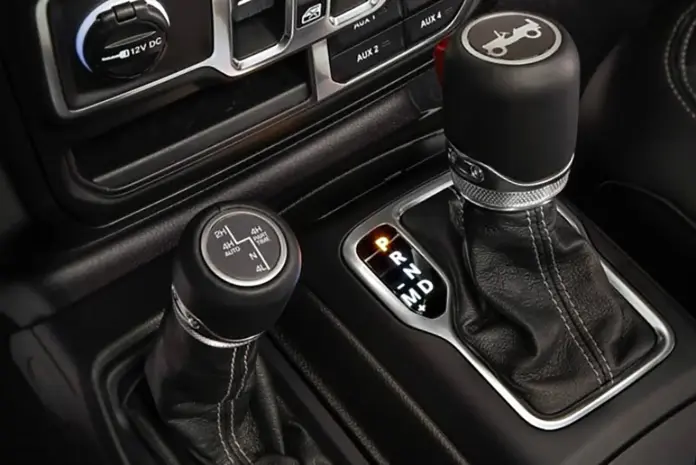
You hop into your Jeep, buckle in, press your foot on the brake, and hit the start button; exactly the way you’ve done it a hundred times. But this time, when you try to shift into R or D, the Jeep refuses to cooperate. The shifter may move (or the electronic selector may accept your input), yet the transmission stays locked in PARK. Then you see the message staring back at you from the instrument cluster: “Auto Park Engaged, Shift to P, then Select Gear.”
You follow the prompt. You shift to P. You try again. Still nothing. The vehicle remains stuck, the message repeats, and now your stress level spikes; especially if you’re partially blocking a road, stuck in a parking lot lane, or holding up traffic in a tight space. This situation is frustrating, but it’s also a legitimate safety concern because you don’t want to be stranded in an active lane or tempted to “force” the vehicle into motion. The encouraging news is that many Auto Park problems are caused by a handful of predictable triggers, and several of them can be resolved quickly if you use the right troubleshooting sequence. We’ll walk through those solutions below.
Expert note before we begin: “Auto Park Engaged” can be either (1) the system working as designed because it detected an unsafe condition, or (2) a false/erroneous engagement caused by a sensor input, software logic, or an intermittent electrical issue. The goal is to determine which one you’re dealing with; without introducing new risk. If you’re currently stuck in a dangerous location, turn on hazard lights immediately and ask a passenger to guide traffic if it’s safe to do so. If the vehicle is in a position that creates immediate danger, call roadside assistance rather than experimenting under pressure.
In this guide, you’ll learn what the message actually means, what conditions trigger Auto Park, why it can “trap” a Jeep in PARK, the safest on-the-spot fixes, how to disable Auto Park (when appropriate), and what to check if the problem keeps returning.
What Does the Jeep Auto Park Engaged Mean?
The Jeep message “Auto Park Engaged” means the vehicle’s Auto Park system has activated and commanded the transmission into PARK (and, on many models, may also apply the electronic parking brake depending on configuration). Auto Park is one of several modern safety features designed to reduce roll-away incidents and prevent unintended vehicle movement. In plain terms, the system is trying to protect you; either from accidentally leaving the driver’s seat while the vehicle is still in gear, or from driving while a key safety condition (like a door fully closed) isn’t met.
Auto Park exists because modern Jeep models; especially those equipped with electronic shifters and an 8-speed automatic; rely on computers and actuators rather than purely mechanical linkages. That electronic control allows useful safety strategies, such as Auto Park. But it also means the system depends on clean sensor inputs: door-ajar signals, seat occupancy signals, seat belt latch signals, brake pedal signals, and vehicle speed data. If any of those signals indicate risk (or falsely indicate risk), Auto Park may engage.
Most of the time, Auto Park is doing exactly what it’s supposed to do. For example, if the Jeep isn’t in PARK and you attempt to exit while the engine is running, Auto Park may step in to prevent a roll-away. Similarly, it can protect you from moving the vehicle when a door is ajar. In many Jeep models, you’ll see a door-ajar icon in the instrument cluster when the driver’s door isn’t fully latched. If you try to drive with that condition present, the Auto Park system may engage and stop the vehicle from moving.
Practical takeaway: When you see “Auto Park Engaged,” the Jeep is saying: “I’m not comfortable letting you move this vehicle right now based on the data I’m reading.” The next step is identifying what data point the Jeep doesn’t like.
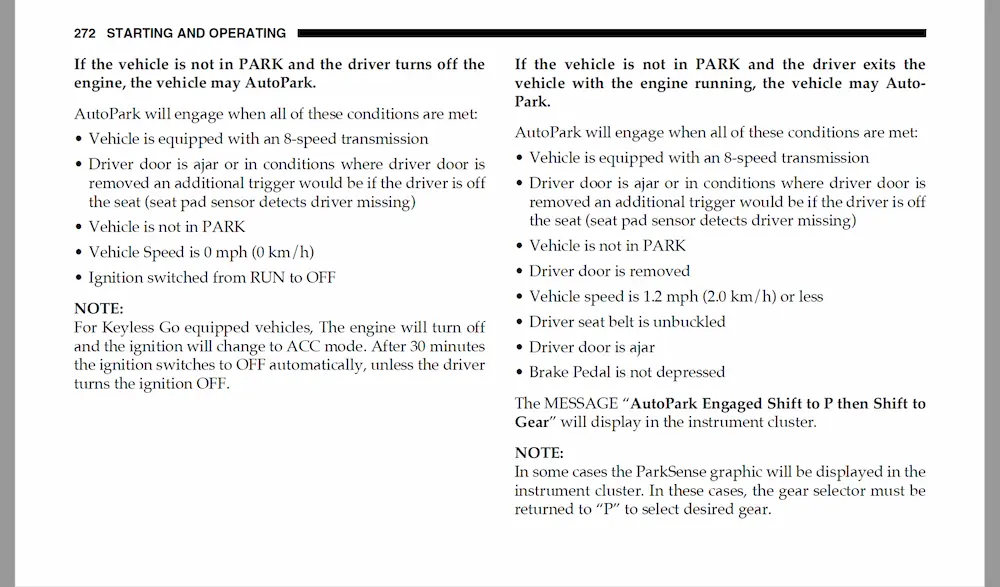
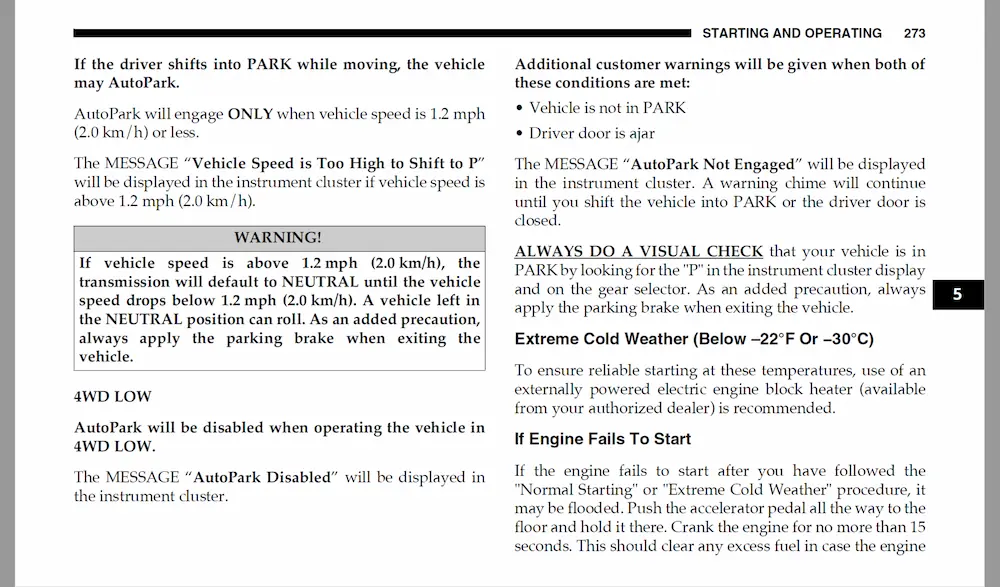
The Auto Park will automatically activate when the following conditions are satisfied:
- Your Jeep has an 8-speed transmission
- The driver’s door is ajar
- When you remove the driver’s door
- The seat pad sensor detects you (the driver) is missing (off the seat).
- You’ve unbuckled the seat belt
- The vehicle isn’t in PARK
- You’ve not depressed the brake pedal
- The car is moving at 1.2 mph (2 km/h) or less
Those conditions deserve a bit of expert context. Auto Park is essentially a “logic gate”; it watches for combinations of signals that suggest the driver may be leaving control of the vehicle while it is not safely parked. The system isn’t judging your intentions; it’s reacting to inputs. That’s why a misread door sensor or a seat pad sensor behaving erratically can create a scenario where the Jeep believes you are “not in the seat,” “door open,” or “belt unbuckled,” even when you’re sitting normally and trying to drive.
This is also why Jeep owners sometimes experience Auto Park engagement after doing normal activities such as:
- Cleaning the interior and moving the seat repeatedly
- Removing doors (common on Wrangler/Gladiator setups)
- Re-latching a door that didn’t close fully on the first try
- Leaning off the seat temporarily while the vehicle is running (reaching for something)
- Starting the vehicle with low voltage (weak battery) that causes modules to behave unpredictably
Why Jeep uses Auto Park in the first place: Auto Park systems became more common across several brands after industry-wide attention to roll-away incidents. Jeep’s implementation is meant to reduce the odds of a driver stepping out while the vehicle is still capable of moving. For a tall vehicle with substantial weight like many Jeeps, even slow roll-away movement can cause serious damage and injury. Auto Park is designed to be conservative; sometimes annoyingly so; because the downside of letting a vehicle roll is far worse than the downside of forcing the driver to re-check door and seat belt conditions.
Important distinction: “Auto Park Engaged” is not the same as a transmission failure. In many cases, the transmission is fine; it’s the safety logic preventing a shift command from being executed.
Now let’s address the situation that brings most people here: Auto Park is engaged, you’re doing what the cluster says, and the Jeep still refuses to shift out of PARK.
Why the Jeep Can Get Stuck in “Auto Park Engaged” Mode (Real-World Causes)
In the field, I typically group “stuck in Auto Park” cases into two categories:
- Correct engagement (system working as designed): The Jeep is truly reading a door-ajar condition, no seat belt latch, driver not detected on the seat, brake not pressed, or a door removed status; so it engages Auto Park until you correct those conditions.
- False engagement (system misreading an input): A sensor, wiring connection, or software state causes the vehicle to think a condition exists when it does not (for example, a door latch switch that intermittently reports “open”).
Both categories can present the exact same dashboard message. The difference is that the first category is usually resolved immediately by closing the door firmly and buckling the belt, while the second category may keep returning until the underlying cause is diagnosed.
Common contributors to false/recurring Auto Park engagement include:
- A driver door latch sensor that intermittently reads “ajar” due to wear, contamination, or misalignment
- Seat occupancy (seat pad) sensor inconsistencies, especially if the driver shifts weight off the seat during start-up
- Seat belt buckle switch issues (buckled but not detected, or latch switch delay)
- Low battery voltage creating odd module behavior, especially at start-up
- Aftermarket accessories or wiring modifications near the console/shifter area
- Software needing an update (less common, but real, particularly when a known pattern exists)
While the guide below focuses on the immediate fixes (the ones most Jeep owners can safely try), it’s helpful to keep those longer-term contributors in mind; especially if this happens repeatedly rather than as a one-off.
How Can I Fix the Auto Park Engaged Issue on Jeep?
To fix the Auto Park Engaged issue on Jeep, start by checking whether a door-ajar notification is active on the dashboard. If you see it, close the door firmly and correctly; Auto Park often disengages immediately once the system sees the door latched and the vehicle is in the proper state. Another way many drivers escape the situation is by pressing the accelerator pedal (after confirming seat belt and door status). If the message persists, you can attempt a simple “reset” procedure; cycling the ignition on and off in a specific way; so the modules exit the trapped logic state. The reset involves performing a few engine ON and OFF cycles.
Safety reminder: Only attempt these steps if you are in a safe area or can safely remain stationary. If you are stopped in a risky location (blind curve, lane of travel, narrow shoulder), prioritize safety: hazards on, call assistance, and avoid hurrying through steps.
Below are the three most common solutions in the order I recommend trying them; starting with the simplest and most likely.
Possible Solution #1: Close the Door
If Auto Park activated the way it was designed to, you should see some indication that the system believes the driver’s door is not properly secured; typically a door-ajar icon or “Open Door” style notification in the instrument cluster. If you can see that indicator, shift to PARK (if you’re not already), then close the driver’s door firmly and deliberately. Don’t just “push lightly.” Close it with enough force to ensure the latch fully seats, especially if you are parked on uneven ground or the body is slightly twisted (which can happen off-road or on steep driveways).
After that, try shifting into drive or reverse again. In many cases, the Jeep will immediately allow the shift and you’ll be out of the frustrating situation. However, if you do not see a door-ajar indicator, something else may be happening; either a different input is triggering Auto Park, or the Jeep is misreading a sensor.
Expert technique: If the door-ajar message is intermittent, open the door fully, then close it again; firmly; while watching the cluster. If the door icon flickers, the latch sensor may be inconsistent. That doesn’t mean you can’t drive today, but it does mean the issue can return until the latch/sensor is inspected.
Also check: Doors can appear closed while still being on the “first catch.” If the door isn’t fully latched, the Jeep may treat it as ajar. This is common when:
- A seat belt or jacket edge gets caught in the door
- The door seal is stiff in cold weather
- The vehicle is parked at an angle and the door swings differently
- The driver door was removed and reinstalled (Wrangler/Gladiator), and alignment is slightly off
If closing the door properly clears the message, treat it as a reminder that Auto Park is responding to the inputs it receives. If it doesn’t clear, proceed to the next solution.
Possible Solution #2: Press the Accelerator Pedal
Before trying this fix, confirm you’ve fully closed and locked the driver’s door and that your seat belt is buckled. These conditions are important because Auto Park was created specifically to intervene when those safety signals are missing. Once those are correct, keep your foot on the brake, select the gear you need (if the system allows the selection), and then apply gentle pressure to the accelerator. On some Jeeps, this can prompt the system to exit the trapped Auto Park state and release the park/parking brake logic.
Why this can work: Auto Park and related brake logic may require a clear “driver intent” signal; door closed, belt latched, and a drive command; before it allows movement. Sometimes the system needs that combination to confirm you are seated, in control, and intentionally trying to drive.
How to do it safely (expert guidance):
- Make sure the area in front/behind the vehicle is clear.
- Close the driver’s door firmly.
- Buckle your seat belt (even if you’re only moving a few feet).
- Hold the brake pedal down.
- Attempt to select D or R.
- Apply gentle accelerator input; do not mash the pedal.
Important caution: If the Jeep suddenly releases and moves, you need full control. That’s why you should keep your foot ready on the brake and ensure the path is clear. Never do this in a tight space with obstacles close to the bumper.
If the accelerator method does not help, move on to the reset procedure below.
Possible Solution #3: ‘Reset’ the Jeep
Sometimes Auto Park gets “stuck” because a module is holding on to a logic state that doesn’t clear immediately; especially if the engagement happened during an awkward sequence (for example, door not fully closed during start-up, seat belt buckled late, or you leaned off the seat while the Jeep was powering up). In that case, a controlled ignition cycling procedure can help the vehicle re-initialize its state checks.
The basic approach is simple: shut off your Jeep and turn it back on. Repeat a few times so it can effectively “reset” and allow you to move. While doing that, ensure the driver’s door is properly closed and the seat belt is buckled so the system sees a fully safe operating condition when it reboots.
Alternatively, follow this specific sequence (which many owners report as effective): shut the Jeep off and open and close the door. Press the start button WITHOUT YOUR FOOT ON THE BRAKE, and then turn the vehicle off. Repeat the process a third time. After that, put your foot back on the brake, press the start switch normally, and attempt to shift to R or D. Often, the Jeep will comply after this sequence because the modules have re-checked the “door closed / driver present / belt latched / brake applied” conditions in a clean order.
Expert explanation: Pressing the start button without the brake typically places the vehicle into an ignition-on/accessory state rather than starting the engine. Cycling through that state can clear temporary logic conflicts between modules. It’s not guaranteed, but it’s a low-risk step that often helps when the system is confused rather than physically broken.
If the reset works: Great; but don’t ignore the event. If Auto Park engaged unexpectedly, it may happen again. Pay attention to whether the door-ajar icon appears intermittently or whether seat belt latch detection seems delayed. Those clues matter.
If the reset does not work: You may be dealing with a deeper issue; such as a persistent door latch sensor fault, a brake pedal switch issue, a battery/voltage problem, or a shift interlock fault. At that point, continued random cycling isn’t productive. You’ll want a diagnostic approach (more on that later in this article).
What to Do If You’re Stuck in Traffic or Blocking a Road (Safety-First Checklist)
If the message appears when you are partially blocking a road, the priority is preventing secondary accidents. Auto Park problems create a particularly uncomfortable situation because the vehicle may appear “fine” but refuses to move; drivers behind you often assume you can simply accelerate away.
Use this safety-first checklist:
- Turn on hazard lights immediately.
- Keep your foot on the brake if you are on an incline or near traffic.
- Close the driver’s door firmly and buckle your seat belt even if you plan to move only a short distance.
- Try Solution #1 quickly (close door, verify door-ajar icon disappears).
- Try Solution #3 (reset cycle) only if you can do so without creating new danger.
- If traffic conditions are unsafe, call roadside assistance or a tow rather than continuing to troubleshoot in the lane.
Expert warning: Avoid “creative” solutions such as forcing the shifter, repeatedly revving the engine, or turning the steering hard while toggling ignition states. These actions rarely solve the problem and can create additional faults or safety risks.
How To Turn Off the Auto Park on Jeep
To turn off the Auto Park on Jeep, go to the Uconnect screen and navigate to the “Settings” tab. While on this screen, tap on the “Brakes” option. Next, uncheck the Auto Park entry, and you will have successfully disabled the feature.
If that doesn’t work for your model, consult your owner’s manual. The manual typically offers a step-by-step path specific to your trim level and Uconnect version. Different Jeep models and model years can present the Auto Park setting differently, and some may restrict disabling depending on configuration and safety programming.
The steps below may also apply to various models:
- Open your Jeep “Settings” using the touchscreen display or pressing the button.
- Choose the “Brakes” option from the menu.
- Find the “AutoPark Brake” feature and then choose “Off.”
- Verify that you’ve turned off the Auto Park feature. Do that by shifting the vehicle into Park and then checking that the system isn’t active.
Note: It’s true: Auto Park can misbehave and trap your Jeep in PARK, and disabling it can spare you from a repeat of an annoying and risky moment. But turning off Auto Park also removes a layer of protection that exists to prevent roll-away accidents; especially in situations where someone unbuckles, opens a door, or steps out while the vehicle is not securely parked. That’s why, from a safety and liability standpoint, it’s usually best to keep Auto Park enabled unless you have a specific reason and understand the risk. If Auto Park is repeatedly misbehaving, the most responsible solution is to diagnose and repair the cause; not permanently disable a system designed to prevent accidents.
Professional recommendation: If you do choose to disable Auto Park, treat it like disabling traction control: it may be useful in a specific situation, but it shifts more responsibility onto the driver. Make sure every driver of the vehicle understands that change.
Advanced Troubleshooting: If the Three Fixes Don’t Solve It
The three solutions above address the most common “I’m stuck right now” Auto Park scenarios. But if your Jeep repeatedly gets trapped in Auto Park engaged mode; or refuses to shift even after door/seat belt confirmation and reset cycles; you should treat it as a diagnostic problem, not a convenience glitch.
Here’s how a technician typically thinks through it, explained in owner-friendly language. This section does not replace a professional diagnosis, but it will help you communicate symptoms clearly and avoid unnecessary parts replacement.
1) Confirm whether the Jeep is truly seeing “door ajar”
The instrument cluster door icon is your first clue. If it shows door ajar when the door is visibly closed, the likely suspects include the door latch switch, latch alignment, or wiring/connector issues. A latch can be physically fine but electronically inconsistent; especially if dirt, moisture, or wear affects the internal switch.
What you can do: Observe whether the door-ajar icon changes when you push/pull the door slightly while closed. If it flickers, the latch sensor is suspect.
2) Evaluate battery health and voltage stability
Modern Jeeps are extremely sensitive to low voltage. A battery that still “starts the engine” can nevertheless cause weird module behavior; especially during start-up when many systems initialize at once. Auto Park logic depends on multiple modules communicating cleanly. If voltage dips, the system can misinterpret inputs or fail to clear states properly.
Signs pointing to voltage: slow cranking, random warning messages, infotainment resets, or issues that appear after the Jeep sits for a few days.
3) Consider brake pedal switch / shift interlock behavior
Auto Park logic often depends on brake pedal status. If the Jeep is not confidently seeing “brake applied,” it may refuse to allow shifting. This can feel like an Auto Park issue because the message is related to Park state, but the root cause may be a brake switch input problem.
Clue: If the brake lights behave strangely or intermittently, mention that to a technician immediately.
4) Check for software updates or technical service information
Not every Auto Park problem is a hardware failure. Some are software-state issues that are corrected via updated module programming. Dealers and well-equipped independent shops can check for updates. If your Jeep repeatedly shows Auto Park messages without an obvious mechanical cause, ask whether there is a known update applicable to your VIN.
5) Scan for stored codes using a capable tool
Even when the dash message feels “generic,” the vehicle may store useful codes in modules such as the transmission control module, body control module, or ABS/ESC system. A proper scan can reveal whether the Jeep recorded a door switch fault, seat belt status fault, gear selector signal issue, or other related events.
Expert note: A basic OBD-II reader may not see body and transmission module details. A more capable scan tool (or a shop scan) is often required to pinpoint Auto Park-related faults.
How Auto Park Interacts With Door Removal (Wrangler/Gladiator Owners Should Read This)
Jeep is unique because many models; especially Wrangler and Gladiator; are designed with removable doors. That’s one reason Auto Park includes “door removed” as a trigger input. The vehicle needs a strategy to prevent movement when a critical “driver containment” component is missing.
If you remove the driver’s door, the Jeep may interpret that as an unsafe driving condition unless other requirements are met (such as seat belt being latched and the driver being detected in the seat). Depending on model/year, some owners report Auto Park engagement during transitions; like installing/removing doors, reconnecting door wiring harnesses, or switching between summer and winter setups.
Best practice: When removing doors, follow the owner’s manual sequence carefully. Ensure any door harness connectors are handled properly, and avoid turning the ignition on/off repeatedly while connectors are partially connected. Intermittent or partially seated connectors can create false “ajar” signals and trigger Auto Park at inconvenient times.
If Auto Park problems started immediately after door removal or reinstallation, that timeline is valuable diagnostic evidence. Mention it to your mechanic or dealer, because it narrows the investigation.
FAQs
Why Would My Jeep Get Stuck in the PARK?
A Jeep can stick in the PARK for various reasons. One typical one is that it may be low on transmission fluid. That can happen if a leak occurs and go unnoticed for long enough. Your car can also fail to shift out of the park due to low voltage or a wiring problem, such as a disconnected transmission shift cable.
Expert addition: When the dash message specifically mentions Auto Park, it often points more toward a safety logic trigger than a purely mechanical transmission issue. But the broader reasons listed above are still valid; especially in cases where the shifter moves but the transmission doesn’t respond, or where multiple symptoms appear (noise, warning lights, harsh shifting). If you suspect a fluid issue, don’t keep forcing shift attempts; low fluid can cause internal transmission damage. Have it inspected promptly.
Why Is My Jeep Stuck in Park but the Shifter Moves?
Your Jeep can stick in the park, although the gear shifter moves if there is debris in the transmission lines causing an obstruction. The shift solenoid itself could also be faulty. Another cause of this problem may be physical damage within the transmission.
Expert context: With many modern Jeep shifters (especially electronic selectors), the shifter is not always mechanically linked to the transmission. So the shifter moving doesn’t guarantee the transmission will move out of Park. If the vehicle is receiving “do not shift” logic from Auto Park (door/seat/belt/brake conditions) or from a related module, it may ignore the shift request even though the selector physically moves. That’s why checking the door-ajar icon and performing the reset cycle can resolve what feels like a mechanical issue.
Is it safe to drive if Auto Park has been acting up?
If Auto Park engages unexpectedly once and you can clearly identify the cause (for example, the driver door wasn’t fully latched), you may be fine after correcting it. But if Auto Park engages repeatedly without a clear trigger, treat it as a safety-related defect. Intermittent door latch sensors or electrical issues can distract you and can also create unpredictable behavior at low speeds. In that situation, have the Jeep diagnosed as soon as possible.
Will turning Auto Park off fix the underlying problem?
Turning Auto Park off may prevent the vehicle from engaging that particular safety routine, but it does not repair the underlying cause if the system is misreading a door or seat input. If the Jeep is falsely detecting “door open” or “driver not present,” disabling Auto Park may remove one symptom while leaving the root issue unresolved. From a professional standpoint, it’s better to diagnose the input that’s triggering the behavior.
Conclusion
Getting stuck in the Jeep “Auto Park Engaged” situation can be incredibly frustrating; especially if you’re in a hurry, new to the message, or stopped in an awkward spot. Fortunately, many Jeep owners resolve it quickly once they understand what Auto Park is watching: door status, driver presence, seat belt latch, brake input, and low-speed conditions. In most cases, the fix is simple: close the driver’s door properly, confirm your seat belt is buckled, and follow the shifting prompt again.
The key is to avoid panicking. Instead, slow down and work through the three most effective solutions: (1) close the door and confirm the door-ajar indicator clears, (2) try the accelerator method once all safety conditions are met, and (3) perform the ignition cycling “reset” procedure carefully. One of these approaches will often get your Jeep moving again. If none of them work; or if the issue keeps coming back; don’t keep fighting it. Contact a reliable mechanic or tow the vehicle to a dealer for proper diagnosis, because repeated Auto Park engagement can indicate a sensor, voltage, or wiring issue that deserves attention.
Finally, while disabling Auto Park can reduce annoyance, it can also remove a layer of protection designed to prevent roll-away accidents. The safest long-term outcome is not simply turning features off; it’s restoring the vehicle to normal, predictable operation so you can drive confidently.

