
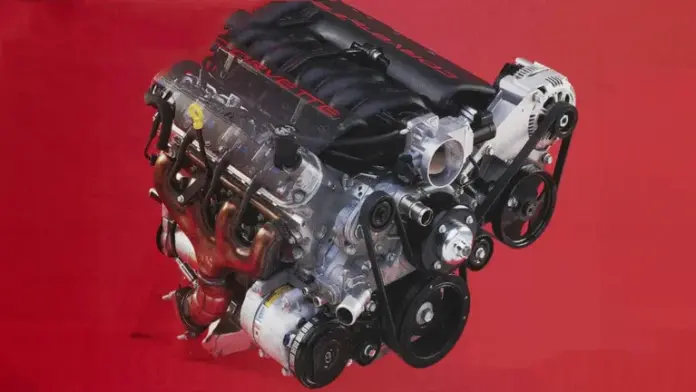
After the production of the LT1 engine in 1977, Chevy introduced the LS1 engine, another small-block performance engine. The LS1 engine came out exactly in 1997. Both the LT1 and LS1 were an improvement on the existing 265 ci which had previously come out in 1955.
If you’re reading this, there’s a good chance you’re doing something practical; routing plug wires, diagnosing a misfire, planning a camshaft swap, or simply trying to understand why the LS family feels and sounds different from earlier small-block generations. And that’s exactly why firing order matters: it’s not just trivia. The firing order influences how evenly the engine delivers torque, how the exhaust pulses behave, how heat is distributed across cylinder banks, and how smooth the crankshaft is loaded through each power event.
What is the engine’s firing order? Is it an upgrade on the older order and what benefits do auto owners and drivers get from the LS1 engine? I’ll answer these and other related questions in this article. We’ll cover the exact LS1 firing order, cylinder numbering, why GM moved away from the older LT1-era sequence, what “4/7 swap” really means, how this affects engine behavior, and how to avoid the most common wiring and diagnosis mistakes. Let’s get started.
What is an LS1 engine Firing Order?
The firing order of a typical LS1 engine is 1-8-7-2-6-5-4-3. This LS1 firing order is widely associated with the LS-family small-block V8 architecture and is commonly referenced across GM performance discussions. You may also see it discussed alongside engines such as Chevy 5.7L, and sometimes people mention other displacements in general conversation. The important point as a technician is this: always verify firing order against your exact engine family and platform, because V6 and non-LS engines can use different sequences even if the displacement number looks familiar.
The firing order is connected to the engine’s cylinder number through the fold method numbering system. GM moved away from the traditional 1-8-4-3-6-5-7-2 firing arrangement commonly associated with older small-block/big-block Chevy layouts used in many LT1-era discussions. The reason for the change in firing arrangement was to support improved balance and reduced vibration characteristics, working with a cross-plane crankshaft architecture that divides crank events evenly by 90o in typical V8 operation.
There’s an issue with the old firing order, especially cylinders 5 and 7 which sit next to each other on the engine blocks and head. When the distributor fires cylinder 5, it can create conditions that negatively influence cylinder 7; heat concentration, uneven loading, and in some performance scenarios, undesirable interactions that can reduce power or promote uneven wear. In practical terms, the old sequence could encourage localized stress patterns in certain adjacent cylinders, especially when tuning is aggressive or when thermal management isn’t ideal.
In an LS1 engine, the distributor (or, more accurately in most LS applications, the ignition control strategy) follows the LS firing order. You’ll often hear the change described as “cylinders 4 and 7 are exchanged.” That description is commonly used because relative to the classic Chevy V8 order, the LS-family order is frequently discussed as a 4/7 swap concept. In many explanations, this is the easiest way to describe how the LS firing order was reorganized to improve loading and breathing behavior. (In deeper technical discussions, you may also see references to additional sequence reshuffling beyond just 4 and 7; the key takeaway is that the LS order was intentionally redesigned for improved behavior.)
One thing to note about the LS1 is that its exhaust doesn’t produce quite the same sound as older generations of small blocks. Part of that is firing order and pulse behavior, and part of it is modern exhaust design, manifold geometry, and the way the LS platform routes and scavenges exhaust. The left bank of the cylinders is marked 1-3-5-7 while the right bank is numbered 2-4-6-8.
A vehicle engine fires effectively through the spark plugs. These spark plugs ignite the air-fuel mixture and push each cylinder through its power stroke, and the engine follows the firing order in a defined sequence. Depending on the ignition system type, the distribution of spark events can be represented as moving either clockwise or counter-clockwise across distributor cap terminals (where distributors are used), or as timed coil outputs in distributorless systems. LS vehicles need the firing order because it defines the proper series in which internal cylinders are sparked to output power consistently and smoothly.
An LS firing order also comes in the form of a request to transfer power across the LS engine cylinders. In other words, it’s the engine’s “rhythm” for converting combustion events into rotational motion at the crankshaft. When the rhythm is correct, the engine feels smooth and stable; when it’s wrong, you get misfires, rough idle, loss of power, and sometimes backfiring.
The LS1 is often discussed as a blend of ideas that later show up in LS2 and LS6 families; depending on the conversation and the comparison being made. The big message is that LS1 helped establish the Gen III LS architecture as a major step forward in small-block performance and efficiency. It can be modified through common performance practices such as porting and polishing cylinder heads to unlock horsepower gains.
Before we move on, here’s an expert “sanity check” that prevents a lot of mistakes: the firing order is only useful if cylinder numbering is correct. So let’s lock down cylinder numbering and bank identification clearly.
LS1 Cylinder Numbering and Bank Layout (Don’t Skip This)
Most firing order confusion doesn’t come from the order itself; it comes from incorrect cylinder identification. LS engines follow the traditional Chevrolet V8 cylinder numbering pattern that many techs already know, but DIYers sometimes mix it up when they come from other brands that number cylinders differently.
For LS-family V8 engines, including LS1, cylinder numbering is:
- Left bank (driver side on most LHD vehicles): 1-3-5-7 (front to rear)
- Right bank (passenger side on most LHD vehicles): 2-4-6-8 (front to rear)
Once you know this, the LS1 firing order 1-8-7-2-6-5-4-3 becomes easy to visualize: it alternates banks frequently, and that alternation is part of how it reduces stress concentration and improves operating smoothness.
Expert tip: if you’re diagnosing misfires or doing coil/plug wire work, label everything before you disconnect it. A five-minute labeling habit can save you hours of troubleshooting later.

Why the New LS1 Firing order?
One of the reasons General Motors changed the firing order is the incredible reduction in vibration. In practical terms, a firing order that distributes combustion events more evenly across the crankshaft and cylinder banks reduces the tendency for the engine to “load up” one side or one section of the crank repeatedly. That’s good for smoothness, bearing life, and overall refinement; especially as power output increases.
Additionally, the LS1 firing order supports engine design goals that include higher compression ratios without unnecessary restricted pre-detonation and overheating. While firing order alone doesn’t magically prevent detonation, the overall combustion stability and thermal distribution improvements contribute to a platform that tolerates higher performance tuning with fewer localized hot spots.
Another benefit of the 1-8-7-2-6-5-4-3 firing order is that it aligns well with broader engineering updates GM introduced as the LS family evolved beyond older generations. You may see discussion about how LS engines moved away from earlier reverse-flow cooling strategies used in some performance generations (like certain Corvette-era configurations). While cooling system design is a separate engineering topic from firing order, the larger story remains: LS engines were designed as a more modern and stable platform overall. Even if this new firing order can make some LS1 vehicles sound different (some describe it as a “motorboat” tone), it still offers better stability when the engine is idling and smoother operation through the RPM range.
From an expert viewpoint, the “why” can be summarized like this:
- Reduced vibration and improved NVH (Noise, Vibration, Harshness) compared to older sequences under certain conditions.
- Improved thermal distribution by avoiding problematic adjacent-cylinder sequencing patterns.
- More consistent exhaust pulse timing for better scavenging behavior, especially in performance applications.
- Better long-term durability under load when paired with the LS architecture and its ignition/fuel strategies.
Now that you know the reasoning, the next big question most owners ask is: can you change it?
Can I change LS1 firing order?
Yes, your natural firing order is not “fixed” in the sense that engine builders can design around different firing sequences. However, changing firing order is not the same thing as simply swapping plug wires around. On an LS1, the firing order is determined primarily by the camshaft lobe arrangement (and how the PCM commands ignition and injection relative to that cam/crank timing). So if you want to truly change firing order, it typically requires mechanical and tuning changes; often involving a camshaft designed for a different firing sequence and the correct calibration adjustments.
The LS1 engine firing order is designed in a way that power is conveyed to various cylinders in a balanced pattern. It makes a strong showing between banks. If you have the 1-8-7-2-6-5-4-3 firing order, you can re-design the sequence by changing it; but only if you do it the correct way mechanically and electronically.
If you can get the new firing order of your LS1 engine right, the engine can vibrate less, improve idle stability, and run more smoothly. As a result, the engine will run smoothly, enhancing the driver and vehicle’s protection. Remember to engage the service of an expert auto technician.
Here’s the expert clarification that keeps you out of trouble: do not “experiment” by rewiring coils or plug wires to “change firing order.” That will not change how the camshaft is opening valves. It will only cause spark events to occur at the wrong time, leading to misfires, backfiring, and potentially engine damage. Firing order changes are engine-building and calibration tasks, not plug-wire tricks.
So when people talk about changing firing order, what they typically mean in the LS world is using a camshaft ground with an alternate firing sequence (or a “4/7 swap” cam concept in older small-block contexts) and tuning accordingly. It’s a legitimate performance conversation; but it’s not a casual DIY wiring change.
LS1 vs LT1 Firing Order: What Actually Changed and Why It Matters
Because you referenced the LT1, it’s worth comparing the sequences in a way that makes the engineering intent obvious.
Traditional LT1-era small-block Chevy firing order is commonly cited as:
LT1 / traditional SBC: 1-8-4-3-6-5-7-2
And the LS1/LS-family sequence is:
LS1 / LS-family: 1-8-7-2-6-5-4-3
Even if you don’t memorize every number, notice how the LS order rearranges events around the end of the sequence. This changes which cylinders fire close together, which can influence adjacent-cylinder thermal and exhaust pulse interactions. In performance engines, those interactions matter because “hot spots” and uneven loading can influence durability and tuning safety margins.
It’s also why you’ll sometimes hear the LS firing order described in simplified terms as swapping cylinders relative to older SBC orders. The simplified description helps people remember, but as a technician you should always work from the actual sequence and cylinder numbering rather than mental shortcuts.
How to Use LS1 Firing Order for Real-World Troubleshooting
Most owners search “LS1 firing order” for one of four reasons:
- They replaced spark plugs or coils and the engine now runs rough.
- They have a misfire code and want to understand cylinder sequence.
- They’re doing a cam swap or engine build and need correct reference.
- They’re diagnosing injector/coil harness routing on a swap.
Here’s how firing order knowledge helps in each case.
1) Plug/Coil Work Gone Wrong
On most LS1 applications, you’re dealing with coil-near-plug (distributorless) ignition. That reduces the chance of classic “plug wire on wrong cap terminal” mistakes, but it introduces other risks; such as mixing coil connectors, incorrectly routing extensions on swaps, or misidentifying cylinders during assembly.
If the engine ran fine before you touched ignition parts and now runs rough, check:
- Correct coil connector location for each cylinder
- Correct cylinder numbering (1-3-5-7 left, 2-4-6-8 right)
- Proper spark plug gap and correct plug part number
- Ground connections and coil bracket grounds (critical on some installs)
Firing order helps you confirm you’re not accidentally “mirroring” cylinder layout. Misidentifying the front cylinder is a classic DIY error.
2) Misfire Diagnosis (Using the Order to Spot Patterns)
If you have misfire codes (like P030x), firing order helps you see whether misfires might be related to shared components or shared conditions. For example, if misfires show up on cylinders that fire close together in the sequence, it can hint at ignition energy issues under load, fuel delivery instability, or certain timing-related problems. It doesn’t prove a cause on its own; but it helps you ask smarter questions.
Professional approach: treat firing order as a diagnostic lens, not a diagnosis by itself. Always confirm spark, fuel, air, and compression.
3) Cam Swaps and Engine Builds
When you change the camshaft, you’re changing the valve event timing that defines when each cylinder is ready to fire. That’s why cam swaps demand correct reference for firing order and engine timing. If you move into alternate firing sequences, you must match mechanical cam design with PCM calibration and ignition/injection timing.
In other words: firing order becomes a build-and-tune conversation, not just a spark plug conversation.
4) Engine Swaps and Harness Routing
Engine swaps are where firing order knowledge saves the most time. When harnesses are custom or modified, it’s possible to accidentally cross injector or coil circuits. The engine may run, but poorly, or it may not start at all. Having the LS1 firing order and cylinder numbering clearly documented helps you map connectors correctly and avoid “mystery misfires” that are really wiring mistakes.
LS1 vs LS2: Which is Better?
The question is not so much about which is better between LS1 and LS2; it is more about what features they each sport. Typically, the LS1 is an older design but boasts more torque and horsepower. LS2 was manufactured in 2005, unlike LS1 which was introduced as far back as 1997.
In terms of cost, LS2 is more expensive given that it is a newer Corvette engine. It is produced in smaller quantities, making it harder for Chevy lovers to find the engine in the market.
No doubt, the intake of the LS2 engine has a better performance rating than the LS1, even though they both flow well. The intake runners and openings in the LS2 are relatively larger than their LS1 counterparts. It transfers enough air to give off and maintain at least 400 horsepower.
The intake of the LS1 vehicle is designed for a 5.7L engine, making it capable of maintaining 350 horsepower. On the other hand, the intake of the LS2 vehicle is intended to work on a 6.0L engine. However, the latest LS1 vehicle can deliver more horsepower than a typical LS2 will, depending on build quality, tuning, airflow modifications, and supporting hardware.
What’s more, the LS1 has a lighter exhaust manifold. In fact, it is one-third lighter than the manifold of its LS2 counterparts. What it means is that LS1 can produce improved exhaust flow thanks to its reduced wall thickness.
From an expert standpoint, “better” depends on your goal:
- Budget build and availability: LS1 is often easier to source and can be very cost-effective.
- Displacement and airflow headroom: LS2’s 6.0L naturally supports stronger baseline torque and airflow demand.
- Performance per dollar: A well-built LS1 with good heads/cam/intake tuning can be extremely competitive.
- Swap practicality: Depending on your project, accessory drive, wiring, and ECU compatibility may matter more than raw numbers.
In other words: LS1 vs LS2 is not a simple “newer is better” debate. It’s a project-specific decision; budget, parts availability, tuning support, and intended use (street, track, towing) should determine your choice.
Frequently Asked Questions (LS1 Firing Order)
Does the LS1 firing order apply to every LS engine?
The LS1 firing order 1-8-7-2-6-5-4-3 is widely associated with many LS-family V8 applications, and it’s often treated as the “LS firing order” in general conversation. However, you should still verify your exact engine code and year, especially if you’re working with modified engines, aftermarket camshafts, or engine families that share displacement naming but not architecture.
Why do some people say the LS firing order is a 4/7 swap?
Because relative to the classic Chevy small-block firing order, the LS-family order is often described as exchanging the positions of certain cylinders in the sequence; commonly referenced as a 4/7 swap concept. It’s a simplified way of describing the engineering change. In practice, you should always use the full correct sequence rather than rely on the “swap” phrase alone.
Will changing firing order make my LS1 faster?
Not automatically. Firing order changes are tied to camshaft design and tuning strategy. Gains, if any, depend on the entire build: heads, cam, intake, exhaust, compression, fueling, and calibration. A firing order change done incorrectly will simply create misfires and instability. Always work with an experienced builder or tuner if you’re exploring alternate firing order strategies.
What happens if I mess up the firing order on an LS engine?
If ignition or injection events occur out of order, the engine may not start, may run extremely rough, or may backfire. On some setups, repeated backfire can damage intake components. If you’ve recently worked on ignition/injection wiring and the engine now runs poorly, double-check cylinder numbering first, then confirm the LS1 firing order and connector routing.

Final Thoughts
The LS1 firing order generally provides a more modern rhythm for the engine and reinforces energy delivery. Besides, the 1-8-7-2-6-5-4-3 firing order also improves forces and cooling distribution, enabling the engine to run faster and more smoothly than it normally should in comparable older patterns.
The LS is a family of engines that have quite similar features and architectural designs. Generally, LS engines are small-block engines with multiple cylinder heads. They have eight cylinders to be exact (V8). They belong to the General Motors line of performance engines. The engine operates on one cross-plane driving rod that is divided equally by 90 degrees.
From an expert closing perspective, the LS1 firing order is best thought of as part of a broader engineering package: improved stability, reduced vibration, and better distribution of load and heat across the engine. Whether you’re maintaining a stock LS1, troubleshooting a misfire, or planning a performance build, knowing the firing order; and pairing it with correct cylinder numbering; keeps you from the most common mistakes and helps your engine deliver the smooth, consistent power the LS platform is known for.
If you’re unsure about your exact model or you’re working with a swap or modified build, don’t rely on memory alone; verify firing order and cylinder layout against your engine documentation and tune strategy. That one habit prevents hours of frustration and protects your investment.

