
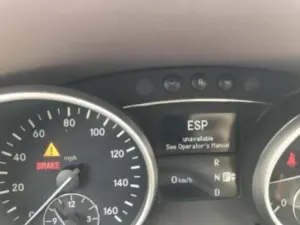

If you’re driving a Mercedes and the dashboard suddenly displays “ESP Unavailable, See Operator’s Manual,” it’s natural to feel a jolt of concern. That message means your Electronic Stability Program has shut itself off, and one of your car’s most important safety systems is no longer active.
The good news? In most cases, the cause is something relatively straightforward: a sensor issue, a weak battery, or a calibration problem. The bad news? Ignoring it leaves you without the system that keeps your car from skidding or spinning out when road conditions get tricky.
Let’s walk through what ESP actually does, why this warning appears, and how to fix it.
What Mercedes ESP Does and Why It Matters
ESP stands for Electronic Stability Program, and Mercedes-Benz was one of the first manufacturers to make it standard equipment. It’s the system that monitors your driving inputs and compares them to what the car is actually doing. When those two things don’t match, meaning the car is starting to slide, spin, or lose traction, ESP steps in automatically.
The system works by using a network of sensors to continuously track:
- Individual wheel speeds (through ABS wheel speed sensors)
- Steering wheel angle (through the steering angle sensor)
- Lateral acceleration and yaw rate (through the stability sensors)
A central control unit processes all this data in real time. When it detects that the car is starting to deviate from where the driver is pointing the steering wheel, it intervenes by selectively applying brakes to individual wheels, reducing engine power, and in some models, adjusting the suspension. All of this happens in milliseconds, often before the driver even realizes the car was starting to lose control.
Think about what that means in practical terms. You’re taking a curve on a wet road, the rear end starts to swing out, and before you can even react, ESP has already braked the outside front wheel and cut engine power to bring the car back in line. It’s the kind of technology that prevents accidents you never even know almost happened.
When the system goes unavailable, all of that protection disappears. You’re driving without a safety net.
Why the “ESP Unavailable” Message Appears
The ESP system depends on accurate data from multiple sensors. When any of those sensors fail, lose calibration, or can’t communicate properly with the control unit, the system shuts itself down rather than risk operating on bad information. That’s actually a safety feature in itself; a stability system working with incorrect data could make things worse, not better.
Here are the three most common causes Mercedes owners encounter.
A Failed ABS Wheel Speed Sensor
This is the single most frequent culprit. Each wheel has its own ABS speed sensor that reports how fast that wheel is spinning. The ESP system relies on this data to detect when a wheel is losing traction or locking up.
These sensors live in a harsh environment, right next to the brake rotors and wheel hubs. They’re exposed to road debris, water, salt, and extreme heat from the brakes. Over time, the sensor itself can fail, the wiring can get damaged, or the connector can corrode. When one sensor stops reporting, the system can’t accurately compare wheel speeds, so it disables ESP entirely.
A dead giveaway that a wheel speed sensor is the issue: you’ll usually see the ABS and traction control warning lights come on at the same time as the ESP message. All three systems share the same sensor data, so when one sensor fails, it takes down all three.
A Weak or Dying 12-Volt Battery
This one catches people off guard. A battery that’s losing capacity doesn’t always show obvious symptoms like slow cranking. Sometimes the first sign is electronic systems acting up, and ESP is particularly sensitive to voltage drops.
The ABS and ESP control modules need stable, clean voltage to operate correctly. When the battery can’t deliver consistent power, these modules may throw fault codes and shut down. If your ESP warning appeared out of nowhere and you haven’t had any other obvious electrical issues, check your battery voltage with a multimeter. A healthy battery should read around 12.6 volts with the engine off and 13.7 to 14.7 volts with the engine running. If it’s significantly below those numbers, a new battery may be all you need.
Mercedes vehicles are particularly sensitive to battery health because they run so many electronic systems simultaneously. A battery that would still start a simpler car without any issues might not provide enough stable voltage for a Mercedes to keep all its modules happy.
Steering Angle Sensor Out of Calibration
The steering angle sensor tells the ESP system which direction you’re trying to steer the car. If this sensor loses its calibration, the system can’t compare your steering input to the car’s actual movement, so it shuts down.
This commonly happens after the battery is disconnected and reconnected, which resets the sensor’s zero point. It can also occur after wheel alignment work, steering component repairs, or even after running over a particularly nasty pothole that jars the steering system.
The good news is that this is often the easiest cause to fix. In many cases, the sensor will recalibrate itself with a simple procedure you can do in your driveway (more on that below).
How to Diagnose and Fix the Problem
Work through these steps in order, from simplest to most involved. There’s no point pulling wheel sensors apart if the problem is just a battery or a sensor that needs recalibrating.
Step 1: Try the Steering Angle Sensor Recalibration First
This takes about two minutes and costs nothing. It’s the first thing to try because it resolves the problem surprisingly often, especially if the warning appeared after battery work or a recent service.
- Park the car on level ground with the engine running and the transmission in Park.
- Turn the steering wheel fully to the left, then fully to the right. Repeat this full lock-to-lock motion several times.
- Return the steering wheel to center.
- Check whether the ESP warning has cleared.
If the message goes away, the steering angle sensor just needed to relearn its center position. Problem solved. If the message persists, move on to the next step.
Step 2: Scan for Fault Codes
If the recalibration didn’t fix it, you need to find out exactly what the system is complaining about. This requires a diagnostic scanner capable of reading Mercedes-specific fault codes (a generic OBD-II reader often won’t pull ESP-related codes on a Mercedes).
Connect the scanner to the OBD-II diagnostic port, which is located under the driver’s side dashboard. The scanner will retrieve any stored fault codes from the ESP, ABS, and related modules. These codes will point you directly to the problem, whether it’s a specific wheel speed sensor, the steering angle sensor, a communication error, or something else entirely.
If you don’t own a compatible scanner, most independent Mercedes specialists and even some auto parts stores can pull these codes for you. Knowing the exact fault code before spending any money on parts can save you hundreds of dollars in unnecessary repairs.
Step 3: Check Your Battery
If the fault codes point to communication errors or multiple systems acting up simultaneously, test the battery before replacing any sensors. A voltmeter check takes 30 seconds. If the battery is weak, replace it and clear the codes. In many cases, that resolves everything.
Keep in mind that on many Mercedes models, a new battery needs to be registered with the vehicle’s computer so the charging system adjusts to the new battery’s characteristics. A shop with Mercedes diagnostic capability can handle this.
Step 4: Replace the Faulty Sensor
If the codes identify a specific wheel speed sensor or the steering angle sensor as the problem, replacement is the fix. For an ABS wheel speed sensor, here’s the general process:
- Locate the sensor at the affected wheel. It’s mounted near the brake rotor or on the wheel hub assembly.
- Disconnect the electrical connector.
- Remove the mounting bolt and carefully extract the sensor from its housing. Sometimes these seize in place from corrosion and require some persuasion.
- Install the new sensor, reconnect the wiring, and clear the fault codes with the scanner.
ABS wheel speed sensors for most Mercedes models are relatively affordable parts. The job itself is straightforward if you’re comfortable working around brakes. If you’re not, any independent Mercedes shop can handle it quickly.
Always consult your specific model’s service manual for exact sensor locations and any model-specific steps. Sensor placement and connector types can vary between different Mercedes platforms.
Don’t Drive Around With ESP Disabled
It’s tempting to just live with the warning, especially if the car seems to drive fine otherwise. But ESP exists specifically for the moments when things aren’t fine: the sudden downpour on the highway, the patch of black ice you didn’t see, the deer that makes you swerve. Those are the situations where ESP earns its keep, and they’re exactly the situations where you won’t have time to wish you’d fixed the warning.
Start with the steering angle recalibration. If that doesn’t clear it, scan for codes and let the data tell you what’s wrong. Most of the time, the fix is a sensor swap or a new battery, not a trip to the dealer for an expensive control module. The sooner you address it, the sooner your safety net is back in place. Have you checked your battery voltage lately?