
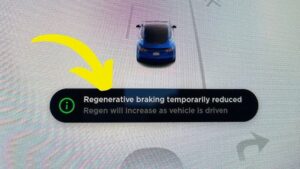

The notification “Regenerative Braking Temporarily Reduced” can feel alarming—especially if you’re new to Tesla ownership and have gotten used to smooth one‑pedal driving. The good news is that, in most cases, this message is informational rather than a sign of a serious fault. In plain terms, it means your car is temporarily limiting how much regenerative braking (“Regen”) it can provide, so deceleration from lifting off the accelerator won’t be as strong or as consistent as you expect.
Below, we’ll walk through how to get out of this “Tesla regenerative braking not working” (or “regen limited”) situation using practical, real-world steps. We’ll also cover a set of prevention tips so you’re less likely to encounter it again—particularly in colder weather, after a full charge, or after changes that require the vehicle to recalibrate.
Quick safety note from an EV driving perspective: When Regen is limited, the car may “coast” more than usual. That’s normal. What matters is that you adjust your driving style for a short period—leave more following distance and be ready to use the brake pedal. Your friction brakes are still there for a reason, and using them is exactly what Tesla expects when Regen is reduced.
How Does the Tesla’s Regenerative Braking Work?
Tesla’s regenerative braking uses the vehicle’s electric drive motor to create resistance that slows the car down. Instead of “wasting” motion as heat (as traditional brakes do), the motor operates like a generator during deceleration. As it reverses its role to slow the vehicle, it captures kinetic energy and converts that energy into electricity that is sent back to the battery pack.
Regenerative braking is typically one of the first differences drivers notice when switching from a gasoline vehicle to an electric vehicle (EV). Many owners simply call it Regen. Conventional braking relies on friction: brake pads clamp onto rotors, producing heat to slow the wheels. Regen, by contrast, uses the motor’s electromagnetic resistance to slow the vehicle—often allowing you to drive using mostly the accelerator pedal, reserving the brake pedal for emergencies, very low-speed stopping, or situations where additional braking is required.
From an engineering perspective, this is more than a “cool feature.” Because Regen reduces reliance on friction brakes during everyday driving, it can reduce wear on brake pads and rotors. It can also improve efficiency: converting some kinetic energy back into usable electricity can add up to roughly 10% additional driving range in many conditions. Over time, by reducing how aggressively the battery is cycled in certain driving patterns and improving overall efficiency, it can also contribute to improved battery longevity—some sources cite up to 50% longer battery life in favorable use patterns.
However, Regen is not unlimited. The battery must be able to accept the returning energy safely. When the battery is too cold, too full, or otherwise unable to take in additional charge at that moment, Tesla will restrict regenerative braking. When that happens, the car will not slow as quickly when you lift off the accelerator, and you may need to use the brake pedal more than you’re accustomed to.
You’ll typically see an on-screen notification stating that regenerative braking is limited (or “temporarily reduced”). That’s the situation you’re in—so next we’ll focus on how to restore normal Regen behavior and how to avoid the most common triggers.
Expert driving insight: Many owners interpret this message as “brakes not working.” That’s not quite accurate. It’s the regenerative portion that’s reduced. Your standard friction brakes are still available and designed to stop the vehicle safely. The main change is in the feel of deceleration when you lift off the accelerator (especially if you drive with strong Regen settings and rely on one‑pedal driving).
Why Tesla limits Regen at all: It’s primarily a battery-protection and traction-safety decision. Charging a cold battery quickly can stress the cells. Charging a nearly full battery can also be unsafe and is physically limited by how the battery manages incoming energy. And on slippery roads, too much Regen can cause wheel slip—so the car may reduce Regen to maintain stability.
How To Fix a Limited Tesla Regenerative Braking System
To fix a limited Tesla regenerative braking system, the most reliable approach is to drive normally and allow the battery pack to warm up. Above 68 degrees F is considered an ideal battery temperature for full Regen performance. You can also enable a newer Tesla feature that automatically applies regular braking whenever Regen is limited—so the car maintains more consistent deceleration even when the battery can’t accept much regenerative energy.
Let’s break down the fixes in a practical, step-by-step way—along with what’s actually happening in the vehicle when you apply each fix.
Possible Fix #1: Drive the Car for the Battery to Warm Up
A drop in temperature is one of the most common reasons your Tesla will reduce regenerative braking. Your vehicle may limit Regen when the battery is below 68 degrees F. When that happens, you may see an on-screen message explaining that regen is limited, and you may also notice the car coasts more than usual.
Depending on how cold the battery is, Regen may be slightly reduced or significantly limited. This is most noticeable in winter, after the car has been parked outside overnight, or when the vehicle has “cold soaked” (meaning the battery temperature has had enough time to match the cold ambient air). Cold batteries have higher internal resistance, and they cannot safely accept high charging power—whether that power comes from a Supercharger or from regenerative braking.
If the temperature drops to around 32 degrees F, charging capability can become heavily restricted, and the battery may stop accepting charge in certain conditions until it warms up. In those moments, Regen can also be greatly reduced because the car has nowhere safe to “store” that returned energy. This is why the message often shows up right after you start driving on a cold morning—exactly when you expect strong one‑pedal deceleration, but the car is still protecting the pack.
The good news is that Regen typically returns on its own once the battery warms up. In many cases, you only need to drive for a few minutes for the pack temperature to rise and for the battery to accept energy more normally. As soon as temperatures rise above 68F, charging behavior tends to normalize, and regenerative braking usually resumes full effectiveness.
What “drive normally” means in practice: You don’t need to drive aggressively. Just drive smoothly, as you normally would, and allow the car to manage battery heating. If you’re in traffic, that may take longer. If you’re cruising at moderate speed, the pack may warm more quickly. Either way, give the system a little time.
Best practices while Regen is reduced:
1) Increase following distance. Your car may not slow as quickly when you lift off the accelerator.
2) Use the brake pedal normally. That’s what it’s there for, and the vehicle is engineered to do it safely.
3) Avoid last-second braking habits that depend on strong Regen. In winter, build in extra margin until full Regen returns.
Expert note on driver feel: Many Tesla drivers calibrate their driving around Regen. When it’s reduced, the sensation can feel like the car is “slipping” forward. It’s usually not a mechanical failure—it’s a deceleration change. Once you anticipate it, the experience becomes predictable and manageable.
Possible Fix #2: Activate Automatic Regular Brake Application
Tesla’s software update (2022.16.0.2) introduced a major improvement for drivers who want consistent deceleration even when Regen is limited. The update adds an option that allows the vehicle to automatically apply regular (friction) braking to compensate for reduced regenerative braking.
According to Tesla, the car can now apply regular brakes automatically so the vehicle continues to slow down in a more predictable way when Regen is restricted—whether due to cold battery temperature or a high state of charge. This is especially helpful for owners who strongly prefer one‑pedal driving behavior and don’t want sudden changes in deceleration feel on cold mornings or right after charging.
Here’s how to enable the feature:
First, tap “Controls” on the display. Next, select the “Pedals & Steering” option. Finally, choose “Apply Brakes When Regenerative Braking is Limited.” Once enabled, the car will blend in regular braking whenever Regen is limited, so you don’t have to wait for the drivetrain to warm up for the vehicle to decelerate more consistently.
What this feature does (and does not do): It does not “fix” the battery’s inability to accept charge in that moment—Regen is still limited. Instead, it smooths the driver experience by adding friction braking to maintain a similar slowdown rate. This may slightly reduce efficiency compared to full Regen (because friction braking turns energy into heat rather than electricity), but it improves predictability and can reduce driver stress.
Expert recommendation: If you drive in a colder climate, if multiple drivers share the car, or if you frequently start trips right after a full charge, enabling this feature is a practical quality-of-life improvement. It’s also helpful if you commute in stop-and-go traffic where consistent deceleration matters.
Important driving reminder: Even with this feature on, always stay attentive. Conditions like ice, wet roads, or gravel can still reduce traction and change stopping distances—no software setting replaces safe driving habits.
How To Prevent a “Regenerative Braking Not Working” Issue?
To prevent a “regenerative braking not working” issue, focus on a few high-impact habits. First, park your EV in a warm or climate-controlled place whenever possible—especially during cold seasons. Second, avoid keeping your battery at a 100% charge unless you truly need it for a longer trip. And third, perform regular tire inspections so you aren’t driving on worn-out tires that compromise braking traction and stability.
Let’s explain each prevention strategy in detail, with the “why” behind it—because understanding the reason makes it much easier to apply consistently.
Tip #1: Park Your Car in a Warm Place
As mentioned earlier, extreme cold is one of the most common triggers for reduced regenerative braking. Whenever you can, park your Tesla in a warmer location—such as a garage, underground parking, or a climate-controlled space. This is especially important if you live in a region with cold mornings or winter temperatures, because your battery temperature is strongly influenced by where the car sits for long periods.
Keeping the vehicle warmer helps maintain the battery temperature within a range where it can accept regenerative energy more efficiently. That means less “regen limited” time at the start of your drive, a more consistent one‑pedal feel, and generally better efficiency in the first minutes of the trip.
Expert habit that helps even more: If your Tesla is plugged in at home, preconditioning (warming the cabin and, indirectly, helping the battery system) before you leave can reduce the chance of reduced Regen on departure. Even without explicitly discussing every Tesla feature, the principle remains: a warmer pack accepts energy more easily, so Regen is more available.
Practical winter reality: You may not always be able to park indoors. If you park outdoors, simply expect Regen to be limited briefly when it’s cold—then drive with extra margin until it returns. Think of it as “winter behavior,” similar to how gasoline cars behave differently when cold (thicker fluids, different idle characteristics), except here the difference shows up in deceleration feel.
Tip #2: Inspect Your Tires Regularly
Tires are the foundation of braking performance—regenerative or friction. Worn-out tires compromise grip, increase stopping distance, and can reduce stability during deceleration. Even though Regen is “motor braking,” it still depends on tire traction at the road surface. If the tires can’t grip well, the vehicle may reduce regen output to avoid wheel slip, especially on wet, dusty, or cold roads.
For best results, keep your tires in excellent condition and at the correct pressure, and inspect tread depth regularly. If you drive in winter conditions, consider seasonal tires appropriate for your region; cold weather changes rubber performance, and the wrong tire compound can reduce traction long before the tread is worn out.
Note: After a tire change, regenerative braking may temporarily reduce. Tesla Regen often needs time to recalibrate after tire replacement or major tire changes. The good news is that this usually resolves automatically after driving for about an hour.
Why recalibration may be needed: Tire changes can subtly affect wheel speed readings, traction control behavior, and how the car estimates grip. The system uses sensor feedback to decide how much Regen is safe. After changes, it may behave conservatively until it “relearns” normal signals.
Expert tip: If you just changed tires and notice reduced Regen, don’t panic. Drive normally for a while. If the limitation persists after reasonable driving time and normal temperatures, then it’s worth checking for warnings, tire pressure issues, or contacting support.
Tip #3: Keep Your Battery 80% to 95% Charge
Charging an EV can take time, so many owners plug in overnight and let the battery reach 100%. That’s convenient—and for long trips, it can be the right decision. But a battery that is full (or near full) has less room to accept additional energy. Since regenerative braking “charges” the battery during deceleration, a 100% state of charge can limit Regen because the battery simply can’t take in much more electricity at that moment.
That’s why a full battery can reduce the effectiveness of regenerative braking, sometimes enough to trigger the “temporarily reduced” message. To reduce how often this happens, avoid charging to 100% for everyday driving if you don’t need the extra range. Keeping the battery within about 80% to 95% is a practical habit for many drivers and helps preserve Regen performance.
So, let your battery not charge fully. That will avoid compromising the effectiveness of this braking feature.
Expert perspective on daily charging: Think of Regen as needing “space” in the battery. If your driving includes hills, frequent stops, or heavy traffic, leaving that extra capacity can make your car feel more consistent and can improve efficiency because you’re capturing more energy instead of wasting it in friction brakes.
Practical compromise: If you must charge to 100% (for a long drive), consider timing it so you begin driving soon after reaching full charge. As you use a few percent, Regen typically becomes available again because the battery regains room to accept energy. This doesn’t eliminate cold-weather limitations, but it can reduce full-charge limitations.
Deep-Dive (Expert Context): Why Tesla Regen Gets Limited in the First Place
If you want the short answer, Tesla limits Regen when the battery can’t accept charge safely or when stability would be compromised. But understanding the “why” helps you make better decisions in daily driving—especially in climates with temperature swings or if you frequently charge close to full.
1) Battery temperature and charge acceptance
Battery cells behave differently at different temperatures. When a lithium-based battery is cold, internal resistance rises. That resistance makes it harder (and potentially harmful) to push charging current into the pack quickly. Regen is, essentially, rapid charging bursts during deceleration. If the pack is cold, Tesla reduces that charging burst—so Regen is reduced.
2) State of charge (SOC) and “nowhere to put the energy”
When your battery is at 100% SOC, it’s at or near its upper voltage limit. Even if the car wanted to recapture energy, the battery management system may restrict charging to protect the cells and maintain safety margins. The result: reduced Regen until SOC drops.
3) Traction and stability on slippery surfaces
Regen applies braking force through the drive wheels. If the road is slippery, too much motor braking can cause wheel slip. To keep the car stable and predictable, Tesla may reduce Regen. In those scenarios, friction brakes and stability systems help manage stopping safely.
4) System calibration events (like tire changes)
As mentioned earlier, after a tire change, the car may need to recalibrate. During recalibration, the system may behave conservatively and limit Regen until sensor feedback confirms normal conditions.
Bottom line: Regen limitations are usually the car behaving responsibly—prioritizing battery health and vehicle stability over a consistent one‑pedal feel. That’s why many cases resolve on their own with time, driving, and a small amount of battery warm-up or SOC reduction.
Troubleshooting Checklist: What to Do When You See the Warning
If you want a quick, expert-style checklist (similar to what an EV technician or experienced owner would run through), use this sequence:
Step 1: Stay calm and adjust driving. Expect less deceleration when you lift off the accelerator. Use the brake pedal normally and keep more distance.
Step 2: Consider temperature. Did the car sit in cold weather? If yes, drive normally for several minutes to warm the battery.
Step 3: Consider state of charge. Did you just charge to 100%? If yes, Regen may remain limited until SOC drops a few percent.
Step 4: Enable the auto braking feature. If your Tesla has the feature, turn on “Apply Brakes When Regenerative Braking is Limited” to maintain consistent deceleration feel.
Step 5: Watch for persistent or unusual symptoms. If the warning persists in warm conditions at moderate SOC, or if you see additional alerts, contact Tesla service or visit a Tesla dealer.
When it’s worth escalating: This guide focuses on the common “temporary” scenarios. If Regen remains limited for extended periods under normal conditions, or if you notice other braking warnings, unusual noises, or abnormal pedal feel, treat it as a separate issue and get professional assistance.
Conclusion
There are two main reasons why Tesla’s regenerative braking would stop working (or become noticeably limited): the battery’s temperature is too low, or the battery’s charge is at 100%. The solutions are usually straightforward and do not require repairs. Once the battery warms up—or once the state of charge drops enough to allow energy recovery—Regen typically returns to normal. Our guide has provided practical fixes and prevention tips. Here’s a recap:
- Your regenerative braking will limit if your car’s battery drops below 68-degree Fahrenheit
- To fix the limitation issue, drive your EV to allow the battery to warm up
- You can also activate the auto braking system. It will apply regular brakes whenever the Regen is limited
Parking your car in a warm or climate-controlled place is one of the simplest ways to reduce regen limitations, especially during cold seasons. Also, avoid charging to 100% unless you need maximum range, because a full battery can reduce Regen until the charge level drops slightly.
At this point, you’ve got all the key information you need: understand what the message means, apply the correct fix, and use prevention habits to reduce how often it happens. Restore your Regen and get your one‑pedal feel back. If the problem persists despite normal temperatures and a non-full battery—or if you see additional warnings—take your car to a Tesla dealer for further diagnosis.