
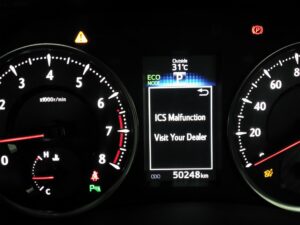

Is your Toyota suddenly flashing “ICS Malfunction” on the dashboard? You’re not alone; and you’re not imagining the seriousness of it. Toyota’s Intelligent Clearance Sonar (ICS) is designed to reduce low-speed collisions and parking-lot mishaps, but when it goes offline (or worse, behaves erratically), it can leave you wondering whether the vehicle is still trustworthy in tight spaces.
The good news is that most ICS malfunctions fall into a few predictable categories: sensor obstruction (dirt, salt, ice, water film), software logic issues (including known carwash-related false activations), electrical faults (low battery voltage, corroded harnesses, blown fuses), or sensor alignment/communication problems after repairs. In many cases, the fix is straightforward once you understand how ICS works and what it needs to operate correctly.
Table of Contents
This expert guide explains what Toyota’s ICS system does, why the “ICS Malfunction” warning appears, how to diagnose it step-by-step, and what the realistic repair options and costs look like. We’ll also cover the important safety angle: how to drive when ICS is disabled, what to do if you experience false braking, and how to prevent the warning from coming back.
What Is Toyota’s ICS System?
Toyota’s Intelligent Clearance Sonar system is a safety feature designed to help prevent low-speed collisions. Using ultrasonic sensors mounted in your front and rear bumpers, it detects nearby obstacles when you’re moving at very low speeds; typically under about 10 mph. It’s the kind of system that’s most active when you’re pulling into a garage, creeping through a parking lot, or reversing in close quarters.
The system works by:
- Providing audible alerts when obstacles are detected
- Displaying visual warnings on your dashboard
- Automatically applying brakes to prevent collisions
From an engineering standpoint, the “sonar” part matters. Ultrasonic sensors emit high-frequency sound waves and measure the echo return time. If the return indicates an object is too close, the system escalates warnings and may apply brakes. This is why anything that changes the sensor’s ability to send or receive echoes; water film, ice, thick dirt, paint buildup; can cause false readings or force the system into a fault state.
First introduced in 2014, ICS has become common across many Toyota models including the Camry, Prius, and Highlander. It’s part of Toyota’s broader Safety Sense package and can interact with other vehicle systems (including braking control and related driver-assistance logic). While the driver-assist ecosystem can include multiple technologies, ICS is best thought of as the “close-range, low-speed safety brake” tool; more like an intelligent version of traditional parking sonar, with braking authority.
Key distinction: ICS is not the same as “parking sensors only.” Basic parking sonar just beeps. ICS can intervene by applying brakes when it believes a collision is likely. That’s why malfunction symptoms can include sudden braking in situations like automatic car washes or tight drive-through lanes.
What ICS is designed to prevent:
- Accidentally creeping into a wall, post, or another vehicle
- Rolling forward when you meant to brake (or pressing the wrong pedal)
- Low-speed parking-lot impacts where reaction time is short
What ICS is not designed for:
- High-speed collision prevention
- Autonomous parking or fully automated driving
- Guaranteeing collision avoidance in all weather and all surfaces
This matters because many owners misinterpret an ICS malfunction as a sign that “the car is unsafe.” In most cases, the vehicle remains mechanically safe to drive; you’ve simply lost (or the car has disabled) a low-speed driver-assist layer.
Common Signs of ICS Malfunction
ICS malfunctions can present as a clear dashboard message, but they can also show up as strange braking behavior or “stacked” warning lights that look unrelated. In practice, it helps to think of symptoms in three buckets: (1) warning messages, (2) braking behavior changes, and (3) electrical/communication side effects.
Warning Messages and Alerts
The most obvious sign is the “ICS Malfunction” message on your dashboard. This warning can also appear alongside:
- Check engine light illumination
- Parking assist system failure notifications
- Beeping or chiming sounds from the dashboard
Real-world pattern: many owners see the warning shortly after a car wash, after driving in heavy rain, or during winter road-salt season; times when bumper sensors are most likely to be coated.
“My 2018 Camry started flashing the ICS Malfunction warning right after I went through a carwash,” reports one Toyota owner. “The parking sensors stopped working completely.”
Expert interpretation: A carwash scenario is often an important clue. It points either to temporary sensor blockage (water film, foam, wax residue) or to the known false-activation software behavior Toyota acknowledged in service documentation for certain model years.
Strange Braking Behavior
One reason ICS malfunctions feel so alarming is that the system can influence braking. Many drivers report unexpected behaviors like:
- Your car suddenly braking in carwashes
- Automatic braking engaging when no obstacles are present
- System falsely detecting obstacles that aren’t there
Why false braking can happen: Ultrasonic sensors don’t “see” like a camera. They interpret distance by sound reflection. Water jets, moving brushes, thick foam, uneven surfaces, and close conveyor rails can produce reflections that mimic obstacles. When the software is too aggressive (or the sensors are partially blocked), the system may misclassify the environment and apply brakes to prevent what it believes is an imminent collision.
Safety note: If your vehicle is engaging unexpected braking outside predictable conditions (like a carwash), treat it as a high priority issue. Erratic braking; especially in traffic; should be addressed promptly, and you should avoid relying on any driver-assist features until resolved.
Related Electrical Problems
ICS malfunctions rarely occur in isolation, particularly when the underlying cause is electrical or communication related. You might also notice:
- Engine misfires (particularly cylinder 3 in Camry models)
- Oxygen sensor errors (like code P0037)
- Other dashboard warning lights appearing simultaneously
Expert context: When multiple warnings appear at once, do not assume multiple systems “broke” at the same time. Low voltage, a compromised ground, or CAN-bus communication issues can cause several modules to behave abnormally. That’s why battery health and connector integrity are part of the ICS diagnostic process even though the system is “parking sonar.”
What Causes Toyota ICS Malfunctions?
From a technician’s perspective, ICS faults generally come from four categories: software logic, sensor hardware, electrical power/communication, and calibration/alignment. The same dashboard message can be triggered by very different root causes, which is why diagnosis matters.
Software Issues
Software problems are behind approximately 80% of ICS malfunctions, particularly those tied to false activations. Toyota acknowledged key behavior patterns through Technical Service Bulletin (TSB) J0R, which addresses false activations; especially in carwash scenarios.
Key software-related problems can include:
- Improper ECU programming in 2017-2019 models
- Software conflicts between vehicle systems
- Failure to properly update firmware during service
Expert note: When a TSB exists, the smartest approach is to confirm whether your VIN and software version fall under the bulletin’s scope. Many owners spend money replacing sensors only to discover later that the fix was a software reflash and calibration check.
Why software matters so much: The sensors only provide raw distance signals. The ECU decides what those signals mean; obstacle vs. water spray vs. brush movement; and whether to warn or brake. A small software tweak can drastically reduce false activations without changing the sensor hardware at all.
Sensor Failures
The ultrasonic sensors themselves can fail, and when they do, the system may either disable itself or behave unpredictably. Common sensor failure causes include:
- Corrosion damage from water exposure
- Physical damage to bumper-mounted sensors
- Calibration drift causing inaccurate readings
“After replacing my rear bumper sensor, the system still wouldn’t work properly,” shares a RAV4 Prime owner. “The dealer explained they needed to recalibrate the sensor angles to very specific measurements.”
Expert explanation: Ultrasonic sensors are directional. If they’re mounted slightly crooked after a bumper repair; or if a bracket is bent; the detection cone changes. The system may then interpret normal nearby surfaces as obstacles, or fail to detect real obstacles reliably. That’s why sensor replacement often must be paired with correct positioning and verification.
Additional sensor-related triggers worth knowing:
- Aftermarket bumper paint that is too thick over sensor faces
- Non-OEM sensor replacements that don’t match factory specifications
- Water intrusion into connectors behind the bumper after winter salt exposure
- Impact damage that is “invisible” externally but cracks the sensor housing
Electrical Problems
Electrical issues account for about 30% of ICS malfunctions (and this category overlaps with others). Common electrical triggers include:
- Low battery voltage (below 12V)
- Corroded wiring harnesses in bumper assemblies
- Blown fuses (particularly the 10A ICS fuse)
Expert detail: Low voltage can cause module “brownouts” where control units reset or misreport sensor status. This can create the illusion of a sensor failure when the real culprit is an aging 12V battery or poor terminal connection. That’s why battery testing is a required step when diagnosing recurring ICS issues.
Corrosion is also a major factor because bumper harnesses live in harsh environments: water spray, road salt, and temperature cycling. Connector pins may look “fine” externally but still develop resistance that causes intermittent faults under load.
How to Diagnose ICS Problems
The most efficient diagnostic process is to start with what costs nothing (cleaning and visual inspection), then progress to power checks (battery/fuse), and only then move to scan-tool diagnostics and calibration. This approach mirrors how experienced technicians avoid unnecessary part replacement.
Simple Checks You Can Do
Before heading to the dealer, try these preliminary steps:
- Visual inspection: Check your sensors for dirt, debris, or damage. The Toyota emblem often houses the front radar sensor, so ensure it’s clean.
- Battery check: A weak battery can cause sensor communication issues. Make sure your battery is holding at least 12V.
- Clear codes and restart: Sometimes turning your car off for 10 minutes and restarting can temporarily clear minor glitches.
Expert clarification: Step 3 (“clear codes”) assumes you have a scan tool capable of reading body/parking assist codes, not just engine codes. If you don’t have one, you can still restart the vehicle and see whether the warning clears after a short drive. However, if the warning returns immediately, that’s a strong clue that a fault is still active.
Carwash-specific diagnostic hint: If the warning appears only during or immediately after a carwash and clears after drying/driving, the root cause is more likely environmental (water film/foam) or software logic (TSB J0R) rather than permanent sensor failure.
Battery testing best practice: A resting voltage reading is useful, but it’s not the whole story. A battery can show 12.4V at rest and still collapse under load. If your Toyota is more than 3–5 years old and you see multiple warnings across systems, consider a proper load test.
Professional Diagnosis
For accurate diagnosis, a technician will typically combine scan-tool evidence with physical inspection and system tests. This is where you move from “likely causes” to verified root cause.
For accurate diagnosis, your mechanic will likely:
- Use an OBD-II scanner to retrieve error codes like P107A2A (ICS ECU failure) or C1A40 (sensor circuit faults)
- Perform a Techstream analysis to monitor data from the Advanced Parking Guidance module
- Test individual sensors for proper function and communication
Expert note on scan tools: Many cheap “OBD2 scanners” only read engine and transmission emissions-related codes. ICS faults often live in body/parking modules and require Techstream or a scan tool with Toyota enhanced coverage. If your shop says “no codes,” confirm whether they scanned the relevant module, not just the engine ECU.
Additional professional checks often performed:
- Voltage drop testing on the bumper harness and ground points
- Connector inspection for water intrusion and corrosion
- Verification of sensor mounting angle and bumper bracket integrity
- Software version check against applicable TSBs
How to Fix Toyota ICS Malfunction
The correct fix depends on what your diagnostics reveal. In general, if the issue is software-related or calibration-related, dealer service is often the fastest and most reliable path. If the issue is environmental (dirty sensors), DIY cleaning may resolve it completely. If the issue is electrical or hardware failure, repairs range from simple fuse replacement to sensor replacement with calibration.
Dealer Solutions
For many ICS issues; especially those tied to software bulletins; dealership repair is often the most reliable option because dealers have the correct tools (Techstream), the current calibration files, and access to Toyota’s service procedures.
For most ICS issues, dealership repair is the most reliable option:
- ECU Reprogramming: This addresses most carwash-related false activations per Toyota’s TSB J0R and costs around $150-200 for programming time.
- Sensor Replacement: Genuine Toyota sensors (part number 86960-06120 for Camry models) cost approximately $200 each, plus 1.5-2 hours of labor for installation and calibration.
- Wiring Repairs: Fixing corroded connectors in bumper wiring assemblies can resolve electrical faults and typically costs $100-300 depending on damage extent.
Expert tip: If you’ve had bumper work or a sensor replacement, ask whether calibration/verification was performed. Many “still broken after replacement” stories are actually incomplete calibration or incorrect sensor mounting rather than a second failed part.
Expert tip: If a dealer suggests replacing multiple sensors at once, ask to see the code map showing which sensor circuits are failing. It’s not that multiple sensors can’t fail, but it’s far more common for one harness/connector issue to trigger multiple sensor codes. A good diagnostic process will confirm whether the faults follow a single wiring path.
DIY Approaches
While professional repair is recommended for software updates and calibration, some owners can address minor issues successfully; especially those tied to dirt, basic electrical supply, or obvious fuse failure.
While professional repair is recommended, some owners have successfully addressed minor issues:
- Clean sensors: Use a soft cloth and mild soap to clean ultrasonic sensors and the area around them.
- Check fuses: Locate and check the ICS fuse in your fuse box (typically a 10A fuse).
- Battery maintenance: Ensure your battery terminals are clean and connections are tight.
DIY cleaning best practices (avoid making it worse):
- Don’t use abrasive pads on sensor faces; scratches can distort ultrasonic behavior.
- Avoid harsh solvents that can haze plastic or degrade sensor seals.
- Rinse salt and grit before wiping to reduce the chance of scratching.
- If you use wax or ceramic coatings, do not apply thick layers directly over sensor faces.
DIY fuse inspection tip: A blown fuse is often a symptom, not a random event. If you replace a fuse and it blows again, stop and investigate wiring or water intrusion. Repeated fuse replacement can lead to more damage if the underlying short isn’t corrected.
Is This Covered Under Warranty?
Toyota has issued multiple service bulletins related to ICS malfunctions, most notably TSB J0R which covered over 234,000 vehicles and addressed ECU programming issues causing false activations in carwashes.
Warranty coverage depends on:
- Your model year (2017-2019 models are most commonly covered)
- Vehicle age and mileage
- The specific nature of the malfunction
If your vehicle is affected by TSB J0R, the ECU reprogramming should be covered at no cost to you. For other issues, coverage depends on whether your vehicle is still under Toyota’s basic warranty (typically 3 years/36,000 miles) or powertrain warranty (5 years/60,000 miles).
Expert advice: Always bring documentation: photos of the warning, a description of the conditions (carwash, rain, cold start), and any codes a shop pulled. Clear symptom descriptions help dealers apply the correct TSB faster.
Models Most Affected by ICS Malfunctions
While ICS exists across multiple models, owner reports and service trends show some platforms experience specific failure patterns more frequently. The table below highlights common clusters; remember that “more affected” doesn’t mean “guaranteed failure.” It simply reflects reported trends and service patterns.
| Model | Years | Common Issues |
|---|---|---|
| Camry | 2018-2024 | False activations, sensor failures |
| RAV4 Prime | 2021-2023 | ECU communication errors |
| Prius | 2016-2020 | Carwash activation problems |
| Highlander | 2017-2021 | Sensor calibration drift |
| Corolla | 2019-2023 | Wiring harness corrosion |
Expert note: Corrosion and harness issues tend to be climate-dependent. Road salt regions see higher rates of connector corrosion. Hot/humid regions can see higher rates of moisture-related connector and sensor sealing issues.
Preventing Future ICS Malfunctions
ICS is a sensor-dependent system, and sensor-dependent systems perform best when you reduce contamination and keep vehicle electrical fundamentals healthy. Prevention is mostly about simple routines rather than complex maintenance.
Regular Maintenance
Keep your ICS system in top shape with these preventative measures:
- Clean sensors regularly: Every 3-6 months, clean the ultrasonic sensors with a soft cloth to remove dirt and debris.
- Inspect wiring: During oil changes, have your mechanic check the integrity of sensor wiring, especially if you live in areas with road salt or high humidity.
- Maintain battery health: A weak battery can cause numerous electrical issues, including ICS malfunctions.
Expert additions for harsh climates:
- If you live in road-salt regions, rinse bumper areas more often in winter to reduce salt crust accumulation over sensors.
- Avoid directing high-pressure washer jets directly at sensor faces and seals at close range.
- After heavy rain or a carwash, allow time for sensor areas to dry before relying on low-speed automated braking.
Stay Updated on Recalls
Toyota regularly issues updates and service guidance to address known issues:
- Check for recalls and service bulletins at Toyota’s owner support website
- Schedule dealer updates at least annually for models with VINs dating after 2019
- Keep documentation of all system updates performed on your vehicle
Expert tip: If your ICS malfunction is carwash-related and your model falls within the affected years, ask specifically about TSB J0R applicability and software updates. Service advisors handle many complaints daily; bringing clear, specific information helps.
The Impact on Safety
While an ICS malfunction is often “just” an annoyance, it can also affect your vehicle’s low-speed safety behavior. ICS is designed to prevent collisions in parking lots and garages; places where visibility is limited and accidents are frequent.
When functioning properly, Toyota’s data indicates the ICS system can reduce parking lot accidents by up to 70%. However, a malfunctioning system might:
- Fail to detect actual obstacles
- Create distractions with false warnings
- Cause unexpected braking in inappropriate situations
Remember: ICS is an aid, not a substitute for careful driving. Use mirrors, cameras, and deliberate brake control. If you know your system is malfunctioning, drive with more margin in tight spaces.
Expert driving guidance when ICS is malfunctioning:
- Increase caution in carwashes, drive-throughs, and tight garages.
- Be prepared for warnings or braking that may not match reality.
- If false braking is occurring, consider disabling ICS temporarily until serviced (instructions below).
What Toyota Is Doing About ICS Problems
Toyota has taken several steps to address recurring ICS issues:
- Technical Service Bulletins: TSB J0R and others provide free repairs for specific known issues.
- Software Updates: Toyota continues to release firmware updates to improve system performance.
- Dealership Training: Specialized technician training for diagnosing and repairing ICS-related problems.
However, some owners report frustration with Toyota’s approach, citing inconsistent repair outcomes and difficulty getting dealers to acknowledge the problem quickly. Online forums show many owners needed multiple visits to fully resolve ICS issues; often because the initial visit focused on sensors instead of software, or because the issue was intermittent and hard to reproduce.
Expert recommendation: If your malfunction is intermittent, document it. Take photos/videos of warnings, note weather conditions, and describe whether it occurred in a carwash. Intermittent faults are much easier to diagnose when you provide repeatable context.
The Future of Toyota’s ICS Technology
Toyota continues to evolve its safety systems, and future improvements may include:
- More robust sensor designs resistant to environmental damage
- Over-the-air update capabilities to reduce dealership dependency
- Improved self-diagnostic capabilities to better identify system issues
For current Toyota owners, staying informed about updates and maintaining your vehicle properly are your best defenses against ICS malfunctions.
Remember that despite these issues, Toyota’s ICS system has prevented countless accidents and continues to be refined with each model year.
Deep Dive: ICS vs Parking Sonar vs PKSB (Why the Symptoms Can Feel Similar)
Many Toyota owners use the term “parking sensors” to describe several different systems that may exist on the same vehicle. This matters because you may see multiple warnings for systems that share sensor inputs or share control authority (brakes).
Here’s how to mentally separate them:
- Parking sonar (basic): usually beeps and shows distance bars; may not brake automatically.
- ICS (Intelligent Clearance Sonar): adds logic for low-speed collision prevention and can apply brakes.
- PKSB (Parking Support Brake): a related Toyota feature (depending on model/market) that can apply brakes based on sonar detection and other conditions.
If you’re seeing “ICS Malfunction,” it often implies the brake-support layer for close-range sonar is compromised. That’s why owners sometimes notice unusual braking behavior or sudden disablement of multiple parking and low-speed assist features at once.
Expert takeaway: If the vehicle is disabling braking support features, it’s doing so because it cannot guarantee reliable obstacle detection. That is safer than braking unpredictably. But if you’ve experienced false braking, that’s a sign the system is still trying to operate under unreliable conditions; often a software/logic issue or sensor contamination.
How to reset or turn off the ICS system.
To reset the ICS system, you just have to turn it off and turn it on again. This is a practical step if the system is stuck in a temporary state after a carwash, heavy rain, or minor glitch. It does not repair hardware faults, but it can restore normal operation if the fault condition is no longer present.
- On the steering wheel, locate the directional buttons with an okay button in the middle. Press the down button.
- The Dashboard will bring up the Eco setting or the driving support system. No matter what pops up first, keep pressing down until you reach settings.
- Once you are at settings, press the right button until you reach the ICS on/off setting.
- The system is currently on. Highlight the symbol and press the okay button.
- The screen will change, and it will ask if you would like to turn off ICS. Press the up button so the YES is highlighted and press okay. When the ICS system is off, there will be a small orange symbol indicating that it is off.
- Now you can turn off the car. After the engine is finally cool, turn the car back on and then reactivate the ICS system.
Expert tip: If you’re going through an automatic carwash and your vehicle has a history of false braking, many owners choose to turn off ICS beforehand to prevent unwanted brake intervention. Just remember to re-enable it afterward so you don’t permanently lose the safety benefit.
Detailed ICS Troubleshooting Flow (From Easiest to Most Technical)
If you want a clear “do this, then this” process, use the flow below. It’s designed to reduce the chance of replacing expensive parts unnecessarily.
- Confirm the conditions: Did it start after a carwash, heavy rain, snow/ice, or road salt exposure?
- Clean sensor faces: Use mild soap/water and a soft cloth; rinse grit before wiping.
- Dry and warm the vehicle: If moisture/ice is present, let the vehicle dry or warm up; condensation can affect readings.
- Battery health check: Confirm 12V battery voltage and terminal integrity.
- Check the ICS fuse: Replace only with the correct rating if blown; don’t “upsize” fuses.
- Reset ICS: Turn ICS off and on via the cluster menu procedure above.
- Scan for codes: Use Techstream or a tool with Toyota enhanced body/parking module coverage.
- Inspect connectors/harnesses: Especially behind bumpers where corrosion is common.
- Consider TSB J0R applicability: If your model/year fits and symptoms match (carwash false braking), pursue software update.
- Replace/calibrate sensor(s): Only after verification with codes and testing.
This flow aligns with the reality of modern diagnostics: start with environment, then power supply, then software, then hardware. That order solves the largest percentage of cases with the least cost.
When Should You Stop Driving and Get the Car Serviced Immediately?
Most ICS malfunctions do not require towing. However, there are situations where you should not ignore the behavior.
Seek immediate service (and avoid relying on driver-assist) if:
- ICS is applying brakes unexpectedly on normal roads (not in a carwash/parking maneuver)
- Multiple safety systems fail simultaneously and do not recover after power cycling
- The warning is accompanied by severe brake system warnings (not just parking assist)
- You have repeated electrical warnings consistent with undervoltage and the vehicle is struggling to start
Expert framing: A disabled ICS system is usually just the loss of a convenience/safety layer. An ICS system that brakes when it shouldn’t is a behavior issue that can create a hazard. The second scenario deserves faster attention.
FAQs About Toyota ICS Malfunctions
Does an ICS malfunction mean my car is unsafe?
Mechanically, your Toyota is usually safe to drive. An ICS malfunction typically means low-speed collision prevention features are reduced or disabled. You should drive more carefully in parking lots and tight spaces and avoid relying on automatic braking.
Why did the warning appear right after a carwash?
Carwash conditions can coat sensors with water, soap, wax, and moving brush reflections. Certain model years also experienced software logic issues leading to false activations, which Toyota addressed through TSB J0R.
Can low battery voltage really cause an ICS malfunction?
Yes. Many driver-assist systems are voltage-sensitive. When battery voltage drops, modules can miscommunicate, sensors can report inconsistently, and the system may disable itself for safety. Always include the 12V battery in your diagnosis.
Do aftermarket sensors work?
Sometimes, but the risk is compatibility and calibration accuracy. ICS sensors are not “generic beepers.” If an aftermarket sensor has different response characteristics or doesn’t mount precisely, the ECU may reject it or the system may behave unpredictably. OEM is typically safer for critical driver-assist functions.
Conclusion
If there’s an issue with the ICS system, it’s often because the sensors are contaminated or damaged, the wiring harness/connectors are compromised, or the software needs updating. Replacing a sensor can cost anywhere from $150 to $650 depending on model, labor, and calibration needs. Once the issue has been solved, you can reset the ICS system by turning it off and on again using the cluster menu procedure outlined above.
The key is to diagnose intelligently: start with cleaning and environmental conditions, then confirm battery voltage and fuses, then escalate to scan-tool codes and TSB/software updates, and only then replace components. With that approach, most Toyota ICS malfunctions can be resolved without unnecessary expense; and you’ll regain the low-speed safety support ICS is designed to provide.