

Cars sit at the center of modern life. They get us to work, haul groceries, take kids to school, and turn weekend plans into reality. Yet the same machine that gives us freedom can also deliver pure chaos: warning lights at the worst time, strange noises that vanish when a mechanic is near, and those “how did that even happen?” moments that are impossible to explain without laughing.
That’s why car trouble stories are such great comedy fuel. A breakdown might feel miserable in the moment, but once everyone is safe and the dust settles, the memory often turns into a story that gets better every time you tell it. And when Jimmy Fallon—master of everyday humor—asked his fans to share their funniest car mishaps, the responses were exactly what you’d expect from the internet at its best: oddly specific, painfully relatable, and genuinely hilarious.
What makes these stories hit so well is that they’re built from shared experience. Almost everyone has had at least one automotive fail: keys locked inside, running out of fuel, confusing a parking spot, trusting a questionable “quick fix,” or learning a hard lesson about weather and traction. These anecdotes form a kind of unofficial driver’s education—just delivered with punchlines instead of lectures.
As an automotive expert, I’ll add something useful along the way: for each story, I’ll highlight the practical takeaway—because comedy and car knowledge can absolutely share the same lane. So buckle up for 40 of the funniest car trouble moments shared by Jimmy Fallon’s fans. They prove that while cars may test your patience, they also create memories that last for years—and stories you’ll laugh about forever.
40 Funniest Car Trouble Stories Shared by Jimmy Fallon’s Fans
These are presented in the same numbered order as the original thread style. Each entry includes a brief expert lens—what happened, why it’s funny, and what it quietly teaches drivers about real-world car ownership.
1. Hitchhiker
If you have ophidiophobia (a fear of snakes), this is the kind of encounter that would instantly turn your commute into a personal horror film. Snakes and other small animals are surprisingly talented at finding warm, protected spaces—especially around parked vehicles—so the “I have no idea how it got there” factor is, unfortunately, very real.
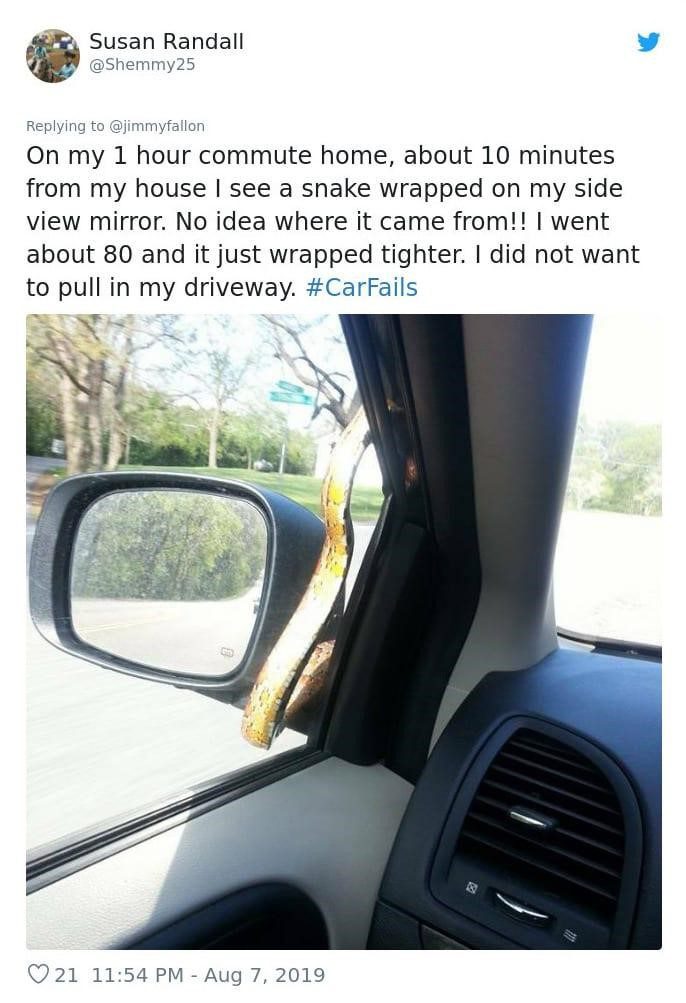
On her drive home, @Shemy25 noticed a snake wrapped around the side mirror. She kept her cool and sped up hoping the airflow would shake the snake loose. Instead, the snake tightened its grip like it had signed a lease. The mystery remains: where did it come from, and how did she finally persuade it to leave?
Expert takeaway: If you ever find wildlife clinging to your vehicle, prioritize safety over speed. Pull over safely if possible and seek help rather than escalating the situation on the road—especially if panic is likely.
2. And The Winner Is…
Driving confidence grows with time. The more hours you log behind the wheel, the more natural basic decisions become—speed control, cornering, spacing, and braking. The problem is that confidence sometimes matures faster than judgment, and that’s where “I can totally pull this off” moments are born.
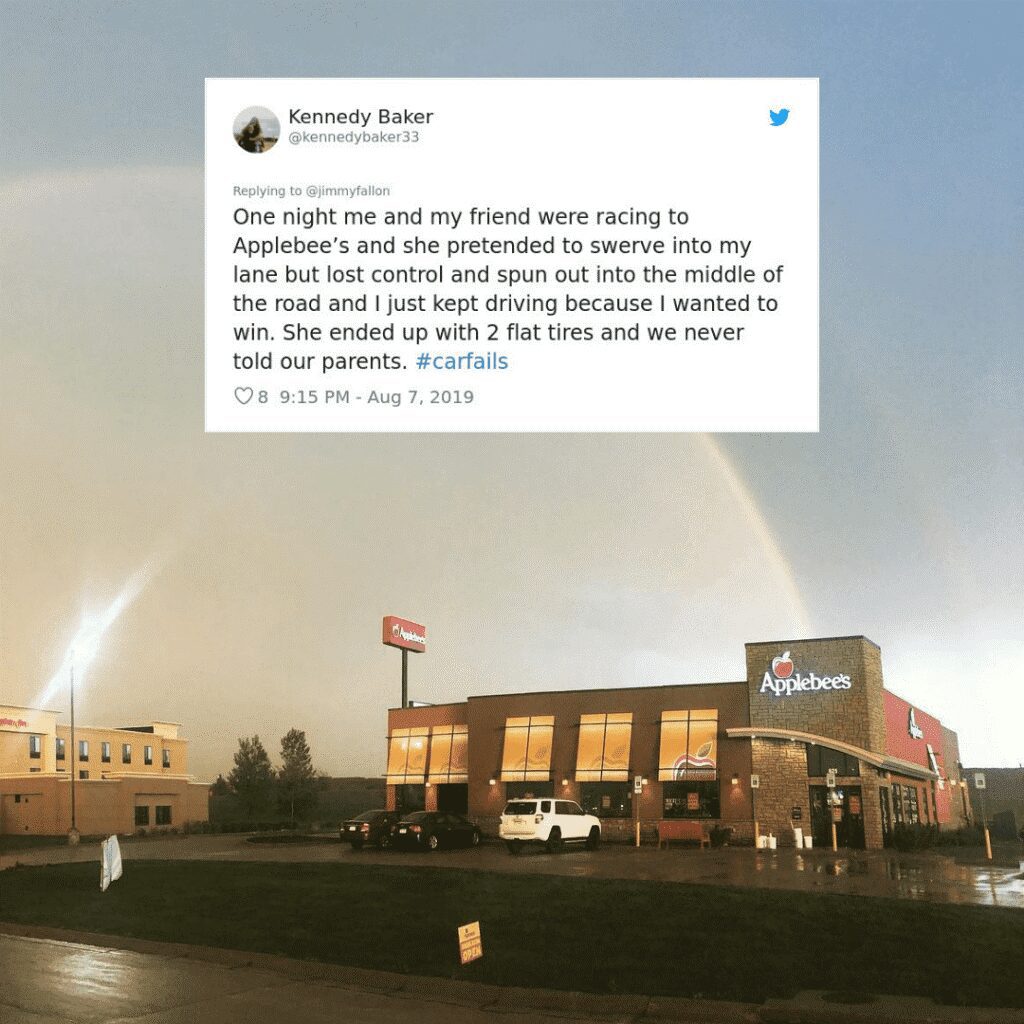
While racing to Applebee’s (a sentence that already has “bad decisions” energy), @kennedybaker33’s friend attempted a stunt that didn’t go as planned. He technically “won,” but the price of victory was two flat tires and the kind of embarrassment that lingers far longer than the meal.
Expert takeaway: Tires are your only contact with the road. If a stunt ends with tire damage, you can assume something else took a hit too—alignment, suspension, wheel integrity, and sometimes the driver’s ego.
3. Drink Responsibly
We all know the label warnings: don’t drive after drinking alcohol, and don’t operate machinery impaired. Most people follow this, but occasionally a misunderstanding makes an innocent moment sound like a crime scene confession—especially when a kid is the storyteller.

@jimmyq921 accidentally made his mom sound like the world’s most casual rule-breaker by claiming she “drank while driving.” Years later he realized he should have clarified that it was just water. Hopefully the only thing harmed was her reputation—temporarily—by her own child.
Expert takeaway: Kids will repeat everything. If you care about your image, narrate your actions like you’re being cross-examined—because sometimes you are, by a child with no filter.
4. Attention Hog
A car horn is easy to ignore—right up until you need it. It’s a safety tool for alerting drivers, warning pedestrians, and signaling in situations where eye contact and hand gestures fail. When the horn doesn’t work, you suddenly realize how much modern traffic depends on that one loud button.
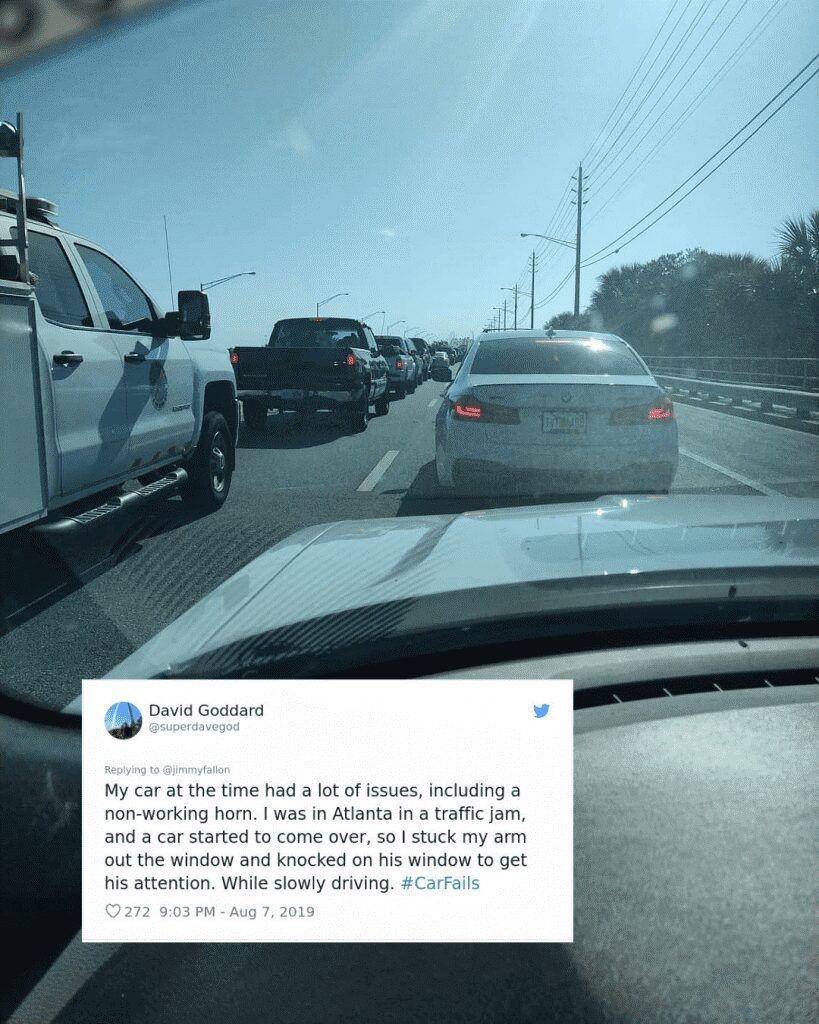
Stuck in Atlanta traffic with a faulty horn, @superdavegod invented a new (and slightly terrifying) communication method: knocking on other vehicles’ windows. Creative? Yes. Recommended? Not unless you enjoy the idea of your arm becoming a traffic accessory.
Expert takeaway: If your horn fails, treat it as a repair priority. It’s not a luxury feature—it’s a safety device, especially in dense urban driving.
5. If You Don’t Have Something Nice To Say…
Friend groups have an unwritten rule: if someone is doing the driving, you keep the commentary supportive—especially if the car is the only reason everyone is getting to dinner. Mocking the vehicle that’s carrying you is a bold move, and it rarely ends well socially.
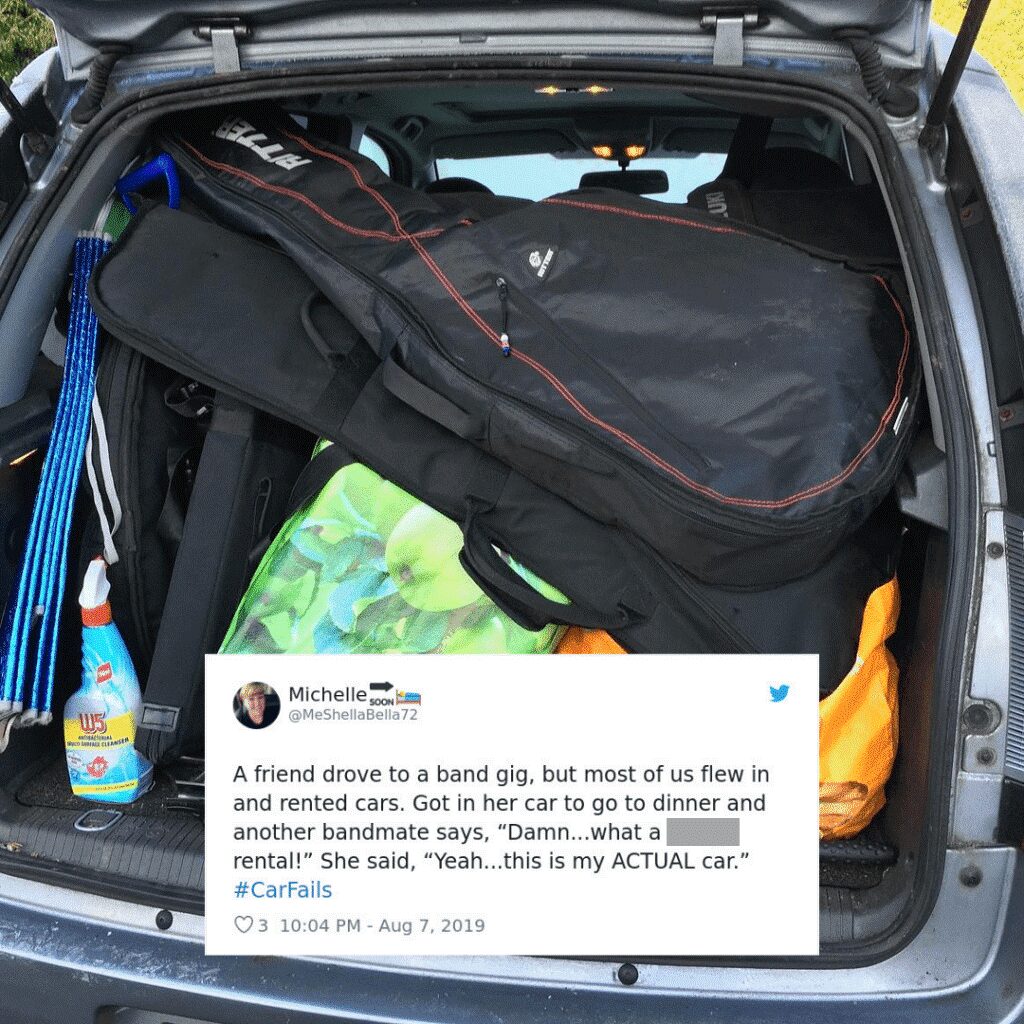
@MeShellaBella72 described a band trip where some members flew in and rented cars, while one friend drove her own car the whole way. On the way to dinner in that very car, one bandmate made the spectacularly poor choice of insulting the ride. Let’s hope he apologized—preferably before being “accidentally” left at the curb.
Expert takeaway: The best car is the one that gets you there. Respect the vehicle—and the person who’s keeping everyone mobile.
6. From Bad To Worse
Cars don’t go to the hospital when they’re sick—they go to a repair shop. Ideally, they leave healthier than they arrived. But every now and then, the “treatment” becomes the disaster, and the repair visit turns into the plot twist nobody asked for.
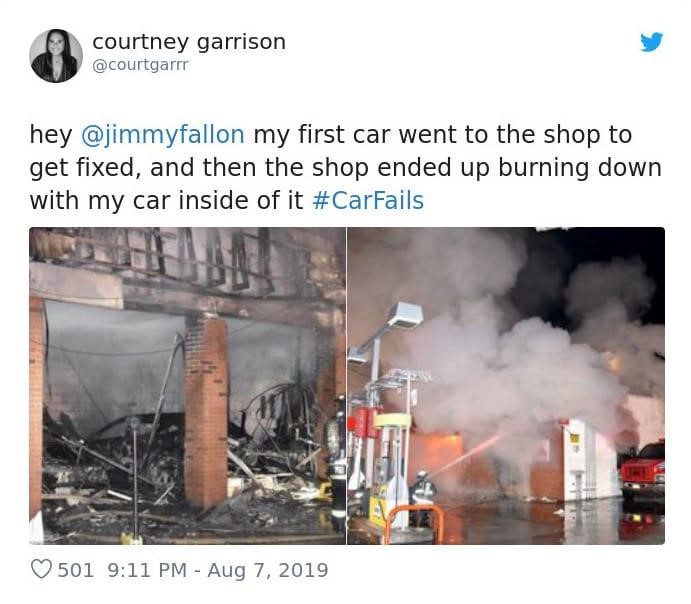
In a genuinely heartbreaking story, @courtgarrr lost her first car in a garage fire. The blaze didn’t just take her vehicle—it also destroyed other cars waiting for repairs. It’s one of those situations where everyone loses: owners, the shop, and the memories tied to that first car.
Expert takeaway: Verify your insurance coverage and understand how claims work when a vehicle is in a shop’s custody. It’s not fun paperwork, but it matters when the unexpected happens.
7. Disaster Averted?
Experienced drivers learn that avoiding one hazard should not create a bigger hazard. Quick swerves can be more dangerous than the original threat, especially in tight spaces where there’s little margin for correction.
@RyanBartholomee shared that while his wife was driving in their alley, she dodged a pothole—success! Unfortunately, the dodge came with an upgrade: contact with a minivan and a city dumpster. The pothole was avoided, but the repair list probably grew by several chapters.
Expert takeaway: In low-speed areas like alleys, it’s often safer to slow down and roll through a pothole carefully than to swerve into something solid and expensive.
8. Lightweight
Workplace pranks are usually confined to desks, chairs, and harmless jokes. But some coworkers treat the parking lot like a comedy stage—and if your car is small enough, you may become the punchline.
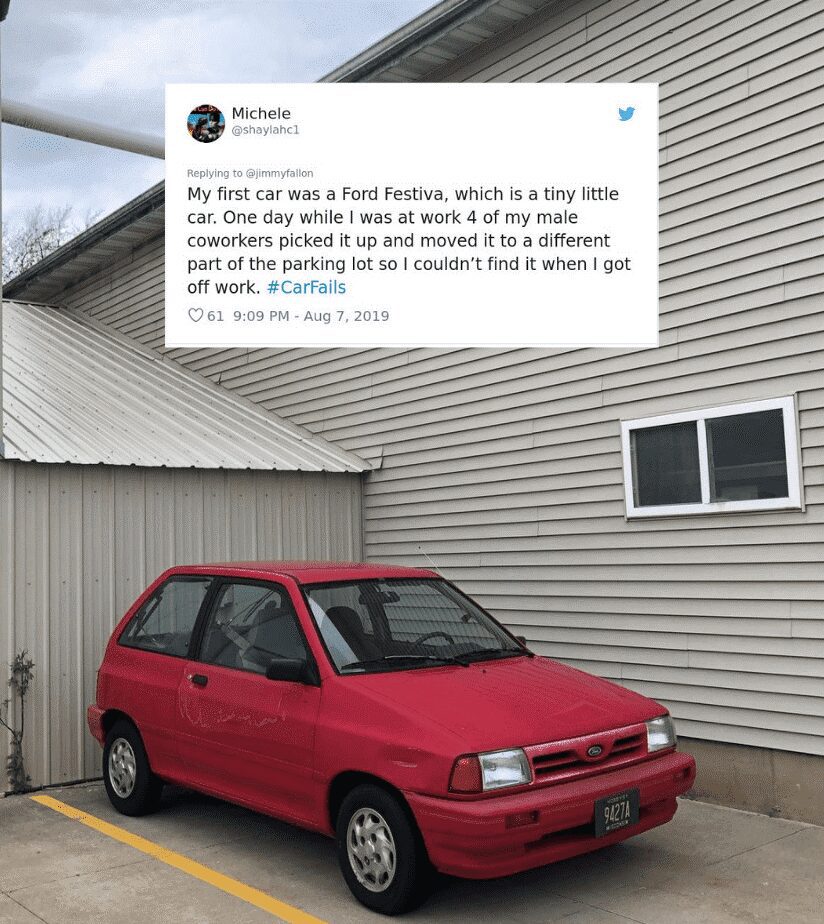
@shaylahc1 described the kind of prank that makes you question reality: four coworkers physically picked up his car and moved it to another part of the lot. That moment when your car isn’t where you left it is pure panic—until you realize your coworkers are apparently forklift-certified with their bare hands.
Expert takeaway: If a car can be carried away, it can also be damaged in the process. Even “funny” pranks can stress suspension components or scratch bodywork—so yes, you’re allowed to be annoyed.
9. “Dream On”
Movies love the idea that sound can shatter glass. In reality, it’s possible under very specific conditions—sustained frequency and resonance—but most cracked windshields have far more ordinary villains: rocks, pebbles, and road debris at exactly the wrong angle.
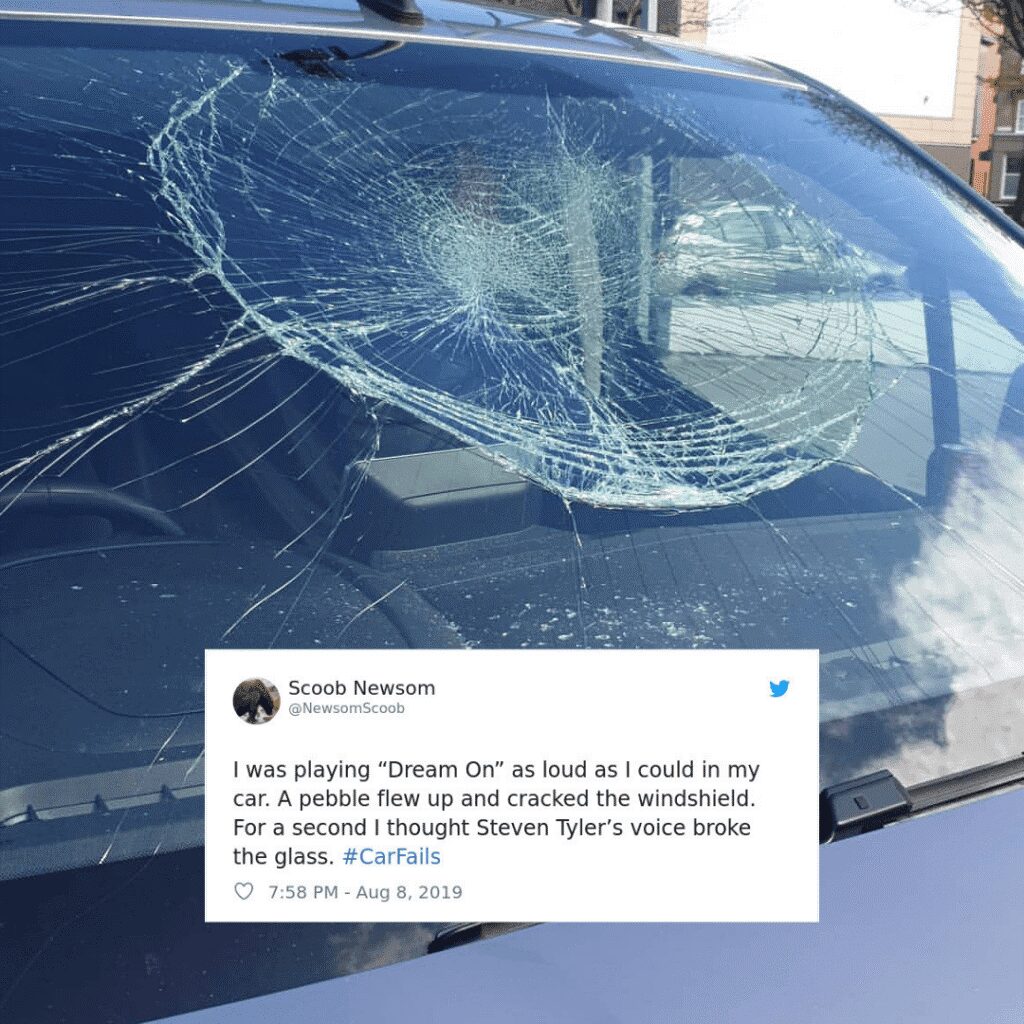
@NewsomScoob thought Steven Tyler’s vocals—blasting “Dream On” at full volume—might have blown out the windshield. After inspecting the damage, reality hit: the crack came from a high-speed pebble, not the soundtrack. Still, it’s a hilariously poetic moment: the music was innocent, but it definitely got blamed.
Expert takeaway: If you get a chip, repair it early. Small chips often become large cracks with temperature changes, vibration, and time.
10. Tough Terrain
First-time driving stories are a genre of comedy all their own. Early on, the best “training ground” is flat, predictable, and low-pressure. Off-roading may feel private and forgiving, but it actually demands more vehicle control, more terrain reading, and more respect for physics.
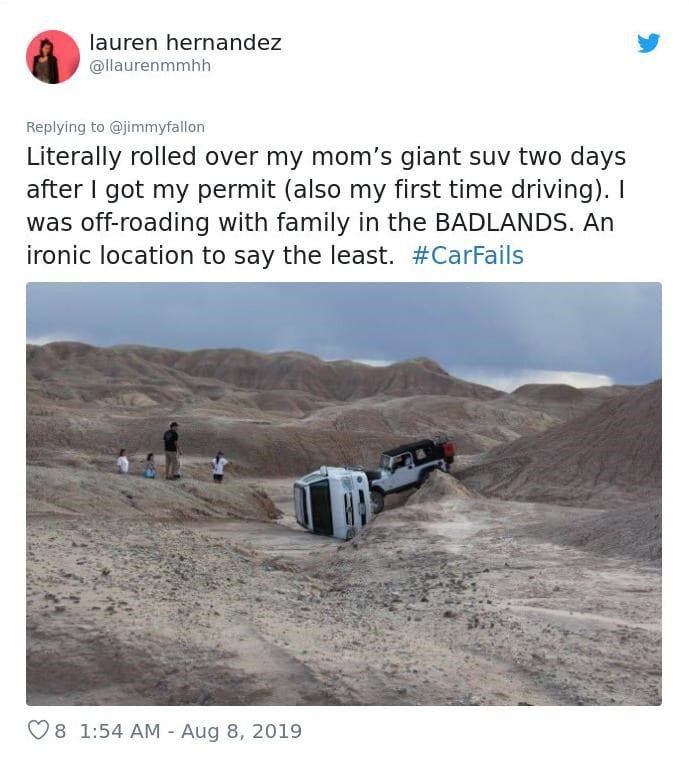
@llaurenmmhh learned this lesson in the Badlands—by rolling her mom’s large SUV just two days after earning her permit. That’s not a “minor oops,” that’s a family legend with permanent status. The only question is how her parent reacted—and how long it took before she was allowed to drive again.
Expert takeaway: Off-road driving requires training and the right vehicle setup. Traction, approach angles, and rollover risk are not beginner-level concepts.
11. Who’s Horn Is That?
Car horns are designed to be loud for a reason: they need to cut through traffic noise and get immediate attention. The downside is that when a horn is accidentally pressed, everyone around you becomes part of the event.
@pottsyMJ shared a moment of accidental chaos: a mom’s breast rested on the horn while her forearms were on the wheel, triggering a long honk. She was annoyed by the noise—until she realized she was the one creating it. That’s the kind of instant self-betrayal that comedy writers dream about.
Expert takeaway: Seating posture matters—especially when you’re leaning forward. Comfort isn’t just about fatigue; it can also prevent accidental control inputs.
12. Three Doors Down
Trying to get into the wrong car is almost a universal experience. It happens when you’re rushed, distracted, tired, or simply too confident that “my car is right here.” In busy parking lots, your brain fills in gaps with assumptions.
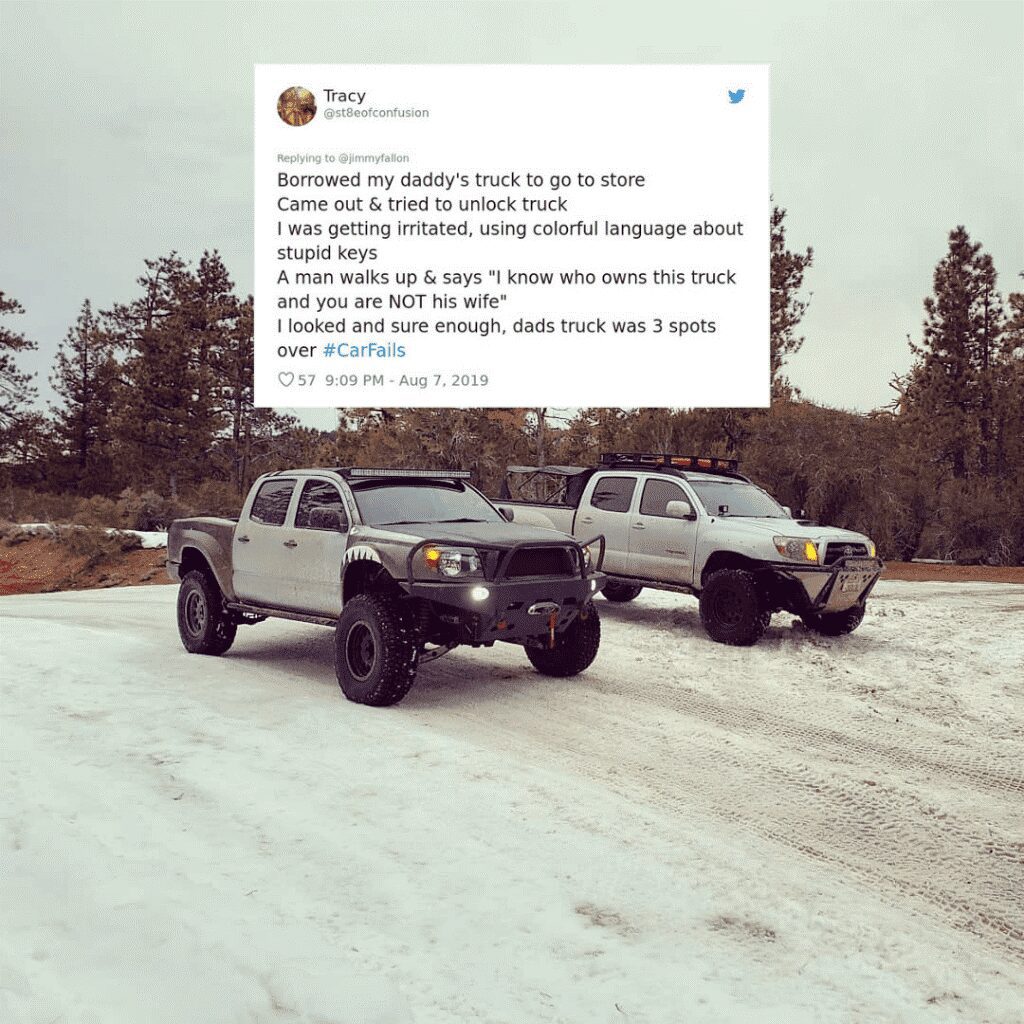
@st8eofconfusion nearly drove the wrong truck home. The mistake is understandable—she had borrowed her father’s vehicle. It took another man’s intervention for her to realize she was trying to open the wrong truck, and her actual ride was parked three spots away.
Expert takeaway: Always confirm the license plate, especially when driving a borrowed vehicle. Your “muscle memory” can’t help you when the car isn’t yours.
13. Batter Up
Older cars have personality—and sometimes that personality includes seats that stop cooperating. When a part fails, owners often improvise, especially when a proper repair isn’t immediately possible. Improvisation can be clever, but it can also become the kind of solution that makes passengers nervous.
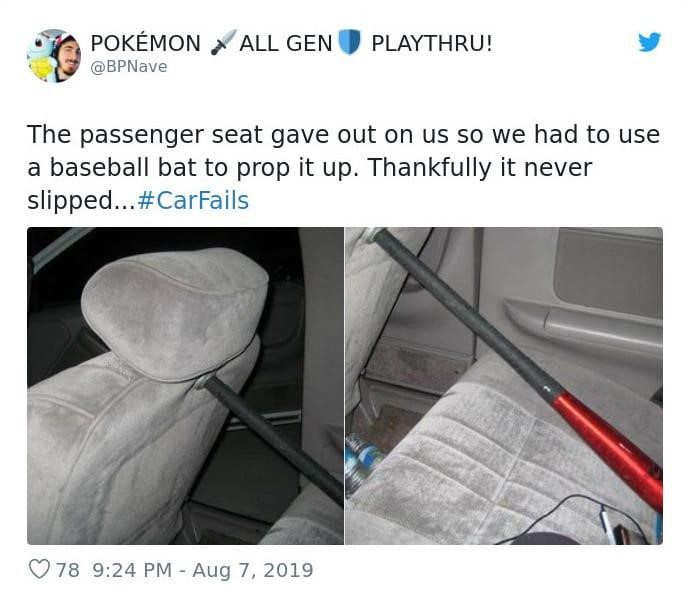
When the passenger seat of @BPNave’s car gave out, he found a surprisingly neat-looking workaround to keep the seat upright. At first glance, you’d never realize the seat was broken. The only catch: if the vehicle is full, someone has to keep the “support system” in place.
Expert takeaway: Seat integrity is a safety issue. A collapsing seat changes occupant position and can reduce seatbelt effectiveness—so treat it as more than a comfort problem.
14. Unlucky Mailbox
Neighborhood driving feels easy—until it isn’t. Posts, curbs, and mailboxes are stationary, but they have a way of “jumping out” at drivers during bad weather or tight maneuvering, especially when traction is compromised.
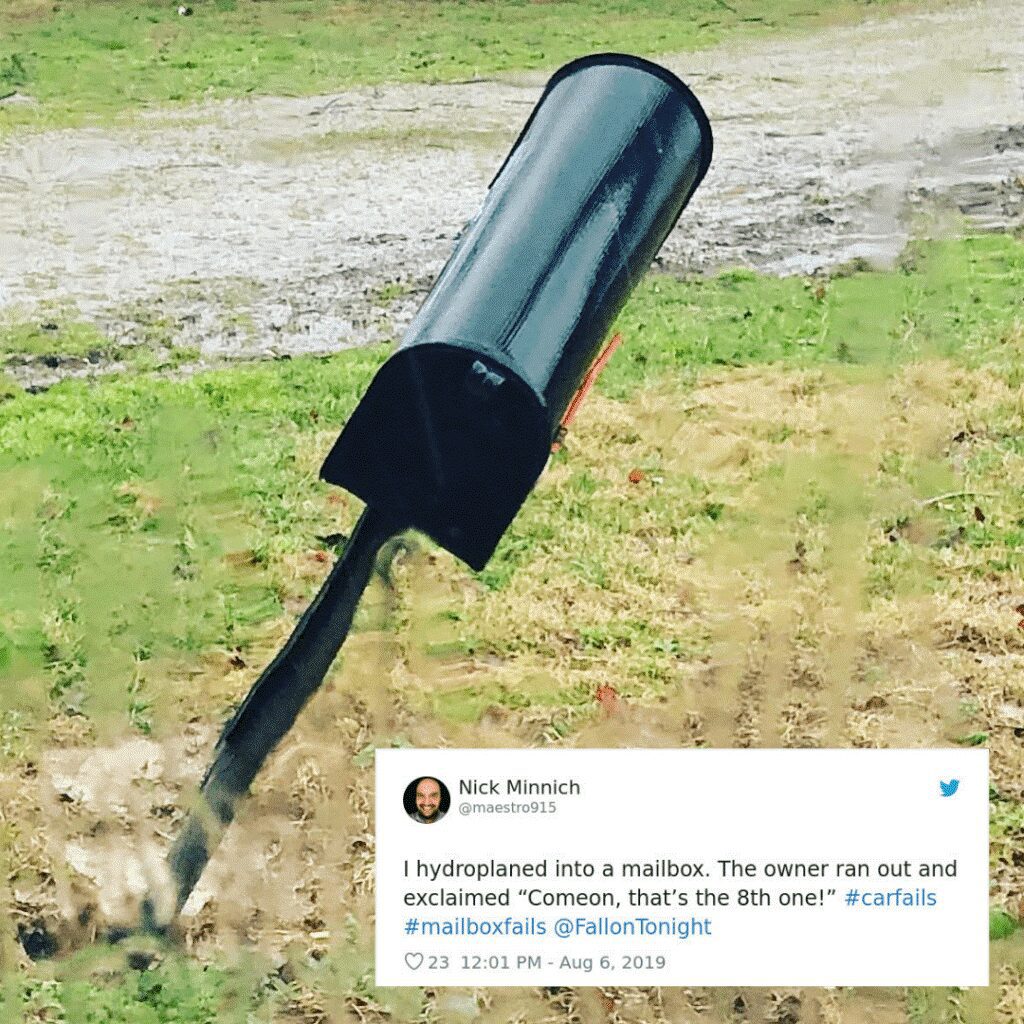
@maestro915 hydroplaned into a mailbox, and the homeowner’s reaction was the real punchline: they were tired of fixing it—this was apparently the eighth time. At that point, the mailbox isn’t just a mailbox; it’s a community landmark with an unusually violent relationship to cars.
Expert takeaway: Hydroplaning can happen at lower speeds than many drivers expect, especially with worn tires. Tire condition and tread depth are true safety equipment.
15. Play It Again
Before streaming and instant playlists, car music was a commitment. Tapes, radio, and CDs shaped road trips—and if something got stuck, you couldn’t just “skip track.” You had to live with your choice. Repeatedly.
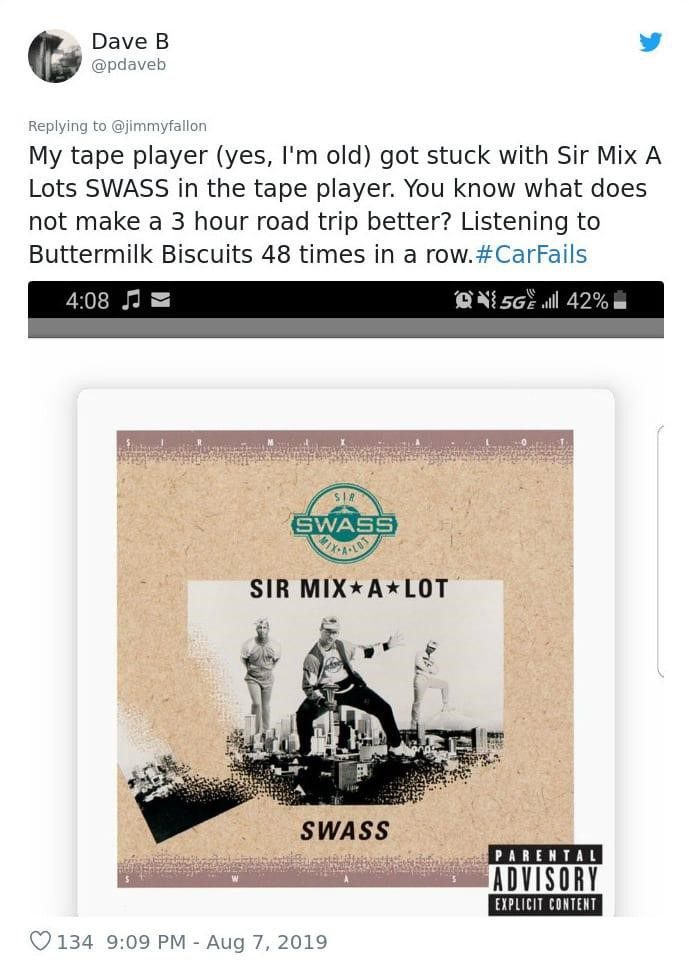
On a three-hour road trip, @pdaveb’s Sir Mix A Lot SWASS cassette jammed in the player—on loop. He listened to “Buttermilk Biscuits” more than forty times, learning the hard way that your favorite song can become your sworn enemy if you can’t escape it.
Expert takeaway: Old audio systems are mechanical—meaning they fail like mechanical parts. If something jams, forcing it can break the head unit, turning a small annoyance into a replacement job.
16. Don’t Point Fingers
Sometimes we blame strangers for “bad driving,” only to discover the villain is us—specifically, our own forgotten parking brake. It’s the automotive version of yelling at someone for leaving the fridge open… while your own hand is still on the door.
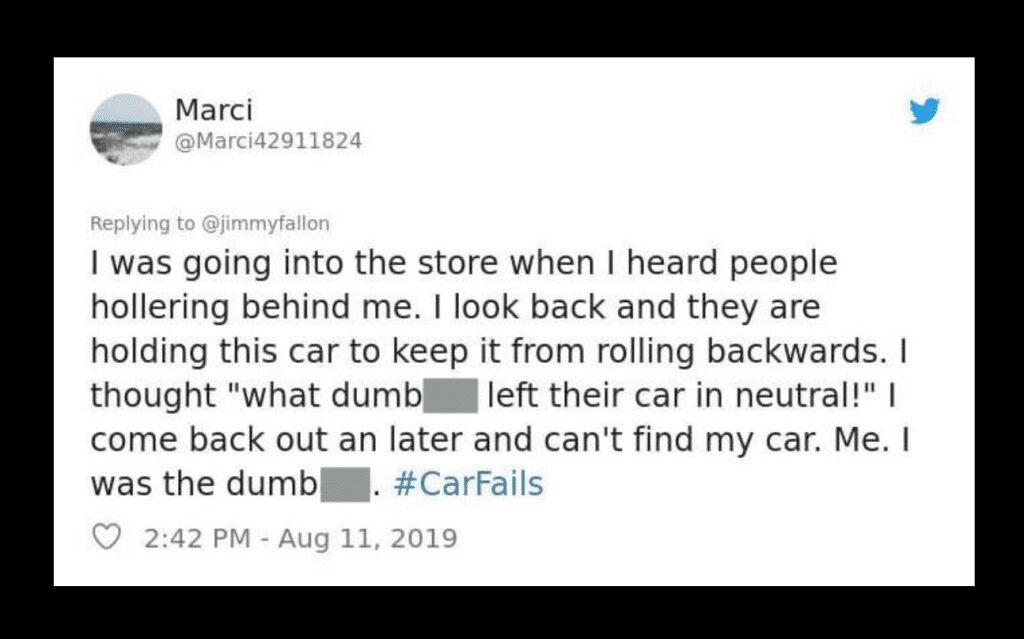
@Marci42911824 ignored people calling out to her as she walked into a store, assuming they were reacting to some irresponsible driver. Then reality hit: she was the irresponsible driver. The shock of that realization is funny because it’s so human.
Expert takeaway: Parking routine matters. “Park, brake, check” should be muscle memory—especially on slopes or uneven surfaces.
17. Duck And Cover!
Friendships are good for the soul… unless you’re actively hiding from someone. Sometimes avoiding an awkward interaction leads to a physical mishap that is both painful and absurd.
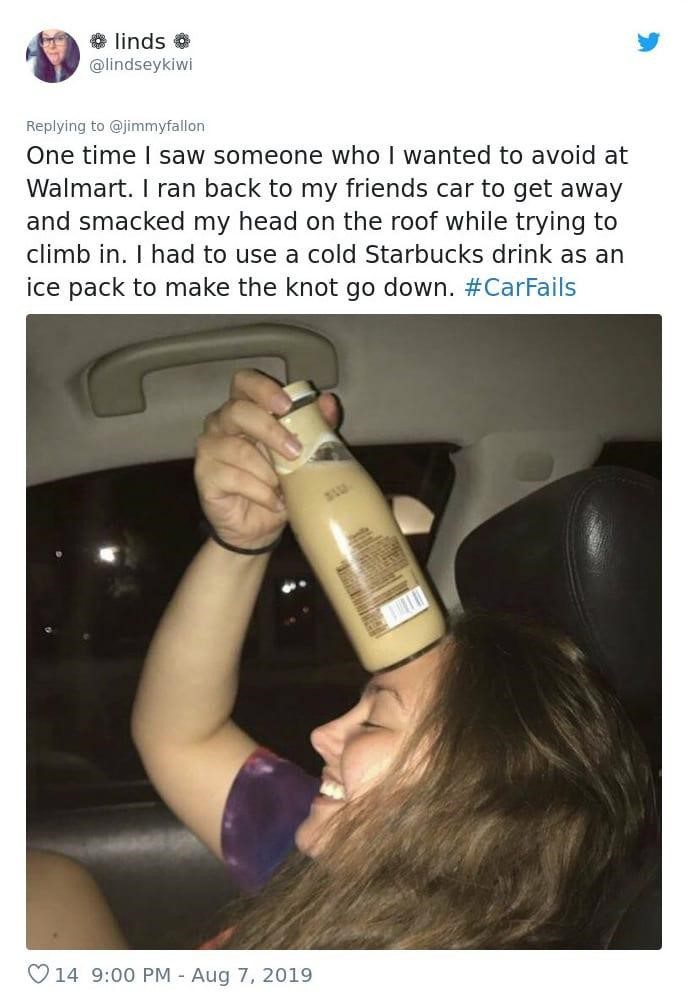
@lindseykiwi tried to dodge someone and ended up hitting her head on the roof of a friend’s car. The silver lining: their grocery bags had something cold to help with the pain. The mystery: who was she avoiding, and was it worth the self-inflicted bonk?
Expert takeaway: Car door frames don’t care about your social anxiety. Move slowly around vehicles—especially when distracted by people.
18. The Babysitter
Babysitters shape childhood memories in unexpected ways. Sometimes that influence is heartwarming. Sometimes it’s… a creative punishment system involving a leaking car roof.
@Overtired_Katie said her babysitter used a leaking roof as discipline for misbehavior. While kids can absolutely test patience, “wet ride punishment” is a bold strategy. Hopefully the lesson was learned quickly and the soggy commutes didn’t become a recurring event.
Expert takeaway: A leaking roof is more than discomfort—moisture can lead to mold and electrical issues. If your car leaks, repair it promptly, even if you’re not using it as a punishment tool.
19. No Failure Here
Car stereotypes are persistent—especially the tired idea that women can’t handle repairs. Real life repeatedly disproves this, particularly when people are motivated by a hard deadline and a strong reason not to be stranded.
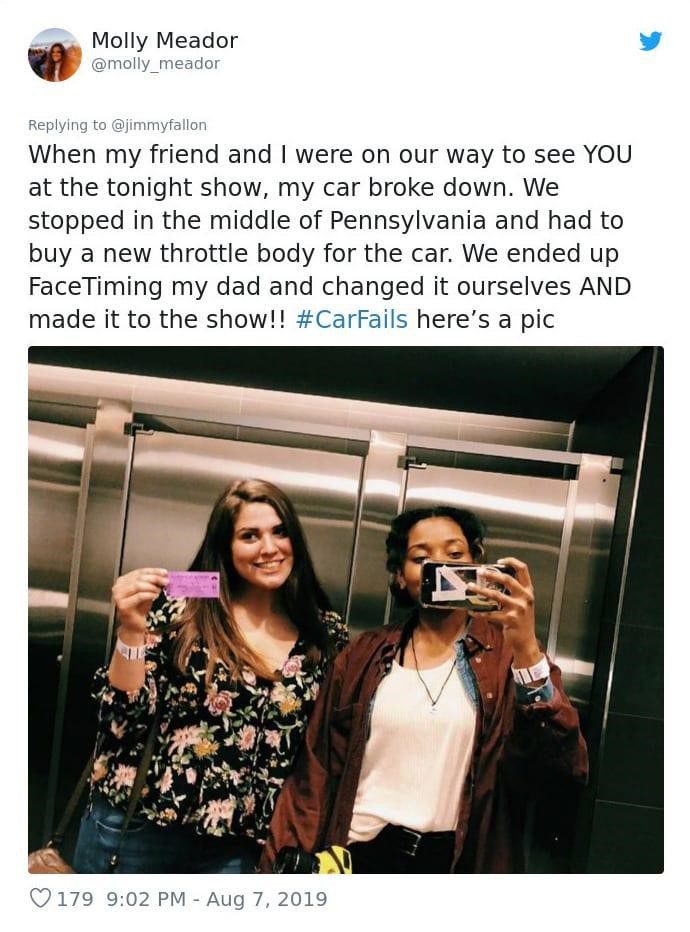
On the way to The Tonight Show Starring Jimmy Fallon, @molly_meador and her friend faced a problem that could have ruined the night. Instead, they used FaceTime guidance from her dad to change the throttle body and still made it on time. That’s not just a story—it’s a victory lap.
Expert takeaway: Remote help can be powerful if the advisor knows the system and the person wrenching can follow steps safely. For anything involving fuel lines or high-voltage systems, though, hands-on professional help is the safer call.
20. Just A Scratch
Even careful drivers can’t control everything—especially what happens to their car when it’s parked. Parking lots are basically low-speed battlefields where corners, blind spots, and oversized vehicles occasionally collide with bad attention.
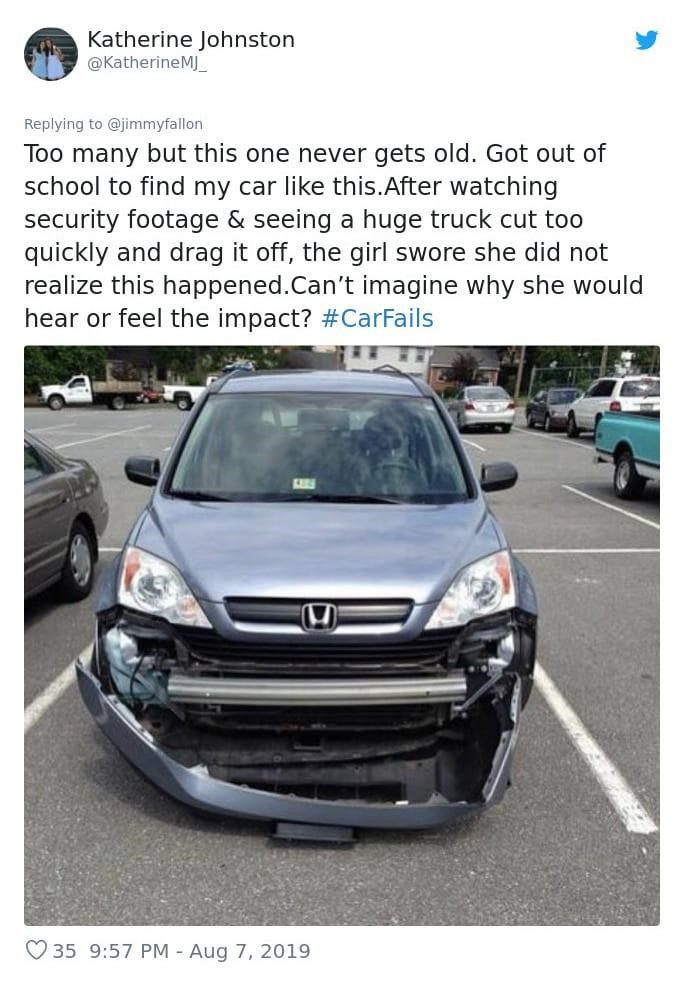
@KatherineMJ_ found her car badly damaged and checked security footage to discover the culprit: a large truck grazed her vehicle and kept going. The driver claimed she didn’t hear or feel the impact—an explanation that somehow makes it worse, because it suggests the truck was basically a moving building.
Expert takeaway: If you park next to large trucks, you increase your risk. Choose end spots or wider areas when possible—and consider a dash cam that records while parked if your area supports it.
21. Using One Car To Find Another
Losing your phone makes your heart rate spike. Losing your car in a massive mall lot? That’s a different level of panic—because it’s not just missing, it’s immovable and expensive.
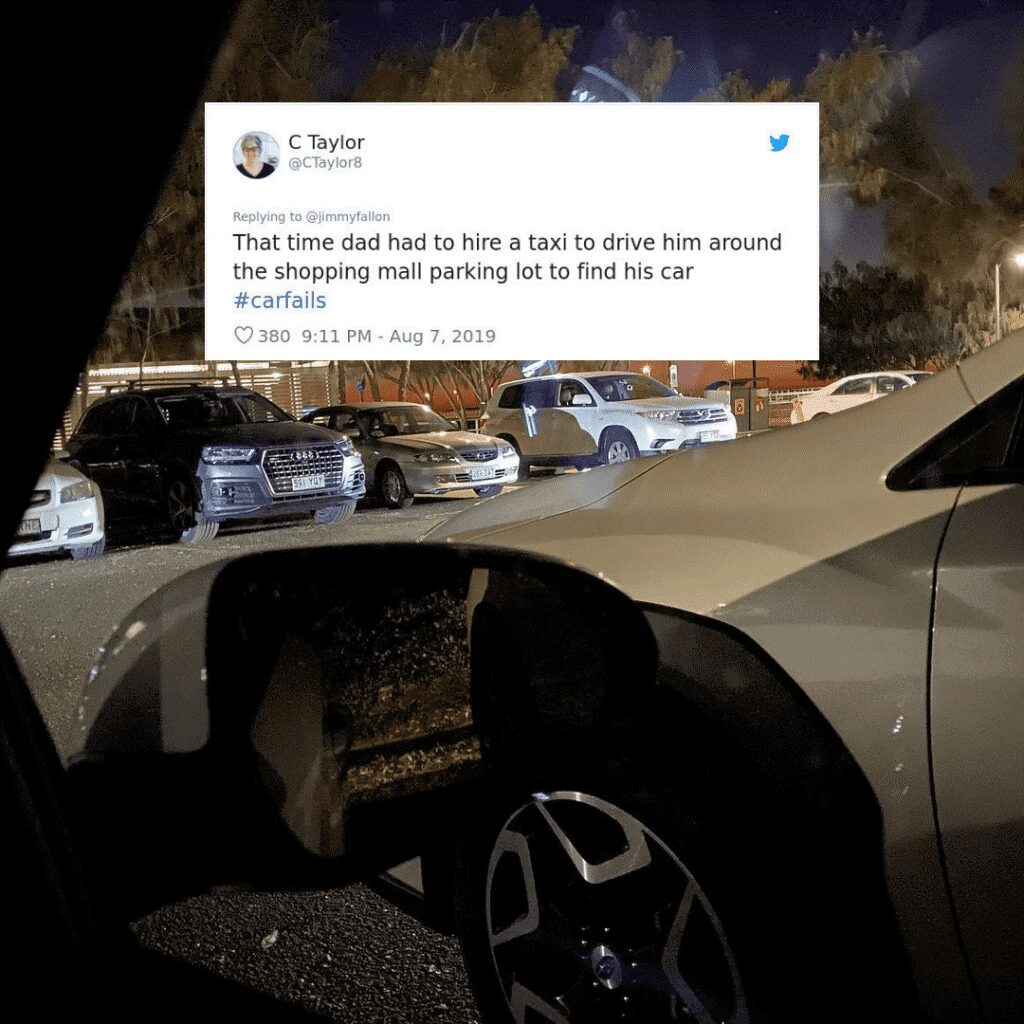
@CTaylor8 shared that her dad hired a taxi to drive around the parking lot to find his own car. It’s resourceful, slightly dramatic, and honestly impressive. Next time, an alarm button might be cheaper—but this story is funnier.
Expert takeaway: Use your phone to drop a pin when you park. It’s one of the simplest modern tools that prevents the “I live here now” feeling in giant lots.
22. Looking For The Wrong Car
New-car ownership changes your mental picture of “your car.” For a while, your brain still looks for the old model, the old color, or the old shape. That transition period can create the kind of confusion that feels like theft—until you realize it’s just your own memory lagging behind.
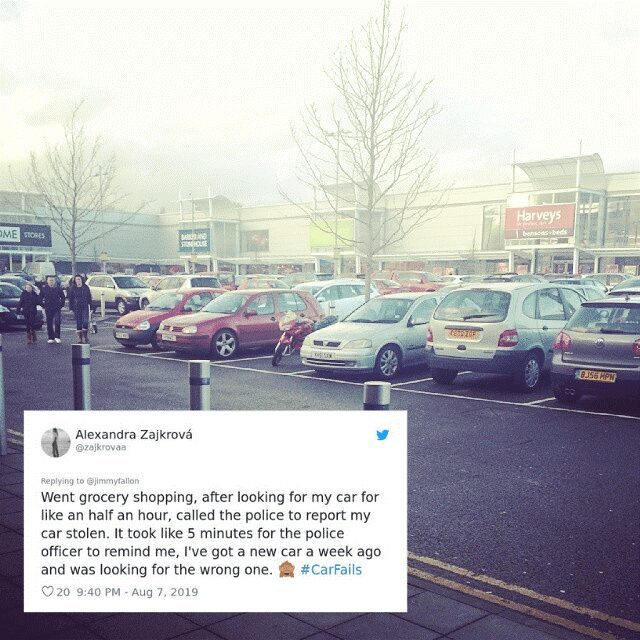
@zajkrovaa panicked a week after getting a new car when she couldn’t find it at the grocery store—and called the police. The twist: she was searching for the wrong car. Relief and embarrassment arrived together, like a matching set.
Expert takeaway: If you’ve recently changed vehicles, take a photo of your new car and plate. It helps your brain update its “search image” faster.
23. Be Careful Where You Park Your Luggage
Sexist driving jokes are common—and unfair. The truth is, anyone can have a bad moment behind the wheel, especially when the environment is cluttered with hazards that shouldn’t be in the driving path in the first place.
Trying to prove to a male attendant that women can drive just fine, @the_eh_teamUSA’s mother ran over another couple’s luggage. Honestly, the luggage placement deserves some blame here. A lot of drivers—regardless of gender—wouldn’t expect suitcases to be sitting right where a car needs to move.
Expert takeaway: Ground-level obstacles are hard to see from the driver’s seat, especially near the front corners. Slow movement and spotters help in congested pickup zones.
24. Stranger Danger
Mass production has a side effect: lots of identical-looking cars. Without checking the license plate, it’s surprisingly easy to open the wrong door—especially if your doors are unlocked and someone else is equally distracted.
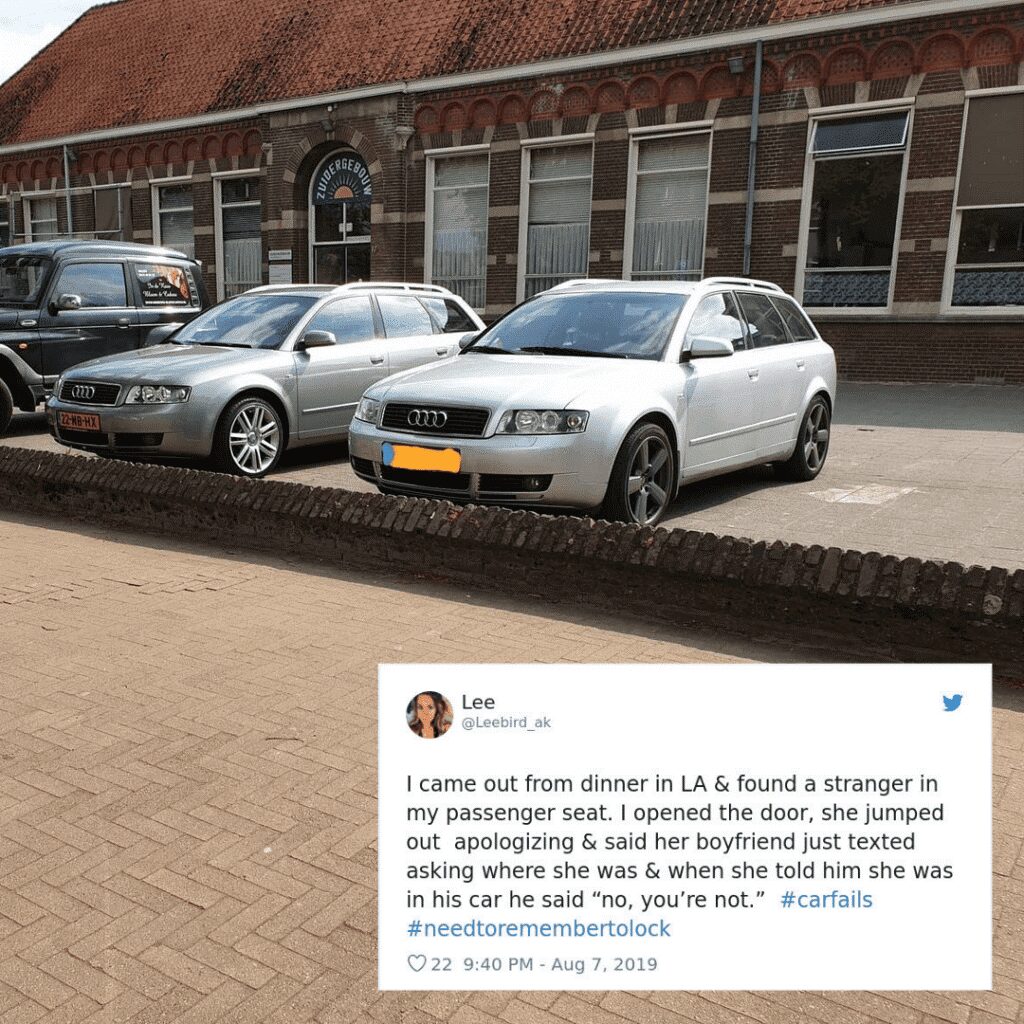
@Leebird_ak once discovered a stranger sitting in her passenger seat. The stranger apologized, explaining she was trying to surprise her boyfriend and chose the wrong car. It’s the kind of wholesome mistake that still makes your brain scream “security breach” for a full second.
Expert takeaway: Lock your doors in public parking areas. Not because everyone is dangerous—because confusion is common, and you don’t want your car to become someone else’s accident.
25. D-I-Wipers
Windshield wipers are small, but they are critical. Clear visibility isn’t optional—it’s the foundation of safe driving. A failed wiper in rain or snow can turn a routine trip into a high-risk situation in minutes.
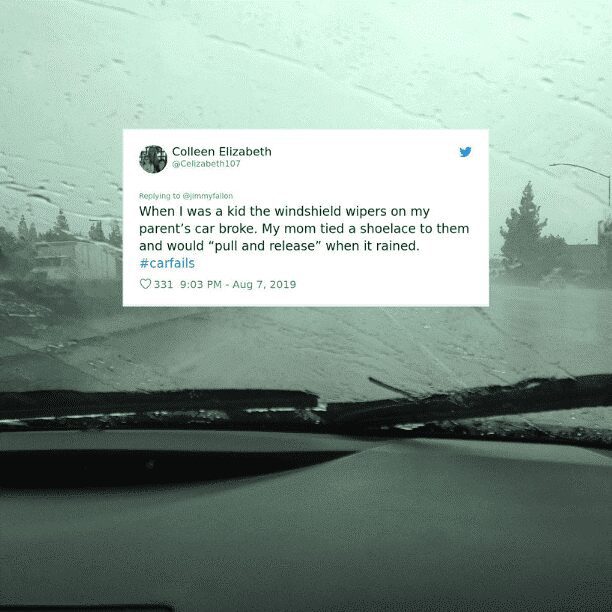
When a wiper broke and repair wasn’t immediate, @Celizabeth107 said her mom improvised: she tied a shoelace to the wiper so she could pull and release it manually when it rained. It’s clever in a “we must survive this storm” way—and also a reminder of how much we depend on basic components.
Expert takeaway: Temporary fixes can get you off the road safely, but don’t treat them as permanent. Wiper failure should be repaired before the next weather event.
26. Brake, Not Lake
New drivers have a lot to juggle—traffic rules, mirror checks, parking technique, fuel awareness. It’s easy for one small step to slip through the cracks, and parking brake habits are often the first casualty of mental overload.
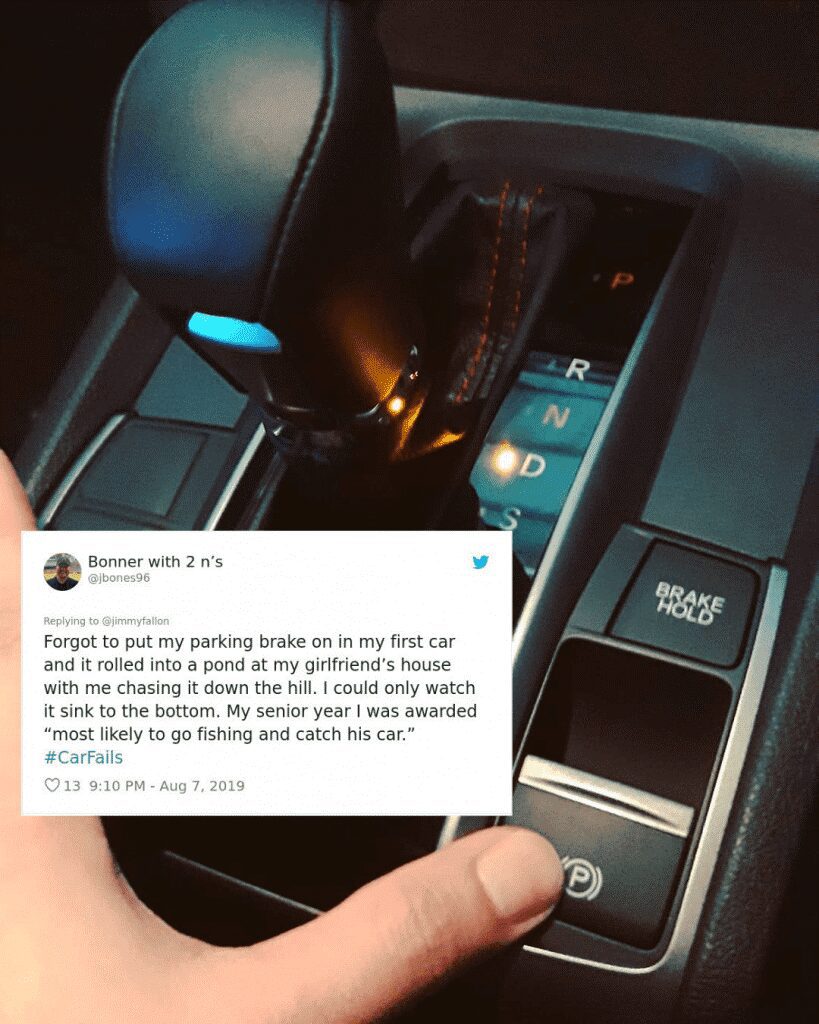
@jbones96 forgot to set the parking brake, and the car rolled into a pond at his girlfriend’s home. Watching a car sink is the kind of lesson that permanently installs a new habit in your brain. At least it earned him an award in his senior year—because sometimes life gives trophies for failure.
Expert takeaway: Engage the parking brake and confirm the car is secured before stepping away—especially on slopes. On automatics, “Park” is not always enough.
27. An Unforgettable Encounter
Accidents happen—even cautious drivers make mistakes. And sometimes the “what” you hit is less memorable than the “who,” especially when that “who” will be grading your work for the rest of the semester.
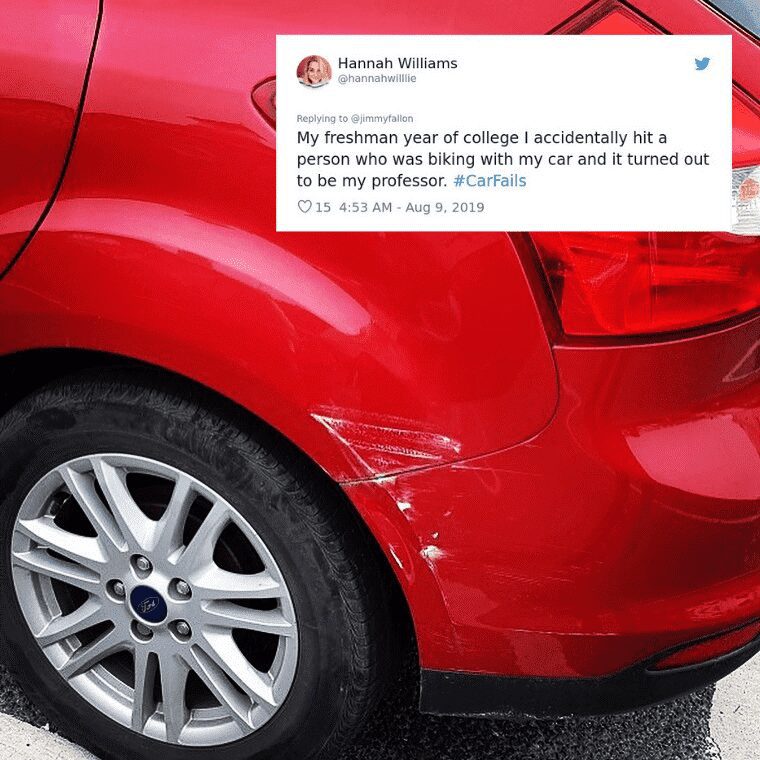
@hannahwilllie shared that during freshman year of college, she hit her professor—who was riding a bike. That’s the kind of first impression you can’t undo, no matter how great your class participation is afterward.
Expert takeaway: In areas with heavy pedestrian and bicycle traffic, slow speeds and scanning at intersections are essential. Bikes can appear quickly, especially in blind zones.
28. New Furnishings
Moving house is exciting—but it also turns your car into a temporary cargo ship. That’s where people discover that “it fits” is not the same thing as “it will come out again.”
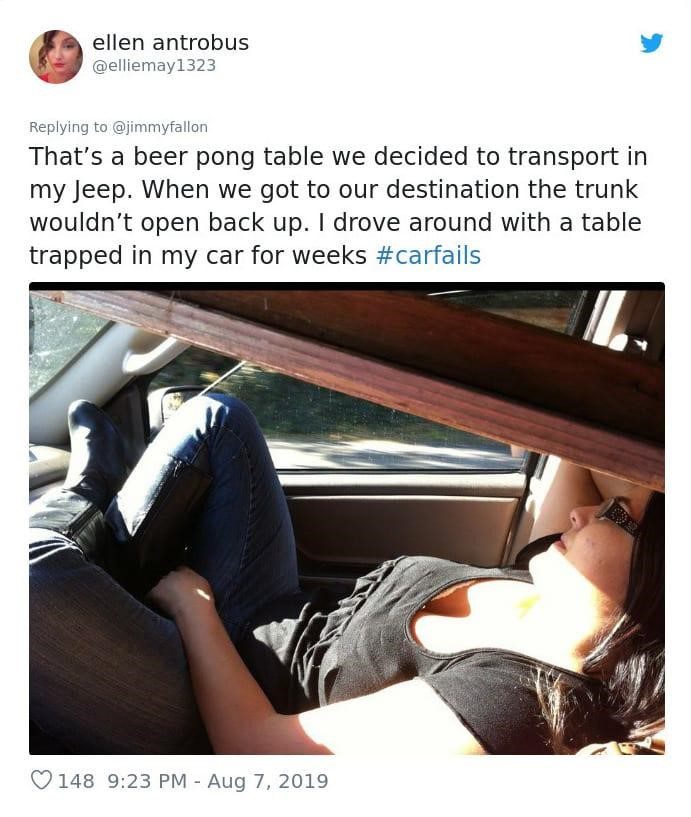
@elliemay1323 tried to transport a beer pong table in her Jeep. The problem? The trunk wouldn’t open afterward. The result was weeks of driving around with a table inside the vehicle, like it had become a permanent passenger. You almost have to admire the commitment.
Expert takeaway: When loading large items, consider exit strategy before entry strategy. Folding seat mechanisms, hatch clearance, and latch access can turn simple hauling into a long-term relationship with your cargo.
29. First Date Failure
First dates are stressful enough. Add unfamiliar vehicle controls, and suddenly you’re starring in an awkward short film titled Why Won’t This Car Move?
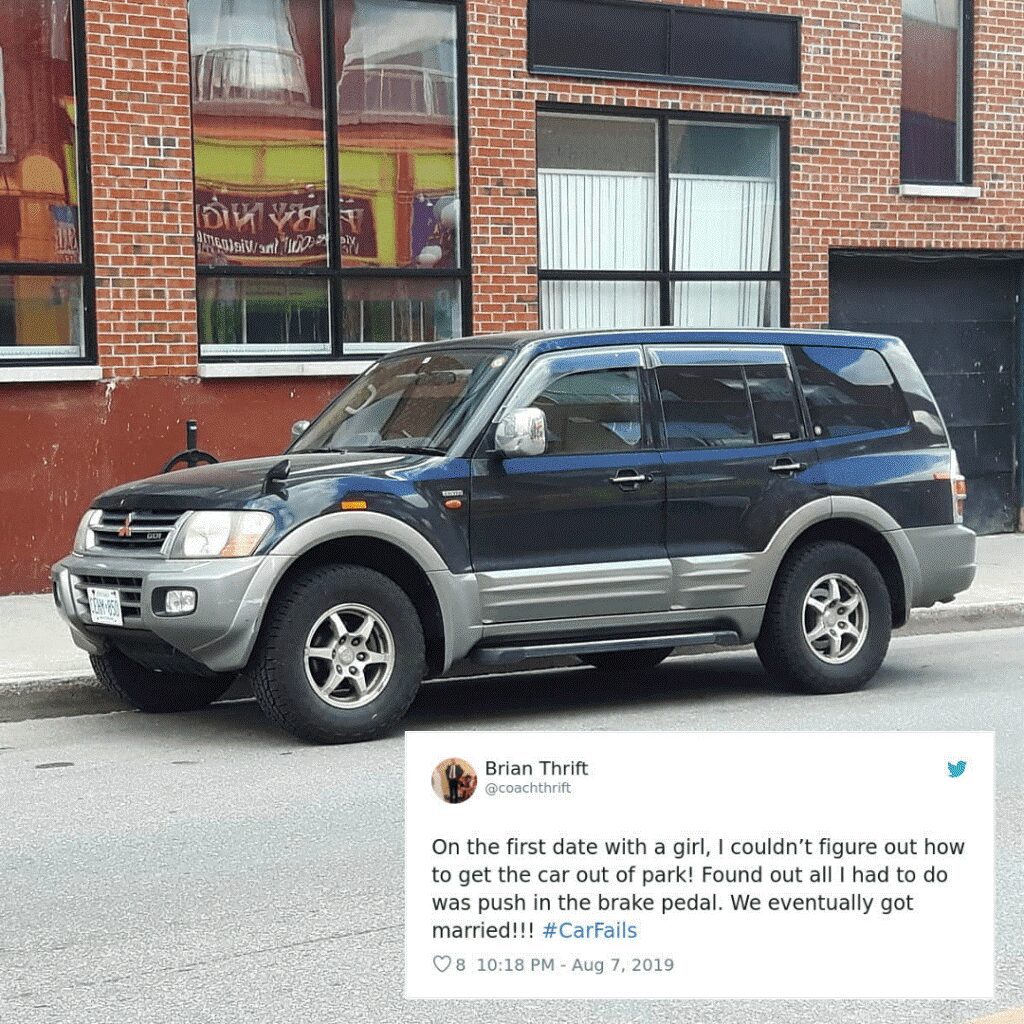
@coachthrift couldn’t shift out of Park and eventually learned he needed to press the brake pedal. While it may have felt humiliating in the moment, the upside is that the story became part of the date—an unforgettable one, apparently.
Expert takeaway: Modern cars include shift interlocks for safety. If something “won’t move,” check the basics: brake pedal pressed, ignition in correct mode, and proper gear selection.
30. Press Start To Begin
Push-button start felt like science fiction not long ago. Now it’s normal, and with it comes new “how does this work?” mistakes—especially for drivers transitioning from traditional keys to proximity fobs.
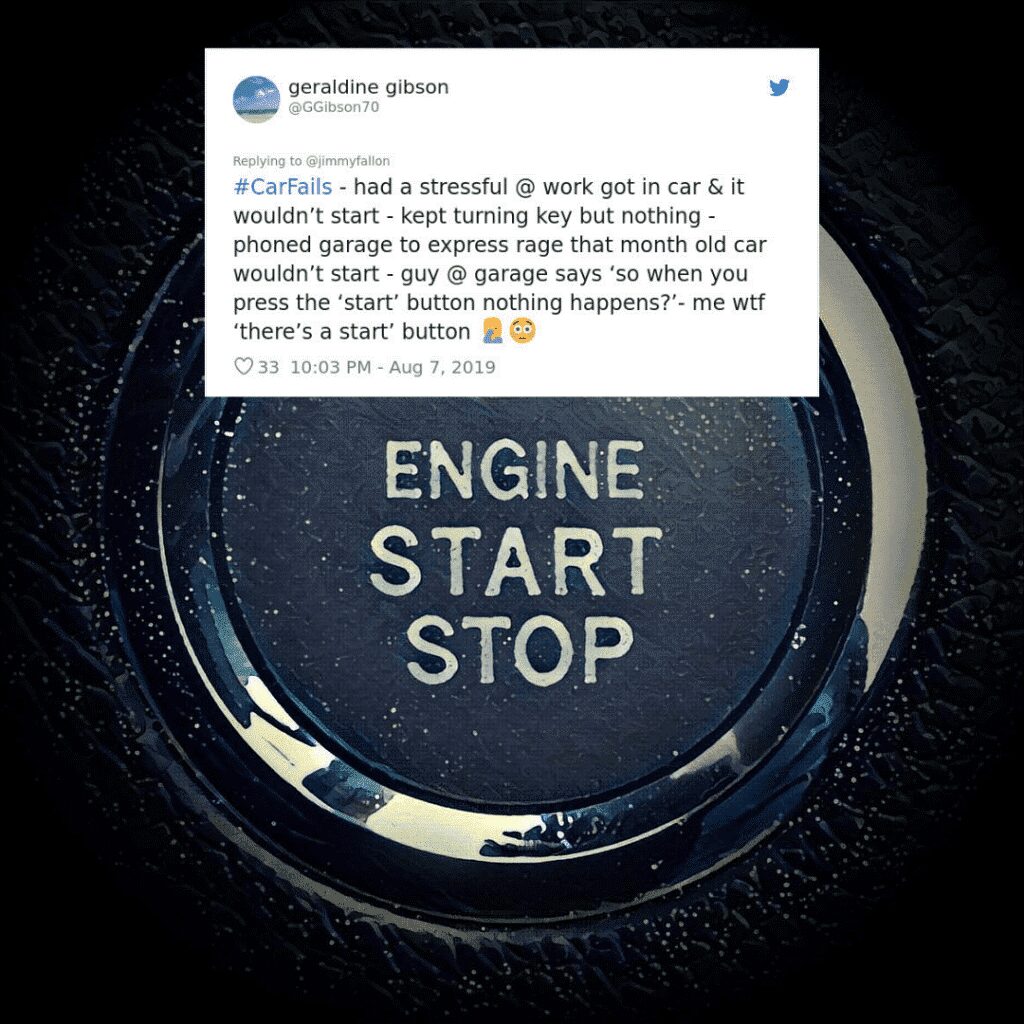
@GGibson70 didn’t realize the basic sequence: step on the brake, then press the start button. He panicked and called the garage, convinced something was wrong with his brand-new car—only to learn it was user error. At least he learned early, and with witnesses.
Expert takeaway: Spend ten minutes reading the quick-start section of the owner’s manual when you get a new vehicle. It prevents hours of unnecessary stress.
31. Check Your Pockets
Nothing spikes panic like “I locked my keys in the car.” The worse version is “I locked my keys in the car and now I’m going to solve it with violence.” Sometimes that violence is directed at the wrong target—like a window you didn’t need to break.
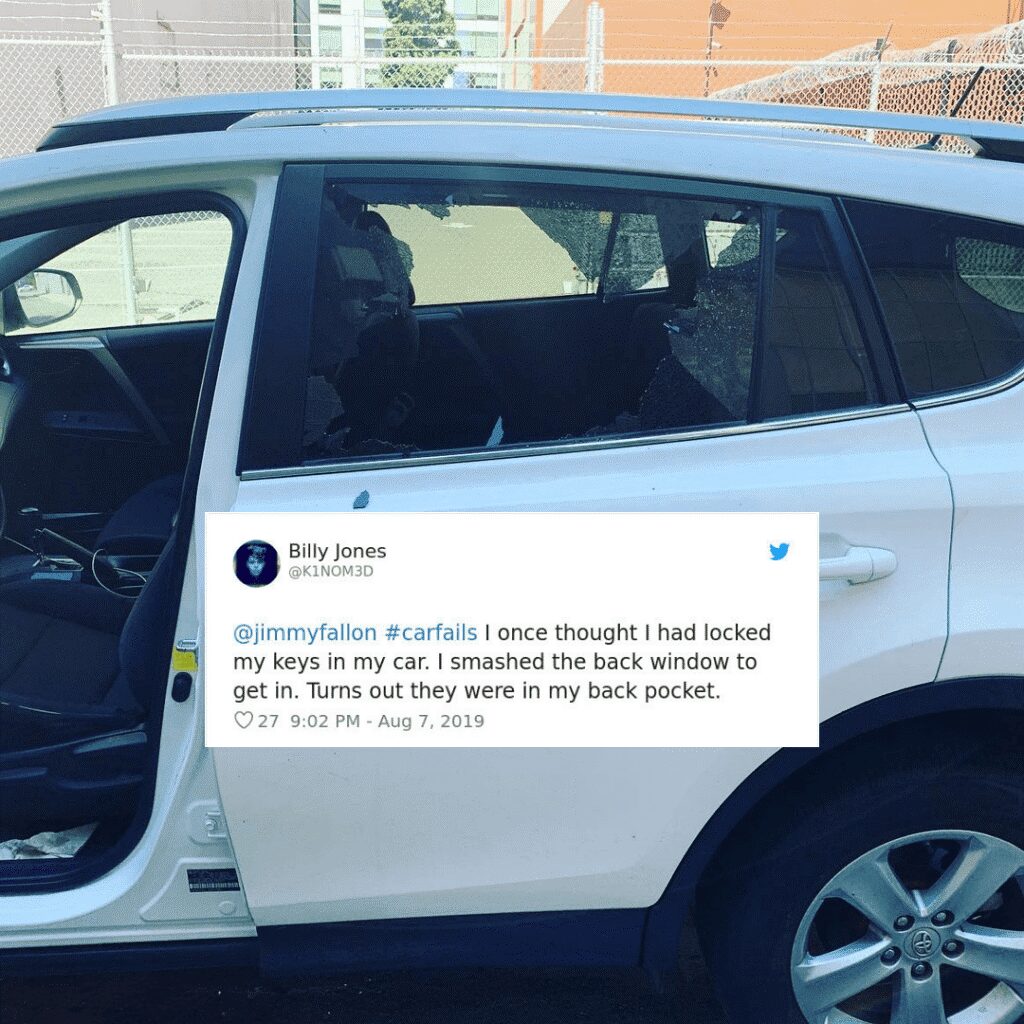
@K1NOM3D thought he had locked his keys inside the car, so he smashed the rear window to retrieve them—only to discover they were in his back pocket. Relief arrived immediately, followed by the less fun realization: replacing a window is not cheap, and pockets should always be checked first.
Expert takeaway: Before breaking anything, do a full “key audit”: pockets, bag compartments, coat lining, and anywhere keys can slide. Then call a locksmith or roadside assistance if needed.
32. A Dangerous Seat
A car should protect you—not injure you. But electrical issues can turn a “comfortable passenger seat” into an unexpected hazard, especially if wiring is damaged or a system is modified improperly.
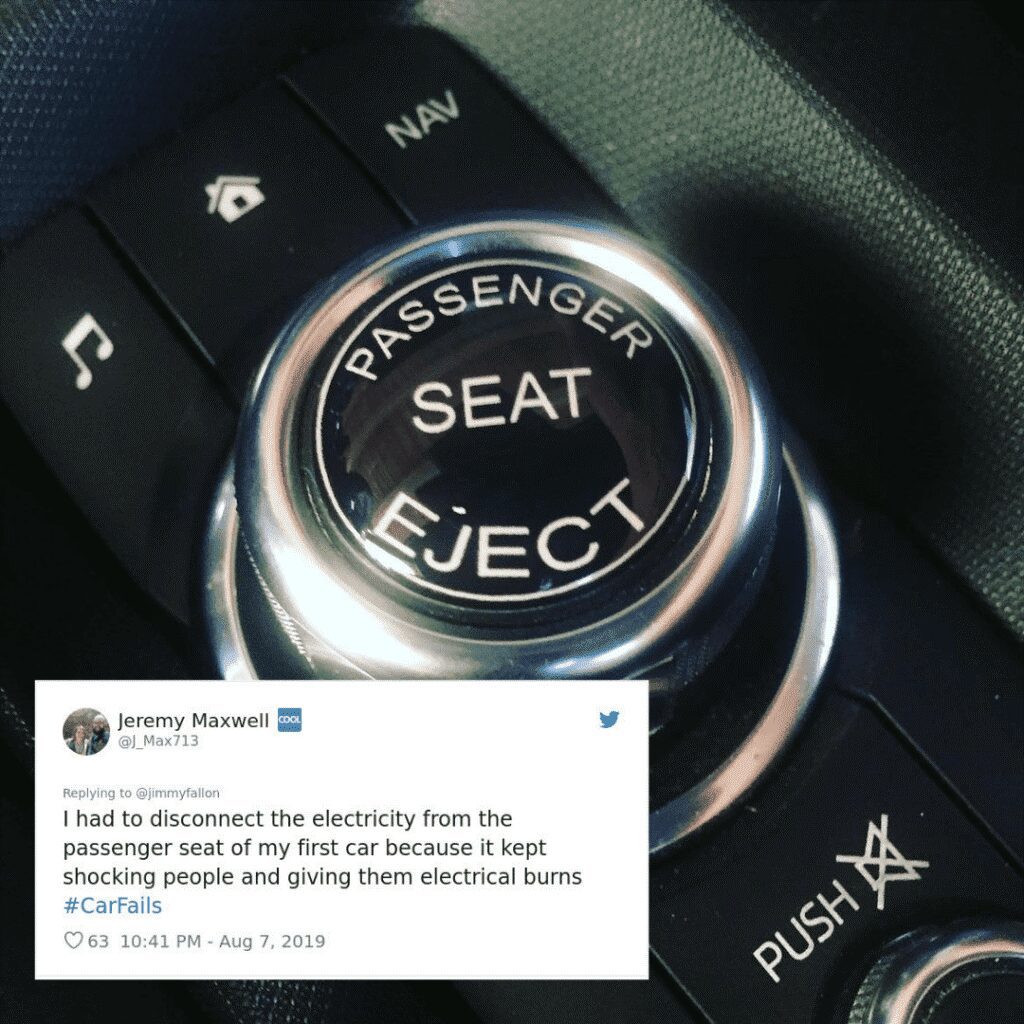
@J_Max713 said his passenger seat was essentially electrocuting people, causing minor electrical burns. After multiple passengers became unwilling test subjects, he disconnected the seat’s power. It solved the problem and likely saved him from a future of solo drives.
Expert takeaway: Electrical faults should be diagnosed promptly. Improvised wiring fixes can create short circuits, shocks, and fire risk. If something “zaps” you, don’t ignore it.
33. Turn It Up
Older cars required creativity. No modern entertainment system? No air conditioning? Fine—bring a boombox and roll the windows down. It’s a vibe, until the sun turns the interior into a slow cooker.
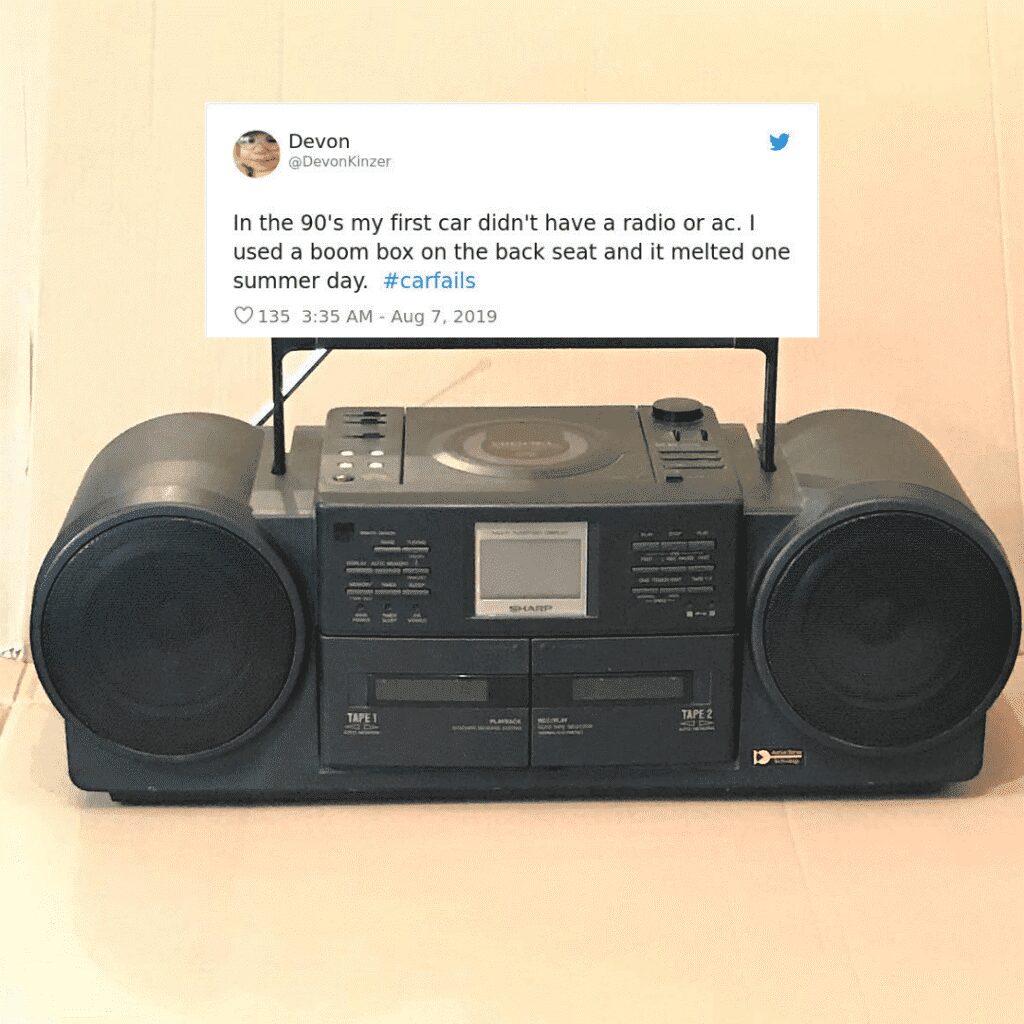
@DevonKinzer recalled the 90s reality of driving a car without AC or a radio. The boombox in the backseat made summer better—until it literally melted in the heat. Few things capture “the inside of a car gets extremely hot” better than a deformed piece of audio equipment.
Expert takeaway: Cabin temperatures can rise rapidly, even on mild days. Heat damages electronics, interior plastics, and can be dangerous for pets and people. Treat parked cars like ovens.
34. The Birds
Driving with the sunroof open feels like freedom—light, air, scenery. Nature sometimes responds by entering your personal space without permission.
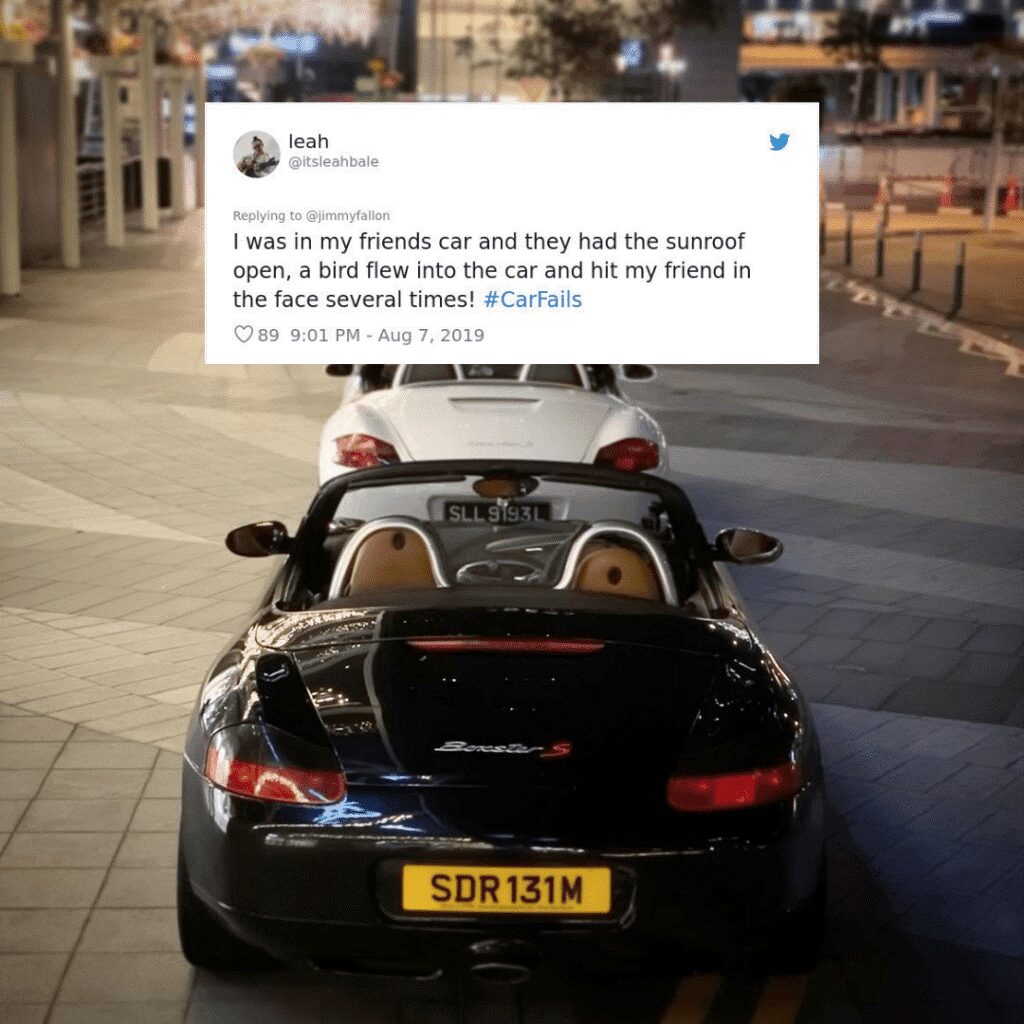
@itsleahbale shared that a bird flew into her friend’s face while driving with the sunroof open. It’s funny because it’s so sudden and absurd—but also terrifying in the moment. Hopefully it left more surprise than mess.
Expert takeaway: Unexpected cabin intrusions can distract a driver instantly. If something flies in, prioritize maintaining control and pulling over safely rather than reacting wildly.
35. One Size Fits All
Being the only friend with a car in college makes you valuable. It also makes your car the default group transport, even if it’s held together by hope and one functioning door.
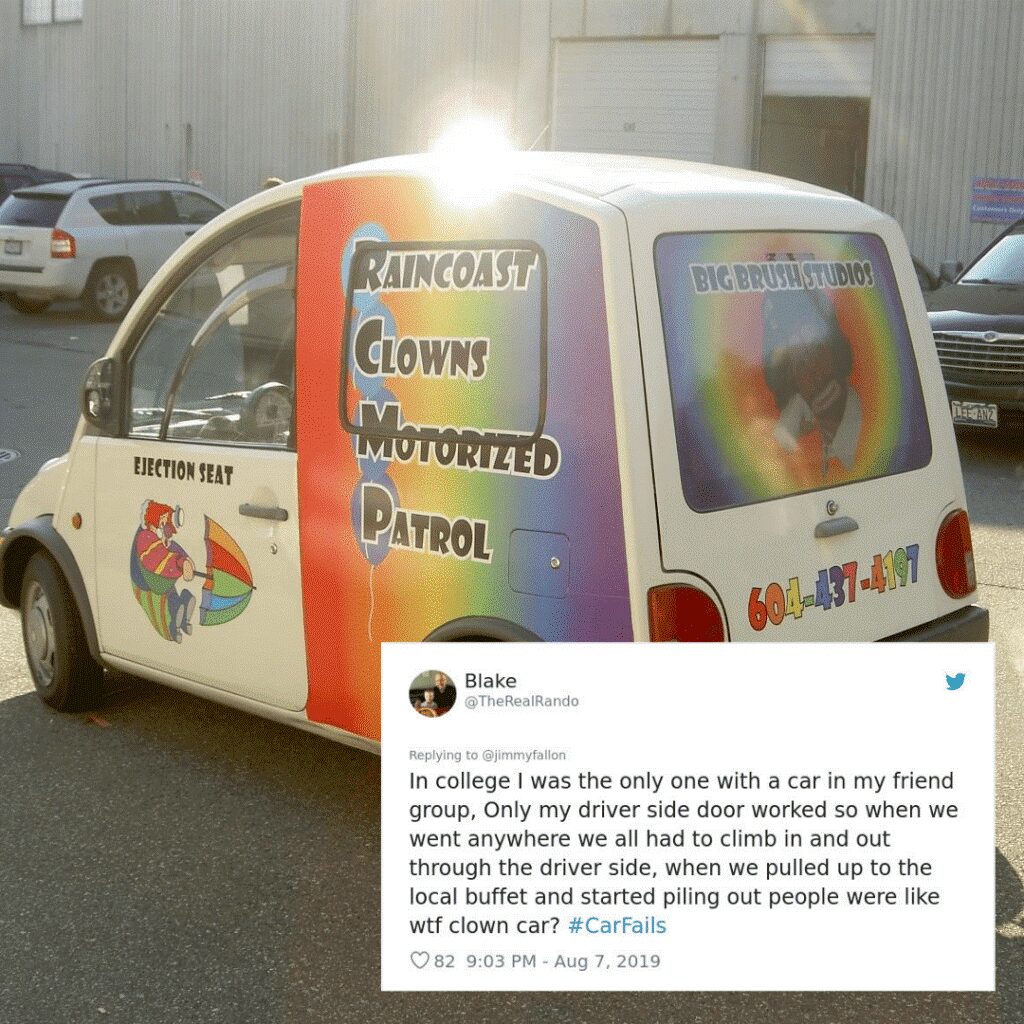
@TheRealRando explained that only the driver’s side door worked, so everyone had to enter and exit through one opening. The group dubbed it a “clown car,” which is both cruel and accurate. If you’ve ever watched four adults climb out of one door, you know the scene writes itself.
Expert takeaway: Door latches and handles aren’t just convenience features—they’re safety and emergency egress components. If multiple doors don’t open, prioritize repairs.
36. Filled To The Brim
Running out of fuel is stressful, but overfilling can be dangerous too. Modern pumps click off when the tank is full—yet new drivers (and anyone fueling in bad weather) can miss that signal and create a mess fast.
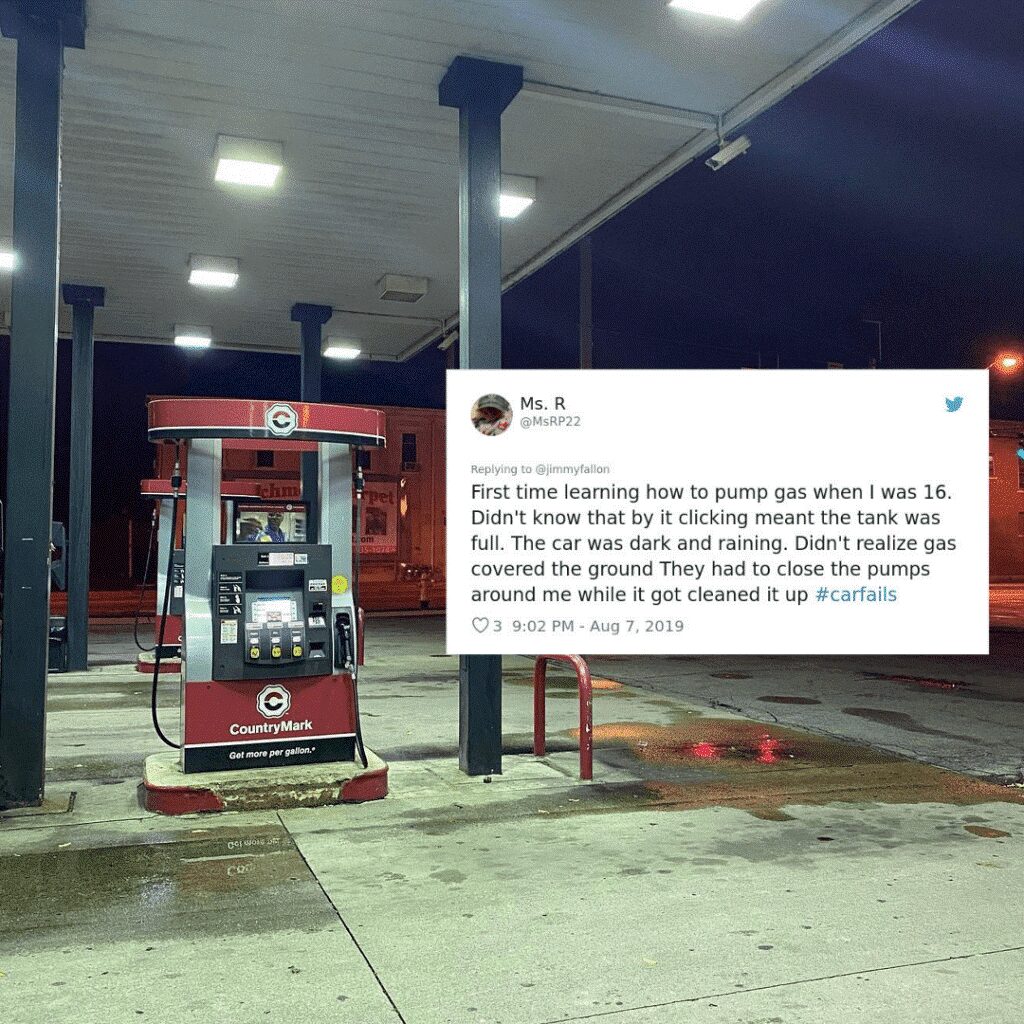
@MsRP22 filled the tank until it overflowed, later learning that the click is your cue to stop. Darkness and rain hid the spill, leaving a slick and hazardous puddle. The lesson arrived with the smell of gasoline and the realization that “more” isn’t always better.
Expert takeaway: When the pump clicks, stop. Overfilling can damage EVAP components and creates a fire hazard—especially if fuel contacts hot parts or drains improperly.
37. Hottest Car Of The Year
Vehicles need maintenance. When they’re neglected, they can turn from “reliable transportation” into “unexpected hazard.” Some failures are gradual; others look like the car spontaneously chose violence.
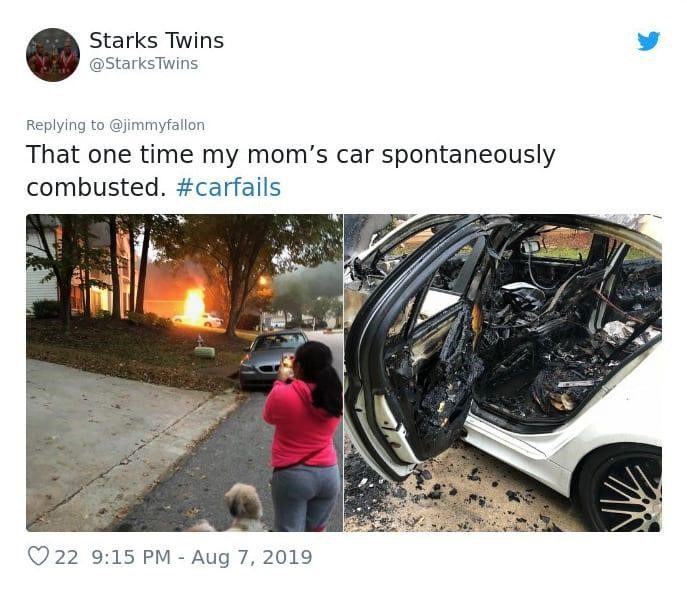
@StarksTwins shared a story that reads like a warning label: her mother’s car self-destructed in the driveway. Since it was still parked, we hope the damage was limited to the vehicle itself. But the image stays with you—and it’s a strong reminder that “I’ll service it later” can end badly.
Expert takeaway: If you smell burning, see smoke, or notice fluid leaks, stop driving and investigate immediately. Small issues become big failures when heat is involved.
38. Helping or Hinderance?
Every driver eventually needs help—stuck in snow, ice, mud, or a steep hill. The best moments in driving culture are when strangers jump in to help. The worst moments are when you accidentally sabotage the rescue without realizing it.
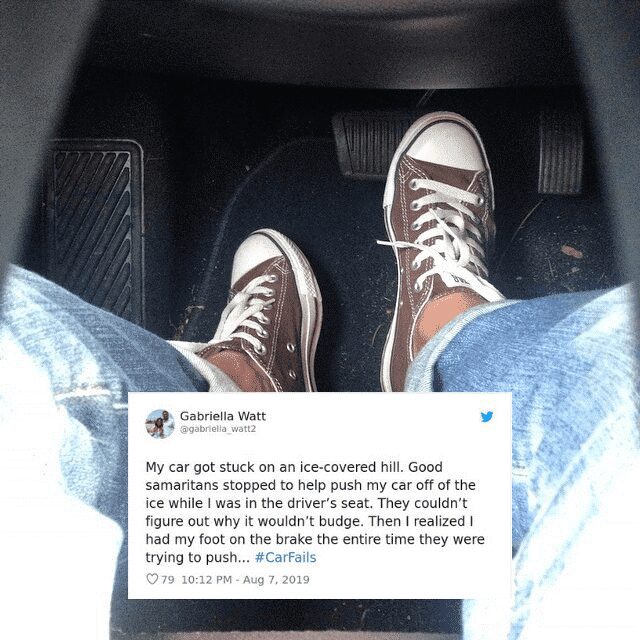
@gabriella_watt2 shared a feel-good story: she was stuck on an icy hill and strangers tried to push her free. The twist? She accidentally had her foot on the brake, meaning the car wasn’t going anywhere no matter how heroic the push team felt. It’s the kind of mistake you only make once—because embarrassment is a powerful teacher.
Expert takeaway: If people are pushing, confirm the car is in the correct gear and your foot isn’t fighting the rescue effort. Communication matters, even when everyone is cold.
39. Unwanted Passenger
Cars feel like a sealed bubble, but nature disagrees. Creepy crawlies can enter through windows, vents, or open doors—and if you’re unlucky, they arrive at the exact moment you are least emotionally prepared.
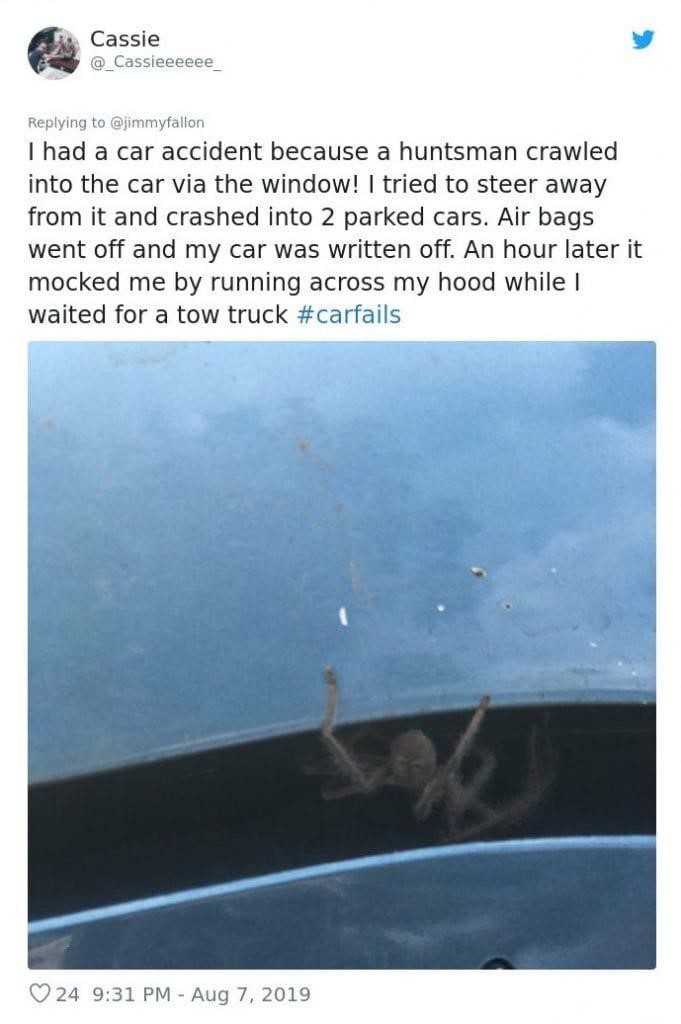
@_Cassieeeeee_ crashed into two parked cars after a huntsman spider crawled into the car, prompting an immediate attempt to escape the spider while still driving. The tragic-comic ending: the spider stayed, waiting for the tow truck alongside her like it owned the place.
Expert takeaway: If something terrifying appears in the cabin, don’t make aggressive steering inputs. Your safest move is to slow down, pull over, and deal with the problem while stationary.
40. A Pup Named Diesel
Fuel mistakes are expensive, time-consuming, and surprisingly common—especially when drivers switch between vehicles or don’t pay close attention at the pump. It’s one of those errors that doesn’t feel dramatic until the engine tells you it is.
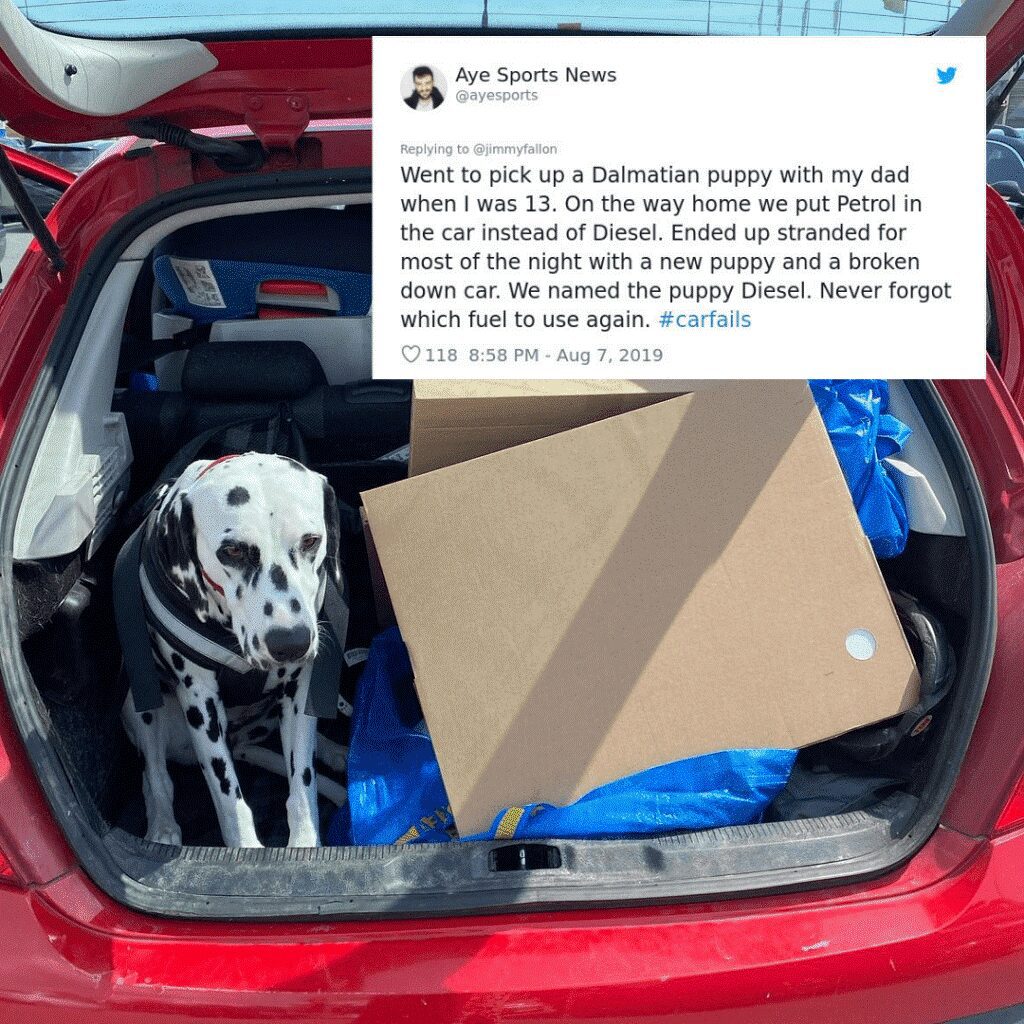
@ayesports shared that at 13, he went with his father to pick up a Dalmatian puppy. That evening, they forgot the car required diesel and filled up with the wrong fuel. To commemorate the chaos (and ensure they never forgot the lesson), they named the puppy Diesel—a living reminder to use the correct fuel.
Expert takeaway: Always confirm fuel type before pumping. If you realize you used the wrong fuel, do not start the engine—call for proper service to drain the tank and protect the fuel system.
Why These Stories Are Funny (and Why They Stick With Us)
Car trouble is frustrating because it disrupts plans and removes control. But once the situation is over—once the snake is gone, the spider is defeated, the keys are found, or the towing is complete—we’re left with something surprisingly valuable: a shared human experience. These stories become funny because they reveal how imperfect we all are when life gets stressful, unexpected, or absurd.
The best part is that many of these mishaps carry a real driving lesson: lock your doors, check your pockets, respect weather, don’t ignore maintenance, and never underestimate how quickly a simple mistake can turn into a story you’ll tell for the rest of your life.
Conclusion
Cars may be essential, but they’re also unpredictable characters in the story of everyday life. Jimmy Fallon’s fans proved that even when vehicles fail, the result can be pure comedy—especially when it’s told after the fact with just the right amount of disbelief.
Whether your worst moment was a car you couldn’t find, a horn you couldn’t stop, a fuel mistake you’ll never repeat, or a surprise “passenger” you didn’t invite, the best approach is the same: stay safe first, solve the problem next, and laugh about it later.

