


In 1962, in the Isle of Man beach resort town of Peel, two microcars that would later become legends in “small-car history” rolled into existence: the P.50 and the Trident. Their origin traces back to the company’s founder and owner, engineer Cyril Cannell, who had become captivated by a relatively new material at the time—reinforced ultralight fiberglass. Cannell first applied fiberglass to boatbuilding, drawn to its excellent strength-to-weight ratio and the freedom it offered in shaping complex forms. It wasn’t long before he began applying the same thinking to automobiles.
By the early 1960s, Cannell was pursuing a bold engineering question: could a “bubble car” be made extraordinarily light and extraordinarily compact, yet still remain functional as a real vehicle? The P.50 and Trident were the cleanest expression of that experiment—minimal footprint, minimal mass, and a philosophy centered on efficiency and practicality rather than outright speed or luxury.
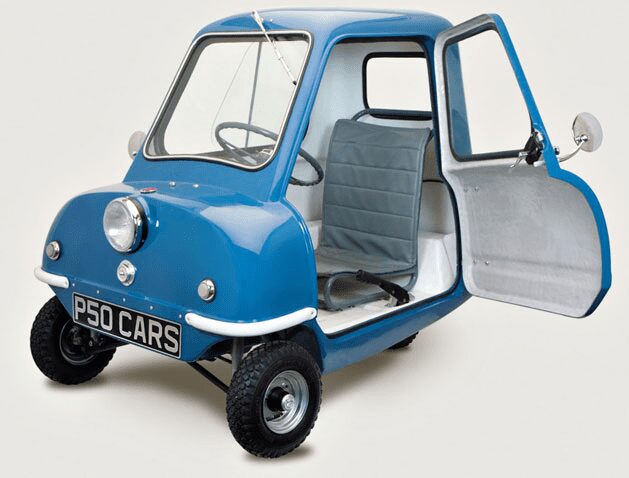
There has always been a limited market for the smallest car in the world, because ultra-microcars occupy a narrow niche. They tend to attract collectors, city drivers with specific needs, and enthusiasts who enjoy unusual engineering. Still, the P.50’s reputation never truly vanished. In 2010, P.50 Cars revived the original designs with the promise of “fusing 1960s elegance with modern reliability.” In practical terms, the goal was clear: keep the recognizable charm and proportions of the original Peel microcars, while improving the ownership experience to suit modern expectations.
From an expert manufacturing standpoint, reviving a low-volume classic is far more demanding than it sounds. Recreating a vehicle with such a unique scale and structure requires specialized tooling, careful handwork, and repeated validation to ensure the final product is both faithful to history and genuinely usable. Skilled artisans reportedly spent nearly a decade completing this re-engineered model. And although most components are replicas of the originals, the matching is so precise that many parts are difficult to distinguish from vintage pieces at a glance.
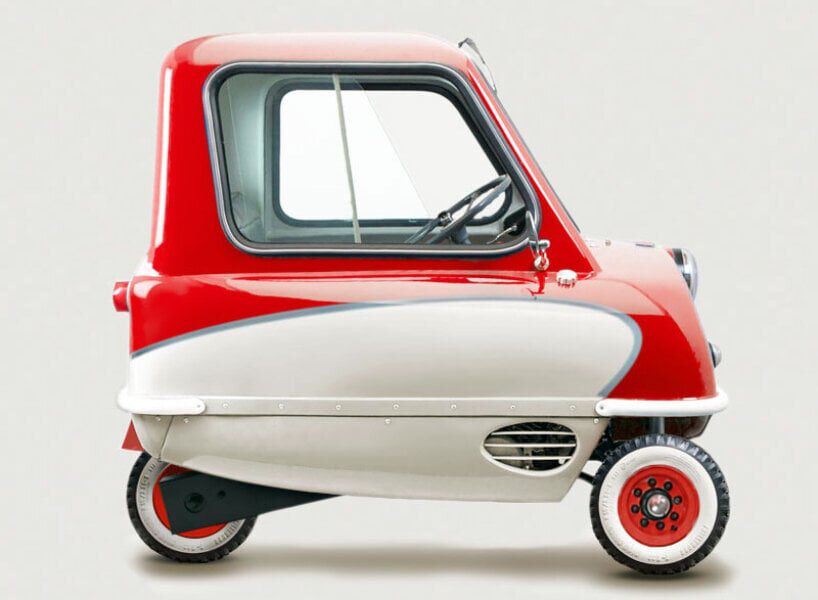
Can I fit inside? It’s a common—and perfectly sensible—question, because the P.50’s proportions can look almost toy-like in photos. Many adults assume it must be impossible to sit in comfortably. P.50 Cars addresses this directly in its FAQ section, and the stated benchmarks are striking: the tallest person confirmed to have sat in the microcar was six feet and nine inches tall, and the heaviest passenger weighed more than 300 pounds.
Even with those extremes, the revived version includes a practical update for today’s drivers: legroom was increased by an extra two inches. That adjustment reflects a real-world design reality—average height has increased over time, and a faithful revival still needs to accommodate modern bodies if it’s going to remain enjoyable to own and drive.

Although Cannell’s original company, Peel Engineering, ended production in 1966, the designs didn’t disappear into history. P.50 Cars brought them back for modern buyers and collectors, and today you can purchase one either factory-built or as a kit you assemble yourself. That flexibility is part of the modern appeal: you can own a tiny automotive legend ready to drive, or you can enjoy the satisfaction of building it piece by piece while still preserving the spirit of the original concept.
Expert takeaway: The P.50’s enduring appeal isn’t only about being small. It represents a design philosophy—maximum ingenuity with minimum material—and it remains one of the rare microcar stories that continues to draw global attention long after its original production ended.