

Picture this. You are driving home from work on a Tuesday evening, and your car suddenly dies in the middle of an intersection. Or maybe you come out to the parking lot after grocery shopping and find that your tire is not just flat, it is shredded. Perhaps you slid off the road during a rainstorm and your car is now sitting nose-down in a ditch.
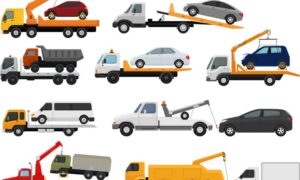
In all of these situations, you are going to need a tow truck. You pull out your phone, call for help, and within 30 to 45 minutes, a truck shows up. But have you ever noticed that the truck that arrives looks completely different depending on the situation? Sometimes it is a flatbed. Sometimes it has a strange mechanical arm on the back. Sometimes it is an absolute monster of a vehicle that looks like it could pull a building off its foundation.
Table of Contents
That is because there is no single “tow truck.” There are actually several distinct types, each designed for specific situations, vehicle sizes, and recovery scenarios. And while most people never think about this until they are standing on the side of the road waiting for help, knowing the difference can actually save you money, protect your vehicle from damage, and help you communicate clearly with the towing company when you call.
The towing industry is far bigger and more specialized than most people realize. These trucks do not just haul broken-down sedans. They move everything from motorcycles and sports cars to semi-trucks, buses, construction equipment, and even boats. Each type of tow truck brings a different set of capabilities, and using the wrong one for your situation can result in damage to your vehicle, a bigger bill, or both.
So let us walk through the six main types of tow trucks, how each one works, what situations they are best suited for, and what you should know as a vehicle owner so you can make smarter decisions when the time comes.
Why the Type of Tow Truck Matters More Than You Think
Before we get into the specific types, it is worth understanding why this even matters. A lot of people assume that when you call a tow truck, whatever shows up will work fine. And in many cases, the towing company will send the right truck for the job without you needing to ask. But not always.
Here is the thing. Using the wrong type of tow truck can actually damage your vehicle. Some towing methods put stress on the drivetrain, especially on all-wheel-drive and four-wheel-drive vehicles. Others can scratch the bumper, bend the frame, or even rip off body panels if the vehicle is not properly secured. If you are having a luxury car, a classic, or a vehicle with a lowered suspension towed, the method matters even more.
There is also the cost factor. Different types of tow trucks have different operating costs, and those costs get passed on to you. A basic wheel-lift tow for a sedan might cost $75 to $125. A flatbed tow for the same car might run $100 to $200. And if you need a heavy-duty integrated wrecker to recover a large truck, you could be looking at $500 or more. Knowing what you actually need helps you avoid overpaying for a service you do not require, or underpaying and getting a truck that is not up to the task.
Let us break down each type.
1. Wheel-Lift Tow Trucks: The Modern Workhorse
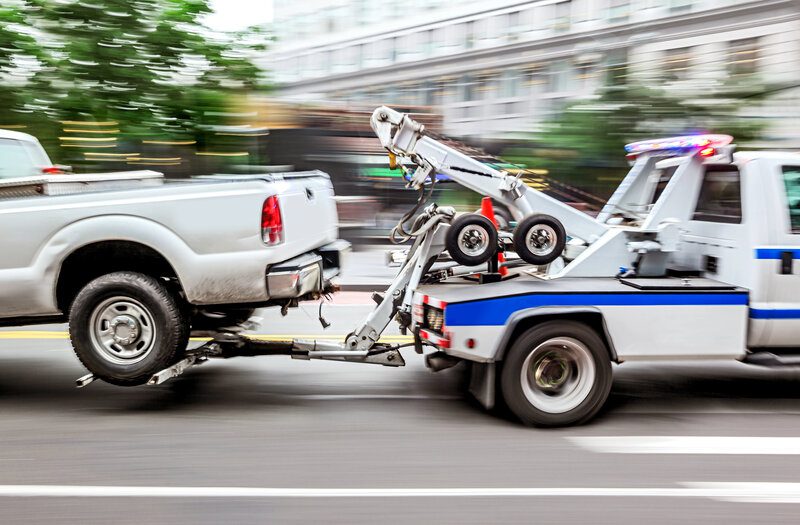
If you have ever seen a tow truck cruising down the road with a car’s front wheels lifted off the ground and its rear wheels rolling along the pavement, you have seen a wheel-lift tow truck in action. This is one of the most common types of tow trucks on the road today, and for good reason. It is relatively simple, efficient, and works well for a wide range of everyday towing situations.
How a Wheel-Lift Tow Truck Works
The wheel-lift system evolved from the older hook-and-chain method (which we will cover next), but it works in a completely different and much less destructive way. Instead of hooking onto the bumper or frame with chains, a wheel-lift truck uses a metal yoke, sometimes called a crossbar or stinger, that slides under the drive wheels of the vehicle being towed.
The yoke cradles the tires themselves. It does not touch the bumper, the body, or the undercarriage of the car. Once the yoke is positioned under the wheels, a hydraulic or pneumatic hoist lifts that end of the vehicle off the ground. The other end stays on its own wheels and rolls freely as the tow truck drives.
Which end gets lifted depends on whether the car is front-wheel drive, rear-wheel drive, or all-wheel drive. For a front-wheel-drive car, the front wheels go into the yoke and get lifted. For a rear-wheel-drive car, the rear wheels get lifted. The idea is to lift the drive wheels off the ground so they are not spinning while the car is being towed. If the drive wheels stay on the ground and spin while the transmission is not running, it can cause serious and expensive damage to the drivetrain.
When a Wheel-Lift Truck Is the Right Call
Wheel-lift tow trucks are ideal for most standard towing situations involving passenger cars, sedans, small SUVs, and light trucks. If your car broke down on the side of the road and needs to be moved to a repair shop a few miles away, a wheel-lift truck is usually the quickest and most cost-effective option.
They are also faster to hook up than a flatbed, which matters when you are sitting on the shoulder of a busy highway. A skilled operator can have your car hooked and ready to move in just a few minutes.
When a Wheel-Lift Truck Is Not the Best Choice
There are some situations where a wheel-lift truck is not ideal:
- All-wheel-drive (AWD) vehicles: Because a wheel-lift truck only lifts one axle, the other set of wheels stays on the ground. On an AWD vehicle, this can damage the transfer case and drivetrain. Most towing companies know this, but it is worth mentioning when you call.
- Lowered or modified vehicles: Cars with lowered suspension, body kits, or aftermarket bumpers may not have enough clearance for the yoke to slide underneath safely.
- Long-distance tows: Since two of the vehicle’s wheels are still on the ground, they are accumulating wear. For short tows to a nearby shop, this is fine. For a 100-mile tow, a flatbed is usually a better option.
- Luxury or high-value vehicles: While wheel-lift towing is much gentler than hook-and-chain, a flatbed still provides the most protection because all four wheels are off the ground.
Typical cost: $75 to $150 for a local tow, depending on your area and the distance to the destination.
2. Hook-and-Chain Tow Trucks: The Old-School Method (and Why It Is Mostly Retired)
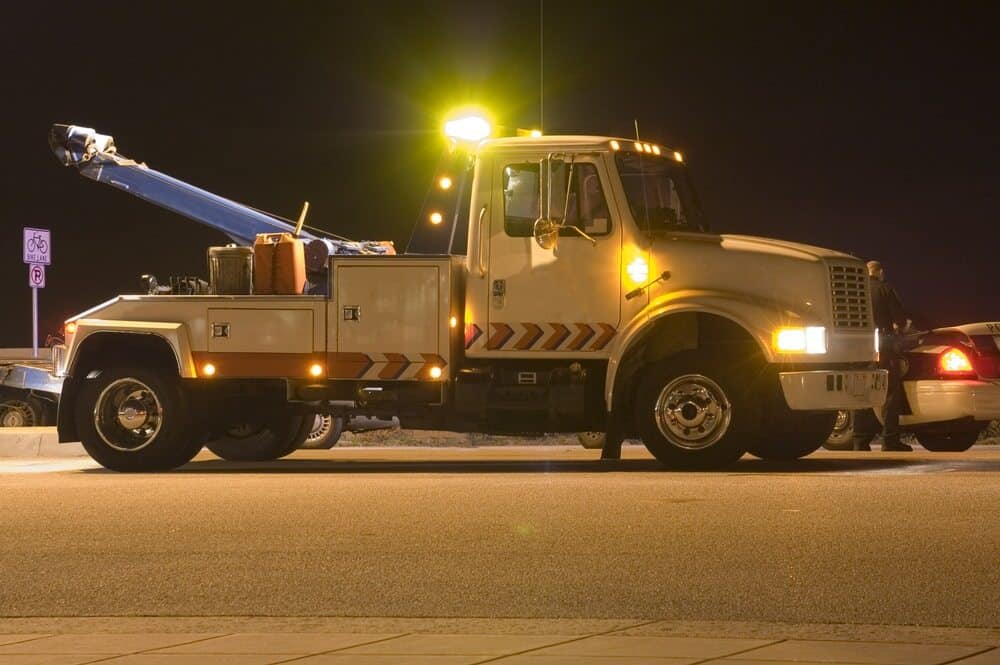
When most people picture a tow truck in their mind, they are probably thinking of the hook-and-chain setup. It is the classic image: a car being dragged behind a truck with chains wrapped around its frame, front end lifted off the ground by a boom, rear tires dragging along the pavement. You have seen it in movies, cartoons, and old TV shows. It is the original tow truck design, and it has been around for decades.
How a Hook-and-Chain Tow Truck Works
The concept is straightforward. A heavy-duty hook, attached to a chain or cable, is secured to the vehicle’s frame, axle, or bumper. The chains are then wrapped around the frame or a structural point on the vehicle. A boom (a mechanical arm) at the rear of the tow truck lifts the front end of the vehicle off the ground using the chain as the connection point. The rear wheels stay on the pavement, and the tow truck drags the car behind it.
It sounds brutal, and honestly, it kind of is. The chains can scratch and dent the vehicle’s body. The hook can damage the bumper or bend the frame if not positioned carefully. And because the entire weight of the lifted end is hanging from a chain attached to a single point, there is a lot of stress concentrated on whatever part of the car the chain is wrapped around.
Why You Rarely See Hook-and-Chain Trucks Anymore
The towing industry has largely moved away from hook-and-chain setups for everyday passenger vehicle towing. The potential for damage is simply too high, and modern vehicles are not built to handle the stress. Unibody cars (which is what most modern cars and crossovers are) do not have a traditional frame that a chain can safely wrap around. The sheet metal and structural components were not designed for that kind of load.
That said, hook-and-chain trucks have not completely disappeared. They are still used in some specific situations:
- Towing junk vehicles: If a car is heading to the scrapyard and cosmetic damage is irrelevant, a hook-and-chain truck gets the job done quickly and cheaply.
- Towing vehicles from accident scenes where the car is already totaled and the priority is clearing the road as fast as possible.
- Impound operations: Some impound lots still use hook-and-chain trucks because speed and efficiency matter more than protecting the vehicle’s finish.
If a towing company shows up with a hook-and-chain truck to tow your daily driver, and your car is not totaled, you have every right to ask for a different truck. The risk of scratches, dents, and structural damage is real, and most reputable towing companies will not even attempt it on a vehicle you plan to keep driving.
Typical cost: Usually the cheapest option, around $50 to $100 for a local tow. But the potential for vehicle damage often makes it a false economy.
3. Boom Trucks: The Rescue Specialists
Imagine your car has slid off the road and is sitting at the bottom of a steep embankment. Or picture a vehicle that has gone off a bridge into a shallow ditch. Or think about a car that is wedged into a tight space between two buildings in a parking garage. In situations like these, a standard wheel-lift or flatbed truck cannot just pull up and hook on. The vehicle is in a spot where conventional towing simply will not work.
That is where boom trucks come in.
How a Boom Truck Works
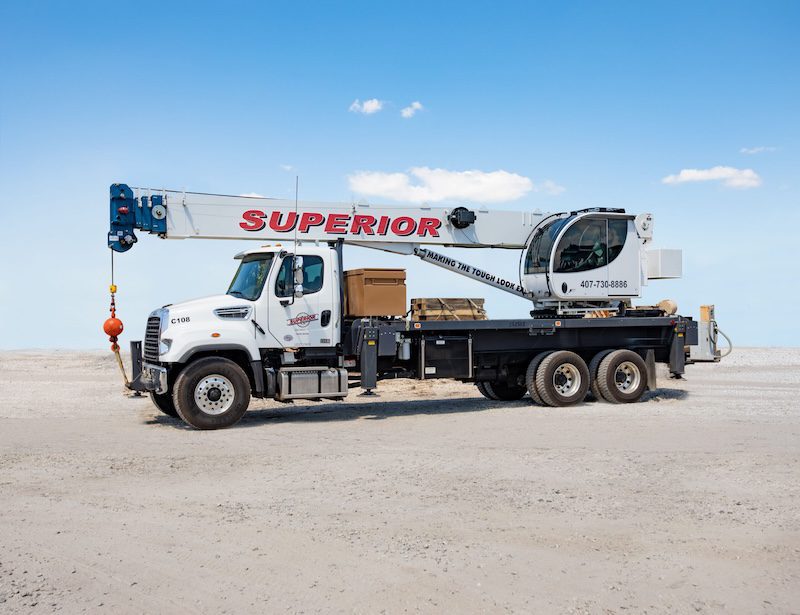
A boom truck features a hydraulic arm (the boom) that extends outward and sometimes upward from the rear of the truck. Think of it as a small crane mounted on the back of a tow truck. The boom is connected to a winch with a heavy-duty cable or strap. The operator extends the boom out over or toward the vehicle, attaches the winch cable, and then uses the combined power of the boom and winch to pull the vehicle out of wherever it is stuck.
Some boom trucks have a fixed boom, meaning the arm extends straight out and does not pivot. Others have an articulating boom that can swing side to side and adjust its angle, giving the operator much more flexibility in reaching vehicles that are in awkward positions.
In the early days, boom trucks used hook-and-chain attachments at the end of the cable. Today, most use slings or belt lifts, which distribute the load more evenly and reduce the risk of damaging the vehicle during recovery. This is a welcome upgrade, because a vehicle that has already been in an accident or gone off the road does not need additional damage from the recovery process.
When a Boom Truck Is the Right Call
Boom trucks are recovery vehicles first and foremost. They are built for situations where the vehicle needs to be extracted from a position that a standard tow truck cannot reach:
- Vehicles that have gone off the road into ditches, embankments, or ravines
- Cars stuck in tight spaces like parking garages, narrow alleys, or between other vehicles
- Vehicles that are partially submerged in water or mud
- Accident recovery where the car cannot be reached by a conventional tow truck
Important Limitations to Know About
Boom trucks have one significant limitation that you need to be aware of: they are not safe for all-wheel-drive vehicles in most configurations. Because the boom lifts only one end of the vehicle, the other end remains on the ground. Just like with wheel-lift trucks, this can damage the AWD drivetrain if the free-rolling wheels are connected to a transfer case or center differential that expects all four wheels to be moving together.
If your AWD vehicle needs to be recovered from a ditch, the usual approach is to use the boom truck to get it out of the ditch, and then load it onto a flatbed for transport to the shop. It is a two-step process, but it protects your vehicle.
Heavy-duty boom trucks are essentially scaled-up versions of the standard models. Some of these larger units function almost like mobile cranes and can recover vehicles weighing several tons. They are the go-to for pulling overturned box trucks out of medians or recovering delivery trucks that have gone off the road.
Typical cost: $150 to $400 or more, depending on the complexity of the recovery. Simple extractions are on the lower end. Complex recoveries involving winching up steep grades or pulling vehicles out of water can get expensive quickly.
4. Flatbed Tow Trucks: The Safest Way to Move a Vehicle
If you want the safest, most damage-free way to transport a vehicle from point A to point B, a flatbed tow truck is the answer. Also called a “slide” truck or “rollback” truck, this is the type of tow truck that carries your car entirely on its back, with all four wheels off the ground and the vehicle secured to a flat platform.
Flatbed trucks are the most popular type of tow truck in the industry, and it is easy to see why. They are versatile, they work with virtually any type of vehicle, and they virtually eliminate the risk of drivetrain damage during transport.
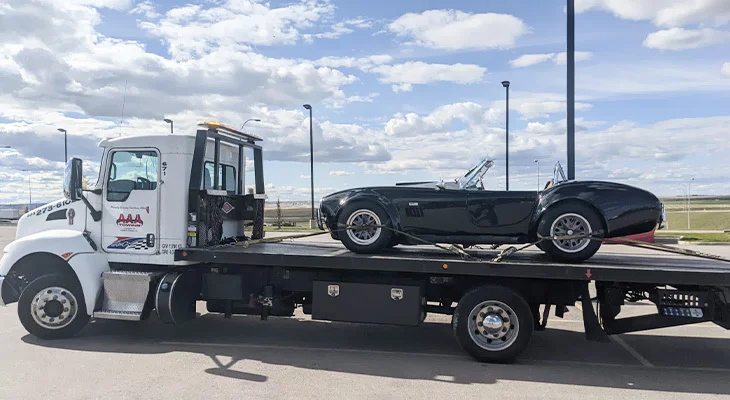
How a Flatbed Tow Truck Works
The flatbed truck has a long, flat platform (the bed) mounted on the back of the truck chassis. This platform is hydraulically operated and can do one of two things, depending on the design:
- Tilt and lower: The entire bed tilts backward so that the rear edge touches the ground, creating a ramp. The vehicle is then driven up the ramp (if it can run) or winched up the ramp (if it cannot). Once the vehicle is on the bed, the platform tilts back to level.
- Slide back: On some models, the bed slides backward off the truck’s frame and lowers to the ground. The vehicle is loaded the same way, and then the bed slides forward back into position.
Once the vehicle is on the bed, the operator secures it using straps, chains, and wheel chocks. The car sits flat on the platform with all four wheels off the ground for the entire trip. There is no dragging, no spinning wheels, and no contact with the road surface.
A winch is mounted at the front of the bed for situations where the vehicle cannot be driven onto the ramp. This is common when the car will not start, has a flat tire, or has been in an accident that damaged the wheels or drivetrain. The winch cable is attached to the vehicle’s frame or tow hooks, and the winch pulls the car up onto the bed.
Why Flatbed Towing Is Often the Best Option
There are several reasons why flatbed towing is considered the gold standard:
- Zero drivetrain risk: Because all four wheels are off the ground, there is absolutely no risk of damaging the transmission, transfer case, or differential during transport. This makes flatbed towing the only safe option for AWD and 4WD vehicles.
- No tire wear: The tires are not touching the road, so there is no wear during transport. This matters for long-distance tows.
- Minimal body damage risk: When done correctly, the straps and tie-downs hold the vehicle securely without touching the body panels, bumpers, or paint.
- Works with any vehicle: Sedans, trucks, SUVs, vans, sports cars, motorcycles (with proper tie-downs), and even small equipment can all ride on a flatbed.
- Ideal for disabled vehicles: If your car cannot roll at all, whether due to a locked-up engine, seized brakes, or damaged wheels, the winch handles loading without any need for the car to move under its own power.
Are There Any Downsides to Flatbed Towing?
Honestly, not many. The main drawbacks are cost and setup time. Flatbed tows tend to cost a bit more than wheel-lift tows because the equipment is larger and the loading process takes a few extra minutes. A flatbed operator needs to tilt the bed, winch or drive the vehicle on, secure it with multiple straps, and then level the bed before driving away. A wheel-lift hookup can be done in two or three minutes by comparison.
There are also situations where a flatbed physically cannot reach the vehicle. If your car is at the bottom of a steep ditch, a flatbed cannot lower its bed down to the car. In those cases, a boom truck would need to extract the vehicle first, and then a flatbed can take over for transport.
For lowered vehicles or cars with very low ground clearance, the approach angle of the ramp can sometimes be too steep. Some flatbed operators carry ramp extensions or can adjust the bed angle to accommodate low cars, but it is worth mentioning when you call for a tow so the company sends the right setup.
Typical cost: $100 to $250 for a local tow. Long-distance flatbed towing is usually charged per mile, typically $2 to $5 per mile after a base fee.
5. Integrated Tow Trucks: Heavy-Duty Power for Big Rigs and Buses
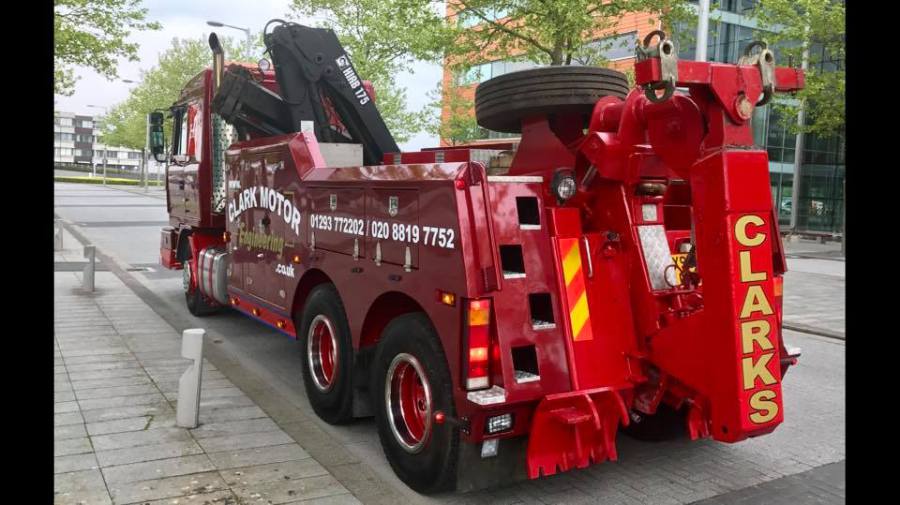
Now we are getting into the big leagues. Integrated tow trucks, also called heavy-duty wreckers, are the largest and most powerful tow trucks you will ever see on the road. These are not for towing your Honda Civic. These are for towing other trucks. Semi-trucks. Buses. RVs. Construction equipment. Anything that weighs 25,000 pounds or more.
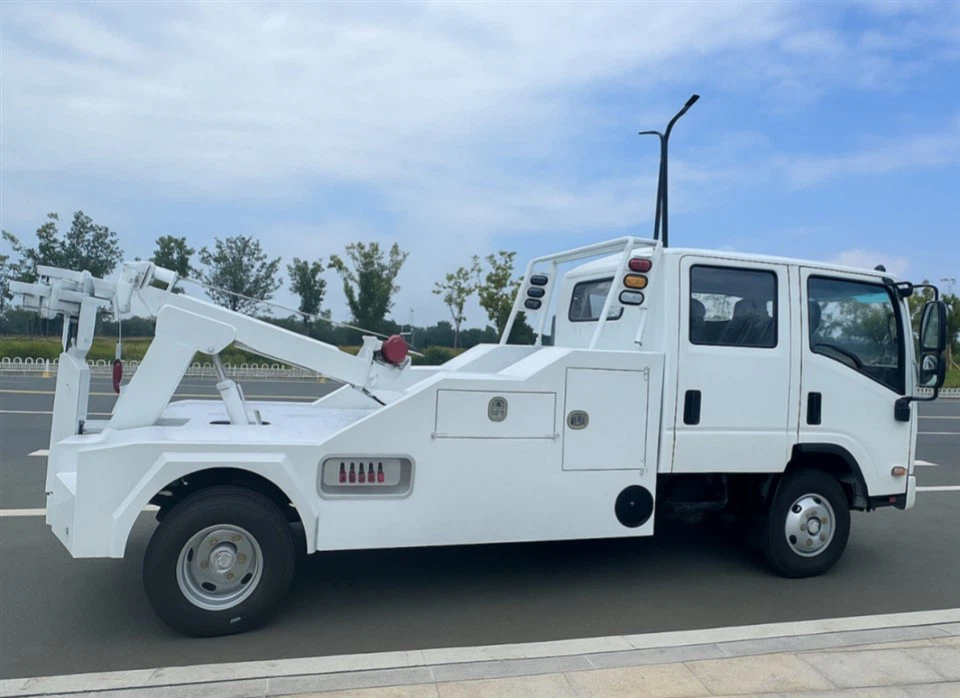
How an Integrated Tow Truck Works
The term “integrated” refers to how the towing apparatus is built into the truck’s chassis rather than being bolted on as an afterthought. The boom, winch, wheel-lift mechanism, and stabilizing outriggers are all engineered as a single, unified system that is permanently integrated into the truck’s frame. This gives the truck dramatically more strength and stability compared to a regular tow truck with bolt-on equipment.
Most integrated wreckers are built on heavy-duty truck chassis with multiple axles. Having that extra axle (or two) gives the truck significantly more weight capacity, more stability when lifting heavy loads, and better traction when pulling against massive resistance. Some of these trucks weigh 50,000 pounds or more just by themselves, before they even start towing anything.
The typical integrated wrecker features:
- A heavy-duty boom with a lifting capacity of 25 to 75 tons (yes, tons)
- One or more powerful winches with thousands of feet of cable
- A wheel-lift or underlift system rated for the weight of the vehicles it is designed to tow
- Hydraulic outriggers (stabilizer legs) that extend from the sides of the truck and plant firmly on the ground to prevent the wrecker from tipping over during heavy lifts
- Extensive lighting, signage, and safety equipment for working on highways and at accident scenes
When You Need an Integrated Wrecker
You will never need to call one for a regular passenger vehicle. But if you drive or manage a fleet that includes heavy-duty trucks, buses, RVs, or large commercial vehicles, these are the trucks that come to the rescue when something goes wrong:
- A semi-truck that has broken down on the highway and needs to be towed to a repair facility
- An overturned delivery truck or box truck that needs to be righted and recovered
- A city bus that has suffered a mechanical failure and needs to be moved off the route
- Heavy construction equipment that has broken down or gotten stuck at a job site
- Tractor-trailers involved in highway accidents that need to be cleared quickly
What a lot of people do not realize is that large trucks and buses break down frequently. A long-haul semi-truck might cover 100,000 miles a year or more, and at those kinds of distances, mechanical failures are inevitable. Blown tires, engine failures, transmission problems, overheated brakes, broken driveshafts. All of these can leave a 40-ton rig sitting dead on the shoulder of an interstate. And you cannot exactly push it to the next exit.
Integrated wreckers are also essential for accident recovery on highways. When a semi-truck jackknifes or overturns, clearing the scene quickly is a priority because of the massive traffic disruption. These trucks have the power and the equipment to right an overturned trailer, winch a rig out of a ditch, or tow a disabled truck and its loaded trailer to a safe location.
Typical cost: $300 to $1,000 or more, depending on the size of the vehicle being towed, the distance, and the complexity of the recovery. Some heavy-duty recoveries involving overturned trucks or accident scenes can run several thousand dollars.
6. Oversized Towing Rigs: When Nothing Else Is Big Enough
And then there are the true giants of the towing world. Oversized towing rigs are specialized vehicles designed for hauling things that are simply too large for any standard tow truck, no matter how heavy-duty. We are talking about massive boats, construction cranes, industrial equipment, prefabricated buildings, military vehicles, and the kind of oversized loads that require escort vehicles and special permits just to move down the highway.
What Makes Oversized Towing Different
Oversized towing is not really about “towing” in the traditional sense. It is about heavy hauling and transport. These rigs often use specialized trailers with multiple axles, hydraulic suspension systems, and extendable decks to accommodate loads that are both extremely heavy and physically large.
You have probably seen one of these operations on the highway without realizing exactly what was happening. That wide-load convoy with pilot cars in front and behind, flashing lights, and a massive piece of equipment sitting on a trailer that takes up two lanes? That is oversized towing in action.
These operations require extensive planning. The route has to be surveyed in advance to make sure there are no low bridges, tight turns, or narrow roads that the load cannot clear. Permits need to be obtained from state and sometimes local authorities. Escort vehicles are required in most states. And the truck operators who handle these loads are specialists with years of training and experience.
When Oversized Towing Comes Into Play
Most small towing companies do not have oversized towing capability. This is a niche within the towing industry, and the companies that do it tend to focus exclusively on heavy hauling and industrial transport. Situations that call for oversized towing include:
- Moving large boats and yachts over land between waterways or from a boatyard to a marina
- Transporting construction equipment like excavators, bulldozers, and cranes from one job site to another
- Hauling industrial machinery for factories and manufacturing plants
- Moving prefabricated structures like modular homes, office trailers, and storage buildings
- Transporting military vehicles and equipment
- Recovering overturned or disabled oversized loads (like a wind turbine blade that has fallen off a transport trailer)
For the average car owner, you will probably never need to call for oversized towing. But it is good to know it exists, especially if you are involved in a business that uses heavy equipment or if you ever find yourself sharing the road with one of these convoys and wondering what is going on.
Typical cost: Highly variable. Oversized towing is priced based on the weight of the load, the distance, the number of escort vehicles required, permit costs, and the complexity of the route. A short move might cost $1,000 to $3,000. A long-distance oversized haul can easily exceed $10,000.
Quick Comparison: Which Tow Truck for Which Situation
Here is a side-by-side comparison to help you see at a glance which type of tow truck fits different scenarios:
| Tow Truck Type | Best For | Not Ideal For | Approx. Cost |
|---|---|---|---|
| Wheel-Lift | Standard cars, short local tows | AWD vehicles, luxury cars, long distance | $75 – $150 |
| Hook-and-Chain | Junk cars, totaled vehicles, impounds | Any vehicle you want to keep in good condition | $50 – $100 |
| Boom | Vehicle recovery from ditches, tight spaces | AWD vehicles (for transport), standard road towing | $150 – $400+ |
| Flatbed | AWD/4WD vehicles, luxury cars, long distance, disabled vehicles | Vehicles in inaccessible locations (need boom first) | $100 – $250+ |
| Integrated | Semi-trucks, buses, heavy equipment, accident recovery | Regular passenger vehicles (overkill) | $300 – $1,000+ |
| Oversized | Boats, construction equipment, industrial loads | Anything a standard tow truck can handle | $1,000 – $10,000+ |
What to Tell the Towing Company When You Call
When you are standing on the side of the road and you call for a tow, the dispatcher is going to ask you some questions to determine which truck to send. Knowing what information to have ready can speed up the process and help ensure the right truck shows up:
- Your exact location. An address is ideal. If you are on a highway, give the road name, direction of travel, and the nearest mile marker or exit.
- Your vehicle’s make, model, and year. This helps the dispatcher determine the size and type of truck needed.
- Is the vehicle drivable? Can it roll, or is it completely immobile? This determines whether a winch will be needed.
- What drivetrain does it have? Front-wheel drive, rear-wheel drive, all-wheel drive, or four-wheel drive? This is critical for determining whether a flatbed is necessary.
- Where is the vehicle positioned? On the road? On the shoulder? In a ditch? In a parking lot? The vehicle’s location determines whether a standard truck can reach it or if a boom truck is needed.
- Does it have any modifications? Lowered suspension, body kits, aftermarket bumpers, oversized wheels? These can affect which towing method is safe to use.
- Where do you want it taken? Have the address of the repair shop or destination ready.
Providing this information upfront saves time and reduces the chance of the wrong truck showing up, which would mean waiting even longer while the correct one is dispatched.
How to Protect Your Vehicle During a Tow
Even when the right type of tow truck shows up, there are a few things you can do to protect your vehicle:
- Take photos before the tow. Document the condition of your vehicle, especially the bumpers, wheels, and undercarriage. If any damage occurs during towing, you will have proof of the vehicle’s condition before it was hooked up.
- Remove personal valuables. Take anything important out of the car before it goes on the truck. While theft is uncommon, it is better to have your laptop, wallet, and other valuables with you.
- Ask the operator how they plan to tow it. A good operator will explain the process. If something sounds off, like using a wheel-lift on your AWD car, speak up.
- Make sure the parking brake is off if the rear wheels will be rolling on the ground during towing. A locked rear wheel being dragged will flat-spot the tire.
- Put the transmission in neutral if the tow operator asks you to. On some vehicles, this prevents damage to the transmission during towing.
- Get a receipt and the tow truck number. If your vehicle is damaged during the tow, you will need this information to file a claim.
How Much Should a Tow Actually Cost?
Towing costs vary widely depending on where you live, the type of truck used, the distance, and the time of day (after-hours tows often carry a surcharge). Here is a general breakdown to give you some idea of what to expect:
- Base hookup fee: $50 to $100 in most areas
- Per-mile charge: $2 to $5 per mile after the first few miles (some companies include the first 5 to 10 miles in the base fee)
- Flatbed premium: Usually $25 to $75 more than a wheel-lift tow for the same distance
- After-hours surcharge: $50 to $100 extra for nights, weekends, and holidays
- Winching fee: $50 to $150 extra if the vehicle needs to be winched out of a ditch, off soft ground, or up a steep grade
- Heavy-duty towing: $300 to $1,000+ depending on the size of the vehicle
If you have roadside assistance through your insurance company, AAA, or your vehicle manufacturer, a significant portion of this cost may be covered. Most roadside assistance plans cover a basic tow up to a certain distance (often 5 to 15 miles) at no charge. Beyond that, you pay the per-mile rate. Some premium plans cover longer distances or even include flatbed towing at no extra cost.
It is worth checking your coverage before you ever need it, because finding out the details while you are standing on the side of a dark highway is not the ideal time to read the fine print.
Can the Wrong Tow Truck Damage Your Car? Absolutely.
This is not a scare tactic. It is reality. Using the wrong towing method for your vehicle can cause real, expensive damage. Here are the most common types of towing damage and how they happen:
Transmission damage: This is the big one. If your vehicle is rear-wheel drive and it is towed with the rear wheels on the ground and the transmission in park, the output shaft of the transmission is spinning while the internal gears are locked. This can destroy the transmission. The same applies to front-wheel-drive vehicles towed with the front wheels down. And for AWD vehicles, towing with any wheels on the ground can damage the center differential or transfer case.
Bumper and body damage: Hook-and-chain towing is notorious for this. The chains can scrape paint, dent panels, and crack bumpers. Even wheel-lift towing can damage a front bumper if the yoke is positioned incorrectly or if the bumper hangs lower than the tow operator realized.
Suspension damage: If a vehicle is lifted from one end and the straps or yoke are not properly positioned, the weight distribution can put excessive stress on suspension components. This is especially true for vehicles with independent rear suspension or air suspension systems.
Tire damage: A flat-spotted tire results from being dragged with the brakes locked or the wheels unable to rotate freely. This can happen if the parking brake is left on during a dolly or wheel-down tow.
The takeaway? Always make sure the towing company knows your vehicle’s drivetrain type, and do not hesitate to request a flatbed if you are at all concerned about potential damage. The extra $50 to $75 for a flatbed tow is a bargain compared to a $3,000 transmission replacement.
A Few Things Most People Do Not Know About Towing
Since we are on the topic, here are some lesser-known facts about the towing industry that might come in handy someday:
Tow truck operators are trained professionals. A good tow truck operator knows the specific towing requirements for hundreds of different vehicle makes and models. They understand which vehicles can be safely flat-towed, which ones need dollies, and which ones absolutely must go on a flatbed. If an operator tells you something about your vehicle’s towing requirements that you did not know, listen to them. They probably know more about it than you do.
Your owner’s manual has towing instructions. Somewhere in that thick book sitting in your glove box (or buried in the infotainment system on newer cars) is a section on emergency towing. It will tell you the correct towing method for your specific vehicle, including whether it can be flat-towed, which end should be lifted, and any special precautions. Read it before you need it.
Not all towing companies are created equal. Like any industry, there are excellent operators and there are ones you want to avoid. Look for companies that are properly licensed and insured, have good online reviews, and are willing to answer your questions about the towing method they plan to use. If a company is dismissive of your concerns about vehicle damage, find another company.
You have rights during a tow. In most states, towing companies are required to provide you with a written estimate before they start, and they cannot hold your vehicle hostage for inflated fees. If something feels off, ask for the estimate in writing and note the company name, truck number, and operator name. If you believe you have been overcharged or your vehicle was damaged, you can file a complaint with your state’s consumer protection agency or the local transportation authority.
Tow trucks respond to more than breakdowns. Towing companies also handle accident recovery, impound services, repossessions, parking enforcement towing, police-requested tows, and even moving vehicles for dealerships and auction houses. The industry is much bigger and more diverse than most people realize.
What About Towing Dollies and Tow Bars?
While not technically “tow trucks,” these are two other towing methods worth knowing about:
Towing dollies are small two-wheeled trailers that cradle the front (or rear) wheels of a vehicle. The other two wheels stay on the ground. This is a common method for towing a car behind an RV or motorhome. It is basically a portable version of what a wheel-lift truck does, but without the tow truck. Dollies work well for front-wheel-drive vehicles but are not safe for AWD vehicles for the same reasons we discussed earlier.
Tow bars (also called A-frame tow bars) connect the front of the towed vehicle directly to the rear of the towing vehicle. All four wheels of the towed car stay on the ground. This is called flat towing or “four-down towing.” It only works with vehicles that are specifically designed to be flat-towed, which means the transmission can handle being in neutral while the wheels spin. Many manual-transmission vehicles and certain automatic-transmission models can be flat-towed, but you must check your owner’s manual first. Flat-towing a vehicle that is not designed for it will destroy the transmission.
What to Do If Your Car Gets Damaged During a Tow
If you pick up your vehicle after a tow and notice damage that was not there before, here is what to do:
- Document the damage immediately. Take clear photos from multiple angles. Include close-ups of the damaged area and wider shots showing the overall vehicle.
- Compare to your pre-tow photos. This is why we recommended taking photos before the tow. Having before-and-after evidence is powerful.
- Contact the towing company. Report the damage and request their insurance information. Reputable companies carry liability insurance for exactly this kind of situation.
- File a claim. If the towing company is uncooperative, contact your own insurance company. Your comprehensive or collision coverage may cover towing damage, and your insurer can pursue the towing company for reimbursement.
- File a complaint. If the towing company denies responsibility or refuses to cooperate, file a complaint with your state’s attorney general, consumer protection agency, or the Better Business Bureau.
Every Driver Should Know This Stuff
Most people never think about tow trucks until they need one. And by then, they are stressed, stranded, and in no position to make informed decisions. They just want the car off the road and someone else to handle it. That is understandable. But a little bit of knowledge goes a long way.
Knowing the difference between a wheel-lift and a flatbed, understanding why your AWD crossover cannot be towed with two wheels on the ground, and having the right information ready when you call the towing company can save you from vehicle damage, unexpected costs, and a lot of frustration.
The towing industry exists to help people in some of their worst moments on the road. A broken-down car, a fender bender, a tire blowout in the rain. These are stressful situations. But when the right truck shows up, operated by a professional who knows what they are doing, it turns a bad day into a manageable one.
So here is a simple action item: pull out your owner’s manual (or look it up online for your specific vehicle) and find the section on emergency towing. Read it. Know whether your car needs a flatbed. Know which end should be lifted if a wheel-lift truck shows up. Save a reputable local towing company’s number in your phone. Because when you are standing on the shoulder of a highway at 11 PM in the rain, you will be glad you did.