

From an engineering and operational standpoint, a police vehicle has to do far more than simply “drive fast.” A patrol car must be tough enough to survive constant stop-and-go use, long idling hours, curb impacts, and the occasional high-stress pursuit; often all in the same shift. It also needs dependable performance: strong acceleration for merging and response, stable high-speed handling on open roads, and braking systems capable of repeated heavy use without fading. In many jurisdictions, it must carry extra weight as well; radios, computers, protective partitions, emergency lighting, and specialized equipment; all while remaining predictable and safe to control.
Equally important, a modern law-enforcement vehicle has to keep pace with the real world of civilian performance. Today’s roads are filled with powerful sedans, tuned coupes, and SUVs that can accelerate quickly and cruise at high speeds. When an offender attempts to flee, the responding unit must be able to maintain contact, close distance when appropriate, and do so without compromising officer safety or the safety of the public. This is why many agencies invest in vehicles with upgraded powertrains, reinforced components, heavy-duty cooling, and purpose-built drivetrains. The goal is not “racing”; it’s control, reliability, and the ability to respond decisively when seconds matter.
However, performance is only one part of the story. Some countries also deploy highly distinctive, high-end vehicles for strategic visibility. In certain cities; particularly global tourist destinations; police supercars can serve as rolling symbols of technological progress, public reassurance, and deterrence. A vehicle that turns heads can also draw attention to the police presence in crowded districts, promoting compliance and improving perceptions of safety. And while it may look like pure extravagance from a distance, the real motivation often combines public relations, rapid-response capability, and an unmistakable statement: law enforcement can match the pace of the fastest machines on the road.
With that context in mind, it becomes easier to understand why the fleet of vehicles used by certain law-enforcement organizations can be surprisingly stylish; and, in some cases, genuinely exotic. Below is a closer, expert-oriented look at several nations recognized for operating some of the most advanced (and memorable) police vehicles, including hybrid supercars, ultra-high-speed hypercars, specialized pursuit packages, and performance icons built in the very countries that deploy them.
UAE – BMW i8
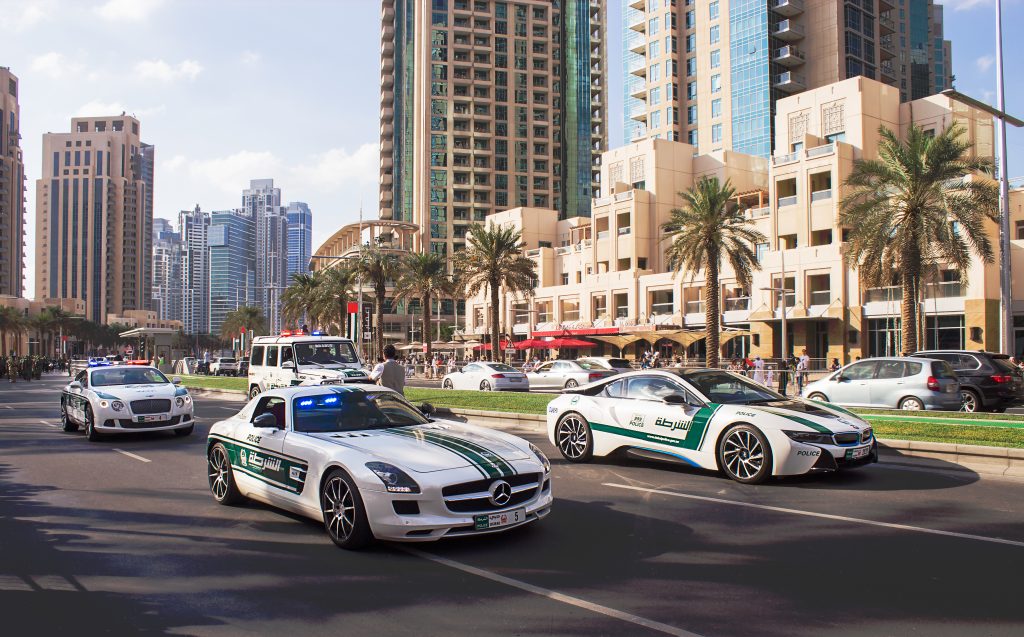
In virtually every high-profile undertaking; architecture, infrastructure, tourism, and technology; the United Arab Emirates is known for projecting confidence, ambition, and a taste for premium experiences. That same public-facing philosophy has, at times, extended into policing, particularly in Dubai, where the police fleet has gained international attention for featuring some of the most luxurious and advanced supercars on the planet. While a typical patrol vehicle must prioritize durability, practicality, and low operating cost, Dubai’s more visible performance cars are often positioned as flagship assets: highly recognizable, strategically deployed, and engineered to perform at a level that matches the city’s modern image.
One standout example is the plug-in hybrid version of the BMW i8. Even by today’s standards, the i8 remains a distinctive machine because it blends sporty design with electrified performance. In this police-oriented context, that combination can be more than a styling choice; it can be a functional advantage. Hybrid powertrains can offer immediate torque delivery, brisk low-speed acceleration, and the ability to operate more efficiently during urban patrol cycles where stoplights, short bursts, and frequent idling are common. It also signals a forward-looking approach: an advanced vehicle that reflects both performance and evolving automotive technology.
From a specifications perspective; as referenced in the details above; this high-performance vehicle delivers more than 355 horsepower, generated by a 1.5-liter turbocharged three-cylinder engine working in tandem with an electric motor. That configuration is notable because it demonstrates how modern engineering can extract serious output from a comparatively small internal-combustion unit by pairing it with electric assistance. The result is a car that can respond quickly in real-world scenarios while maintaining the kind of efficiency and composure that fits city operations. According to the provided figures, it achieves 112 miles per gallon and produces 420 foot-pounds of torque, numbers that highlight its dual character: performance-oriented yet efficiency-conscious.
It is also worth discussing why a vehicle like this can be attractive to law enforcement beyond raw speed. In public spaces; shopping districts, event venues, tourist corridors; police vehicles serve an additional role: visibility. A recognizable car can act like a moving beacon, helping citizens locate assistance quickly and reminding would-be offenders that law enforcement is present. The BMW i8 is visually unmistakable, which makes it particularly effective in that “high-visibility patrol” function. In that sense, the car is not merely transportation; it can be an element of a broader strategy focused on deterrence and public engagement.
From an operational perspective, any advanced patrol vehicle; especially a specialized one; must be integrated thoughtfully. Performance alone is not enough. Agencies have to consider maintenance routines, tire selection, brake wear, and the training required to operate a fast car safely in dense traffic. They also have to decide how and where such vehicles will be used. Many departments that operate high-end vehicles reserve them for specific corridors, high-profile events, community outreach, or situations where rapid response is beneficial and risk can be managed. That type of structured deployment ensures that the vehicle’s strengths are used responsibly, without treating public roads like racetracks.
In short, the UAE’s use of an advanced hybrid supercar like the BMW i8 illustrates a particular blend of priorities: cutting-edge automotive technology, strong performance credentials, and a public-facing presence that aligns with Dubai’s reputation for modernity. Whether parked at a landmark location, patrolling an upscale district, or appearing at an official event, it reinforces the message that the city’s law-enforcement image is designed to be both capable and unmistakably contemporary.
UAE – Bugatti Veyron
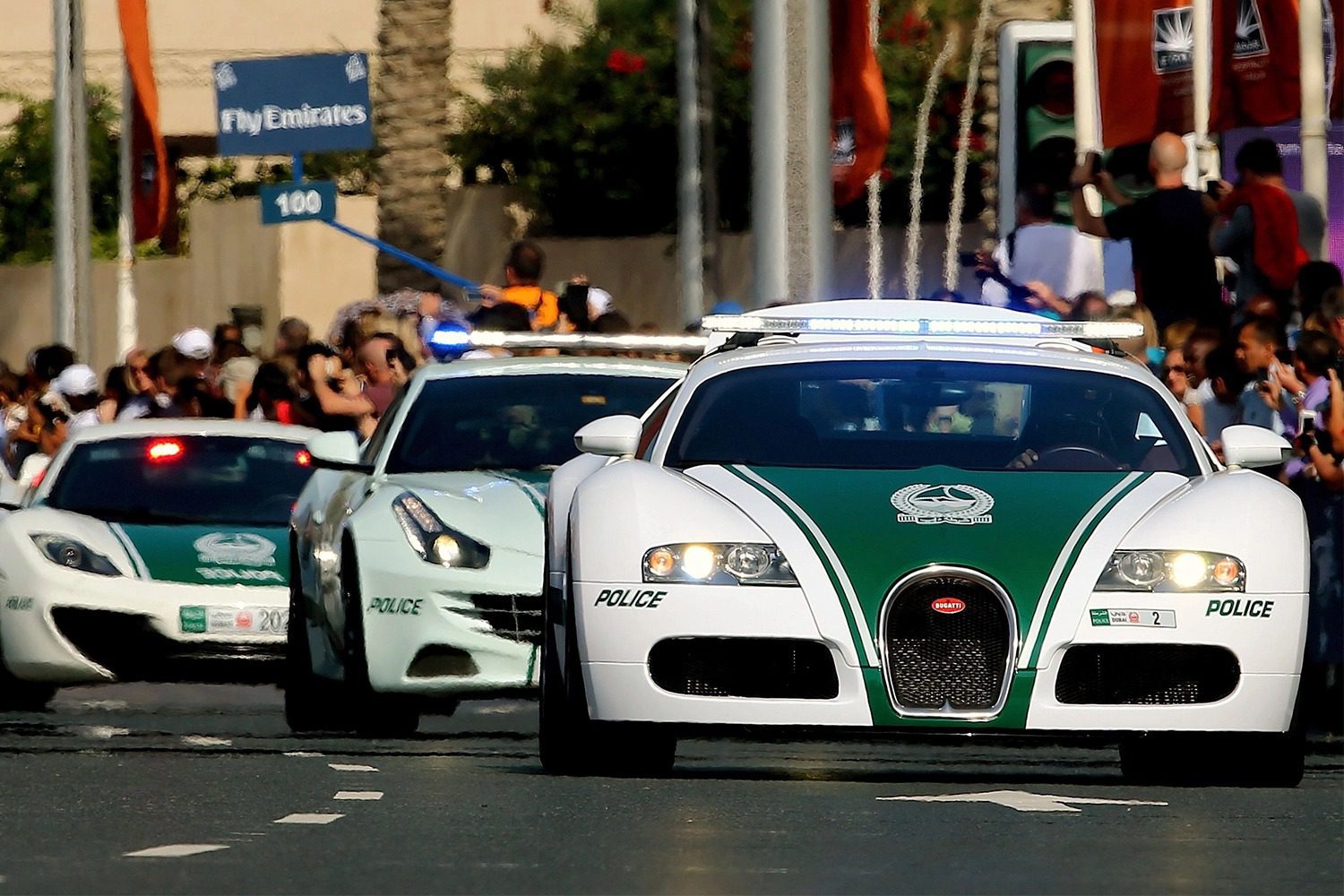
If the BMW i8 feels like an impressive blend of innovation and performance, the Bugatti Veyron shifts the conversation into a different universe entirely. The very name “Veyron” is often treated as shorthand for extreme speed and engineering excess; the kind of vehicle that sits at the top of the supercar hierarchy. And yes, it is true that the police force in Dubai is equipped with one of the world’s most costly supercars, a fact that has fueled global headlines, social media attention, and ongoing curiosity about how such an extraordinary machine fits into real law-enforcement work.
As stated in the provided information, this high-performance automobile has a top speed of 265 miles per hour and carries an approximate purchase price of $1.6 million. Those numbers matter, not because most police operations require anything close to that maximum speed, but because they signal what the vehicle represents: the outer edge of automotive capability. In practice, top speed is only one dimension of performance, but it is a highly visible one, and in Dubai’s case, visibility is part of the point. A Bugatti in police livery is not just transportation; it is a rolling headline, a statement of resources, and an unmistakable symbol that captures attention in a way standard fleet vehicles simply cannot.
From an expert viewpoint, it is important to interpret such a vehicle through the lens of mission fit. A hypercar like the Veyron is not typically purchased because an agency expects to conduct daily patrol in it. Instead, a vehicle at this tier is more commonly associated with selective deployment: strategic appearances, ceremonial roles, community engagement, and targeted patrol presence in highly visited areas. When used thoughtfully, it can function as an outreach tool; an icebreaker that invites positive interaction, photographs, and conversation. In cities that prioritize tourism and international branding, those interactions can be considered part of public safety culture, not separate from it.
At the same time, the existence of such a vehicle within a police fleet also communicates a deterrence message. Even if it is rarely used in typical enforcement, it reinforces the idea that law enforcement can field equipment that exceeds the performance of most civilian cars. That perception can influence behavior in subtle ways, especially in environments where drivers are tempted to treat highways and open stretches of road as arenas for speed. In other words, the Veyron’s value is not only in what it can do mechanically, but also in what it implies psychologically.
Of course, the practical considerations are substantial. Operating a hypercar in any official capacity requires serious planning: specialized maintenance schedules, carefully managed storage, controlled driver training, and strict usage guidelines. Tire costs, brake service, and component wear are all magnified in vehicles engineered for extreme performance. Furthermore, every responsible agency must consider risk: the faster the vehicle, the higher the potential consequences of misuse. That is why any “advanced” police vehicle; especially one capable of 265 miles per hour; must be paired with disciplined policy, clear accountability, and a culture that prioritizes public safety over spectacle.
Still, Dubai’s association with the Bugatti Veyron has become part of the city’s modern mythology. It illustrates a particular model of policing image-making: one where elite vehicles support a high-visibility strategy, reinforce a message of capability, and align with a broader narrative of ambition. Even among luxury police fleets, the Veyron remains a standout; less because it is necessary for everyday enforcement and more because it symbolizes the outer boundary of what a police vehicle can be.
In that sense, the Veyron’s role can be understood as a fusion of engineering prestige and public presence. It attracts attention instantly, and that attention can be leveraged to create engagement, amplify deterrence, and strengthen the police brand in a city that is globally recognized for doing things on a grand scale.
U.S. and Canada – Ford Mustang SSP
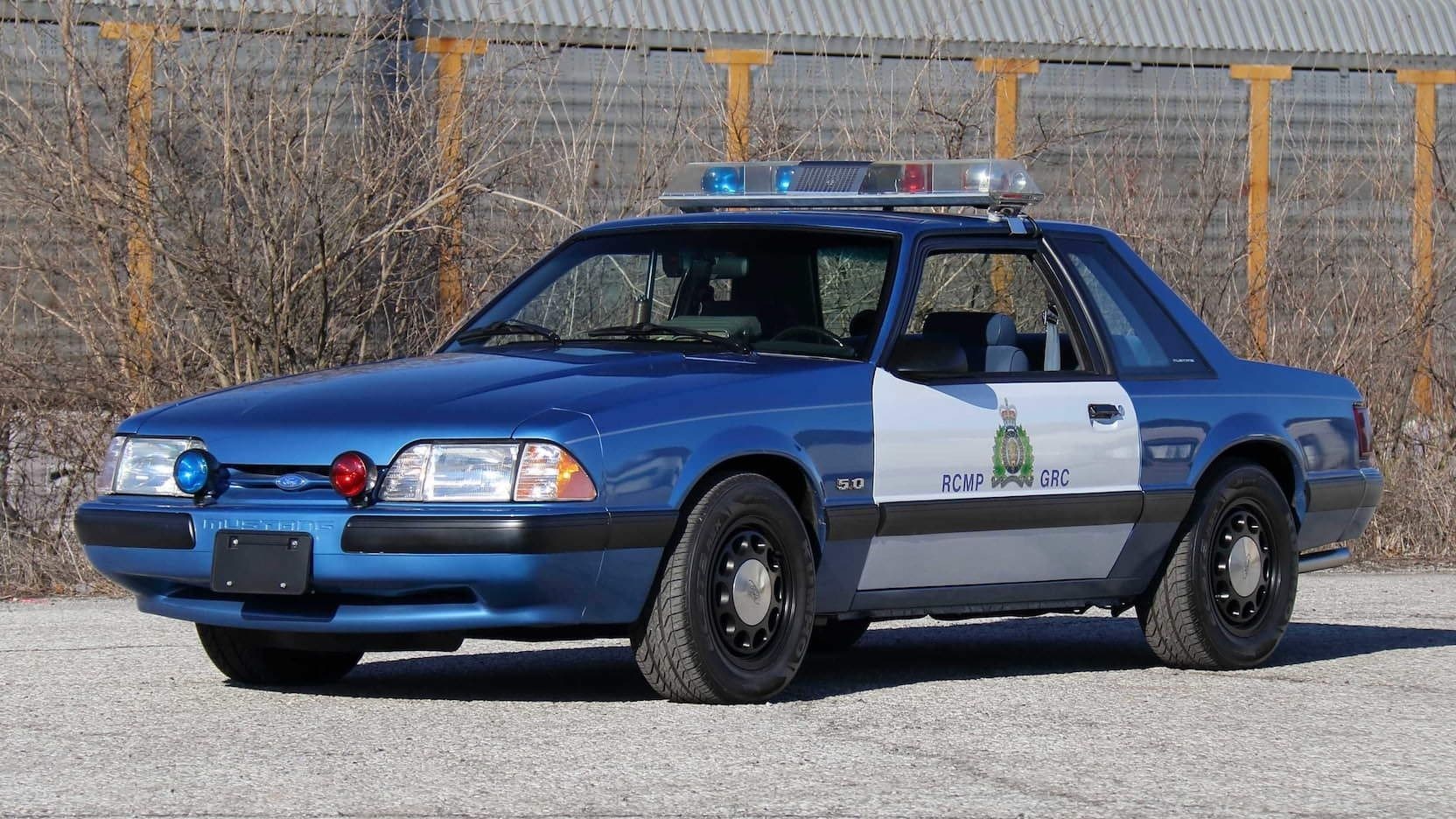
In the United States and Canada, the conversation around advanced police vehicles often looks different from the supercar headlines seen in Dubai. Here, the emphasis typically leans toward pursuit capability, fleet practicality, and durability under heavy operational tempo. That is exactly where the Ford Mustang SSP stands out. Rather than being a publicity-first exotic, the Mustang SSP was designed specifically to improve law-enforcement operations by offering strong performance in a package that could be adapted for service use. It represents a distinctly North American approach: power and speed, yes, but also a focus on components built to withstand the realities of patrol work.
According to the provided details, the Mustang SSP uses a 5.0-liter V8 producing 225 horsepower. While horsepower figures are often the headline, the deeper story is that this vehicle was configured with police work in mind. The mention of reinforced floor pans is particularly telling. Reinforcement matters because patrol cars experience stress that most civilian vehicles never see: hopping curbs, abrupt maneuvers, uneven road surfaces, and the continuous vibration that comes with long hours of service. Reinforced structural components can help maintain integrity over time, reducing the risk of damage from repeated impacts and hard use.
Also noted are the engine and transmission coolers; another detail that carries real operational significance. High-performance driving, extended idling, and repeated acceleration can generate substantial heat, especially during extended response scenarios. Cooling upgrades are not glamorous, but they are critical. A vehicle that overheats or begins to reduce power under load is a liability in enforcement conditions. When you consider that a police unit may be required to accelerate hard, slow down, reposition, and then accelerate again; often within minutes; the value of robust thermal management becomes clear. It is one of those behind-the-scenes features that can make the difference between consistent performance and mechanical strain.
From an expert perspective, the Mustang SSP also embodies a strategic idea that remains relevant: the pursuit vehicle as a specialized tool rather than a one-size-fits-all platform. North American policing frequently includes large highway networks, long-distance corridors, and sprawling suburban environments. Those settings can demand vehicles that are stable at speed and confident during quick lane transitions. A car built with pursuit in mind can provide that stability and driver feedback, helping officers make better decisions under pressure. Importantly, however, capability must be paired with policy; many agencies have strict pursuit rules, and for good reason. The safest pursuit is the one that balances enforcement needs with the broader responsibility to protect the public.
It is also worth noting the cultural dimension. The Ford Mustang is an icon in the U.S. and widely recognized across Canada. Deploying a Mustang-based pursuit platform can have a psychological effect similar to the UAE’s supercars, though in a different register. Where a Bugatti creates shock and spectacle, a Mustang communicates muscle, authority, and traditional performance. It signals that the police vehicle is not an ordinary sedan struggling to keep up; it is a purpose-built car associated with speed and power, adapted for official use.
In terms of fleet integration, a performance package like the SSP offers a practical advantage: it aligns more naturally with service realities than a hypercar ever could. The vehicle can be maintained within more conventional service frameworks, supported by broader parts availability, and operated without the ultra-specialized constraints that come with exotic engineering. That does not mean it is “simple”; it is still specialized; but it exists closer to mainstream automotive ecosystems, which can be important for agencies balancing performance needs with operational budgets.
Ultimately, the U.S. and Canadian embrace of vehicles like the Ford Mustang SSP highlights a different definition of “advanced.” Here, advancement is not solely measured by price or top speed; it is measured by how effectively a vehicle supports real enforcement tasks: staying cool under strain, holding together structurally, accelerating with confidence, and remaining predictable when driven hard. In a pursuit context, those qualities can be more valuable than exotic status; and they help explain why the Mustang SSP has earned a lasting reputation in the law-enforcement world.
Italy – Lamborghini Huracan
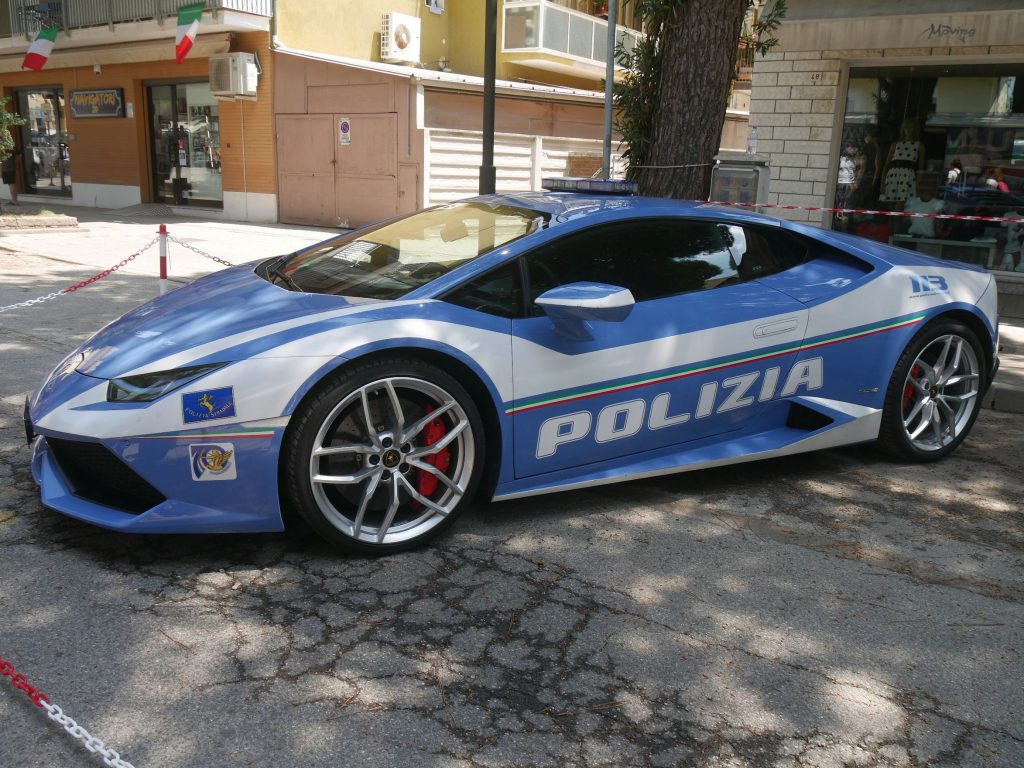
When Italy appears on a list of advanced police vehicles, the name Lamborghini feels almost inevitable. The brand is rooted in Italian engineering and design culture, and its cars are built with performance as a central identity. Given that heritage, it should not come as much of a surprise that Italian law enforcement has made use of Lamborghinis in its fleet. Beyond national pride, there is a practical narrative: in certain scenarios; particularly those involving rapid transport over longer distances; high-performance vehicles can offer real utility when paired with disciplined procedures and specialized training.
Among the vehicles associated with the Italian police is the Huracan LP 610-4, a serious performance machine by any standard. As noted in the provided information, it is powered by a 5.2-liter V10 engine generating 610 horsepower. This kind of output is not simply about headline numbers; it translates to strong acceleration and high-speed stability, characteristics that can be valuable when time-sensitive movement is required. The “LP 610-4” designation also underscores its performance intent, and in a law-enforcement context, it reflects a willingness to employ advanced automotive capability in a structured, mission-oriented way.
Another important element is the equipment installed to adapt the vehicle for policing. According to the description, the Huracan is outfitted with a video system, a pistol holster, and a refrigerator as standard equipment. Each of these features points to a different operational requirement. A video system supports documentation, accountability, and evidence collection; critical functions in modern enforcement, where transparency and recordkeeping can be as important as response capability. A pistol holster reflects the need for safe, consistent weapon retention and accessibility in a vehicle that was not originally designed around police ergonomics. And the inclusion of a refrigerator, while surprising to casual observers, makes sense when the car is used for specialized tasks that require temperature-controlled transport.
From an expert perspective, the most fascinating part of Italy’s use of a Lamborghini is not the spectacle; it is the adaptation. High-performance road cars are engineered around speed, but policing requires more than speed. It requires predictable handling across varied road conditions, reliable braking, and driver familiarity with the vehicle’s limits. If a supercar is deployed in an official capacity, the agency must treat it as a specialized tool. That means defining where it can be used, ensuring the drivers are trained to a high standard, and maintaining the vehicle meticulously so that performance remains safe and consistent.
It also illustrates a broader truth about “advanced law enforcement vehicles”: advancement is as much about integration as it is about horsepower. A Lamborghini Huracan can be astonishingly capable, but capability becomes meaningful only when aligned with clear procedures. For example, the video system becomes valuable when officers follow evidence protocols. The vehicle’s speed becomes valuable when dispatch and coordination ensure that rapid response genuinely improves outcomes. Even the refrigerator becomes valuable only when it is used within a defined operational need. Without those frameworks, a high-end car is merely impressive. With them, it becomes an asset that supports real-world policing objectives.
There is also a symbolic dimension that cannot be ignored. Italy’s association with Lamborghini is deeply cultural, and a police Huracan can serve as a visible bridge between national engineering excellence and public service. It can reinforce confidence, generate community interest, and create an approachable talking point; especially during public events. In other words, it can function as both a performance platform and a communication tool, reminding the public that law enforcement is equipped, professional, and ready to respond.
Ultimately, the Italian Lamborghini Huracan example rounds out the global picture. Dubai highlights prestige and high-visibility presence through ultra-luxury vehicles, North America emphasizes pursuit-oriented packages built for service realities, and Italy showcases how an iconic domestic supercar can be adapted with practical equipment; video systems, secure gear placement, and specialized storage; to support policing needs. Different environments shape different solutions, but the underlying principle remains consistent: advanced police vehicles are chosen to meet specific strategic and operational goals, not just to make an impression.
Closing Perspective: Why These Police Cars Matter
At first glance, a supercar wearing police decals can look like a novelty. Yet when you examine these vehicles through an operational lens, a clearer story emerges. Every country and every agency faces its own mix of geography, traffic patterns, public expectations, budget constraints, and policing priorities. In some places, the most “advanced” solution is a hybrid performance car that combines modern technology with efficiency. In others, the focus is on a purpose-built pursuit package engineered to endure hard duty cycles. And in select environments, a hypercar becomes a high-visibility symbol; a strategic tool for deterrence, engagement, and public reassurance.
What connects the UAE’s BMW i8, the UAE’s Bugatti Veyron, the U.S. and Canada’s Ford Mustang SSP, and Italy’s Lamborghini Huracan is not a single definition of policing; but a shared recognition that mobility matters. Whether the mission is rapid response, specialized deployment, or visible presence in high-profile locations, the vehicle becomes part of how law enforcement projects readiness. When deployed responsibly, supported by training, and governed by clear policy, advanced vehicles can be more than eye-catching machines: they can be specialized assets that align performance, technology, and strategy in service of public safety.