

You turn the key. Instead of the engine roaring to life, you hear a nasty grinding noise, like metal chewing on metal. Then nothing. You try again. This time it starts, but that grinding sound lingers in your memory. Third time? More grinding, followed by the starter spinning uselessly, like it is not grabbing onto anything.
Your first instinct is to blame the starter motor. Or the battery. Maybe even the ignition switch. Those are the usual suspects when a car will not start, and nine times out of ten, one of them is the culprit. But there is another component hiding behind your engine that can cause the exact same symptoms, and most car owners have never even heard of it.
Table of Contents
The flywheel.
It sits between your engine and your transmission, doing its job quietly for hundreds of thousands of miles. When it goes bad, though, it can absolutely cause starting problems. And because most mechanics do not check the flywheel until they have ruled out everything else, it can take a while before anyone figures out what is really going on.
Let us go through what the flywheel does, how it connects to your starting system, the specific ways it can fail, what a bad flywheel sounds like, and how to tell the difference between a flywheel problem and a starter or battery issue. By the end, you will know exactly what to listen for and what to tell your mechanic if you suspect the flywheel is the problem.
What the Flywheel Actually Does (And Why You Should Care)
Most people have never seen their flywheel. It is tucked away between the engine and the transmission, completely hidden from view unless you pull the transmission out. But just because you cannot see it does not mean it is not working hard every single time you drive.
The flywheel is a heavy metal disc, usually made of cast iron or steel, that bolts directly to the back of your engine’s crankshaft. It serves several important purposes, and understanding them will help you see why a failing flywheel can mess with your car’s ability to start.
It Smooths Out Your Engine’s Rotation
Here is something most people do not think about. Your engine does not produce power in a smooth, continuous stream. Each cylinder fires in a sequence, and between those firing events, there are brief gaps where no power is being produced. If you could feel those gaps directly, the engine would feel like it was pulsing or shuddering with every rotation.
The flywheel fixes this by acting as a rotational energy storage device. Its heavy mass absorbs energy during the power strokes and releases it during the gaps. Think of it like a merry-go-round at a playground. Once you get it spinning, the weight of the platform keeps it going even when nobody is pushing. The flywheel does the same thing for your engine, smoothing out the rotation so everything feels consistent and balanced.
Without it, your engine would run rough at low RPMs and vibrate noticeably at idle. The flywheel is the reason your engine purrs instead of stutters.
It Gives the Clutch Something to Grab (Manual Transmissions)
If you drive a stick shift, the flywheel has an extra job. One side of it has a smooth, machined friction surface. When you let out the clutch pedal, the clutch disc presses against this surface, creating a friction connection between the engine and the transmission. That friction is what transfers engine power to your wheels.
When you push the clutch pedal in, the clutch disc pulls away from the flywheel, disconnecting the engine from the transmission so you can shift gears. Every time you engage and disengage the clutch, the flywheel’s friction surface is doing work.
Over time, that surface can become scored, warped, or glazed from heat and friction. But that is primarily a drivability issue, not a starting issue. Where the flywheel really matters for starting is on its outer edge.
It Provides the Teeth That the Starter Motor Grabs Onto
This is the big one for our purposes. Around the outer perimeter of the flywheel, there is a ring of teeth called the ring gear (sometimes called the starter ring gear). This ring gear is the connection point between your starter motor and your engine.
When you turn the key or press the start button, a small gear on the starter motor (called the pinion gear) extends outward and meshes with the ring gear teeth on the flywheel. The starter motor spins the pinion gear, which rotates the flywheel, which turns the crankshaft, which moves the pistons, and that is how your engine begins its combustion cycle.
If those ring gear teeth are damaged, worn down, or missing, the starter pinion has nothing to grab onto. And that is when your starting problems begin.
A Quick Note About Flexplates
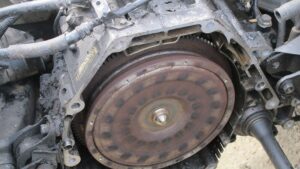
If you drive an automatic transmission vehicle, your car does not have a traditional flywheel. Instead, it has a flexplate. The flexplate serves the same basic role for starting purposes. It has a ring gear on its outer edge that the starter motor engages with, and it bolts to the crankshaft just like a flywheel does.
The key difference is that a flexplate is thinner and lighter than a flywheel. It does not have a clutch friction surface because automatic transmissions use a torque converter instead of a clutch. The flexplate bolts to the torque converter on one side and the crankshaft on the other, acting as the bridge between the engine and the automatic transmission.
Because the flexplate is thinner, it is actually more prone to cracking than a traditional flywheel. We will get into that in the failure section. For the rest of this article, when we say “flywheel,” the same information generally applies to flexplates unless we specifically note otherwise.
How the Flywheel Fits Into Your Starting System, Step by Step
To understand how a bad flywheel causes starting problems, you need to understand the sequence of events that happens every time you start your car. It happens fast, usually in under two seconds, but there is a lot going on in that brief moment.
Here is the full starting sequence, broken down into individual steps:
- You turn the key or press the start button. This sends an electrical signal from the ignition switch to the starter motor’s solenoid.
- The solenoid activates. It does two things simultaneously: it engages an internal switch that sends battery power to the starter motor, and it pushes the starter’s pinion gear forward so it extends out of the starter housing.
- The pinion gear meshes with the ring gear. The small pinion gear slides forward and its teeth interlock with the much larger ring gear teeth on the flywheel’s outer edge. This is where the physical connection between the starter motor and the engine is made.
- The starter motor spins. With the pinion gear engaged, the starter motor’s powerful electric motor begins to spin. Because the pinion gear is much smaller than the ring gear, there is a significant mechanical advantage at play. The starter does not need to match the engine’s eventual running speed. It just needs to spin the crankshaft fast enough (usually around 200 to 300 RPM) for the engine to fire.
- The crankshaft turns. As the flywheel rotates, it turns the crankshaft. The crankshaft moves the pistons up and down, the valves open and close in sequence, fuel is injected, and spark plugs fire. The engine begins its combustion cycle.
- The engine fires and runs on its own. Once the engine catches and starts running under its own power, it quickly exceeds the speed the starter motor can produce. At this point, a one-way clutch inside the starter’s pinion assembly allows the pinion to spin freely without being driven by the now-faster engine. The solenoid retracts the pinion gear back into the starter housing, and the starter motor stops.
That entire sequence relies on one thing going right at step three: the pinion gear must successfully mesh with the ring gear teeth on the flywheel. If those teeth are worn, broken, or missing, the whole chain falls apart.
And it is not just the teeth. If the flywheel itself is cracked, loose, or wobbling on its mount, it disrupts the alignment and stability needed for a clean engagement. Think of it like trying to put a gear into mesh with a spinning disc that is wobbling like a drunk frisbee. The teeth might line up for a second, but they will not stay engaged long enough to do the job.
Six Ways a Bad Flywheel Can Cause Starting Problems
So yes, a bad flywheel can absolutely cause starting problems. But “bad flywheel” is a broad term. There are several specific types of flywheel failure, and each one produces slightly different symptoms. Knowing the difference helps you (or your mechanic) zero in on the problem faster.
1. Worn, Chipped, or Missing Ring Gear Teeth
This is the most common flywheel-related starting problem, by a wide margin. It is also the one that produces the most distinctive symptoms.
Every time you start your engine, the starter pinion slams into the ring gear teeth with considerable force. Over thousands and thousands of starts, that repeated impact wears the teeth down. They get rounded, chipped, or in severe cases, teeth break off entirely, leaving gaps in the ring gear.
Here is what makes this problem so frustrating: the wear is usually concentrated in certain spots on the ring gear. When your engine shuts off, the crankshaft (and the flywheel attached to it) always stops in one of a few natural resting positions, determined by the engine’s compression and balance. That means the starter pinion tends to engage the same sections of the ring gear more often than others. Those heavily used sections wear out first.
The result is an intermittent starting problem. Sometimes the flywheel stops with the good teeth facing the starter, and the car starts perfectly. Other times, the damaged section lines up with the pinion, and you get that horrible grinding or spinning sound. The car might start on the second or third try after the flywheel rotates to a different position.
This intermittent nature is exactly why ring gear problems are often misdiagnosed as a failing starter motor. The symptoms overlap significantly. But here is a clue that points to the ring gear: if the problem comes and goes seemingly at random, and the starter works perfectly sometimes but fails other times with no pattern related to temperature, battery charge, or weather, worn ring gear teeth are high on the suspect list.
What you will hear: Loud grinding or metallic crunching when turning the key. Sometimes a high-pitched whirring as the starter spins freely without engaging anything. Occasionally a single loud click followed by silence if the pinion jams against a damaged tooth section.
What the engine does: It either does not turn over at all, turns over briefly then makes a harsh noise and stops, or makes grinding sounds before eventually catching and starting normally. The key detail is inconsistency. Sometimes it works. Sometimes it does not.
2. Cracked or Fractured Flywheel (or Flexplate)
While less common than ring gear wear, a cracked flywheel or flexplate is a more serious problem. Cracks can develop due to manufacturing defects, extreme heat cycling, engine misfires that create abnormal stresses, or simple fatigue over hundreds of thousands of miles.
Flexplates are especially vulnerable to cracking because they are thinner than flywheels. The most common crack locations on a flexplate are around the crankshaft bolt holes and around the torque converter bolt holes. These are stress concentration points where the metal flexes repeatedly during normal operation.
A cracked flywheel or flexplate loses its structural rigidity. It can no longer rotate as a solid, balanced disc. Instead, it flexes and wobbles as it spins, which creates several problems for starting.
The wobble throws the ring gear out of alignment with the starter pinion, making engagement unreliable. The crack can propagate into or near the ring gear mounting area, causing the ring gear itself to wobble independently of the flywheel. And if the crack worsens to the point where a piece breaks off, you are looking at catastrophic damage to the starter, the transmission bellhousing, and potentially the engine block itself.
What you will hear: A rhythmic metallic rattling or ticking sound coming from the area where the engine meets the transmission (the bellhousing area). This sound is often most noticeable during cranking and at idle. It may get louder under load. Some people describe it as a metallic “chirping” that follows engine speed.
What the engine does: Cranking may feel erratic or uneven. The engine might turn over in a choppy, inconsistent rhythm instead of the smooth “ruh-ruh-ruh-ruh” you normally hear. In severe cases, the engine may refuse to crank at all if the cracked section causes physical binding or obstruction. You will likely feel excessive vibration through the floorboard or the shifter during cranking.
Important warning: Do not ignore a suspected cracked flywheel or flexplate. If the crack propagates and a chunk of metal breaks free while the engine is running, it becomes a high-speed projectile trapped inside the bellhousing. The damage it can cause to surrounding components is extensive and expensive.
3. Loose Flywheel Bolts
The flywheel is attached to the crankshaft by a series of high-strength bolts, typically six to eight depending on the engine. These bolts are torqued to a very specific value during installation, and they are often treated with threadlocker to prevent them from backing out under vibration.
If those bolts are not properly torqued during an engine or transmission installation, or if they loosen over time due to vibration, the flywheel will not be securely attached to the crankshaft. A loose flywheel wobbles during rotation, and that wobble causes the ring gear to move in and out of alignment with the starter pinion.
This is a problem that tends to show up after recent engine or transmission work. If you just had your transmission replaced, your clutch changed, or your engine rebuilt, and you are now experiencing starting problems, loose flywheel bolts should be one of the first things checked. It is an installation error, and unfortunately, it happens more often than it should.
What you will hear: A pronounced knocking or clunking sound that changes with engine speed. During cranking, you may hear grinding from the starter as the pinion struggles to engage the wobbling ring gear. Some people initially mistake this sound for a rod knock, which is a much scarier (and more expensive) diagnosis. The key difference is that a loose flywheel knock often has a slightly different character and may be more pronounced at the back of the engine.
What the engine does: Slow or erratic cranking, intermittent grinding from the starter, and noticeable vibration during cranking and engine operation. In extreme cases, if the bolts back out far enough, the flywheel can come completely detached from the crankshaft. You do not want to be anywhere near the vehicle if that happens.
4. An Imbalanced Flywheel
A flywheel must be precisely balanced to rotate smoothly. Any imbalance creates centrifugal forces that pull the crankshaft off its true center of rotation. These forces increase exponentially with speed, which is why an imbalanced flywheel causes progressively worse vibration as RPMs climb.
Imbalance can result from manufacturing defects, improper resurfacing (when a machine shop resurfaces a flywheel for clutch replacement and removes material unevenly), or physical damage that removes metal from one side of the flywheel.
For starting purposes, an imbalanced flywheel makes it harder for the starter motor to rotate the engine smoothly. The starter has to fight against the dynamic imbalance forces, which acts like a resistance that varies with each rotation. The result is that the starter works harder and cranks the engine more slowly than it should.
What you will hear: A low, harmonic humming or growling during cranking, accompanied by noticeable vibration. The sound may pulse or waver as the imbalanced section rotates past certain points.
What the engine does: Slow, labored cranking. The engine sounds like it is struggling to turn over even when the battery is fully charged and the starter is working properly. Extended crank times before the engine fires are common. The vibration may continue after the engine starts, especially at idle and at certain RPM ranges.
An imbalanced flywheel is not typically a sudden failure. It is a problem that develops gradually, and many drivers adapt to it without realizing that their engine should not be vibrating that much. If your car has always had a noticeable vibration at idle and you have owned it since it was new, it might just be normal engine characteristics. But if the vibration developed suddenly or has gotten progressively worse, an imbalanced or damaged flywheel is worth investigating.
5. Clutch or Pressure Plate Drag (Manual Transmissions Only)
This one is technically a clutch problem, not a flywheel problem. But because the clutch components interact so directly with the flywheel, clutch issues can absolutely present as starting problems, and they are worth understanding if you drive a manual transmission vehicle.
When you press the clutch pedal, the pressure plate should fully release the clutch disc from the flywheel, disconnecting the engine from the transmission. But if the clutch disc is warped, damaged, or stuck to the flywheel surface, or if the pressure plate is broken and not fully releasing, the clutch continues to create friction against the flywheel even with the pedal pressed all the way to the floor.
This friction creates drag on the crankshaft. It is like trying to spin a wheel while someone is holding a brake pad against it. The starter motor now has to overcome not just the engine’s internal compression and friction, but also the additional resistance from the dragging clutch.
In mild cases, this just makes the engine crank a little slowly. In severe cases, the drag can be so significant that the starter cannot turn the engine at all. The starter motor sounds strained and labored, and the engine barely moves.
What you will hear: A strained, struggling starter motor sound. The starter might sound strong for a split second when it first engages, then immediately bog down as it hits the resistance. You might also hear a squealing or grinding noise from the clutch area.
What the engine does: Very slow cranking or a complete no-crank condition. The engine feels like it is seized even though it is not. One diagnostic clue: if the engine cranks normally when the clutch pedal is pressed but struggles when the pedal is released (or if it cranks slightly better with the pedal pressed), clutch drag is a strong possibility.
You might also notice other clutch-related symptoms during normal driving, like difficulty shifting gears, the car creeping forward in gear with the clutch pedal fully depressed, or a burning smell from overheated clutch material.
6. Seized or Damaged Pilot Bearing (Manual Transmissions Only)
The pilot bearing (or pilot bushing, depending on the design) is a small bearing located in the center of the flywheel or at the end of the crankshaft. Its job is to support the tip of the transmission’s input shaft, keeping it centered and aligned.
This is a tiny part, maybe the size of a silver dollar. But when it fails, the consequences are outsized. A seized pilot bearing creates enormous friction between the crankshaft and the transmission input shaft. That friction acts as a brake on the crankshaft, directly resisting the starter motor’s efforts to turn the engine.
The symptoms can be maddeningly similar to a weak battery. The cranking sounds slow and labored. The starter sounds strained. Everything points to a low-charge battery, except the battery tests fine. This is one of those failures that can send you on a wild goose chase through the electrical system before someone finally thinks to check the pilot bearing.
What you will hear: A squealing or grinding noise when the clutch pedal is depressed, especially in neutral. During cranking, the starter sounds like it is struggling against heavy resistance. The squealing may disappear when the clutch pedal is released.
What the engine does: Slow, labored cranking that sounds almost identical to a weak battery, except the battery is fully charged and passes a load test. If you disconnect the transmission input shaft from the pilot bearing (which requires removing the transmission), the engine cranks freely and starts normally. That confirms the pilot bearing as the source of the drag.
What a Bad Flywheel Sounds Like: A Quick Reference
Sound is your best diagnostic tool when it comes to flywheel problems. Each type of failure produces a characteristic noise that, once you know what to listen for, is fairly easy to identify. Here is a summary of the sounds and what they typically mean:
| Sound | What It Usually Means |
|---|---|
| Loud grinding or metallic crunching | Starter pinion failing to mesh with worn or damaged ring gear teeth |
| High-pitched whirring (starter spinning freely) | Missing ring gear teeth; pinion has nothing to engage |
| Single loud click followed by silence | Pinion jammed against damaged teeth; starter cannot rotate |
| Rhythmic metallic rattling or ticking | Cracked flywheel or flexplate |
| Pronounced knocking or clunking | Loose flywheel bolts or fractured component |
| Low harmonic humming with vibration | Imbalanced flywheel |
| Squealing when clutch pedal is pressed | Seized or worn pilot bearing |
| Strained, bogging starter sound | Clutch drag or pilot bearing seizure creating resistance |
A tip that helps with diagnosis: try starting the car multiple times and pay close attention to whether the sound changes between attempts. If sometimes it grinds and sometimes it starts perfectly, that intermittent pattern is a classic sign of ring gear damage. If the sound is consistent every time, you are more likely dealing with a crack, imbalance, or drag issue.
How to Tell a Flywheel Problem Apart From Other Starting Issues
Here is the challenge with flywheel problems: they can mimic other, more common starting issues almost perfectly. A worn ring gear sounds a lot like a failing starter. A cracked flexplate can feel like a weak battery. A seized pilot bearing produces the exact same symptom as low cranking power from bad battery cables.
Because flywheel issues are relatively uncommon compared to battery, starter, and electrical problems, most mechanics and car owners check those common culprits first. And that is actually the right approach. Do not jump straight to “my flywheel is bad” without ruling out the obvious stuff. But if you have ruled out the usual suspects and the problem persists, the flywheel moves up the suspect list quickly.
Here is how to differentiate between the most common starting problems:
| Problem | What It Sounds/Feels Like | Quick Check | How It Differs From a Flywheel Issue |
|---|---|---|---|
| Weak or dead battery | Slow, lazy cranking; dashboard lights dim; rapid clicking | Test battery voltage (should be 12.4V+ at rest). Do a load test. Check if headlights dim significantly during cranking. | Weak battery symptoms are consistent every start attempt. No grinding or metallic crunching sounds. Cranking speed is uniformly slow, not intermittently normal. |
| Corroded or loose battery cables | Similar to weak battery; intermittent no-start; slow crank | Inspect cable terminals for white/green corrosion. Wiggle cables while trying to start. Clean and retighten connections. | Cleaning and tightening cables resolves the issue immediately. No metallic grinding or crunching. Problem is electrical, not mechanical. |
| Failing starter motor | Grinding, clicking, or no response when turning key | Tap the starter with a hammer while someone turns the key (can temporarily unstick worn brushes). Have the starter bench-tested. | A bad starter typically fails consistently or gets progressively worse. A flywheel ring gear issue is intermittent, working fine sometimes and failing other times with no clear pattern. |
| Bad starter solenoid | Single click but no cranking; sometimes rapid clicking | Listen for the solenoid click. Test voltage at the solenoid’s input and output terminals during cranking. | Solenoid issues produce clicking without any grinding. The starter motor never engages. With a flywheel issue, the starter engages but cannot mesh properly. |
| Seized engine | Single loud clunk then nothing; starter will not turn at all | Try turning the crankshaft by hand with a socket and breaker bar on the crankshaft pulley bolt. If it will not move, the engine is seized. | A seized engine produces a dead stop every time, no intermittent behavior. The crankshaft cannot be rotated by any means. |
The biggest distinguishing factor with a flywheel ring gear problem is inconsistency. The car starts fine sometimes and fails other times, with no relationship to temperature, battery charge, or how long the car has been sitting. That randomness is the signature of damaged ring gear teeth, because the outcome depends entirely on where the flywheel happens to stop when the engine shuts off.
If you want to test this yourself, here is a trick. When the car refuses to start and you hear grinding, put the transmission in a high gear (third or fourth in a manual, or try rocking the car slightly if it is an automatic in park with the parking brake on). Gently push the car forward or backward just a few inches. This rotates the flywheel slightly, potentially moving the damaged section away from the starter pinion. Then try starting again. If the car starts perfectly after being moved, you have a very strong indication that the ring gear teeth are the problem.
How Mechanics Diagnose a Flywheel Problem
If your symptoms point toward a flywheel issue, here is the diagnostic process a mechanic will typically follow. Understanding these steps helps you know what to expect and ensures you are not paying for unnecessary work.
Step 1: Listen and Analyze the Sound
A good mechanic will ask you to start the car (or attempt to start it) several times while they listen carefully. They are trying to identify the exact nature of the noise, its location, and whether it changes between attempts. They may use an automotive stethoscope or a chassis ear, which is essentially a set of contact microphones that can be placed on different parts of the engine and bellhousing to pinpoint exactly where a sound is originating.
If you drive a manual transmission, they will also listen to how the noise changes when the clutch pedal is pressed and released. This helps distinguish between flywheel/ring gear issues and clutch/pilot bearing issues.
Step 2: Rule Out Electrical and Starter Problems
Before going through the labor of accessing the flywheel, a smart mechanic rules out everything that is easier and cheaper to check first. This means:
- Load-testing the battery to make sure it can deliver adequate cranking power.
- Inspecting battery cables and terminals for corrosion, looseness, and damage.
- Testing the starter motor, either on the vehicle by measuring voltage and current draw during cranking, or off the vehicle with a bench test.
- Checking the starter’s drive mechanism (the bendix) to make sure the pinion extends and retracts properly and the one-way clutch is functioning.
A failing starter drive can produce symptoms very similar to a damaged ring gear. The pinion gear on the starter can also wear out, not just the ring gear on the flywheel. A bench test of the starter will reveal whether the starter side of the equation is in good shape.
Step 3: Visual Inspection Through the Inspection Plate
Many vehicles have a small inspection plate, cover, or rubber plug on the transmission bellhousing that allows a limited view of the flywheel. A mechanic can remove this cover, shine a flashlight inside, and manually rotate the engine (by putting a socket on the crankshaft pulley bolt) to slowly inspect the ring gear teeth as they pass by the opening.
This is not a complete inspection. You can only see a portion of the ring gear at a time, and cracks in the flywheel body may not be visible from this angle. But it is often enough to spot worn, chipped, or missing ring gear teeth without removing the transmission. If the mechanic sees obvious damage through the inspection hole, the diagnosis is confirmed and the next step is repair.
If your mechanic suggests this step, it is a good sign. It means they are trying to confirm the diagnosis before committing you to the labor-intensive process of removing the transmission.
Step 4: Manual Rotation Test
With the spark plugs removed to eliminate compression resistance, the mechanic can try to turn the engine over by hand using a large socket and breaker bar on the crankshaft pulley bolt. The engine should rotate smoothly and evenly. Any binding, hard spots, grinding, or unusual resistance suggests a problem with the flywheel, pilot bearing, or internal engine components.
This test can also help identify a cracked flywheel. If the flywheel is cracked, you may feel a slight “thump” or unevenness at certain points in the rotation as the cracked sections flex under load.
Step 5: Transmission Removal for Full Inspection
If the diagnosis is still uncertain after the above steps, or if there is clear evidence of a flywheel problem that requires repair, the transmission must be removed to gain full access to the flywheel. This is the definitive diagnostic step, but it is also the most labor-intensive, typically requiring several hours of work.
Once the flywheel is fully exposed, the mechanic can inspect:
- The entire circumference of the ring gear for worn, chipped, or missing teeth.
- The flywheel body for cracks, heat spots, and warping.
- The flywheel bolt torque and condition.
- Flywheel runout (wobble) using a dial indicator.
- The pilot bearing condition (manual transmissions).
- The clutch disc and pressure plate condition (manual transmissions).
Because the transmission is already out at this point, most mechanics will recommend replacing any worn clutch components (disc, pressure plate, throw-out bearing, and pilot bearing) at the same time. The parts are relatively inexpensive compared to the labor cost of removing and reinstalling the transmission. It makes no sense to put everything back together and then have to take it all apart again in six months because the clutch wore out.
What It Costs to Fix a Bad Flywheel
Flywheel repair costs vary significantly depending on what exactly is wrong, what type of vehicle you drive, and whether you go to a dealership or an independent shop. The biggest variable is labor, because accessing the flywheel requires removing the transmission, which is a time-consuming job on most vehicles.
Here is a realistic breakdown of costs for the most common flywheel-related repairs:
| Repair | Parts Cost | Labor Cost | Total Estimated Cost |
|---|---|---|---|
| Ring gear replacement (pressed onto existing flywheel) | $30 to $80 | $400 to $800 | $430 to $880 |
| Complete flywheel replacement | $100 to $400 | $400 to $800 | $500 to $1,200 |
| Flexplate replacement | $80 to $250 | $400 to $1,000 | $480 to $1,250 |
| Flywheel resurfacing | $25 to $75 (machine shop fee) | Included in transmission removal labor | $425 to $875 total |
| Pilot bearing replacement | $10 to $40 | Included if transmission is already out | $10 to $40 on top of other repairs |
| Clutch kit (disc, pressure plate, throw-out bearing) | $150 to $400 | Included if transmission is already out | $150 to $400 on top of other repairs |
Notice that the labor cost is roughly the same regardless of what is being replaced. That is because the expensive part is getting to the flywheel, not the actual replacement. This is why it makes financial sense to replace everything that is accessible while the transmission is already out. If you are paying $600 in labor to pull the transmission for a ring gear issue, spending an extra $200 on a new clutch kit and pilot bearing saves you from paying that same $600 in labor again when those parts wear out later.
If you drive an all-wheel-drive vehicle or a vehicle with a transversely mounted engine (common in front-wheel-drive cars), the labor cost may be on the higher end because these configurations make transmission removal more complex. Rear-wheel-drive vehicles with a longitudinally mounted engine and a standard transmission tunnel are generally the easiest and cheapest to work on.
Can You Replace Just the Ring Gear?
Yes, in many cases. The ring gear on most flywheels and flexplates is a separate piece that is press-fitted or shrink-fitted onto the flywheel body. A machine shop or experienced mechanic can remove the damaged ring gear and press a new one on without replacing the entire flywheel.
The process involves heating the new ring gear in an oven to expand it slightly, then quickly placing it onto the flywheel where it contracts as it cools and locks into place. It requires some skill and the right equipment, but it is a well-established repair technique.
That said, if the flywheel body itself is cracked, warped, or otherwise damaged, replacing just the ring gear will not solve the problem. In those cases, the entire flywheel needs to be replaced.
Some mechanics prefer to replace the entire flywheel rather than just the ring gear, especially if the flywheel has high mileage. Their reasoning is that if the ring gear wore out, the flywheel friction surface is likely worn too, and the flywheel has been subjected to the same stresses and heat cycles that damaged the ring gear. Replacing the whole unit ensures you do not end up pulling the transmission again in the near future for a different flywheel-related failure.
Discuss the options with your mechanic and make the decision based on the condition of the flywheel as a whole, not just the ring gear.
DIY or Mechanic? Be Honest With Yourself
Replacing a flywheel is not a beginner-level repair. It requires removing the transmission, which means supporting the engine, disconnecting the driveshaft (on rear-wheel-drive vehicles), disconnecting various electrical connectors and hydraulic lines, and carefully maneuvering a heavy transmission out of the vehicle.
If you have experience working on transmissions and clutches, and you have access to a proper floor jack, jack stands, a transmission jack, and the necessary hand tools, this is a doable weekend project. Expect it to take anywhere from four to eight hours depending on the vehicle and your experience level.
If you have never pulled a transmission before, this is probably not the right project to learn on. A mistake during transmission removal or installation can damage the transmission input shaft, the crankshaft rear seal, or the bellhousing alignment, turning a $500 repair into a $2,000 nightmare. The labor cost at a shop is money well spent for peace of mind and a job done right.
One middle-ground option: do the diagnostic work yourself, confirm the problem, and then bring the car to a shop for the repair. You will save money on diagnostic fees, and you can have an informed conversation with the mechanic about exactly what needs to be done. Mechanics appreciate customers who come in with a clear description of the problem and a reasonable idea of what might be causing it. It saves everyone time.
How Long Can You Drive With a Bad Flywheel?
This depends entirely on the type of failure.
If you have worn ring gear teeth, you can technically keep driving as long as the car starts. The problem is that it will get progressively worse. Each time the starter grinds against the damaged teeth, it damages them further. The good sections of the ring gear will start wearing out from the extra stress, and eventually the car will reach a point where it will not start no matter how many times you try.
The bigger risk is that a grinding starter can also damage the starter’s pinion gear. Now you need both a new flywheel and a new starter, doubling the parts cost.
If you have a cracked flywheel or flexplate, driving time is limited and uncertain. Cracks propagate. A small crack today can become a catastrophic fracture tomorrow, especially under the stress of highway driving. If the flexplate breaks apart while the engine is running, the fragments can destroy the starter, damage the bellhousing, and in extreme cases, puncture the transmission case. Do not gamble with a cracked flywheel or flexplate. Get it fixed as soon as possible.
If you have loose flywheel bolts, stop driving immediately. Loose bolts can back out completely, allowing the flywheel to detach from the crankshaft. This is a catastrophic failure that can cause thousands of dollars in damage to the engine, transmission, and surrounding components. Have the car towed to a shop.
Preventing Flywheel Problems Before They Start
Flywheels are built to last a long time. Most factory flywheels will go the entire life of the engine without needing replacement. But there are things you can do to extend the flywheel’s lifespan and avoid premature failure.
- Do not hold the key in the start position if the engine does not catch. If the engine does not start within three to four seconds of cranking, release the key and wait a few seconds before trying again. Prolonged cranking heats up the starter and puts unnecessary stress on the ring gear teeth.
- Do not crank the engine repeatedly without investigating. If the car is not starting, cranking it over and over without figuring out why is just grinding the ring gear for no reason. After two or three failed attempts, stop and diagnose the problem.
- Make sure your starter is in good condition. A worn starter with a damaged pinion gear can chew up the ring gear teeth. If your starter is making unusual noises or not engaging smoothly, replace it before it damages the flywheel.
- Insist on proper torque values during service. If you have any work done that involves removing the flywheel (clutch replacement, rear main seal replacement, engine swap), make sure the mechanic torques the flywheel bolts to the manufacturer’s specification using a torque wrench. “Hand tight” is not good enough for flywheel bolts. They need to be torqued precisely, and they often require new bolts or threadlocker per the manufacturer’s specifications.
- Address engine misfires promptly. Severe engine misfires create abnormal stress on the flywheel because the crankshaft rotational speed becomes erratic. Prolonged misfires can fatigue the flywheel material over time, making cracks more likely. If your check engine light is on for a misfire, get it fixed.
- If you race or drive aggressively, inspect the flywheel periodically. High-performance driving puts extra stress on the flywheel through higher RPMs, harder clutch engagement, and greater thermal cycling. If you do track days, autocross, or spirited back-road driving regularly, have the flywheel inspected whenever the transmission is out for clutch work.
Dual-Mass Flywheels: A Special Case
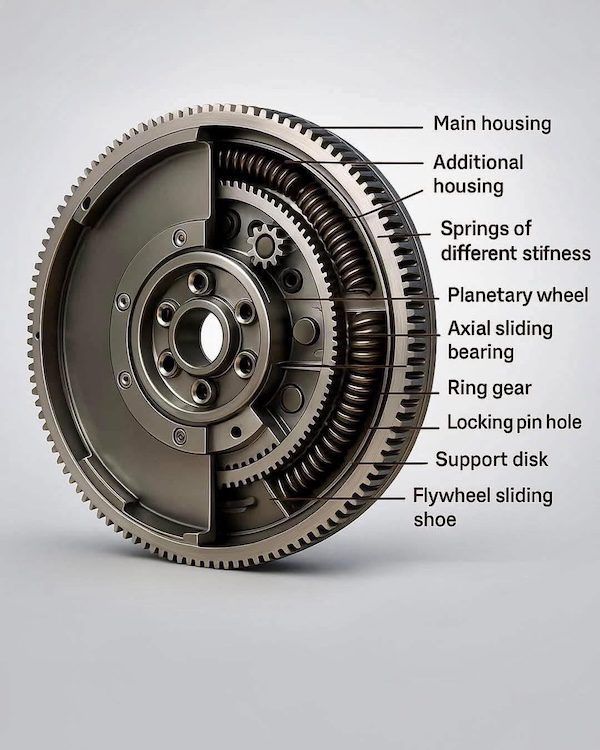
If you drive a newer vehicle, especially a European car or a diesel-powered vehicle, you might have a dual-mass flywheel (DMF) instead of a traditional single-mass flywheel. Dual-mass flywheels have become increasingly common over the past two decades because they do an even better job of smoothing out engine vibrations.
A dual-mass flywheel consists of two separate flywheel masses connected by a set of internal springs and dampers. The springs absorb rotational vibrations between the engine and the transmission, resulting in a smoother, quieter drivetrain.
The trade-off is complexity and cost. Dual-mass flywheels have internal moving parts that can wear out. When the springs weaken or break, the flywheel develops excessive free play between its two halves. This produces a distinctive rattling or chattering noise at idle that goes away as RPMs increase.
A worn dual-mass flywheel can also cause starting problems because the free play in the spring mechanism allows the ring gear half to move independently of the crankshaft half. This movement can cause the ring gear to misalign with the starter pinion, producing intermittent grinding during cranking.
Dual-mass flywheels cannot be resurfaced or repaired. They must be replaced as a unit, and they are significantly more expensive than single-mass flywheels. A replacement DMF can cost anywhere from $300 to $1,000 or more for the part alone, plus the labor to remove and reinstall the transmission.
Some car owners choose to convert from a dual-mass flywheel to a single-mass flywheel during clutch replacement. Conversion kits are available for many popular vehicles and typically cost less than a new DMF. The downside is that you lose the vibration-damping benefits of the DMF, which can result in more drivetrain noise and harshness, especially at low RPMs. For a daily driver focused on comfort, this trade-off may not be worth it. For a performance build where engagement feel matters more than smoothness, it can be a smart move.
The Real-World Scenario That Catches People Off Guard
Let us paint a picture of how this typically plays out for an average car owner, because understanding the story helps you recognize it if it happens to you.
You are in a parking lot after work. You turn the key and hear a brief grinding noise, but the engine catches and starts. Weird, but it started, so you drive home without thinking much about it. The next morning, the car starts perfectly. No grinding. You forget about it.
A week later, it happens again. This time the grinding lasts a little longer before the engine catches. You make a mental note to get it checked. But then it starts fine for the next two weeks, so you push it to the back of your mind.
Then one morning, it will not start at all. Grinding, whirring, nothing. You wait a few seconds, try again, and it fires up. But now you are worried.
You take it to a shop. They test the battery. It is fine. They test the starter. It is fine. They tell you the car started perfectly every time they tried it at the shop (because the flywheel happened to stop with the good teeth facing the starter). They cannot find anything wrong. You pick the car up, pay the diagnostic fee, and drive home frustrated.
A month later, the car refuses to start in a grocery store parking lot. You call a tow truck. Different shop this time. This mechanic is more thorough. He pulls the inspection plate off the bellhousing, rotates the engine by hand, and spots three missing teeth on the ring gear. Mystery solved.
That whole saga, the weeks of intermittent symptoms, the misdiagnosis, the frustration, is incredibly common with ring gear problems. The intermittent nature of the failure is what makes it so hard to catch. If you find yourself in this situation, specifically describe the intermittent pattern to your mechanic and ask them to visually inspect the ring gear through the bellhousing inspection plate. That one sentence could save you weeks of diagnostic runaround.
The Bottom Line on Flywheels and Starting Problems
A bad flywheel can absolutely cause starting problems. The most common scenario is worn or damaged ring gear teeth that prevent the starter from engaging properly. But cracks, loose bolts, imbalance, and related clutch-side issues can all contribute to a car that will not start or struggles to crank.
The tricky part is that flywheel problems often mimic more common failures like bad batteries and worn starters. The key diagnostic clue is intermittent behavior that does not correlate with temperature, battery charge, or any other variable. If the car starts fine three times in a row and then grinds on the fourth attempt for no apparent reason, the ring gear is where you should be looking.
Rule out the simple stuff first. Test your battery. Check your cables. Have the starter evaluated. But if everything checks out and the problem keeps coming back, ask your mechanic to pop the inspection plate off the bellhousing and take a look at those ring gear teeth. It takes five minutes and a flashlight, and it could save you from weeks of chasing electrical ghosts that do not exist.
Next time your car grinds when you turn the key and then starts perfectly on the second try, do not just shrug it off. That grinding is the sound of metal being destroyed, one tooth at a time.