
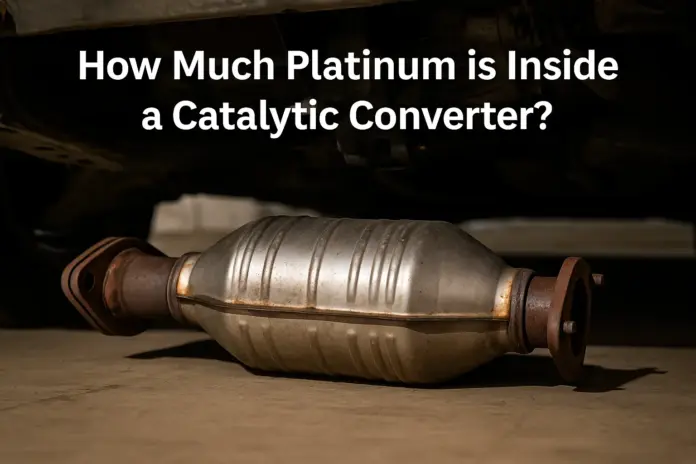

If you want to know how much platinum a catalytic converter contains, you can’t judge it by the outer shell. The real story is inside the converter—specifically in the ceramic honeycomb core and the precious-metal coating layered over it.
And here’s the part that surprises a lot of people: platinum is only one piece of the value puzzle. Palladium and rhodium matter too, and in many gasoline converters, they can matter even more. So if you’re trying to estimate scrap value, identify a unit, or just understand what’s actually inside one of these things, you need to look deeper than the steel case.
1. How the Three-Way Catalyst Actually Works
To accurately value a catalytic converter, you have to look past the steel shell and understand the chemistry happening inside the ceramic monolith. A three-way catalyst uses a ceramic honeycomb structure coated in a wash coat that contains PGM materials.
Those metals don’t all do the same job. Each one has a specific role in reducing emissions.
- Platinum (Pt): An oxidation catalyst that treats hydrocarbons (HC) and carbon monoxide (CO).
- Palladium (Pd): Also an oxidation catalyst. It was historically used as a cheaper substitute for platinum in gasoline engines, though market shifts have made it highly valuable in its own right.
- Rhodium (Rh): A reduction catalyst that specifically targets nitrogen oxides (NOx). By weight, this is typically the most expensive of the three.
If you’ve ever wondered why two catalytic converters that look nearly identical can have wildly different scrap values, this is why. The metal mix inside matters far more than the outside dimensions.
Why Diesel and Gasoline Converters Are So Different
This is the single biggest factor when estimating platinum content.
- Diesel engines: These run in a lean-burn, oxygen-rich environment and at lower exhaust temperatures. Platinum performs better here because palladium is more vulnerable to sulfur poisoning and oxidation at lower temps. Diesel converters are platinum-dominant.
- Gasoline engines: These operate at higher temperatures. Starting in the early 2000s, manufacturers moved toward palladium-heavy catalyst loads to cut costs and improve thermal stability. Modern gasoline converters are often palladium-dominant, with lower platinum yields.
That means a diesel unit and a gasoline unit may look similar from the outside, yet contain very different precious-metal profiles. In the scrap world, that difference is everything.
2. What Changes Platinum Load Weights?
Before you even look at a table of platinum estimates, you have to account for a few major variables. Think of these as the factors that push the number up—or drag it down.
- OEM vs. Aftermarket:
- OEM (Original Equipment Manufacturer): These have high PGM loading because they’re built to satisfy federal warranty requirements—typically 8 years or 80,000 miles in the U.S. These are the valuable ones.
- Aftermarket: These are usually built with the bare minimum PGM coating needed to keep the check-engine light off for 1 to 2 years. Metallurgically speaking, they typically contain 90% to 95% less PGM than OEM units. In refining terms, they’re close to worthless.
- Engine displacement and vehicle weight:
- Bigger engines move more exhaust gas, which means they need a larger substrate surface area to clean it effectively. A 6.0L V8 truck converter will usually carry more wash coat volume than a 1.5L inline-four.
- Regional regulations:
- The California factor: Vehicles built for the California market and made to meet CARB requirements usually carry denser PGM loading than federal 49-state vehicles because California emissions standards are stricter.
In the real world, this is why two converters from the same brand can have completely different values. One might be an OEM California-spec unit from a heavy SUV. The other might be an aftermarket replacement from a compact sedan. Same category on paper, very different metal content inside.
3. Platinum Content by Vehicle Type
The estimates below apply to OEM catalytic converters only. Aftermarket units are excluded because their precious-metal content is generally negligible.
Note: 1 troy ounce = 31.1035 grams.
| Vehicle Category | Catalyst Composition Profile | Estimated Platinum (Pt) Range (Grams) | Estimated Platinum (Pt) Range (Troy Oz) | Metallurgical Notes |
| Standard Domestic Passenger Car (Gasoline) | Pd Dominant / Pt Minor | 0.5g – 1.5g | 0.016 – 0.048 oz | Older domestic units (pre-2000) have higher Pt. Newer units rely heavily on Pd. |
| Foreign/Import Passenger Car (Toyota/Honda/German) | High Load Mixed | 1.5g – 3.0g | 0.048 – 0.096 oz | “Torpedo” or “Bread Loaf” shapes often have very high wash coat density. German imports often utilize higher Pt loads for Autobahn speeds. |
| Light Duty Truck / SUV (Gasoline) | High Volume / Mixed | 2.0g – 4.0g | 0.064 – 0.128 oz | Two to four converters per vehicle is common. The primary “front” cats hold higher value than rear “monitors.” |
| Heavy Duty Diesel (Semi-Trucks/Industrial) | Platinum Dominant | 5.0g – 12.0g+ | 0.160 – 0.385 oz+ | The highest Platinum yields. Some large DPF systems contain very high Pt loads to burn off soot. |
| High-Performance / Exotic (Ferrari/Lamborghini) | Ultra-High Flow | 4.0g – 8.0g | 0.128 – 0.257 oz | Requires massive surface area to prevent backpressure while scrubbing high-volume emissions. |
If you’re looking for the short answer, this is it: most standard gasoline OEM converters contain a relatively modest amount of platinum, while diesel converters are where the platinum content really jumps.
4. Why Recyclers Don’t Guess: The Code System Matters
In the refining industry, visual identification is basically guesswork. The real standard is serial or part-number analysis.
Here’s how that works:
- The markings: Manufacturers stamp an alphanumeric code onto the steel body or the heat shield.
- The database: Recyclers run that code through proprietary assay databases such as Eco Cat or PMR.
- The result: The code connects to a lab assay showing the exact ppm—parts per million—of platinum, palladium, and rhodium for that specific batch.
- Example: One GM converter may look identical to another, but code 12564563 may recover $80 while 12573211 may recover $250 because the internal loading is different.
That’s why experienced buyers don’t size a converter up by eye and call it a day. They read the code first. Always.
5. How Catalytic Converter Scrap Value Is Calculated
To determine the scrap value of a catalytic converter, refiners don’t just look at platinum alone. They calculate the recoverable value of platinum, palladium, and rhodium separately, then add them together.
The formula also has to account for recovery losses during de-canning and smelting. No process is 100% efficient, so refiners typically use a recovery rate of 85% to 90%.
The Formula:

- Spot price: The current market trading price per troy ounce.
- Refining margin factor: Usually 0.80 to 0.85. Recyclers generally pay 80% to 85% of refined metal value to cover processing costs and profit.
Important: You have to run this formula separately for platinum, palladium, and rhodium, then total the results to get the full value of the converter.
So if someone asks, “How much is this cat worth?” the honest answer is: it depends on the assay, the current metal prices, the recovery rate, and the recycler’s margin.
6. What a “Typical” OEM Converter Contains
If you don’t have a serial number or a precise vehicle model, the best you can do is work from industry averages.
For a standard full OEM converter from a mixed gasoline vehicle, average composition is approximately:
- Platinum: 1.4 grams
- Palladium: 1.8 grams
- Rhodium: 0.3 grams
That’s a useful baseline, but it comes with an important caveat. In an average gasoline converter, the value is often driven more by palladium and rhodium than by platinum.
If the converter is from a diesel, you should increase the platinum estimate to 5.0 grams or more and cut the palladium number down significantly. That diesel-vs-gas split is one of the biggest valuation differences in the entire category.
7. The Legal Side: What Gets Sellers Into Trouble
Catalytic converters are heavily regulated because theft has become such a serious problem. So even if you know the metal content and the likely value, selling one isn’t as simple as walking into a scrap yard anymore.
There are a few big red flags sellers need to understand:
- Don’t remove the heat shield if the code is on it.
If the identifying code is stamped on a rusted heat shield, leave that shield in place. Once it’s removed, the converter loses its identity and often drops to generic-grade pricing. - Don’t sell a blown-out unit like it’s a full one.
If the ceramic honeycomb is loose or rattling, that’s bad news. A broken core often means the precious-metal dust has already gone out the tailpipe. These units get graded as “empty” or “half-full.” - Expect paperwork.
Legitimate refiners and scrap buyers now commonly require photo ID, fingerprinting, and proof of vehicle ownership—usually a title or registration that matches the part being sold.
If you’re trying to estimate what a converter is worth, don’t guess from the shell, don’t trust shape alone, and definitely don’t assume all cats are created equal. Get the serial number, identify whether it’s OEM or aftermarket, and start there.