
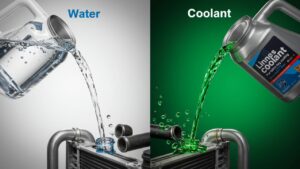

It seems like it should work, right? Water is cheap, it’s everywhere, and since the whole point of a cooling system is to get rid of heat, why wouldn’t plain water do the job? In an emergency, topping off with water might even be the right call to get you home safely.
But using water as a long-term substitute for coolant is a different story entirely. Behind that seemingly simple decision is a mix of thermodynamics, chemistry, and material science that can quietly wreck your engine from the inside out. We’re talking corrosion, mineral scaling, reduced boiling protection, and in cold climates, the kind of freezing damage that cracks engine blocks.
A lot of people use plain water out of convenience, to save a few bucks, or because they’ve been told it works fine. Most of them don’t realize what’s actually happening inside their cooling system until the repair bill shows up. Let’s break down why this matters and what really goes on when water replaces coolant.
A Quick Look at How Your Cooling System Actually Works
Your engine is remarkably inefficient at converting fuel into motion. Only about 25 to 35 percent of the energy in your fuel becomes useful mechanical work. The rest? It turns into waste heat. Without a cooling system to manage that heat, your engine would overheat and self-destruct within minutes.
The cooling system is a closed loop. A fluid (coolant) circulates through passages cast into the engine block and cylinder head, absorbing heat as it goes. It then flows to the radiator, where that heat transfers into the ambient air. The cooled fluid cycles back to the engine and the process repeats continuously.
The Key Components in the Loop
- Radiator: The heat exchanger that transfers heat from the coolant to the outside air
- Water pump: Keeps the fluid circulating through the system
- Thermostat: Regulates flow to maintain the engine’s ideal operating temperature, typically around 90 to 105 degrees Celsius
- Reservoir tank and pressure cap: Manage fluid expansion and maintain system pressure (usually around 15 psi)
- Hoses and seals: Route the fluid throughout the system and keep it contained
The system’s effectiveness depends on more than just flow rate and radiator size. The thermal and chemical properties of the fluid itself play a huge role in how well everything works and how long it lasts.
Why Engineers Designed Coolant Instead of Just Using Water
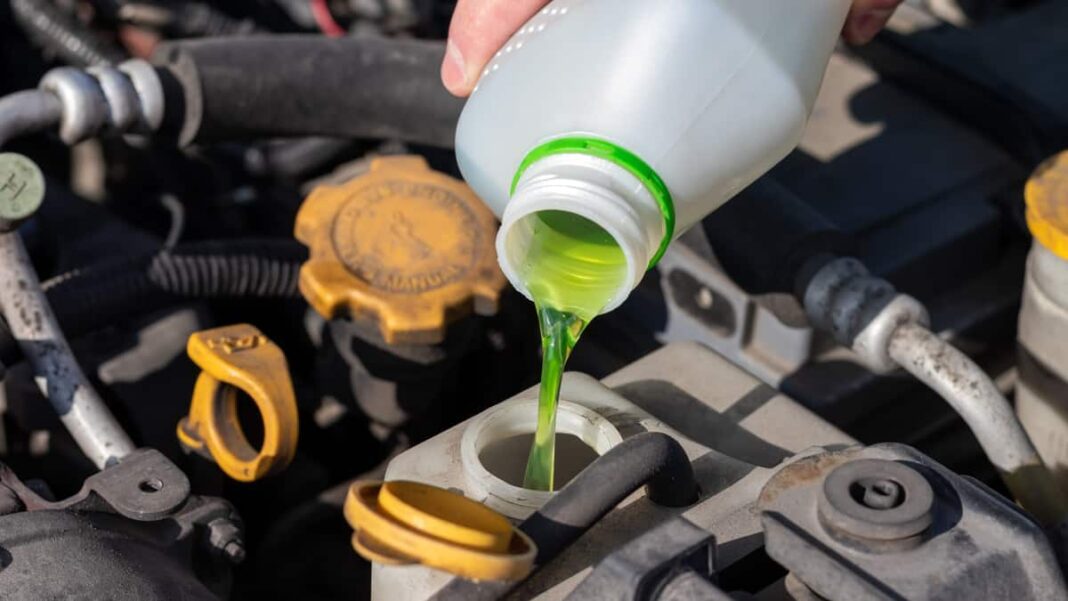
Engine coolant is typically a mixture of water and ethylene glycol (or sometimes propylene glycol). But it’s not just antifreeze. It’s a carefully formulated fluid that serves five distinct functions simultaneously:
| Function | What It Does |
|---|---|
| Heat transfer | Absorbs and transports heat away from the engine efficiently |
| Boiling and freezing protection | Raises the boiling point well above water’s limit and lowers the freezing point far below zero |
| Corrosion inhibition | Protects the aluminum, iron, brass, and gasket materials inside the system from chemical attack |
| Cavitation prevention | Reduces the formation of vapor bubbles that can erode internal surfaces |
| Lubrication | Preserves the water pump seals and bearings |
Water actually has a slightly better specific heat capacity than glycol-based coolant, meaning it can absorb more heat per degree of temperature rise. But heat absorption is only one piece of the puzzle. Water completely lacks the chemical stability and protective properties that keep a cooling system healthy over months and years of use.
What Water Does Well (And Where It Falls Apart)
The Case for Water
Water does have some genuine advantages in specific situations:
- Superior heat absorption: With a specific heat capacity of 4.18 kJ/kg per degree Kelvin (versus glycol’s 2.4), water absorbs heat more effectively per unit of mass.
- Universal availability: In an emergency, water is almost always accessible when coolant isn’t.
- Non-toxic: Unlike ethylene glycol, which is poisonous to humans and animals, water poses no toxicity risk.
The Case Against Water (And It’s a Long List)
Here’s where things go wrong, and they go wrong in multiple ways simultaneously:
It boils too easily. Water boils at 100 degrees Celsius at atmospheric pressure. System pressure raises that to about 120 degrees, but that’s still well below the 129 to 135 degree range that a proper coolant mixture provides. In heavy traffic on a hot day, that difference matters enormously.
It freezes too soon. Water freezes at zero degrees Celsius. When it freezes, it expands by roughly 9 percent. That expansion has enough force to crack radiators, cylinder heads, and engine blocks. A 50/50 coolant mix doesn’t freeze until around minus 37 degrees Celsius.
It corrodes metal. Water reacts with the aluminum, iron, and magnesium alloys inside your engine. Iron components develop rust. Aluminum surfaces form aluminum oxide, which reduces heat transfer efficiency. Over time, this corrosion eats through gasket surfaces, weakens hose connections, and creates debris that clogs passages.
Tap water creates scale buildup. Unless you’re using distilled water, the calcium and magnesium ions in tap water precipitate out as limescale on hot surfaces. This scale acts like an insulating blanket inside your radiator and engine passages, reducing heat transfer and slowly choking flow.
It provides no lubrication. The water pump relies on the fluid passing through it to lubricate its seals and bearings. Coolant contains additives that do this. Water doesn’t. Over time, running pure water accelerates pump seal wear.
The Chemistry Behind the Damage
Three specific chemical processes cause the most harm when water replaces coolant:
- Galvanic corrosion: Dissolved oxygen and electrolytes in the water create tiny electrochemical cells between dissimilar metals, causing pitting and rust
- Electrolysis: Modern engines often use an aluminum head bolted to an iron block. When water sits between these two different metals, stray electrical currents accelerate corrosion far beyond what you’d see with either metal alone
- Scale formation: Calcium carbonate precipitates out of hard water onto the hottest surfaces in the system, creating an insulating layer that progressively reduces cooling efficiency
Side-by-Side Performance Comparison
| Property | Distilled Water | Tap Water | 50/50 Coolant Mix |
|---|---|---|---|
| Boiling point | ~100°C | ~100°C | ~129 to 135°C |
| Freezing point | 0°C | 0°C | ~minus 37°C |
| Specific heat | 4.18 kJ/kg·K | 4.18 kJ/kg·K | 3.35 kJ/kg·K |
| Corrosion resistance | Moderate | Poor | Excellent |
| Scale risk | None | High | None |
| Lubrication | None | None | Yes |
Notice the pattern: water wins on raw heat absorption, but coolant wins on literally everything else that matters for system longevity.
How Climate Changes the Risk Equation
Where you live dramatically affects how dangerous water-only cooling is. The same shortcut that might be survivable for a few days in one climate can destroy an engine overnight in another.
Temperate Climates
Distilled water can work as a temporary measure if coolant isn’t available. The risks are gradual corrosion and a slight chance of localized boiling during heavy summer traffic. Replace it with proper coolant within a few days and you’ll likely be fine.
Tropical and Humid Climates
High ambient temperatures above 35 degrees Celsius push water dangerously close to its effective boiling limit inside a pressurized system. When water boils in localized spots, it creates vapor pockets that dramatically reduce cooling efficiency right where you need it most. Coolant’s higher boiling range provides a critical safety margin in these conditions.
Cold and Winter Climates
This is where water becomes genuinely dangerous. If temperatures drop below freezing while your engine is sitting overnight with water in the system, that water expands as it freezes. Nine percent expansion doesn’t sound like much until you consider that it’s happening inside rigid metal passages with nowhere to go. Cracked radiators, split heater cores, and fractured engine blocks are all possible outcomes. In cold climates, a minimum 50/50 coolant mix isn’t a suggestion. It’s mandatory.
Desert and Arid Climates
Extreme ambient heat combined with low humidity means your cooling system is working at its limits even under normal conditions. Water’s lower boiling point creates risk of steam pockets and localized hot spots that can warp cylinder heads or damage head gaskets. In desert environments, many manufacturers recommend a 60/40 coolant-to-water ratio or even specialty high-temperature formulations.
Four Myths That Keep Getting Repeated
| The Myth | The Reality |
|---|---|
| “Water cools better than coolant.” | Technically true per unit of mass, but coolant prevents boiling, freezing, and corrosion. Overall system reliability is far higher with coolant. |
| “Tap water works fine.” | The minerals in tap water cause scale buildup and accelerate galvanic corrosion between dissimilar metals. |
| “Coolant is only needed in winter.” | Coolant is a year-round protectant. Its corrosion inhibitors, lubricants, and boiling point elevation matter just as much in summer. |
| “I can mix any color of coolant together.” | Different coolant types (IAT, OAT, HOAT) use different chemical formulations. Mixing them can cause gel-like deposits that clog the system. |
That last one catches a lot of people. Coolant colors aren’t just cosmetic. They indicate different additive chemistries that can react badly with each other. Always match the type your manufacturer specifies.
What Happens When You Use Water Long-Term: A Real Example
A diesel delivery truck operating in tropical Malaysia was repeatedly topped up with tap water to save on coolant costs. Within 18 months, the radiator passages were 30 percent blocked with calcium deposits. Electrochemical pitting had eaten through the aluminum head gasket surface. The total repair bill exceeded $2,000, all traceable to using tap water instead of coolant.
In contrast, a test fleet that used distilled water with an additive package during an emergency showed zero corrosion damage after a proper coolant refill was done within 48 hours. The difference between “temporary emergency measure” and “ongoing practice” is the difference between no damage and a destroyed cooling system.
How to Use Water Safely in an Emergency
There are situations where using water is the right call. If your coolant level drops while you’re on the road and you don’t have coolant available, topping off with water is absolutely better than driving with an empty system and overheating the engine. But how you do it matters.
Step-by-Step Emergency Procedure
- Use distilled or demineralized water if at all possible. Never use tap water, well water, or river water. The minerals will cause problems fast.
- Let the engine cool completely before opening the radiator cap or reservoir. A hot pressurized system can spray boiling fluid.
- Add water slowly to avoid thermal shock to the engine components and to minimize air pocket formation.
- Drive gently. Avoid heavy acceleration, towing, or high RPM. You’re operating with reduced boiling protection.
- Watch your temperature gauge constantly. If it starts climbing toward the red, pull over and let the engine cool.
- Flush and refill with proper coolant as soon as possible. Ideally within 48 to 72 hours. The longer water sits in the system, the more corrosion and scale it produces.
What to Do After the Emergency
Once you can get to a shop or your garage, don’t just top off with coolant and call it good. The water that’s been circulating through your engine needs to come out completely:
- Flush the entire system to remove all water, debris, and any early-stage scale
- Inspect for corrosion around the radiator cap, water pump, and hose connections
- Refill with the correct coolant at the manufacturer-specified ratio (typically 50/50 premix)
- Bleed the system to eliminate any trapped air pockets that could cause hot spots
The Full Comparison at a Glance
| Feature | Distilled Water | Tap Water | 50/50 Coolant Mix |
|---|---|---|---|
| Boiling point | ~100°C | ~100°C | 129 to 135°C |
| Freezing point | 0°C | 0°C | Minus 37°C |
| Corrosion protection | Fair | Poor | Excellent |
| Scale formation | None | High | None |
| Pump and seal lubrication | None | None | Yes |
| Emergency use | Acceptable short-term | Not recommended | Ideal |
| Usable lifespan | Hours to days | Hours | 3 to 5 years |
| Climate suitability | Mild only | None recommended | All climates |
Keep Your Cooling System Healthy Year-Round
The smart approach to cooling system maintenance is straightforward, inexpensive, and saves you from expensive failures:
- Always use the manufacturer-recommended coolant mix, typically 50/50 glycol and water
- Only use distilled or deionized water when mixing coolant or flushing the system
- Check coolant condition every 12 months or 20,000 km, whichever comes first
- Never mix different coolant types. Match the chemistry (IAT, OAT, HOAT) to what your car requires
- Replace coolant every 2 to 5 years depending on the formulation
- Keep a small container of premixed coolant in your vehicle so you never have to resort to water in the first place
A gallon of premixed coolant costs around $10 to $15. A cracked engine block costs thousands. Water might get you home in a pinch, but coolant is what keeps your engine alive for the long haul. When was the last time you actually checked what’s in your reservoir?