
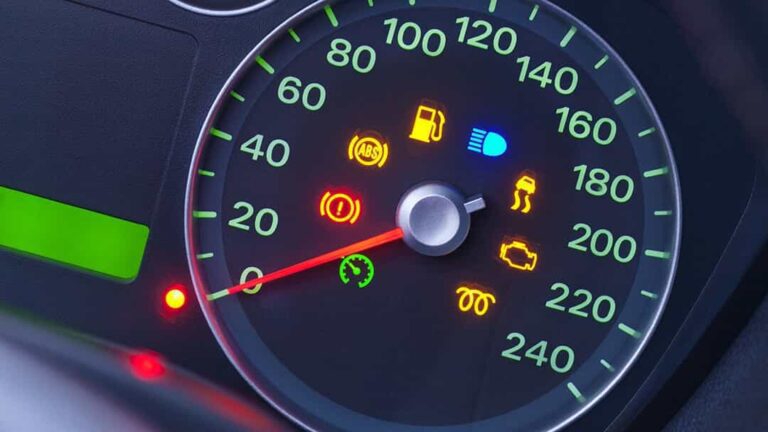
Last winter, a guy drove his Chevy Malibu into our shop lot with steam curling out from under the hood and a knocking sound loud enough to hear through the glass office door. When I asked him when the red thermometer light had come on, he shrugged and said, “About twenty miles back on the interstate, right next to the little orange engine light that’s been on since October.” He figured all dashboard lights meant the same thing: get around to it on your next day off. Mixing up an amber emissions light with a red overheating alert cost him a warped aluminum cylinder head and a $3,400 engine job.
Your car talks to you through those little glowing symbols behind the steering wheel, and knowing how to read them is one of the best money-saving skills any driver can have. Sometimes a new light on the dash is nothing more than a $15 gas cap that didn’t click tight at the pump. Other times, that tiny red icon is giving you a sixty-second warning to pull over and shut the key off before the crankshaft bearings weld themselves together.
You don’t need an engineering degree to tell the harmless reminders apart from the engine-killers. We’re going to walk through the dashboard color code that tells you how fast to react, break down all 30 warning and indicator symbols you’ll see on modern cars, and share the exact driveway checks and repair costs we go over with customers in the shop every day.
Why dashboard warning lights deserve your attention before a small glitch snowballs
A modern car is packed with anywhere from forty to eighty sensors watching oil pressure, coolant temperature, wheel speeds, fuel trim, exhaust oxygen, battery voltage, and airbag circuits every millisecond. Whenever a reading drifts outside the factory safety window, the control module turns on a dashboard telltale symbol to get your attention while the problem is still manageable.
I don’t blame drivers for feeling confused when an unfamiliar symbol pops up at 65 mph. Under federal and international instrument panel rules (standardized through SAE International and federal FMVSS 101 guidelines), automakers pack dozens of tiny hieroglyphics onto a dark gauge cluster: wavy lines, exclamation points inside circles, little teapots, and coils that look like toaster elements. You don’t have to memorize every symbol in the manual, as long as you know how to read the color and behavior of the light first.
Putting a piece of black electrical tape over a glowing warning light never fixes the mechanical problem underneath. A weeping $25 radiator hose turns into a blown head gasket when driven hot. A $45 misfiring ignition coil melts a $1,400 catalytic converter in twenty minutes of highway driving. Paying attention the day a light comes on is how you keep a five-minute repair from turning into a tow-truck bill.
What the dashboard colors mean: green, amber, and red explained
Almost every carmaker on earth follows the exact same traffic-light color system on the instrument cluster. Before you even squint at the shape of the icon, look at its color and whether it is glowing steady or blinking:
- Green, blue, or white lights (Informational status): These simply tell you that a normal feature is switched on right now, such as your low-beam headlights, turn signals, high beams (blue), or cruise control. Nothing is broken, and no repair is needed.
- Yellow or amber lights (Caution / check soon): Amber means a control module has logged a fault, a fluid or tire pressure is getting low, or a safety system like ABS or traction control has stepped in or gone offline. As long as the car still sounds, steers, and brakes normally, you can usually drive home or to a repair shop gently, but you should investigate it within a few days.
- Red lights (Immediate danger or safety warning): Red means stop and deal with it right now. Excluding simple reminders like an unbuckled seatbelt or an open door, a red mechanical warning light signals critical trouble: zero oil pressure, severe engine overheating, low brake hydraulic fluid, a failed alternator charge circuit, or an airbag fault. Pull into a safe spot off the road immediately.
Pay special attention to any warning light that is flashing or blinking. With the exception of the traction control icon (which flashes briefly when your tires slip on wet pavement), a flashing warning light is much more urgent than a steady one. A flashing check engine light means raw, unburned gasoline is dumping straight into your red-hot exhaust right this second, and you need to back off the gas pedal and pull over immediately.
| Light Color & Behavior | Urgency Level | Can You Keep Driving? | Best Immediate Move |
|---|---|---|---|
| Green / Blue / White (Steady) | None (Normal operation) | Yes, 100% normal | Just verify you meant to have that feature (like high beams or fog lights) turned on |
| Yellow / Amber (Steady) | Moderate (Service needed soon) | Yes, if the car drives, sounds, and brakes normally | Check tire pressure, gas cap, or fluid levels; scan OBD-II codes within a few days |
| Yellow / Amber (Flashing Check Engine or O/D) | High (Active component damage) | No, do not keep cruising at highway speed | Ease off the throttle immediately, pull over safely, and shut the engine off |
| Red (Steady or Flashing Mechanical Warning) | Critical (Safety or engine survival emergency) | No! Stop as soon as it is safe | Pull over immediately; shut the engine off for oil pressure or overheating alerts |
ABS warning light (anti-lock braking system)
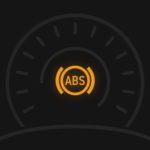
When the amber ABS circle lights up and stays on after you start the car, the anti-lock brake computer has disabled itself because it lost a signal from one of its parts. Normally, ABS watches all four wheels fifty times a second and pulses hydraulic brake pressure if a tire starts to lock up during a panic stop on rain, ice, or loose gravel.
Here is the good news that calms people down in the shop: if only the amber ABS light is on (and the red BRAKE light is off), your normal hydraulic brakes still work fine! You can still stop the car at red lights like normal. However, if a deer jumps out in front of you in the rain and you slam the brake pedal to the floor, your tires can lock up and skid instead of pulsing, so leave extra following distance.
What to do and what it costs: Drive home carefully and have a shop scan the ABS module (basic $25 engine code readers often can’t read ABS codes). Eight times out of ten, the culprit is a dirty, rusted, or broken wheel speed sensor bolted behind one of the brake rotors ($120 to $260 installed), a cracked magnetic tone ring on an axle or wheel bearing, or a broken wire near the strut.
Airbag / SRS warning light

When the red person-with-a-circle icon (or the letters SRS / AIRBAG) stays lit on your instrument panel, the Supplemental Restraint System computer has found a fault in an airbag circuit, impact sensor, occupant weight mat, or seatbelt pretensioner. Don’t shrug this one off: while the red SRS light is on, your airbags and pyrotechnic seatbelt tighteners may not fire at all in a crash.
Don’t confuse the red cluster fault light with the separate amber “Passenger Airbag OFF” light near your center radio screen. That center light is supposed to turn on when you toss a heavy backpack, laptop bag, or rear-facing child seat onto the front passenger seat, telling you the seat weight sensor turned the right-side airbag off on purpose for safety.
What to do and what it costs: One free check you can do (with the ignition turned completely OFF!) is to look under the driver and front passenger seats to see if a water bottle, umbrella, or vacuum cleaner nozzle bumped the yellow airbag wiring plug loose as the seat slid back and forth. Another super common culprit is a broken spiral ribbon cable (clockspring) inside the steering column ($200 to $450), which usually kills your horn and steering wheel buttons at the exact same time. Also check your VIN on the NHTSA recall database, because many airbag module, seat mat, and inflator faults are covered free of charge under federal safety recalls.
Battery or charging system warning
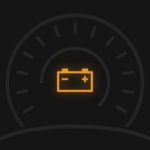
Even though this red symbol looks like a little 12-volt battery with a plus and minus sign, it is really your alternator and charging system warning light. When it pops on while the engine is running, system voltage has dropped below roughly 12.5 volts (or spiked too high), meaning the alternator is no longer recharging your battery.
Once the alternator quits, or if the rubber serpentine belt spinning the alternator snaps, your car is running 100% on whatever reserve power is sitting inside the battery. Depending on whether your headlights, AC blower, and wipers are running, you typically have 15 to 35 minutes of driving time before battery voltage drops below 9 volts and the fuel pump, spark plugs, and power steering shut down in traffic.
What to do and what it costs: Immediately switch off the AC, heater fan, radio, heated seats, and rear defroster, and head straight for a safe parking spot or repair shop without shutting the engine off at red lights. Under the hood (with the engine off!), check whether the serpentine belt is still intact and whether the battery terminal clamps are tight. A replacement battery runs $160 to $320, while a failed alternator typically costs $400 to $850 installed.
Brake pad wear indicator

If you drive a BMW, Mercedes-Benz, Audi, Volkswagen, Porsche, Mini, or certain full-size vans and trucks, you’ll see a circle flanked by three dashed curved lines on each side. That is your electronic brake pad wear sensor light. Engineers clip a tiny sacrificial wire loop into a slot on the inner brake pad; once the friction pad wears down to its last 2 to 3 millimeters, the spinning metal brake rotor rubs through that tiny wire loop, breaks the circuit, and turns on the amber light.
This light is an early-warning gift, not an emergency breakdown. When the sensor wire first trips, you normally still have 500 to 1,000 miles of gentle city braking left before the friction material is completely gone. Wait too long, though, and the steel pad backing plate will grind directly into the iron brake rotor, ruining the rotor and overheating the caliper piston.
What to do and what it costs: Book a brake inspection within the next week or two. Replacing a set of pads, rotors, and the $20 plug-in wear sensor wire typically runs $300 to $650 per axle depending on the vehicle.
Brake system / brake fluid warning
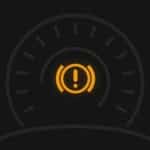
Unlike the amber ABS or pad-wear lights, the red BRAKE light (or a red circle with an exclamation mark inside) is a serious safety warning. It turns on for one of two reasons: either your mechanical handbrake / electronic parking brake is still pulled up at least one click, or the float switch inside your master cylinder has dropped because your hydraulic brake fluid is dangerously low (or one half of the dual-circuit brake hydraulic system has lost pressure).
What to do and what it costs: First, push your parking brake lever or foot pedal all the way down to make sure it didn’t catch on the first notch. If the parking brake is completely released and the red BRAKE light stays on, pull over immediately! Step on the brake pedal: if it feels spongy or sinks toward the carpet, do not drive the car another foot. Pop the hood and inspect the clear plastic brake fluid reservoir on the driver’s side firewall. If the fluid is down near the MIN line because of a rusted brake line, leaking caliper, or blown wheel cylinder, have the car towed to a mechanic right away.
Exterior bulb failure warning

This amber icon shaped like a glowing lightbulb with an exclamation mark tells you the Body Control Module noticed an open circuit or abnormal current draw on one of your outside lights. That could be a low-beam headlight, a rear brake light, a turn signal, a reverse light, or even one of the tiny bulbs above your rear license plate.
Here is a shop tip if you check all your lights and one bulb looks dead even after you put a brand-new $6 halogen bulb in it: inspect the plastic bulb socket on European and domestic tail lamp housings! Heat from brake light bulbs often melts the plastic ground contact tab inside the tail light tray, causing a “Bulb Out” warning even when the bulb filament itself is still good. Also remember that putting cheap unresisted LED bulbs into a housing designed for halogen bulbs will trigger this light because LEDs draw far less amperage than the computer expects.
What to do and what it costs: Turn on your headlights and hazard flashers, walk around the car (and have a helper step on the brake pedal or back up near a garage door or glass storefront to see the reflection), and swap the dead bulb for $5 to $25.
Oil change / maintenance reminder
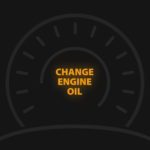
An amber wrench icon, a “MAINT REQ’D” light, or a “Change Engine Oil Soon” banner on your dash is a scheduled service timer, not a sensor telling you the engine is broken. Your car’s computer tracks miles driven, cold starts, engine RPM, and idle hours since the last oil service reset, and turns this reminder on when calculated oil life drops down to 15% or 5%.
You don’t need to pull over on the side of the freeway when a maintenance reminder pops on, yet you shouldn’t ignore it for another 4,000 miles either. Dirty, sheared-down motor oil loses its detergent additives and packs varnish into tiny variable-valve-timing oil screens and turbocharger oil feed lines.
What to do and what it costs: Check your dipstick today to verify the oil level is full, and book a routine oil and filter change ($55 to $120) within the next 500 miles. (If you just changed your own oil at home and the light is still on, check your owner’s manual for the 30-second ignition/pedal sequence to reset the oil life monitor to 100%.)
Check engine light (malfunction indicator lamp / MIL)
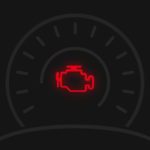
The amber engine-block outline, officially called the Malfunction Indicator Lamp (MIL), is controlled by your car’s On-Board Diagnostics (OBD-II) computer whenever an engine, ignition, fuel, evaporative emissions, or automatic transmission parameter fails its self-test. Because a single lamp covers more than a thousand possible Diagnostic Trouble Codes (from `P0010` to `P2999`), the light alone never tells you which part to buy.
Instead, watch whether the check engine light is steady or flashing:
- Steady amber check engine light: The computer logged a fault that affects emissions or sensor accuracy (such as a loose gas cap `P0455`, an aging oxygen sensor heater `P0135`, a thermostat running slightly cool `P0128`, or a lean vacuum leak `P0171`), without an immediate catastrophic misfire. If the engine sounds smooth and temperature is normal, you can drive home and have the code scanned within a few days.
- Flashing / blinking check engine light: Stop pushing the gas pedal immediately! A flashing MIL means a cylinder is actively misfiring (`P0300` to `P0308`) and dumping raw, unburned liquid gasoline straight into your exhaust manifold. Within minutes, that raw fuel ignites inside the ceramic honeycomb of your catalytic converter, heating it past 2,000°F until the catalyst melts into a solid brick and blocks the exhaust completely!
What to do and what it costs: For a steady light, tighten your gas cap and scan the OBD-II port under the driver’s dash (you can read how federal OBD-II monitors work on the EPA On-Board Diagnostics portal). For a flashing light, pull over safely and fix the $60 ignition coil or $15 spark plug before it destroys a $1,500 catalytic converter.
Cruise control indicator
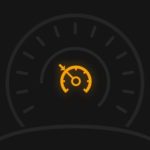
This little dial with an arrow pointing at a speed mark simply tells you that your cruise control system is turned on. On most cars, the icon glows white or amber when you press the main Cruise ON/OFF standby button on the steering wheel, and switches to green once you press SET and the computer takes over holding your speed.
The only time a cruise control light indicates a fault is if the word “CRUISE” starts flashing amber while the Check Engine light is on (common on Subarus, Toyotas, and Hondas). Because the engine computer automatically disables cruise control whenever an engine or wheel-speed fault code is stored, fixing the underlying check-engine code will bring your cruise control right back to life.
Diesel exhaust fluid (DEF / AdBlue) warning
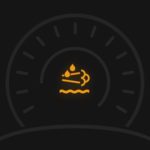
On modern diesel pickups, SUVs,vans, and passenger cars equipped with Selective Catalytic Reduction (SCR), this exhaust-puff icon with drops of liquid tells you the Diesel Exhaust Fluid (DEF / AdBlue) tank is getting low (or that the DEF heater/quality sensor detected a fault). The system sprays a precise mist of 32.5% high-purity urea and deionized water into the hot exhaust stream to turn nitrogen oxide (NOx) pollutants into harmless nitrogen and water vapor.
Never ignore a DEF countdown message! By federal law, if you let the DEF tank run completely empty, the computer will give you a mileage countdown (starting at 500 or 1,000 miles), progressively limit your top speed to 55 mph and then 5 mph, and eventually lock out the starter motor so the engine refuses to restart once you shut the key off.
What to do and what it costs: Pick up a 2.5-gallon jug of API-certified DEF ($14 to $25 at any auto parts store or truck stop) and pour it into the blue-capped DEF filler neck, never into the diesel fuel tank! Adding at least 2 gallons is usually required for the ultrasonic tank level sensor to register the refill and clear the countdown.
Diesel particulate filter (DPF) warning
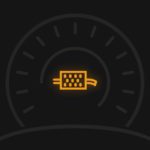
This rectangular box filled with little dots (representing trapped soot inside a muffler screen) is your Diesel Particulate Filter (DPF) warning light. When you drive a modern diesel on short five-mile city errands all week long, the exhaust never gets hot enough to burn off the trapped carbon soot inside the DPF honeycomb, and backpressure builds up until this amber symbol lights up.
What to do and what it costs: As soon as this amber DPF icon appears (before it turns red or triggers limp mode!), take the vehicle out onto an open highway for 20 to 30 minutes at steady speeds above 45 to 60 mph, keeping engine revs between 2,000 and 2,600 RPM. That sustained highway heat driving should trigger a regeneration cycle that burns the trapped soot into ash and turns the light off for free. If you ignore it until the car enters limp mode, a shop will have to run a forced computer regeneration ($150 to $300) or remove the filter for thermal/ultrasonic cleaning ($450 to $850).
Door, hood, or trunk ajar warning
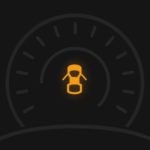
This red top-down car silhouette with open doors (or an open trunk/hood lid) means one of the latch micro-switches isn’t reading fully closed. Aside from the obvious danger of a hood flying up into your windshield at 60 mph or a child’s door popping open around a corner, an open-door signal will also keep your interior dome lights on or prevent your key fob from locking the car and arming the alarm.
What to do: Pull over in a safe spot, check for a seatbelt buckle or coat hem caught in the door jamb, and close each door, the trunk/tailgate, and the hood firmly. (Pro tip: if all doors are slammed tight and the light still flickers over bumps, spray a little electrical contact cleaner or silicone lubricant into the door latch mechanism where the sticky rubber micro-switch plunger lives.)
Electronic throttle control (ETC) warning

Often shaped like a red or amber lightning bolt sitting between two curved parentheses `(⚡)` (especially common on Jeep, Ram, Dodge, Chrysler, Ford, and Nissan models), this is the Electronic Throttle Control (ETC) warning light. Because modern cars have no steel cable connecting your right foot to the engine, two redundant sensors on your accelerator pedal send voltage signals to the engine computer, which drives a small electric motor inside the throttle body on the intake manifold.
If the throttle butterfly plate sticks on a ridge of black carbon grime, if the plastic gears inside the throttle body strip out, or if one of the dual pedal position sensors disagrees with the other by even 0.2 volts, the computer immediately lights up the lightning bolt and drops the car into fail-safe mode so the throttle can never stick wide open on its own.
What to do and what it costs: If the lightning bolt is glowing steady or flashing and the gas pedal barely responds, pull off the road safely. Sometimes shutting the engine off for 30 seconds and restarting resets a temporary sticky-plate glitch enough to get you to a shop. Cleaning carbon out of the throttle bore costs $15 to $100, while replacing a failed electronic throttle body assembly typically runs $250 to $600.
Engine temperature / coolant warning
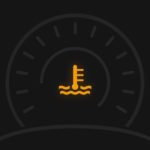
A glowing red thermometer floating in two wavy lines is a five-alarm fire for your engine. It means coolant temperature has climbed past roughly 240°F to 250°F (115°C to 121°C), either because coolant leaked out from a split radiator hose, cracked plastic radiator tank, or bad water pump, or because a stuck-closed thermostat or dead electric radiator fan stopped heat from leaving the engine.
Note that on many newer cars that don’t have a temperature needle gauge on the dash, this exact same thermometer symbol glows blue or green for the first three minutes when you start a cold engine in the morning; blue simply means the coolant is still cold (so don’t rev the engine hard yet) and turns off once warmed up. When it glows red, however, aluminum cylinder heads can warp and blow the head gasket in less than two minutes of continued driving!
What to do: If you are stuck in traffic and need 30 seconds to reach a safe shoulder, immediately turn the AC off and crank your cabin heater temperature and fan to MAX HOT (the heater core acts like a miniature backup radiator to pull heat out of the engine!), then pull over and shut the engine off. Never twist open a hot radiator cap or pressurized coolant tank! Pressurized boiling coolant can cause severe third-degree steam burns the instant pressure is released. Wait at least 45 to 60 minutes for the engine to cool down completely before checking fluid or calling a tow truck.
Engine oil pressure warning
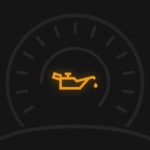
If there is one symbol on your dashboard that gives you zero margin for error, it is the red genie lamp / oil can dripping a drop of oil. This is the Low Engine Oil Pressure warning light, and most drivers misunderstand what triggers it. On most cars, the oil pressure switch doesn’t even trip until hydraulic oil pressure inside the engine block drops below a tiny 4 to 7 psi!
That means when the red oil can lights up at highway speed, your crankshaft bearings, camshaft journals, and connecting rods are already starving for lubrication. Driving even one or two miles down the highway to “make it to the next exit” with zero oil pressure will spin a rod bearing and turn your engine into a $6,000 boat anchor.
What to do and what it costs: Signal, pull onto the shoulder immediately, and shut the engine off within seconds. Let the car sit for five minutes, pull the dipstick, and check the oil level. If the dipstick is bone-dry from a leak or oil consumption, adding 2 to 3 quarts of the correct oil may save the engine if you shut it off fast enough. If the dipstick shows the oil is completely full and the red light stays on (especially if accompanied by a ticking or knocking sound), do not run the engine! Either the oil pump failed, the oil pickup screen is clogged with sludge, or the $35 oil pressure sending switch itself is faulty, so have a shop test mechanical pressure with a gauge after towing it in.
Fog light indicator
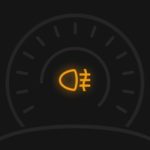
A green lamp icon with three slanted beams crossed by a vertical wavy line tells you your front fog lights are switched on (while an amber version facing the opposite way indicates a bright rear fog lamp on European cars). Front fog lights mount low in the bumper to cast a wide, flat bar of light underneath thick fog, heavy snow, or rain glare without bouncing light back into your eyes.
Nothing is wrong when this light is on. Just remember to switch your fog lights back off once the weather clears up, especially if your car has a high-intensity rear fog lamp, which glows as brightly as a brake light and annoys drivers following behind you on clear nights.
Low fuel warning
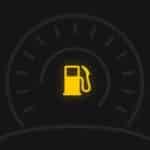
Everybody knows the amber gas-pump icon means you’re down to your reserve fuel, typically between 1.5 and 2.5 gallons (roughly 30 to 50 miles of range) depending on the size of your tank. What most people don’t realize is why mechanics hate seeing customers drive around on “E” every single week.
Your high-pressure electric fuel pump lives submerged inside the bottom of your gas tank, and it relies on liquid gasoline flowing around and through the pump housing to cool and lubricate its spinning electric motor brushes. When you constantly run the tank down until the pump is sucking air and sloshing vapors around corners, the fuel pump runs hot and wears out tens of thousands of miles early, turning a trip to the gas station into a $500 to $900 fuel pump replacement. (Bonus dashboard trick: look right next to the little gas pump icon on your gauge cluster; the tiny triangular arrow `◀` or `▶` tells you which side of the car your fuel filler door is on!)
Glow plug indicator (diesel only)
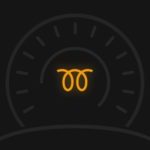
Diesel engines don’t use spark plugs to light the fuel; they compress air inside the cylinder until the air itself gets hot enough (over 900°F) to ignite the injected diesel mist. On a cold morning, the cold metal cylinder walls soak up that compression heat, so each cylinder has a pencil-shaped electric heating element called a glow plug that pre-heats the chamber before cranking.
When you turn the key to ON before starting a diesel, this amber curly-loop icon lights up for 2 to 10 seconds while the glow plugs heat up; wait until the light goes out before cranking the starter. However, if the glow plug coil light starts flashing while you are driving down the road (especially on Volkswagen, Audi, Ford, Mercedes, and Sprinter diesels), it doubles as an engine management and boost/injector fault light! Have the ECM scanned right away if it flashes mid-drive or stays on after startup (replacing a burned-out glow plug or glow plug control module typically costs $120 to $350).
Overdrive off / transmission warning
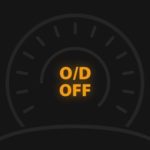
Seeing an amber O/D OFF light on your dashboard means the automatic transmission has locked out its highest highway cruising gear (overdrive). Nine times out of ten, the driver (or a dog climbing across the center console) accidentally bumped the small O/D button on the side of the gear shifter! When O/D is off, you’ll notice your engine revs about 600 to 800 RPM higher than normal at 65 mph; simply press the button on the shifter once and the light will disappear.
On the other hand, if pressing the shifter button does nothing, or if the O/D OFF light starts blinking rhythmically while you drive, the Transmission Control Module has detected a serious electronic or hydraulic fault (such as a failed shift solenoid, turbine speed sensor, or excessive clutch slip). Ease off the throttle and have a shop scan the transmission codes (`P0700` series) before heat ruins the clutch packs.
Loose gas cap / fuel cap warning
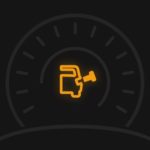
This symbol showing a screw-cap dangling off the side of a car tells you the Evaporative Emission Control (EVAP) system failed its fuel tank pressure/vacuum test. Modern gas tanks are sealed tight so raw hydrocarbon vapors can’t vent into the atmosphere; instead, vapors are stored in a charcoal canister and burned inside the engine.
What to do and what it costs: Pull over, unscrew your gas cap, wipe any dirt off the rubber O-ring seal, and turn it clockwise until it clicks 2 or 3 times. Keep in mind that the EVAP monitor only runs when your fuel tank is between roughly 1/4 and 3/4 full and the car completes a couple of cold-to-warm drive cycles, so the light may take 2 to 4 days of driving to turn off by itself after you tighten the cap! If a new $20 OEM gas cap doesn’t clear it, the next most common culprit is a sticking EVAP canister purge valve ($90 to $220) under the hood.
Power steering warning (EPS / hydraulic)
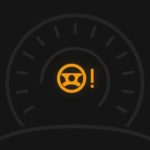
A steering wheel icon next to an exclamation mark `!` (glowing amber or red) tells you there is a fault in your power steering assist system. On older cars with hydraulic power steering or electro-hydraulic pumps, it usually means low power steering fluid or pump failure; on modern cars with Electric Power Steering (EPS), it means the electric assist motor on the steering column or rack has reduced or shut off its power assist.
Don’t panic if this light pops on: your steering wheel is still mechanically connected to the front wheels by a steel shaft, so you can still steer the car to the side of the road! However, without the electric motor or hydraulic pump helping you, turning the wheel at parking-lot speeds takes two hands and serious upper-body effort.
What to do and what it costs: On a hydraulic system, check the power steering fluid reservoir under the hood. On an electric EPS system, pull over safely, shut the ignition completely off for 30 seconds, and restart the car; sometimes a brief battery voltage dip or overheated motor trips the EPS module, and a restart restores assist. Also check whether your battery or alternator is weak, because electric steering racks draw up to 60 amps and are always the first module to drop offline when charging voltage sags!
Rear window defroster indicator
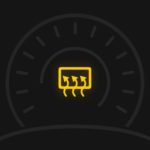
A rectangular window shape with three wavy arrows rising through horizontal grid lines simply tells you the rear window defroster (and on many cars, the heated side-view mirrors) is switched on. It sends 12-volt current through thin copper-ceramic grid lines baked onto the inside of the rear glass to melt ice and fog, and usually shuts itself off automatically on a 10- to 15-minute timer so it doesn’t waste electrical power.
Reduced engine power / limp mode
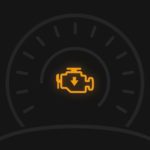
When your dashboard displays “Reduced Engine Power,” “Engine System Service Urgent,” or an engine icon with a downward-pointing arrow, the Engine Control Module has intentionally put the car into protective limp-home mode. To save the engine, turbocharger, or transmission from blowing up, the computer cuts turbo boost, limits engine revs to roughly 2,500 or 3,000 RPM, locks the transmission into a single safe gear, and slows throttle response to a crawl.
When a car drops into limp mode on the highway, flooring the gas pedal to the carpet won’t make it go any faster. The most common triggers we see in the shop are electronic throttle body faults (`P2135`), turbocharger overboost or underboost deviations (`P0234` / `P0299`), clogged diesel particulate filters, or transmission solenoid failures.
What to do: Put your turn signal on, move into the right lane, and exit the highway carefully. Once parked in a safe spot, scanning the stored fault codes is the only way to see which sensor or actuator triggered the protective shutdown.
Seatbelt reminder
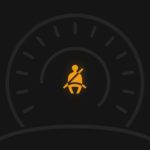
This red figure wearing a diagonal shoulder belt (along with the persistent dinging chime once you pass 5 or 10 mph) tells you the driver or a detected passenger hasn’t clicked their seatbelt into the buckle switch. Aside from buckling up every person in the car, if the light and chime ever go off while the passenger seat is empty except for a heavy grocery bag, briefcase, or wet gym bag, simply move that heavy bag to the floor or trunk so it stops pressing on the passenger seat’s occupant weight sensor mat.
Security / immobilizer warning

A car silhouette with a padlock, a key icon, or a small red LED blinking slowly every two seconds while your car is parked and locked is 100% normal: it just shows that the factory anti-theft immobilizer is armed and watching the vehicle.
The problem only starts if this security/key icon stays solid or flashes rapidly when you turn the key to ON or press the Start button, and the engine either refuses to crank or starts for one second and dies. That means the antenna ring around your ignition switch or push-button didn’t recognize the encrypted RFID transponder chip inside your key.
What to do and what it costs: If you have a push-button start car and the key fob battery is dead, hold the nose of the plastic key fob directly against the Start/Stop button while pushing it in so the induction coil can read the passive transponder chip without battery power! Also remove any bulky metal keychains or aftermarket metallic trim rings glued around the ignition switch that block the radio signal, or test your spare key. If a key lost programming or failed, an automotive locksmith can usually program a replacement transponder key for $140 to $300.
Service vehicle soon (SVS / wrench light)
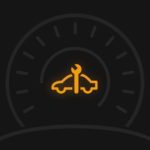
How is the amber Service Vehicle Soon light (a car silhouette with a wrench, or a standalone amber wrench on Ford/GM vehicles) different from the Check Engine light? By federal law, the Check Engine light (MIL) is strictly reserved for faults that increase tailpipe emissions. When a non-emissions fault occurs in the chassis, body control module, electronic powertrain throttle/drivetrain, brake switch, or lighting circuits, the car turns on “Service Vehicle Soon” instead!
What to do: Because a basic $20 emissions-only code reader often shows “No Codes Stored” when the Service Vehicle Soon light is on, have a shop scan the Body Control Module (BCM), Powertrain Control Module (PCM), and Chassis modules with a full-system diagnostic scanner to read the manufacturer-specific fault code.
Traction control / electronic stability control (ESC / TCS)
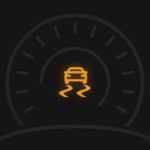
The amber car icon with two curvy skid marks behind the tires is your Traction Control and Electronic Stability Control (ESC) indicator, and how it lights up tells two totally different stories:
- Flashing while you accelerate or corner on wet, snowy, or gravel roads: Completely normal! The system is doing its job right now, pulsing individual wheel brakes and trimming engine torque for a second to stop your tires from spinning or sliding sideways. Just ease up slightly on the gas pedal and drive smoothly for the road conditions.
- Glowing solid continuously on dry pavement: Either someone bumped the physical “TCS / ESC OFF” button on the dashboard or center console, or the stability control system has shut itself off due to a fault.
Here is a mechanic secret that confuses drivers all the time: why does the solid Traction Control light so often pop on at the exact same moment as the Check Engine light or ABS light? Because Stability Control relies on the ABS wheel speed sensors to measure tire slip AND relies on the Engine Control Module to reduce engine torque cleanly! Whenever the engine computer logs a misfire, MAF sensor fault, or throttle code (or whenever an ABS wheel sensor fails), the car automatically disables Traction Control as a side effect. Fix the engine or ABS code first, and the traction control light will turn off right along with it.
Transmission temperature / transmission fault warning
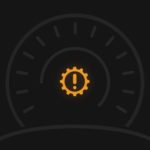
A toothed gear icon with a thermometer inside (or an exclamation mark in the center of a gear) means your automatic transmission, CVT, or dual-clutch gearbox is either overheating past roughly 240°F to 260°F (115°C to 126°C) or experiencing an internal pressure/sensor fault. Heat is the #1 killer of automatic transmissions: while healthy ATF comfortably runs around 175°F to 200°F, every 20-degree jump above 220°F cuts the life of the fluid and rubber clutch seals in half!
What to do and what it costs: If this light comes on while you are towing a trailer, climbing a steep mountain pass in summer heat, or rocking the car out of deep snow, pull over immediately, shift into Park or Neutral, and leave the engine idling with the AC off for 10 to 15 minutes! Why leave the engine idling in Park instead of shutting the key off? Because with the engine idling in Park, the transmission pump keeps circulating hot transmission fluid out through the radiator/transmission cooler while the cooling fan pulls air across it; shutting the engine off traps all that scorching heat inside the stagnant aluminum case! Once cooled, have a shop inspect the fluid level, condition, and cooler lines.
Tire pressure monitoring system (TPMS) warning
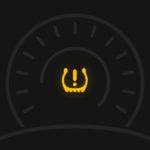
Shaped like a horseshoe or flat-bottomed tire cross-section with an exclamation point in the middle `(!)`, the amber TPMS light warns you that one or more tires has dropped at least 25% below your car’s recommended cold inflation pressure (for example, dropping to 24 psi when the door sticker calls for 33 psi). Remember that tire pressure drops by roughly 1 psi for every 10°F drop in outside temperature, which is why half the cars on the road get a TPMS light on the first frosty morning of autumn!
Notice the difference between a solid TPMS light and a flashing TPMS light:
- Solid TPMS light from the moment you start the car: At least one tire (and on some older SUVs, the full-size spare tire hanging under the trunk!) is genuinely low on air. Check all four tires when cold and inflate them to the PSI printed on the sticker inside the driver’s door jamb, never the “MAX PRESS 44 PSI” molded onto the rubber tire sidewall!
- Flashes for 60 to 90 seconds at startup, then turns solid: Even if all four tires have 35 psi of air, a flashing-then-solid TPMS light means the TPMS computer lost radio communication with one of the wireless sensor valves inside the wheels. Usually, the sealed coin battery inside one of your wheel sensors has finally died after 7 to 10 years ($60 to $130 per sensor installed at a tire shop). Federal TPMS safety rules and tire inflation guidelines are overseen by the National Highway Traffic Safety Administration (NHTSA).
Washer fluid low

This curved windshield outline with a dotted fountain spraying upward is the easiest fix on the entire dashboard: your windshield washer reservoir under the hood is down to its last pint of fluid. Pick up a $4 gallon of windshield washer fluid (use properwinter-rated -20°F de-icer fluid in cold climates rather than plain tap water, which freezes solid and cracks the plastic washer pump!), pour it into the reservoir cap marked with the matching windshield-spray symbol, and the float sensor will turn the light right off.
One odd mechanic quirk worth knowing: if your washer tank is 100% full to the brim with orange rain-repellent or bug-wash fluid and the low-washer light stays stuck on, some cars (especially Volkswagen, Audi, BMW, and GM models) use two tiny metal prongs instead of a mechanical float to measure fluid conductivity. Silicone rain-repellent additives in specialty washer fluids can coat those two metal prongs with an invisible water-repellent film so the sensor thinks the tank is dry! Flushing the tank with warm water or wiping the sensor prongs fixes it for free.
Master reference table: 30 dashboard lights at a glance
When a light pops up in traffic and you need a five-second answer on whether you can keep driving to work or need a tow truck, use this shop cheat-sheet:
| Dashboard Light | Usual Color | Safe to Drive? | Most Common Cause | Typical Fix Cost |
|---|---|---|---|---|
| Engine Oil Pressure (Oil Can) | Red | NO! Stop immediately | Critically low oil level, failed oil pump, clogged pickup, or bad pressure switch | $15 (2 qts oil) to $60 (switch) or $800+ (pump/pickup) |
| Engine Coolant Temp (Thermometer) | Red | NO! Stop immediately | Coolant leak (hose/radiator/water pump), stuck thermostat, or dead cooling fan | $150 to $650 (hose/thermostat/fan) or $2,500+ if overheated into head gasket failure |
| Brake System / Fluid (! / BRAKE) | Red | NO (unless parking brake was left up) | Parking brake engaged, low brake fluid in reservoir, or hydraulic brake leak | $0 (release handbrake) to $200 to $600 (leaking caliper/line) |
| Battery / Charging System | Red | Short distance only (15 to 30 mins max) | Failed alternator, snapped serpentine belt, or bad battery / loose terminal | $50 to $180 (belt) to $180 to $320 (battery) or $400 to $850 (alternator) |
| Check Engine Light (Flashing) | Amber (Blinking) | NO! Pull over to save catalytic converter | Severe active engine misfire (bad ignition coil, spark plug, or fuel injector) | $80 to $350 (coil/plugs) vs. $1,200 to $2,500 if converter melts |
| Check Engine Light (Steady) | Amber | Yes, drive gently & scan soon | Loose gas cap, oxygen sensor, EVAP valve, MAF sensor, or catalyst efficiency | $0 to $25 (gas cap) to $150 to $400 (sensor/valve) |
| Transmission Temp (Gear + Thermometer) | Red / Amber | NO! Pull over & idle in Park to cool | Overheated ATF from towing/hills, low transmission fluid, or cooler blockage | $150 to $350 (fluid service/cooler) or $2,500+ if burned up |
| Electronic Throttle (Lightning Bolt) | Red / Amber | Caution (Limp speed only) | Dirty/sticking electronic throttle body or faulty accelerator pedal sensor | $20 to $120 (throttle cleaning) to $250 to $600 (new throttle body) |
| Reduced Engine Power (Limp Mode) | Amber / Red | Caution (Exit highway safely) | Turbo boost fault, throttle body fault, transmission fault, or clogged DPF | $100 to $850+ depending on stored fault code |
| Airbag / SRS Warning | Red | Drivable, but airbags may not deploy! | Unplugged under-seat wire, broken steering clockspring, or bad seat weight mat | $0 (re-seat plug) to $200 to $600 (clockspring/sensor) |
| ABS Warning Light | Amber | Yes (Normal brakes work; no anti-lock skid help) | Bad wheel speed sensor, rusted tone ring, or damaged sensor wire | $120 to $300 per wheel sensor |
| Power Steering Warning (Wheel + !) | Red / Amber | Caution (Steering will be very heavy) | Low hydraulic PS fluid, weak battery/alternator, or EPS motor/torque sensor fault | $15 (fluid) to $250 to $1,200+ (pump or EPS rack/column) |
| Tire Pressure (TPMS Horseshoe) | Amber | Check tires first (Don’t drive on a flat!) | Cold weather pressure drop, nail puncture, or dead TPMS sensor battery (flashing) | $0 (air up tires) to $25 (patch) or $75 to $130 (new TPMS sensor) |
| Traction / Stability Control (Car + Skids) | Amber | Yes (Drive carefully on slick roads) | Normal slip when flashing; if solid, button pressed off or linked to ABS/Check Engine code | $0 (press TCS button) or matches ABS/engine sensor fix |
| Diesel Particulate Filter (DPF Box) | Amber | Yes (Do a 25-min highway drive now) | Soot buildup from short city trips or faulty DPF differential pressure sensor | $0 (highway regen drive) to $150 to $800 (forced regen/cleaning) |
| Diesel Exhaust Fluid (DEF Drops) | Amber | Yes, until countdown hits zero | Low DEF (AdBlue) tank level or faulty DEF tank heater/NOx sensor | $18 (2.5-gal DEF jug) to $350 to $900 (DEF heater/sensor) |
| Brake Pad Wear (Circle + Dashed Arcs) | Amber | Yes (500 miles left; book brake job) | Front or rear brake pads worn down to 2 to 3 mm sensor contact wire | $300 to $650 per axle (pads, rotors & new sensor wire) |
What to do when a warning light appears: a step-by-step response
When a chime dings and a new symbol lights up while you’re merging onto the freeway at 65 mph, your heart rate jumps, and that’s when drivers make bad snap decisions like slamming on the brakes in a live lane or ignoring a red oil light for twenty miles. Keep this six-step routine in the back of your mind so your reaction is automatic:
- Check the color and whether it’s blinking first: Green or blue means relax. Steady amber means you have time to finish your drive gently if the car feels normal. Red or flashing amber means you need to get off the road right now.
- Scan your temperature gauge, oil gauge, and how the car feels: Glance at the coolant thermometer needle and listen to the engine. Does the steering feel heavy? Is the brake pedal firm? Is the engine stumbling or knocking?
- Move to a safe shoulder or parking lot for any red or flashing light: Put your right turn signal on early, ease off the throttle, and coast onto a wide paved shoulder or exit ramp parking lot away from fast traffic.
- Know when to shut the key off vs. when to leave it idling: For a red oil pressure light, red coolant overheating light, or flashing check engine light, shut the engine off immediately! For a hot transmission fluid light, shift into Park and leave the engine idling for 10 minutes so the pump circulates fluid through the cooler. And for a red battery/alternator light, don’t shut the engine off until you are parked in your final safe spot, because it won’t have the battery juice to crank over again.
- Open the glovebox manual or run a quick visual check: Once parked safely (and cooled down if hot), check the symbol against your owner’s manual index, check your dipstick oil level, verify your gas cap is tight, and walk around your tires.
- Call a tow truck instead of gambling an engine: A $95 tow bill (or free AAA / insurance roadside tow) feels annoying in the moment, until you compare it to a $4,500 replacement engine after driving three miles with a broken water pump or zero oil pressure.
How to keep warning lights from showing up in the first place
You can prevent at least three-quarters of the amber and red lights we see in our shop bays with fifteen minutes of simple driveway care once a month. You don’t need a mechanic’s toolbox to stay ahead of dashboard drama:
- Stick to real-world fluid intervals, not stretched marketing numbers: Change your full-synthetic engine oil and filter every 5,000 to 7,500 miles, flush brown brake fluid every 2 to 3 years so moisture doesn’t rust your ABS valves from the inside, and service your automatic transmission fluid every 40,000 to 60,000 miles.
- Do a 60-second under-hood fluid glance once a month: While waiting for your windshield to clean or before a road trip, pop the hood and look at the translucent coolant overflow bottle, the clear brake fluid reservoir, the washer fluid tank, and the engine oil dipstick. Catching a slow coolant seep when the bottle is down two inches saves you from ever seeing the red thermometer light on the highway.
- Check tire pressures when the seasons change: Keep a $10 pencil or digital tire gauge in your glovebox and check all four tires (plus your spare!) on a cool morning once a month, especially when autumn temperatures drop by 20 degrees.
- Keep your battery terminals clean and swap aging batteries before year 5: Almost half of the weird “Christmas tree” multi-light warnings on modern cars (where ABS, Traction Control, Power Steering, and Airbag lights all flash at once) are actually triggered by a weak four-year-old 12-volt battery or a loose negative cable clamp causing low-voltage glitches across the CAN bus!
- Tuck a $25 Bluetooth or handheld OBD-II scanner in your glovebox: Plugging a basic code reader into the port under your steering wheel takes thirty seconds and tells you right away whether an amber Check Engine light is a $0 loose gas cap (`P0455`) or a crankshaft sensor code (`P0335`) that needs a mechanic before your next commute.
Frequently asked questions about car dashboard warning lights
Can I keep driving if a warning light comes on?
It depends on the color of the light and how the car is acting. Green, blue, and white icons are just status reminders showing a system is on. A steady yellow or amber light (like a steady check engine light, ABS light, or low washer fluid light) usually means it is safe to drive home or to a repair shop gently, provided you verify your tires aren’t flat and the car sounds and brakes normally. A red mechanical warning light (oil pressure, coolant temperature, brake hydraulics) or a flashing check engine light means stop driving immediately to prevent a crash or catastrophic engine damage.
Why did my check engine light come on and then go off by itself?
Your car’s computer runs continuous pass/fail tests on dozens of sensors and emissions monitors every time you drive. If a condition fails once or twice (for example, a slightly loose gas cap, a brief misfire from damp morning air, or a sticky EVAP valve) and then passes three consecutive drive cycles in a row without failing again, the computer will turn the dashboard Check Engine light back off automatically! However, the computer still saves the “History / Pending Code” in its memory for 40 warm-up cycles, so a mechanic can still scan it and see what happened.
Is it safe to drive with the ABS light on?
As long as only the amber ABS light is on and the red BRAKE system light is off, your normal foot brakes still have full hydraulic stopping power and it is safe to drive carefully to a shop. Keep in mind that because the anti-lock pulsing computer is offline, slamming the brakes hard on wet pavement, snow, or gravel can lock the wheels into a skid, so slow down and leave plenty of room behind the car ahead of you.
What is the most dangerous warning light on a car dashboard?
From a safety standpoint, the red Brake System / Brake Fluid light is the most dangerous to your life because a hydraulic brake fluid leak can leave you with a pedal that goes straight to the floor when approaching an intersection. From an engine-survival standpoint, the red Engine Oil Pressure light and the red Engine Coolant Overheating light are tied for #1: driving even a few minutes with zero oil pressure or boiling coolant will permanently destroy the engine.
Why do all the warning lights come on when I turn the key before starting?
That three-second light show is called the bulb check (prove-out test), and it is completely normal! Every time you turn the ignition to ON before cranking the starter motor, the instrument cluster lights up every warning symbol so you can verify that all the LED indicators work (and so a shady used-car seller can’t hide a Check Engine or Airbag fault by disabling the light). Once you start the engine, all the red and amber fault lights should go dark within 2 to 4 seconds.
Can a loose gas cap really trigger the check engine light?
Yes, and we see it in the shop every single week! Your fuel tank is pressurized and vacuum-tested by the Evaporative Emission Control (EVAP) system to keep raw gasoline fumes from escaping into the air. If you forget to click the gas cap tight after buying fuel, or if the rubber O-ring inside an old gas cap cracks, the system detects a pressure leak (`P0442` or `P0455`) and turns on either the Loose Gas Cap icon or the Check Engine light.
How much does it cost to diagnose a dashboard warning light?
For a basic Check Engine light, most major auto parts stores will plug a handheld code reader into your OBD-II port in the parking lot and print out the generic “P-code” for $0 (free), or you can buy your own pocket OBD-II scanner for $20 to $45. Remember that a fault code only names the circuit that complained, not the guaranteed bad part: if you need a professional mechanic to run live sensor data, smoke-test an EVAP leak, or pull proprietary Airbag, ABS, or Body Control codes, an independent shop or dealership typically charges $80 to $180 for a full diagnostic test (and many independent shops credit part of that fee toward the repair if you have them fix it).
A mechanic’s verdict: what to do next and when to visit a shop
Your dashboard isn’t trying to ruin your week when a symbol lights up; it’s giving you a head start before a small mechanical hiccup turns into a roadside breakdown. Once you know the three-color traffic light rule (green/blue means active, steady amber means check soon, and red or flashing means pull over right now), you’ll never have to guess whether it’s safe to finish your commute.
If an amber light popped up on your dash today and the car still feels normal, start with the free two-minute driveway checks: twist your gas cap until it clicks, check all four tires with a pressure gauge, glance at your oil dipstick and coolant bottle, and plug in an OBD-II code reader to write down the exact fault code. Simple fixes like airing up cold winter tires, topping off washer fluid, tightening a loose battery clamp, or swapping a burned-out tail light bulb are 100% DIY jobs that take ten minutes and cost next to nothing.
On the other hand, never try to “tough it out” when a red oil pressure can, a red overheating thermometer, a red brake system light, a battery/alternator light, or a flashing check engine light comes on. Pull over safely, shut the engine off before heat or friction ruins your internals, and let a trusted mechanic test the system properly. Listening to your dashboard the first time it speaks up is the easiest way to keep your car running safely for hundreds of thousands of miles without ever facing a surprise $4,000 engine bill.