
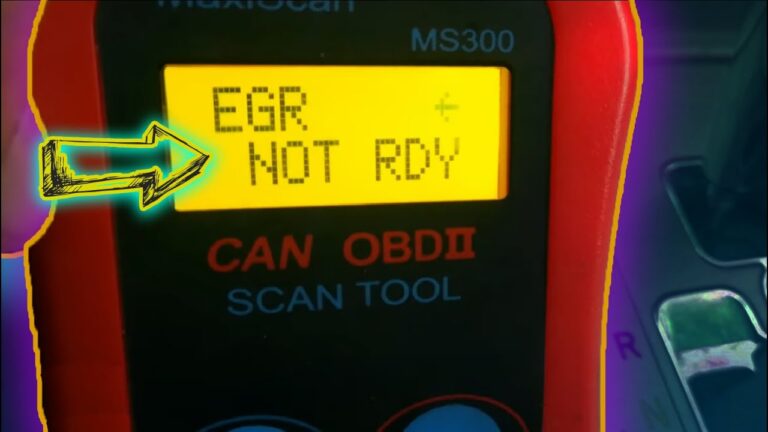
You’re trying to get your car through an emissions test, and everything seems fine. No check engine light. No weird engine behavior. You’ve been driving for weeks. But when they plug in the scanner, the EGR monitor comes back as “not ready,” and suddenly you can’t pass.
It’s one of the most frustrating situations in car ownership because there’s nothing obviously wrong with the vehicle. The engine runs great. The light isn’t on. Yet the computer is telling you it hasn’t finished checking one of its own systems, and until it does, you’re stuck.
Let’s walk through what the EGR system actually does, why the monitor gets stuck on “not ready,” and exactly how to fix it so you can get on with your life.
What Does the EGR System Actually Do?
Before you can understand why the monitor won’t cooperate, it helps to know what the EGR system is doing in the first place. EGR stands for Exhaust Gas Recirculation, and it’s part of your engine’s emissions control setup.
Here’s the basic idea: when your engine burns fuel at very high temperatures, it creates nitrogen oxide (NOx), which is a harmful pollutant. The EGR system takes a small portion of the exhaust gas and routes it back into the combustion chambers. This lowers the combustion temperature and pressure, which reduces the amount of NOx your engine produces.
The system relies on a few key components working together:
- EGR valve: Controls how much exhaust gas gets recirculated back into the intake
- Actuator solenoid: Opens and closes the EGR valve based on commands from the engine computer
- DPFE sensor (Differential Pressure Feedback EGR): Measures the flow of exhaust gas through the system and reports back to the ECU
When everything is working correctly, these parts coordinate to deliver the right amount of exhaust gas recirculation based on engine load and temperature. Your car runs cleaner, and you never even think about it.
What “EGR Not Ready” Actually Means
Here’s where people get confused. “EGR not ready” doesn’t mean the EGR system is broken. It means the onboard diagnostic system hasn’t finished running its self-test on the EGR components yet.
Your car’s computer (the ECU) constantly runs background checks on various emissions systems. These are called readiness monitors, and each one corresponds to a different part of the emissions control setup: the catalytic converter, the oxygen sensors, the evaporative system, and yes, the EGR.
Each monitor needs specific driving conditions to complete its self-test. The EGR monitor, for example, typically needs a combination of highway cruising, deceleration, and varying engine loads before the ECU has enough data to confirm the system is functioning properly. If those conditions haven’t been met, the monitor stays in “not ready” status.
The frustrating part? Your EGR system could be in perfect health. But if the OBD system can’t verify that because it hasn’t completed its checks, you’ll still fail an emissions inspection in most states. The system isn’t saying something is wrong. It’s saying it hasn’t had the chance to confirm everything is right.
5 Reasons Your EGR Monitor Gets Stuck on “Not Ready”
Several things can prevent the EGR monitor from completing its self-test. Some are obvious, and some catch people off guard.
1. You Recently Replaced or Disconnected the Battery
This is the single most common cause. When your car battery gets disconnected, whether for a replacement, a jump start gone wrong, or just routine maintenance, the ECU loses its stored data. All the readiness monitors reset to “not ready” and have to run through their self-tests from scratch.
Think of it like restarting your phone. All your apps need to reload, and some of them take longer than others. The EGR monitor is one of those slower ones because it needs very specific driving conditions to complete.
This catches a lot of people right before emissions testing. They replace a dead battery, drive straight to the inspection station, and get turned away because none of their monitors have had time to complete.
2. Someone Cleared the ECU Memory
If you or a mechanic recently used a scan tool to clear diagnostic trouble codes, that action also resets all the readiness monitors. It’s the same effect as disconnecting the battery, but done through software instead of hardware.
This is actually a common (and shady) trick some people try before an emissions test. They clear the codes hoping the check engine light will stay off long enough to pass. But inspectors know this game. If they see multiple monitors showing “not ready,” they know the codes were recently cleared and they’ll reject the test.
After a code clear, you typically need to drive 50 to 100 miles under varied conditions before all the monitors complete their cycles again.
3. There’s an Underlying Emissions Control Problem
Sometimes the EGR monitor won’t complete because another part of the emissions system has an issue that’s preventing the self-test from running. A faulty oxygen sensor is a frequent culprit here.
The oxygen sensor tells the ECU whether the engine is running rich or lean. If it’s sending inaccurate data or not responding quickly enough, the ECU may not have the baseline information it needs to evaluate the EGR system. Other emissions components like the catalytic converter or the EVAP system can also interfere if they’re malfunctioning.
In these cases, the EGR “not ready” status is actually a symptom of a different problem entirely. Fix the underlying issue, and the EGR monitor will complete on its own.
4. A Recent Software Update Reset the Monitors
If your car received a software update at the dealership, whether it was a recall, a TSB (Technical Service Bulletin), or just a routine ECU reflash, there’s a good chance the readiness monitors got wiped in the process. The ECU essentially starts fresh after a software update and needs to relearn everything through driving.
This is completely normal, but dealerships don’t always mention it. You pick up your car, everything seems fine, and then you fail an emissions test a week later because the monitors haven’t had time to cycle through.
5. You Recently Had Major Repairs Done
Any significant repair that involves disconnecting sensors, replacing components near the engine management system, or resetting the ECU can cause the EGR monitor to show “not ready.” This includes things like replacing an intake manifold, swapping ignition coils, or doing head gasket work.
The repair itself might have been done perfectly. But the ECU needs time and driving cycles to re-establish its baseline data before it can run the EGR self-test again.
How to Fix “EGR Not Ready”: The Drive Cycle That Actually Works
The fix for most “EGR not ready” situations is straightforward: you need to complete a drive cycle. This is a specific sequence of driving conditions that gives the ECU what it needs to run its self-tests on the EGR system.
Random driving around town might eventually get the job done, but it could take days or weeks. Following a structured drive cycle speeds things up dramatically. Here’s how to do it step by step.
Step 1: Start With a Cold Engine
Park the car and let the engine cool for at least 8 hours. Overnight is ideal. The initial coolant temperature needs to be between 0°F and 104°F for the drive cycle to register properly.
While you’re at it, make sure your gas tank is between 25% and 75% full. Too empty or too full can prevent certain monitors (including the EVAP system) from completing, which can indirectly affect the EGR monitor.
Step 2: Cold Start and Idle
Start the engine and let it idle for 3 to 5 minutes. Don’t touch anything. Keep the air conditioning off. Keep the rear defroster off. The ECU needs a clean, unloaded idle baseline to begin the monitoring process.
Step 3: Accelerate to Highway Speed
With all accessories still off, accelerate smoothly to 50 mph within about 15 seconds. If your car has a manual or selectable automatic transmission, get it into 4th gear. Hold this speed and drive at highway speeds for 10 to 15 minutes without interruption.
This sustained cruise is when the ECU typically gathers the data it needs for the EGR self-test. The system is looking at engine load, exhaust flow, and EGR valve behavior at steady state.
Step 4: Drive in Stop-and-Go Traffic
After the highway portion, drive for another 20 minutes in city-style stop-and-go conditions. This gives the ECU a chance to evaluate the EGR system under varying loads, which is part of the complete readiness check.
Step 5: Perform Controlled Acceleration and Deceleration
This is the part most people skip, but it’s often what triggers the EGR monitor to finally complete.
- Hold 50 mph in 4th gear for about 5 minutes
- Decelerate by braking gently down to 45 mph, staying in 4th gear, and hold for 3 seconds
- Accelerate at full throttle back up to 55 mph, still in 4th gear, and hold for 3 seconds
- Decelerate again to 45 mph for 3 seconds
- Repeat this acceleration/deceleration pattern 3 to 4 times, finishing at 55 mph
These speed transitions force the ECU to evaluate EGR flow across different engine loads and throttle positions. It’s the final piece of data the system needs.
Step 6: Stop and Idle Again
Pull over safely, park the car, and let it idle for about 5 minutes. By this point, the EGR monitor should have completed its self-test. Plug in an OBD-II scanner and check. If it still shows “not ready,” you may need to repeat the cycle one more time.
For most cars, one or two complete drive cycles will get the job done. If you’ve gone through the cycle three or four times and the EGR monitor still won’t set, that usually points to an underlying issue that needs professional diagnosis.
Can You Replace the EGR Monitor?
No, and this is something that confuses a lot of people. The EGR monitor isn’t a physical part you can swap out. It’s a software function built into your car’s ECU. Think of it as a diagnostic routine, like a program running in the background, not a sensor or a valve you can unbolt and replace.
The monitor’s job is to run internal self-tests on the EGR system during what’s called a drive cycle. If the EGR valve, DPFE sensor, or solenoid is faulty, you replace those physical components. But the monitor itself is just the ECU checking on those parts. You can’t replace software logic with a wrench.
If the monitor consistently refuses to complete even after multiple drive cycles, the issue is almost always one of two things: either a physical component in the EGR system is malfunctioning and preventing the self-test from passing, or another emissions system has an unresolved problem that’s blocking the EGR check from running at all.
When It’s Time to Stop DIY and Call a Mechanic
The drive cycle fix works in the vast majority of cases, especially when the “not ready” status was caused by a battery disconnect or code clear. But if you’ve completed multiple drive cycles and the EGR monitor still won’t set, something deeper is going on.
At that point, a mechanic with a professional-grade scanner can pull freeze frame data, run bi-directional tests on the EGR valve and solenoid, and pinpoint whether a specific component is preventing the monitor from completing. Trying to guess your way through it at that stage usually just wastes time and money.
The good news? In most situations, “EGR not ready” is nothing more than a patient car needing the right driving conditions to finish its homework. Give it the drive cycle it’s asking for, and you’ll likely see “ready” on the next scan.
