
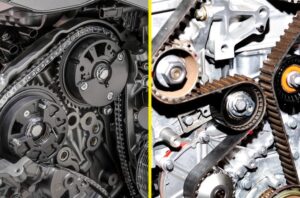

If you have ever gone car shopping and asked, “Does this one have a timing belt or a timing chain?” you probably got a blank stare from the salesperson. Most people selling cars have no idea. And honestly, most people buying cars do not think to ask. But this single detail about your engine can determine whether you are spending $500 on a scheduled maintenance item or $5,000 on an engine rebuild somewhere down the road.
Both timing belts and timing chains do the same fundamental job. They keep the top half of your engine synchronized with the bottom half. Without that synchronization, your engine cannot run. It is that simple and that important.
Table of Contents
But despite doing the same job, belts and chains are made from completely different materials, they wear out at different rates, they fail in different ways, and they cost vastly different amounts to replace. Knowing which one your car has, and understanding what happens when it fails, is one of the most valuable pieces of automotive knowledge you can carry around in your head.
Let us go through everything: what these parts actually do inside your engine, how they differ, what their strengths and weaknesses are, what happens when they break, and how to take care of whichever one your car has so it does not leave you stranded on the side of the highway.
What the Timing Belt and Timing Chain Actually Do Inside Your Engine
To understand why these parts matter so much, you need a basic understanding of how your engine works. Do not worry, we are keeping this simple.
Your engine has two main rotating assemblies. Down at the bottom, you have the crankshaft. This is the heavy, rotating shaft that converts the up-and-down motion of your pistons into the rotational motion that ultimately turns your wheels. Up at the top, you have one or two camshafts. The camshafts control the opening and closing of your intake and exhaust valves, which let air and fuel into the cylinders and push exhaust gases out.
These two assemblies, the crankshaft and the camshaft(s), must operate in perfect synchronization. The valves need to open and close at precisely the right moment relative to the position of the pistons. If the timing is off by even a few degrees, the engine runs poorly. If the timing is off by a lot, or if the synchronization fails entirely, the engine can destroy itself in a fraction of a second.
The timing belt or timing chain is the physical link between the crankshaft and the camshaft. It wraps around sprockets (gears) on both shafts and ensures that every time the crankshaft completes two full rotations, the camshaft completes exactly one rotation. This 2:1 ratio is fundamental to the four-stroke engine cycle, and the timing belt or chain maintains it with precision throughout the life of the engine.
Think of it like two gears in a clock connected by a chain or a belt. If the connection breaks, the gears spin independently and the clock stops keeping accurate time. In an engine, “stops keeping accurate time” can mean bent valves, cracked pistons, and a repair bill that makes you question your life choices.
A Brief History: How We Ended Up With Both
The internal combustion engine has been around since the late 1800s, and from the very beginning, timing chains were the standard. The earliest engines used simple roller chains, similar to bicycle chains, to connect the crankshaft to the camshaft. Chains were the obvious choice because they were strong, durable, and the manufacturing technology already existed.
For about 50 years, every car engine used a timing chain. Nobody questioned it. It was just how engines were built.
Then, in 1940, Pontiac did something different. They released a six-cylinder engine that used a reinforced rubber belt instead of a metal chain. It was quieter, lighter, and cheaper to produce. The automotive world took notice.
Through the 1960s and 1970s, timing belts exploded in popularity. Manufacturers loved them because they were cheaper to make and lighter, which helped with fuel economy. Drivers appreciated the quieter engines. By the 1980s, a huge percentage of passenger cars worldwide had switched to timing belts.
But then something interesting happened. Starting in the 1990s, timing chains began making a serious comeback. Manufacturers like BMW, Volkswagen, and Mercedes-Benz started putting chains back into their engines, even smaller four-cylinder models that traditionally would have used belts. The reason? Longevity. A properly maintained timing chain can last 150,000 to 200,000 miles or more, while a timing belt typically needs replacement every 60,000 to 100,000 miles.
The shift back toward chains was not universal, though. Some manufacturers stuck with belts for certain engine families. Others used chains on some models and belts on others within the same lineup. Today, both technologies exist side by side, and which one your car has depends on the specific engine it was built with.
That is the short version of how we ended up in a world where two different solutions to the same problem coexist. Each has genuine advantages, and each has real drawbacks. Let us dig into both.
What Makes Timing Belts a Smart Choice
Timing belts get a bad reputation because they need to be replaced periodically. People hear “you need to spend $500 to $1,000 on a timing belt job” and immediately wish they had a chain instead. But belts have some genuine advantages that chains cannot match. Here is what belts do well.
Quieter Operation
This is one of the biggest selling points of a timing belt. A rubber belt running over smooth sprockets produces almost no noise. Compare that to a metal chain running over metal gears, and the difference is immediately obvious, especially at idle when there is less engine noise to mask it.
If you have ever stood next to an older car with a timing chain and heard a faint metallic whirring or rattling from the front of the engine, that is the chain doing its thing. Belts eliminate that sound entirely. For luxury vehicles and cars where cabin quietness is a selling point, this matters a lot.
Modern chain-driven engines have gotten significantly quieter thanks to better chain design, improved tensioners, and better sound insulation. But even the quietest chain is louder than a belt. Physics just works that way when metal meets metal.
Lower Cost to Produce and Replace
A timing belt is made of reinforced rubber with internal fiberglass or Kevlar cords for strength. This is significantly cheaper to manufacture than a precision metal chain made of dozens or hundreds of individual links, pins, and rollers.
The cost savings extend to the consumer. A timing belt itself typically costs between $25 and $75 for the part. A complete timing belt kit, which usually includes the belt, tensioner, idler pulleys, and sometimes the water pump, runs between $100 and $300 for most vehicles.
Compare that to a timing chain kit, which can cost $150 to $500 or more for parts alone, and you can see why manufacturers who are trying to keep production costs down tend to favor belts.
No Lubrication Required
A timing belt runs dry. It does not need engine oil to keep it lubricated because there is no metal-on-metal contact. The belt rides on smooth sprockets and tensioner pulleys, and the rubber compound is designed to operate without any external lubrication.
This is a significant advantage in terms of engine design simplicity. The belt can be located on the outside of the engine, covered by a simple plastic or metal timing cover, completely separate from the engine’s oiling system. There is no risk of oil contamination affecting the belt’s performance (though oil leaking onto the belt from a failed seal is a different story, and we will get to that).
Timing chains, on the other hand, run inside the engine and are bathed in engine oil. They absolutely require proper lubrication to function. If the oil level drops, the oil degrades, or the oil pressure drops, the chain suffers. This dependency on the engine’s oiling system creates a vulnerability that belts simply do not have.
Lighter Weight
A timing belt and its associated components weigh noticeably less than a timing chain setup. The belt itself weighs a few ounces. A timing chain, plus its guides, tensioner, and sprockets, can weigh several pounds.
In isolation, a few pounds does not sound like much. But every pound matters when engineers are trying to optimize engine weight for fuel economy, vehicle balance, and emissions. Multiply that weight savings across millions of engines, and it adds up to real fuel savings across a fleet.
High Mechanical Efficiency
Timing belts operate with very high mechanical efficiency, often around 98%. This means very little energy is lost to friction as the belt drives the camshaft. The smooth, flexible rubber compound glides over the sprockets with minimal resistance.
Chains also have high efficiency, but the metal-on-metal contact and the need for lubrication introduce slightly more parasitic drag. In practice, the difference in efficiency between a belt and a chain is small, but for engineers squeezing every fraction of a percent out of fuel economy numbers, it is a consideration.
Resistant to Chemicals and Corrosion
Modern timing belts are made from materials like HNBR (Hydrogenated Nitrile Butadiene Rubber), which is resistant to oil, coolant, and other chemicals found in the engine bay. The belt will not rust, corrode, or react with common automotive fluids.
This chemical resistance, combined with the fact that the belt runs outside the engine’s oiling system, means the belt’s operating environment is relatively clean and controlled. It does not have to deal with contaminated oil, metal shavings, or sludge the way a chain does.
No Slippage Under Normal Conditions
A timing belt has teeth on its inner surface that mesh with corresponding grooves on the crankshaft and camshaft sprockets. This positive engagement means the belt cannot slip under normal operating conditions. It either meshes correctly with the sprockets, or it does not. There is no gradual slipping like you might get with a smooth V-belt or serpentine belt.
This toothed design ensures precise timing throughout the belt’s service life. As long as the belt is intact and the tensioner is maintaining proper tension, the timing stays exactly where it should be.
Where Timing Belts Fall Short
For all their advantages, timing belts have some genuine weaknesses that you need to understand. These are the trade-offs you accept when your engine uses a belt instead of a chain.
They Have a Finite Lifespan (And the Clock Is Always Ticking)
This is the big one. Timing belts are made of rubber, and rubber degrades over time. Heat, ozone, UV exposure, and the constant flexing as the belt wraps around sprockets all contribute to gradual deterioration. No matter how well you maintain your car, the belt will eventually need to be replaced.
Most manufacturers recommend replacing the timing belt every 60,000 to 100,000 miles, or every 5 to 7 years, whichever comes first. That “whichever comes first” part is important. A timing belt can deteriorate from age even if the car has low mileage. If your car has been sitting in a garage for six years with only 30,000 miles on it, the belt may still need to be replaced based on age alone.
The replacement interval varies by manufacturer and engine, so always check your owner’s manual for the specific recommendation for your vehicle. Do not guess. Do not assume. Do not rely on what your neighbor’s mechanic told him about a different car. Check the manual.
Missing the timing belt replacement interval is one of the most expensive gambles a car owner can take. If the belt breaks while the engine is running, the consequences range from “inconvenient” to “engine is totaled,” depending on the type of engine you have. We will cover that in detail later.
The Water Pump Complication
On many engines with timing belts, the water pump is driven by the timing belt. The water pump sprocket sits in the belt’s path, and the belt drives the pump as it rotates. This is an efficient design because it uses the belt to drive a necessary component without adding another belt or chain to the engine.
The problem is that the water pump and the timing belt share the same service window. When you replace the timing belt, you are already paying for the labor to access it (which involves removing timing covers, aligning sprockets, and tensioning the new belt). Since the water pump is right there in the same space, most mechanics strongly recommend replacing it at the same time.
Why? Because if you install a new timing belt and keep the old water pump, the pump could fail before the next belt change is due. If the pump seizes, it can snap the brand-new belt. If the pump leaks, coolant can contaminate the belt and cause it to slip or deteriorate prematurely. Either way, you are back to paying for the same labor all over again to fix something you could have addressed the first time.
This is why a “timing belt job” is rarely just a belt. A complete timing belt service typically includes the belt, the tensioner, idler pulleys, and the water pump. The total cost for parts and labor usually runs between $500 and $1,200 depending on the vehicle and the shop.
They Require Active Owner Attention
Unlike a timing chain, which is largely a “set it and forget it” component for most of its life, a timing belt requires you to actively track its service interval and schedule the replacement. If you buy a used car and do not know whether the previous owner replaced the timing belt, you have a ticking time bomb under the hood with no way to see the timer.
This is a real issue with used car purchases. If you are buying a used car with a timing belt engine and the seller cannot provide documentation that the belt has been replaced at the recommended interval, budget for an immediate timing belt service. It is the only way to be sure.
Vulnerable to Oil Contamination
While the belt itself does not need lubrication, a leaking crankshaft front seal or camshaft seal can allow engine oil to seep onto the timing belt. Oil degrades the rubber compound, causing the belt to swell, soften, and lose its structural integrity. A belt contaminated with oil can skip teeth on the sprockets, losing timing accuracy, or it can break altogether.
If you notice oil around the timing cover area, have the seals inspected immediately. Replacing a front crankshaft seal or camshaft seal is relatively inexpensive, but the damage an oil-soaked timing belt can cause is not.
What Makes Timing Chains Worth the Extra Cost
Timing chains have staged one of the great comebacks in automotive engineering. After being largely pushed aside by belts in the 1970s and 1980s, chains are now used in the majority of new engines. And for good reason. Here is what chains bring to the table.
Dramatically Longer Lifespan
This is the timing chain’s biggest advantage and the primary reason for its resurgence. A timing chain is made of metal, usually high-strength steel, and it is engineered to last much, much longer than a rubber belt.
Many manufacturers claim that their timing chains are designed to last the lifetime of the engine. In practice, “lifetime” usually means somewhere around 150,000 to 250,000 miles, depending on the engine design and how well the car is maintained. Some chains go even further. There are well-maintained engines running their original timing chains well past 300,000 miles.
Compare that to a timing belt’s 60,000 to 100,000 mile replacement interval, and the advantage is clear. Over the life of a car that is driven 200,000 miles, a belt-equipped engine would need two or three belt replacements. A chain-equipped engine might need zero.
That said, “lifetime” is not a guarantee, and some timing chains do fail prematurely. We will talk about the specific engines that have had chain problems later in this article. The point is that under normal conditions, with proper maintenance, a timing chain will outlast a timing belt by a wide margin.
It Warns You Before It Fails
When a timing belt is about to fail, there is often no warning whatsoever. It runs fine right up until the moment it snaps. One second the engine is running perfectly, the next second the belt breaks and the engine stops. There might be no noise, no vibration, and no check engine light to tip you off.
A timing chain, on the other hand, almost always gives you warning signs before it reaches the point of catastrophic failure. A worn chain stretches over time, and that stretch causes the timing to drift. The engine management system detects the timing change and may set a check engine light with timing-related codes.
But even before the computer catches it, you can hear it. A worn, stretched timing chain produces a distinctive rattling or slapping noise from the front of the engine, especially during cold starts and at idle. The noise comes from the loose chain whipping against the chain guides and tensioner. It sounds like a metallic rattle or like someone shaking a can of marbles inside the engine.
This audible warning is genuinely valuable. It gives you time to schedule a repair before the chain actually breaks. A timing belt does not give you that courtesy.
No Water Pump Dependency (Usually)
In most chain-driven engines, the water pump is driven by the serpentine belt, not the timing chain. This means that when (or if) you replace the timing chain, the water pump is a separate service item that can be addressed independently.
This simplifies the chain replacement somewhat and eliminates the “should we replace the water pump while we are in there?” question that makes timing belt jobs more expensive. You still need to maintain the water pump, of course. But its replacement is not tied to the timing chain service interval.
There are exceptions. Some engines do use the timing chain to drive the water pump, and in those cases, the same logic applies as with a belt: replace the pump when you replace the chain. Check your specific engine to see how your water pump is driven.
Minimal Thermal Expansion
A metal timing chain does not change its length based on temperature. Whether the engine is stone cold on a winter morning or running at full operating temperature on a summer highway, the chain’s physical dimensions remain essentially the same.
This thermal stability means the timing chain tensioner does not need to compensate for material expansion and contraction. The tensioner’s job is simpler, which contributes to more consistent timing accuracy across all operating conditions.
Rubber timing belts, while they perform well, are more susceptible to dimensional changes from temperature variations. Modern belt compounds have minimized this effect, but it is still a factor that chain proponents point to as an advantage.
Handles Higher Loads
Timing chains can handle greater mechanical loads than belts. This is why high-performance engines, large-displacement engines, and diesel engines (which have higher compression ratios and greater forces acting on the valvetrain) tend to use chains rather than belts.
The metal construction of the chain gives it a much higher tensile strength than even the best reinforced rubber belt. Under extreme conditions, like high-RPM operation, heavy towing loads, or the increased forces in turbocharged or diesel engines, a chain is simply more robust.
Positive Engagement That Does Not Slip
Like a belt, a timing chain meshes positively with its sprockets. The chain’s links lock into the teeth of the sprockets, preventing any possibility of slippage under normal conditions.
But the chain has an advantage in scenarios where the belt might be compromised. If oil leaks onto a timing belt, the belt can lose traction and skip teeth. A timing chain runs in oil by design, so oil on the chain is not just normal, it is required. There is no risk of the chain losing engagement due to fluid contamination.
Where Timing Chains Have Problems
Timing chains are tougher and longer-lasting than belts, but they are not without their own set of issues. Understanding these weaknesses helps you maintain a chain-equipped engine properly and avoid the specific failure modes that chains are prone to.
More Engine Noise
Metal links running over metal sprockets produce noise. Period. Even a perfectly functioning, brand-new timing chain generates more sound than a timing belt. In older vehicles with less sound insulation, the chain noise was a noticeable part of the engine’s character. Some people describe it as a faint metallic whirring or a subtle rattle at idle.
Modern engines have done a lot to minimize chain noise through better chain designs (such as silent chains or inverted tooth chains), hydraulic tensioners that take up slack more effectively, and improved engine compartment insulation. In a current-model car, you probably will not notice the chain noise from inside the cabin. But if you pop the hood and listen, you can still hear the difference compared to a belt-driven engine.
Much Higher Replacement Cost
When a timing chain does need to be replaced, it is significantly more expensive than a timing belt job. There are two reasons for this: the parts cost more, and the labor is more involved.
A timing chain kit (chain, guides, tensioners, and sometimes new sprockets) costs more than a timing belt kit because of the metal construction and the additional components involved. Parts alone can run $150 to $500 or more depending on the engine.
The labor is also more extensive because the timing chain runs inside the engine. Replacing it typically requires removing the front cover of the engine, draining the oil, and sometimes removing or repositioning other components to gain access. On some engines, particularly those with rear-mounted chains (looking at you, certain Audi and Volkswagen models), the labor can be astronomical because the chain is located between the engine and the transmission, requiring partial engine removal to access it.
A complete timing chain replacement can cost anywhere from $800 to $3,000 or more depending on the vehicle, the engine design, and where the chain is located. Compare that to $500 to $1,200 for a typical timing belt job, and the cost difference is substantial.
The saving grace is that you are paying that cost much less frequently (or potentially never, if the chain lasts the life of the engine). But when the bill does come, it is a big one.
Completely Dependent on Proper Lubrication
This is the most important thing to understand about timing chains: they live and die by your engine oil. The chain runs inside the engine, bathed in oil. The oil lubricates the chain links, the sprockets, the guides, and the tensioner. Without adequate, clean oil, the chain wears rapidly.
This means that every oil change you skip, every mile you drive past the recommended oil change interval, and every time you use the wrong oil specification, you are shortening the life of your timing chain. Engines that develop sludge from neglected oil changes are particularly susceptible to premature chain wear because sludge blocks the oil passages that feed the chain tensioner.
If you have an engine with a timing chain, treat your oil changes as non-negotiable. Use the oil weight and specification recommended by your manufacturer, change it at the recommended interval (or sooner if you drive in severe conditions), and use a quality filter. Your timing chain will thank you with a long, trouble-free life.
If you neglect the oil, the chain will stretch, the tensioner will fail to compensate, the timing will drift, and eventually the chain will either skip teeth or break. All because of oil changes you skipped to save $50.
Hydraulic Tensioner Vulnerability
Most modern timing chain tensioners are hydraulically operated. They use oil pressure to push a piston against the chain, maintaining proper tension. This system works beautifully when the oil pressure is good and the oil is clean. But it introduces a dependency on the engine’s oiling system.
When you first start a cold engine, it takes a moment for oil pressure to build. During that brief window, the hydraulic tensioner does not have full pressure behind it. The chain may be slightly slack, and you might hear a brief rattle or clatter from the chain before oil pressure builds and the tensioner takes up the slack. Many car owners hear this on cold mornings and worry something is wrong. In most cases, a brief rattle on startup that goes away within a second or two is normal behavior for a hydraulic tensioner.
But if the rattle persists for more than a few seconds, or if it occurs when the engine is warm, the tensioner may be failing. A worn tensioner that cannot maintain adequate tension allows the chain to flop around, accelerating wear on the chain, the guides, and the sprockets. It is a self-reinforcing cycle of failure that gets progressively worse over time.
Timing belt tensioners, by contrast, typically use a simple spring mechanism that provides constant mechanical tension regardless of oil pressure. They are less sophisticated but also less dependent on other engine systems.
Chain Stretch Is a Real Thing
“Chain stretch” is a bit of a misnomer. The chain itself does not actually stretch like a rubber band. What happens is that the pins and links that make up the chain wear down over time, and the accumulated wear across all those tiny contact points effectively makes the chain longer.
A chain that has “stretched” even a small amount changes the relationship between the crankshaft and the camshaft. The timing drifts, valve events happen slightly too early or too late, and engine performance degrades. You might notice rough idling, reduced fuel economy, a loss of power, or a check engine light with camshaft position correlation codes.
Chain stretch is gradual and progressive. It does not happen overnight. But if you are running the wrong oil, skipping oil changes, or driving an engine with known chain wear issues (we will get to those), stretch can become significant enough to cause problems well before the typical “lifetime” expectation.
Side-by-Side: Timing Belt vs. Timing Chain at a Glance
Here is a consolidated comparison to help you see the differences clearly:
| Feature | Timing Belt | Timing Chain |
|---|---|---|
| Material | Reinforced rubber (HNBR) with fiberglass or Kevlar cords | High-strength steel links, pins, and rollers |
| Typical Lifespan | 60,000 to 100,000 miles (5-7 years) | 150,000 to 250,000+ miles (often lifetime of engine) |
| Noise Level | Very quiet | Slightly louder (metallic whir); modern designs are much quieter |
| Parts Cost | $100 to $300 (belt kit) | $150 to $500+ (chain kit) |
| Total Replacement Cost | $500 to $1,200 | $800 to $3,000+ |
| Requires Lubrication | No (runs dry, outside the engine) | Yes (runs inside the engine, depends on engine oil) |
| Weight | Lighter | Heavier |
| Warning Before Failure | Usually none | Rattling, rough running, check engine light |
| Water Pump Involvement | Often driven by the belt (replaced together) | Usually driven separately by serpentine belt |
| Maintenance Attention Required | Must track replacement interval actively | Primarily oil change discipline |
Engines With Known Timing Chain Problems
While timing chains generally outlast belts by a wide margin, not all chain designs are created equal. Some engines have earned a reputation for premature timing chain failure, and if you own one of these engines, or are considering buying a used car with one, you should be aware of the risk.
BMW N47 diesel engine. This four-cylinder diesel was used in numerous BMW models from 2007 to 2014. It became notorious for premature timing chain failure, often well before 100,000 miles. The chain was located at the rear of the engine (between the engine and the transmission), making replacement extremely expensive. BMW eventually faced lawsuits and significant warranty claims over this issue.
Volkswagen/Audi 1.2 and 1.4 TSI engines (early versions). These small turbocharged engines used a timing chain that was prone to stretching prematurely, sometimes as early as 50,000 to 70,000 miles. The problem was so significant that Volkswagen eventually switched some of these engines back to timing belts in later revisions. If you are looking at a used VW or Audi with one of these early TSI engines, check the service history carefully for timing chain replacement documentation.
Certain GM Ecotec 2.0L and 2.4L engines. Some versions of the General Motors Ecotec four-cylinder engine experienced timing chain stretch and tensioner failure. The problem was linked to oil maintenance issues in some cases, but some engines experienced chain problems even with proper maintenance.
Ford 3.5L and 3.7L Duratec/Ti-VCT engines. Some owners of vehicles with these engines have reported timing chain rattle and stretch, particularly on higher-mileage examples. Oil maintenance is a key factor in chain longevity for these engines.
If you own a car with an engine known for timing chain problems, pay extra attention to any rattling noises on startup, and be meticulous about your oil changes. Early detection of chain stretch gives you time to plan a repair before the chain fails catastrophically.
What Happens When a Timing Belt or Chain Breaks: The Interference vs. Non-Interference Question
This is the section that determines whether a broken timing belt or chain is a $500 inconvenience or a $5,000 catastrophe. The answer depends on one thing: whether your engine is an interference design or a non-interference design.
What Is an Interference Engine?
In an interference engine, the pistons and the valves occupy some of the same physical space inside the cylinder, just not at the same time. Under normal operation, this works perfectly because the timing belt or chain ensures the pistons and valves are never in the same position simultaneously. The valves open to let air and fuel in, then close before the piston comes up. The timing keeps everything choreographed so nothing collides.
But if the timing belt or chain breaks while the engine is running, that choreography stops instantly. The crankshaft keeps spinning because of the engine’s momentum, but the camshaft stops because nothing is driving it. The pistons continue moving up and down, and the valves freeze in whatever position they were in when the belt or chain broke.
If any valves are in the open position, the rising piston slams into them. Hard. The valves bend. The pistons can crack. The cylinder head can be damaged. In severe cases, the connecting rods can bend and the engine block can crack.
In an interference engine with a broken timing belt, you are typically looking at replacing at minimum the bent valves (often all of them as a precaution), the head gasket, and having the cylinder head inspected and rebuilt. If the pistons are damaged, you need those too. If the connecting rods are bent, you are into engine rebuild or replacement territory.
When a timing chain breaks in an interference engine, the damage is often even worse. The chain is a heavy metal object, and when it breaks loose from the sprockets, it can thrash around inside the timing cover area, damaging the engine block, the cylinder head, and even bending the crankshaft. A broken chain in an interference engine frequently means you need a new engine.
Here is the sobering reality: the majority of modern engines are interference designs. Manufacturers use interference designs because they allow for better compression ratios, more efficient combustion, and improved power and fuel economy. The trade-off is the catastrophic failure risk if the timing fails.
What Is a Non-Interference Engine?
In a non-interference engine, the pistons and valves are designed so that they never occupy the same space, regardless of their positions. Even if all the valves are fully open and the piston is at the very top of its stroke, there is enough clearance between them that they will not make contact.
If the timing belt or chain breaks in a non-interference engine, the engine simply stops. The pistons and valves might end up in random positions, but they do not hit each other. Once you replace the broken belt or chain (and inspect for any secondary damage), the engine can typically be started and driven normally.
This is obviously a much better outcome. You are looking at the cost of a timing belt or chain replacement plus a tow truck, rather than the cost of an engine rebuild. It is still an inconvenience, and it usually means you are stranded wherever the failure happens, but the repair cost is manageable.
Non-interference engines are less common in modern cars. They were more prevalent in older vehicles, particularly some Honda, Subaru, and Mitsubishi engines from the 1990s and early 2000s. If you happen to own one, consider yourself lucky in this particular regard.
How to Find Out Which Type You Have
Your owner’s manual will not typically tell you whether your engine is an interference or non-interference design. But a quick internet search with your specific engine code (not just the car model, but the actual engine designation) will give you the answer. You can also call a dealership service department and ask. They will know.
If you find out you have an interference engine with a timing belt, take the replacement interval very seriously. The cost of a scheduled belt change is a fraction of what you will pay to repair the damage from a broken belt. It is one of those maintenance items where prevention is not just cheaper than repair, it is potentially ten to twenty times cheaper.
How to Know Which One Your Car Has
If you are not sure whether your car has a timing belt or a timing chain, here are a few ways to find out:
- Check your owner’s manual. Look in the maintenance schedule section. If there is a line item for “timing belt replacement” at a specific mileage interval, your car has a belt. If there is no mention of timing belt replacement in the maintenance schedule, it is almost certainly a chain.
- Look at the engine. Pop the hood and look at the front (or side) of the engine. If you see a plastic or metal cover along the side of the engine (usually on the passenger side) with the word “timing” or a belt diagram on it, your engine likely has a timing belt. Timing chains are usually hidden behind a metal cover that is part of the engine block itself.
- Search your engine code. Look up your specific engine designation (found on the emissions sticker under the hood, in the owner’s manual, or on the engine block itself) and search for “timing belt or chain.” There are numerous online databases that list this information for every engine sold in every vehicle.
- Ask your mechanic. Any decent mechanic can tell you in about 30 seconds by looking at the engine.
Signs Your Timing Belt Is Wearing Out
One of the frustrating things about timing belts is that they often give little to no warning before they fail. But there are a few signs that can indicate the belt is approaching the end of its life or is already in trouble.
- You are at or past the recommended replacement interval. This is the most reliable “warning sign.” If your manual says to replace the belt at 90,000 miles and you are at 95,000, you are living on borrowed time.
- Ticking or tapping noise from the front of the engine. As the belt wears, its surface may start to fray or develop cracks. The deteriorating belt can create a fast ticking or slapping sound as it rotates.
- Engine misfires or rough running. If the belt has stretched slightly or if a tooth has worn down, the timing can drift enough to cause misfires, rough idling, or a loss of power.
- Oil leaking near the timing cover. Oil on the timing belt degrades the rubber and accelerates failure. If you see oil seeping from around the timing cover, have it inspected.
- Visible damage during inspection. If you or your mechanic remove the timing cover and inspect the belt, look for cracks on the tooth side, fraying on the edges, missing teeth, or a shiny, glazed appearance. Any of these indicate the belt is worn and should be replaced immediately.
Signs Your Timing Chain Is Wearing Out
Timing chains are better at warning you than belts, but you need to know what to listen and watch for.
- Rattling on cold start. A worn chain or failing tensioner produces a metallic rattling from the front of the engine, especially during the first few seconds after a cold start. If the rattle lasts more than a second or two and goes away once the engine warms up, the chain is stretched and the tensioner is struggling to compensate when oil pressure is low.
- Rattling that persists when warm. If the rattling continues after the engine reaches operating temperature, the problem is more advanced. The chain has stretched beyond the tensioner’s ability to compensate, even with full oil pressure. This needs attention soon.
- Check engine light with timing codes. Codes like P0016, P0017, P0018, or P0019 indicate a correlation error between the crankshaft position sensor and the camshaft position sensor. This means the timing has drifted from its factory specification. Chain stretch is one of the most common causes.
- Poor engine performance. A stretched chain changes valve timing, which affects how efficiently the engine breathes and burns fuel. You might notice a loss of power, reduced fuel economy, rough idling, or hesitation during acceleration.
- Metal shavings in the oil. When a timing chain and its guides wear, they shed tiny metal particles into the engine oil. Your mechanic might notice metallic debris during an oil change, or you might see it if you inspect the oil drain plug or the oil filter element. Metal in the oil is never a good sign and warrants further investigation.
Maintaining a Timing Belt Engine: What You Need to Do
If your car has a timing belt, your maintenance responsibilities are straightforward but non-negotiable.
- Know your replacement interval. Check your owner’s manual and note the recommended mileage and time interval for timing belt replacement. Write it down. Put it in your phone. Stick a note on your dashboard. Whatever it takes to make sure you do not forget.
- Replace the belt on schedule, not “when it breaks.” This is not a “run it until it dies” component. The entire point of the replacement interval is to change the belt before it fails. Waiting until you hear something wrong is waiting too long.
- Replace the water pump, tensioner, and idler pulleys at the same time. The labor to access these components is the same as the labor to access the belt. Replacing them all together saves you from paying that labor cost twice. A tensioner or water pump that fails between belt changes can destroy the new belt.
- Fix oil leaks around the timing cover promptly. Oil on the belt accelerates degradation and can cause the belt to slip. A leaking crankshaft or camshaft seal should be repaired before or during the timing belt service.
- If you buy a used car with a belt engine, verify the service history. If the previous owner cannot prove the belt has been replaced at the recommended interval, budget for an immediate timing belt service. Do not take anyone’s word for it. Demand documentation.
Maintaining a Timing Chain Engine: What You Need to Do
If your car has a timing chain, your maintenance focus shifts to the engine’s oiling system. The chain’s health is directly tied to the quality and quantity of oil in your engine.
- Change your oil on time, every time. This is the single most important thing you can do for a timing chain engine. Follow the manufacturer’s recommended oil change interval. If you drive in severe conditions (short trips, extreme temperatures, towing, stop-and-go traffic), use the severe service interval, which is shorter.
- Use the correct oil specification. Your owner’s manual specifies a particular oil weight and certification (such as 5W-30 that meets a specific API or manufacturer specification). Use exactly that. Do not substitute a different weight because it is cheaper or because someone at the auto parts store recommended it. The timing chain tensioner is calibrated for a specific oil viscosity, and using the wrong weight can affect its ability to maintain proper tension.
- Use a quality oil filter. A cheap filter that does not adequately trap contaminants allows debris to circulate through the engine and abrade the chain, guides, and tensioner. Use OEM or a reputable aftermarket filter.
- Listen for rattling on startup. Make it a habit to listen to your engine for the first few seconds after a cold start. A brief rattle that goes away quickly is usually not cause for concern. A rattle that persists for several seconds, or one that is present when the engine is warm, should be investigated.
- Do not ignore check engine lights related to timing. If you get a code related to camshaft/crankshaft correlation (P0016 through P0019), do not just clear it and forget about it. Get it diagnosed. It could be a sensor issue, but it could also be early evidence of chain stretch.
- Check your engine’s reputation. If you own a car with an engine known for timing chain issues, be extra vigilant. Stay on top of oil changes, listen for warning sounds, and consider having the chain inspected at higher mileage intervals (around 100,000 miles or so) even if you are not experiencing any symptoms.
A Real-World Cost Comparison Over the Life of a Vehicle
Let us put some numbers to this to see how the total cost of ownership compares between a belt engine and a chain engine over 200,000 miles.
Timing belt engine (replacement every 80,000 miles):
- First belt service at 80,000 miles: $800 (belt kit, water pump, labor)
- Second belt service at 160,000 miles: $800
- Total timing-related maintenance cost: approximately $1,600
Timing chain engine (no replacement needed, assuming proper maintenance):
- Timing chain replacement: $0 (chain lasts the life of the engine with proper oil maintenance)
- Total timing-related maintenance cost: $0
On paper, the chain wins by a mile. But there is a catch. If the chain engine develops a problem at 120,000 miles due to a known design weakness or a period of neglected oil changes, a single chain replacement could cost $1,500 to $2,500. Suddenly the lifetime cost advantage evaporates.
The honest truth is that neither option is inherently “better” in terms of total cost. A well-maintained belt engine with timely belt changes will cost you a predictable amount on a predictable schedule. A well-maintained chain engine may cost you nothing for timing maintenance, but carries the risk of a large, unexpected bill if the chain or tensioner fails.
The best approach is the same regardless of which system your car has: maintain it properly, stay on top of the schedule, and do not gamble with the single component that keeps your engine’s top and bottom halves playing nicely together.
Which One Should You Prefer When Buying a Car?
If you are in the market for a new or used car and you have the choice between similar models with belt or chain engines, here are some factors to consider:
Choose a timing chain if:
- You plan to keep the car for a very long time (200,000+ miles).
- You are diligent about regular oil changes with the correct oil.
- You prefer fewer scheduled maintenance events, even if the unscheduled ones are more expensive.
- You want the peace of mind of knowing the timing system gives warning signs before it fails.
A timing belt is fine if:
- You are disciplined about following the maintenance schedule and replacing the belt on time.
- You prefer a quieter engine.
- The belt engine is otherwise a better fit for your needs (power, fuel economy, availability, price).
- You understand and accept the scheduled replacement cost as part of the ownership experience.
In practice, the engine’s overall reliability, fuel economy, and suitability for your needs matter much more than whether it uses a belt or a chain. A reliable engine with a timing belt that you replace on schedule will give you fewer headaches than an unreliable engine with a timing chain that you neglect.
The One Piece of Advice That Applies to Both
Whether your car has a timing belt or a timing chain, the advice that matters most is the same: respect the maintenance.
For belts, that means replacing the belt, tensioner, idler pulleys, and water pump at the manufacturer’s recommended interval. No excuses. No “I will do it next month.” No “it still looks fine.” Do it on schedule, and you will never experience a timing belt failure.
For chains, that means changing your oil on time with the correct specification. Every time. Without exception. A timing chain that receives clean, proper oil throughout its life will almost certainly outlast the rest of the engine. A timing chain that runs on dirty, degraded oil will wear out years before it should.
The timing system is the one area of your car where preventive maintenance is not just cost-effective. It is the difference between a running engine and a pile of scrap metal. Treat it accordingly.
Right now, do you know which one your car has? And if it is a belt, do you know when it was last replaced? If the answer to either question is “I am not sure,” that is your homework for today. Find out before the engine decides to teach you the answer the hard way.