
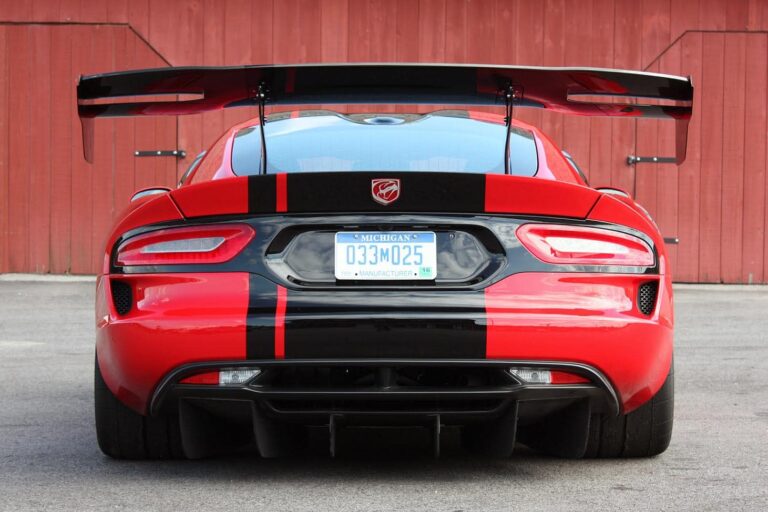
Walk through any car show or scroll through any automotive forum, and you will see spoilers everywhere. Some look aggressive and purposeful. Others look like they were bolted on purely for the sake of looking cool. But here is what most people do not know: a properly chosen and correctly installed spoiler is not just a cosmetic add-on. It is a functional aerodynamic component that can genuinely affect how your car handles, how safely it behaves at speed, and even how much fuel it burns.
That said, the wrong spoiler, poorly installed, can make things measurably worse. So before you go shopping for one, it pays to understand what spoilers actually do, which type makes sense for your car, and what to watch out for when buying and fitting one.
What Does a Car Spoiler Actually Do?
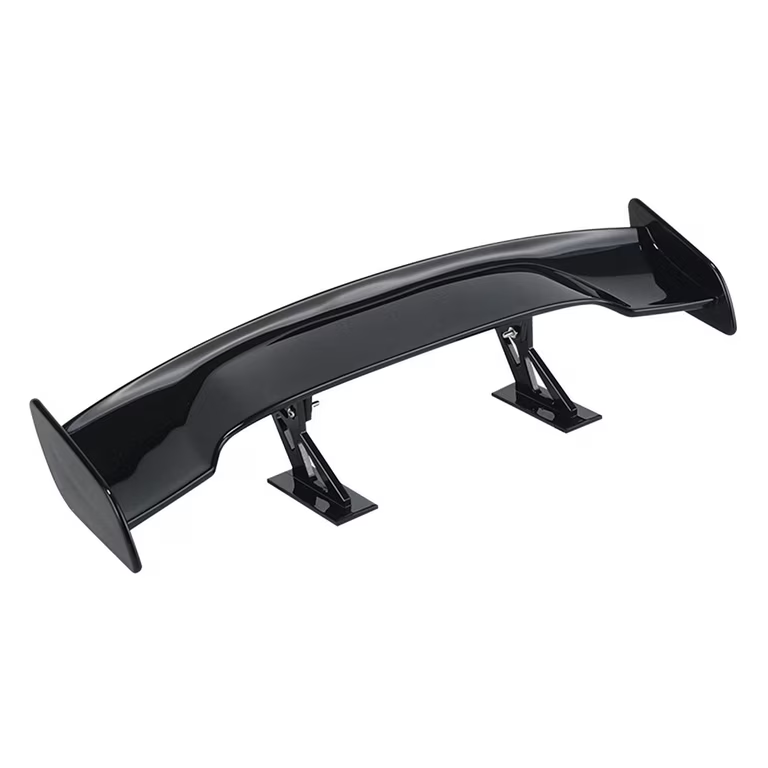
The name is a good clue. A spoiler is designed to “spoil” unfavorable airflow around the car. At higher speeds, air does not just flow harmlessly around your vehicle, it creates forces that push, pull, and lift the car in ways that can compromise stability and handling. A spoiler is engineered to interrupt and redirect those airflows to reduce their negative effects.
Here is what is happening aerodynamically when you drive at highway speeds. Air gets under the car and creates an upward lift force, essentially reducing the effective weight pressing your tires into the road. At the rear, turbulent air pockets form behind the car, creating drag that works against forward momentum. The combination of front lift, rear turbulence, and overall drag increases as speed rises, and the car becomes progressively less stable and efficient.
A spoiler addresses these issues by changing how air flows over and around the car. A rear spoiler, for example, reduces the amount of lift at the back of the vehicle, keeping the rear tires planted more firmly on the road. Better rear traction means better handling in corners, more confident braking, and reduced skidding risk. A front spoiler or air dam reduces the amount of air flowing under the car, cutting front-end lift and improving overall aerodynamic balance.
There is a secondary benefit that does not get talked about as often. On some vehicles, a rear spoiler changes how air flows across the rear window, reducing the amount of road grime, dust, and water that settles on the glass. If you have ever noticed a hatchback or estate car that keeps its rear window cleaner than expected in wet conditions, there is a good chance an effective spoiler design is partly responsible.
At What Speed Does a Spoiler Start to Actually Make a Difference?
This is one of the most common questions, and the honest answer is that aerodynamic forces become meaningful at around 100 km/h (60 mph). Below that speed, the aerodynamic forces acting on the car are relatively minor, and a spoiler’s contribution to stability and handling is minimal. Above that speed, particularly on motorways and fast A-roads, those forces grow significantly, and a well-designed spoiler starts earning its place.
For everyday urban driving, a spoiler provides essentially zero functional benefit. Its impact is almost entirely aerodynamic, and aerodynamics barely matter at 30 or 40 mph. Which brings us to an important point: if you are fitting a spoiler purely for aesthetics and your driving is mostly city-based, that is a completely valid choice, but go in with realistic expectations about what the spoiler is and is not doing for you mechanically.
The Different Types of Car Spoilers and Where They Go
Not all spoilers are the same, and the differences go far beyond how they look. The type, location, mounting method, and material all affect both function and longevity. Here is a breakdown of what is available.
By Location on the Car
- Rear trunk or lip spoilers: The most common type. Mounted on the trailing edge of the boot lid on saloons and coupes. They reduce rear lift and add a sporty visual profile. These range from subtle factory-style lips to large, high-mounted wings depending on the intended use.
- Roof spoilers: Common on hatchbacks and tailgate vehicles. Mounted at the top of the rear glass area, these manage the airflow coming off the roofline before it meets the turbulent wake behind the car. They are often more aerodynamically effective on hatchbacks than a trunk spoiler would be, given the body shape.
- Front spoilers and air dams: Fitted at the lower front of the car, these reduce the amount of air flowing underneath the vehicle. This cuts front-end lift and reduces overall drag. They are a functional upgrade for any car that spends time at higher speeds, but they also reduce ground clearance, which is worth considering on anything other than smooth roads.
- Side skirts: Fitted along the sills between the front and rear wheels. These manage airflow along the sides of the car, reducing turbulence under the body. They also have the benefit of lowering the visual profile of the car, making it look lower and wider.
- Diffusers: Fitted underneath the rear of the car. These are more common on performance and track-oriented vehicles. A diffuser accelerates airflow under the car and then expands it, creating a low-pressure zone that pulls the car downward, generating downforce rather than just reducing lift. True diffusers require relatively low ride height to function correctly.
By Mounting Method
- Bolt-on or screw-mounted spoilers: Attached using hardware that physically fastens through the body panel. This is the more secure mounting method and is preferred for any spoiler that will be exposed to significant aerodynamic forces at speed. It does leave holes in the body if the spoiler is ever removed, so that is worth factoring in if you think you might want it gone later.
- Adhesive-mounted spoilers: Attached using double-sided tape or industrial adhesive. These are easier to install and leave no permanent holes in the bodywork, but they carry real risks. There are documented cases of adhesive-mounted spoilers detaching at highway speeds, which is both dangerous for the car behind and potentially damaging to your own vehicle. If you choose this method, use the highest quality automotive-grade adhesive available, and be very thorough with surface preparation. Even then, this method is only reliable for lighter, lower-profile spoilers.
By Design Origin
- Factory-fitted spoilers: Designed and installed by the manufacturer specifically for that vehicle. These are engineered to complement the car’s existing aerodynamic profile and are usually the best-integrated option both visually and functionally. Many sporty trim levels include a factory spoiler as standard.
- Model-specific aftermarket spoilers: Designed to fit a particular make and model, these are often the next best option after factory fitment. A good model-specific aftermarket spoiler should integrate cleanly with the car’s body lines and deliver the aerodynamic benefit it claims.
- Universal spoilers: Designed to fit a wide range of vehicles. These are typically cheaper but come with compromises. Because they are not designed for your specific car’s aerodynamic profile, they may not provide the functional benefits of a model-specific spoiler, and they can look out of place if the proportions do not suit your car’s body shape.
- Custom spoilers: Made to order based on individual specifications. These offer the most flexibility in terms of design, size, and material, but they are also the most expensive option. Custom spoilers are most common in track or show builds where a specific look or precise aerodynamic function is required.
What Materials Are Car Spoilers Made From?
The material a spoiler is made from affects its weight, durability, appearance, and cost. Here is a practical comparison of the main options:
| Material | Weight | Durability | Appearance | Cost | Best For |
|---|---|---|---|---|---|
| ABS Plastic | Light | Moderate: degrades with UV over time | Can be painted to match body color | Low to moderate | Budget builds, daily drivers |
| Fiberglass | Moderate | Good: can crack on heavy impact | Can be painted, good finish quality | Moderate | Aftermarket upgrades, track use |
| Carbon Fiber | Very light | Excellent | Premium look, often left unpainted | High | Performance builds, premium aesthetics |
| Aluminum | Light | Very good | Distinctive look, can be polished or painted | Moderate to high | Custom builds, track use |
| Polyurethane | Moderate | Good : more flexible than fiberglass | Can be painted | Moderate | Daily drivers who want impact resistance |
Plastic (ABS) spoilers are by far the most common type you will find in the budget to mid-range market. They are affordable and easy to paint, but they have a real weakness: prolonged exposure to direct sunlight causes the plastic to fade, become brittle, and crack over time. If you buy a plastic spoiler and live somewhere with intense sun, expect to replace it sooner than you would a carbon or aluminum equivalent.
Carbon fiber is the gold standard for performance applications, incredibly strong for its weight, dimensionally stable under temperature changes, and visually striking. But it is expensive, and on a car that does not genuinely benefit from the weight saving, it is often more of an aesthetic statement than a functional necessity.
Aluminum hits a good middle ground for those who want something more durable than plastic without paying carbon fiber prices. It is lightweight, structurally strong, and can be finished in a variety of ways.
Do Spoilers Actually Improve Fuel Economy?
This question comes up constantly, and the answer is: yes, a correctly installed spoiler can reduce fuel consumption at higher speeds, but only under the right conditions.
Here is the logic. At highway speeds, aerodynamic drag is one of the primary forces working against your car’s forward movement. Your engine has to work harder to overcome that drag, which means burning more fuel. A spoiler that reduces drag and manages airflow more efficiently reduces the resistance the engine has to fight, which translates to a slight improvement in fuel economy during sustained high-speed driving.
The key phrase is “sustained high-speed driving.” At city speeds, this effect is essentially nonexistent. And the improvement even at motorway speeds is incremental, we are not talking about a dramatic change in your fuel bills. But it is real, and it is measurable, particularly on vehicles where the factory aerodynamics were not optimized from the outset.
The flip side is also true. A spoiler that is incorrectly angled or positioned relative to the airflow can increase drag rather than reduce it. Instead of smoothly redirecting air, it creates additional turbulence and resistance. In that scenario, the spoiler actively hurts your fuel economy rather than helping it. This is one of the reasons why professional installation and choosing the right spoiler for your specific vehicle matters so much.
Do Spoilers Make Your Car Safer?
Yes, in specific circumstances they do. The safety benefit of a spoiler is directly connected to its aerodynamic function. By reducing rear lift, a properly installed rear spoiler keeps the rear tires in better contact with the road at higher speeds. Better tire contact means:
- More grip available during cornering, which reduces the risk of the rear end stepping out
- More predictable handling when changing lanes or making fast maneuvers at speed
- More effective braking, because the rear brakes have better traction to work with
- Reduced skidding risk, particularly in slippery conditions where every bit of tire contact counts
Side skirts add a further dimension to braking effectiveness by managing airflow under the sides of the car, which helps maintain more consistent aerodynamic balance across all four wheels. For vehicles regularly driven at motorway speeds, these are not trivial benefits.
That said, it is important to keep perspective. A spoiler is not a safety system in the way that ABS or stability control is. Its benefits are proportional to speed, at 50 mph in urban traffic, a spoiler is doing essentially nothing for your safety. At 80 mph on a motorway, particularly in crosswind conditions or during an emergency lane change, the improved stability it provides is genuinely meaningful.
The Downsides of Spoilers: When They Do More Harm Than Good
Spoilers are not universally beneficial. There are real disadvantages to be aware of, and most of them come down to one word: installation.
Incorrect Installation Reverses the Benefits
A spoiler that is fitted at the wrong angle, in the wrong position, or with the wrong aerodynamic orientation for your vehicle can do the opposite of what it is supposed to. Instead of reducing lift, it can increase it. Instead of reducing drag, it can add to it. Instead of improving handling, it can make the car harder to correct when it does step out of line. These outcomes are not hypothetical, they are well-documented consequences of poorly designed or incorrectly installed spoilers.
Reduced Ground Clearance
Front spoilers, side skirts, and diffusers all reduce ground clearance to varying degrees. On smooth, well-maintained roads, this is a minor consideration. But on roads with speed bumps, potholes, gravel tracks, or steep driveways, low-mounted body kit components can ground out, crack, or be torn off entirely. Plastic spoilers are particularly vulnerable. If you regularly drive on rough surfaces, fitting a ground-scraping front splitter is a decision you are likely to regret quickly.
Material Degradation Over Time
Budget plastic spoilers have a limited lifespan, especially in climates with strong sun exposure. UV radiation causes ABS plastic to fade, yellow, and become brittle. Road debris, stone chips, and general wear also take a toll. A spoiler that looks great when new can look tired and cracked within a few years if it is made from poor-quality materials and not properly maintained.
Adhesive Mounting Failures
As mentioned earlier, spoilers attached with adhesive tape or glue can and do come off at speed. This is a hazard both for your car and for other road users. If you are using adhesive mounting, the preparation and adhesive quality need to be taken very seriously. In reality, for any spoiler that will be driven at motorway speeds, mechanical fastening is the only genuinely reliable option.
How to Choose the Right Spoiler for Your Car
With so many options available, choosing the right spoiler can feel overwhelming. Here is a practical framework to help you make a good decision.
Start With Your Primary Goal
Are you primarily after improved aerodynamics and handling? Or is this mainly an aesthetic upgrade? Your answer should shape every decision that follows. If performance is the goal, you need a spoiler that is engineered for your specific vehicle’s aerodynamic profile. If aesthetics are the priority, you have more flexibility, but you should still avoid spoilers that would actually harm the car’s aerodynamic behavior.
Model-Specific Over Universal
Always choose a model-specific spoiler over a universal one if it exists for your vehicle. Universal spoilers are a compromise by definition. They cannot account for the specific body lines, roofline angle, trunk geometry, or aerodynamic characteristics of your particular car. A model-specific spoiler is designed to work with those factors, not in spite of them.
Match the Material to Your Use Case and Budget
If you drive a high-mileage daily car and just want a clean, sporty look, a good quality ABS plastic spoiler in a model-specific fitment is a perfectly sensible choice. If you are building a track-day car or a premium show vehicle where weight and visual quality matter, carbon fiber justifies its cost. For something in between, fiberglass or polyurethane give you a good balance of durability and value.
Buy From a Reputable Source
The cheapest spoilers on the market are cheap for a reason. Very low-cost spoilers from unknown manufacturers are typically made from substandard materials, have poor fitment tolerances, and offer no meaningful aerodynamic benefit. They exist primarily as cosmetic items, and even in that role, they often disappoint after a short time in service.
Buying from a specialist tuning shop or a reputable aftermarket parts supplier gives you access to better quality products, correct fitment advice, and professional installation. The premium you pay upfront is almost always worth it compared to the cost of replacing a cheap spoiler that cracks, fades, or falls off within two years.
Consider Professional Installation
For bolt-on spoilers especially, professional installation ensures the spoiler is correctly aligned, properly torqued, and sealed against water ingress at the mounting points. A spoiler that is even slightly misaligned can look wrong and underperform aerodynamically. Installation at a specialist tuning workshop typically takes between 30 minutes and 2 hours, depending on the spoiler type and mounting method, and the labor cost is generally between $50 and $150.
How Much Does a Car Spoiler Cost?
The price range is genuinely wide. Here is a realistic breakdown:
| Spoiler Type | Part Cost (Approximate) | Labor Cost | Total Estimated Cost |
|---|---|---|---|
| Budget universal plastic spoiler | $20 to $80 | $50 to $100 | $70 to $180 |
| Mid-range model-specific spoiler | $100 to $300 | $75 to $150 | $175 to $450 |
| Premium or carbon fiber spoiler | $300 to $500+ | $100 to $150 | $400 to $650+ |
| Custom-made spoiler | $500 and above | Varies by complexity | Can exceed $1,000+ |
These figures cover most passenger vehicles. Prices can be higher for exotic, prestige, or heavily modified vehicles where parts are less available or installation is more complex.
Can You Remove a Spoiler Once It Is Installed?
Yes, and it is generally easier than the installation. Bolt-on spoilers can be removed by reversing the installation process. The catch is that you will be left with holes in the bodywork that need to be properly filled and repainted if you want the car to look clean afterward, an additional cost to factor in if you are not committed to keeping the spoiler long-term.
Adhesive-mounted spoilers can be removed using heat (a heat gun softens the adhesive) and careful peeling, followed by adhesive remover to clean up any residue. The advantage is no holes, but there is a risk of lifting the paint underneath the spoiler if the adhesive bond is strong and the removal is done carelessly. With patience and the right products, a clean removal is achievable without paint damage.
Removal time is typically under an hour for most spoiler types.
Spoiler vs. Wing: Are They the Same Thing?
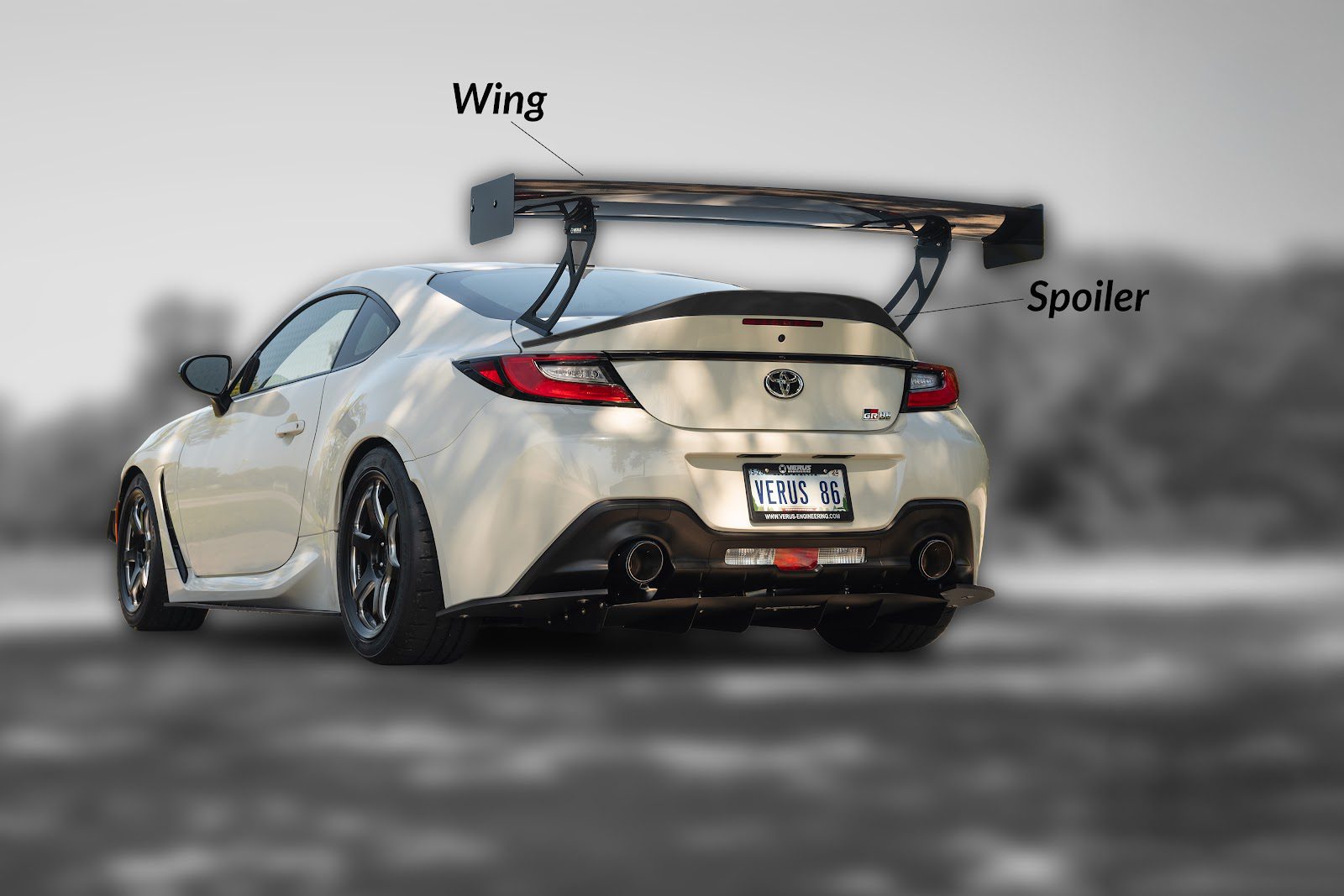
These two terms are often used interchangeably, but they are technically different things. Understanding the distinction helps you make a more informed choice.
A spoiler works by disrupting and redirecting airflow. It sits relatively close to the body surface and modifies the airflow path over and around the car to reduce lift or drag. The trunk lip spoilers common on road cars are good examples.
A wing, by contrast, is a freestanding aerodynamic element mounted on supports above the body surface. It works more like an upside-down aircraft wing, generating actual downforce by creating a pressure differential between its upper and lower surfaces. Wings are far more effective at generating downforce than spoilers, but they also produce more drag, which is acceptable on a dedicated race car but undesirable on a road car where efficiency matters.
The large, tall elements you see on race cars and some extreme performance road cars (like track-spec Porsches or touring car racers) are wings. The subtle lip on the boot lid of a BMW M3 or a Honda Civic Type R is a spoiler. Both improve aerodynamic performance, but they do so through different mechanisms and to different magnitudes.
For almost all road car applications, a spoiler is the appropriate choice. A wing makes sense if the car is genuinely being used for track days or competitive motorsport where the downforce benefit outweighs the drag penalty.
A Few Common Spoiler Myths Worth Correcting
Myth: Any Spoiler Will Improve Your Car’s Performance
Not true. A spoiler only improves performance if it is correctly designed for your vehicle’s aerodynamic profile and correctly installed. The wrong spoiler, incorrectly fitted, can make handling worse and increase fuel consumption. Performance improvement is the outcome of the right spoiler, not any spoiler.
Myth: Bigger Spoilers Are Always Better
Completely false. A very large spoiler on a road car typically increases drag significantly without providing proportional handling benefit. The optimal spoiler size for a road vehicle is far more modest than what you might see on a race car. Oversized spoilers on road cars are usually an aesthetic choice, not a functional one, and they often hurt fuel economy and top speed.
Myth: Spoilers Only Benefit Sports Cars
Also not accurate. Any car driven regularly at highway speeds can benefit from improved aerodynamic management. Estate cars, hatchbacks, and even some SUVs see meaningful results from well-chosen spoilers. The benefit is not exclusive to high-performance vehicles, it is proportional to how much time you spend at speeds where aerodynamic forces are significant.
If you are considering a spoiler, take the time to research what actually works for your specific vehicle. Talk to a reputable tuning specialist, choose a model-specific fitment where possible, invest in decent materials, and have it installed properly. A spoiler done right genuinely earns its place on the car. One chosen carelessly is just money spent on something that looks the part while quietly making your car worse to drive.