
One crucial aspect of the auto system is the brake system; its components, how they work together, and how reliably they keep a vehicle controllable under real-world conditions. Brakes are not like cosmetic parts where “close enough” might still look fine. When you replace faulty components with improper parts, wrong hardware, or incorrect specifications, you can trigger severe damage or sudden failure. In the best-case scenario, the mistake wastes your hard-earned money on repeat repairs. In the worst case, it creates a safety problem that shows up when you need maximum braking performance.
Knowing how to change worn-out brake components is critical for any mechanic or serious DIYer. But having the basic technical knowledge of the torque specs for brake caliper bracket bolts is even more crucial, because these bolts anchor the caliper bracket to the knuckle and maintain alignment under extreme braking forces. If they are loose, the caliper can shift. If they are over-tightened, the bolt can stretch, snap, or strip threads. Either way, the consequences can be expensive; and dangerous.
Relax and read this guide to that end. It not only details the torque specs for brake caliper bracket bolts but also explains what those numbers really mean, how to apply torque correctly, why there are different torque specs for different bolts on the same caliper assembly, and how to spot the warning signs of a loose or improperly installed caliper bracket before it escalates into rotor damage or brake failure. To set the ball rolling, first, you deserve to know what exactly a brake caliper is. Shall we?
What Is a Brake Caliper?
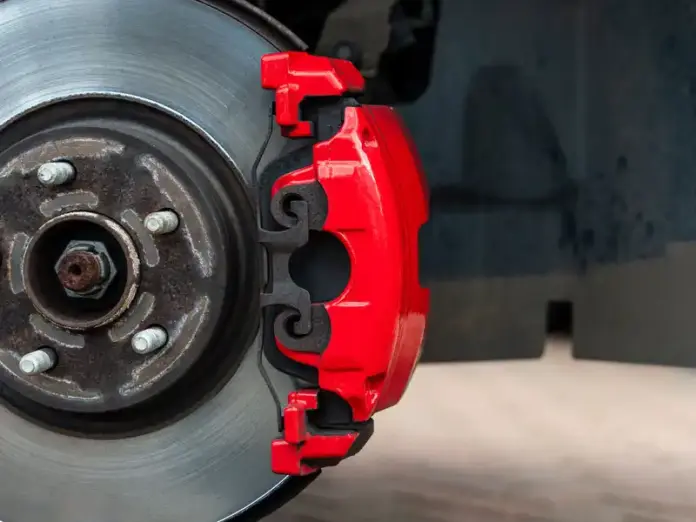
A caliper is one of the most important elements in the brake system. It is the clamp-like assembly that houses a vehicle’s pistons and holds the friction material; metal-backed pads called the brake pads; in the correct position relative to the brake rotor (disc). When people say “my brakes are worn,” they usually mean pads or rotors, but the caliper is the component that turns hydraulic pressure into mechanical clamping force.
If you’re wondering what the pistons do, here it is: a caliper uses one, two, or up to six pistons (and sometimes more on performance applications) to push the brake pads against the rotor. A single-piston sliding caliper is common on many passenger vehicles because it is cost-effective and reliable when maintained. Multi-piston fixed calipers are often used on higher-performance vehicles because they apply more even pressure across the pad surface. Regardless of type, the caliper’s job is always the same: create controlled friction at the rotor to reduce wheel speed.
When you step your foot on the brake pedal, pressure from the brake fluid travels through the brake lines and enters the caliper. That hydraulic pressure acts on the piston(s). In turn, the pistons push the brake pads into the brake rotor. As a result, friction between pad and rotor slows the wheel or stops the vehicle completely.
Expert context you should know: The caliper itself is usually mounted in two ways. In many designs, the caliper “floats” or slides on guide pins (also called slider pins) so it can center itself over the rotor. The caliper bracket (also called the caliper mounting bracket or carrier) bolts rigidly to the steering knuckle. The bracket holds the pads and provides the structure the sliding caliper moves on. In other designs (fixed calipers), the caliper body mounts rigidly and does not slide, but the basic principle of strong mounting bolts and correct torque still applies.
This distinction matters because most brake assemblies have two different bolt types that people confuse:
- Caliper guide/slide bolts (smaller bolts) that secure the sliding caliper to the bracket.
- Caliper bracket bolts (larger bolts) that secure the bracket to the steering knuckle.
These bolts are not interchangeable, and their torque values are not “close.” Bracket bolts are typically torqued much higher because they take the full braking load. Guide bolts are torqued lower because they clamp the caliper to the slide pins and must allow controlled movement without binding.
What then are the Torque Specs for Brake Calipers Bracket Bolts?
Typically, the torque specs for a brake caliper bracket bolt should be in the neighborhood of 101.69 Nm to 128.80 Nm (75 to 95 foot-pounds). That range is a widely referenced general guideline for many passenger cars and light-duty vehicles, and it’s a practical “ballpark” when you’re trying to understand what “normal” looks like.
Does this range vary from car to car? In the real world, yes; sometimes significantly; because vehicle weight, rotor diameter, bracket design, bolt diameter, thread pitch, and knuckle material all influence the required clamp load. However, many everyday vehicles do cluster around similar bracket-bolt torque ranges, which is why you’ll see the 75–95 ft-lb neighborhood mentioned often. The critical point remains: your exact vehicle spec is the one that matters, and a proper service or repair manual is the correct authority when you want to avoid mistakes.
On average, your car brakes should last 20,000 to 40,000 miles. Once it hits this threshold, the braking system; or at least some of its components; will likely need replacement. Wear doesn’t only affect pads. It can affect slide pins, boots, bracket hardware, and even bolt threads if the fasteners have been abused or installed incorrectly in the past.
You won’t just go to the part seller or dealer and order a new set and bolt it on blindly. It doesn’t matter if you’re a mechanic or a DIYer. There’s the need to have the torque specs for brake caliper bracket bolts and the technical replacement and installation know-how. A loose bolt or unsuitable part can cause issues later. Installing and tightening the caliper bracket bolts may require special expertise on some vehicles; especially those that use thread locker patches, torque-to-yield fasteners, or unusual bolt head types.
To apply correct torque settings, you will need a torque wrench so the bolts are tightened to the required tightness; not guessed tightness. For instance, a torque of 47.45 Nm to 67.79 Nm (35 ft/lbs to 50 ft/lbs) is often enough for the bolts guiding the caliper (guide/slide pin bolts) on many applications. You’ll typically need a 1.3cm (13mm) wrench or socket size on some designs (though head sizes vary widely by vehicle). A good idea is to utilize the repair manual and follow the stated tightness.
Important expert clarification about the two torque ranges: The caliper guide bolt torque can be lower than 35–50 ft-lb on some vehicles (often 25–35 ft-lb is common), while others use higher values depending on caliper design, pin diameter, and thread engagement depth. That’s why you’ll see slightly different “typical” numbers across guides. The bracket bolts, however, are almost always the higher-torque fasteners in the system.
Why your torque wrench matters as much as the torque number: Torque is a measurement of rotational force, but what we actually want in a fastener is clamp load; the force holding the bracket against the knuckle. Torque is simply the most practical way to estimate clamp load. Dirty threads, rust, incorrect lubrication, or excessive thread locker can change friction and alter clamp load even at the same torque value. That’s why professional brake work includes cleaning threads and following OEM recommendations about thread locker and bolt reuse.
Practical measurement note: Many service specs list torque in Nm, ft-lb, or sometimes in “torque + angle” (particularly for torque-to-yield bolts). If your vehicle uses a torque-angle method, do not substitute a single torque value; follow the torque-plus-angle procedure exactly because it controls bolt stretch more precisely.
Tool selection matters: Use a torque wrench that covers the required range. For example:
- A small 1/4″ drive torque wrench is usually best for low-torque fasteners.
- A 3/8″ drive torque wrench often covers common guide pin torque ranges.
- A 1/2″ drive torque wrench is often needed for caliper bracket bolts and lug nuts.
Using a torque wrench at the extreme low end of its range can reduce accuracy. Likewise, using an undersized wrench that “maxes out” before you reach the torque value encourages unsafe guessing. Professionals match the tool to the job.
Brake service isn’t only about torque: Proper assembly also requires correct pad hardware seating, clean bracket pad lands, lubricated slide pins with appropriate grease, and correct rotor installation. But torque remains the foundation, because even perfect pads and rotors can’t perform safely if the caliper bracket is not securely mounted.
Why Follow the Proper Torque Specs?
Caliper bracket bolts can be tightened to different extents depending on factors like vehicle type, model, and driving comportment. Still, brakes are said to last 32,187 to 48,280 kilometers or so. Torque specs represent the amount of force exerted when the hardware is installed. It is vital to put this into consideration because over-tightening can not only damage rotors but also the wheels. More specifically, excessive torque can strip threads in the knuckle, fracture the bolt, distort the bracket seating surface, or create uneven clamping that contributes to vibration and noise.
On the other hand, if less than the required torque is followed, the assembly may begin to loosen. Under-torqued caliper bracket bolts can back out from vibration and heat cycling, allowing the bracket to move. That movement can cause uneven pad wear, abnormal noises, and in severe cases, caliper contact with the wheel. Likewise, under-torqued wheel lug nuts can cause wheel wobble or even wheel separation. Therefore, to avoid risks and expensive repairs, the right torque specs should be followed. Yes, it is advisable to let a professional handle the job for you if you’re not confident.
Expert explanation of what torque protects you from:
- Vibration loosening: Brake components experience constant vibration, and bolts that are not clamped properly can “walk” loose.
- Thermal cycling: Brakes heat up and cool down repeatedly. Metal expands and contracts. Correct clamp load keeps components stable through those cycles.
- Braking torque reaction: When the pads bite the rotor, the bracket and bolts resist rotational force. This is not gentle force; it is substantial, especially in hard stops.
Another professional reason torque specs matter: many manufacturers use thread locker, specific bolt coatings, or even “single-use” bolts on caliper brackets. Over-torquing can damage these coatings and reduce long-term reliability. Under-torquing can prevent the thread locker from performing properly. The correct torque ensures the bolt seats and stretches exactly as designed.
Torque is also about consistency: When both sides of the vehicle are torqued correctly, braking behavior stays balanced. Inconsistent torque can contribute to strange noises, uneven pad wear, or a “different feel” left vs right during braking. You might not notice it immediately, but the components will.
Where DIY installers go wrong most often:
- They confuse bracket bolts with guide pin bolts and apply the wrong torque.
- They torque bolts with dirty, rusty, or wet threads (changing clamp load).
- They use a torque wrench incorrectly; pulling too fast, using extensions improperly, or “double clicking.”
- They reuse bolts that should be replaced (torque-to-yield or damaged threads).
How to use a torque wrench correctly (quick professional tips):
- Set the torque value accurately and lock the handle (if your wrench has a lock).
- Pull smoothly until the wrench clicks; stop immediately at the click.
- Hold the wrench by the grip area only (not choked up on the head).
- Do not use a torque wrench as a breaker bar to loosen bolts.
Following torque specifications isn’t about being overly cautious. It’s about respecting that brake hardware is safety-critical. Your car’s ability to stop reliably is not negotiable.
3 Simple Steps to Removing the Caliper Mounting Brackets
Before removing caliper mounting brackets, prioritize safety. Work on level ground. Use wheel chocks. Support the vehicle properly on jack stands. Never rely on a jack alone. With that said, here are three simple steps that reflect common caliper bracket removal procedures:
- Using a compact torque wrench, remove the caliper bolts by moving them counterclockwise. The bolts are usually 10mm hex drive, 14mm, 15mm or 18mm.
- You can then detach it from the caliper mounting bracket.
- Replace or repair any damaged parts around the caliper and brake hose.
Expert refinement of Step 1: While the text references a compact torque wrench, in practice you typically loosen tight caliper bracket bolts using a breaker bar or a strong ratchet first, then use the torque wrench only for reinstallation. Many bracket bolts are installed with thread locker and can be very tight. If a bolt feels stuck, don’t round it off; use the correct socket, apply penetrating oil if appropriate, and use controlled leverage.
Expert refinement of Step 2: Once the caliper is detached, support it with a hook or bungee cord. Do not let the caliper hang from the brake hose. Hose damage can cause internal restrictions or rupture later, creating braking problems that are much harder to diagnose than a visible leak.
Expert refinement of Step 3: Look beyond the obvious. Check slide pins for smooth travel, inspect boots for tears, check brake hose condition, inspect pad wear patterns, and examine the rotor surface. Brake repairs are most successful when you address the root causes of uneven wear (stuck pins, corroded hardware) rather than just swapping friction parts.
Can I Reinstall Caliper bolts with the right Torque specs?
There are no hard and fast rules about this because it depends on your mechanical knowledge, the tools you have, and the specific vehicle design. But yes; you can reinstall caliper bolts correctly if you work carefully, follow proper torque specifications, and ensure the hardware is in good condition. To reinstall the bolts with the right torque specs, follow the steps below:
- Ensure the slides are in good condition.
- Gently fix the caliper slides with the mounting bracket.
- Insert the bolts into the housing bracket.
- Properly screw the bolts using 70 to 90 foot-pounds.
Expert explanation of what those steps imply:
Slides in good condition means the guide pins are clean, straight, and move smoothly, and the boots are intact. A seized slide pin can make new pads wear unevenly in a few thousand miles, and it can cause pulling or overheating on one wheel.
Fixing the caliper slides with the bracket means aligning the caliper so the pins seat properly without forcing. If you have to “fight” the caliper into place, something is wrong; often the piston isn’t fully compressed or the pads are not seated correctly.
Insert the bolts into the housing bracket should always start by hand-threading. This prevents cross-threading the bracket or pin. Cross-threaded caliper bolts are a common DIY failure that leads to expensive bracket replacement or thread repair.
Torque of 70 to 90 foot-pounds is a commonly referenced range for bracket bolts on many vehicles. Again, confirm the exact spec for your model. The safe professional approach is: torque to OEM spec, and if OEM specifies thread locker, apply the correct type.
Thread locker guidance: Many caliper bracket bolts come with factory-applied thread locker. If it’s missing or worn, a medium-strength thread locker is often recommended. But do not automatically apply thread locker if your service manual forbids it or specifies a different method (some bolts rely on specific coatings or torque-angle procedures).
Also note the difference in bolt types: Caliper guide bolts may require a different torque value than bracket bolts. This guide includes both ranges (35–50 ft-lb and 25–35 ft-lb are commonly referenced for guide bolts, depending on vehicle), which is why it’s important to verify which bolt you’re tightening.
Dos and Don’ts When Changing your Calipers, Brake Rotors and Pads
When replacing your brake rotors, calipers, and pads, you must avoid a few mistakes. Brake work rewards patience and punishes shortcuts. Here are a few precautions to take:
- Never remove a caliper guide with a wrench longer or shorter than 13mm (1.3cm). If you do, you can break the heads off as a result of overtightening.
- Don’t install the brake pads backwards. This can happen, especially if you’re in an emergency or a dangerous drive or safety zone.
- Incorrectly torturing the brake caliper bracket bolts is dangerous. While some brake caliper bracket bolts can accommodate up to 110 feet-pounds in torque level, you must be careful not to damage it.
- You may need liquid tread locks when torturing the brake caliper bracket bolts. You may be lucky to get torque-to-yield bracket bolts.
- Never install new pads without cleaning or replacing the brake slides, hardware, and/or clips. You should also lubricate the caliper guide pins.
- Installing a torn boot on your car braking system is suicidal and safety-risky.
Expert clarification and best-practice expansion:
About the 13mm point: The core idea is correct; use the correct tool size and avoid using the wrong wrench or a mismatched socket. A wrong size tool rounds fasteners and creates “impossible” bolts that require extraction. Overtightening can indeed shear bolt heads. Use the correct socket, correct drive size, and correct torque wrench range.
Pad orientation matters: Installing pads backward ruins friction surfaces instantly and can destroy rotors. Always confirm the pad’s friction material faces the rotor. Also confirm any wear indicators or clips are positioned correctly. Some pads are inside/outside specific.
On “torturing” bolts: This clearly refers to torquing bolts. Incorrectly torquing brake caliper bracket bolts is dangerous. While some bracket bolts can indeed accommodate higher torque values (some vehicles go up to around 110 ft-lbs or higher), applying excessive force without a torque wrench risks stripping threads or snapping bolts.
Thread locker (“liquid tread locks”): Many brake bracket bolts use thread locker from the factory because these fasteners see constant vibration. If your bolts are designed for thread locker, apply the correct type and amount. Too much thread locker can create false torque readings and can make future removal difficult.
Torque-to-yield bracket bolts: Some vehicles use torque-to-yield bolts that stretch permanently. If your manual indicates torque-to-yield, replace the bolts rather than reusing them. Reusing torque-to-yield bolts can lead to insufficient clamp load or bolt failure.
Clean hardware is not optional: If you install new pads without cleaning or replacing the brake slides, hardware, and clips, pads may bind and wear unevenly. Always clean pad contact surfaces on the bracket and install new hardware kits when provided. Lubricate guide pins with appropriate brake grease that is compatible with rubber components.
Torn boots are a serious issue: Torn caliper boots let water and dirt enter slide pin bores. That causes corrosion, stuck pins, uneven braking, and overheating. Calling it “suicidal” is dramatic, but the warning is valid: a compromised boot increases the risk of brake malfunction. Replace torn boots and service slide pins properly.
Additional dos and don’ts (professional add-ons that prevent comebacks):
- Do torque bolts with the vehicle safely supported and the caliper bracket fully seated on clean mounting surfaces.
- Don’t contaminate pad friction surfaces with grease or oil; clean with brake cleaner if accidental contact occurs.
- Do check rotor thickness and minimum specifications; replacing pads on a rotor below minimum thickness is unsafe.
- Don’t ignore brake fluid condition; old fluid absorbs water and can reduce braking performance under heat.
- Do perform a careful test drive and bed-in procedure for pads/rotors when applicable.
In professional brake service, torque specs are only one part of “doing it right,” but they are a non-negotiable part because they determine whether the caliper bracket stays fixed under stress.
How to Know Your Brake Caliper Bolts Are loose
Here are the symptoms of loose caliper bolts. In most cases, the vehicle will give you early warning signs before a bolt fully backs out; if you know what to listen for and what to feel:
- Crushing Noise: You’ll experience this sound once the brake caliper is trapped and the brake pads are worn out. The grinding wheel bearing sound is an indication that your caliper bolts need tightening.
- Car pulling to one side when braking: Loose caliper bolts might cause your car to pull to one side once you step your feet on the brake pedal or the wheel hits a pothole.
- Spongy brake pedal: A soft or spongy brake pedal is what you feel when your brake caliper bolts have a hole in them. It may also be a seized caliper-bound cylinder.
Other symptoms include uneven brake pad wear and leaking brake fluid.
Expert interpretation of these symptoms:
Noise is often the first sign. A “crushing” or grinding noise can mean metal-to-metal pad wear, but it can also occur if the bracket shifts and forces the pad into an abnormal position. A wheel-bearing-like grind that changes during braking deserves immediate inspection.
Pulling to one side can be caused by many issues (uneven pad friction, stuck caliper, tire problems), but loose caliper bracket hardware can absolutely contribute. If the caliper is not held square to the rotor, braking force can become uneven and the vehicle may dart under braking.
Spongy pedal typically suggests hydraulic issues (air in system, flexible hose, caliper piston problems). Loose bracket bolts do not usually create a spongy pedal by themselves, but in severe cases the caliper can bind or flex in a way that feels like inconsistent braking. The mention of a “hole” in bolts is not typical, but the point remains: unusual pedal feel should not be ignored. Whether it’s loose bolts, seized calipers, or fluid issues, you need immediate inspection.
Uneven pad wear is a major clue. If one pad is worn much more than the other on the same caliper, you likely have slide pin issues, bracket binding, or caliper piston issues. Loose hardware can accelerate uneven wear by allowing movement where none should exist.
Brake fluid leaks are serious and require immediate repair. If you see fluid around a caliper, hose, or bleeder screw, don’t drive the vehicle until it’s fixed and the system is properly bled. While leaks aren’t typically caused by loose bracket bolts, they can occur if components move and stress hoses or fittings.
What to do if you suspect loose caliper bolts: Stop driving aggressively, avoid highway speeds, and inspect the brake assembly as soon as possible. If you see missing bolts, severe movement, or caliper contact marks on the wheel, do not drive; tow the vehicle. A low-speed brake failure is bad; a high-speed brake failure is catastrophic.

Final Wrap
The average torque spec range for brake caliper bracket bolts is commonly 70–90 foot-pounds on many passenger vehicles, with some applications falling in the neighborhood of 101.69 Nm to 128.80 Nm (75 to 95 foot-pounds). For caliper guide bolts, many vehicles use a lower range; often 25 to 35 foot-pounds, while some designs call for higher guide bolt torque such as 47.45 Nm to 67.79 Nm (35 ft/lbs to 50 ft/lbs). The correct value depends on your specific vehicle design, bolt size, and manufacturer procedure.
Following the specific torque tightness is vital because it prevents disastrous endings and unnecessary expenses. Under-torque can lead to loosening, noise, uneven pad wear, or even caliper bracket failure. Over-torque can strip threads, snap bolts, distort components, and create expensive repairs that could have been avoided with a torque wrench and patience. As for bolts and nuts, they can fail and become quickly worn out if the right torque is not followed; especially when heat and vibration are involved.
Professional closing advice: If you remember one rule, make it this: torque is not a guess. Use a torque wrench, follow the correct specs, clean and inspect hardware, and never rush brake work. Your brake system is the most important safety system on your vehicle, and caliper bracket bolts are a key part of that chain.

