
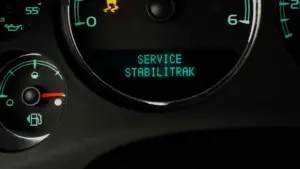

You’re driving your GMC Acadia when a “Service StabiliTrak” message suddenly lights up the dashboard. That moment can feel confusing—and, depending on the situation, a little unsettling. This message often indicates an issue with your vehicle’s stability control system and can involve sensors or other components. The good news is that the warning is usually diagnosable with a clear process, and in many cases the fix is far less dramatic than the message sounds.
In this guide, I’ll walk you through what StabiliTrak actually does, what this warning typically means on the Acadia, which symptoms matter most, and what you should do next to keep your vehicle safe and predictable. You’ll also learn which issues can trigger StabiliTrak warnings indirectly (yes—sometimes the stability system is “innocent” and simply reacting to another fault), how to diagnose the problem intelligently, and how to reduce the odds of the message coming back.
Whether you’re seeing the message once in a while or every time you start the vehicle, the key is to avoid two common mistakes: (1) ignoring it for months until it becomes a safety problem, and (2) replacing random parts without confirming the actual cause.
Understanding StabiliTrak
StabiliTrak (GM’s branding for Electronic Stability Control, or ESC) is a safety feature in many vehicles, including the GMC Acadia. It enhances driving stability by detecting and reducing loss of traction. This system plays a crucial role in maintaining vehicle control—especially during quick steering inputs, emergency maneuvers, slippery weather, or any situation where the vehicle is not following the path the driver intends.
It’s important to understand one core idea: StabiliTrak isn’t a “comfort feature.” It is an active safety system designed to prevent loss-of-control events. When the vehicle detects that it’s beginning to understeer (push wide) or oversteer (rotate too much), the system can apply brake pressure at individual wheels and can also request reduced engine torque. That combination is what helps the vehicle return to its intended path.
What Is StabiliTrak?
StabiliTrak is a form of traction control with enhanced abilities. While basic traction control helps manage wheel slip during acceleration, StabiliTrak goes further by assisting in steering control. When your vehicle starts to drift or spin, StabiliTrak kicks in to help you steer where you want to go. It’s a sophisticated system designed to keep you safe by ensuring your car maintains its intended path on the road.
On your Acadia, StabiliTrak works closely with:
- ABS (Anti-lock Braking System), which prevents wheel lockup during braking
- Traction Control, which helps prevent excessive wheel spin during acceleration
- Engine and transmission control, which can reduce torque when stability is threatened
This is why the “Service StabiliTrak” message often appears alongside other indicators such as traction control lights or ABS warnings. These systems share sensors, wiring, and the same underlying control module network.
How StabiliTrak Operates
StabiliTrak uses sensors to monitor data such as wheel speed, steering angle, and vehicle yaw rate. When it detects a potential skid, the system applies brakes individually to specific wheels. This selective braking helps realign the vehicle’s path. Rather than taking over the entire drive, StabiliTrak works with you, aiding your control when slipping or skidding may occur. It is particularly useful in challenging conditions like wet or icy roads.
From a diagnostic perspective, StabiliTrak can only be as accurate as the information it receives. If a sensor reports incorrect data—such as a wheel speed sensor intermittently dropping out—StabiliTrak may interpret that as a traction event, a skid, or a loss of stability. When that happens, the vehicle’s control modules may disable or limit parts of the stability system and display the warning message to alert you that the system cannot reliably protect you as designed.
In many cases, the system will “fail safe.” That means it disables stability interventions rather than risking incorrect interventions. In plain language: if the system is not sure what’s happening, it would rather turn itself off than apply the wrong brake at the wrong time.
Components of the StabiliTrak System
The StabiliTrak system incorporates various components that work together to enhance vehicle stability. Key parts include:
- Wheel Speed Sensors: Monitor each wheel’s speed.
- Steering Angle Sensor: Detects the direction your steering wheel is turned.
- Yaw Rate Sensor: Measures the vehicle’s rotation rate around its vertical axis.
Each of these components provides data to a central computer, enabling quick and precise brake application. The system’s precision ensures smooth operation without noticeable interference in your driving experience.
In a real Acadia diagnostic scenario, you should also be aware that stability control typically involves additional supporting components and inputs, including:
- ABS hydraulic modulator/control module (the unit that can apply brake pressure precisely)
- Brake pressure sensing and brake pedal position/switch inputs (so the system understands braking intent)
- Electrical grounds, connectors, and wiring harnesses (because voltage stability is critical)
- Powertrain data sharing (engine torque reduction requests must be communicated correctly)
This expanded view matters because stability warnings often come from the “support structure” around the system—corroded connectors, damaged wheel speed sensor wiring, or low system voltage—rather than from the core logic of StabiliTrak itself.
What “Service StabiliTrak” Usually Means on a GMC Acadia
When the Acadia shows “Service StabiliTrak,” the vehicle is essentially telling you one of the following is happening:
- A required sensor signal is missing or implausible (wheel speed, steering angle, yaw rate, etc.).
- The ABS/traction/stability system has detected a fault and has reduced or disabled stability intervention to protect the system and the driver.
- The vehicle is experiencing a related issue that affects stability control operation, such as low voltage, brake system faults, or powertrain limitations.
In other words: the message is not a “guess.” It’s a response to a stored fault condition. The fastest way to stop guessing is to read diagnostic trouble codes (DTCs) from all relevant modules, not just the engine module.
Expert guidance: Many owners only scan the engine computer (ECM) and find “no codes,” then assume the car is fine. Stability control faults often live in the ABS/EBCM module (Electronic Brake Control Module). A scan tool must be able to read that module to see the real issue.
Symptoms of a Failing StabiliTrak System
When your GMC Acadia’s StabiliTrak system starts to fail or when the vehicle detects it cannot operate reliably, you may notice several specific symptoms. Watch for dashboard warning messages, changes in traction/stability behavior, and unexpected actions while driving. Identifying these signs early can help keep you safe on the road.
To make symptom interpretation easier, here is a simple way to categorize what you experience:
- Indicator symptoms: lights and messages that tell you the system has detected a problem.
- Behavior symptoms: what the vehicle physically does or fails to do (traction loss, pull, unexpected braking).
- Performance symptoms: how power delivery changes if the vehicle is limiting torque to preserve stability.
Warning Lights and Messages
One of the most noticeable symptoms is the StabiliTrak warning light turning on. This can be a clear signal that something is wrong with the system. You might also see the Traction Control light appear on your dashboard.
The ABS light may come on as well, suggesting problems with the overall stability control network. It’s wise to check these lights promptly, because when ABS and stability systems are disabled, your vehicle may still brake normally, but it will lose important “assist” functions designed for slippery or emergency situations.
Expert note: A stability-control light alone can sometimes mean the system is temporarily unavailable (for example, if the system detects a sensor glitch and disables itself). An ABS light combined with stability warnings usually signals a more significant issue in the braking/stability architecture.
Vehicle Traction and Stability Issues
You may experience problems related to traction loss, especially on slippery roads. Your Acadia might struggle to maintain grip, or it may feel like the vehicle is more prone to sliding than usual in conditions where stability control would normally assist.
In some cases, the StabiliTrak system may not correct or stabilize your vehicle as it should. This makes it harder to maintain control during quick maneuvers or in poor weather conditions. If you notice these issues, it’s time to have the system checked—because stability control is most valuable in exactly the moments when traction is limited.
Expert note: If the system is disabled, you may not feel any difference on dry pavement during normal driving. The danger is that you lose the safety net in “one mistake” scenarios—ice patches, sudden lane changes, emergency braking while cornering, and similar conditions.
Unexpected Vehicle Behaviors
StabiliTrak faults can also cause unexpected actions in your Acadia. For example, the vehicle might brake unexpectedly, pull slightly to one side, or feel as if it is resisting acceleration. These behaviors are not always the stability system “misbehaving”—sometimes they’re the vehicle’s response to uncertain inputs, trying to reduce risk.
You may also feel changes in how the vehicle accelerates or stops. These behaviors can make driving challenging and potentially unsafe. Addressing these symptoms early, by consulting with a professional, can help prevent accidents and further vehicle damage.
Recognizing the signs of a failing StabiliTrak system is crucial. Pay attention to warning lights and any odd vehicle behaviors you’re experiencing. This way, you can ensure your GMC Acadia remains safe and reliable.
Common Causes for Service StabiliTrak Message
When your GMC Acadia shows a “Service StabiliTrak” message, it often signals an issue with the vehicle’s stability system. Common triggers include faulty sensors, brake problems, and engine power limitations. Understanding these categories helps you identify the issue efficiently and avoid unnecessary repairs.
Below are the most common causes, ordered from “most frequently encountered in real diagnostics” to “less common but still important.”
Faulty Wheel Speed Sensors
Wheel speed sensors are crucial for monitoring each wheel’s speed. These sensors feed data to the StabiliTrak system, helping it decide when to activate stabilizing actions. When a wheel speed sensor fails, the system may inaccurately assess your car’s motion, causing the “Service StabiliTrak” message to appear.
One of the first signs is often incorrect traction control behavior. Dust, debris, metallic particles near the sensor, or wiring issues are typical culprits. Sometimes the sensor itself is fine, but the wheel bearing/hub assembly (where the sensor reads a tone ring) has developed play, producing an unstable signal. That is why some repairs involve replacing a hub assembly rather than only the sensor.
Testing or replacing the faulty sensor (or repairing its wiring) can usually resolve the issue. If you’ve noticed traction problems or the warning appeared after hitting a bump or pothole, a wheel speed sensor or its wiring/hub is a high-probability suspect.
Expert check: If the warning comes and goes with steering movement or suspension travel, inspect the sensor harness near the wheel well. A partially broken wire can reconnect intermittently, creating “ghost” faults that are hard to reproduce unless you look at live wheel-speed data while driving.
Malfunctioning Steering Angle Sensor
The steering angle sensor measures how far and how quickly the steering wheel is turned and provides that data to the stability system. If this sensor malfunctions—or if it loses calibration after an alignment, steering work, or a battery disconnect—StabiliTrak may not trust the steering data. That can disrupt the entire logic chain and trigger the warning message.
Symptoms can include stability corrections that feel “off,” steering that appears misaligned, or a stability warning that shows up after steering-related service. Some cases are resolved by recalibration (a scan tool procedure), while others require sensor replacement if the unit is physically failing.
Expert note: Calibration matters. Even when the steering wheel looks centered, the sensor may not agree. On many modern GM vehicles, the steering angle sensor is not something you “eyeball” into correctness—it’s something you confirm with scan data and calibration routines.
Brake System Issues
The brake system plays a significant role in StabiliTrak’s operation because the system uses the brakes to correct yaw and traction events. If your brakes have a defect, the stability system may not be able to apply pressure as needed—or it may detect abnormal behavior and disable itself.
Issues such as low brake fluid, worn pads (to the point of affecting braking consistency), damaged brake lines, or ABS hydraulic module problems can contribute to warnings. Regular brake inspections help prevent this.
If your brakes feel spongy, if stopping distances increase, or if you’ve noticed inconsistent braking performance, address those problems quickly. A professional examination can determine whether brake pads, calipers, rotors, lines, or the ABS modulator require service.
Expert note: Many owners assume “Service StabiliTrak” means the brake pads are low. That’s not typically the direct cause. The stability system cares about brake control and feedback, not just pad thickness. The warning is more often linked to sensor data, hydraulic control faults, or ABS-related codes.
Engine Power Limitations
Sometimes, the “Service StabiliTrak” message appears because the vehicle is experiencing engine power limitations or powertrain faults that affect stability management. GM systems may reduce engine torque during stability events, and the stability system communicates with the powertrain controller to do this. If the powertrain system has its own fault—such as sensor malfunctions, throttle control issues, or transmission-related problems—StabiliTrak may log a fault because it can’t request torque reduction reliably.
You may notice sluggish acceleration or reduced performance. If reduced power occurs at the same time as stability warnings, it’s smart to scan both the engine module and the ABS/stability module. Fixing the underlying engine or transmission issue can restore proper stability control operation.
Expert note: Stability control is a “team sport.” If one module can’t communicate properly or can’t execute torque reduction requests, the system may disable or limit itself, because partial operation can be unsafe.
Low Voltage, Weak Battery, or Charging System Problems
Even though it isn’t always obvious, low system voltage is a surprisingly common trigger for electronic stability warnings. Modern vehicles are sensitive to voltage stability. If the battery is weak, terminals are corroded, or the alternator output is inconsistent, modules may log communication faults or sensor plausibility faults, and systems like StabiliTrak may temporarily shut down.
Expert check: If the warning appears on cold mornings, after the vehicle sits overnight, or right at startup, check battery and charging health early. A stable electrical foundation prevents a lot of “electronic chaos” that looks like multiple unrelated failures.
Tire Size Mismatch, Uneven Wear, or Incorrect Tire Pressure
StabiliTrak uses wheel speed comparisons to decide what the vehicle is doing. If one tire has a significantly different rolling circumference—because it’s a different size, has dramatically different wear, or is at a very different pressure—the wheel speed data may not agree. In some cases, that can contribute to traction/stability warnings or unexpected traction control activation.
This is especially relevant after tire replacement. If you replace only one tire on an AWD vehicle, or if you mix brands/models with different effective diameters, wheel-speed differences can become more pronounced and confuse the system.
Expert note: Tire mismatch does not “break” StabiliTrak, but it can make its input data noisy enough to trigger warnings or behavior that feels incorrect. Always confirm tire sizes, condition, and pressures before chasing expensive electronic components.
What You Should Do Immediately When the Message Appears
When “Service StabiliTrak” appears, your first actions should be about safety and information—not immediate parts replacement.
- Stay calm and note any other warnings (ABS light, traction control light, reduced engine power, check engine light).
- Adjust your driving expectations: assume stability/traction assistance may be limited, especially in wet/icy conditions.
- Avoid aggressive maneuvers until you know whether the system is disabled.
- Plan to scan for codes as soon as practical (preferably the same day).
- Check tire pressures if you can do so safely; correct any major differences.
If the vehicle also shows severe braking issues, a flashing brake warning, or significant drivability problems, park the vehicle and seek professional assistance. Safety systems are not the place to “drive it until it gets worse.”
How to Diagnose “Service StabiliTrak” Correctly (The Professional Approach)
Owners often ask, “Can’t I just clear the message?” You can sometimes clear messages by disconnecting the battery or using a scanner, but that does not fix the underlying cause. A correct diagnosis follows a predictable method:
- Scan all relevant modules (at minimum: engine, ABS/EBCM, and sometimes BCM).
- Record codes and freeze-frame data (don’t clear first—save the evidence).
- Check for the highest-probability causes first (wheel speed sensors/wiring, battery voltage, steering angle calibration).
- Confirm with live data (wheel speed readings, steering angle, yaw rate, brake switch status) if your tool supports it.
- Repair the root cause, then clear codes and test drive to verify the fix.
Expert recommendation: A “generic” OBD-II scanner can miss stability codes. You want a scan tool that can read ABS/StabiliTrak-related modules. Without that, you risk replacing parts blindly because you’re not seeing the actual fault.
General Maintenance and Prevention
To prevent issues with your GMC Acadia’s StabiliTrak system, it’s crucial to focus on sensor maintenance and brake system servicing. Regular attention to these components can help maintain vehicle stability and enhance the traction control system’s performance, offering a safer driving experience.
Preventative maintenance doesn’t eliminate electronic failures, but it does reduce the most common “environmental” triggers: corrosion, debris buildup, and mechanical wear that interferes with sensor signals.
Regular Sensor Maintenance
Maintaining the sensors in your GMC Acadia is vital for the smooth operation of the StabiliTrak system. Sensors monitor wheel speed, steering, and other aspects crucial for stability and traction. Dust, dirt, and road debris can affect their performance, leading to the Service StabiliTrak message.
Tips for Sensor Maintenance:
- Clean Regularly: Use a soft brush or cloth to gently clean visible sensor areas when doing brake or tire work.
- Check for Damages: Inspect sensor wiring and connectors for abrasion, cracked insulation, or loose clips.
- Calibration: Have sensors (especially steering angle) recalibrated during routine check-ups after alignments or steering work.
Regular maintenance can prolong sensor life and prevent false alarms from triggering warning lights. It also helps you catch wiring damage before it becomes intermittent—intermittent faults are often the most time-consuming and expensive to diagnose.
Brake System Servicing
Your brake system is interconnected with the StabiliTrak system, affecting your vehicle’s stability. Proper brake maintenance is essential not only for stopping power but also for consistent traction and stability control.
Important Brake Servicing Tasks:
- Brake Fluid Checks: Brake fluid should be at the correct level and in good condition. Contaminated fluid can reduce braking consistency and may affect ABS/StabiliTrak performance.
- Brake Pad Inspection: Ensure pads are in good condition. Severely worn pads can contribute to uneven braking behavior.
- Rotor Health: Make sure rotors aren’t warped or badly damaged, because inconsistent braking can confuse stability interventions.
Keeping your brake system in top shape improves vehicle stability and reduces the chance of warning messages. It also makes stability control interventions more predictable—when the system applies a brake to correct yaw, it needs consistent brake hardware to do it accurately.
Tire and Alignment Discipline (Often Overlooked)
Because stability control uses wheel speed and yaw behavior as core inputs, the “foundation” of the vehicle matters. Uneven tire wear, mismatched tires, and poor alignment can make the car behave inconsistently—and can also make sensor signals harder to interpret.
- Keep tires matched by size and, ideally, brand/model on the same axle (and often across all four on AWD vehicles).
- Maintain correct tire pressures and correct major imbalances quickly.
- Align when needed, especially after suspension work or impact events.
This won’t fix a broken sensor, but it prevents many of the “it feels unstable and now the system is complaining” scenarios that start as simple tire issues and end as expensive diagnostic appointments.
Specific Cases and Models
Understanding the “Service StabiliTrak” message on your GMC Acadia can vary depending on model year, trim, and platform details. Here’s a closer look at the 2015 GMC Acadia Denali and other GMC models, including how they might overlap with related GM vehicles.
2015 GMC Acadia Denali
The 2015 GMC Acadia Denali is known for its advanced features, and the StabiliTrak system is one of its key safety components. Many drivers have reported the “Service StabiliTrak” message appearing due to sensor issues. This might be due to problems with wheel speed sensors or steering angle sensors. A faulty sensor can trigger warnings, affecting the vehicle’s stability control.
This model also shares some components with other GM vehicles, which means similar issues may appear in related SUVs. Regular maintenance and scanning for error codes using a diagnostic tool can help you spot issues early. If the message persists, having a professional inspect the control module and related circuits is wise.
Expert note for this platform: Many intermittent stability warnings come down to wheel-end data reliability—sensor wiring near the hub/strut area, corrosion at connectors, or hub-bearing wear creating signal noise. If your Acadia’s warning is triggered after bumps, turns, or wet weather, prioritize wheel-end inspection and electrical checks.
Other GMC Models
For other GMC models, the “Service StabiliTrak” message can appear due to similar causes. This includes older models of the GMC Acadia and other SUVs in the lineup. Problems often stem from the traction control system or components like the ABS sensors. These parts work together to ensure safety and stability while driving.
GMC vehicles may share platforms and components with other GM SUVs, which means part failures and sensor patterns can look similar across vehicles. If you own a different model, checking for updates or recalls can help reduce repeat issues. Regular service checks are key to maintaining the StabiliTrak system across different models and avoiding unnecessary alerts.
Step-by-Step DIY Checks (Before You Pay for Diagnostics)
If you want to do smart triage at home—without guessing or throwing parts at the problem—use this practical sequence. The goal is not to replace professional diagnosis; it’s to check the common, inexpensive triggers first.
- Check tire pressures and correct any major differences.
- Visually inspect tires for severe uneven wear, mismatched sizes, or obvious damage.
- Check battery terminals for corrosion and ensure they’re tight.
- Check brake fluid level and inspect for obvious leaks.
- Inspect wheel speed sensor wiring at each wheel (look for rubbed-through insulation or broken clips).
- Note when the message occurs (startup, bumps, turns, rain, highway, etc.). This pattern is often the biggest clue.
If nothing obvious appears, the next correct step is scanning the ABS/StabiliTrak module for codes. Once you have codes, the repair path becomes much clearer.
Is It Safe to Drive With “Service StabiliTrak” On?
This is one of the most common questions—and the honest answer is “it depends.” Many vehicles will still drive normally on dry roads, but the stability/traction safety net may be limited or disabled. That increases risk in emergency maneuvers and poor weather.
Use this practical safety guideline:
- Usually drivable short-term (with caution): Only the “Service StabiliTrak” message is on, braking feels normal, and no ABS/brake warnings are present.
- Diagnose before driving far: The message appears with traction control light, intermittent ABS light, or noticeable changes in vehicle behavior.
- Stop driving and seek help: ABS light + brake warning + poor braking feel, or any message suggesting to stop, or major reduced power combined with stability warnings.
Even if it’s “drivable,” don’t treat it as “ignore forever.” Stability systems exist for the one moment you can’t predict—and that’s when you want them working.
Final Thoughts
Seeing “Service StabiliTrak” on your GMC Acadia isn’t something to panic about, but it is something to take seriously. StabiliTrak is a major safety system that depends on accurate sensor data and reliable brake control. When the vehicle detects a fault, it may limit or disable the system—and that changes how much protection you have during traction-loss events.
The best strategy is simple and professional: scan the correct modules, identify the real fault, and fix the root cause. In many cases, you’ll find the problem is a wheel speed sensor issue, a wiring/connector fault, a calibration concern, or a voltage problem—not an expensive “system replacement.”
If you address the warning early and maintain the supporting components (tires, brakes, sensors, and electrical health), your Acadia’s stability system will remain what it was designed to be: a quiet safety net you almost never notice—until it saves you.