
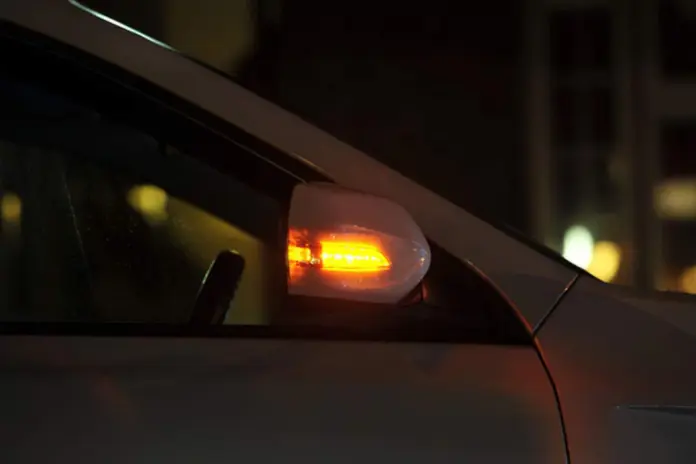

Your side mirror turn signals are those small but important LED indicators built into your exterior mirrors. When you flip your turn signal stalk, they light up on the corresponding side to let other drivers know you’re about to change lanes or make a turn. They’re a visibility feature that adds an extra layer of safety beyond your standard fender-mounted or bumper-mounted turn signals.
But like every other electronic component on your car, they can stop working. And when they do, diagnosing the problem isn’t always straightforward because several different issues can produce similar symptoms.
Let’s walk through the symptoms you might notice, the most common causes, and how to actually fix the problem without wasting time on guesswork.
How to Tell Something’s Wrong With Your Mirror Turn Signals
A dead light is the most obvious symptom, but it’s not the only one. Paying attention to exactly how the signal is misbehaving can point you toward the cause before you start pulling things apart.
The Light Won’t Come On at All
This is the most common complaint and the easiest to spot. You activate your turn signal and the mirror stays dark. The usual suspects here are a blown fuse, a burned-out LED module, or a broken wire somewhere in the mirror assembly. Since this is the most visible failure, it’s typically what prompts people to start investigating.
The Light Stays On But Doesn’t Flash
If the mirror signal illuminates but just sits there without blinking, you’re likely dealing with a wiring issue or a problem with the flasher module. This one is worth addressing quickly. A constant-on signal draws more power than a flashing one, and if left unchecked, the underlying electrical issue could damage the LED module itself, turning a cheap fix into a more expensive one.
The Light Won’t Turn Off
A mirror turn signal that stays lit even after you’ve canceled the turn signal is a different kind of headache. This can drain your battery if the car is parked with the engine off. The problem is usually traced back to a wiring fault or a stuck turn signal canceling mechanism inside the steering column.
The Flash Rate Is Too Fast or Too Slow
This is a subtle one that a lot of people miss. If your mirror signal blinks noticeably faster or slower than your other turn signals, something’s off. In most cases, it means the wrong replacement bulb was installed, or the flasher relay isn’t matched correctly to the LED load. You’ll notice it most easily by comparing the mirror signal’s blink rate to the fender or rear turn signals.
The Dashboard Indicator Lights Up But Doesn’t Blink
When your dashboard turn signal arrow illuminates but stays solid instead of flashing, it’s usually telling you that one of the external lights in the circuit has failed. This could be the mirror signal, a fender signal, or a rear signal. The car’s electrical system detects the change in resistance caused by the dead bulb and alters the indicator behavior as a warning.
6 Reasons Your Side Mirror Turn Signal Isn’t Working
Now that you know what the symptoms look like, let’s get into what’s actually causing them. These are the six most common culprits, roughly ordered from simplest to most involved.
1. Blown Fuse
This is always the first thing to check with any electrical failure, and for good reason. The fuse protects the turn signal circuit from current spikes. When it blows, the circuit is broken and no power reaches the signal at all.
Fuses blow for a reason, though. If you replace one and it blows again immediately, don’t just keep shoving in new fuses. There’s a short circuit somewhere in the wiring that needs to be found and repaired. Repeatedly replacing fuses without fixing the underlying cause can damage other components in the circuit.
2. Burned-Out Bulb or LED Module
Turn signal bulbs and LED modules have a finite lifespan. LEDs last significantly longer than traditional incandescent bulbs, but they do eventually fail. They can also burn out prematurely if there’s a voltage irregularity in the circuit, like a bad ground connection sending inconsistent power to the module.
On most modern vehicles, the mirror turn signal uses a self-contained LED unit rather than a replaceable bulb. That means you’re replacing the entire module rather than just a bulb, which costs a bit more but is still a straightforward fix on most cars.
3. Faulty Turn Signal Switch
The turn signal switch is the lever on the side of your steering column. When you push it up or down, it sends a signal to the corresponding lights. If the switch itself is damaged or worn out internally, it may not send the proper signal to the mirror light, even if everything else in the circuit is fine.
A failing switch often shows inconsistent behavior. The signal might work sometimes and not others, or it might work on one side but not the other. If you’re seeing that kind of intermittent behavior, the switch is a strong suspect.
4. Corroded or Dirty Bulb Socket
Over time, moisture and oxidation can build up inside the bulb socket, creating a layer of corrosion between the bulb and the electrical contact. Even a thin film of grime can be enough to block current flow and prevent the light from working.
This is especially common in climates with lots of rain, snow, or road salt. Side mirrors are constantly exposed to the elements, and water can find its way into the housing over time. Whenever you’re replacing a bulb or LED module, take a moment to inspect and clean the socket. A bit of electrical contact cleaner and a small brush can resolve what looks like a much bigger problem.
5. Damaged Flasher Module
The flasher module (sometimes called a flasher relay) is the component that controls the on-off-on-off blink pattern of your turn signals. Modern vehicles with LED turn signals use electronic flasher modules calibrated for the lower amperage draw of LEDs.
If the flasher module fails or isn’t compatible with your specific LED setup, you’ll see abnormal behavior. The lights might not flash at all, flash at the wrong speed, or work erratically. This is also the component to look at if you recently switched from incandescent bulbs to LEDs and the blink rate changed dramatically. Standard flasher relays expect a certain electrical load, and LEDs draw much less, which confuses the relay into hyper-flashing.
6. Weak or Failing Battery
This one is easy to overlook because a weak battery affects so many things at once. If your battery is old or losing capacity, it may not deliver consistent voltage to all the electrical accessories in the car. Turn signals, particularly the lower-priority mirror signals, can be among the first to show symptoms.
If your mirror signal issues appeared around the same time you started noticing slow cranking, dimming headlights, or other electrical gremlins, test the battery before you start chasing wiring problems. A $150 battery replacement is a lot cheaper than hours of diagnostic time hunting for a phantom electrical fault.
How to Diagnose and Fix the Problem Step by Step
The key to fixing this efficiently is working systematically from the simplest, cheapest possibilities to the more involved ones. Here’s the process:
Step 1: Set up safely. Park on a level surface and turn off the engine, but leave the key in the “ON” or “ACC” position so the electrical system stays powered. You need the circuits live to test the signals.
Step 2: Check the fuse. Use your owner’s manual to locate the fuse panel and identify the fuse for the turn signal circuit. Pull it out and inspect it visually. If the metal strip inside is broken or blackened, the fuse is blown. Replace it with one of the exact same amperage rating. If the new fuse blows immediately, stop. You have a short circuit that needs professional diagnosis.
Step 3: Inspect the bulb or LED module. If the fuse is fine, the next step is checking the light itself. On most vehicles, the mirror housing has a removable panel or the entire mirror cap pops off to access the signal module. Look for obvious damage, discoloration, or burn marks. Replace if needed.
Step 4: Clean the socket and check connections. While you have the light out, inspect the socket and wiring connector for corrosion, dirt, or loose connections. Clean any buildup with electrical contact cleaner. Make sure the connector seats firmly.
Step 5: Test the turn signal switch and flasher module. If the fuse and bulb are both good, the problem is likely upstream in the circuit. Testing the switch and flasher module usually requires a multimeter or a scan tool. If you’re not comfortable with electrical diagnostics at this level, this is a good point to bring in a professional.
When to Call a Mechanic
Some mirror signal issues are vehicle-specific, especially on cars where the mirror assembly integrates the turn signal, puddle light, blind spot indicator, and mirror motor into a single wiring harness. On those vehicles, a problem in one component can affect others in ways that aren’t obvious without the right wiring diagrams.
If you’ve checked the fuse, inspected the bulb, cleaned the contacts, and the signal still isn’t working, it’s time to let someone with proper diagnostic tools trace the circuit. Chasing intermittent electrical faults without a wiring schematic and a multimeter is a fast way to waste an entire weekend and still end up at the shop on Monday.