
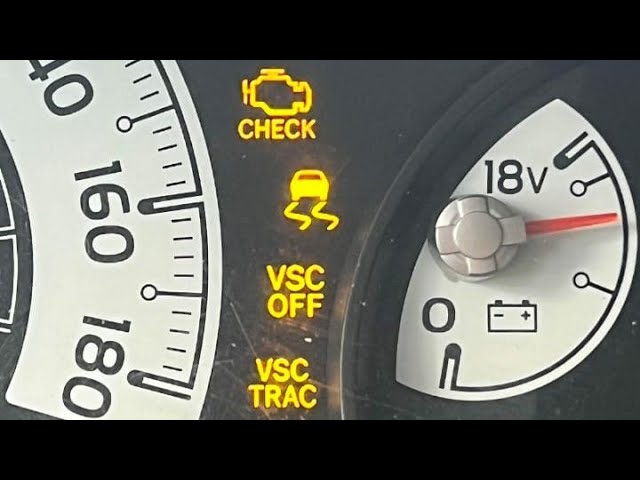
If the VSC OFF indicator is lit on your Toyota, you should not ignore it. That light often means the Vehicle Stability Control system is not doing its job the way it should, which matters most when roads are slippery, visibility is poor, or you need quick reactions to avoid a crash.
Sometimes the cause is simple, like a glitch, a bad indicator bulb, or something as basic as a gas cap that was not tightened. Other times it points to a stability control or vehicle computer issue that needs a proper diagnostic scan. Either way, address the VSC OFF light promptly so you know what you are dealing with before the next rainstorm or emergency maneuver.
This guide explains why the VSC OFF light might flash, what the VSC system does, and what you can do to resolve it. You will also find a step-by-step Toyota reset procedure, plus practical “what to check first” advice that can save you time and money.
Why Does the VSC OFF Light Flash?
Let us start with the driving reality. Twisty roads are fun until the grip changes. You may be doing everything right, and then another driver forces a sudden swerve, or a patch of wet pavement shows up where you did not expect it. In those moments, traction and stability control are what help keep the car pointed where you intend.
The warning makes sense because loss of control can happen fast. Too much speed can cause skids that turn into impacts with trees, poles, or other roadside obstacles. Wet roads can also lead to hydroplaning, which reduces tire contact with the surface and makes steering feel delayed or vague.
This is where the Vehicle Stability Control (VSC) system earns its keep. VSC is designed to help your Toyota maintain stability when the car starts to slip or behave differently than the driver inputs. When VSC is active, you may see a VSC-related dashboard indication, because the system is engaged and working to keep the vehicle under control.
A blinking VSC OFF light is the vehicle’s way of warning you that the computer detected a potential issue related to the stability control system. The important part is that “OFF” indicates the system may not be operating as intended.
So, what causes a flashing VSC OFF light? There are a few commonly reported scenarios. The three most typical causes are:
- A malfunction in the computer controlling the VSC system and its indicator light.
- A defective bulb or wiring for the VSC OFF light.
- An improperly secured gas cap.
Those three causes give you a solid place to start, especially because they cover both electronics-side problems and the “check something quick” mechanical-side issue.
Even so, the real world often includes variations. Sometimes the stability control system acts up because of wheel speed sensor problems, steering angle sensor faults, or ABS-related issues, and the dash warning you see can be related to more than one component. You should still treat the flashing light as a sign you need diagnosis, not just a puzzle to ignore.
Steady light versus flashing light: what it implies
Owners often ask whether steady versus flashing matters. In practice, it often does. A flashing warning generally indicates the computer is actively detecting a fault condition right now, while a steady light can indicate a stored fault or a less urgent status.
Because you are seeing the VSC OFF light flash, it is wise to treat it as more immediate. If it is flashing while you drive, you can reduce risk by slowing down, avoiding sudden steering inputs, and planning for extra stopping distance until you have it checked.
Do not assume you can “wait it out” during bad weather. If the system is disabled or not functioning correctly, you are giving up safety assistance when you might need it most.
A quick scenario that helps you picture the issue
Picture this. You wash the car, then you drive the next day and the VSC OFF light starts flashing after a few turns. You might think it is related to wetness or washing, but it can also be an unrelated fault that just becomes noticeable during driving. That is why the first job is to check easy basics, like the gas cap, and then move to diagnosis.
Another scenario: after a battery change, or after you jump-start the vehicle, you may see VSC-related warnings briefly. Battery voltage glitches can confuse sensors and trigger stability control faults. Those cases can sometimes clear, but flashing warnings should still be reviewed if they persist.
Now let us shift from “why” to “what the system does,” because that makes the fix logic easier to follow.
What Does the VSC System Do?
If you own a Toyota, you might have come across the term “VSC” in your owner’s manual. Sometimes it is just a definition. Other times it is what you see when something goes wrong.
So, what is this VSC light, and why does it matter?
The VSC light is a dashboard warning connected to Toyota’s Vehicle Stability Control system. It works similarly to other major warning indicators you know, but it is specific to stability and traction support.
The main goal is straightforward: it helps your vehicle’s wheels and body move in the same direction. When the car senses that it is going into oversteer or understeer, VSC helps bring the vehicle back to the path you are trying to follow.
Try this mental picture. You are driving along and another vehicle cuts in front of you. You swerve to avoid a crash. The tires do their best, but the car begins to rotate or slide more than you intended. That is the exact moment when stability control steps in, using sensors and computer logic to reduce the loss of control.
Without quick correction, a slide can turn into contact with another car or a barrier. VSC tries to prevent that by detecting the mismatch between where the driver wants the car to go and where the car is actually going.
The VSC system activates mainly when needed, such as during sharp turns or on slippery roads. Sensors monitor things like vehicle behavior and alignment. Those readings then guide the engine computer to engage the system.
When VSC is active, the VSC light can illuminate to tell you the system is working. That is normal during traction events. What is not normal is seeing VSC OFF because that suggests the stability system is not available or is malfunctioning.
You do not need to memorize sensor names to understand the concept. Just remember this: VSC is a safety assist built into the vehicle’s computer and braking behavior. When the dash says OFF, you should treat the situation like the assist might not be there.
That brings us to the practical part. How do you resolve the flashing VSC OFF light?
How to Resolve the VSC OFF Light Issue
The good news is that fixing a VSC OFF light can be affordable. Some solutions are also possible without paying for labor. The key is to follow the right steps in the right order, so you do not waste time or replace parts that are not actually the problem.
In this section, you will see two primary paths. First, try a VSC reset for a glitching indicator situation. Second, if the issue seems computer-related, visit a Toyota service center for diagnostics. Then, verify the gas cap because it can trigger warnings, including VSC OFF related illumination.
Glitching Dashboard Light: Try the VSC Reset
One common DIY method is the VSC reset, especially when the light seems to glitch and does not stay consistent. Start by turning on the car while keeping it in Park. If you are already driving, pull over somewhere safe first, because you want stable conditions for the reset procedure.
Next, locate the VSC button. Hold it for a few seconds. When you do this correctly, both the VSC OFF and TRAC OFF lights should illuminate, which indicates the systems are disabled.
Now wait for about 30 seconds. After the wait, press the VSC button again. The lights should flash briefly and then turn off.
If this reset does not work, the issue may not be a simple glitch. In that case, the problem may be tied to the dashboard bulb, wiring, or the vehicle’s computer system.
It is worth saying out loud: you are not “repairing” the underlying issue if you just disable and re-enable a system. You are trying to confirm whether it is a temporary glitch or something that requires deeper attention.
Computer Malfunction: Visit a Toyota Service Center
If the computer is malfunctioning, you should lean toward professional diagnosis. A mechanic at a Toyota service center can run proper diagnostic tests using specialized tools. Those tools help identify the exact fault and why the stability control system is not behaving correctly.
Here is what you should ask for. Request a scan of the relevant stability and traction control modules, plus any related codes that tie to wheel speed, steering input, yaw behavior, or brake control. Even if you just want “what to fix,” the scan tells you what the car actually detected.
Also, when you bring the car in, tell the technician when the light flashes. If it appears only after certain conditions, that detail narrows down the diagnosis. A stability control fault that appears during wet turns is not identical to one that appears after a gas cap incident or battery voltage drop.
Loose Gas Cap: Secure It Properly
This is the part that feels surprising to many owners. An improperly secured gas cap can trigger the VSC OFF light. Many Toyota owners on forums have reported this exact experience, which is why it is a smart first check.
Sometimes the gas cap is not tight enough. Other times it does not seal due to a worn gasket or cap damage. The car can detect a problem in the fuel vapor control system and react with warning indicators.
So what should you do? Remove the cap, inspect it quickly, and then reinstall it until you feel it fully seat and tighten properly. Then drive normally for a short period and watch whether the VSC OFF warning stops flashing.
If you still have the flashing behavior after securing the gas cap, treat that as evidence the gas cap may not be the only issue. At that point, you should move to code scanning or a service check.
Final Thoughts
A flashing VSC OFF light on your Toyota can point to a loose gas cap, a computer glitch, or a faulty dashboard light bulb or wiring. The Vehicle Stability Control system is designed to activate automatically so the car can help maintain control when it veers unexpectedly. When the dash says OFF, you should not assume everything is fine.
Here is the most practical next step: check the gas cap right now, then try the VSC reset procedure in Park. After that, pay attention to whether the light continues to flash. If it does, schedule a diagnostic appointment quickly, because you want to know what the computer actually detected before the next slick-road moment.
Extra Owner Checks You Can Do While Waiting for Service
Many owners fixate on the light itself, but your goal is to protect yourself and your vehicle in the meantime. Before you book a shop visit, there are a few smart checks you can do that cost little and can prevent a frustrating back-and-forth with the technician.
Think of it like this. The car has a fault stored in its memory, but you can also gather clues from the way it behaves. Those clues are what help the shop diagnose faster and more accurately.
Battery voltage and battery health: an overlooked trigger
Stability control systems are electronics-heavy. When battery voltage is weak, sensors can behave erratically or the computer can log faults. That can show up as VSC-related warnings, including VSC OFF flashing.
If your car recently had a jump start, if the battery is old, or if you notice dimming lights, it is worth mentioning that to the shop. Some faults go away after voltage stabilizes. Other faults remain and still need repair.
You can also help yourself by checking whether any other warning lights are on at the same time. If you see ABS, traction control, or steering-related warnings along with VSC OFF, that points toward a shared sensor or control issue.
Fuses and bulbs: when it is “just the indicator”
One of the commonly listed causes is a defective bulb or wiring for the VSC OFF light. That matters because sometimes the dash shows the warning even when the underlying stability control hardware is actually fine.
However, it is still not something you should ignore. The reason is that an indicator wiring fault can occur alongside a real stability issue, especially if connectors got wet or disturbed. If the reset does not clear the warning and the light continues flashing, you should treat it as real until a scan proves otherwise.
If you want to do a simple check at home, look for any visibly loose dashboard connections only if you are comfortable and safe doing so. Do not pull apart dashboard wiring. That is not a quick job, and it is easy to create additional problems.
OBD-II scan before the shop: get the codes, even if you DIY nothing
Even if you plan to bring the car to Toyota, it helps to know what codes are stored. A basic OBD-II scanner can sometimes pull codes related to stability control or related systems.
Write down the codes and any freeze-frame data if your scanner provides it. Then bring that information with you. This small step can help your technician connect the dots faster, especially if the light appears only under certain driving conditions.
If your scanner does not read the exact stability module codes, do not worry. The shop tool will still handle it. Your goal at home is just to gather whatever you can without guessing.
What It Feels Like When VSC OFF Is a Real Problem
When VSC OFF is truly disabling stability control, you might notice how the car behaves differently during normal driving. It might not feel dangerous in everyday conditions. It might feel unpredictable during quick steering moves or on wet pavement.
Do not expect a dramatic “car is broken” symptom. Many stability faults are subtle until you drive hard or the road changes. That is part of why these warnings matter. The safety system might be absent when you need it most, even if you feel fine driving around town.
Here are a few real owner-type clues that often show up when stability control is not operating normally:
- Reduced confidence in steering during quick turns
- More sliding or drifting than usual when roads are wet
- Stability control feeling “less active” when the car should correct itself
- Warning lights that appear during certain drive conditions and then return
If you experience those kinds of symptoms while the VSC OFF light is flashing, treat it as an urgency signal. Slow down. Avoid sudden maneuvers. Get the diagnostic done sooner rather than later.
Safety Advice for Driving While the VSC OFF Light Flashes
You might be wondering whether you should keep driving. The honest answer is that you should avoid pushing the limits. The goal is not panic. The goal is to reduce the chance that you will need stability control assistance before you fix it.
If the light is flashing:
- Drive slower than usual, especially in rain or snow
- Increase following distance
- Avoid sudden lane changes and sharp steering corrections
- Do not tow heavy loads until you confirm what the fault is
- Plan a service appointment quickly if the light stays active
Also, be mindful that the exact behavior can vary by Toyota model and year. Still, when the stability control warning is flashing, you should treat it like the car is telling you, “I might not stabilize as expected.”
A Simple Troubleshooting Roadmap (In Plain English)
Here is a straightforward way to approach the problem without getting overwhelmed. Follow this order. It is built around the most common causes and the best “value per minute” checks.
Step-by-step: what to do first when VSC OFF flashes
Use this sequence as your plan:
- Inspect the gas cap. Remove it and reinstall it properly until it fully seats.
- Confirm the warning behavior. Does it flash immediately, or does it appear after driving for a while?
- Try the VSC reset in Park, by holding the VSC button for a few seconds, waiting about 30 seconds, and pressing again.
- Check whether the lights change. After the reset, do the VSC OFF and TRAC OFF lights flash briefly and turn off, or do they keep returning?
- If it returns, scan for codes if you have an OBD-II scanner that can read relevant information.
- Book Toyota diagnostic service if the warning persists, especially if it flashes repeatedly or is accompanied by other warning lights.
That is how you avoid guessing. Gas cap and reset are quick. Scanning and diagnosis are next when those do not resolve it.
Why the “Loose Gas Cap” Connection Can Happen
Some drivers ask, “How can a gas cap affect stability control?” The short answer is that modern vehicles share sensor networks and computer monitoring across multiple systems. If the engine management system detects a fuel vapor control issue, it can trigger warnings that overlap with other dashboard indicators.
Even when the gas cap issue is separate from the stability hardware, the vehicle computer might still light the VSC OFF indicator because it is detecting an abnormal condition. That is why the gas cap check is worth doing first. It is inexpensive and easy, and sometimes it is the real cause.
Do not treat the gas cap check as a ritual. Treat it as a diagnostic step. If tightening it stops the flashing, you solved it. If it does not, you move on.
When the Problem Is a Dashboard Light or Wiring Issue
The guide lists defective bulb or wiring for the VSC OFF light as a common cause. That is an important distinction, because it can change what actually needs fixing.
If the indicator wiring is wrong, you can see the warning even if the stability system is otherwise working. Still, you cannot confirm that without checking codes and module data. It is easy to mistake a false indicator for a real control problem.
If the reset procedure does not clear the warning, you should take the situation seriously. The same wiring or connector issues that affect the dash light can also affect sensors used by stability control.
When It Is a Computer Malfunction: What Toyota Diagnostics Will Likely Do
When the computer is malfunctioning, the best move is professional diagnosis, and the guide explicitly recommends a Toyota service center. The reason is simple: stability control faults are not usually fixed by guesswork. They require a scan, interpretation of stored codes, and verification of sensor inputs.
A typical diagnosis process often includes checking for:
- Stored VSC-related fault codes
- Whether the VSC control module detects abnormal sensor signals
- Whether related systems like traction control, ABS input, or brake control show faults
- Whether wiring or connector integrity is compromised
- Whether the stability system is actually disabled or merely the indicator is incorrect
With that, the shop can tell you whether you need a simple fix or a more involved repair.
Frequently Asked Questions About VSC OFF
Is it safe to drive with VSC OFF flashing?
It is not the safest situation. When VSC OFF flashes, the stability control system may not assist the way it should. If you must drive, reduce speed and avoid slippery roads until you confirm the cause.
If the light keeps flashing, you should schedule diagnostics quickly rather than waiting for a later date.
Does the VSC reset always fix it?
No. The VSC reset can help with a glitching dashboard light scenario. If the cause is a real computer fault or a broken wiring issue, the warning can return after the reset.
If the light does not go away after a reset, do not keep repeating the same steps. Move toward diagnosis.
If I tighten the gas cap, will it clear permanently?
Often, yes, but not always. If the gas cap was the actual trigger, tightening it and driving normally can clear the issue. If another fault is present, the VSC OFF light can continue to flash.
Monitor after tightening it. If it returns, it is time for the scan and professional inspection.
What should I tell the technician so they fix it faster?
Tell them when the light flashes and how it behaves. For example, does it appear immediately after starting, or after driving for a while? Mention whether it happens only in wet conditions, only after certain turns, or after fueling.
If you tried the VSC reset, tell them whether it changed the behavior. Those details help narrow diagnosis quickly.