
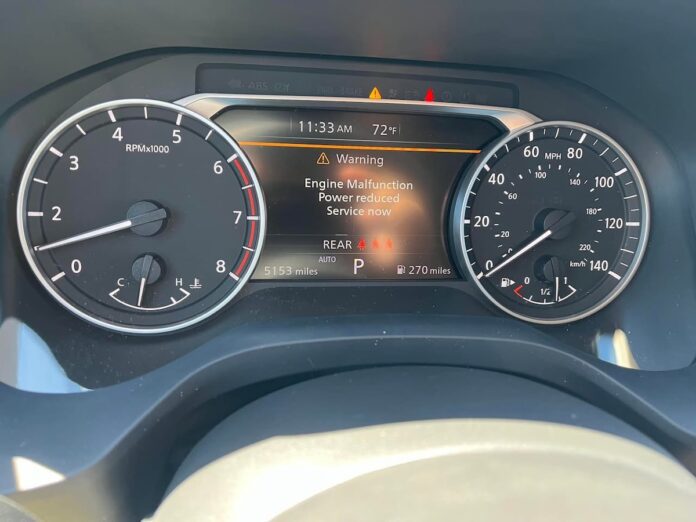
You’re driving along, everything feels normal, and then — out of nowhere — your Nissan flashes “Engine Malfunction, Power Reduced, Service Now.” The car suddenly feels sluggish, the throttle barely responds, and you’re left wondering if something just broke in a very expensive way.
Take a breath. This warning means the engine control unit (ECU) detected a fault and is deliberately limiting power to prevent further damage. Your car is basically protecting itself. That’s actually good news — it means the system is working as designed. The bad news? You’re stuck driving a car that feels like it’s wading through mud until you figure out what triggered it.
The cause could be a failing sensor, an emissions component acting up, a weak battery, a wiring issue, or the vehicle entering limp mode. Let’s dig into what’s most likely going on, how to get it diagnosed, and what you can do to keep this warning from coming back.
What’s Behind the “Power Reduced” Warning?
This warning isn’t tied to one single problem — that’s what makes it tricky. Your Nissan’s engine relies on a web of sensors, control modules, fuel components, and stable electrical supply to deliver the right power at the right time. If any of those inputs goes sideways, the ECU may cut performance as a precaution.
That’s why the same warning can pop up for completely different reasons. A dying battery can trigger it. So can a gunked-up EGR valve, a flaky throttle position sensor, or a wiring connector that’s corroded just enough to confuse the computer.
But here’s the thing — reduced engine power rarely happens out of the blue. There’s usually a trail of clues leading up to it: rough acceleration, intermittent hesitation, a check engine light that flickers on and off, hard starts, or a vague feeling that the car just isn’t pulling like it used to. Recognizing those patterns helps you zero in on the real problem faster.
Sensor Failures That Fool the ECU
Sensors are the ECU’s eyes and ears. They measure everything in real time — air-fuel ratios, throttle position, airflow, engine speed — and feed that data back to the computer. The ECU then adjusts fuel delivery, ignition timing, and throttle behavior based on what it’s told. When a sensor starts sending garbage data, the ECU has no choice but to work with bad information. That’s when things go wrong.
The oxygen sensor is a prime example. It monitors oxygen content in the exhaust to help the ECU fine-tune the air-fuel mixture. If it gets contaminated, sluggish, or just inaccurate, the ECU can’t tell whether the engine is running rich or lean. You might notice worse fuel economy, rough idle, or hesitation before the full warning ever appears. A failing O₂ sensor creates a domino effect — incorrect fuel adjustments lead to poor combustion, which eventually triggers the reduced power response.
The throttle position sensor (TPS) is another big one. It tells the ECU how far the throttle is open and helps coordinate your acceleration requests. If it sends erratic or conflicting signals, the engine might hesitate, respond slowly, or surge unpredictably. Since throttle control is directly tied to safe engine operation, the ECU gets very conservative very quickly when it spots a TPS fault. You press the gas, and the car just… won’t go. Not because the engine is broken, but because the computer doesn’t trust what it’s being told.
These two aren’t the only troublemakers. Airflow sensors, camshaft and crankshaft position sensors, manifold pressure sensors, and pedal position sensors can all cause the same warning if they start to drift or fail. What makes sensor problems particularly annoying is their tendency to come and go. The car might run fine on Monday and enter reduced power mode on Tuesday. That inconsistency usually points to an electrical or sensor issue rather than a mechanical one.
Don’t ignore a sensor fault just because the car still moves. An engine running on bad data suffers from poor combustion, higher emissions, and extra strain on related components. If you’re experiencing rough idle, hesitation, or erratic throttle response alongside the warning, get the system scanned sooner rather than later. Catching a bad sensor early almost always prevents bigger, more expensive secondary problems.
When Emission Control Parts Start Failing
Emission control components aren’t just about passing smog tests. In a modern Nissan, they’re tightly woven into engine efficiency and combustion quality. When one of these parts stops doing its job, the result isn’t just higher tailpipe emissions — it’s hesitation, rough running, restricted exhaust flow, and yes, reduced engine power.
The EGR valve (exhaust gas recirculation) is a classic offender. It recirculates a controlled portion of exhaust gases back into the intake to lower combustion temperatures and reduce harmful emissions. Sounds straightforward, but problems pile up fast. If it sticks open, you get rough idle and stumbling at low speeds. Sticks closed? Combustion issues and elevated emissions. Gets clogged with carbon? Both problems at once. Either way, the ECU notices the abnormal behavior and may cut power to protect the system. EGR issues are especially common in cars that see lots of short trips, extended idling, or delayed maintenance — basically, the conditions that let carbon build up unchecked.
The catalytic converter is the other heavy hitter. When it’s working properly, it cleans up exhaust gases. But if it gets clogged or internally damaged, exhaust flow becomes restricted. That backpressure makes it harder for the engine to breathe. You’ll feel sluggish acceleration, reduced power at higher speeds, possible overheating under load, and sometimes a noticeable sulfur smell. A severely restricted catalytic converter makes the car feel like it’s suffocating — because in a sense, it is.
One thing worth knowing: catalytic converter problems are often caused by something else upstream. Repeated misfires, excessive oil burning, or long-term sensor faults can damage the converter over time. Replacing it without addressing the root cause is like putting a bandage on a wound that’s still bleeding. The same logic applies to EGR problems — carbon buildup usually points to a broader maintenance issue, not just an isolated part failure.
If your Nissan feels restricted under acceleration or shows the warning alongside a check engine light, emissions components belong high on the diagnostic checklist.
Electronic and ECU-Related Faults
Your Nissan’s engine depends on electronics for practically everything. The ECU (sometimes called the ECM) is the central decision-maker — it controls fuel injection, ignition timing, throttle response, emissions management, and a long list of protective strategies. It processes sensor data, compares readings against programmed limits, and sends commands across the engine and transmission. When the ECU itself has a software hiccup, or when the wiring that feeds it becomes unreliable, engine behavior can change dramatically.
In many reduced power cases, the issue isn’t mechanical at all. It’s the ECU refusing to allow full operation because it no longer trusts the data it’s receiving.
Software glitches are possible, though less common than basic sensor failures. A calibration issue, corrupted data, or control logic error can sometimes trigger false warnings or odd engine responses. Manufacturers occasionally release updates to fix these. If your Nissan keeps throwing warnings despite healthy components, software shouldn’t be ruled out — especially when symptoms are inconsistent or don’t match any obvious mechanical problem.
Wiring faults and poor connections are far more common. A loose ground, corroded connector, chafed harness, or high-resistance wire can interrupt communication between sensors and the ECU. From the driver’s seat, the symptoms feel mysterious — the car hesitates, enters reduced power mode, then behaves normally after a restart. That kind of intermittent behavior is a classic hallmark of an electrical issue. Heat, vibration, moisture, and age all take their toll on wiring, especially near the engine where conditions are harshest.
Electronic faults also extend beyond the ECU itself. Throttle body control modules, accelerator pedal circuits, control relays, and inter-module communication networks all play a role. A fault in one area can cause the ECU to reduce power even when every mechanical part is healthy. That’s why professional diagnosis with a scan tool — checking not just codes but live data, communication status, and command signals — is so valuable here. It separates a real hardware failure from a wiring or software problem, which can save you from replacing parts that were never broken.
If the warning shows up alongside other electrical oddities — erratic gauges, hard starting, random warning lights — there’s a strong chance the root issue is in the voltage supply, module communication, or harness integrity. The engine might be mechanically perfect, but the control system can only make good decisions when its electrical foundation is solid.
The Weak Battery You’re Probably Overlooking
This one catches a lot of people off guard. Most drivers don’t connect a weak battery to reduced engine power, but the relationship is more direct than you’d think. Your battery supplies and stabilizes voltage for the ECU, sensors, ignition system, and every electronic module in the vehicle. When voltage drops too low, those systems start getting inconsistent or insufficient power. That leads to communication errors, unstable sensor readings, and incorrect control decisions.
In some Nissans, a low-voltage condition alone is enough to trigger warnings that look far more serious than a tired battery.
A weak battery can also mess with how the car starts, how smoothly the throttle system initializes, and how accurately sensors report their values. If voltage dips during startup, the ECU might flag faults in components that aren’t actually failing — they just weren’t powered correctly at that moment. This is exactly why battery condition should be one of the first things checked during diagnosis, especially if the warning appears after difficult starts, long periods of sitting, or cold weather.
Battery-related problems are especially deceptive because they can appear suddenly and vanish just as quickly after a recharge or restart. That temporary improvement often convinces owners to delay diagnosis — right up until the warning comes back. If your Nissan shows signs of slow cranking, random warning lights, or the battery is past its expected service life, testing it isn’t optional. It’s a necessary part of getting to the bottom of the problem. Never underestimate how much a dying battery can disrupt an otherwise healthy engine management system.
Getting Your Nissan Fixed: What to Expect
Seeing this warning can turn an ordinary Tuesday into a stressful one, especially if you’re not sure whether the car is safe to keep driving. But the repair process gets a lot less overwhelming when you know what steps matter, when professional diagnosis is necessary, and what information can speed things along.
In many cases, the car is still drivable — but that doesn’t mean you should push it. Reduced power mode exists to protect the engine. If the vehicle is struggling badly, hesitating, or lighting up like a Christmas tree with warnings, treat it as a prompt for diagnosis, not a suggestion to ignore.
When It’s Time to See a Professional
If the warning won’t go away, it’s time to visit a Nissan dealer or a qualified shop with Nissan experience. This is especially true if the car has noticeably lost power, struggles to accelerate, or behaves unpredictably. Reduced engine power isn’t a routine maintenance reminder — it’s a protective response to a confirmed fault.
Get professional help right away if the warning appears alongside unusual noises, rough running, hard starts, or a check engine light. If the engine is stumbling, the transmission is shifting strangely, or the car won’t respond to the accelerator properly, continued driving can add stress to the engine, exhaust system, or drivetrain. In severe cases where speed is severely limited, it might be safest to drive only a short distance to a shop or arrange a tow.
Before you go, make two quick observations:
- Is the car in limp mode? (Does it feel slow, restricted, or capped at a certain speed?)
- Are any other warning lights on, like the check engine light?
Also note when the warning appeared. Was it during acceleration? After refueling? In wet weather? After the car sat for a week? After a recent battery replacement? These details can help a technician narrow things down far faster than fault codes alone.
A Nissan dealer typically has factory-level scan tools, service bulletins, and model-specific information that’s especially useful for software or communication faults. That said, what matters most isn’t the building — it’s the quality of the diagnosis. A good technician will verify fault codes, check live data, test voltage, and confirm the root cause before recommending any repairs.
And if the issue seems intermittent? Don’t assume it fixed itself just because the car restarts normally. Many reduced-power events start as occasional glitches — especially when caused by voltage drops, loose connectors, or dying sensors. Waiting until the problem becomes constant might make it easier to reproduce, but it can also allow extra damage to develop. When in doubt, get it checked sooner.
How Long Repairs Take (and What They Cost)
The honest answer: it depends. The warning itself doesn’t identify the exact failed part, so timelines vary based on what the diagnosis reveals. Some repairs are quick — a weak battery, a clearly failed sensor, or a loose connector can sometimes be confirmed and corrected in a single visit. Others take longer, particularly if the problem is intermittent, multiple fault codes are stored, or parts need to be ordered.
The diagnostic phase is where the real work happens. That’s where a technician determines whether you’re dealing with something simple, something layered, or a cascading problem where one fault triggered several others.
Questions worth asking at the shop:
- How extensive is the fault?
- What parts are needed, and are they in stock?
- Are there related systems that should be inspected at the same time?
For instance, if the catalytic converter is restricted, was there an upstream cause like misfires or a bad fuel mixture that needs fixing too? If the battery was weak, has the charging system been tested? A good repair plan solves the problem completely — it doesn’t just silence the warning for a few days.
Costs vary based on diagnostic labor, part prices, access difficulty, and whether additional repairs surface during the process. A battery swap or common sensor replacement will cost far less than a catalytic converter replacement or ECU-related repair. The smartest way to manage costs is to stay in close communication with the shop — ask for an explanation of findings, request a parts-and-labor breakdown, and confirm whether the quoted repair addresses the actual root cause.
If exact figures can’t be given right away, that’s not always a red flag. Sometimes it just means the shop is still verifying the cause. What matters is that they explain the process, keep you updated, and don’t pressure you into replacing parts without evidence. A thorough diagnosis might take a little longer, but it leads to fewer repeat visits — and that’s worth the wait.
One last thing: ask whether the car is safe to drive temporarily while waiting for parts or a follow-up appointment. Reduced power mode doesn’t always make the car undriveable, but driving with an unresolved fault — especially involving exhaust restriction, low fuel pressure, or throttle problems — can sometimes make things worse.
How to Keep This Warning Off Your Dashboard
The best defense against this warning isn’t luck — it’s consistent maintenance. Modern Nissan engines depend on clean oil, stable electrical power, reliable sensors, and healthy fuel and emissions systems. When regular service gets delayed, small problems quietly accumulate until the ECU steps in and forces the issue. Preventive care can’t guarantee you’ll never see this warning, but it dramatically lowers the odds and catches problems while they’re still cheap to fix.
Don’t Skip Oil Changes
This sounds basic, but it matters more than most people realize. Engine oil lubricates moving parts, carries away heat, reduces friction, and helps suspend contaminants so the filter can trap them. When oil gets old, dirty, or low, it loses its ability to do any of that effectively. The result? Increased wear, heat buildup, sludge formation, and engine behavior that can eventually trigger warnings or reduced power.
Follow Nissan’s recommended interval for your specific model, but factor in your driving conditions too. Short trips, extreme heat, heavy traffic, and towing all justify shorter intervals. And use the correct oil grade — the wrong specification can affect startup protection, operating temperature, and variable valve timing performance.
A routine oil change also creates an opportunity to spot leaks, check for abnormal wear, or catch contamination early. Milky oil, fuel smell in the oil, or excessive sludge are all red flags worth investigating. If you want to minimize the risk of surprise power warnings, treat oil service as non-negotiable.
Check Your Battery and Sensors Regularly
Since so many reduced-power events trace back to electrical instability or bad sensor data, regular check-ups in these areas pay for themselves. This is especially true if your vehicle is a few years old, has had recent starting issues, or has shown intermittent warnings that are hard to reproduce.
Don’t just eyeball the battery — have it properly tested. A battery can look perfectly fine and still fail a load test. Check its age, resting voltage, charging performance, and terminal condition. Corroded terminals, loose connections, and a weak alternator can all create the kind of voltage instability that confuses the ECU and triggers false warnings. Replacing an aging battery before it becomes unreliable is one of the cheapest ways to prevent a whole cascade of electrical headaches.
Sensors deserve periodic attention too, especially if performance has felt slightly off even before any warning appeared. Oxygen sensors, mass airflow sensors, and throttle-related components all work best when they’re clean, responsive, and electrically sound. A sensor doesn’t have to completely fail to cause trouble — it can simply become slow or drift out of spec, which still affects the ECU’s decisions. During routine service, it’s smart to look for stored pending codes, unusual fuel trim readings, or signs of dirty connectors and damaged wiring.
Schedule Engine Diagnostics Before Problems Find You
Regular engine diagnostics might be the most underrated maintenance habit for modern vehicles. Even when your Nissan seems to be running perfectly, the ECU may have stored pending codes, minor sensor irregularities, or performance trends that haven’t become noticeable yet during everyday driving. A diagnostic check catches those hidden issues before they snowball into a “Power Reduced” event on the highway.
During a diagnostic session, specialized equipment talks to the vehicle and evaluates sensor data, fuel system behavior, ignition operation, and module communication. A technician can spot fuel trim imbalances before the car starts running poorly, identify an aging oxygen sensor from its response time, or catch a voltage problem that hasn’t yet triggered a full warning. None of that is visible from behind the steering wheel.
If your Nissan has shown intermittent hesitation, reduced response, or occasional warning lights that vanish after a restart, a diagnostic check should be at the top of your to-do list. Problems that come and go are often easier to understand when the ECU’s stored data is reviewed early — before more symptoms pile up and muddy the picture.
Think of diagnostics as a health screening for your engine’s electronic nervous system. The more information you have, the easier it is to stay ahead of trouble instead of reacting to it.
Limp Mode Explained: What Your Nissan Is Really Doing
Limp mode is exactly what it sounds like — your Nissan is limping along instead of running normally. It’s a built-in safety strategy that activates when the ECU detects a fault serious enough to risk further damage if the engine kept operating at full power. The computer cuts output, limits how the vehicle behaves, and essentially says, “Get me to a shop before this gets worse.”
It doesn’t necessarily mean the engine is about to fail. It means the car has identified something it can’t safely ignore — a sensor disagreement, a throttle fault, a fuel delivery issue, a transmission problem, overheating, or any number of other conditions. The “Engine Malfunction, Power Reduced, Service Now” message is often the driver-facing expression of this protective strategy.
The important thing to remember: limp mode is temporary by design, not a permanent fix. Restarting the car might clear it briefly, but that doesn’t solve the underlying issue. If the fault remains, the system will almost certainly re-enter reduced power mode again — usually at the worst possible time.
How to Tell If You’re in Limp Mode
The most obvious sign is a sharp drop in power. The car still moves, but acceleration feels limited and unresponsive. You can push the gas pedal to the floor and the engine just… won’t rev. It’s holding back on purpose. The ECU is limiting output to reduce stress on the engine or drivetrain while the fault is present.
The throttle position sensor often plays a starring role here. If the throttle system can’t be trusted, the ECU restricts power to prevent unsafe or erratic behavior. That’s why limp mode and throttle-related faults tend to show up together.
You’ll usually see warning lights on the dash too — the check engine light is almost guaranteed, and you might see reduced power indicators or model-specific text alerts. These appear because the ECU has stored a fault code and changed its operating strategy in response.
Transmission behavior often changes as well. The transmission might be slow to shift, reluctant to change gears, or effectively locked into a single gear. This is another protective measure — by simplifying gear changes, the vehicle reduces drivetrain stress. From behind the wheel, it feels heavy, jerky, and frustratingly slow. It might seem like the transmission has failed, but often it’s just the ECU commanding a simplified operating pattern until repairs are made.
Diagnostic Trouble Codes (DTCs) are almost always generated when limp mode kicks in. Even a basic OBD-II scanner can read these and give you a starting point — throttle-related codes, sensor faults, voltage issues, fuel system problems. Just remember that codes should be interpreted in context. A single code doesn’t always tell the whole story, especially with electrical or intermittent issues. But recording them before clearing anything gives you valuable evidence for diagnosis later.
Limp mode severity varies too. Some vehicles only feel slightly weaker. Others are dramatically limited, barely able to keep pace with city traffic. The difference usually depends on the nature of the fault — a mild sensor drift creates modest power loss, while a serious throttle or transmission problem triggers much stricter restrictions.
What to Do When Your Nissan Goes Into Limp Mode
First: stay calm and get safe. Find a place to pull over as soon as traffic allows. Don’t try to force the car to perform normally — if it’s in limp mode, it won’t. If warning lights are flashing, the engine is running very poorly, or the car feels unsafe, shut it down and call for professional help rather than risking further damage.
Once you’re safely stopped, try turning the engine off for a few minutes. In some cases, this brief shutdown resets the system and the car drives normally again for a while. But don’t mistake that for a fix — the fault is likely still there, and the warning will probably return. Consider the restart a tool for controlled movement, not a solution.
Next, check the basics:
- If your model allows it, check the transmission fluid level and condition. Low or burned fluid can be relevant if the problem involves transmission protection.
- Think about whether the car recently had any electrical trouble — weak battery, slow cranking, recent jump-start. Voltage instability can trigger reduced power conditions that mimic other faults.
- If you have an OBD-II scanner, plug it in and read the codes. Record them before clearing anything. Those codes are your starting point for a real diagnosis.
After gathering what information you can, contact a professional mechanic or Nissan-qualified repair facility. Even if the car restarts and seems fine for a bit, limp mode almost always indicates an underlying issue that deserves expert attention. Continuing to drive for extended periods in reduced power mode can lead to bigger problems — especially if the cause involves poor fuel delivery, exhaust restriction, electrical instability, or throttle system failure.
The biggest mistake? Assuming the car is “fine now” because the warning disappeared after a restart. Temporary recovery is textbook behavior for intermittent sensor and electrical faults — and those are exactly the kind of problems that get worse over time.
Finally, keep notes about what happened. The weather, your speed, fuel level, warning lights, recent maintenance, anything unusual you felt before the problem appeared. Some faults only show up under specific conditions, and those details from the driver can help a technician reproduce and identify the problem much more effectively. When it comes to reduced power warnings, information is your best ally.

