

As a car owner, I’m sure dealing with a malfunction related to your PCM power feed; especially a blown PCM fuse or a faulty PCM relay; is not the kind of surprise you want in your day. When it happens, it can feel like the vehicle “randomly” decided not to cooperate: maybe it won’t start, maybe it starts and dies, or maybe your dashboard lights up like a Christmas tree. If you’re not already familiar with what the PCM does and why its power supply is so important, the situation can quickly become stressful.
Here’s the good news: the PCM fuse (and the relay that often works alongside it) is part of a straightforward protective strategy. It’s meant to fail before expensive wiring or control modules do. In many vehicles, replacing a blown fuse is quick and inexpensive. However, if the PCM fuse keeps blowing, that’s not “bad luck”; it’s the vehicle telling you there is an underlying electrical fault that must be diagnosed properly, or you’ll keep replacing fuses forever.
Also, a quick clarification that makes this guide easier to understand: people often say “PCM relay problem” and “PCM fuse problem” as if they are the same thing. They are related, but they are not identical. The PCM relay is typically an electrically controlled switch that allows or routes power to the PCM under certain conditions (ignition ON, key start, etc.). The PCM fuse is the protective device that sacrifices itself if that circuit sees too much current. A relay can fail without blowing a fuse, and a fuse can blow even when the relay is perfectly fine. That’s why diagnosis matters.
Perhaps you’re also not familiar with the function of this vital part? The PCM is often described as the “brain” of the powertrain. Thanks to the PCM; which centrally regulates and monitors key engine and transmission management functions; modern vehicles require far fewer old-school “tune-up adjustments” than they did decades ago. That doesn’t mean the PCM eliminates maintenance (spark plugs, fluids, filters, and sensors still matter). It means the PCM continuously monitors and controls the engine and transmission with a level of precision that once required frequent manual adjustments.
In this expert-level guide, we’ll cover what a PCM is, what the PCM fuse means, what happens when it blows, why it may keep blowing, and how to replace it safely and correctly. I’ll also show you the diagnostic mindset technicians use so you can avoid the most common (and expensive) mistake: repeatedly installing new fuses without addressing the underlying short or overload.
What is a PCM?
The powertrain control module (PCM) is essentially your vehicle’s powertrain “command center.” It is responsible for controlling and coordinating the engine and transmission (and, on many vehicles, additional subsystems tied to emissions and drivability). It works by receiving input data from multiple sensors across the vehicle, processing that information, and then commanding outputs; such as fuel injector pulse width, ignition timing, idle speed control, electronic throttle behavior, and transmission shift timing.
Depending on the make and model of your car, the vehicle may use separate computers for the engine and transmission; commonly called the ECM (Engine Control Module) and TCM (Transmission Control Module); or it may use a single combined unit (PCM) that handles both. Some automakers make the PCM a standalone computer; others integrate these functions in different modules but still use the term “PCM” generically.
Between these systems, there is a wide range of control and vehicle management functions. The PCM is central to everything from managing fuel injection parameters to controlling how your transmission shifts gears. If your PCM loses power, loses communication, or receives damaged power input, the vehicle can experience anything from poor performance to a no-start condition.
It also determines when and how to activate and deactivate your vehicle’s check engine light (MIL; Malfunction Indicator Lamp). A problem with the powertrain control module; or with the circuit that powers it; is a problem for your car because it can prevent the PCM from performing even basic control tasks.
Expert note: It is helpful to think of the PCM as a “computer that must stay awake and stable.” It needs clean electrical power and clean ground connections. If power is interrupted (by a blown fuse or bad relay), the PCM can go offline instantly. And when the PCM is offline, many systems that depend on its logic either stop working or default to fail-safe behavior.
What the PCM controls (typical examples):
- Fuel injectors and air-fuel mixture control
- Ignition timing and spark control
- Idle speed strategies (including electronic throttle control on many vehicles)
- Transmission shift scheduling, torque converter lockup, and shift pressure control (on many automatics)
- Emissions controls (EVAP purge, oxygen sensor monitoring, EGR control where equipped)
- On some vehicles, fan control and other powertrain-linked functions
Because the PCM is involved in so many functions, anything that prevents it from receiving proper power; including a blown PCM fuse; can stop the vehicle from starting or running correctly.
PCM Fuse vs PCM Relay: What’s the Difference?
Even though this article focuses on the PCM fuse, many owners start researching because they suspect a “PCM relay.” Here’s the expert-level difference, explained simply:
- PCM fuse: a sacrificial protective device. If current draw becomes dangerous (short circuit or overload), the fuse melts internally and opens the circuit.
- PCM relay: an electrically controlled switch. It uses a low-current control circuit to close a higher-current circuit that powers the PCM (often when ignition is ON).
What this means in practice: If your PCM relay fails, the PCM may not receive power even though the fuse is fine. If your fuse blows, it doesn’t matter how good the relay is; the PCM still loses power. And if the fuse keeps blowing, simply replacing the relay won’t fix the underlying short (unless the relay itself is shorted internally, which is less common but possible).
Many vehicles have multiple fuses and relays that affect PCM operation. That’s why diagnosis should be based on the circuit diagram for your vehicle rather than assumptions about a single “PCM fuse.”
What Does the PCM Fuse Mean?
From your understanding of what the PCM is and what it does, you can already infer what the PCM fuse means. Regardless of its name, size, or type, a car fuse is a safety component designed to protect electrical wiring and modules from amperage overload. Automotive fuses guard against short circuits and overcurrent by disconnecting the circuit when they detect a hazardous condition.
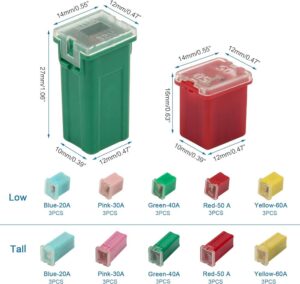
Most modern vehicle fuses are blade-type units with a plastic body and two prongs. They may look similar, but they are rated for different amperage levels and different applications. They are mounted in fuse holders, fuse clips, and fuse blocks; often grouped into one or more fuse panels around the vehicle (engine bay, cabin, trunk, or under-seat locations depending on design).
The PCM fuse is a two-terminal protective device that allows current to flow to the powertrain control module up to a maximum safe level. Its job is to protect your vehicle’s “brain” from receiving too much current (overcurrent) or being damaged by a short circuit. In normal conditions, current flows through the fuse to power the PCM. When the current spikes beyond the fuse’s rating, the fuse element melts and breaks the circuit to prevent module damage.
Let me burst your bubble: there are often several fuses that influence the PCM, not just one. On many vehicles, the PCM has multiple power feeds; such as constant battery feed, ignition-switched feed, sensor reference feeds, and sometimes separate injector/coil or transmission solenoid feeds protected by different fuses. In other words, “PCM power” is often managed by many fuses across multiple fuse blocks.
Once an excessive current passes through the PCM circuit, the fuse element inside melts to prevent damage to the PCM and wiring. Like other automotive fuses, once the PCM fuse blows, no more current flows into the PCM through that protected feed. As a result, the circuit opens and the PCM is cut off from the predesigned current limit that allows it to function.
Expert clarification on “undercurrent”: A fuse does not directly protect against low current in the way it protects against overcurrent. But if current becomes abnormal due to poor connections, corrosion, voltage drop, or weak battery/charging system, the PCM can malfunction or behave unpredictably. That’s not the fuse “protecting” the PCM; that’s the PCM reacting to unstable power quality. Both conditions matter in diagnosis.
What Happens if the PCM Fuse Blows?
A PCM fuse does two jobs: it allows current flow to the PCM under normal operation, and it protects the PCM and wiring during abnormal current events. When it blows (opens), the PCM loses its power supply. Depending on which fuse blew and how your vehicle is wired, you may see mild symptoms; or the vehicle may become completely inoperative.
When the device opens up, melts, and blows, the PCM loses power. Without PCM power, the vehicle cannot properly manage ignition, fuel delivery, and transmission control. The result is that the PCM can no longer operate the circuits and logic required to run the engine.
As a result, the spark to fire the engine may not be commanded, the throttle control may default to a safe mode or shut, and fuel delivery may cease; because the PCM is what drives injectors and ignition in most modern vehicles. In many cases, the entire operation of the engine will stop, preventing the vehicle from moving.
Typical real-world symptoms of a blown PCM fuse include:
- No-start condition (cranks but will not start)
- Engine starts and dies immediately
- No communication with scan tool (PCM offline)
- Check engine light may not illuminate at key-on (because PCM isn’t powered)
- Transmission may default to limp mode or not shift correctly (if TCM/PCM logic is compromised)
Important nuance: Some vehicles will still crank even if the PCM fuse is blown because the starter circuit can be separate. That leads to the common confusion: “the engine turns over, so the PCM must be fine.” Not necessarily. Cranking does not guarantee PCM power. The PCM must be powered and functioning to deliver fuel and ignition logic.
What happens electrically when the PCM fuse blows: the fuse becomes an open circuit, which removes the PCM’s supply voltage. The PCM cannot energize relays, cannot process sensor input, and cannot command actuators. This is why the PCM fuse is considered a high-priority fuse in diagnosis.
Why Does PCM Fuse Keep Blowing?
Nothing can be more frustrating than replacing a blown PCM fuse only to have it blow again immediately; or shortly afterward. When that happens, it’s a strong indicator that the fuse is doing its job: it is protecting the circuit from a repeating overcurrent event. The correct response is not to keep installing fuses; it’s to find the cause of the overcurrent.
There are a couple of factors that can be responsible. The prime suspect is often a short circuit in the wiring harness. Overloading or a faulty component on that circuit can also be the culprit. In some cases, a bad PCM can cause abnormal current draw, but in professional diagnosis, a wiring short is usually more common than a PCM internal short.
But primarily, if the PCM itself is damaged or has gone bad, the fuse cannot remain functional. One of the symptoms of PCM system failure is that your car won’t start. It may start but run roughly. A spoiled wiring harness is also one major reason the PCM will fail to work, leading to the car not starting.
Whether it is the wire harness or a defective PCM, you should attend to the problem as soon as possible. Otherwise, you may get stranded in an undesirable location; possibly far from help.
Expert-level breakdown of common reasons a PCM fuse repeatedly blows:
- Short-to-ground in the PCM power feed: Chafed insulation contacting the chassis or engine metal. Common near brackets, engine mounts, and sharp edges.
- Short inside a component fed by the same fuse: Some vehicles power multiple devices through the same fuse (PCM, sensors, solenoids). One failed component can blow the fuse and make it look like the PCM is the issue.
- Water intrusion: Moisture inside fuse boxes or connectors can bridge terminals and cause intermittent shorts.
- Aftermarket wiring modifications: Remote start systems, alarm systems, audio amplifiers, LED light bars, and other add-ons can introduce shorts or overloads, especially if spliced into PCM or ignition circuits.
- Incorrect fuse rating installed previously: If someone installed the wrong fuse type or rating, it can lead to repeated failure or damage that creates ongoing issues.
- Internal PCM fault: Less common, but possible. If the PCM has internal damage (from a prior electrical surge, jump start mishap, water intrusion, or overheating), it can create abnormal current draw and blow the fuse.
Professional warning: If your PCM fuse blows immediately when you turn the ignition on, do not keep replacing it and cycling the key. Each time you cycle power into a shorted circuit, you risk damaging connectors, wiring, or other modules. Diagnose first.
How technicians isolate the cause: A technician will use a wiring diagram to identify everything powered by that fuse. Then they may disconnect loads (PCM connector, sensor harnesses, solenoid connectors) one at a time to see when the short disappears. They may also use a fused jumper or a circuit breaker tool to prevent repeated fuse purchases during diagnosis. This approach is faster and safer than trial-and-error part replacement.
Common clue that the PCM itself is not the cause: If the PCM fuse blows even when the PCM is unplugged, the PCM is not the direct short (because it is physically removed from the circuit). That points strongly to harness or another component on the same feed. If the fuse stops blowing when PCM is unplugged, PCM becomes a suspect; but you still need to confirm with proper testing.
How to Replace a Blown PCM Fuse
Here are steps to replace a blown PCM fuse. These instructions focus on safe, correct replacement; while also encouraging you to think like a technician. Replacing a blown fuse is not complicated, but it must be done carefully to avoid replacing the wrong fuse, installing the wrong rating, or reintroducing power to a circuit that has an active short.
Materials needed:
- A flashlight
- A flathead Screwdriver
- Protective gear (goggles and gloves)
- A pair of pliers
- Replacement fuse
Expert add-on tools (optional but highly useful):
- A fuse puller (often included in the fuse box)
- A multimeter or test light (for verifying blown fuses and power supply)
- Owner’s manual or fuse diagram reference
Step 1: Switch off the engine and locate the panel: Switch off your engine and allow the vehicle to cool if it has been running. Locate the fuse panel. Typically, the PCM fuse is in a fuse box under the hood or under the dash, but depending on the vehicle it can also be under seats, in the trunk, behind kick panels, or under the passenger floorboard. Consult your owner’s manual to find the exact location and fuse labeling.
Expert safety note: If your vehicle died while driving or the fuse blew during operation, it’s wise to wait a minute for modules to power down before touching fuse panels. This reduces the chance of arcing or accidental shorting when handling tools.
Step 2: Remove the panel lid: Take off the panel lid to access the fuses. You’ll see multiple fuses with amperage ratings and color coding. Check the diagram behind the panel lid or the fuse box labeling to identify which fuse is assigned to the PCM (sometimes labeled PCM, ECM, ECU, IGN, EFI, ENG, or similar).
Expert tip: Some vehicles have more than one “PCM-related” fuse. One may power the PCM memory (constant battery feed), while another powers ignition-switched functions. Make sure you identify the correct one before pulling.
Step 3: Find and remove the blown PCM fuse: Locate the suspect fuse and remove it with a fuse puller or pliers. A blown fuse may look discolored, blackened, or have a broken metal strip/filament inside. If you aren’t sure visually, test it with a multimeter for continuity. Replace only the fuse that is confirmed blown.
Step 4: Replace the bad Fuse: Install a new fuse of the same type, size, rating, and amperage. This is not optional. Using a higher-rated fuse can allow wiring to overheat and damage the vehicle. Using a lower-rated fuse can cause repeated nuisance blowing even when the circuit is healthy.
Step 5: Check if the new fuse works: Start the engine and verify the issue is resolved. If the fuse blows immediately, stop. Do not keep replacing fuses. At that point, the underlying short circuit or overload must be diagnosed before further operation.
Professional-level warning: If the fuse blows instantly or your vehicle still won’t start, you may have deeper circuit issues or a PCM relay/PCM power feed problem. A scan tool may not communicate if the PCM has no power. In that case, basic electrical checks (power/ground at PCM connector, relay output checks) become the next step.
Can I Repair my Car PCM Fuse?
My straight answer is no. You can neither reset nor repair a PCM fuse; or any other automotive fuse for that matter. A fuse is designed to melt when it reaches its limit. Once it blows, the metal strip inside has physically separated. The best thing to do if you have a blown PCM fuse is to replace it.
The good thing is that fuses typically do not cost an arm and a leg. In most cases, with $10–$30 you can purchase a set of quality fuses. The critical point is not the fuse cost; it’s the reason the fuse failed. If the fuse failed due to a one-time surge, replacement may solve the problem. If the fuse failed due to an ongoing short circuit, repeated replacement will not solve anything until you repair the underlying fault.
Expert clarification: You may see “reset fuse” language online, but that’s usually confusion with resettable circuit breakers used in some diagnostic scenarios. Standard blade fuses are one-time-use devices. Replace them; don’t attempt to “repair” them.
Advanced Troubleshooting: What to Do When the Fuse Keeps Blowing
If the PCM fuse keeps blowing, you’re no longer dealing with “replace a fuse and move on.” At that point, you must find the overcurrent source. This is the part of the process where professional diagnostics can save you money, because random parts replacement is often more expensive than paying for one hour of proper circuit testing.
Here’s how a technician approaches repeated PCM fuse failure; explained in a way a skilled DIYer can understand:
1) Confirm the correct fuse is blowing
Vehicles have multiple powertrain-related fuses. Confirm you are replacing the correct PCM-related fuse and not a different engine-related fuse. Misidentification leads to wasted effort and misdiagnosis.
2) Identify all loads on that fuse
Using a wiring diagram, list everything powered by that fuse. On some vehicles, the same fuse powers the PCM and other components (solenoids, sensors, coils, injectors, transmission circuits). Any one of those could be shorted.
3) Inspect harness routing and common chafe points
Look for harness sections that rub against metal brackets, engine components, or body edges. A small worn spot in insulation can touch ground and cause an overcurrent event.
4) Disconnect components and isolate the short
In professional diagnosis, technicians often disconnect suspected components (one at a time) to see when the fuse stops blowing. If the fuse holds with a component unplugged, that component or its branch wiring becomes a suspect.
Important caution: Do not unplug or plug in PCM connectors with the ignition on. Always follow safe procedures and allow modules to power down.
5) Consider water intrusion and aftermarket wiring
Water inside fuse boxes, under-hood connectors, or under-dash wiring can cause intermittent shorts. Aftermarket accessories spliced into ignition/PCM feeds are also a frequent source of trouble. If the fuse started blowing after installing new accessories, that timeline matters.
Expert takeaway: The fuse blowing repeatedly is not “normal” and is not solved by better fuses. It means the circuit is unsafe unless corrected. Diagnose and repair the root cause.
When to Call a Professional (And Why It’s Often Cheaper)
Many PCM fuse replacements are easy DIY tasks. But if the fuse keeps blowing, you should strongly consider professional help. Electrical diagnostics can be time-consuming without a wiring diagram, load-testing tools, and experience isolating faults.
Seek professional diagnosis if:
- The PCM fuse blows immediately after replacement.
- Your vehicle cranks but will not start, and you have no scan tool communication.
- You suspect harness damage but cannot visually locate it.
- There are signs of water intrusion in fuse boxes or connectors.
- You have aftermarket electronics installed and suspect wiring conflicts.
Why paying for diagnosis can save you money: The cost of a proper diagnostic session is often less than the cost of replacing a PCM unnecessarily, replacing multiple sensors, or damaging wiring by repeated fuse cycling. A trained technician can isolate the fault quickly using current clamps, wiring diagrams, test lights, and load substitution tools.
Final Thoughts
The PCM fuse is central to the functioning of your powertrain control module. More importantly, a blown fuse can ground your vehicle and your journey by removing power from the system that manages ignition, fuel delivery, and drivetrain control. Replacing your car’s PCM fuse isn’t something you do often; usually it happens during troubleshooting or when addressing a larger PCM power issue. Always choose a recommended fuse that matches your vehicle’s specifications in type, amperage, and design.
By now, you should understand why the PCM fuse is so critical to the health of your car: it’s a small component protecting your vehicle’s “brain” from electrical damage. I hope you can make an informed decision the next time you face a blown PCM fuse; and more importantly, I hope you’ll avoid the trap of repeated fuse replacement when the fuse keeps blowing. In that scenario, the fuse isn’t the enemy; it’s the messenger. Diagnose the cause, fix it correctly, and your vehicle will return to reliable operation. Have a safe trip!