
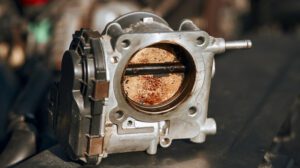

A properly maintained throttle body plays a critical role in your vehicle’s overall performance. As a core component of the engine’s air intake system, the throttle body regulates how much air flows into the engine during acceleration and idle. When this component becomes dirty or coated with carbon buildup, airflow is restricted, combustion efficiency drops, and engine performance suffers. Over time, ignoring a contaminated throttle body can lead to rough idling, hesitation, poor fuel economy, and costly engine repairs that can easily run into hundreds of dollars.
Because this issue is both common and often misunderstood, we created this comprehensive, expert-backed guide to help you understand when your throttle body should be cleaned, how frequently it needs maintenance, what it typically costs, and; just as importantly; what problems you should watch for after the cleaning is complete.
Whether you’re a seasoned car owner, a DIY enthusiast, or someone simply trying to avoid unnecessary repair bills, this guide will give you the clarity and confidence you need to make informed decisions about your vehicle’s throttle system.
How often to clean the throttle body
As a general industry benchmark, most vehicles benefit from having the throttle body cleaned every 75,000 miles or approximately 120,000 kilometers. This guideline is widely accepted among mechanics and manufacturers alike and serves as a reliable starting point for routine maintenance planning.
However, it’s important to understand that this mileage figure is not a universal rule carved in stone. In real-world driving conditions, the ideal cleaning interval can vary significantly depending on several key factors.
The age of the vehicle, its make and model, engine design, driving habits, exposure to dust or pollution, accident history, and even fuel quality all influence how quickly carbon and grime accumulate inside the throttle body.
Some modern vehicles with efficient engine designs and well-calibrated fuel systems may go well beyond 75,000 miles before showing any signs of throttle contamination. Others; particularly older models or vehicles frequently driven in stop-and-go traffic; may require attention much sooner.
There are two additional, highly reliable methods to determine whether your throttle body needs cleaning: consulting the manufacturer’s recommended maintenance schedule for your specific vehicle model, or identifying airflow irregularities through sensor diagnostics, most commonly via the oxygen sensor.
Other Standard Rules
While 75,000 miles remains the most commonly cited interval, it’s far from the only guideline worth considering. Some vehicles; particularly those driven infrequently or primarily on long highway trips; may never experience enough carbon buildup to require throttle body cleaning at all.
On the other end of the spectrum, certain trucks and high-displacement engines, especially those known for heavy fuel consumption, may need throttle maintenance as early as every 30,000 miles. Smaller passenger cars, compact sedans, and hybrid or electric-assisted vehicles often remain problem-free until they reach or exceed the 100,000-mile mark.
Understanding where your vehicle falls within this range can help you avoid unnecessary service while still protecting engine performance.
Manufacturer’s Guide
Every vehicle comes with a manufacturer-issued maintenance guide designed to help owners keep their cars running efficiently and reliably throughout their lifespan. This guide outlines recommended service intervals for everything from oil changes to air filter replacements; and, in many cases, throttle body cleaning.
If throttle body maintenance is required for your specific model, the instructions and mileage intervals should be clearly stated in the manual. If you no longer have access to the physical manual, most manufacturers provide digital versions online or through their customer support channels.
In cases where the manual does not explicitly mention throttle body cleaning, contacting the manufacturer directly via email or customer service can provide clarity tailored to your vehicle’s engine design.
Oxygen sensor
Another effective way to determine whether your throttle body requires cleaning is by monitoring engine wear indicators and oxygen sensor feedback. Every modern vehicle is equipped with one or more oxygen sensors that measure how much usable oxygen remains in the exhaust gases after combustion.
These sensors help the engine control unit (ECU) adjust the air-to-fuel ratio in real time. When airflow becomes restricted due to carbon buildup in the throttle body, the oxygen sensor detects irregular combustion patterns and sends a signal to the ECU.
If insufficient air reaches the engine, the ECU may trigger the check engine light. Once this happens, a mechanic can retrieve diagnostic trouble codes using an OBD scanner to pinpoint airflow-related issues, including throttle body contamination.
How much does it cost to get the throttle body cleaned?
Throttle body cleaning is often more expensive than many drivers expect, primarily due to labor costs and accessibility. On average, professional throttle body cleaning ranges between $100 and $300, depending on how easily the throttle assembly can be accessed and whether removal is required.
Some engines allow mechanics to clean the throttle body without fully removing it from the intake system. When this is possible, labor time is reduced, and the total cost is often significantly lower.
However, delaying service for too long can dramatically increase costs. If carbon buildup leads to mechanical failure or electronic damage, throttle replacement may become necessary. In such cases, repair costs can exceed $500, making replacement nearly twice as expensive as preventive cleaning.
Throttle cleaning might be included in tune-up service
If your vehicle is due for a routine tune-up, this presents an ideal opportunity to have the throttle body inspected and cleaned. Many repair shops include throttle cleaning as part of comprehensive tune-up packages, particularly for vehicles experiencing idle or acceleration issues.
If your current mechanic does not offer throttle body cleaning during a tune-up, it may be worthwhile to contact other repair shops in your area. Comparing services can help ensure you receive complete maintenance without unnecessary add-ons.
Problems after cleaning the throttle body
Once the throttle body has been thoroughly cleaned, many drivers expect immediate improvements in engine performance. In most cases, this expectation is justified; but only if the throttle body was the sole cause of airflow disruption.
If performance issues persist after cleaning, it usually indicates that another component within the air intake or fuel management system requires attention.
Engines are complex systems, and airflow problems often overlap with sensor calibration, vacuum integrity, and ECU learning behavior. Monitoring changes before and after cleaning is essential to diagnosing lingering issues accurately.
Below are the most common post-cleaning symptoms to watch for, along with what they typically indicate.
Car requires more power than usual to accelerate from a full stop
Proper acceleration depends on a balanced air-to-fuel mixture inside the combustion chamber. When airflow is either insufficient or excessive, the mixture becomes unbalanced, resulting in sluggish or delayed acceleration.
If the throttle body has already been cleaned, this symptom may point to a vacuum leak elsewhere in the intake system. Cracked hoses, loose fittings, or worn gaskets can allow unmetered air to enter the engine, disrupting combustion.
Loud noises while your car is on but in idle
Unusual rumbling or vibration noises at idle can be alarming, but they do not always indicate a new mechanical failure.
As carbon buildup accumulates around the throttle body, airflow becomes restricted. Over time, engine sensors adapt by compensating for reduced air intake.
After cleaning removes these deposits, airflow increases suddenly. The engine control unit must then recalibrate fuel delivery and idle speed; a process known as ECU adaptation. During this adjustment period, idle noise or vibration is normal. Allowing the vehicle time to relearn airflow patterns or performing a sensor reset usually resolves the issue.
Air Sensor still forcing check engine light
If the check engine light remains illuminated after throttle cleaning, the issue may no longer be mechanical but electronic. Sensors responsible for monitoring airflow and oxygen levels can fail independently of throttle condition.
Faulty sensors may require replacement. On average, professional sensor replacement costs range from $240 to $350, including labor.
Drivers with mechanical experience may choose to replace the sensor themselves, reducing costs to the price of the part alone. Most air sensors cost around $150, though some foreign or luxury vehicle sensors can exceed $400.