
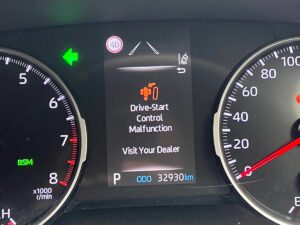

You’re rolling along in your Toyota; maybe running errands, maybe heading to work; when a message jumps onto the dash: “Drive-Start Control Malfunction.” That’s the kind of warning that instantly tightens your grip on the steering wheel. Is the car about to quit? Did a major safety system fail? Are you one stoplight away from a costly tow?
Here’s the reality from a technician’s point of view: this alert is often less dramatic than it sounds, but it’s also not something you should ignore. In many cases, the Drive-Start Control system is simply stepping aside because your Toyota has detected another issue; something that makes it unsafe for the system to “intervene” confidently. In other words, the warning frequently means: “I’m not sure I can help you correctly right now.”
In this guide, we’ll translate what the car is actually telling you, why this warning pops up across different Toyota models, and how to troubleshoot it intelligently; starting with the low-cost, high-success checks that can save you a dealership visit. We’ll also cover when it’s safe to keep driving, when you should stop, and how to avoid paying for unnecessary parts.
What Is Drive-Start Control Anyway?
Drive-Start Control is Toyota’s built-in safety “buffer” designed to reduce one of the most common low-speed accidents: pressing the accelerator when you intended to press the brake; especially when pulling into or out of a parking space.
Think of it as a supervisor watching for a very specific kind of mistake. If the vehicle senses that you’ve shifted out of Park (or you’re maneuvering at low speed) and your accelerator input doesn’t match the situation, it can reduce engine power through the electronic throttle system and, in certain configurations, apply braking to prevent a surge forward. This type of pedal-misapplication protection has reduced parking-lot crashes by roughly 70% in vehicles equipped with a full, properly functioning safety suite.
Here’s the part most drivers don’t realize: Drive-Start Control is not a standalone gadget. It’s built to cooperate with other safety and driver-assistance systems; most notably the Intelligent Clearance Sonar (ultrasonic sensors typically mounted in the bumpers) and the Brake Override System. When one system loses reliable inputs, Toyota’s fail-safe strategy often disables the group. That’s why this warning can appear even when the “Drive-Start Control” hardware itself isn’t broken.
From an engineering standpoint, that conservative behavior is intentional. A system that can reduce power or apply brakes must be extremely confident in what it “sees.” If the data becomes questionable; even briefly; Toyota would rather disable intervention than risk an inappropriate response.
How the System Actually Works
Modern Toyotas use a drive-by-wire throttle. That means there’s no physical cable linking your accelerator pedal to the throttle body. Instead, the pedal position is measured by sensors, and the command is interpreted by the Engine Control Module (ECM), which then opens the throttle electronically. The ECM is continuously estimating engine output by monitoring air intake, throttle angle, fuel delivery, ignition timing, and other feedback signals.
When Drive-Start Control detects a situation consistent with unintended acceleration; such as selecting a gear while applying significant accelerator input; it can restrict throttle opening regardless of what your foot is asking for. In more advanced implementations (depending on model and option package), it can also command braking pressure at the calipers to stop the vehicle quickly.
The “gotcha” is that Drive-Start Control depends on clean, stable inputs across multiple systems: engine torque estimation must make sense, wheel speed data must be consistent, and voltage must be steady enough for modules and sensors to communicate reliably. If the car detects abnormal engine behavior, sensor faults, or electrical instability, the system may shut itself off and throw the warning you’re seeing.
So when you read “malfunction,” don’t assume the Drive-Start Control module itself has failed. Very often, the system is functioning exactly as designed; it’s just refusing to operate without trustworthy data.
Why Your Warning Light Isn’t What It Seems
This is where Toyota owners are frequently blindsided: a “Drive-Start Control Malfunction” message usually does not mean the Drive-Start Control feature is physically broken.
More commonly, it means the vehicle has detected an underlying fault; sometimes minor, sometimes serious; and has decided it cannot guarantee safe intervention. Imagine the system incorrectly cutting engine power while you’re trying to merge, or applying braking based on a sensor that’s “hallucinating” an obstacle. Toyota’s logic is conservative by design: if confidence drops, the system opts out.
That’s also why this warning often appears alongside other alerts or disabled features. Depending on the model and the nature of the fault, you may also see messages related to Pre-Collision, cruise control, lane functions, or parking sonar. It can feel like the car is falling apart, when in reality one problem has triggered a protective shutdown across the safety network.
The correct approach is not to guess. It’s to treat the warning as a sign that the car needs a quick health check; starting with the most common root causes.
The Real Culprits Behind the Warning
Your Engine’s Running Rough
An engine that isn’t running smoothly forces the ECM to make “messy” torque calculations. A cylinder misfire, poor combustion, or unstable idle can make it difficult for the computer to predict how much power the engine is producing moment to moment. Because Drive-Start Control may need to limit power precisely, Toyota often disables it when torque estimation becomes unreliable.
Ignition coils and spark plugs are common triggers, especially as mileage climbs. Worn spark plug electrodes require higher voltage to fire, which increases stress on the coil. Over time, a marginal coil can fail intermittently; sometimes only under load or in damp conditions; causing a misfire that cascades into multiple warnings: Check Engine Light, Drive-Start Control Malfunction, and often disabled cruise or lane features.
One of the more frustrating details is that you might not feel the misfire clearly. The ECM can detect subtle combustion irregularities long before the driver notices a shake at idle. So even if the car “seems fine,” the computer may be seeing enough irregularity to shut down the intervention systems.
If you’re troubleshooting at home, remember a practical diagnostic principle: when the Check Engine Light appears with this warning, the engine-related fault is frequently the first domino.
The P1604 Code Mystery
Few codes appear as often in Toyota vehicles alongside this message as P1604. Its label; “Startability Malfunction”; sounds like a major failure, but it’s often describing something mundane: the engine cranked longer than expected before starting, or it stumbled/stalled shortly after startup.
Common causes include low fuel pressure, a throttle body that’s dirty enough to restrict airflow at idle, and; very frequently; a weak 12-volt battery that cannot spin the starter fast enough for a clean start. In cold weather, that marginal battery becomes even more noticeable.
Here’s the detail that confuses many owners: even after you correct the underlying issue, P1604 may remain stored in the ECU’s memory. That can keep warnings active until the vehicle completes the correct readiness checks (a drive cycle) or the codes are cleared with a proper scan tool. So it’s possible to “fix” the car and still see the alert for a while; especially if the system needs confirmation data before it reinstates driver-assist functions.
Your Battery’s Crying for Help
Today’s Toyotas are essentially networks of control modules. They rely on stable voltage to keep sensor references accurate and communication consistent. A weak 12-volt battery can cause voltage sag during cranking, and that sag can lead to module resets or momentary loss of calibration data.
When voltage dips, components like the Skid Control ECU or Steering Angle Sensor may briefly lose power. When they reboot, their “zero point” (the baseline that tells the system what straight-ahead and stationary look like) can be lost or flagged as invalid. Without reliable calibration, systems that depend on precise vehicle direction and speed inputs may be disabled as a safety measure.
Importantly, a battery can be weak even if it still starts the car most of the time. The critical test is voltage under load. If your battery drops below about 9.6 volts during cranking, you’re in the danger zone for random warnings and “phantom” faults; especially in colder temperatures or after the vehicle sits.
Muddy Sensors Are Blinding Your Car
On many newer Toyotas, Drive-Start Control depends heavily on Intelligent Clearance Sonar (ICS). Those round bumper sensors are ultrasonic transducers; think of them as short-range “sonar” that judges distance to obstacles. If the system can’t trust sonar inputs, it may disable intervention to avoid unwanted braking or incorrect throttle reduction.
If snow, mud, thick road salt, wax residue, or even certain types of clear protective films cover those sensors, the system can misread the environment. A sensor that thinks it sees an object inches away can cause the vehicle to behave unpredictably, so Toyota often chooses the safer route: shut the feature down and show the malfunction warning.
It’s also not unusual for the message to appear immediately after a car wash. High-pressure spray, spinning brushes, and water sheets can temporarily confuse sensor logic. Some automated washes can trigger a short-term shutdown until the car is driven normally again and the sensors regain stable readings.
From a practical standpoint, when this warning appears after heavy weather or a wash, cleaning and drying the sensors is one of the highest-return first steps.
The Electrical Gremlins You Don’t See
Brake Switch Circuit Failure
Drive-Start Control must know, with certainty, whether you’re pressing the brake. It reads this information through the brake pedal position switch (and related circuits); the same system that turns on your brake lights. If that input becomes unreliable, Toyota disables Brake Override and Drive-Start Control because they share the need for accurate brake application status.
If the “STOP” fuse is blown, wiring is damaged, or the switch fails, the vehicle may assume it cannot verify braking input. The result can be a cluster of warnings that look unrelated until you trace them back to that single circuit.
A fast, real-world check: do your brake lights illuminate properly? If they don’t, that’s not merely a convenience issue; your safety systems may be offline because the car cannot confirm driver braking input.
The Shipping Fuse Mystery
Some brand-new Toyotas are shipped with a “D/C CUT” fuse removed or configured for transport. If it’s reinstalled incorrectly or the required initialization steps aren’t completed, certain features can remain in a sort of “not fully awake” state. The car may display warnings because modules detect a configuration mismatch: the vehicle’s computers are essentially saying, “I’m not sure which equipment is installed or initialized.”
This scenario is more common than most people expect, especially on vehicles that have been transported, prepped, or had accessories installed before delivery. If your Toyota is relatively new and you’re seeing this warning without obvious symptoms, it’s worth asking whether a dealer initialization procedure is needed.
Model-Specific Issues You Should Know
Toyota uses the same general safety philosophy across the lineup, but the triggers and patterns can vary by model, year, drivetrain, and option package. Here are some model-specific behaviors that show up repeatedly in real-world reports and shop diagnoses.
Corolla (2020-2024)
For late-model Corollas, owners frequently report a strong correlation between the warning and water pump failures. When a water pump starts leaking or fails outright, the engine can run hot or overheat. Toyota’s control logic interprets overheating as a critical stress event; so the car may disable non-essential driver assistance features to reduce system complexity and risk during abnormal engine operation.
Ignition coil failures are also common enough in this range that they deserve special mention. Many owners and technicians find that OEM Denso coils tend to communicate most reliably with the ECU’s monitoring logic. Aftermarket coils can sometimes function “well enough” mechanically yet still cause irregular feedback or timing behavior that triggers misfire detection and secondary safety shutdowns.
If you’re seeing this warning in a Corolla along with temperature fluctuations, coolant smell, or a low coolant reservoir, prioritize cooling system checks immediately. Overheating is one of the few scenarios where continuing to drive can turn a manageable repair into an engine-damaging event.
Tacoma and Tundra
On Tacoma and Tundra trucks, the most frequent triggers are often environmental and wiring-related rather than purely engine-related. Off-road use, muddy trails, water crossings, and heavy debris exposure increase the odds that sonar sensors, harness connectors, and underbody wiring will get contaminated or damaged. In trucks, components such as transmission range sensor wiring and rear sonar sensors can be more exposed than in low-slung sedans.
In rare but important cases, a warning like this can be the first visible sign of a deeper mechanical issue. One 2025 Tundra owner reported that a severe camshaft bearing failure initially surfaced as a Drive-Start Control-related warning. When mechanical wear disrupts valve timing or oil pressure enough to affect engine stability, the computer’s torque model becomes unreliable; and Toyota will often disable intervention systems as a downstream effect.
Most truck cases won’t be that extreme, but the lesson is useful: if you have abnormal noises, oil pressure warnings, persistent misfires, or drivability issues along with this message, treat it as a prompt for deeper diagnosis rather than a simple reset.
Camry (ICS Sensitivity)
Camry models equipped with Intelligent Clearance Sonar have a known sensitivity quirk in certain automated car washes. When the car is in neutral on a conveyor and sensors are being bombarded by moving brushes, water spray, and close obstacles, the system can interpret conditions incorrectly and trigger warnings or intervention messages.
Toyota addressed this behavior in Technical Service Bulletin T-SB-0134-16. The fix typically involves a software update that adjusts detection thresholds and improves system behavior during car wash scenarios.
If your Camry’s warning appears predictably after a particular wash but disappears later, you may be dealing with a calibration/logic sensitivity rather than failing hardware. That’s good news; but it still merits checking for updates and ensuring sensors are clean and undamaged.
DIY Fixes You Can Try First
Before you schedule a dealer appointment, it’s worth working through a structured set of DIY checks. These steps resolve a surprising number of Drive-Start Control Malfunction warnings because they target the most common root causes: dirty sensors, voltage instability, and simple engine/emissions triggers.
A professional tip: don’t start by clearing codes blindly. If you erase data before you capture it, you may lose freeze frame information that points directly to the cause. If you have access to a scan tool, read and save codes first, then proceed with physical checks.
Clean Your Sensors Properly
Start with the easiest win: walk around the vehicle and locate the circular sonar sensors in the front and rear bumpers. They’re typically about quarter-sized, evenly spaced, and flush-mounted. Even if they look “mostly clean,” a thin film of salt or wax can distort ultrasonic readings.
Clean each sensor gently using water and a soft microfiber cloth. Avoid harsh solvents. Most importantly, do not blast the sensors with a pressure washer at close range; high-pressure water can force moisture into the sensor assembly or disturb seals, potentially causing permanent failure of the piezoelectric element.
Also check the front emblem area on models equipped with Pre-Collision features. On many Toyotas, the forward radar sensor sits behind the Toyota badge. Packed snow, ice, or mud there can trigger a chain reaction of warnings because radar and sonar inputs are often used together for safety logic.
After cleaning, take a short drive in normal conditions. If the warning was caused by contaminated sensor surfaces, it may clear after the system revalidates its sensor checks.
The Battery Reset Procedure
A temporary fault or corrupted state can sometimes be cleared by a full power reset. Disconnect the negative battery terminal and wait 15 to 30 minutes. This allows capacitors in various modules to discharge so the system can reboot cleanly rather than “waking up” from a half-powered state.
When you reconnect the battery, don’t be alarmed if the engine idles a bit rough for a few minutes. The ECM may be relearning idle airflow control and fuel trim values. Your steering may also feel slightly unusual until the steering angle sensor reestablishes its reference; often helped by turning the steering wheel lock-to-lock once or twice in a safe area.
One practical warning: you’ll lose radio presets and clock settings. Most modern Toyotas don’t require radio security codes, so reprogramming is usually just an inconvenience; not a barrier.
If the message returns quickly after a reset, treat that as useful information: the vehicle is detecting a persistent fault, not a one-time software hiccup.
Check the Obvious Stuff
Sometimes the “obvious” really is the issue. For example, confirm your fuel cap is tightened properly. A loose cap can trigger an evaporative emissions leak code, turning on the Check Engine Light. Once that happens, many Toyotas disable certain safety and driver-assist features as a precaution; including Drive-Start Control.
When tightening the cap, aim for the classic confirmation: three clicks. If you don’t hear them, the seal may not be set.
Also do a quick walk-through of basics that can cascade into system shutdowns:
• Brake lights: verify they illuminate consistently (ties back to brake switch logic).
• Battery terminals: ensure they are clean and tight (voltage drop can mimic failing electronics).
• Engine temperature: confirm the gauge behaves normally and the cooling fans run when expected.
• Recent work history: any bumper repair, alignment, or battery change can require calibration steps.
What the Diagnostic Codes Really Mean
To move beyond guesswork, you need diagnostic trouble codes (DTCs). And here’s a critical nuance: a basic OBD2 reader may only show engine codes. Drive-Start Control Malfunction warnings can be triggered by ABS/traction modules, sonar/parking ECUs, steering angle sensors, and network communication faults; many of which require a scan tool capable of reading Toyota-specific or at least enhanced codes.
When you scan your car, the codes you find aren’t just labels; they’re breadcrumbs. They narrow the search from “anything in the vehicle” to a few likely systems. Below are codes that commonly show up in Drive-Start Control-related events and what they typically indicate in real-world diagnostics.
| Code | What It Means | What’s Really Wrong |
|---|---|---|
| P1604 | Startability Malfunction | Engine cranked too long or stalled; usually battery or fuel delivery |
| P0300-P0306 | Cylinder Misfire | Bad spark plug, ignition coil, or fuel injector |
| P1349 | VVT System Problem | Valve timing off; oil pressure issue or cam bearing damage |
| C1A47 | Steering Angle Sensor | Lost calibration after battery disconnect or alignment |
| C1A48 | ICS System Fault | Sonar sensor dirty, damaged, or miscalibrated |
| U0100 | Lost Communication with ECM | CAN bus network error; often from voltage drop |
One expert-level detail that can save you hours: the freeze frame data is often as valuable as the code itself. For example, if you see P1604 and the freeze frame shows engine RPM at zero, the fault was recorded during cranking; often implicating battery condition, terminal contact, or starter performance. If RPM is above about 400, the code may have been captured during a stall event shortly after startup, which can point more toward airflow, throttle body contamination, or fuel delivery.
Misfire codes (P0300–P0306) are another area where details matter. A single-cylinder misfire (like P0302) often points to an ignition coil or spark plug localized to that cylinder. A random/multiple misfire (P0300) can be caused by fuel quality, low fuel pressure, vacuum leaks, or broader ignition wear. Because Drive-Start Control depends on stable torque modeling, even intermittent misfires can trigger safety feature shutdowns.
Network codes such as U0100 should make you think about voltage and connections before you assume module failure. In many cases, the ECM didn’t “die”; it simply dropped off the network briefly due to a low-voltage event, corrosion at terminals, or a weak battery that dips hard during start.
If you’re serious about DIY diagnostics, look for a scan tool that can read ABS, parking/sonar, and body modules; not just engine. The Drive-Start Control message is often a secondary symptom, and the real story may be stored outside the engine computer.
The Professional Repair Path
Some problems can be resolved in your driveway. Others require tools, calibration equipment, and procedures that are realistically dealer-level (or at least a well-equipped independent shop). When Drive-Start Control Malfunction persists after basic checks, the next step is not “throw parts at it”; it’s structured diagnosis and calibration.
Professional repair tends to fall into three buckets: calibration resets, sensor configuration/registration, and root-cause repairs (ignition, electrical, cooling, or engine mechanical). The trick is identifying which bucket you’re in before you spend money.
Zero Point Calibration
After wheel alignments, battery replacement, steering work, or collision repairs, Toyota’s stability and steering-related systems may need a baseline reset. If that baseline is missing, the car may disable Drive-Start Control because it can’t accurately interpret direction, yaw, or steering angle in relation to vehicle movement.
The procedure is commonly called “zero point calibration.” In plain language, it teaches the Skid Control ECU what “straight, level, and stopped” looks like. This isn’t guesswork: the car must be on a level surface (typically within about one degree), and the technician uses Toyota Techstream software (or equivalent capability) to clear old reference values and record new ones.
If this step is skipped after relevant work, your Toyota may behave as if it’s constantly turning, sliding, or misaligned; even when it isn’t. And when the car’s internal math doesn’t line up, safety intervention systems often stay offline.
Sensor Replacement and Registration
Replacing a parking sonar sensor (or repairing a bumper that houses one) is rarely as simple as snapping in a new part. Toyota often requires that the sensor configuration be registered to the vehicle and that calibration checks confirm position and angle.
In practice, technicians may need to measure sensor height from the ground and confirm sensor angle using a digital gauge. These measurements must align with factory specifications stored in the ECU. Even small deviations can matter because ultrasonic sonar is sensitive to reflections and surface angles at low distances.
A common calibration failure example: if a sensor is angled downward too far; more than roughly 5 degrees; it may “see” the road surface as an obstacle. That can cause constant detection alerts, false positives, or system shutdowns. The vehicle may protect itself by disabling Drive-Start Control and related systems rather than risk inappropriate braking or power limitation.
This is why dealership pricing is higher for sensor-related repairs: you’re paying not only for the part, but also for bumper removal, precise setup, and post-repair calibration.
The Confirmation Drive Cycle
After certain repairs; especially those related to startability (P1604), emissions readiness, or intermittent faults; your Toyota often needs a confirmation routine before it fully restores system status. Clearing codes alone doesn’t always prove the vehicle is healthy. The car wants to observe successful self-tests under specific conditions.
A commonly effective drive cycle looks like this: let the car sit overnight for a cold soak (at least 8 hours). Start it and idle for about 2 minutes. Then drive at a steady highway speed; around 40 to 55 mph; for several minutes with gentle throttle. Finally, decelerate smoothly without riding the brakes if traffic conditions allow.
This pattern gives the ECM and related modules time to run diagnostics on fuel trim behavior, misfire monitoring, and emissions-related checks. If the vehicle completes those tests successfully, the warning may clear on its own, and disabled features may return without further intervention.
If the warning returns during the drive cycle, that’s meaningful too; it indicates the fault is still present and reproducible, which helps a professional technician isolate the cause faster.
What It Costs and What’s Covered
Cost is where this warning becomes emotionally expensive. Not necessarily because the fix is always pricey; but because misdiagnosis can be. Drive-Start Control Malfunction is a “network-level” message that can be triggered by dozens of different faults. Without proper scanning and test steps, it’s easy to replace parts that weren’t actually bad.
As a rough benchmark, a single ultrasonic sonar sensor may cost around $200 online. But at a dealer, that repair can climb to $600–$1,000 because the bumper may need to come off and post-install calibration is often mandatory. The labor and calibration process is a real part of the repair, not an optional upsell, because the car needs to trust what the sensor reports.
Diagnostic charges can sting too. Since the same dashboard message can represent many different root causes, you may pay for an hour of diagnostic labor only to discover the real issue is a weak battery, corroded battery terminals, a brake light switch, or a software update that costs far less than the diagnosis itself. It feels backward; but it’s the cost of systematically proving what failed.
Warranty coverage depends on the component at fault and vehicle age. If the root cause is an emissions-related issue, some items may fall under emissions warranty terms. If it’s a sensor or module within a safety suite, coverage may depend on the specific warranty and whether damage is considered external (impact, corrosion, water intrusion). Always document the warning messages, dates, mileage, and any repair attempts.
In extreme situations; such as persistent warnings that return despite multiple repair attempts; some owners have pursued Lemon Law buybacks. That’s not common, but it does happen, especially when a vehicle repeatedly disables critical safety features and the manufacturer cannot provide a durable fix. If you’re stuck in that loop, keep records of every visit, scan result, invoice, and the exact wording of dash warnings.
Can You Keep Driving?
In many cases, yes; you can usually drive the vehicle to a safe location or to a shop. This message does not automatically mean your brakes have failed or your steering is about to lock up.
However, you should drive with a clear understanding of what you’ve lost. With Drive-Start Control disabled, you’re operating without that low-speed “safety net” that can reduce power if the accelerator is pressed mistakenly. And because these systems share data and logic, Pre-Collision Braking is often disabled too, meaning your automatic emergency braking may be unavailable until the fault is resolved.
Also note: many Toyotas will enter a form of fail-safe or “limp mode” when certain engine or network faults occur alongside this warning. In limp mode, speed may be limited (often around 40 mph), the transmission may refuse higher gears, and throttle response can be reduced. That can make highway merging legitimately hazardous; not because the car will stop instantly, but because you may not have the acceleration you expect.
If you experience additional red flags; such as a flashing Check Engine Light, overheating, severe shaking, burning smells, braking warnings, or low oil pressure indicators; do not treat this as a simple “drive it later” situation. Those symptoms suggest a condition that can cause damage or compromise safety quickly. In that case, stopping and arranging a tow is often the smarter decision.
For most drivers, the best middle-ground strategy is: drive gently, avoid aggressive acceleration, avoid high-speed traffic if the car feels underpowered, and schedule diagnosis soon. Even if the underlying issue turns out to be minor, driving long-term with safety systems disabled isn’t a trade worth making.
The Bottom Line
In real-world diagnosis, “Drive-Start Control Malfunction” is usually a secondary warning; not a declaration that the Drive-Start Control system itself has catastrophically failed. More often, it’s triggered by everyday issues: a weak 12-volt battery, dirty sonar sensors, a brake switch circuit problem, or routine ignition wear like spark plugs and coils.
Start with the high-impact basics: clean the sensors carefully, verify battery health (including voltage under load), confirm brake lights and fuses, and tighten the fuel cap correctly. If the warning remains, move to proper diagnostics with a scan tool that can read ABS and ICS-related codes; not just generic engine codes; because many of the most relevant clues live outside the ECM.
Modern Toyotas are tightly interconnected. That connectivity is what enables advanced safety features; but it also means a small fault can disable a larger safety suite. A $15 spark plug or a marginal battery can indirectly take a $2,000 set of driver-assist functions offline. It’s frustrating, but it reflects conservative safety logic: Toyota won’t allow a system to intervene unless it can do so with confidence.
Bottom line: the car is communicating that something needs attention. Treat it as early warning. Addressing the root cause now is often the difference between a quick fix and an expensive chain reaction later.