
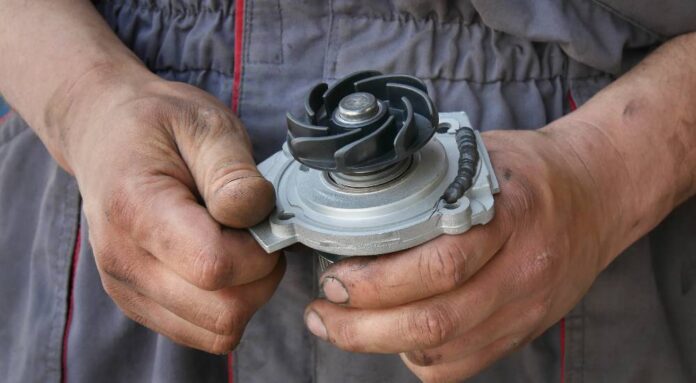

For each type of vehicle, a corresponding recommended torque specification exists. You can always find the required torque spec in the vehicle owner’s manual for the individual pump you are using, which you should check because specifications vary by make, model, and year. However, let’s get into details about torque specs for a water pump.
In the workshop, “torque spec” is one of those phrases that gets thrown around so often that it can start to sound like a suggestion rather than a requirement. But in reality, torque is a control method; one of the few ways you can reliably ensure that a gasketed joint seals properly, a housing doesn’t warp, and threaded fasteners aren’t overstressed. With a water pump, that matters because the pump is part of your cooling system’s pressure boundary. A small leak can quickly become a big problem: coolant loss, overheating, and potential engine damage.
At the same time, there’s nuance. Many water pump bolts are small, thread into aluminum, and clamp thin castings. That combination is easy to over-tighten. So the “right” approach isn’t just tightening until you feel good about it; it’s tightening in a controlled way, using a correct pattern, and using the manufacturer’s spec when available. If you’re a DIYer, this guide is designed to help you understand what torque specs mean, how torque specs are established, why patterns matter, and how to diagnose and avoid the most common water pump sealing failures.
Because this topic often brings confusion, I’ll also be clear about terminology as we go. You’ll see torque listed in ft-lbs (foot-pounds), in-lbs (inch-pounds), and Nm (Newton-meters). Mixing these up is one of the fastest ways to strip threads or crack housings. For example, 20 ft-lbs equals 240 in-lbs. That’s a huge jump if you mistakenly torque a small bolt to the wrong unit. So pay attention to units as carefully as you pay attention to the number.
Finally, remember that water pump fasteners don’t just clamp a pump to an engine. They also deal with thermal cycling (hot-cold changes), coolant chemistry, vibration, and in some engines, different fastener lengths and torque values across the same pump. That’s why the owner’s manual/service information should always be your first reference.
What is a Torque Spec?
Torque is the amount of rotational force applied at the application site. Torque standards are the amount of force advised on the hardware to ensure correct installation when mounting a wheel to a vehicle. A water pump shouldn’t require a torque wrench. Just tighten the nuts until the gasket is completely sealed.
Let’s refine that with an expert’s lens: torque is a proxy measurement. You’re not tightening a bolt “for the bolt’s sake”; you’re tightening it to achieve clamp load, the force that squeezes the gasket and keeps the joint sealed. Torque specs exist because manufacturers have tested the joint: fastener size, bolt grade, thread engagement, gasket material, housing thickness, and even the thermal expansion of aluminum vs. iron. The torque number is chosen so the fastener stretches (within safe limits) and holds the correct clamp load without stripping threads or cracking parts.
It’s true that many water pump installs can be done successfully without a torque wrench by an experienced mechanic using a “calibrated elbow.” That’s what people often mean when they say a torque wrench isn’t required. However, for DIYers; and especially when bolts are small and the engine uses aluminum threads; using a torque wrench is one of the simplest ways to avoid expensive mistakes. Over-tightening a water pump bolt can strip the block threads or distort the pump housing, which leads to leaks even with a brand-new gasket.
So think of it this way: you can often get away without a torque wrench on some water pump designs, but you rarely regret using one when the spec is available. In particular, a small inch-pound torque wrench is extremely helpful for water pumps, thermostat housings, and other cooling-system fasteners that don’t tolerate brute force.
An excellent technique is to progressively tighten each bolt instead of tightening them all at once in a circular pattern. Although not required, it is ideal if you have never handled a spanner before.
This progressive-tightening concept is more important than many people realize. When you tighten one bolt fully right away, you can pinch the gasket unevenly, shift the pump slightly, or even cock the housing. Progressive tightening allows the pump to seat flat against the engine surface and compress the gasket evenly. In sealing work, even clamp load beats high clamp load every time.
Your car’s water pump needs torquing for a couple of reasons and there are torque specifications. While you don’t need a torque wrench for the water pump, you’ll need to tighten the bolts to ensure the gaskets are firmly in place. This way, the gasket won’t leak. Care must be taken not to tighten the bolts hurriedly and in a circular pattern. Rather, you should do it in a cross pattern.
That “cross pattern” point is worth emphasizing. A cross pattern distributes load evenly across the gasket face, reducing the chance of warping. If the pump has 6–10 bolts around its perimeter, you want to bring them all down gradually: snug them lightly, then apply torque in stages (for example: 30%, 60%, then 100% of final torque), crossing from side to side instead of walking around the bolt circle. This is the same logic used on cylinder heads and wheel lug nuts; just scaled down.
Also note: some engines use a combination of bolts and studs, or bolts of different lengths. It’s common for a water pump to have at least two different bolt lengths, and installing them in the wrong holes can bottom a bolt out (giving you a “tight” feel without real clamp load) or crack a casting. Always lay bolts out in order, photograph the bolt layout before removal, or use a bolt organizer.
Why Water Pump Bolt Torque Matters More Than People Think
Many cooling-system leaks after a water pump replacement aren’t caused by a “bad pump.” They’re caused by installation errors: uneven clamp load, contaminated gasket surfaces, incorrect sealant use, or torque that was too low (leading to seepage) or too high (distorting the pump flange). Torque is the part you can control.
Here are the most common ways incorrect torque causes trouble:
- Under-torque can allow coolant to seep past the gasket, especially after heat cycles shrink or relax gasket material.
- Over-torque can crack a plastic or thin-cast housing, strip threads in aluminum, or distort the pump face so the gasket never seals evenly.
- Uneven tightening can create “high spots” on the gasket and leave other areas loose, causing leaks at one edge of the pump.
- Wrong torque unit (in-lbs vs ft-lbs) can instantly destroy threads or snap bolts.
- Dirty threads can change friction dramatically and produce misleading torque readings; meaning you “hit torque” without achieving the intended clamp load.
This is why professional procedures often include thread cleaning, dry vs lubricated torque specification awareness, and sometimes thread sealant on bolts that pass into coolant passages. Torque isn’t a single step; it’s part of an installation system.
What are the Torque Specs For a Water Pump?
To determine the torque specs for your water pump, you will need to carry out two different critical tests. First, you’ll need to measure the torque and angle to a particular tension. Secondly, there’s also measuring torque and bolt angle to failure.
This section is describing how torque specs are established in engineering and validation, not necessarily what a DIYer will do in a home garage. But understanding the logic behind the spec helps you respect why it exists.
What does each test aim to achieve? Measuring torque to bolt angle to failure seeks to determine installation torque and evaluate how the bolt joint performs. In this test, several varying run-downs are performed to determine a torque spec. It requires graphing torque vs. angle of rotation to ascertain the amount of torque needed to reach the bolt’s yield strength.
In plain terms: engineers tighten bolts while measuring how far the bolt turns and how much torque is required, then they watch where the bolt begins to permanently stretch (yield). A safe spec is set below that yield point, accounting for manufacturing variability. This is also how torque-to-yield strategies are evaluated on some engine components. Water pump bolts are usually not torque-to-yield, but the same engineering approach helps define safe and repeatable torque values for the joint.
On the other hand, measuring the torque and angle to a particular tension is intended to estimate the relationship between torque and tension. This test may be impractical in certain instances, depending on the structure and material of the joints.
That’s because actual clamp load (tension) is influenced heavily by friction; under the bolt head, in the threads, and across the gasketed joint. Lubrication, thread sealant, corrosion, and surface finish all change friction. Torque is easier to measure than true bolt tension, which is why torque specs are still widely used even though they are an indirect measurement of clamp load.
The amount of torque on your cylinder head also matters. Typically, you should apply 7-9 foot-pounds of tension to each bolt while 12 to 14 foot-pounds of torque should go to each bolt.
This statement introduces a key concept: different components on the engine have different torque demands. A cylinder head joint is far more critical and is usually torqued in a multi-stage sequence. Water pump bolts are typically much lower torque than head bolts, but the same principle applies: follow the correct specification for the joint you’re tightening.
This table shows the perfect torque specs for a water pump.
| Part | Bolt Size | Maximum Torque |
| Water Pump Bolts | 3/8”-16 | 27.12Nm (20 ft. lbs.) |
| Thermostat Housing | 3/8″-16 | 47.45Nm (35 ft. lbs.) |
| Oil Filter bolt | 1/2″-13 | 40.67Nm (30 ft. lbs.) |
| Starter Bolts | 3/8″-16 | 47.45Nm (35 ft. lbs.) |
Use this table as a general reference, not as a replacement for vehicle-specific service information. Even for the same bolt size, torque can vary depending on whether it threads into aluminum or iron, how much thread engagement exists, and whether thread sealant or lubricant is used. For example, a 3/8”-16 bolt in cast iron can often handle higher torque than the same bolt in aluminum without stripping. Some manufacturers specify lower values specifically to protect aluminum threads.
It’s also important to understand that “maximum torque” is not always the same as “installation torque.” Some procedures specify a final torque plus an angle (for certain fasteners), or they specify a torque range. If your manual lists 18–22 ft-lbs, the goal is not to “hit the top number.” The goal is consistent clamp load and correct sealing. Many professionals aim for the middle of the range unless otherwise specified.
Sometimes you want to tighten the starter bolts firmly but are unsure how firmly it should. The process is simple. You should align the starter motor with the engine and tighten the upper and lower bolts by hand. Alternatively, tighten the top bolts between 21 and 27 N-m (16-19 lb-ft).
This is a good reminder that torque knowledge extends beyond the water pump. Starter bolts, thermostat housings, and other engine accessories all benefit from correct torque. If you’re already working in the engine bay, following correct specs can prevent stripped threads and loosening over time.
Water Pump Torque Specs: Practical Installation Guidance (What Pros Actually Do)
Once you understand the theory, the next step is applying it in the garage. Even if you don’t have the exact spec in front of you, you can still improve your odds of a leak-free install by using professional habits. Here’s a field-proven checklist:
- Clean the mating surface completely: old gasket material, corrosion, and sealant residue cause leaks.
- Use the correct gasket/sealant strategy: some pumps use paper gaskets, some use RTV, some use O-rings. Follow the pump manufacturer’s instructions.
- Inspect bolt threads: chase dirty threads lightly if needed and remove corrosion. Dirty threads change torque accuracy.
- Hand-start every bolt: cross-threading is common when bolts are started with a ratchet.
- Snug evenly in a cross pattern: seat the pump flat before applying final torque.
- Torque in stages: especially on thin housings.
- Let RTV cure if required: many RTV sealants specify cure time before adding coolant.
One of the most common mistakes is rushing coolant refill before sealant cure. If RTV is used and you fill immediately, coolant can seep through uncured sealant and create a leak path. Always follow the RTV product label and service information.
Also, don’t ignore bolt length. Engines frequently use different bolt lengths around the pump. Installing a long bolt into a short hole can crack the block or housing. Installing a short bolt into a long hole can leave too few threads engaged, which risks loosening. If you didn’t label bolts during disassembly, compare them carefully before installation.
What is a Torque Wrench Really Doing (and Why “Feel Tight” Can Be Misleading)
A torque wrench doesn’t measure clamp load; it measures the force required to rotate the fastener. That force is heavily influenced by friction. Two bolts tightened “by feel” can end up with very different clamp loads if one has oil on the threads and the other is dry and rusty. Even two brand-new bolts can behave differently if the surface under the bolt head is different (painted, corroded, or clean metal).
This is why service manuals may specify whether bolts should be installed dry, with thread sealant, or with a specific lubricant. If you change the friction condition significantly, you can change the clamp load at a given torque. In simple terms: a lubricated bolt reaches higher tension at the same torque value than a dry bolt.
For water pumps, this matters because:
- Over-tension can distort housings and cause leaks.
- Under-tension can allow seepage once the system is hot and under pressure.
- Incorrect tension can loosen bolts over time under vibration and thermal cycling.
So when you see “torque spec,” treat it as part of a system: correct surface prep, correct gasket, correct bolt placement, correct tightening pattern, and correct torque.
How Powerful was the Buick Skylark’s Engine?
The 215-cubic-inch V8 was tuned to produce 190 horsepower (140 kW) at 4800 rpm. The Skylark Special was the first American vehicle to use a V6 engine in mass production in 1962, and it was named Vehicle of the Year by Motor Trend.
This section may seem like a shift in topic, but it highlights a broader truth: torque specs and fastener strategies often vary across engines, eras, and designs. Older engines used different materials and sealing strategies, and service procedures often included re-torquing after heat cycles. Modern engines frequently use different gasket technologies and bolt designs, which is why the owner’s manual or service information is always the best authority.
If you’re using a Buick model, for example, the axle nut of the car depends on the model.
| Buick Allure | Buick Axle Nut Torque |
| 2016-2017 | 150Nm (111ft-lbs |
| 2013-2017 | 37Nm (50 ft-lbs) |
| 1992-1995 | 103Nm (140ft-lbs) |
However, for the 2016-2017 model, you can back off by 45o before retightening to about 250Nm or 184 ft-lbs. You can turn extra 20 degrees for the 1992-1995 models.
This illustrates two important torque principles that also apply to engine work:
- Torque + angle methods are used when consistent clamp load is required despite friction variability.
- Procedural steps matter (backing off, retightening, turning an additional angle) because the spec is part of the engineering plan for that joint.
Even though axle nuts are a different component than water pumps, the lesson is the same: the specification is not random, and the procedure is part of the seal and safety strategy.
What are the Torque Specifications for a Buick Engine?
For the majority of engines, post-tightening is required, in which case the bolts must be torqued once more to the desired value after the engine reaches maximum operating temperature. In specific circumstances, it is required to use Perfect Seal sealing compound (Buick component #980456) on the bolts.
Post-tightening (re-torque) is a concept that appears in certain engine designs and service procedures, especially where gasket materials compress after heat cycles or where thread sealant is required to prevent seepage. While many modern water pump designs do not require re-torque, some older designs and some specific gasket materials may benefit from a follow-up inspection after a heat cycle.
As always, follow the service manual. If it states “do not re-torque,” don’t do it. If it specifies a heat-cycle recheck or a sealant compound on certain bolts (especially bolts that pass into coolant), follow that instruction precisely. Thread sealant is often used not because bolts will “loosen,” but because coolant can wick along threads and cause leaks that look like gasket failure.
Frequently Asked Questions
Torque and water pump installation generate a lot of common questions because they sit at the intersection of engineering and “real-world wrenching.” Below are clear, expert explanations that keep the original intent intact while adding practical meaning you can apply.
How is Torque Run-Down Determined?
To make contact, the nut or bolt should be turned down to about a half-turn (the washer is still loose). Add to the total the amount of torque needed to move the nut one last time before making contact.
In practice, “run-down” refers to the phase where the bolt is turning freely until it contacts the clamped surfaces. That portion of tightening is mostly overcoming thread friction and bringing parts together. Only after contact does torque translate into meaningful bolt stretch (tension). Understanding the run-down phase helps explain why some bolts “feel tight” quickly; because friction is high; while others turn smoothly and then suddenly tighten at the end. That difference can influence DIY “feel” dramatically.
For water pumps, run-down consistency matters because you want the pump seated evenly against the engine before applying final torque. If one bolt hits contact earlier because it’s longer or the hole is shallower, it can distort seating unless you tighten progressively and in a cross pattern.
How Do You Check Torque?
Make a mark on the application and fastener that have been tightened. Apply gentle pressure to the tool in the tightening direction until the fastener makes its first movement. The reading that was taken is a reliable reflection of the initial torque that was applied to the joint. The most effective approach to calculating residual torque is this.
This method describes a way to approximate residual torque (sometimes called breakaway torque), which can give clues about whether a fastener has loosened over time. However, residual torque is not exactly the same as the original installation torque. Many factors (heat cycles, gasket compression, corrosion) change the relationship between breakaway torque and clamp load. Still, it can be a useful diagnostic tool when you’re investigating why a component loosened or leaked.
For a water pump leak diagnosis, checking bolt tightness can be informative, but don’t assume “tight bolts” guarantee a sealed gasket. A pump can leak with bolts tight if the flange is warped, the surface wasn’t cleaned, the gasket shifted, or sealant was misapplied. Torque is important; but it’s only one part of sealing.
How tight should a water pump bolt be?
They ought to fit snugly. Use your calibrated elbow to tighten till it is, then spin an additional 1/8th turn. Progressively tighten both bolts until they are snug. Never over-tighten one bolt before doing the other.
This “snug + 1/8 turn” guidance describes a practical approach when you don’t have a spec available, but it must be used cautiously. The correct tightness depends on bolt diameter, thread pitch, and what material the bolt threads into. On small bolts in aluminum, “just a little more” can be too much.
As a professional recommendation, if you’re going to rely on feel, use a shorter wrench rather than a long breaker bar. A short wrench reduces the chance of accidental over-torque. Even better: use a torque wrench and follow the manual.
Should the bolts on a water pump be torqued?
A water pump shouldn’t require a torque wrench. Just tighten the nuts until the gasket is completely sealed. An excellent technique is to progressively tighten each bolt instead of tightening them all at once in a circular pattern.
To keep the original message intact while adding expert clarity: many water pump installations can be completed without a torque wrench, especially by experienced hands. But when you’re working on modern engines with aluminum threads, thin housings, and expensive components, using the correct torque spec is the safer and more repeatable method. Whether you use a wrench or not, the progressive and cross-pattern tightening technique remains essential for a reliable seal.
Also note that some pumps use bolts that thread into coolant passages. In those cases, thread sealant may be required to prevent seepage through threads. This is not about torque alone; it’s about the sealing system as a whole.
What is starting torque of a pump?
It depends on your car’s make and model. Typically, however, the torque transmitted by the shaft coupling during run-up is known as the starting torque (see Start-up process). It is determined using a rotational speed function that is based on the power-to-angular velocity ratio (P/).
Starting torque in this context refers more to pump drive mechanics than bolt tightening, but it’s still relevant to understanding “pump stress.” Water pumps are driven by belts, chains, or gears depending on engine design. Any additional resistance (bearing failure, impeller damage) increases drive load and can produce noise, belt slip, or overheating. While this is separate from bolt torque, it’s part of the overall water pump reliability story.
If a water pump is failing mechanically (bearings, shaft, impeller), correct torque on bolts will not fix it. Torque specs are for sealing and mounting. Mechanical failure requires pump replacement.
What torque requirements are there?
Torque standards are the amount of force advised on the hardware to ensure correct installation when mounting a wheel to a vehicle. For a variety of reasons, it is important to adhere to correct torque specifications. An excessive amount of torque can lead to over-tightening, which has serious repercussions.
Those serious repercussions apply across the vehicle:
- Stripped threads (especially in aluminum)
- Cracked housings and castings
- Warped sealing surfaces that cause persistent leaks
- Broken bolts that are difficult to extract
- Improper clamp load that leads to loosening or leakage
Torque requirements exist to prevent these failures. Following specs is not about being “precise for precision’s sake”; it’s about avoiding avoidable damage.
Final Thoughts
Now that you have thorough information about the torque specifications of your car water pump, you shouldn’t have any issues. But your car owner’s manual should be the first guide. Overall, I hope you find this article helpful. Perfect auto maintenance is crucial and you don’t want to take chances for safety reasons.
To wrap this up with a professional perspective: the water pump is not a place to “guess and hope.” Cooling system integrity is directly tied to engine survival. Even a small leak can cause overheating under load, and overheating can trigger head gasket failure, warped heads, or worse. If you use the correct torque specs, tighten in a cross pattern, and prepare sealing surfaces properly, you dramatically reduce the chance of leaks and repeat repairs.
If you can only remember three rules, make them these:
- Use the manufacturer’s torque spec whenever possible (and confirm units).
- Tighten progressively in a cross pattern to seat the pump evenly and protect the gasket.
- Never let torque replace surface prep; a clean, flat mating surface and correct gasket strategy are essential.
Do those three things and you’ll be working like a pro; even if you’re doing your first water pump job.