

Among the 26 letters used in the Latin alphabet, X is one of the most challenging to turn into a natural-sounding automobile brand name. In many languages, it feels more at home as a symbol—something you see on a badge, an emblem, a trim designation, or a concept-car prototype—rather than as the opening letter of a company’s identity. That’s why genuinely established automotive brands beginning with X remain relatively rare when compared with letters like S, M, or T.
Still, “rare” does not mean “irrelevant.” The modest collection of X-brands that does exist—scattered across historical records and modern corporate portfolios—deserves the same careful organization we give to larger, better-documented marque families. Automotive history isn’t only the story of the biggest manufacturers; it’s also the story of how niche names appear, how regional industries evolve, and how branding adapts to language, culture, and technology shifts.
Table of Contents
In practice, many of the X-leading names you encounter today are linked to founder-led ventures or to East Asian markets—especially China and, to a lesser extent, Japan—where romanization (transliteration into English letters) can produce an “X” at the beginning of a name that does not sound like the English “eks.” This linguistic factor is more than a curiosity; it can shape everything from international brand recognition to how a name is pronounced by journalists, customers, and distributors.
To distinguish these companies correctly, the most important step is to understand how the brand name is intended to be pronounced and what the underlying characters or word elements mean in their original language. When a name comes from Chinese pinyin, for example, “X” is typically closer to a soft “sh” sound (similar to “she”) than to the English “x.” Getting that detail right helps preserve the brand’s intended identity, and it reduces confusion when comparing similarly spelled companies across regions.
This guide focuses on a structured overview of several key automotive names that begin with X, with a clear emphasis on modern relevance, historical context, and industry positioning. Where appropriate, I’ll also add the kind of practical interpretation a specialist would consider—what the company actually builds, why its origin matters, and how it fits into the bigger mobility landscape.
Before we explore each brand individually, here’s a quick orientation so you can navigate the names more easily (and avoid mixing them up):
- XPeng: A modern Chinese EV manufacturer focused on electric sedans and crossovers, with advanced technology ambitions.
- Xinkai: A Chinese automaker with an earlier founding date and a manufacturing structure shaped by investment and ownership transitions.
- Xiamen Golden Dragon: A commercial-vehicle brand best known for buses and light vans, with export reach across multiple regions.
- Xiali: A historically important mass-market Chinese passenger-car brand associated with early large-scale domestic production.
Now, let’s look at each one in detail.
XPeng
XPeng is a wholly owned subsidiary of Guangzhou Xiaopeng Motors Technology Co., Ltd, a Chinese manufacturer of electric crossovers headquartered in Guangzhou, with an office in Mountain View, California, USA. The brand was founded in 2014 by Xia Heng (Henry Xia) and He Tao. From an industry standpoint, those details immediately place XPeng into the modern category of technology-forward EV makers: companies that do not simply produce cars, but attempt to compete on software, connected services, and future mobility concepts as much as on mechanical engineering.
It’s also worth highlighting a key point for readers who track corporate structures: the phrase “wholly owned subsidiary” signals centralized control of product direction and strategy. That can matter in fast-moving EV markets where brand positioning, platform timelines, and technology investments must be coordinated tightly to keep pace with competitors. In other words, XPeng is not just a badge; it’s part of a defined corporate system built to scale.
The subsidiary XMotors produced unmanned vehicles. While the term “unmanned” can be interpreted in different ways depending on the project—ranging from robotics to autonomous mobility systems—the most important takeaway is that XPeng’s ecosystem has been linked to automation-oriented development. That aligns with the broader reality of today’s automotive world: modern manufacturers are increasingly judged by their ability to integrate sensors, driver-assistance systems, and intelligent control software into real-world vehicles.
In 2018, the brand tested the XPeng G3 SUV, followed by the P7, a four-door electric sedan. Those milestones tell a familiar modern EV story: an SUV/crossover platform helps capture broad consumer demand, while a sedan often serves as a statement product—used to showcase design, range, performance, and technology features that signal brand maturity. For many EV brands, the first successful sedan is a turning point because it requires strong aerodynamic efficiency, battery integration discipline, and refined chassis tuning to meet customer expectations.
In 2021, the XPeng P5 model will be released. In the context of product strategy, expanding the lineup is not merely about adding a nameplate; it is about filling market segments. A broader range can help stabilize sales, support dealer or distribution expansion, and increase brand visibility across different price points and use cases.
XPeng’s HT Aero brand has announced plans to release a flying car in 2024. Announcements like this are often designed to communicate a larger ambition: to be viewed not only as an automaker, but as a mobility technology company. Whether or not such programs reach mass adoption quickly, they can still influence brand perception by positioning the manufacturer on the frontier of innovation. The practical engineering challenges—power-to-weight ratios, safety systems, certification, and noise management—are significant, so even proposing a timeline is a notable statement of intent.
From an expert perspective, the best way to understand XPeng is to view it as part of a new-generation automotive category: brands that build electric vehicles while simultaneously investing in autonomy-adjacent technology and mobility concepts. The company’s geographic presence—China with an office in the U.S.—also reflects a common modern pattern: engineering, supply-chain management, and market intelligence increasingly operate across borders, even when a brand’s primary sales footprint is regional.
Just as importantly, XPeng illustrates why “X” appears in today’s brand lists at all. In a market where many brands are born from transliteration and modern naming strategy, the letter becomes a visual signature—short, sharp, and future-oriented—rather than a traditional Western-style surname-based automaker identity.
If you want a practical lens for comparing XPeng to other modern EV makers, focus on three things: (1) how rapidly it expands its lineup, (2) how consistently it translates technology claims into day-to-day usability, and (3) how effectively it supports vehicles after sale—charging access, software updates, and service networks. These operational realities are where EV brands ultimately earn or lose long-term trust.
Xinkai

Xinkai Auto Manufacture Corporation (also referenced as Xinkai or Xinkai Auto) is a Chinese automobile manufacturer founded in 1984 in Gaobeidian, Hebei Province, and headquartered there. Compared with newer EV-first brands, Xinkai represents a different era of Chinese automotive development—one shaped by industrial expansion, regional manufacturing identity, and changing ownership structures as the domestic market matured and investment models evolved.
The company was based on foreign investment. That detail matters because the structure of early investment often influenced not only cash flow, but also manufacturing standards, supplier relationships, and access to external expertise. In emerging automotive economies, foreign-linked investment frequently served as a catalyst for scaling production and building a more disciplined manufacturing ecosystem.
In 1992, ownership of the company was transferred to a Hong Kong entity. Ownership transitions can significantly affect a manufacturer’s direction: capital strategy changes, leadership priorities shift, and market positioning may be adjusted to align with broader business objectives. For researchers, this kind of timeline marker helps explain why a brand’s product focus sometimes changes abruptly or why partnerships appear or disappear over time.
Xinkai Auto was established in 1999. Several divisions represent the company. In professional terms, a multi-division structure is often a response to complexity—different vehicle categories, component operations, or regional business units may be separated to improve management and production accountability. It can also reflect an attempt to scale: as output increases, organizations frequently formalize divisions to keep operations coherent.
Together with Mercedes-Benz, the Mercedes-Benz Sprinter model is produced for the domestic market. This point is particularly noteworthy because it indicates a relationship involving a globally recognized commercial vehicle platform. Domestic-market production partnerships can take different forms—assembly, licensed production, or localized manufacturing arrangements—and they often require the local partner to meet stringent requirements in process control and quality management. Even when the final product is localized, association with an internationally established commercial model can influence how a manufacturer is perceived.
Today, production is up to 60,000 cars per year. In purely numerical terms, that is a meaningful figure: it suggests the company is operating beyond the smallest “boutique” category and into a production scale where supply chain stability, workforce training, and consistent quality control become defining challenges. At these volumes, a brand’s reputation is often determined less by a single standout product and more by how reliably it delivers acceptable quality across many units.
From an expert’s viewpoint, Xinkai highlights a key reality of automotive industry analysis: not every important brand is famous internationally. Some manufacturers play primarily domestic or regional roles, contributing to market capacity, employment, and commercial mobility infrastructure without becoming household names worldwide. In the “X” category specifically, Xinkai also demonstrates how transliteration and regional naming conventions can elevate letters that are otherwise uncommon in Western brand traditions.
When you evaluate a company like Xinkai, it helps to ask practical questions: What are its primary vehicle categories today? How does it balance domestic demand with regulatory compliance? Which partnerships are central to its output? These are the factors that typically define a manufacturer’s stability in a competitive market—especially when the broader industry is shifting toward electrification and new mobility expectations.
Xiamen Golden Dragon

Xiamen Golden Dragon Bus Co. Ltd is a Chinese automobile brand formed as a joint venture established in 1992 to develop and sell luxury-class buses and light vans. If you want to understand why this company belongs in an overview of “X” automotive brands, the answer is simple: commercial transport is one of the most direct and visible ways a manufacturer influences daily life. Passenger cars dominate popular conversation, but buses and vans quietly move cities, workers, and economies.
The brand’s vehicles are produced in lengths from 5 to 18 meters. That specification range is more than a number—it reveals breadth. Shorter vehicles typically serve as light vans or compact people-movers, while longer models (approaching the upper end of that range) are commonly associated with full-size coaches and transit buses. In commercial manufacturing, versatility is a competitive advantage: the ability to serve multiple fleet needs can stabilize demand and support export expansion.
The company ranks 10th among Chinese automakers. Rankings can shift year to year, but the key message is that Xiamen Golden Dragon operates as a significant player rather than a minor workshop brand. Commercial vehicle manufacturing requires industrial-scale capability: chassis and body engineering, corrosion protection, interior durability, HVAC system reliability, and safety compliance. Fleets purchase based on total lifecycle value—fuel or energy usage, serviceability, parts availability, and long-term reliability—so a bus brand’s reputation is built on operational performance in the field.
The brand has expanded into markets across Asia, the Middle East, Africa, and South America. That export footprint is an important clue to how the company positions itself: commercial vehicle buyers in different regions often prioritize different things—heat tolerance, heavy-duty suspension, rugged road capability, or fuel efficiency—so successful export typically requires adaptability and a robust support strategy.
Today, the brand has begun to expand in European markets. Entering European markets can be particularly demanding due to regulatory expectations and customer standards. Even “beginning to expand” suggests strategic intent and confidence that products can be adapted for stricter compliance environments. For a bus manufacturer, those requirements frequently involve safety systems, accessibility design, emissions standards (for combustion platforms), and documentation discipline.
Xiamen Golden Dragon is part of King Long, China’s largest bus company. This relationship matters because parent-company integration can bring platform sharing, purchasing advantages, engineering resources, and larger distribution networks. In commercial transport, scale often improves the stability of spare parts support and service training—two factors fleet operators care about as much as the initial purchase price.
From an expert perspective, Xiamen Golden Dragon strengthens the “X” brand list by adding a crucial dimension: mass mobility. Where many modern X-leading names are associated with cutting-edge technology or new-market branding, this brand speaks to the fundamental business of moving people efficiently, safely, and repeatedly in real-world operating conditions.
When evaluating a bus-focused manufacturer, I recommend looking at three practical indicators: (1) how well the brand supports fleets over time, (2) how adaptable it is to regional operating conditions, and (3) how the company manages ongoing product improvements. In commercial transport, reputation is earned route by route, year by year.
Xiali
Xiali is a Chinese automotive brand formerly part of Tianjin FAW. At that time, Tianjin FAW was integrated into the large state-owned FAW Group. This kind of corporate alignment is central to understanding why certain brands became widespread in the 1980s and 1990s: industrial policy, production capacity, and national demand for practical personal transportation created conditions where mass-produced passenger cars could expand rapidly.
The brand was introduced in the 1980s. Its early vehicles were based on Daihatsu models. This detail is historically meaningful because it highlights a common pathway in developing markets: using established designs or engineering foundations to accelerate domestic production. Early in a market’s motorization phase, proven platforms can help deliver reliable, serviceable vehicles quickly—especially when the primary goal is to put affordable cars into widespread use rather than to compete immediately at the luxury or performance level.
These cars were among China’s first mass-produced passenger vehicles during the country’s economic transformation. That statement captures Xiali’s larger significance. For many consumers, the first wave of widely available, locally produced passenger cars is not just a product milestone—it’s a societal shift. It changes commuting patterns, supports small business logistics, and increases personal mobility opportunities. When a brand plays a role in that moment, it becomes part of a country’s everyday transportation memory.
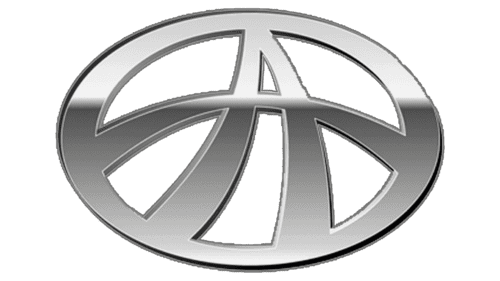
The brand’s logo features an oval shape with a metallic finish. Inside it, there’s a symbol resembling an upward-stretched letter “A.” The internal lines of the logo create the impression of a globe divided into segments, reminiscent of meridians and parallels.
From a brand-design perspective, that logo description is particularly telling. Ovals in automotive badges often imply continuity, completeness, or global reach, while metallic finishes signal industrial strength and modern manufacturing. The globe-like internal line work suggests international ambition or a connection to worldwide standards—an aspirational message that many manufacturers used as they positioned themselves within a rapidly globalizing industry.
If you’re researching Xiali as part of a broader automotive timeline, it helps to view the brand as a bridge between eras: an early mass-market identity in a transforming economy, influenced by external platform references, and carried forward under a state-connected industrial umbrella. That combination made it practical, scalable, and historically significant, even if the badge itself is less familiar to readers outside its main markets.
Xiali also reinforces the central theme of this article: X-brands are uncommon not because they lack value, but because “X” tends to enter brand lists through language structure and transliteration rather than through the traditional Western naming patterns that shaped early automotive history. Where older European and American marques often began as surnames, place names, or descriptive industrial titles, many modern X-leading names reflect a global industry where branding and phonetics intersect.
In short, Xiali belongs on any serious list of X car brands because it represents a pivotal chapter: the rise of large-scale passenger car production during a period of rapid economic and industrial change.
Why “X” Brands Are Rare—and Why They Still Matter
To make sense of the small number of X-starting automotive brands, it helps to separate two ideas: letter rarity and industry influence. The first is simply linguistic. In many European languages, X is not a common starting letter for surnames or place names, which were the traditional sources of early automaker names. The second idea is commercial. Because early manufacturers often relied on local recognition, they preferred names that felt familiar and easy to pronounce in their primary markets.
However, as the automotive world expanded globally—especially with the growth of Chinese manufacturing and international branding—letters like X became more visible. Not necessarily because companies set out to be unusual, but because transliteration systems and the desire for short, memorable names made X a practical branding tool. In modern branding psychology, X often conveys a sense of advanced technology, experimentation, or “next-generation” identity, even when the original name in its native language carries a different nuance.
From a historical preservation standpoint, the X category matters because it forces better research habits. When the list of brands is small, it becomes easier to trace origins, verify timelines, and avoid the “famous brand bias” that can distort automotive history. It also highlights the commercial vehicle sector (as with Xiamen Golden Dragon) and the mass-market transformation era (as with Xiali), both of which are sometimes overshadowed by luxury and performance narratives.
Ultimately, the letter is not the story—the vehicles, the manufacturing decisions, and the social impact are. The “X” label is simply the organizing key that helps us preserve a less crowded, but still meaningful, corner of the automotive world.
FAQ: X Car Brands and Common Questions
Are there many car brands that start with X?
No—compared with other letters, X-starting automobile brand names are uncommon. The letter often appears more frequently in model names and trim designations than in manufacturer names. That said, the brands that do begin with X—especially in modern China—are real and increasingly relevant, particularly in electric vehicles and commercial transport.
Why do so many X-starting brands appear in China?
A major reason is romanization. When Chinese names are represented in English letters, “X” can appear at the beginning of words where the original pronunciation is not the English “eks.” This is why correctly understanding pronunciation and meaning is essential when comparing brands internationally.
Which X brand is most associated with electric vehicles?
XPeng is directly described here as an EV-focused manufacturer, with electric crossover and sedan development milestones and additional technology ambitions via related projects.
Are X brands only passenger cars?
No. Xiamen Golden Dragon is centered on buses and light vans, showing that the “X” list includes commercial mobility manufacturers as well as passenger-car brands. This is important because commercial vehicles often have an outsized impact on daily transportation and regional economic activity.