
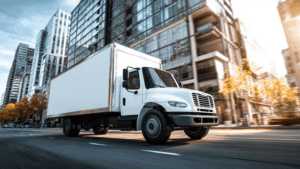

A straight truck — also called a box truck — is a vehicle where the cab and cargo area sit on a single chassis with all axles attached. A wall separates the driver’s compartment from the cargo box, though some models include a pass-through door between the two.
The key difference between a straight truck and a semi-trailer? You can’t just drop the cargo and go. Unlike a semi, where drivers detach the trailer during loading and unloading, a straight truck has to be physically unloaded or reloaded before it moves to the next stop. That’s both its limitation and, in many situations, its advantage.
Table of Contents
Where Straight Trucks Beat Semis
Many cities regulate the size and weight of trucks allowed on local roads, bridges, and through residential neighborhoods. Semi-trucks are often too tall for underpasses and too heavy for local bridges — especially single-lane ones.
Here’s a real-world example: the Wheeling Suspension Bridge in Wheeling, West Virginia has a load limit of just 4,000 pounds. That’s well below the weight of even an empty semi-truck. A straight truck? No problem.
Smaller straight trucks also fit into dense neighborhoods with narrow streets and low overhangs, making them ideal for last-mile deliveries — the final leg of the journey that gets packages from a distribution center to someone’s front door.
The Downside: More Downtime Between Loads
Because the cargo box is permanently attached to the chassis, straight trucks can’t do what semis do best — drop a loaded trailer and immediately hook up to the next one. Instead, the driver has to wait while the truck is unloaded and reloaded. That eats into driving hours and makes it harder to meet tight delivery schedules.
Every hour a truck sits idle without a new load chips away at profitability. Whether you’re an independent owner-operator or driving for a fleet, that downtime adds up fast.
Straight Trucks Are Safer Than Semis in One Critical Way
One major safety advantage straight trucks have over semis: they can’t jackknife. A semi’s cab and trailer can fold together at a 90-degree angle (or worse) during a sudden stop, causing devastating wrecks. A straight truck’s fixed chassis eliminates that risk entirely.
The numbers back this up. Out of roughly 120,000 crashes involving fatalities or injuries between April 2001 and December 2003, approximately 141,000 involved large trucks — and 7,000 of those resulted from jackknifed trailers. By 2020, the FMCSA noted a 52.6% increase in truck crashes between 2009 and 2018, prompting a call for updated safety data from drivers.
Depending on speed, cargo weight, and road conditions, a box truck generally has a lower crash risk than a semi — in large part because that jackknife scenario simply can’t happen.
Better Fuel Efficiency Where It Counts
After labor, fuel is typically the second-largest expense for any trucking operation. Fleet managers can’t control gas prices, but they can control how efficiently their vehicles burn through it.
One smart strategy: use straight trucks for in-city deliveries instead of semis. Offloading last-mile work to box trucks reduces vehicle weight and can cut fuel consumption by 5% to 10%. In a business where margins are tight, that’s a meaningful number.
Built for the Last Mile, Not the Long Haul
Semis are at their best on the highway — fewer stops, fewer starts, peak fuel efficiency at cruising speed. But inside city limits, they’re often overkill. Box trucks offer a more agile solution where maneuverability, vehicle size, and fuel economy matter most — like navigating a tight turn from a main road into a dense residential neighborhood.
That’s the sweet spot for straight trucks. They’re not trying to replace semis on cross-country hauls. They’re filling the gap between the highway and the doorstep — and doing it more efficiently, more safely, and with fewer restrictions than their larger counterparts.