
If you expected a retirement gift to be something dramatic—an engraved trophy, a framed portrait, or a polished, gold-plated keepsake—this story takes a more grounded turn. The memento that keeps coming to mind is a spanner. And yes, it’s fair to pause and ask: what on earth were they thinking? Yet the more you understand the working life it represents, the more that simple tool begins to feel strangely perfect. A spanner is not flashy, but it is fundamental. It is the kind of object that quietly signals competence, persistence, and hands-on problem-solving—the same traits that defined Bryan Webb’s long career.
Bryan Webb lived to 90, and his personal story reads like a living timeline of British motoring—from the era when mechanics relied on feel and experience as much as manuals, all the way to the modern age of computerized diagnostics and electrification. He began at Vauxhall as a mechanic in 1956, a time when the industry was still shaped by direct craftsmanship, mechanical intuition, and (quite literally) grease-stained expertise. In a world increasingly defined by short-term roles, rapid job-hopping, and constantly shifting corporate identities, Bryan’s career stands out not just as impressive, but as historically unusual.
What makes this story worth studying isn’t only that he stayed in the trade. It’s that he stayed committed to the same company for 75 consecutive years without resigning—an achievement that is so rare today that many people struggle to even picture it. When you place that fact against the backdrop of how dramatically automotive work has changed over the last seven decades, the accomplishment becomes even more striking. Remaining relevant through that level of transformation requires more than loyalty; it demands adaptability, discipline, and a deep respect for learning.
So before we treat the spanner as an odd or underwhelming gift, it’s worth reframing it properly. In an industrial context, a spanner is not “small.” It’s symbolic of the work that keeps a company’s products on the road and its reputation intact. It’s also an artifact of continuity: a reminder that long careers are built through thousands of practical, unglamorous decisions—showing up, solving problems, and improving your craft even when nobody is watching.
In the sections that follow, we’ll unpack why Bryan Webb’s story resonates so strongly, what it reveals about the evolution of automotive work, and why his personal milestones—from the watch he still wears to the plaque unveiled at retirement—matter far beyond sentimental value. This is not only a feel-good retirement tale. It’s a case study in professional endurance, vocational identity, and the kind of brand loyalty that companies spend millions trying to engineer through marketing but can rarely achieve through culture alone.
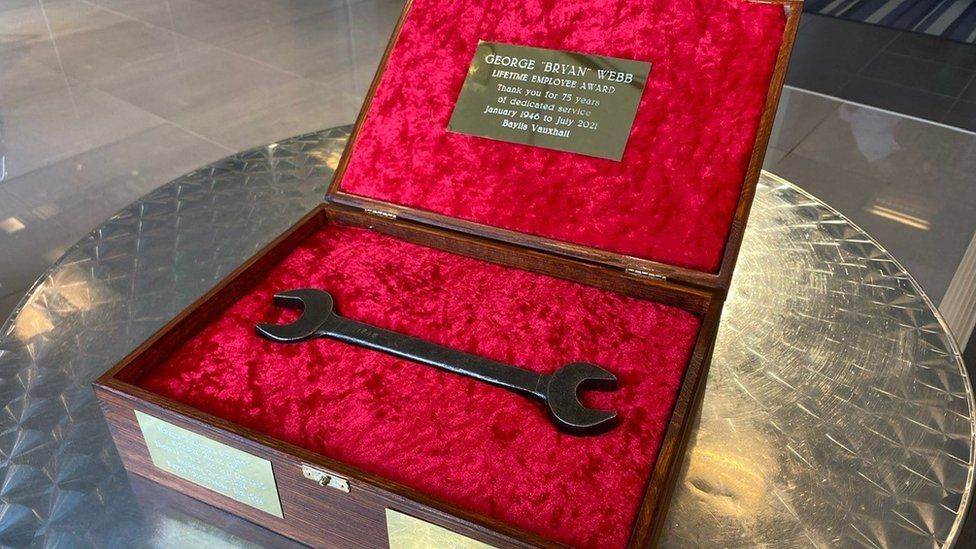
Why a Spanner Actually Makes Sense
From an expert standpoint, the “spanner gift” becomes easier to appreciate once you understand what tools represent inside skilled trades. Tools are not decorations; they are extensions of a worker’s judgment. A veteran mechanic’s tool kit often carries a kind of biography—scuffs from difficult jobs, modifications made for specific tasks, and the accumulated memory of decades of repairs. In many workshops, the most respected technicians are not the ones with the newest tools, but the ones who can pick up any tool and make the job happen with calm precision.
So the spanner isn’t merely a cheeky retirement token. It can be interpreted as a shorthand summary of Bryan Webb’s professional identity. It acknowledges that he entered Vauxhall through the practical doorway—mechanical work—rather than through boardrooms or corporate ladders. And it highlights an important truth about the automotive industry: the people who keep the wheels turning are often not the people the public sees. Yet without them, brands collapse under the weight of unreliability and unmet promises.
If anything, the question shouldn’t be “why a spanner?” The real question might be: why don’t more organizations honor technical careers with symbols that reflect the work itself? Many companies default to generic gifts that could apply to any office job. But in skilled trades, meaning comes from specificity. A spanner says, “We know what you did here.” That recognition can feel more authentic than something expensive but unrelated.
A Career Few People Can Even Imagine
Most of us begin to feel restless after a year in the same role—sometimes even after a few months. In modern employment culture, moving on is often treated as the default path to growth: higher pay, new environments, new titles. That doesn’t automatically make job changes wrong. But it does make Bryan Webb’s career unusually instructive. Working for the same organization for 75 consecutive years, without ever resigning, is so far outside current norms that it becomes a kind of professional outlier—something closer to legend than résumé.
This is precisely why Bryan Webb’s career stands out: it’s not just impressive, it’s educational. It forces us to re-examine what “success” means in the context of work. Today, many people measure success by salary increases, role changes, and visible promotions. Bryan’s story suggests another model: mastery, continuity, and long-term contribution. His example shows what sustained commitment looks like when it’s paired with pride in the craft and a sense of belonging to an organization’s mission.
And to be candid, that kind of stamina and loyalty is rare in any field, not only in automotive. Over three-quarters of a century, most people experience multiple career resets, industry pivots, or complete changes in identity. Bryan’s ability to remain connected to the same employer across eras of profound economic and technological change makes his story remarkable even before you look at what he actually did day-to-day.
To understand why this is such a big deal, consider what 75 years includes in the automotive world: multiple ownership models, changing supply chains, the decline of certain manufacturing traditions, the rise of global competition, new safety and emissions regulations, and the shift from mechanical tuning to software-driven calibration. Staying employed across that landscape requires more than showing up. It requires staying useful.
That is why Bryan Webb isn’t simply a “loyal employee.” He represents an entire category of institutional knowledge that modern companies routinely lose—sometimes without realizing the cost until it’s too late. Veteran technicians carry the kind of understanding that doesn’t always live in manuals: how certain parts fail in real conditions, which repairs tend to last, how customers actually use vehicles, and how to diagnose problems that don’t show up neatly in diagnostic codes.
1956: The Automotive World Bryan Entered
Bryan began working at Vauxhall as a mechanic in 1956. That year matters because it places his early career in a mechanical era—before digital electronics became the nervous system of modern vehicles. In the mid-1950s, the role of a mechanic was intensely hands-on. Diagnosis relied heavily on observation, listening, smell, touch, and experience. You learned the “language” of engines the way a musician learns pitch: subtle differences in sound told you what was wrong long before a computer could translate it into a fault code.
In that environment, craftsmanship wasn’t a slogan. It was the job. Components were designed to be repaired, and mechanics were expected to understand how systems interacted. A technician didn’t only replace parts; they adjusted linkages, tuned engines, and worked with mechanical tolerances in a way that modern “swap-and-test” service workflows sometimes minimize.
Starting in 1956 also means Bryan’s working life overlapped with the long arc of British automotive identity: a period when domestic brands played a strong role in local pride, when dealerships and service departments were cultural touchpoints, and when a person’s car was not just transport but a visible part of their social and professional life. In that sense, Bryan’s career is also a story about how a nation’s relationship with mobility evolved.
Retirement Recognition: The Plaque and What It Signaled
When Bryan finally retired, recognition wasn’t limited to a handshake and a goodbye. A plaque was unveiled in his honor—an acknowledgment of a level of service most companies will never see again. If anything, that plaque felt like the minimum appropriate gesture for someone who had effectively dedicated a lifetime to a single employer.
From an organizational culture perspective, this moment matters because public recognition does two things at once. First, it honors the person retiring. Second, it sends a message to everyone who remains: “This is the kind of contribution we value.” In industries that depend on skilled labor and experience, that message has real strategic value. It reinforces the idea that long-term commitment is not invisible and not taken for granted—at least, not entirely.
Many people were stunned by the consistency of Bryan’s commitment. And the prevailing sentiment was simple: after giving so much of himself to the corporation, he deserved nothing less than a peaceful, well-earned retirement. That reaction is telling, because it reflects a social shift. We are no longer used to seeing work loyalty at that scale, so when it appears, it feels almost unreal—like a story from a different century.
But that’s exactly the point. Bryan Webb’s career is, in a sense, a bridge between centuries of workplace culture: from an era where staying with one employer was common and even expected, to an era where “staying” is often viewed as stagnation. His story challenges that narrative. It suggests that staying can be a form of growth if the work remains meaningful and the person continues to evolve with it.
Loyalty Beyond the Workshop: The Cars He Owned
Bryan’s devotion to Vauxhall showed up not only in his employment record but also in the personal decisions he made away from the workshop. Over the course of seven decades, he owned numerous vehicles—strong evidence that his relationship with the brand wasn’t limited to clocking in and clocking out. He wasn’t simply employed by Vauxhall; he believed in what Vauxhall built.
The first cars he got his hands on in 1956 included a Vauxhall Velox, along with a few more. For automotive enthusiasts, that detail is significant because it reveals something deeper than consumer preference. When a mechanic chooses to own vehicles from the company they work for, it can reflect trust, familiarity, and pride—but it can also reflect a real technical comfort: you understand how these machines work, what they need, and how to keep them in top form.
In a practical sense, owning vehicles over seven decades also means Bryan lived through the changing meaning of “car ownership.” Early on, ownership often meant routine maintenance was unavoidable, because reliability standards and materials were different. Later decades introduced more durability but also more complexity. The modern era added convenience but made DIY work harder through electronic integration. Bryan lived through all of that while staying anchored to one brand ecosystem.
To put it simply: Bryan’s ownership pattern wasn’t transactional; it was rooted in identity, familiarity, and long-term belief. That kind of relationship between person and brand is extremely rare today. It’s the kind of loyalty marketing departments try to simulate through campaigns and slogans. Bryan’s story shows what real loyalty looks like: it’s built slowly, through years of lived experience.
More Than One Role: Warranty Administration and Real-World Expertise
Bryan’s career wasn’t confined to a single job title. He also served as a warranty administrator for Baylis Gloucester for 34 years. That role may sound less dramatic than “mechanic,” but from an industry expert’s viewpoint, warranty work sits at a critical intersection: it connects manufacturing quality, service reality, customer experience, and financial accountability.
Warranty administration requires precision and integrity. It involves understanding how vehicles age, fail, and are repaired in real-world conditions—conditions that rarely match laboratory assumptions. A warranty professional must interpret technical documentation, ensure repairs are legitimate and properly coded, and balance customer satisfaction with organizational policy. It is, in many ways, a role that demands both technical literacy and operational discipline.
The fact that Bryan held that role for 34 years suggests a deep reservoir of trust and competence. You don’t keep someone in warranty administration for decades if they are careless with detail. That position can directly affect costs, brand reputation, and customer loyalty. In other words, it’s not merely administrative—it’s a quality control function that plays out in the real world.
In his retirement remarks, Bryan noted that the most significant advancement in technology occurred during his working lifetime. Coming from someone who began in the 1950s, this carries weight. He witnessed the industry’s transition from mechanical systems to software-driven diagnostics, sophisticated electronics, and rapidly evolving powertrain technologies. This is not a generic “technology changed” statement. It’s a lived observation from someone whose daily job depended on keeping up with those changes.
Looking ahead, he expressed confidence that Vauxhall would keep pace with the growing trend toward all-electric cars and vans. That outlook is notable too. Many veteran mechanics and long-serving employees are skeptical of rapid transitions, especially those that transform the nature of their craft. Bryan’s statement suggests curiosity and acceptance rather than resistance—a mindset that likely contributed to his longevity.

The Technology Shift He Lived Through (And Why It Matters)
To appreciate Bryan Webb’s remark about technological advancement, it helps to outline what an automotive career spanning from 1956 onward actually includes. Without inventing personal details, we can still describe the industry-level transformations he would have had to navigate, because these shifts touched virtually every workshop, dealership, and warranty process in the UK and beyond.
Here are some of the most significant broad changes that occurred across that period—changes that would have reshaped the daily work of mechanics and warranty professionals alike:
- From largely mechanical ignition and fueling to electronic control: the move from points and carburetors toward electronic ignition and fuel injection changed not only performance and emissions, but diagnostic methods.
- From analogue troubleshooting to computer-assisted diagnostics: where “experience and ear” once dominated, scan tools, fault codes, and data streams became essential.
- From simple wiring to networked vehicle electronics: modern cars communicate through systems that require a different kind of literacy—signal integrity, module communication, and software updates.
- From repair-friendly design to modular replacement strategies: many modern systems are integrated, meaning certain failures lead to replacing assemblies rather than rebuilding components.
- From internal-combustion dominance to electrification: EVs and electrified vans are changing the skill sets needed in service and warranty environments, shifting emphasis toward high-voltage safety, electronics, and software.
For a long-serving professional, the key challenge isn’t simply learning new tools—it’s learning new mental models. The way you “think” about diagnosing a mechanical fuel issue is different from the way you interpret a sensor fault, a software mismatch, or a communication error across vehicle modules. Bryan’s longevity suggests he continuously adjusted how he understood cars, not just what he did to them.
That is why his confidence in Vauxhall’s future with all-electric vehicles and vans lands as more than optimistic commentary. It reflects lived experience: he watched the industry survive massive changes before, and he expects it to adapt again. That is a mature perspective—rooted in history, not hype.
The Watch: Why Small Objects Become Big Symbols
One of the most telling details in Bryan Webb’s story is not the plaque, the spanner, or the impressive length of service. It’s the watch. He still wears the watch he received as a “thank you” for 25 years of service. That fact might sound simple, but from a human perspective, it’s powerful: it shows the milestone mattered to him, and that he treated recognition not as a disposable token but as something to carry forward.
In organizational psychology, this is what we call a “meaningful artifact.” When a person keeps and uses a service gift for decades, the object becomes a bridge between time periods—linking the younger worker to the older one, the early days of a career to the closing chapter. It also suggests that the company’s gesture landed with real emotional weight. Not every service award becomes a daily-worn item.
And then the story adds a line that is both humorous and staggering: after reaching 25 years, there was no chance he was going to stop there. He went on for another seventy-five years after that. Taken literally, the numbers stretch beyond normal human career math, but the message is clear and worth preserving exactly as stated: Bryan’s commitment did not slow down after a milestone. He kept going, far beyond what most people would consider the finish line.
That is why the spanner, the plaque, and the watch all belong together. They represent three layers of recognition:
- The spanner: a symbol of craft, work, and technical identity.
- The plaque: public acknowledgement—an official record that the organization recognizes the extraordinary.
- The watch: private continuity—an everyday reminder that time spent working with purpose can become a personal legacy.
What Bryan Webb’s Story Teaches the Automotive Industry
It would be easy to treat Bryan Webb’s career as a charming outlier—a story so unusual that it cannot offer practical lessons. That would be a mistake. Even if no one else matches 75 consecutive years, the underlying factors that enable long, meaningful careers are worth studying, especially as the automotive sector faces a skills gap in many regions.
Here are several insights that industry leaders, managers, and even younger technicians can take from this story:
1) Longevity Requires Continuous Learning
Staying in one company for decades doesn’t mean doing the same thing for decades. Automotive work changes constantly. Bryan began in a hands-on mechanical era and lived through the rise of electronics and software. That implies ongoing learning—whether through formal training, mentorship, self-directed study, or simple daily curiosity.
2) Loyalty Is Usually Earned, Not Demanded
People do not typically remain with one employer for a lifetime unless the relationship offers dignity, meaning, and a sense of purpose. That doesn’t mean every day is easy. But it suggests that over time, something about the environment—work culture, community, pride in the product, or stability—created reasons to stay.
3) Technical Careers Deserve Visible Respect
The spanner may appear modest, but it reflects something important: technical work is the foundation of manufacturing and service. When a company recognizes technicians properly, it supports recruitment and retention by reinforcing that skill matters. Skilled trades are not “lesser” work; they are specialized work. Bryan’s plaque also reinforces this by giving public acknowledgement rather than treating the career as invisible labor.
4) EVs and the Future Will Need People Like Bryan—Just with Different Tools
Bryan believed Vauxhall would keep up with the growing trend of all-electric vehicles and vans. That future will still depend on service expertise, diagnostics, and warranty integrity. The tools will change, but the core values will remain: precision, accountability, problem-solving, and pride in workmanship.
Why This Story Matters Beyond One Person
Too often, we fail to acknowledge the effort and endurance behind other people’s achievements—especially the quiet, long-term struggles that don’t come with applause. It’s a pity. In many workplaces, the most reliable people are also the least celebrated, precisely because they don’t cause disruptions. They simply deliver, year after year.
Stories like Bryan Webb’s give us an opportunity to correct that habit. When it comes to loyalty, Bryan Webb stands head and shoulders above the norm. He kept working, kept adapting, kept contributing, and carried his milestones with him—literally, in the form of the watch he still wears from his 25-year service recognition.
And that is why the story stays with people. It’s not only about a record-length career. It’s about the rare combination of identity and endurance—finding a craft and a company you can commit to, then living long enough in that commitment to watch the entire world around it transform.
In an era when many workers feel disposable and many companies feel temporary, Bryan Webb’s legacy is a reminder that work can still be a long-term relationship. Not always, and not for everyone—but sometimes, with the right person and the right environment, it can become a lifelong story. And in that context, a spanner isn’t a strange retirement gift at all. It’s a signature.

