
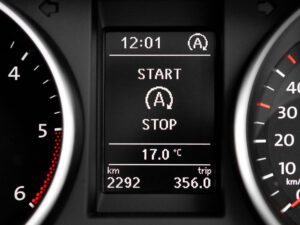

Modern cars do a lot of things that older vehicles never even attempted. They shut engines off at traffic lights, restart in an instant when your foot lifts from the brake, manage fuel delivery with incredible precision, and monitor everything from outside temperature to battery condition dozens of times per second. To many drivers, these features feel normal now. To others, especially anyone who grew up with simpler vehicles, some of this technology still feels suspicious.
One of the most debated examples is Auto Stop-Start, sometimes written as Auto Start/Stop or simply stop-start. It is the system that shuts the engine off when the car is fully stopped, then starts it again automatically when you are ready to move. Some drivers love it because it saves fuel and reduces idling. Others dislike how it feels and worry that repeatedly stopping and restarting the engine must be hard on internal components.
The concern sounds reasonable at first. For generations, drivers were taught that frequent restarting puts stress on a car. So when a newer vehicle turns the engine off at every red light, it is easy to assume the starter motor, battery, bearings, and other parts are quietly being worn down faster than they should be. That suspicion has created a long-running debate online, in repair shops, and at dinner tables between people who trust modern engineering and people who remain convinced that the old ways were safer.
As someone who studies engine systems and long-term vehicle durability, I understand both sides of that debate. The hesitation is not irrational. Engines do experience wear during startup events, and the idea of adding more starts sounds like it should increase wear. But the full answer is much more interesting than that. Not all starts are equal, modern stop-start systems are designed very differently from an ordinary cold start in the morning, and the parts used in these vehicles are not the same parts found in a sedan from twenty years ago.
In this guide, I will explain what Auto Stop-Start technology is, why manufacturers adopted it so aggressively, how it works behind the scenes, whether it is actually harmful to the engine, what components are designed differently to support it, why some systems feel smoother than others, and when it makes sense to leave it on or turn it off. By the end, you should have a much clearer sense of whether this technology is a real threat to engine life or simply one of those features that feels strange until its purpose is understood properly.
The short conclusion is simple, but the explanation matters: in a properly engineered modern vehicle, Auto Stop-Start is not generally bad for the engine. The reasons behind that answer are where things get interesting.
Why Auto Stop-Start Technology Became So Common
To understand why stop-start systems spread so quickly, it helps to look at the environment in which automakers were operating. Vehicle manufacturers have spent the last two decades under increasing pressure to improve fuel economy and reduce emissions across their fleets. Regulators in the United States, Europe, and many other markets have steadily pushed automakers toward cleaner, more efficient vehicles. That pressure did not only produce hybrids and electric cars. It also drove the adoption of smaller changes that, when multiplied across millions of vehicles, make a measurable difference.
Auto Stop-Start is one of those changes. On paper, the idea is simple: an engine that is idling is using fuel but not moving the car. In urban traffic, at stoplights, in school pickup lines, at railroad crossings, and in bumper-to-bumper congestion, engines can spend a surprising amount of time doing exactly that. Shut the engine off during those moments, restart it when the driver needs to move, and the vehicle wastes less fuel while emitting less carbon dioxide and other pollutants.
That matters far more in city driving than on the highway. A driver who spends most of the day cruising at steady speed may barely notice any fuel economy improvement from stop-start technology. A driver who sits through ten stoplights each morning and fifteen more on the way home may see a meaningful change, even if that change seems modest on a single trip. Across millions of vehicles and billions of traffic stops, those small savings become significant.
This is why manufacturers adopted stop-start not as a gimmick, but as part of a much larger efficiency strategy. It sits alongside direct injection, turbocharging, variable valve timing, low-friction engine coatings, improved transmissions, active grille shutters, aerodynamic refinement, electric power steering, and lightweight materials. On its own, Auto Stop-Start does not transform a gas-powered vehicle into an ultra-efficient machine. But as part of a package, it helps manufacturers move closer to fuel economy and emissions targets without radically changing how the average driver uses the car.
In other words, stop-start technology did not appear because engineers thought drivers would enjoy hearing their engines turn off at every red light. It appeared because the fuel that gets burned during idling is real, measurable, and avoidable. Once that became a design priority, engineers had to solve the durability and usability questions that came with it. That is where the real story begins.
What Auto Stop-Start Technology Actually Is
Auto Stop-Start is a vehicle system that temporarily shuts down the engine when the car is stopped and automatically restarts it when the driver is ready to move again. The exact behavior varies by manufacturer, but the general idea remains the same. In a typical automatic-transmission vehicle, the engine turns off when the car comes to a complete stop and the brake pedal is held. The moment the driver lifts off the brake, the engine restarts and the car is ready to move. In some vehicles, the system also factors in steering input, gear selection, brake pressure, and air-conditioning demand.
This technology is different from turning the ignition off and then manually restarting the vehicle. That older process is a full shutdown event initiated by the driver. Auto Stop-Start is a highly controlled, conditional pause in engine operation managed by multiple sensors and the vehicle’s computer systems. The engine is not being shut off casually or blindly. It is being paused only when a specific list of conditions tells the control system that doing so is safe, practical, and beneficial.
It is also important to understand that the system is not active in every moment of every drive. If the engine is too cold, the battery is not healthy enough, the cabin climate system is demanding more output, the vehicle is on a steep incline, the driver is maneuvering in traffic, or certain other conditions are present, the car may choose not to engage stop-start at all. In that sense, the feature is less aggressive than some people think. It is not constantly trying to shut the engine off no matter what. It is waiting for the right opportunity.
Some systems feel nearly invisible in use. Others are more noticeable, especially on less refined vehicles or in certain engine configurations. A mild shudder, slight pause, or change in climate output can make the feature feel more intrusive than it really is mechanically. That difference in feel has contributed greatly to the public debate around the technology. Drivers often judge the system based on the restart sensation, not on the underlying durability design.
So at its core, Auto Stop-Start is a fuel-saving idle reduction system. It is not trying to shorten engine life. It is trying to reduce unnecessary fuel use while preserving drivability through careful control logic. Whether it succeeds elegantly depends on the vehicle and the engineering quality behind it.
How Auto Stop-Start Works Behind the Scenes
To the driver, stop-start may look like a simple trick: the engine turns off, then it turns back on. In reality, the system is managing a long chain of decisions in the background. It does not rely on one switch or one signal. It combines data from several sensors and control modules before acting.
At a basic level, the system monitors vehicle speed, brake pedal position, engine speed, battery condition, engine temperature, cabin climate demand, steering input, transmission state, and sometimes hood position and seatbelt status. When the vehicle comes to a complete stop, and the other conditions are acceptable, the engine control system may shut the engine down. At that moment, the transmission is disengaged appropriately, fuel delivery stops, and the car enters a temporary waiting state.
When the driver releases the brake or performs another action the system recognizes as a request to move, the engine restarts. In traditional stop-start systems, that restart often happens through a reinforced starter motor. In more advanced systems, an integrated starter-generator, belt-driven starter-generator, or combustion-assisted restart strategy may be used instead. The transmission is then ready to resume motion almost immediately.
One of the most important details here is timing. The restart happens while the engine is still warm, the lubricating oil is still distributed, and the vehicle’s computer has full awareness of the engine’s position and condition. This is not a long-dead cold engine being brought back to life after sitting all night. It is a warm engine being resumed after a brief pause. That difference explains much of why the durability concern is smaller than many drivers assume.
Meanwhile, the car’s accessories do not simply give up during the stop event. The radio continues playing. The lights remain on. The wipers continue if needed. Climate systems are managed based on battery strength, thermal demand, and vehicle design. Some vehicles hold cabin comfort extremely well during stop-start events. Others are more noticeable, especially if the air conditioning compressor is engine-driven rather than electrically supported. Again, system quality varies, but the basic intention is the same: preserve normal cabin function while minimizing engine idling time.
This orchestration only works because the car is continuously monitoring whether the stop-start event remains appropriate. If the cabin temperature begins drifting too far, if the engine temperature drops outside the ideal range, or if the battery charge falls below the threshold needed for confidence, the engine may restart on its own before the driver even moves. This is one of the biggest misconceptions about stop-start. People imagine it as a blunt on-off feature. In reality, it is conditional, defensive, and designed to protect itself.
Why People Think Auto Stop-Start Is Bad for the Engine
The suspicion surrounding stop-start technology is easy to understand because it is built on a real mechanical truth: engine starts do create wear. For decades, drivers and mechanics alike understood that one of the harshest moments in engine life is startup, especially cold startup. Oil has drained away from some surfaces, metal parts are at ambient temperature, clearances behave differently, and the system has not yet returned to full, stable lubrication and thermal balance. So when a new technology arrives that intentionally increases the number of engine starts, the instinctive reaction is obvious: that must increase wear too.
The problem is that this logic treats all starts as identical, and they are not. A cold start after the car has been parked overnight is mechanically different from a warm restart at a traffic light after the engine has been running for half an hour. The phrase “starting the engine” sounds the same in both cases, but the internal conditions are not remotely equal.
Another reason people distrust stop-start is sensory. Drivers can feel it. They notice the engine shut off. They feel the slight restart vibration. They hear the change in sound. That makes the process feel more violent than it often is mechanically. A quiet internal design improvement inside an engine bearing is invisible. A restart at a red light is not. Humans tend to trust what they feel over what they are told, which is understandable.
There is also the internet factor. A great deal of discussion around stop-start technology comes from opinion rather than measured evidence. Someone dislikes the sensation, so they conclude it must be harmful. Someone had a battery fail and blames stop-start. Someone’s starter failed on a modern car and assumes the feature caused it. Sometimes those assumptions contain a grain of truth. Often they skip the larger engineering context entirely.
Finally, many drivers judge modern technology through the lens of older cars. That is a major mistake. A starter motor designed for a vehicle without stop-start is not the same as one designed to handle thousands of controlled restart cycles in a stop-start application. The same is true for bearings, batteries, battery management systems, and sometimes even engine calibration. When people say, “That would have worn out the starter on my old car,” they may be right. But that does not automatically mean it wears out the starter on a modern stop-start-equipped vehicle designed specifically for the task.
So the concern comes from a reasonable idea—but one that becomes incomplete once you understand how warm restarts differ from cold starts and how much the hardware has changed to support them.
Is Auto Stop-Start Bad for the Engine?
In normal use, on a modern vehicle designed with this system in mind, Auto Stop-Start is not considered bad for the engine. That is the most defensible evidence-based answer. There is no convincing proof that stop-start systems, as engineered on modern production cars, cause widespread abnormal engine wear compared with similar engines that do not use the feature. The reason is not that starting the engine is harmless. The reason is that the type of starts involved in stop-start operation are different, the hardware is upgraded, and the control logic is selective.
The most important distinction is temperature. Cold starts create the most meaningful startup wear because the oil has settled, internal clearances are changing from ambient temperature, and full lubrication distribution takes a moment to stabilize. With stop-start, the engine was just running. It is already warm. Oil is still present on critical surfaces. The restart occurs before the engine cools significantly. This is much closer to a brief pause in operation than to the morning startup event people instinctively imagine.
In addition, stop-start systems do not operate blindly. They are programmed to avoid conditions that would make the stop event unwise. If the engine is too cold, if battery voltage is too low, if cabin comfort would suffer too much, or if other demands on the engine remain high, the system often keeps the engine running. That is not a coincidence. That is exactly the sort of logic needed to protect durability.
Manufacturers have also redesigned supporting hardware to survive the increased number of restart cycles. Starters are more robust. Batteries are stronger and smarter. Bearings and coatings are improved. Battery management is more sophisticated. Some systems use alternative restart strategies that reduce traditional starter dependence entirely. These are not small changes. They are the reason stop-start could become mainstream at all.
None of this means the system adds zero stress to the vehicle. It does change how certain components are used. But that is not the same as saying it harms the engine in the way many critics claim. The more accurate statement is this: stop-start-equipped vehicles use components chosen to handle stop-start operation. Within that design envelope, the system is generally not harming the engine under normal conditions.
So yes, engine startups matter. But no, that fact alone does not mean stop-start is automatically damaging. The type of startup matters, the conditions matter, and the hardware matters. Once you account for those differences, the fear becomes much less convincing.
The Big Distinction: Cold Starts Versus Warm Restarts
If there is one concept that resolves most of the confusion around stop-start technology, it is this one: a cold start is not the same thing as a warm restart.
When an engine has been sitting for hours, much of the oil has drained back into the pan. A thin protective film remains on many surfaces, but the engine is not in the same lubricated condition it enjoys after running. The metal components are also at ambient temperature, which means their clearances and material behavior differ from their normal operating state. As the engine starts and oil pressure builds, the system transitions from rest to stable operation. That transition is where a meaningful share of engine wear occurs over time.
A stop-start event at a traffic light is different. The engine was running moments ago. Oil is still distributed. Bearings, pistons, cylinder walls, and valvetrain components are still warm. The engine control system is fully awake, the sensors are already active, and the restart occurs before the engine loses its stabilized thermal state. This is not the harsh, dry, long-idle-start scenario that older maintenance advice was warning about.
Think of it this way: a cold start is like getting out of bed after a full night’s sleep and immediately sprinting. A warm restart is like pausing during a jog for a few seconds and then moving again. Both involve movement from stillness, but the physical demands are not equivalent. The same principle applies inside the engine.
This distinction is so important because many of the loudest criticisms of stop-start technology are built on the assumption that every restart is mechanically severe. That assumption sounds intuitive, but it fails to account for the engine’s actual condition during these events. Once the system is understood in terms of warm restarts rather than full cold starts, the wear argument weakens dramatically.
This does not mean stop-start restarts are free of all mechanical effect. Of course they involve movement, fuel delivery, ignition, and component engagement. But the context in which they happen is much gentler than many people assume, and that context is exactly why manufacturers were willing to build around the technology in the first place.
Which Parts Are Upgraded to Support Stop-Start Systems?
One of the strongest arguments against the idea that stop-start is inherently destructive is the fact that modern vehicles with this feature are not simply ordinary cars with one extra software command added. The supporting hardware is often different. Manufacturers know the system increases restart frequency, so they engineer the affected parts accordingly.
The starter motor is an obvious example. In stop-start applications, the starter is usually more robust than a conventional design because it must survive far more restart cycles over the life of the car. Older starter systems may have been designed around roughly 100,000 starts, depending on the application. Many modern stop-start systems are built to endure significantly more. That is not because engineers are ignoring wear. It is because they are designing for it.
The 12-volt battery is another major upgrade area. Stop-start vehicles often use AGM or EFB battery designs rather than simpler conventional lead-acid batteries. These battery types are better suited to repeated discharge-recharge cycling and can support accessories while the engine is off. The vehicle’s battery management system also monitors state of charge closely so the car does not shut down the engine when the battery is not ready to support it.
Then there are the engine bearings. Some manufacturers use more durable bearing materials and coatings designed to withstand a greater number of restart cycles. This matters because bearings are central to the fear around startup wear. If the bearing surfaces are upgraded specifically for repeated operation, that changes the durability equation substantially.
Ring gears, starter engagement components, and sometimes alternator/generator systems are also adapted depending on the design. In mild hybrid systems or vehicles with integrated starter-generators, the restart event may happen more smoothly and with less traditional starter engagement than people expect. Some setups use a belt-driven motor-generator or crankshaft-linked system to spin the engine up quickly and quietly.
Even software calibration matters. The engine control module, transmission logic, climate system, and charging strategy all work together to decide when the engine can be safely stopped and restarted. Good stop-start behavior is not just a hardware issue. It is also a control strategy issue. The car is constantly protecting itself from poor stop-start decisions.
In short, stop-start is not just a feature laid on top of a standard car. It is a system supported by multiple upgraded components. That is one of the biggest reasons the “it must wear everything out” argument does not hold up well in properly designed modern vehicles.
What Parts Can See More Stress with Stop-Start?
Now for the nuance. Saying stop-start is not broadly harmful to the engine does not mean every component experiences identical stress compared with a non-stop-start vehicle. Some parts are more active or more heavily cycled, especially those directly involved in restart and electrical support.
The most obvious one is the battery. Stop-start systems ask more from the 12-volt battery because accessories continue to run while the engine is off, and the system needs enough reserve to restart the engine confidently again and again. That is why these vehicles use stronger battery types and more advanced battery monitoring. Still, batteries remain wear items, and stop-start-equipped vehicles can be more sensitive to battery health than older vehicles were. When the battery weakens, the stop-start feature is often one of the first systems to disable itself.
The starter system, or its equivalent restart hardware, also experiences more cycles by definition. But that does not mean it is being abused beyond design. It means it is a more active component in a system designed for that activity. Over very long ownership periods, replacement costs for batteries or starter-related hardware may become part of the stop-start ownership equation, depending on the vehicle.
In some cars, drivers also notice more strain on cabin comfort systems, especially air conditioning in hot weather. That is not usually because the system is being damaged. It is because cooling performance may briefly change during stop phases if the compressor relies heavily on the engine rather than electric support. Manufacturers often restart the engine preemptively if cabin conditions demand it, but some systems handle this more gracefully than others.
What about the engine itself? In a properly functioning modern stop-start vehicle, there is no strong evidence that the engine is suffering abnormal wear purely because the feature exists. That is the important distinction. Some supporting systems are absolutely more active. That does not automatically translate into engine harm in the way critics usually describe.
The best way to say it is this: stop-start changes the stress profile of some components, especially electrical ones, but those components are usually chosen and calibrated for the role. The system may affect how the vehicle ages in small ways, but that is not the same as saying it is secretly destroying the engine every time the car stops at a traffic light.
Some Systems Do Not Even Rely Mainly on the Traditional Starter
One reason stop-start technology continues to improve is that not every manufacturer handles the restart event the same way. In some vehicles, the traditional starter motor still does most of the work. In others, the design is more advanced and less dependent on the old-fashioned “turn the starter, crank the engine, and fire it” process.
Mazda, for example, has used an approach in some applications that relies heavily on combustion-assisted restart logic. In simplified terms, the system uses the position of the pistons and carefully timed fuel and ignition events to help restart the engine more directly rather than leaning entirely on a conventional electric starter sequence. Other manufacturers use integrated starter-generator designs or belt-driven motor-generators that provide smoother, quieter, and often faster restarts.
This matters because many stop-start critics still imagine the system in terms of an old traditional starter motor being hammered constantly. On some vehicles, that is simply not an accurate picture. The technology has already moved beyond that in many cases, and it continues to evolve.
Mild hybrid systems push this even further. In those vehicles, engine shutdown and restart events can feel extremely refined because the restart mechanism is integrated more deeply into the hybrid support architecture. What the driver experiences may be less like a restart and more like a brief pause in engine operation. The more electrified the powertrain becomes, the less the stop-start event resembles the old mental model that created so much initial resistance in the first place.
This is important because the technology should be judged as it exists now, not as it first appeared in crude form years ago. Like many automotive systems, stop-start has matured. The best versions today are much smarter, more selective, and more mechanically elegant than their early critics often give them credit for.
When the System Will Not Activate
Many drivers assume the car always uses stop-start whenever it comes to a stop. In reality, the system often refuses to engage under a long list of conditions. This is one of the strongest pieces of evidence that the system is designed defensively rather than recklessly.
For example, the engine may stay running if it is not yet warm enough. It may also stay on if the battery charge is too low, if the cabin climate system needs more support, if the steering wheel is being turned sharply during parking maneuvers, if the car is on a steep incline, if the hood is open, if the driver is not properly buckled in, or if other systems need stable engine operation. In diesel applications or vehicles with emissions regeneration events, the system may stay disabled until those conditions are complete. Some turbocharged vehicles also have logic designed to preserve thermal management when needed.
All of that means the car is already making judgment calls about when the feature is appropriate. The engine is not being turned off mechanically just because the vehicle speed hits zero. The control system is asking, “Is this the right moment? Is the engine warm? Is the battery ready? Is cabin comfort acceptable? Will restarting be easy?” Only if the answers line up does the stop event happen.
This selective behavior is often invisible to the driver unless they are watching closely. But it matters enormously in the broader debate. It shows that stop-start is not a crude blanket rule. It is a conditional system designed to avoid obvious downside scenarios.
So if your car sometimes shuts off at lights and sometimes does not, that inconsistency is usually not a problem. It is often the system doing exactly what it was programmed to do: protect the vehicle while still chasing idle-fuel savings where practical.
How Much Fuel Can Auto Stop-Start Actually Save?
One of the reasons drivers debate stop-start so passionately is that the benefit feels small in some driving conditions and very noticeable in others. Both impressions can be true. The feature does not save much on a long uninterrupted highway trip. But in urban driving, especially in heavy stop-and-go conditions, the savings can be meaningful.
For many city commuters, stop-start can improve fuel economy by several percentage points. A figure around 3 to 5 percent is a reasonable general estimate, though the exact result depends heavily on traffic patterns, climate system use, engine type, and how often the feature is actually active. In dense urban traffic with frequent red lights and long idle periods, the gains can be more noticeable. In sparse suburban driving with only occasional stops, they may be minimal.
This is why some drivers swear the feature matters and others are convinced it does nothing. They are often driving in completely different environments. A driver who spends an hour each day crawling through congested traffic is not experiencing the same stop-start opportunity as a driver who covers mostly open roads at steady speed.
The emissions benefit works similarly. Every minute an engine avoids idling is a minute it is not burning fuel unnecessarily while stationary. From the standpoint of fleet-wide regulation and urban air quality, that matters even if the single-driver savings seem modest. Once millions of cars are involved, even modest efficiency improvements add up in a serious way.
So while stop-start is not a miracle technology, it is also not pointless. It simply shines most in the exact environment it was built for: repeated urban stopping where idling would otherwise waste measurable fuel.
Why Some Drivers Still Hate It
Even once you accept that stop-start is not generally harming the engine, it is still easy to understand why some people dislike the feature. Not every automotive complaint is about long-term mechanical damage. Sometimes it is simply about driving feel.
The most common complaint is restart smoothness. Some systems are nearly seamless. Others create a noticeable pause, vibration, or momentary disconnect in the driving experience. Sensitive drivers feel that immediately, especially in traffic where precision and rhythm matter. A half-second interruption at the wrong moment can make a driver feel less connected to the car, even if the system is technically operating correctly.
Another common complaint involves climate control. In very hot or very cold weather, some drivers hate the idea of the engine shutting off when they are depending on maximum cooling or heating. Modern systems usually manage this with smart restart logic, but perception matters. Even a brief change in cabin airflow or compressor feel is enough to annoy some people.
Then there is the psychological factor. Some drivers simply dislike the sensation of the car deciding to shut the engine off for them. They do not care that the system is logical. They do not enjoy the interruption. For those drivers, the fact that the technology is not harmful may not matter emotionally. They want a stable, always-running engine at stops because that is what feels natural and reassuring to them.
That preference is valid. A feature can be mechanically sound and still unpopular in daily use. Those two truths can coexist without contradiction.
So when you hear strong anti-stop-start opinions, remember that some are really complaints about durability assumptions, while others are simply complaints about comfort, control, and feel. Those are different arguments, and they should not be mixed together casually.
Can You Disable Auto Stop-Start?

In most vehicles equipped with stop-start, yes—you can usually disable it temporarily. The most common method is a dedicated dashboard button marked with an “A” surrounded by an arrow or with a similar stop-start symbol. Pressing that button tells the vehicle to suspend the feature for the current drive cycle.
The key phrase there is for the current drive cycle. In many vehicles, the setting resets the next time you restart the car. Manufacturers typically default the system back to active because that is how the vehicle was certified for fuel economy and emissions compliance. Permanent disablement is not usually offered from the factory.
Some vehicles automatically suspend stop-start in certain drive modes. A sport mode, dynamic mode, tow mode, or high-performance setting may leave the engine running at stops to preserve response and maintain a more immediate driving feel. This is particularly common in vehicles where stop-start might interfere with the character expected from a sport-oriented powertrain.
There are also aftermarket devices and coding solutions that claim to remember your preference or disable the feature long term. These exist, but they should be approached carefully. Any modification that alters factory control logic can affect warranty coverage, emissions compliance, or system behavior in ways the average driver may not fully understand. From a professional standpoint, temporary factory disablement is the safer and more responsible path when needed.
So yes, you can usually turn it off for the trip. But no, most manufacturers do not intend for you to delete it permanently with a simple menu setting.
When It Makes Sense to Turn It Off Temporarily
Although I generally view stop-start as a legitimate and safe technology, there are situations where temporarily turning it off makes practical sense. This is not because the system is dangerous. It is because driving conditions sometimes make the feature more annoying than helpful.
For example, during heavy stop-and-creep traffic where the car is barely pausing before moving again, some drivers prefer to disable the feature to avoid repeated engine cycling over a few feet at a time. Likewise, in very hot weather, especially on vehicles where cabin cooling feels noticeably weaker during stop phases, a driver may choose comfort over the small fuel savings.
Parking maneuvers are another common situation. If you are inching into a tight space, making repeated adjustments, or moving through a crowded area with lots of brake modulation, the stop-start intervention may feel intrusive. Many systems already reduce activity in such scenarios, but turning it off manually can still make the experience smoother.
Some people also disable it on steep terrain, in trailer situations, or during aggressive driving where instant response matters more than efficiency. These are preference decisions, not emergency responses.
The important thing is not to confuse temporary preference with permanent fear. Turning the feature off for convenience in specific moments is perfectly reasonable. Believing it must always be disabled because it is secretly ruining the engine is a different claim, and one that modern evidence does not strongly support.
How to Keep a Stop-Start Vehicle Healthy
Even though stop-start systems are designed for durability, they still benefit from good maintenance. A stop-start-equipped vehicle is not fragile, but it is often more dependent on electrical health and correct system condition than an older car without the feature. That means a few habits matter more than owners sometimes realize.
The first is battery care. Because the system relies heavily on battery condition, a weakening 12-volt battery can affect stop-start operation early. If the system begins disabling itself frequently, a tired battery is one of the first things worth checking. Use the correct replacement type when the battery eventually needs replacement—AGM or EFB if specified—not whatever happens to be cheapest.
The second is oil quality and change timing. Modern engines depend on the correct oil viscosity and clean lubrication to protect internals during all operating phases, including warm restarts. Delaying oil changes is never wise, but on a stop-start vehicle it is especially foolish if your worry is engine wear. Good oil is part of the protection strategy.
The third is to respond to warning lights and drivability changes promptly. Weak cranking, battery warnings, erratic restart behavior, rough starts, or system disable messages should not be ignored. They do not necessarily mean the engine is in danger, but they do mean the support system needs attention.
Finally, use the vehicle the way it was designed to be used. A properly maintained stop-start system is not something you need to fear. Treat the battery, charging system, and engine maintenance seriously, and the feature will usually remain just another normal part of the car’s operation.
Common Myths About Auto Stop-Start
Because the feature is so widely discussed, it has collected a lot of myths. Clearing them up helps separate driver preference from engineering reality.
One common myth is that every stop-start event is equal to a cold engine start in the morning. It is not. Warm restarts after a short pause are mechanically much gentler.
Another myth is that the starter motor in these cars is the same as the one used in older non-stop-start vehicles. In most cases, it is not. The system is supported by stronger or differently designed hardware.
A third myth is that stop-start turns the engine off whenever the car stops, no matter what. It does not. The system is conditional and often refuses to activate when battery, engine, climate, or safety conditions are not appropriate.
Another frequent claim is that the system saves no fuel at all. That depends on where and how you drive. In city traffic, the savings are real. On long highway runs, the benefit is small. Both statements can be true depending on use case.
And finally, there is the belief that disliking the system proves it is bad for the engine. That is simply mixing preference with mechanical judgment. A feature can be annoying without being harmful. Many of the strongest complaints against stop-start are really about feel, not damage.
So, Should You Leave Auto Stop-Start On?
For most drivers in a healthy modern vehicle, yes. In general, there is no strong mechanical reason to disable the system all the time out of fear that it is harming the engine. The hardware and control strategies were developed specifically to support this type of operation, and the evidence does not show a broad pattern of stop-start quietly destroying engines that would otherwise live healthy lives.
That said, whether you leave it on all the time depends partly on your tolerance for it. If the restart feel bothers you, if your driving conditions make it more irritating than useful, or if you are in a situation where comfort or immediate response matters more than fuel savings, temporarily disabling it is completely reasonable. That is why the off button exists.
What I would not recommend is treating stop-start as an enemy that must always be defeated because of unproven fear. That view usually rests on outdated assumptions about startups, old hardware comparisons, and a misunderstanding of how modern systems are engineered.
The most balanced position is simple: leave it on when it is not bothering you, turn it off temporarily when the situation calls for it, and keep the vehicle properly maintained so the system can do what it was designed to do.
Final Thoughts
Auto Stop-Start technology was introduced to reduce wasted fuel and lower emissions during idle time, especially in city driving. On the surface, it seems like a simple feature. In reality, it is supported by a network of sensors, upgraded hardware, smart battery management, and control logic that carefully decides when the engine should pause and when it should stay running.
The biggest fear surrounding the feature is engine wear. That fear comes from a real truth—engine starts do create wear—but it often ignores the most important distinction of all: stop-start events are warm restarts, not cold starts after hours of sitting. Modern vehicles are engineered with that distinction in mind. Their starters, batteries, bearings, and control systems are designed to handle the additional restart cycles. For that reason, there is no strong evidence that modern stop-start technology, by itself, is broadly harmful to the engine.
That does not mean every driver has to love it. Some systems feel smoother than others. Some cars manage cabin comfort better than others. Some drivers simply prefer the engine to remain running all the time. That is a preference issue, not necessarily a durability issue.
So the most honest conclusion is this: Auto Stop-Start is not something to fear in a healthy modern car. It is a fuel-saving tool built into a larger efficiency strategy, and in most cases, it does exactly what it was designed to do without harming the engine. Keep the battery healthy, maintain the oil properly, use the system as intended, and treat the off switch as a preference tool—not as protection from a feature that is secretly destroying your car.
For many drivers, that answer is not as dramatic as the online rumors. It is simply more accurate.