

Every car community has that one modification that sparks a heated debate. Some people love it. Some people think it is pointless. And some people think it should be illegal. Actually, in many places, it already is.
We are talking about the EVAP delete. Short for Evaporative Emission Control system delete. It is the act of ripping out the charcoal canister, the purge valves, and the tangle of hoses that make up your vehicle’s fuel vapor recovery system. And depending on who you ask, it is either a smart weight-saving move for a track car or an unnecessary modification that creates more problems than it solves.
Table of Contents
The truth, as usual, lives somewhere in the middle. But before you grab a wrench and start yanking parts out of your engine bay, you need the full picture. Not just the “pros and cons” list that every other article gives you. The real, practical, no-nonsense breakdown of what this modification actually does to your vehicle, your wallet, your legal standing, and your daily driving experience.
Let us get into it.
What Your EVAP System Does (And Why Your Car Has One in the First Place)
Before you can make an informed decision about removing something, you need to understand what it does. And the EVAP system is one of those components that most people never think about until it causes a problem.
Your fuel tank is not just a metal box holding gasoline. It is a sealed container full of a volatile, flammable liquid that is constantly producing vapors. Gasoline evaporates. That is just what it does. And on a hot summer day, the amount of vapor building up inside your fuel tank can be significant.
Back in the 1960s and early 1970s, those vapors just vented straight into the atmosphere. Your car literally leaked raw gasoline fumes into the air all day long, whether you were driving or sitting in a parking lot. Multiply that by millions of vehicles, and you start to understand why cities like Los Angeles had a smog problem that was borderline apocalyptic.
The Clean Air Act amendments in the early 1970s changed everything. Automakers were required to capture those fuel vapors and prevent them from escaping. The solution was the EVAP system, and it has been standard equipment on every car sold in the United States ever since.
How the EVAP System Actually Works
The system is surprisingly simple in concept, even if the execution involves a bunch of parts that clutter up your engine bay.
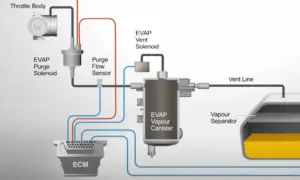
Here is the basic flow. Fuel vapors rise out of the gasoline in your tank. Instead of venting to the atmosphere, those vapors travel through a hose to a charcoal canister. The charcoal inside that canister acts like a sponge, absorbing and trapping the hydrocarbon vapors.
When your engine is running and conditions are right, a purge valve opens. This valve allows the engine’s vacuum to pull those stored vapors out of the charcoal canister and into the intake manifold, where they mix with the incoming air and get burned during normal combustion. The vapors become fuel. They help power the engine instead of polluting the air.
That is a point worth highlighting. The gasoline vapor that the EVAP system captures is flammable. It is essentially free fuel. When the system routes it back into the engine, it contributes (in a very small way) to combustion. This means the system actually helps reduce fuel waste while also managing pressure inside the fuel tank.
The whole setup includes several key parts:
- Charcoal canister: The storage unit for captured fuel vapors. Usually mounted near the fuel tank or in the engine bay.
- Purge valve (solenoid): Controls when vapors are pulled from the canister into the engine.
- Vent valve: Allows fresh air into the canister to push vapors toward the engine during purging.
- Fuel tank pressure sensor: Monitors the pressure inside the fuel tank to detect leaks.
- Network of hoses and connectors: Routes everything where it needs to go.
It is not a power-producing system. It is not directly involved in making your engine run faster or harder. Its job is environmental and regulatory. But that does not mean removing it has zero consequences, which is what a lot of people learn the hard way.
Why People Want to Delete the EVAP System
If you spend any time on car forums or watching build videos, you will hear several reasons why people consider an EVAP delete. Some of those reasons are legitimate, at least in certain contexts. Others are based on misconceptions that have been repeated so many times they have taken on a life of their own.
Let us separate the real reasons from the wishful thinking.
The Engine Bay Cleanup Factor
This is probably the most honest and practical reason people delete the EVAP system. If you pop your hood and look around, you will notice that the charcoal canister, the purge solenoid, the vent valve, and the associated hoses take up a fair amount of real estate. On some vehicles, the canister is the size of a large coffee thermos, and the hoses snake around in ways that make accessing other components a pain.
For someone doing a custom build, an engine swap, or a turbo conversion, that space matters. When you are trying to route a new intercooler pipe or fit a larger intake manifold, having a charcoal canister and its hoses in the way can be genuinely frustrating. Removing the EVAP components frees up that space and simplifies the engine bay layout.
For show cars and clean-bay builds, the aesthetic benefit is real too. A minimalist engine bay with smooth hose routing and no unnecessary clutter looks noticeably cleaner. If you are building a car that will spend its life at car shows and track days rather than commuting to work, the visual payoff of removing the EVAP system is hard to argue against.
Removing EVAP components can also make maintenance on surrounding parts easier. On some vehicles, the charcoal canister sits right in front of the oil filter, or the hoses run across the top of the valve cover. Getting those out of the way means less wrestling with parts every time you need to do basic service.
The Weight Savings Argument
This is a real benefit, but let us be honest about how much weight we are actually talking about.
| Component | Approximate Weight |
|---|---|
| Charcoal canister | 3 to 5 lbs |
| Solenoid valves | 0.5 to 1 lb |
| Hoses and connectors | 0.5 to 1 lb |
| Total potential reduction | 4 to 7 lbs |
Four to seven pounds. That is roughly the weight of a gallon of milk. On a 3,500-pound car, that is a 0.2 percent weight reduction. For a daily driver, you will never, ever feel the difference. Not in acceleration, not in braking, not in handling. It is statistically and physically insignificant for street driving.
But here is the thing. In competitive motorsport, the math works differently. If you are building a dedicated track car and you have already removed the spare tire, the rear seats, the sound deadening, the carpet, and the air conditioning, then every additional pound you shave off adds to the total. A track car builder might remove 200 pounds through dozens of small deletions, and the EVAP system is just one piece of that puzzle.
As one Corvette owner who runs HPDE events put it: “Taking out the EVAP system saved me about 7 pounds. Not much for street driving, but on track day, I will take every advantage I can get.”
That philosophy makes sense in context. The key word, though, is “track day.” If your car is a daily driver that occasionally hits the track, you are probably better off spending that effort on driver skill development than on chasing a handful of pounds.
Eliminating a Potential Source of Vacuum Leaks
This reason has more technical merit than the weight argument. The EVAP system is connected to your engine’s intake vacuum through the purge valve. If that valve fails, or if one of the EVAP hoses cracks or pops off, you suddenly have an unmetered air leak entering the intake.
Vacuum leaks mess with your air-fuel ratio. The engine’s computer sees more air coming in than expected, tries to compensate by adding more fuel, and the whole system gets thrown off. Symptoms include rough idle, hesitation during acceleration, and random misfires.
On older vehicles with aging rubber hoses and brittle plastic connectors, the EVAP system can be a source of hard-to-find vacuum leaks. Some GMT400 truck owners, for example, have reported that removing a failing EVAP system eliminated a stuttering issue under light throttle that they had been chasing for months.
A BMW E36 owner shared a similar experience: “After removing the EVAP system, my idle became noticeably smoother. Turned out the purge valve had been leaking for who knows how long.”
That said, the proper fix in these situations is to repair or replace the faulty component, not delete the entire system. A new purge valve costs $20 to $40 on most vehicles. A new section of vacuum hose is even cheaper. Deleting the whole system because one $25 part failed is like tearing out your kitchen plumbing because the faucet drips.
But in the real world, especially with older project cars that have multiple EVAP-related issues stacking up, some owners reach a point where deletion feels like the simpler path. Whether that is the right call depends on how the vehicle is being used.
The Horsepower Myth
Let us put this one to rest right now. Deleting the EVAP system does not add horsepower. Not one. Not five. Not any.
The EVAP system is not restricting airflow to your engine. It is not creating backpressure. It is not robbing power in any measurable way. The purge valve only opens under specific conditions to allow a small amount of fuel vapor into the intake stream. When it is closed, it has zero effect on engine performance.
There are modifications that genuinely improve power output. A cold air intake, a performance exhaust, a tune, forced induction. The EVAP delete is not one of them. If anyone tells you they gained horsepower from removing their charcoal canister, what they probably experienced was the fix of a vacuum leak that happened to be coming from a faulty EVAP component. The power was not gained. It was restored.
This is an important distinction, and it trips up a lot of people. If your EVAP system is working correctly, removing it will have zero performance benefit. If it is malfunctioning and causing a vacuum leak, you will feel a difference after removing it, but you would have felt the same difference from simply replacing the broken part.
What Your Car’s Computer Does When You Rip Out the EVAP System
This is where the “just delete it” crowd runs into trouble. Your vehicle’s ECU (Engine Control Unit) is programmed to monitor the EVAP system. It checks the purge valve operation, monitors fuel tank pressure, and runs self-tests to verify the system is sealed and functioning. When you remove the system, the ECU notices almost immediately.
Here is what typically happens:
- The check engine light comes on and stays on. This is not a “maybe.” It is a certainty on any OBD-II equipped vehicle (1996 and newer).
- The ECU logs specific diagnostic trouble codes related to the EVAP system. Common ones include P0440 (EVAP system malfunction), P0441 (purge flow fault), P0442 (small leak detected), P0446 (vent control malfunction), and P0455 through P0457 (large leak detected).
- Your vehicle will fail emissions readiness tests because the EVAP monitor will show as “incomplete” or “not ready.”
That persistent check engine light is not just annoying. It masks other potential problems. If your oxygen sensor fails or your catalytic converter starts degrading, the check engine light is already on, so you will not get a new warning. You will have to scan for codes regularly just to make sure nothing else has gone wrong, which most people do not actually do.
How to Deal With the Codes
If you go ahead with an EVAP delete, you have two options for handling the inevitable error codes.
Option one: Install resistors. On some vehicles, you can install resistors in the wiring harness to simulate the electrical feedback the ECU expects from the purge valve and vent valve solenoids. This tricks the computer into thinking the valves are still there and responding to commands. It does not always work perfectly, especially on newer vehicles with more sophisticated self-test routines, but it can prevent the check engine light on some models.
Option two: ECU reprogramming. A custom tune from a reputable tuner can disable the EVAP system monitors in the ECU software. The computer simply stops checking for those components. No check engine light, no codes, no readiness test failures (at least for the EVAP monitors). This is the cleaner approach, but it requires a professional tuner with experience on your specific platform, and it typically costs $200 to $500 or more depending on the vehicle and the tuner.
Neither of these options is a simple DIY project for someone without experience in automotive electronics or engine tuning. If you are not comfortable soldering wires or working with ECU tuning software, you are going to need professional help. And that professional help costs money, which eats into the supposed “simplicity” of the modification.
The Legal Side of EVAP Deletion (This Part is Not Optional Reading)
Here is the part that a lot of modification guides gloss over or bury at the bottom of the page. Deleting your EVAP system is illegal under federal law in the United States.
The Clean Air Act prohibits tampering with, removing, or rendering inoperative any emission control device on a motor vehicle. The EVAP system is an emission control device. Removing it is tampering. It does not matter if your state does not have emissions testing. It does not matter if your county does not do inspections. The federal law applies regardless of where you live.
Now, enforcement is another matter entirely. The EPA does not have agents knocking on garage doors checking for charcoal canisters. In practice, the risk of being caught and fined for an EVAP delete on a personally owned vehicle is relatively low, especially in rural areas without inspection programs. But “low risk” is not the same as “no risk,” and the potential consequences are not trivial.
According to the EPA and NHTSA, tampering with emissions equipment can result in fines reaching thousands of dollars. For shops and tuners, the penalties are even steeper.
Here is a breakdown of the legal landscape:
- California and CARB states (New York, Colorado, Oregon, Washington, and others that follow California Air Resources Board standards) have the strictest enforcement. Vehicles must pass a visual inspection of emissions equipment in addition to a tailpipe test. A missing charcoal canister or disconnected EVAP hoses will fail you on the spot.
- States with emissions testing (but not CARB standards) will likely fail your vehicle for incomplete OBD-II readiness monitors. Even if the check engine light is off thanks to a tune, the EVAP monitor will show as “not ready” unless the tune specifically addresses it.
- States with no emissions testing present the lowest practical risk. But the federal prohibition still applies. If you are ever involved in an accident, an insurance claim, or a legal dispute involving your vehicle, a deleted emissions system could become a liability.
There is also the resale value question. When it comes time to sell the vehicle, a missing EVAP system can be a deal-breaker for buyers in states with emissions requirements. Even in states without testing, savvy buyers might see a deleted emissions system as a red flag that makes them wonder what else has been modified or cut corners on.
And if your vehicle is still under warranty? An EVAP delete will almost certainly void your emissions warranty, and potentially your powertrain warranty if the dealer can argue that the modification contributed to a failure.
The Side Effects Nobody Warns You About
The legal and ECU issues are well-documented. But there are some day-to-day practical problems that catch people off guard after they complete an EVAP delete. These are the things that do not show up in a quick YouTube tutorial but become very real after a few weeks of living with the modification.
That Gasoline Smell That Will Not Go Away
Without the charcoal canister absorbing fuel vapors, those vapors have to go somewhere. If you simply cap off the vent line from the fuel tank, pressure builds up inside the tank (more on that in a moment). If you leave the vent line open to atmosphere, fuel vapors escape freely into the air around your vehicle.
Either way, you are going to smell gasoline. Especially in these situations:
- Hot weather. Higher temperatures mean more evaporation and more vapor production. On a 95-degree day, a full fuel tank produces a significant amount of vapor.
- Right after refueling. The fuel is agitated from being pumped into the tank, producing extra vapors.
- When the vehicle is parked in a garage. The vapors accumulate in an enclosed space. This is not just unpleasant. Gasoline vapor is flammable. In a poorly ventilated garage, concentrated fuel vapors present a genuine safety hazard.
- During long drives. With the windows down, you might catch whiffs of gasoline that were not there before the modification.
A lot of EVAP delete owners report being surprised by how noticeable the smell is. When the system was in place, the charcoal canister was quietly doing its job and you never thought twice about it. Once it is gone, you realize just how much vapor that canister was capturing.
Fuel Tank Pressure Headaches
The EVAP system does more than just capture vapors for environmental reasons. It also manages the pressure inside your fuel tank. As gasoline evaporates, vapor pressure builds up in the tank. The EVAP system provides a controlled pathway for that pressure to be relieved through the canister and eventually through the engine.
When you remove the system, pressure management becomes your problem. If you sealed the tank completely by capping all the vent lines, pressure builds up on hot days and creates several annoying issues:
- Difficulty refueling. The gas pump nozzle may click off repeatedly because the pressure in the tank is pushing back against the incoming fuel. You end up standing at the pump for 10 minutes, squeezing the handle in short bursts, getting increasingly frustrated.
- Fuel cap hissing. When you open the gas cap, you might hear a loud hiss as the built-up pressure escapes. A small hiss is normal on stock vehicles. A loud, prolonged hiss after an EVAP delete indicates significant pressure buildup.
- Potential fuel seepage. Under extreme pressure, gasoline can seep past seals and fittings that were never designed to handle that level of internal tank pressure.
- Vapor lock in extreme heat. In very hot conditions, excessive vapor pressure can cause fuel delivery issues. The fuel pump can struggle when it is trying to push liquid gasoline through a line that is partially filled with vapor. This is rare on modern fuel-injected vehicles but not unheard of in severe heat after an EVAP delete.
To avoid these problems, most EVAP delete installations include a vented fuel cap or a rerouted vent line that allows pressure to escape to the atmosphere. This solves the pressure issue but brings you back to the gasoline smell problem. You are essentially choosing between two annoyances.
Properly capping, rerouting, and managing the vent lines after an EVAP delete adds complexity and time to what most people think is a straightforward “just remove the parts” modification. It is rarely as simple as unplugging a canister and tossing it in the recycling bin.
Triggering Other Diagnostic Issues
On some vehicles, the EVAP system shares data with other engine management functions. The fuel tank pressure sensor, for example, might be used by the ECU for more than just EVAP monitoring. Removing or disconnecting components can sometimes cause unexpected knock-on effects in other systems.
Some owners have reported issues with fuel gauge accuracy after an EVAP delete, though this is model-specific and not universal. Others have noticed that their adaptive fuel trims shifted after the deletion because the ECU was no longer receiving the small amount of extra fuel vapor that used to enter the intake through the purge valve.
These are not catastrophic problems. But they are the kind of small, nagging issues that add up and make you wonder whether the modification was worth the trouble.
The Environmental Angle (Yes, It Matters)
This section is going to be shorter than the legal section, but it is worth addressing honestly. Some people care about this. Some people do not. Either way, the facts are the facts.
A functioning EVAP system reduces hydrocarbon emissions from fuel evaporation by up to 95 percent. That is not a marketing number. That is the measured effectiveness of the charcoal canister at capturing vapors that would otherwise escape into the atmosphere.
Those hydrocarbons, when released into the air, contribute to:
- Ground-level ozone formation (the bad kind of ozone, not the protective layer in the upper atmosphere)
- Smog development, particularly in urban areas
- General air quality degradation
- Respiratory health issues for people with asthma and other lung conditions
One car with a deleted EVAP system is not going to meaningfully change the air quality in your city. That is true. But the regulations exist because the cumulative effect of millions of vehicles matters. The air quality improvements that cities have achieved over the past 50 years are directly tied to emissions controls like the EVAP system. If everyone deleted theirs, we would be back to 1960s smog levels in a hurry.
Whether that factors into your personal decision is up to you. But pretending the environmental impact does not exist would be dishonest.
The Honest Cost-Versus-Benefit Breakdown
Let us lay everything out side by side so you can see the full picture at a glance.
| Potential Benefits | Potential Drawbacks |
|---|---|
| 4 to 7 lbs weight reduction | Illegal under federal law |
| Cleaner, more open engine bay | Persistent check engine light (without a tune) |
| Easier access to surrounding components | Specific EVAP error codes (P0440 to P0457) |
| Eliminates aging EVAP parts as a failure point | Increased hydrocarbon emissions |
| Space for aftermarket modifications | Gasoline smell, especially in heat |
| Simplified engine bay for custom builds | Fuel tank pressure and refueling issues |
| Will fail emissions testing | |
| Possible warranty voiding | |
| Potential resale value impact | |
| Cost of ECU tune or resistor installation |
When you look at the table, the drawback column is noticeably longer. That is not editorial bias. It is just the reality of the modification. The benefits are real but narrow in scope. The drawbacks are varied and affect multiple aspects of vehicle ownership.
Where the EVAP Delete Actually Makes Sense
There are specific scenarios where the math tips in favor of deletion. Not many, but they do exist:
- Dedicated track or race cars that are trailered to the track and never driven on public roads. No registration, no inspection, no emissions testing. In this case, every pound and every inch of space counts, and the legal restrictions on emissions equipment do not apply to vehicles that are not operated on public highways.
- Off-road only vehicles that are registered as off-highway vehicles and never see pavement. Same logic as track cars.
- Older project cars in areas with no emissions testing where the EVAP system has multiple failing components and replacement parts are hard to find or disproportionately expensive. A 1985 project car with a crumbling charcoal canister and discontinued replacement parts is a very different situation than a 2018 daily driver.
- Full engine swap builds where the original EVAP system is incompatible with the new engine and integrating it would require extensive custom fabrication.
If your vehicle does not fall into one of these categories, the EVAP delete is probably not the right move. And even in these scenarios, you should understand exactly what you are giving up before you commit.
Smarter Alternatives That Solve the Same Problems
If the EVAP system is giving you grief, whether it is taking up space, causing vacuum leaks, or throwing codes, there are usually better solutions than deleting it entirely.
Fix What is Broken Instead of Removing the Whole System
This sounds obvious, but you would be surprised how many people jump straight to deletion when the real problem is a $25 purge valve or a $5 section of vacuum hose. EVAP components are not expensive on most vehicles. A charcoal canister typically runs $40 to $100. A purge solenoid is $20 to $50. Hoses and connectors are pocket change.
Compare that to the cost of a professional ECU tune to disable the EVAP monitors ($200 to $500+), and repair suddenly looks like the cheaper option. Plus, you keep your vehicle legal, your check engine light functional as a warning system for other issues, and your fuel tank properly managed.
If you are dealing with a check engine light caused by an EVAP leak code, start with the basics. Inspect the gas cap first. A loose or worn gas cap is the number one cause of EVAP codes and costs about $10 to fix. Then move on to inspecting hoses and connectors for cracks. Then test the purge valve and vent valve. Work through the diagnostic process before deciding the whole system needs to go.
Relocate Components Instead of Removing Them
Need the space where the charcoal canister sits? Some enthusiasts relocate the canister to a less obtrusive location rather than deleting it. The canister does not have to live in the engine bay. It can be moved to the trunk area, under the chassis, or behind a fender liner, as long as the hose routing still works.
This gives you the engine bay space and the clean look you want while keeping the system functional and your vehicle legal. It takes more effort than a simple delete, but it is a smarter long-term solution for a street-driven vehicle.
Upgrade to Newer, Smaller Components
EVAP technology has improved significantly over the decades. If your vehicle has an older, bulky charcoal canister and oversized hoses, you might be able to source newer, more compact components that perform the same function in a smaller package.
Some aftermarket companies even make compact charcoal canisters designed specifically for engine-swapped or custom-built vehicles. They take up a fraction of the space of a factory unit and work just as well.
Upgrading to modern components solves the space and reliability concerns without any of the legal, environmental, or practical downsides of a full deletion.
If You Are Going Through With It Anyway: A Pre-Deletion Checklist
Some of you have read everything above and decided that the EVAP delete is still the right move for your specific build and situation. Fair enough. If that is the case, at least go into it with your eyes open and your bases covered.
Before you touch anything, work through this checklist:
- Research your local and state emissions regulations. Know exactly what your vehicle is required to have and what inspections it must pass. Do not assume. Look it up.
- Check whether your vehicle has any open recalls or TSBs related to the EVAP system. If it does, get the free factory fix before making modifications.
- Research your specific vehicle model for known EVAP delete complications. Some vehicles handle the deletion better than others. Forums and build threads for your specific platform are invaluable here.
- Budget for a proper ECU tune to disable EVAP monitors. Do not plan on just living with a check engine light. That light is your only warning system for dozens of other potential problems.
- Plan your fuel tank venting strategy. Decide whether you will use a vented gas cap, a rerouted vent line, or another solution for managing tank pressure. Do not just cap everything off and hope for the best.
- Consider the impact on resale value. If you might sell the vehicle someday, think about whether you can reinstall the EVAP components later. Keep the parts if you remove them.
- Think honestly about how the vehicle is used. If it is a daily driver that sees rain, heat, cold, and long commutes, the EVAP delete will introduce annoyances you will live with every single day. If it is a weekend track car that gets trailered to events, those annoyances are much less relevant.
The Bigger Picture on EVAP Deletion
The EVAP delete is one of those modifications that looks great on paper if you only read the “benefits” column. Lighter weight. Cleaner engine bay. Fewer hoses to deal with. Sounds like a win.
But the full reality includes a permanently illuminated check engine light (unless you pay for a tune), a gasoline smell that follows your vehicle around, potential fuel tank pressure issues, a vehicle that is technically illegal on public roads, possible warranty problems, and a resale complication that you will have to explain to the next owner.
For dedicated race cars, full engine swap builds, and vehicles that never see public roads, the trade-off can make sense. The rules are different when you are building a machine purely for performance and every ounce and every cubic inch of space is being optimized for a single purpose.
For daily drivers, commuter cars, and street-driven vehicles? The honest answer is that the EVAP system is doing a job that costs you nothing in performance, adds negligible weight, and keeps your vehicle legal and properly functioning. The 4 to 7 pounds it adds to your car is less than the weight of the fast food bag on your passenger seat.
If your EVAP system is causing problems, fix it. If it is in the way of a build, relocate it. If you absolutely must delete it, do it properly with a tune and a venting plan.
But whatever you do, do not delete it expecting horsepower gains. That is not how this works, and no amount of forum posts claiming otherwise will change the physics.