
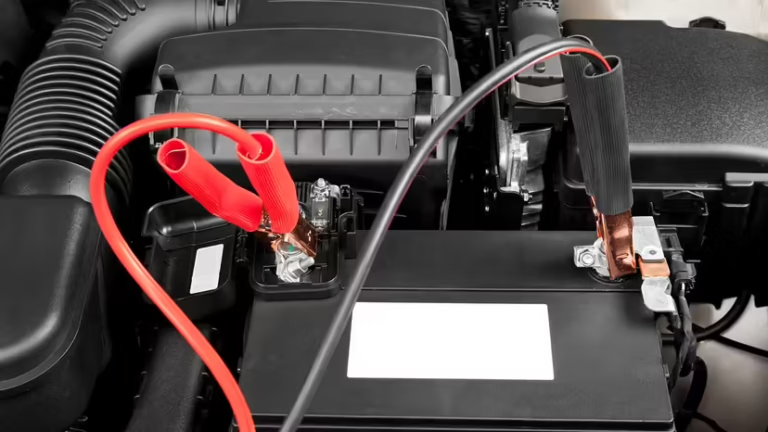
You know the scene. You are in the parking lot, you turn the key, and the engine only gives you a sad click. Someone waves jumper cables at you like they have all the answers. They might even say, “These work on my truck.”
But here is the problem. The gauge of jumper cables matters. It affects how easily the cables can carry the high current a battery needs during a jump-start. Get the thickness wrong and the cables can run hot, under-deliver power, and turn a simple jump into a frustrating, overheated mess.
In this guide, I will help you sort out 2-gauge versus 4-gauge jumper cables, explain what the gauge number really means, and show you which cable thickness makes the most sense for your vehicle. You will also get a practical shopping checklist so you can buy once and stop thinking about it until the next time your battery plays dead.
Since jumper cables are only useful when you need them, this is one of those “buy the right tool now” moments. Let us make sure the set in your trunk is the kind that saves the day.
What the Gauge Number Actually Means
When people compare 2-gauge and 4-gauge jumper cables, the discussion comes down to two things: thickness and conductivity. Thicker cable has less internal electrical resistance, which means less voltage loss, less heat, and more consistent current delivery to the starter.
Here is the counterintuitive part. A lower gauge number means a thicker wire. So a 4-gauge cable is thicker than a 6-gauge cable, and a 2-gauge cable is thicker than a 4-gauge cable. Thicker wire carries more current with less strain.
Less resistance is not just a theory. It directly affects real jump-start performance. When resistance is lower, current flows faster and the battery receives the voltage it needs to get the engine cranking. That is why the right cable thickness usually means the difference between a jump that works in seconds and a jump that keeps failing while cables warm up.
Now think about what a jump-start actually requires. A dead battery typically cannot provide enough current to crank the starter motor, so you are borrowing current from the other vehicle. That borrowed current travels through your jumper cables. If the cables are too thin, they heat up and voltage drops, and the jump may not have enough “push” to start the engine.
Thin cables can work in a pinch. That does not mean they are the best choice for regular use. The warning signs are usually obvious once you have tried it. You might see cables get unusually warm, smell a hot electrical odor, or notice the clamping connection starts acting loose. Those are the moments when a thicker gauge becomes a safety and reliability advantage.
For heavy-duty applications, thickness matters even more. If you are jump-starting a diesel engine or a vehicle with a large engine and heavy electrical demand, you want cables that can handle that current load without overheating.
For most drivers, 4-gauge is the sweet spot. It is thick enough for a wide range of personal vehicles and strong enough to handle longer cable runs more safely than typical thin cables. If you regularly deal with large vehicles, extreme cold, or repeated back-to-back jump attempts, 2-gauge gives you extra headroom.
As a practical example, if you routinely help friends with trucks or you keep tools for road trips and work vehicles, you want cables that keep delivering current even when conditions are not ideal. That is where a heavier gauge starts paying you back, not just in convenience, but in confidence.
Why thin cables “melt” in real life
You sometimes hear stories about jumper cables melting. The myth version blames “magic heat.” The mechanic version is more boring and more accurate.
Thin cables have higher resistance. When high current passes through them for long enough, the cables generate more heat. If the jump does not start the first try, the cables may stay under load while you keep attempting cranking. That makes the heating worse and can damage insulation or clamps. So the thickness is not only about speed. It is about heat management under a load that can last longer than you expect.
That is why a good set of cables is like a good fire extinguisher. You hope you never need it. When you do need it, the tool has to work reliably under real stress.
A quick analogy that makes it stick
Imagine current flow like water through a hose. A thicker hose lets more water move with less friction. A thin hose has more restriction. In electrical terms, restriction becomes resistance, and resistance becomes heat. The “gauge number” is basically your hose thickness number.
The real-world detail most people miss: voltage drop
Even if the jump-start “almost works” with thin cables, it might fail because voltage drop reduces the power reaching the starter. The starter needs a high current burst to crank the engine. If your cable set drops too much voltage along the way, the battery might not get enough power to spin the engine fast enough for ignition.
That is why thicker cable tends to feel more consistent. It is not just about carrying the current. It is about keeping the voltage where the starter needs it.
How They Stack Up in Real-World Performance
Let us talk about what actually happens when you clamp cables onto a dead battery. The process is simple on paper. You connect the cables. You start the donor vehicle. You crank the dead vehicle. In real life, the connection quality and cable resistance decide whether the engine starts quickly or whether you keep retrying until something gets too hot.
4-gauge cables deliver strong current flow with minimal resistance. That is exactly what you want when you are trying to jump-start a truck, SUV, or any vehicle with a bigger engine and higher electrical demand. They handle higher amperage without getting dangerously hot, which is a genuine safety concern with thinner cables.
Now add another real-world factor: cable length. Longer cables increase the path resistance. If you use thin cables over long distances, the voltage drop can become a bigger problem. The original guidance points out a key example: if you have longer cables, say 20 feet, thickness matters more because longer runs of thinner wire lose more voltage along the way.
A 4-gauge cable at 20 feet will maintain much more consistent power delivery than a 6-gauge cable at the same length. That difference can be the line between a jump that starts in one attempt and a jump that fails repeatedly.
2-gauge cables take that idea and push it further. They are built for the most demanding situations. That includes commercial vehicles, extremely cold weather starts, and repeated back-to-back use. They also resist damage better under harsh conditions and high current flow.
In the real world, though, most personal vehicle owners do not need to go that heavy. A lot of owners never touch their jumper cables for months or years. When they finally need them, they want reliability without overthinking it. That is why 4-gauge shows up as the practical default for so many people.
What changes your jump-start outcome the most (besides gauge)
Gauge is a huge factor. It is not the only one. In my experience, these are the other “hidden” variables that decide how the jump goes:
- Clamp contact quality: the clamp must bite metal cleanly, not just cling to paint, corrosion, or grime.
- Battery condition: a battery that is heavily sulfated may accept less current.
- How long you crank: longer cranking attempts build heat and drain both batteries.
- Donor vehicle health: a weak donor battery or poor alternator output limits the assist.
- Cold temperatures: in extreme cold, batteries deliver less current and engines need more cranking time.
- Cable length and routing: keeping the cable run short and avoiding tight bends helps reduce resistance.
Still, even with those factors in play, a thicker cable gives you more margin. That is what you want when you are stressed and need the problem solved fast.
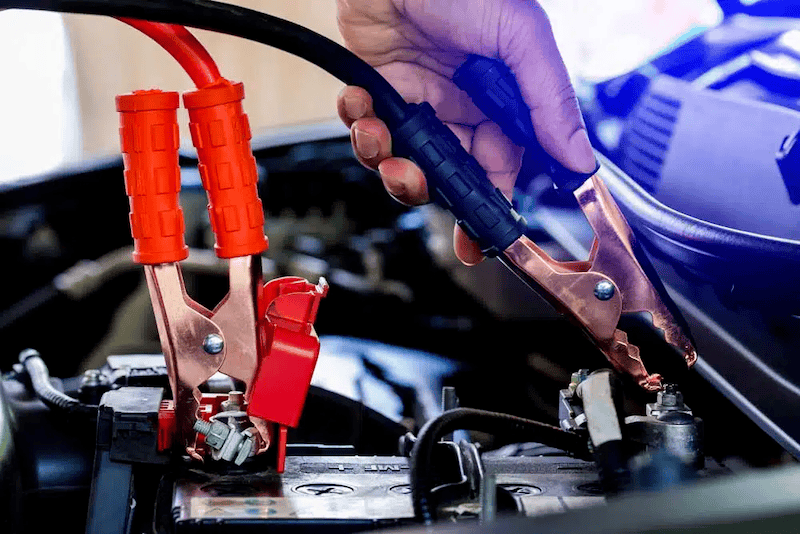
Which Gauge Fits Your Vehicle?
The right cable depends entirely on what you are jump-starting. Here is a simple guide you can actually use without doing electrical math on the side of the road.
| Vehicle Type | Recommended Gauge |
|---|---|
| Small cars (sedans, compacts) | 8 to 10-gauge |
| Standard passenger vehicles | 6-gauge |
| Trucks, SUVs, diesel engines | 4-gauge |
| Commercial/extreme conditions | 2-gauge |
If you want a practical “real life” recommendation, the original guidance is spot on. If you frequently deal with varying battery sizes or live somewhere with brutal winters, lean toward 4-gauge at minimum. Cold weather makes batteries sluggish, and you need cables that can push enough current to overcome that resistance quickly.
A set of 4-gauge cables in your trunk covers about 90% of real-world situations. That is the honest answer for most people because most drivers deal with passenger vehicles, crossovers, occasional larger engines, and a few winter start attempts across the year.
Then there is the “maybe you should go thicker” group. If you regularly handle large vehicles, heavy electrical loads, or repeated jump-starts, 2-gauge gives you extra safety and durability margin. It is not about being fancy. It is about being ready when conditions do not cooperate.
Quick picks based on how you use your vehicle
Let us connect the chart to everyday habits so you can decide without a second thought.
- If your vehicle is a daily commuter and it lives mostly in mild conditions, 6-gauge might be okay, but 4-gauge is still a safer all-around option.
- If you own a truck, SUV, or drive diesels, 4-gauge should be your baseline.
- If you live where winter starts are hard, 4-gauge minimum is the guidance-aligned move.
- If you are doing jump-starts for work vehicles or emergencies in extreme weather often, 2-gauge is the “built for it” choice.
Think of it like buying a snow brush. If you only see snow once a year, any brush might work. If you are in snow every month, you want the brush that clears fast and does not crack.
What You’ll Actually Spend
Let us talk money for a second, because nobody wants to overpay for something that sits in a trunk all year. The key question is not “What is the cheapest set?” It is “What is the most dependable set that will not let you down when the battery is truly dead?”
According to the original guidance, here is what you can expect:
- 4-gauge cables: Typically run $30 to $70. You are paying for thicker copper wire, better clamps, and improved insulation.
- Budget cables: You can find cheap sets for around $15, but they often use flimsy clamps, thinner wire, and lower overall build quality.
- The real cost of cheap cables: If bargain cables overheat or fail during a jump-start, you could end up with damaged battery terminals or other electrical issues. That is not worth the savings.
Good jumper cables are like a fire extinguisher. You do not use them often. When you need them, you want them to work immediately. The original guidance suggests that spending an extra $20 to $30 for a quality 4-gauge set is cheap insurance.
Here is a scenario I see in the real world. Someone buys a super cheap cable set. They try a jump. The cable clamp does not bite cleanly due to corrosion on the battery terminal. The user keeps cranking. The cables warm up. The next day they have a battery issue and possibly damaged terminals because the jump did not go smoothly.
Now compare that to the driver who keeps a solid 4-gauge set. They can clamp securely, they have lower resistance, and the jump either works immediately or it gives you the confidence to stop and troubleshoot correctly instead of repeating cranks.
The price you pay is really a cost of uncertainty
Cheap cables can “work” in perfect conditions. Most of the time, it looks fine because your battery is only slightly weak. But dead batteries are unpredictable. Voltage drop, cold weather, and donor vehicle strength vary. Thicker cables reduce the uncertainty.
So, if you want peace of mind, treat jumper cables like a safety tool. Paying for the right gauge is paying to reduce the chance that a simple problem turns into an electrical mess.
Smart Shopping: What to Look For
Choosing the right gauge is only part of the equation. Even a perfect gauge can fail if the clamps are weak or the insulation is thin. This is why the shopping checklist matters.
Here are the key things worth paying attention to, using the original guidance:
- Length: Get at least 12 feet. If you want real flexibility, such as jump-starting from a vehicle parked behind you, go for 20 feet.
- Clamp material: Look for solid copper clamps. Aluminum corrodes over time and can create a poor connection when you need a strong one.
- Insulation: Choose thick, high-quality insulation. If your region sees extreme cold, this is not optional. Good insulation protects the cables from hot and cold conditions while maintaining safe handling.
- Warranty: Decent cables usually come with a warranty. That is a signal the manufacturer supports the product.
One more detail that matters more than people think. Do not toss your jumper cables loose into your trunk. Keep them in the bag or case they came in. Exposed clamps rattling around can short against each other or damage other items back there.
If your cables constantly move, the connection points wear faster and the clamps can lose their grip. That is another reason thicker, better-built sets tend to last longer and work better when needed.
What I look for as a mechanic when customers ask about jump cables
Owners often bring in cables they bought and ask why a jump still failed. When I inspect them, these are the common issues I see:
- Thin wire markings that do not match what is printed on the cable sleeve.
- Clamps that feel weak, meaning they do not bite firmly into terminal metal.
- Clamps that wobble because the hinge or spring tension is inconsistent.
- Insulation that cracks from storage exposure and age.
- Uneven cable thickness where one side seems lighter or more flexible than the other, which can create mismatch.
When you buy a quality 4-gauge set, you reduce all of those failure points at once. That is why the gauge matters, but the overall build quality matters just as much.
Do your cables need to match the battery type?
Battery type matters, but not in the way people assume. You do not need special “diesel jumper cables.” You need cables that can handle the current demand of the engine cranking, regardless of whether the engine is gas or diesel.
That is why 4-gauge is recommended for trucks, SUVs, and diesel engines. Diesel engines often require strong cranking power to start, especially when cold, and that is exactly what thicker cables deliver better.
A quick, safe jump-start checklist (so the cables perform)
You can have the perfect 4-gauge set and still mess up the jump if you connect it wrong or crank too long. Here is a simple routine that keeps things safer and increases your odds of success.
This is not about being overly cautious. It is about avoiding the mistakes that create heat, sparks, and damaged parts.
Before you connect anything
- Park both vehicles safely so cables can reach without tension.
- Turn off both vehicles, and keep accessories off.
- Check the battery terminals for heavy corrosion or damage. If they are heavily crusted, clean enough for a clamp bite.
- Make sure the cable clamps are not touching each other or metal parts before connection.
How to connect the cables the right way
The exact steps can vary slightly by vehicle design, but the order and polarity concepts are the same. Use this logic:
- Connect one clamp to the positive (+) terminal of the dead battery.
- Connect the other positive clamp to the positive (+) terminal of the donor battery.
- Connect the negative clamp to the negative (-) terminal of the donor battery.
- Attach the remaining negative clamp to a solid ground point on the dead vehicle if recommended in your guidance. Some setups allow negative on the battery, but ground point is often safer because it reduces sparks near the battery.
Do not guess polarity. Reversing polarity can damage electronics and can create dangerous short circuits.
How long to crank (so you do not overheat cables)
If the engine does not start quickly, stop and reassess. Prolonged cranking keeps high current flowing through the cables. Even with good gauge cables, extended attempts generate heat.
A practical rule is to attempt cranking in short bursts, give the dead battery a moment to recover, and then try again if needed. If it still does not start, you might be dealing with more than a simple dead battery, such as a failed alternator, a bad starter, or another power issue.
Real-owner scenarios: which gauge would you want?
Let us make this concrete. You do not buy cables for theory. You buy them for real parking lots and real winters.
Scenario 1: compact car, mild weather, short distance
If you have a compact car and you jump-start it in mild weather with cables stored neatly, a smaller gauge like 8 to 10 can work. The table in the original guidance shows 8 to 10-gauge for small cars. Still, many owners choose 4-gauge because it is more universal.
Even if you do not “need” 4-gauge, you benefit from the reliability margin. You also avoid being stuck when you are not jumping your exact same vehicle next time.
Scenario 2: SUV or diesel pickup in winter
This is where your trunk choice matters. In cold conditions, the battery has reduced output. Thinner cables can lose voltage and heat up. The original guidance recommends 4-gauge for trucks, SUVs, and diesel engines, and it also suggests 4-gauge at minimum for harsh winters.
If you ever tried to jump a diesel in cold weather with cheap thin cables, you know what happens. The donor engine may rev slightly, but the dead engine stays stubbornly silent. A good 4-gauge set gives the starter a better chance.
Scenario 3: you help others, often, with different vehicles
If you frequently deal with varying battery sizes, you want one set that handles most cases. The original guidance says a set of 4-gauge cables covers about 90% of real-world situations. That is exactly why many owners buy 4-gauge once and stop worrying.
When you are the person everyone calls, you want your cables to work fast. That is not the time to discover that the cable set you bought was meant for an occasional emergency on a sunny day.
Scenario 4: commercial work or repeated use
If you regularly run into dead batteries in the field, or you jump-start vehicles back to back, you are closer to the “commercial/extreme conditions” category. The table recommends 2-gauge for commercial/extreme conditions. That is not just about starting. It is about avoiding heat stress and handling repeated current demand.
For fleets and repeated emergencies, thicker cable is part of keeping your tools dependable.
Storage and maintenance: keep your cables ready
Jumper cables degrade when you treat them like random trunk clutter. You do not have to baby them, but you should store them correctly. The original guidance says not to toss them loose, and it specifically warns about exposed clamps rattling around.
Here is what that looks like in a practical way:
- Store cables in their case or bag so clamps do not contact each other.
- Keep clamps clean. If you notice corrosion, wipe the clamp faces so they can bite metal.
- Check insulation for cracks or damage.
- Do a quick “clamp feel” test every so often. If they do not clamp firmly, replace or repair.
- Make sure cables are not twisted hard. Twists can stress insulation and internal conductors.
This does not take long. It does prevent that moment when you finally need cables, and the clamp does not make a proper connection because it is corroded, loose, or damaged from storage.
Also, if you keep other truck or utility accessories, it helps to plan where the cables live. For example, some drivers build storage setups that hold accessories securely so heavy items do not crush cables. If you have a setup that keeps things organized, that makes it more likely you will pull the cables out quickly when needed. If you want ideas for organizing truck storage, this can help: top truck bed accessories you should try.
Organization is not just for looks. It prevents damaged clamps and helps you find the cables quickly.
One more ownership thought: if you want fewer surprises like dead batteries, it helps to stick to basic maintenance routines. When battery health and charging issues get ignored, jump-starts become more frequent. If you want a practical approach to maintenance habits, use this: Top 10 Car Maintenance Tips (Plus Expert Routines, DIY Tools, and Apps).
The question to ask yourself before you buy (or before you rely on what you have)
Here is the real test. If your battery died tomorrow in a freezing parking lot, would you trust your jumper cables to deliver strong current without overheating?
If your answer is uncertain, do yourself a favor. Upgrade to a reliable thickness. Follow the gauge guidance you saw: 4-gauge as the practical default, and 2-gauge if you deal with extreme conditions or heavy-duty use. A quality set costs less than a tow, and it can save you from electrical damage caused by struggling bargain cables.
So ask yourself now: if you needed a jump-start today, would the cables in your trunk start the car quickly, or would you be praying they do not heat up and fail?