

Here’s something most drivers don’t think about nearly enough: your tires are the only thing connecting your car to the road. That’s it. Four patches of rubber, each roughly the size of your hand, are responsible for every turn, every stop, and every lane change you make. And the air pressure inside those tires? It affects way more than you’d expect, from how your car handles to how much you’re spending at the gas pump.
Tire pressure is measured in pounds per square inch (PSI), and getting it right isn’t optional. Drive on tires that are too soft, and you’ll burn more fuel, chew through tread faster, and compromise your ability to brake quickly. Pump them up too much, and you lose grip, especially in the rain. Either way, you’re putting yourself at risk and throwing money away.
So how much PSI do your tires actually need? And how do you keep them there? Let’s break it all down.
Why Wrong Tire Pressure Can Wreck Your Drive (and Your Wallet)
Getting your tire pressure right isn’t just some nerdy maintenance task. It has a direct impact on three things every driver cares about: how the car feels, how far a tank of gas takes you, and how long your tires last.
Your Steering and Handling Depend on It
When your tires are inflated to the right PSI, they maintain their intended shape and provide the optimal contact patch with the road. That means your steering feels sharp, your cornering stays stable, and you’ve got predictable control over the vehicle.
Now imagine your tires are low on air. They flatten out more than they should, creating a bigger, sloppier contact patch. The result? Sluggish steering and more rolling resistance. It’s like trying to ride a bicycle with half-flat tires. Everything feels heavier and less responsive.
Flip that around, and overinflated tires bring their own set of headaches. The contact patch shrinks, so less rubber is actually touching the pavement. You’ll notice a harsher ride and noticeably less traction, which is especially dangerous on wet or icy roads. Think of it like a basketball bouncing down the highway. Not exactly confidence-inspiring.
Low Tires Are Quietly Draining Your Gas Tank
This one surprises a lot of people. Underinflated tires increase rolling resistance, which means your engine has to work harder just to keep the car moving at the same speed. That extra effort burns more fuel. Some estimates suggest that for every 1 PSI drop in all four tires, your gas mileage drops by about 0.2%. It doesn’t sound like much, but over weeks and months, it adds up fast.
Overinflated tires aren’t great for fuel economy either, though the mechanism is a bit different. They can’t flex properly to absorb bumps and road imperfections, which creates a rougher ride and wastes energy in other ways. The sweet spot is always the manufacturer’s recommended PSI.
Want Your Tires to Last? Keep Them at the Right Pressure
Tires aren’t cheap. A full set can easily run you $400 to $800 or more, depending on your vehicle. So it makes sense to get as many miles out of them as possible, right?
When tires are underinflated, the outer edges of the tread wear down faster than the center because the tire is sagging and spreading out under the car’s weight. That uneven wear pattern means you’ll need replacements much sooner than expected.
Overinflation causes the opposite problem. The tire bulges in the middle, and the center of the tread wears out prematurely. Either scenario shortens tire life significantly. Keeping the pressure where it should be distributes wear evenly and helps you get every last mile out of your investment.
How to Find the Right PSI for Your Car
Here’s something that trips people up: the number printed on the tire sidewall is not your recommended tire pressure. That number is the tire’s maximum allowable pressure. What you actually need is the pressure recommended by your vehicle’s manufacturer, which is based on your car’s weight, tire size, and load capacity.
So where do you find the right number? You’ve got a few reliable options:
Check Your Owner’s Manual First
Your owner’s manual is the gold standard. It’ll list the recommended PSI for both front and rear tires (they’re not always the same, by the way). It may also include different recommendations for varying loads or driving conditions, like highway cruising versus city driving with a full car.
Look for the Sticker on Your Driver’s Side Doorjamb
Pop open your driver’s side door and look at the edge of the door frame, near the latch. Most vehicles have a tire information sticker right there. It’ll show the recommended PSI, the correct tire size, and sometimes the load index too. This is probably the quickest and easiest way to find your number without digging through the glove box.
The Glove Box Label
Some vehicles place this information on a label inside the glove compartment or on the fuel filler door. It varies by manufacturer, but a quick look in these spots will usually turn it up.
Online Lookup Tools (Use With Caution)
Plenty of websites and tire manufacturer tools let you punch in your vehicle’s year, make, and model to get a recommended PSI. These can be handy in a pinch, but they’re not always perfectly accurate for every trim level or tire option. When in doubt, trust the sticker on your doorjamb or your owner’s manual over anything online.
How to Check and Adjust Your Tire Pressure (Step by Step)
This is one of the easiest car maintenance tasks you can do yourself. It takes about five minutes and doesn’t require any special skills. Here’s what you need and how to do it.
What You’ll Need
- A tire pressure gauge (digital or stick-type, both work fine. You can grab one for under $10)
- Access to an air compressor (most gas stations have one, or you can buy a portable one for your garage)
Step-by-Step: Checking Your Pressure
- Park on a flat surface. This ensures an even reading.
- Make sure your tires are cold. If you’ve been driving, wait at least three hours. Driving heats up the air inside the tire and gives you a falsely high reading.
- Unscrew the valve stem cap on the first tire. Set it somewhere you won’t lose it.
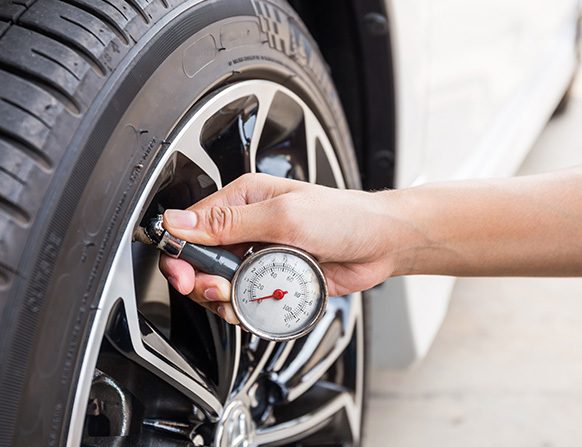
- Press the gauge firmly onto the valve stem. You might hear a quick hiss of air. That’s normal. Just make sure the gauge is seated properly.
- Read the PSI on the gauge display.
- Compare it to your vehicle’s recommended pressure. Do this for all four tires (and don’t forget the spare if you have one).
If the Pressure Is Off, Here’s How to Fix It
Pressure too low? Attach the air compressor hose to the valve stem and add air in short bursts. Check the pressure frequently as you go. It’s easy to overshoot if you’re not paying attention.
Pressure too high? Press the small pin inside the valve stem with the back of your gauge or a fingernail. You’ll hear air escaping. Release it in small increments and recheck until you hit the target PSI. Then screw the valve cap back on and move to the next tire.
What Your TPMS Can (and Can’t) Do for You
If your car was built after 2007 (in the US), it almost certainly has a Tire Pressure Monitoring System (TPMS). This system uses sensors inside each tire to track air pressure in real time. When the pressure in any tire drops significantly below the recommended level, a warning light pops up on your dashboard, usually shaped like a flat tire with an exclamation point.
That’s a great safety net. But here’s the thing: TPMS isn’t a replacement for checking your tires manually.
Why? Because the system typically only triggers when pressure drops 25% or more below the recommended level. That means your tire could be 5 or 6 PSI low, already affecting your fuel economy and tread wear, and the light still won’t come on. TPMS sensors can also malfunction, lose battery power, or give inaccurate readings after a tire rotation or replacement.
Bottom line: treat the TPMS light as a red alert, not a routine check. You should still be grabbing your gauge at least once a month.
How Temperature Swings Mess With Your Tire Pressure
This catches a lot of drivers off guard, especially during seasonal transitions. Air expands when it heats up and contracts when it cools down. Inside a sealed tire, that means your PSI rises in warm weather and drops in cold weather.
As a general rule of thumb, tire pressure changes by about 1 PSI for every 10°F shift in ambient temperature. So if you set your tires to 35 PSI in September and the temperature drops 30 degrees by November, you could be rolling around on tires that are 3 PSI low without realizing it.
That’s exactly why it’s so important to check your tires when they’re cold, meaning they haven’t been driven on recently and haven’t been sitting in direct sunlight. A reading taken after a long highway drive on a hot day could be 4 to 6 PSI higher than the true “resting” pressure. If you adjust based on that hot reading, you’ll actually end up underinflated once the tires cool down.
FAQs
How often should I check my tire pressure?
At least once a month, and always before a long road trip. Tires naturally lose about 1 PSI per month even without a puncture, so regular checks keep you ahead of the curve.
What happens if my tires are underinflated?
You’ll burn more gas, your tires will wear out unevenly and faster, your handling will feel sluggish, and in extreme cases, a severely underinflated tire can overheat and blow out. It’s one of those problems that seems minor but can snowball quickly.
What happens if my tires are overinflated?
Overinflated tires give you a rougher ride because they can’t absorb bumps properly. You’ll also get less grip on the road, the center of your tread will wear out faster, and the tire is more vulnerable to damage from potholes or debris.
Can I adjust tire pressure myself?
Absolutely. All you need is a tire pressure gauge and access to an air compressor. It’s one of the simplest DIY car tasks out there. Just make sure you’re inflating to the manufacturer’s recommended PSI, not the maximum number stamped on the tire sidewall.
What’s the best time of day to check tire pressure?
Early morning is ideal. Your tires are cold, meaning they haven’t been warmed up by driving or sunlight. Cold readings give you the most accurate picture of where your pressure actually stands. If you’ve driven recently, wait at least three hours before checking.
Five minutes with a $10 gauge once a month. That’s all it takes to protect your tires, save fuel, and keep your car handling the way it should. When’s the last time you actually checked yours?