
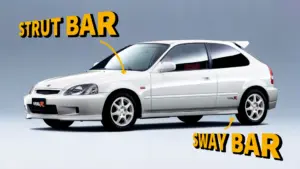

Most car owners know the basics of how a suspension system works. Springs absorb bumps. Shock absorbers dampen the bounce. Simple enough. But ask those same owners about strut bars and sway bars, and you will usually get a blank stare.
That is completely understandable. These are not components most people interact with directly. They live in the background, doing their job quietly until something goes wrong or until you start pushing the car harder than a normal commute demands. But understanding what they do and how they differ from each other can help you make smarter decisions about your car, whether you are dealing with a handling problem, upgrading a performance build, or just trying to understand what is going on underneath your vehicle.
Table of Contents
Let us walk through both, compare them honestly, and figure out which one actually matters more for your situation.
Why Your Car Might Need More Than Just Shocks and Springs
Here is something that does not get talked about enough. A car’s suspension system is only as effective as the structure it is bolted to. You can have perfectly tuned shocks and springs, and the car will still handle poorly if the body flexes too much under cornering loads.
Think about it like this. Imagine trying to hold a bowl of water steady while the bowl itself is made of flexible rubber. No matter how careful you are, the water sloshes around because the container is distorting. The same principle applies to a car’s chassis under hard cornering. If the metal structure around the suspension mounting points flexes and twists, the geometry of the suspension changes in ways it was not designed to. Handling suffers. Traction becomes inconsistent. The car feels vague and unpredictable at the limit.
Strut bars and sway bars both address versions of this problem. But they address different aspects of it, and that is the key distinction.
What Is a Strut Bar?
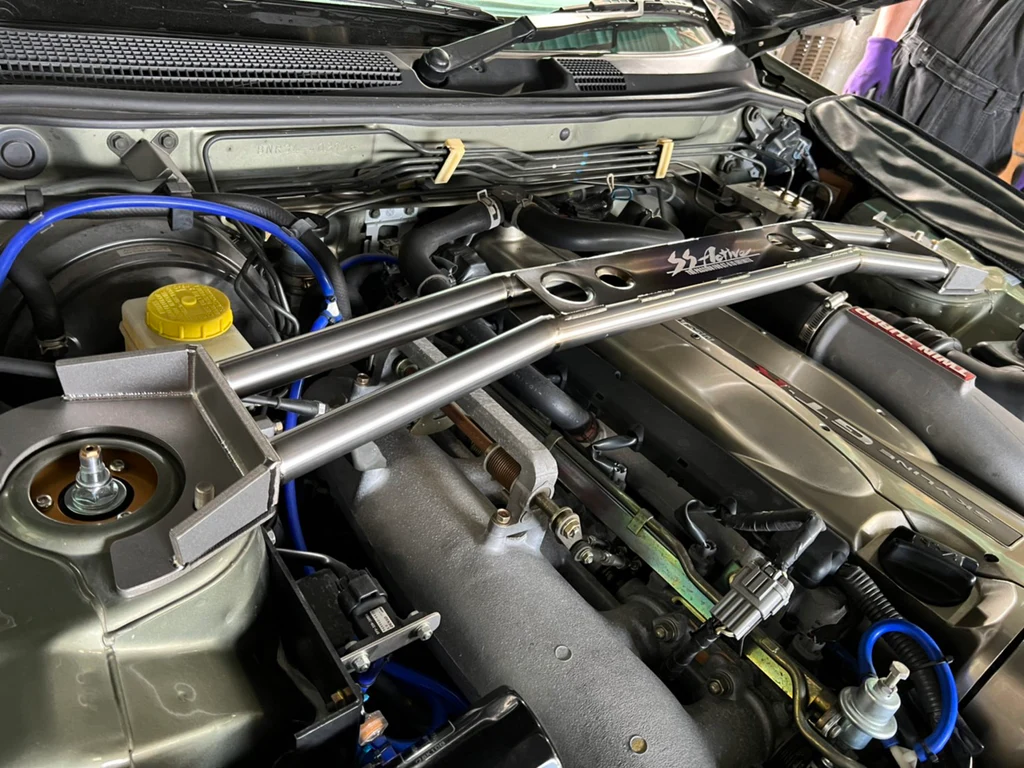
A strut bar goes by a few names depending on who you ask. Strut brace, strut tower bar, chassis brace. They all refer to the same thing: a rigid bar that connects the two strut towers inside the engine bay.
Your strut towers are the mounting points where the front suspension struts attach to the body of the car. They sit on either side of the engine, and they experience significant lateral forces every time the car corners, brakes hard, or hits a bump at an angle.
Without a strut bar, those two towers can flex away from each other slightly under load. It is not dramatic movement, but it does not need to be dramatic to affect handling. Even a few millimeters of flex changes the suspension geometry in ways the engineers did not intend, making the car feel loose or unpredictable during aggressive cornering.
The strut bar physically ties the two towers together into one rigid unit. When one tower experiences a force trying to push it outward, the bar transfers that load to the opposite tower instead of letting the body absorb it through flex. The result is a stiffer, more predictable front end that responds more accurately to steering inputs.
Front strut bars are the most common. They sit across the top of the engine bay, which is why you can often spot them when you open the hood on a performance-oriented car.
Rear strut bars also exist. These mount between the rear strut towers, which are typically located in the trunk area behind the rear seat. Rear strut bars are particularly common on all-wheel-drive vehicles and performance cars where rear-end stiffness has a noticeable effect on handling balance.
What Is a Sway Bar?
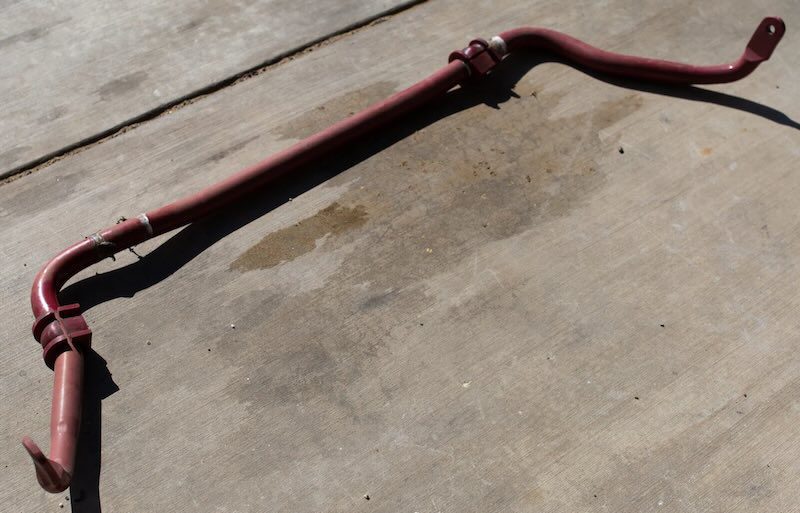
A sway bar has even more names than a strut bar. You might hear it called an anti-roll bar, a stabilizer bar, or a roll bar. All of these refer to the same component.
The job of a sway bar is to resist body roll, which is that sensation of the car’s body leaning heavily to the outside during cornering. You have felt this even if you never knew what was causing it. Take a sharp corner at speed in a tall SUV, and you feel the body lean dramatically outward. That is body roll, and it is not just uncomfortable. Excessive body roll transfers weight unevenly between the inside and outside wheels, which reduces the grip available on the wheels that need it most.
Here is how the sway bar actually stops this from happening. The bar is a U-shaped piece of metal that connects the left and right wheel suspension assemblies either at the front axle, the rear axle, or both. When one wheel rises (as the body rolls and load transfers to the outside during a corner), the bar twists. That twisting creates a resisting force that pushes the opposite wheel up, evening out the load distribution and keeping the body more level.
It is an elegantly simple system. There are no electronics, no sensors, no active components. Just a piece of metal that uses physics to do its job.
Most modern cars come with at least a front sway bar from the factory. Many also have a rear sway bar. Performance vehicles often have stiffer sway bars than their economy counterparts, and aftermarket sway bars are one of the most popular and cost-effective handling upgrades available.
Strut Bar vs Sway Bar: The Key Differences
These two components are often mentioned in the same sentence, and people sometimes assume they do essentially the same thing. They do not. Here is a clear breakdown of where they actually differ.
Where They Live in the Car
| Bar Type | Location |
|---|---|
| Front Strut Bar | Engine bay, connecting left and right front strut towers |
| Rear Strut Bar | Trunk area, connecting left and right rear strut towers |
| Front Sway Bar | Beneath the chassis, connecting left and right front suspension assemblies |
| Rear Sway Bar | Beneath the chassis, connecting left and right rear suspension assemblies |
The strut bar lives up top, visible in the engine bay. The sway bar lives underneath the car, out of sight. This location difference matters because they are solving problems that happen in different physical planes. The strut bar deals with forces trying to spread the strut towers apart. The sway bar deals with forces trying to roll the body sideways.
What Problem Each One Solves
This is where the real distinction sits.
A strut bar reduces body flex at the strut towers. During hard cornering, braking, or aggressive acceleration, the forces transmitted through the suspension into the strut towers try to deform the body structure. The strut bar prevents that deformation by linking the two towers rigidly. You get more consistent suspension geometry, which translates to more predictable handling.
A sway bar reduces body roll. During cornering, the weight of the car shifts to the outside wheels. The body tries to lean in the direction of that weight transfer. The sway bar resists this lean by using the opposite wheel’s suspension travel to counteract the movement. The car stays flatter through corners, load is distributed more evenly, and traction improves.
Think of it this way. The strut bar keeps the mounting points from moving. The sway bar keeps the body from leaning.
Shape and Design
These two components look nothing alike, which is a useful clue when you are trying to identify what you are looking at under the hood or beneath the car.
Strut bars come in several design variations:
- Straight bars with slightly curved or angled ends
- Triangle or Y-shaped bars that add a central mounting point to the firewall for extra rigidity
- Inverted V-shaped bars that clear tall engine components while still bracing the towers
The variation in strut bar designs exists because engine bays are crowded spaces. The bar has to clear the engine, the intake, and whatever else is in the way, which leads to all kinds of creative shapes.
Sway bars are more standardized in their basic shape. They are generally tubular and U-shaped, running across the car with the two ends of the U connecting to the left and right suspension components. However, most sway bars also feature bends, kinks, and offsets designed to clear the exhaust, the subframe, and other underbody components. They can look quite complex despite their fundamentally simple function.
Materials
This is another genuine difference between the two.
Strut bars are made from a variety of materials depending on the application and budget:
- Aluminum is the most popular for aftermarket strut bars because it offers a good balance of stiffness and low weight
- Steel is heavier but extremely stiff and more affordable
- Alloy steel offers improved strength over standard steel
- Titanium shows up in high-end aftermarket bars where weight savings are a priority
The flexibility in material choice for strut bars means you can find options across a wide price range, from budget steel bars to premium titanium units for competition builds.
Sway bars are far less material-diverse. The overwhelming majority are made from 4140 Chromoly steel, which is a specific chrome-molybdenum alloy known for its combination of high tensile strength, toughness, and resistance to fatigue. The reason for this narrow material choice comes down to the nature of the job. A sway bar flexes and twists continuously throughout the car’s life. It needs a material that can handle millions of stress cycles without cracking or permanently deforming. Chromoly steel has proven itself as the ideal material for this application over decades of real-world use.
What Strut Bars and Sway Bars Have in Common
Despite their differences, these two components do share some important common ground.
They are both suspension support accessories. Neither one is part of the primary suspension system. They do not carry the weight of the car. They do not absorb road impacts. But they both enhance the performance of the suspension system that does those things, by keeping that system operating within its intended geometry and range of motion.
Both help with car stability and balance. Whether you are fighting body flex through the strut towers or fighting body roll through the chassis, both bars work toward the same goal: keeping the car composed, stable, and predictable through corners and under heavy loads.
Both can contribute to understeer or oversteer if incorrectly set up. This is an important point that catches some people off guard.
Oversteer is when the rear of the car swings wider than the driver intended. The back steps out. For inexperienced drivers, this can escalate quickly into a spin.
Understeer is when the front of the car pushes wide, not turning as sharply as the driver expects. The car plows straight ahead instead of following the intended line.
Both front strut bars and front sway bars can increase understeer tendency, particularly if the components are very stiff. Both rear strut bars and rear sway bars can increase oversteer tendency for the same reason.
The lesson here is that stiffer is not always better. A bar that is too rigid for the rest of the suspension setup can actually make handling worse, not better. If you are upgrading either of these components on a performance build, the goal is balance across the front and rear, not just maximum stiffness at one end.
A Practical Scenario: What You Would Actually Feel
Here is a way to make this tangible.
Imagine you are driving on a winding road and you approach a sharp corner at moderate speed. You turn the wheel and press into the corner.
Without a strut bar, if your car has significant body flex, the strut towers shift slightly apart as the suspension loads up. This changes the camber angle of the front wheels mid-corner, reducing the contact patch and making the steering feel slightly vague or mushy. The car turns, but it does not feel precise. You are not entirely confident in where the front wheels are pointing.
Without adequate sway bar stiffness, the body rolls heavily to the outside of the corner as weight transfers. The inside wheels unload, carrying almost no weight. The outside wheels are doing all the work with maximum weight pressing down on them. The car leans noticeably, passengers slide toward the outside door, and you feel less in control.
Now add both components back into the picture. The strut bar keeps the strut towers in place, maintaining correct suspension geometry. The sway bar limits body roll, keeping weight distributed more evenly across all four wheels. The corner feels tighter, the steering feels more direct, and the car responds with confidence.
That is the difference these components make in the real world.
If You Can Only Choose One, Which Should It Be?
This is a genuinely useful question for anyone working with a limited budget or a car that can only practically accommodate one modification at a time.
The honest answer is: go with sway bars.
Here is the reasoning. Body roll affects virtually every car on every corner. It is a universal problem with a direct impact on handling and traction, and it is present to some degree every time you make a turn. A properly sized sway bar (or upgraded sway bar on a car with an undersized factory bar) provides immediate, noticeable improvements to how the car feels.
Strut bars, while genuinely effective, offer more benefit on cars that have significant chassis flex to begin with. Many modern unibody vehicles are already quite rigid from the factory, particularly newer designs that have been engineered with performance in mind. On these cars, the difference a strut bar makes may be subtle. On older vehicles, cars with more flexible chassis designs, or dedicated performance builds, the strut bar becomes much more valuable.
If your car already handles reasonably well and you just want to sharpen it up, start with sway bars. If you are building a serious performance or track car, adding both a strut bar and sway bars to the front and rear is the right approach. Together, they create a suspension environment where every other component, your tires, your alignment, your shocks, can do its job properly.
Installing These Components: What to Expect
One of the genuinely good things about both strut bars and sway bars is that they are among the more accessible suspension upgrades from an installation standpoint.
A front strut bar on most cars bolts directly to the existing strut tower mounting bolts. No cutting, no welding, no specialized tools for most applications. A basic socket set and a torque wrench are usually all you need. Many enthusiasts install their first strut bar at home in under an hour.
Sway bar replacement is slightly more involved since you are working underneath the car and need to disconnect end links and mounting hardware from the existing bar, but it is still within reach for a mechanically inclined home mechanic with a basic set of tools and a safe way to raise and support the vehicle.
If you are not comfortable working under cars or doing suspension work, any competent mechanic can handle either installation quickly, and the labor cost is relatively modest.
Your suspension system is only as good as the structure it operates within. Strut bars and sway bars are not flashy upgrades, and they will not add horsepower. But if your car feels vague, rolly, or imprecise through corners, one or both of these components might be exactly what it needs.
If your car still has the original factory sway bars and you have never had them inspected or upgraded, that is where to start. Right now, there is a decent chance your car is handling worse than it should, and the fix is simpler and cheaper than you might think.