
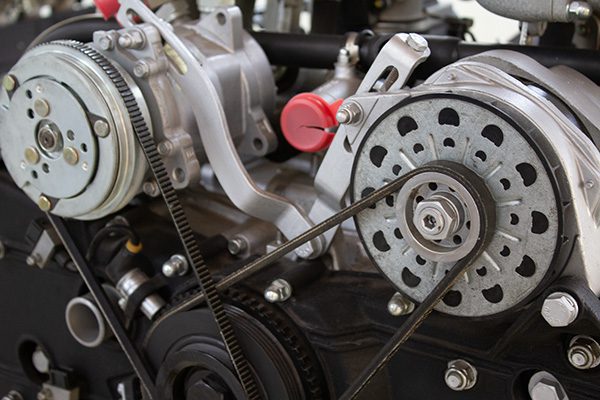
Pop the hood on almost any modern car and somewhere inside that engine bay are two belts quietly doing very different jobs. Most drivers have heard of them, but very few understand what makes them different, why one failing is annoying while the other failing can destroy your engine, or why they need to be replaced on separate schedules.
Let’s clear all of that up.
The timing belt synchronizes the rotation of the crankshaft and camshaft so that the engine’s pistons, valves, and internal components all move in perfect coordination. The drive belt, sometimes called the serpentine belt, takes power from the engine’s crankshaft and uses it to run the accessories your car depends on every day, things like the alternator, air conditioning compressor, water pump, and power steering pump.
Same basic concept, completely different jobs, and very different consequences when they fail. Understanding the difference could save you from being stranded or, worse, facing a repair bill that rivals the value of the car itself.
Timing Belt vs. Drive Belt: The Core Differences at a Glance
| Feature | Timing Belt | Drive Belt (Serpentine Belt) |
|---|---|---|
| Function | Synchronizes crankshaft and camshaft | Powers engine accessories |
| Location | Inside the engine, behind a protective cover | Outside the engine, visible in the engine bay |
| Physical design | Deeper, harder teeth, thicker rubber | Ribbed surface, more flexible |
| Replacement cost | Higher, often requires significant disassembly | Lower, generally easier to access |
| Consequence of failure | Can destroy the engine entirely | Disables accessories, car stops but engine survives |
| Typical lifespan | 100,000 to 170,000 km (62,000 to 105,000 miles) | 60,000 to 100,000 km (37,000 to 62,000 miles) |
One more thing worth noting: older vehicles used timing chains instead of timing belts. Chains are more durable and generally last the life of the engine. Many modern manufacturers switched to timing belts because they are lighter and quieter, but that came with a trade-off: they wear out and need scheduled replacement.
What Does the Drive Belt Actually Do?
The drive belt is the one you can usually see without taking anything apart. It sits on the outside of the engine, looping around a series of pulleys in a path that looks almost like a winding road on a map. That is why it earned the nickname “serpentine belt.” It winds around the crankshaft pulley, which is driven by the engine, and then snakes around the pulleys of every accessory that needs power.
Depending on the vehicle, the drive belt powers some or all of the following:
- The alternator, which charges the battery and powers the electrical systems while the engine runs
- The air conditioning compressor
- The power steering pump (on vehicles with hydraulic power steering)
- The water pump, on engines where it is belt-driven rather than internally driven
- The cooling fan on some older or simpler engine designs
A tensioner pulley keeps the belt tight and prevents slipping. Without proper tension, the belt loses grip on the pulleys and the accessories it is supposed to power start to underperform or stop working entirely.
The belt itself is made of rubber, typically reinforced with internal cords to handle the constant flexing and load. It is a tough component, but rubber degrades over time from heat, friction, and exposure to the elements.
How Long Does a Drive Belt Last?
Under normal driving conditions, most drive belts are designed to last somewhere between 60,000 and 100,000 km, or roughly 37,000 to 62,000 miles. Some last longer. Others wear out earlier, especially in vehicles that spend a lot of time in extreme heat or that have misaligned pulleys putting uneven stress on the belt.
The number in your owner’s manual is a good baseline, but it is not the whole picture. Inspecting the belt visually during routine maintenance is just as important as tracking mileage. A belt that looks wrong at 50,000 km should be replaced regardless of what the schedule says. A belt that still looks clean and intact at 80,000 km might have more life in it.
Signs Your Drive Belt Is Failing
The good news with a drive belt is that it usually gives you some warning before it fails completely. Here is what to watch and listen for.
Noises From the Engine Bay
A squealing or squeaking sound coming from the front of the engine, especially when you first start the car or when you turn on the air conditioning, is one of the first signs of a drive belt problem. The noise is usually caused by the belt slipping on a pulley, which happens when tension is low or when the belt surface has degraded.
A chirping sound that is rhythmic and changes with engine speed often points to a misaligned pulley rather than the belt itself, but the belt still takes the damage over time.
Visible Damage on the Belt
Take a look at the belt itself if you can access it safely with the engine off. A belt in poor condition will show some of these warning signs:
- Cracks running across the ribs or along the edges
- Chunks of rubber missing from the surface
- Fraying or separation of the ribs
- Glazing, which is a shiny, hardened surface that reduces grip
- Uneven wear on one side of the belt
- Signs of melting or rubber deformation
Any of these signs means the belt is overdue for replacement.
Accessory Failures
When a drive belt is slipping badly or has broken, the accessories it powers stop working. The air conditioning may cut out suddenly. The battery warning light may come on because the alternator is no longer charging. The power steering may feel stiff and heavy. The engine temperature may start climbing because the water pump is no longer moving coolant efficiently.
These symptoms can each have individual causes, but when several of them happen at the same time, the drive belt is a very strong suspect.
What Happens When a Drive Belt Breaks?
A broken drive belt is a bad day, but it is not an engine-destroying event. The engine itself will keep running after the drive belt snaps, at least briefly. But everything powered by that belt goes offline immediately.
If your water pump is belt-driven, you have a limited window before the engine starts overheating. If your alternator loses drive, the car is running entirely on battery power, which will last maybe 20 to 30 minutes depending on the battery state and electrical load. Power steering becomes heavy and manual. The air conditioning stops.
The right move when the drive belt breaks is to pull over safely as quickly as possible and not try to nurse the car to the next exit. Driving with no coolant circulation is a fast way to turn a straightforward belt replacement into a head gasket job.
The engine itself survives a broken drive belt in almost all cases. That is the key difference from a timing belt failure.
Drive Belt Replacement Cost
The drive belt itself is a relatively inexpensive part. Depending on the vehicle, the belt typically costs between $25 and $75 at an auto parts store. Labor varies by shop, but because the belt is externally accessible on most engines, the job does not take long. Total cost at an independent shop usually falls somewhere between $75 and $200 including parts and labor.
Dealership service departments charge more for the same job. If you are comfortable doing basic engine bay work, replacing a serpentine belt yourself is one of the more approachable DIY jobs. Most vehicles have a belt routing diagram printed on a sticker somewhere in the engine bay, which makes reinstallation straightforward if you document how the old belt was routed before removing it.
When replacing the belt, it is also worth inspecting the tensioner and idler pulleys. These spin on bearings that wear over time. A new belt on a worn tensioner pulley will wear faster and may still squeal. Replacing them together when they show signs of wear makes sense financially since the labor is largely the same.
What Does the Timing Belt Actually Do?
This is where things get more technical, and where the stakes get much higher.
Inside your engine, the crankshaft and camshaft have to rotate in a very precise relationship to each other. The crankshaft drives the pistons up and down. The camshaft opens and closes the intake and exhaust valves. For the engine to run properly, those valves need to open and close at exactly the right moment in relation to where the pistons are.
If the valve opens at the wrong moment and a piston is moving upward at the same time, the piston hits the valve. Depending on the engine design, this can bend or break valves, damage pistons, and in severe cases cause catastrophic internal engine failure. This kind of engine is called an “interference engine,” and the majority of modern engines fall into this category.
The timing belt is what keeps those two shafts synchronized. It connects the crankshaft sprocket to the camshaft sprocket (or multiple camshaft sprockets in engines with two camshafts), and it keeps them turning in exact coordination through the hardened teeth on its inner surface that lock into the teeth of those sprockets.
It lives inside the engine, hidden behind a protective timing cover, because it cannot be allowed to get contaminated with oil, debris, or external elements that would accelerate its wear.
How Long Does a Timing Belt Last?
Most timing belts are rated to last between 100,000 and 170,000 km, which is roughly 62,000 to 105,000 miles. In terms of time, that often translates to somewhere between seven and ten years of typical use.
But here is what makes timing belt replacement tricky: the belt does not usually give you obvious warning signs before it snaps. A drive belt squeals and cracks visibly. A timing belt often fails without warning because it is hidden inside the engine and not easy to inspect without removing the cover.
This is why timing belt replacement is strictly schedule-based rather than symptom-based. You replace it because the interval says to, not because the car is telling you something is wrong. By the time the car tells you, it may already be too late.
Warning Signs of a Failing Timing Belt
While timing belts rarely announce their failure dramatically in advance, there are some symptoms that can indicate the belt or its related components are wearing out.
Ticking or Slapping Noise From the Engine
A rhythmic ticking noise coming from deep inside the engine, different from the usual valve tick that is normal at startup, can indicate that the timing belt is wearing on its sprockets or that the tensioner keeping it tight is starting to fail. This is worth investigating immediately.
Rough Running, Misfires, or Loss of Power
If the timing belt has worn enough that it has slipped slightly on a sprocket, the engine timing will be off. This causes rough idling, misfires, loss of power, and sometimes a check engine light with misfire codes. The car may still run, but it runs poorly because the valves and pistons are no longer working in proper sync.
Oil Leaking From Behind the Timing Cover
The timing belt runs in close proximity to the camshaft seal and crankshaft seal. When those seals fail, oil can leak onto the belt. Oil contamination dramatically shortens a timing belt’s lifespan and can cause it to slip or snap well before its scheduled replacement interval. A visible oil leak near the timing cover should be taken seriously.
Engine Refuses to Start
If the timing belt has already snapped, the engine will crank when you turn the key but will not start. There is nothing to synchronize the camshaft, so the engine cannot complete its combustion cycle. This is unfortunately often when people discover their timing belt needed replacing long before this moment.
What Happens When a Timing Belt Breaks?
On a non-interference engine, a broken timing belt means the engine stops and will not restart. Frustrating and inconvenient, but the engine survives intact. You replace the belt and carry on.
On an interference engine, which again describes the majority of modern cars, a broken timing belt can cause the pistons and valves to collide. The result can include bent or broken valves, damaged pistons, scored cylinder walls, and in severe cases a crankshaft or camshaft that has been damaged by the sudden impact forces. Repairing this kind of damage can cost thousands of dollars. In many older vehicles, it costs more than the car is worth.
To check whether your specific engine is an interference or non-interference design, look it up by make, model, year, and engine size. This information is available in your owner’s manual and from your manufacturer’s service documentation. Knowing which type of engine you have makes clear exactly how high the stakes are for staying on top of timing belt replacement.
Timing Belt Replacement Cost
This is where the cost difference between the two belts becomes very apparent. The timing belt itself is not necessarily expensive as a part, often in the $25 to $100 range depending on the engine. The cost comes from the labor involved in accessing it.
Getting to the timing belt typically requires removing the engine covers, accessory belts, and various components depending on the engine layout. On some transversely mounted engines, this can be a multi-hour job. On others, the job is even more involved.
Total timing belt replacement costs at a shop commonly range from $400 to $1,000 or more, depending on the vehicle and whether additional components are replaced at the same time.
And that brings up an important point: when you replace the timing belt, it makes strong financial sense to replace the timing belt tensioner and idler pulleys at the same time, and often the water pump if it is driven by the timing belt on your engine. These components have similar lifespans to the belt. Replacing them together means you are not paying for the same labor job again in a year or two when one of those components fails.
A mechanic who recommends replacing the whole timing kit rather than just the belt is giving you sound advice, not upselling you unnecessarily.
What Is a Timing Belt Kit and Should You Always Use One?
A timing belt kit is a set of components sold together that typically includes the timing belt itself, the tensioner, the idler pulleys, and sometimes the water pump. Buying and replacing these as a kit rather than individually is the smart approach for two reasons.
First, all of these components wear together at roughly similar rates. If the belt has reached its replacement interval, the tensioner and pulleys are likely not far behind. Second, the labor cost of opening up the timing cover is the same whether you are replacing one component or five. Doing it all at once means you pay that labor cost once instead of potentially three or four times over the next few years.
Quality matters here. Cheap timing components from unknown brands can fail prematurely, which puts you right back in the same situation you were trying to avoid. Use OEM components or reputable aftermarket brands with a documented track record for your specific engine.
Timing Belt vs. Timing Chain: What Is the Difference?
Some newer vehicles and many older ones use a timing chain instead of a timing belt. A chain is made of metal links, similar in concept to a bicycle chain, and it is designed to last the life of the engine under normal conditions. It does not have a scheduled replacement interval in most cases.
Timing chains are generally more durable and do not require the same replacement schedule as belts. But they are not maintenance-free. Timing chains rely on engine oil for lubrication. Neglected oil changes can cause a chain to wear prematurely, and a stretched timing chain causes the same synchronization problems as a worn timing belt. The difference is that chain problems often announce themselves with a rattling noise on startup that goes away as oil pressure builds, giving you more warning than a belt.
If you are not sure whether your engine has a belt or a chain, check the owner’s manual or ask a mechanic. Engines with timing belts have a scheduled replacement interval listed. Engines with timing chains typically do not.
Frequently Asked Questions
Can you visually inspect a timing belt without removing the cover?
On most modern engines, no. The timing cover completely encloses the belt to protect it from contamination. Some engines have a small inspection port, but in most cases a proper inspection requires at least partial removal of the cover. This is another reason why following the mileage-based replacement schedule is so important rather than relying on visual checks.
Does it matter if oil gets on a timing belt?
Yes, it matters significantly. Oil contamination softens the rubber, reduces friction, and can cause the belt to slip on its sprockets. If oil is getting onto the timing belt through a leaking camshaft or crankshaft seal, the seal needs to be repaired and the belt needs to be replaced, even if it has not reached its scheduled interval. Running an oil-contaminated timing belt is a risk not worth taking.
Is it safe to buy a used car without knowing the timing belt history?
It is risky. If you cannot confirm from service records that the timing belt was replaced within the manufacturer’s recommended interval, you are essentially guessing how much life is left in it. For many buyers, the practical approach is to factor a timing belt replacement into the purchase price and have it done shortly after buying the car if the history is unknown. The cost of that preventive replacement is much lower than the cost of an engine destroyed by a belt that snapped unexpectedly.
Can you replace a drive belt yourself?
On most vehicles, yes. The drive belt is externally accessible, the routing diagram is usually printed in the engine bay, and the job typically requires only basic hand tools and a socket set. The tensioner needs to be released to allow the belt to come off and go back on, but most modern tensioners have a square drive opening that accepts a standard breaker bar. If you are comfortable doing basic car maintenance, this is a manageable DIY job.
How do you know which belt is which when looking at the engine?
The drive belt is the one you can see on the outside of the engine, snaking around the pulleys of the alternator, AC compressor, and other accessories. It has a ribbed surface on one side. The timing belt is hidden behind the timing cover, which is typically a plastic or metal shield on the front of the engine. If you can see a belt without removing anything, it is the drive belt. If you have to remove a cover to see it, it is the timing belt.
Both belts deserve your attention, but they demand it in very different ways. The drive belt tells you when it needs help. The timing belt keeps quiet and waits. Know your replacement intervals, stick to them, and do not let the quieter of the two belts catch you off guard.