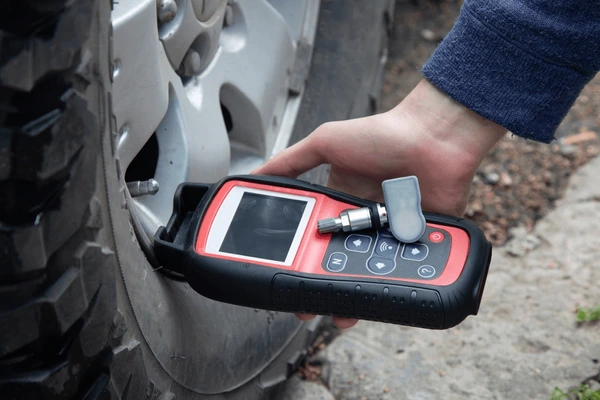
Tire pressure is one of those things most drivers think about only when a warning light shows up on the dashboard. By that point, the tire has already been underinflated long enough to cause problems. The reality is that running on tires with incorrect pressure is not just a fuel economy issue. It is a serious safety risk that has cost lives.
When tire pressure drops below the manufacturer’s specified limit, the tire starts to deform under the weight of the vehicle. That deformation generates heat, reduces the tire’s ability to grip the road, and in extreme cases, especially on a tire that is already near the end of its life, can cause the tire to come apart completely at speed. That is not a theoretical risk. It has happened, and the consequences were catastrophic.
Table of Contents
Low tire pressure also directly affects how the car handles. Cornering becomes less predictable because grip is reduced. On wet roads, stopping distances increase significantly. And because the tire is working harder than it should, rolling resistance goes up, which means the engine burns more fuel just to maintain speed.
The Real-World Disaster That Changed Tire Safety Forever
In the 1990s, a series of incidents involving Ford Explorer SUVs fitted with Firestone tires resulted in 250 deaths and more than 3,000 injuries in the United States. Investigators found that the tires were disintegrating at highway speeds, and the root cause came down to a combination of insufficient tire pressure, high outdoor temperatures, and sustained high-speed driving. It was a preventable tragedy.
The fallout from those incidents triggered a government response. The National Highway Traffic Safety Administration stepped in with new regulations, and in 2000, the US Congress passed a piece of legislation called the TREAD Act, which stands for Transportation Recall Enhancement, Accountability and Documentation.
Among other requirements, the TREAD Act mandated that all new passenger vehicles sold in the United States be equipped with a system that monitors tire pressure in real time and warns the driver before things go dangerously wrong. That system is what we now call the Tire Pressure Monitoring System, or TPMS.
When Did TPMS Become Mandatory?
The rollout was phased in gradually to give manufacturers time to adapt. Here is how it played out in both the US and the European Union.
United States
- October 2005: TPMS required on 20% of new car models sold
- September 2006: TPMS required on 70% of new car models sold
- September 2007: TPMS required on 100% of new car models sold
- January 2008: TPMS required on 100% of all new cars sold
European Union
- November 2012: TPMS required on 100% of new car models sold
- November 2014: TPMS required on 100% of all new cars sold
The United States and European Union were not alone. South Korea, Russia, Indonesia, the Philippines, Israel, Malaysia, and Turkey have all adopted regulations requiring TPMS on new vehicles sold in their markets.
What the Law Actually Requires From a TPMS
The TREAD Act did not just say “put a pressure monitor on the car” and leave manufacturers to figure it out. It laid out specific performance requirements. Here is what every compliant TPMS must do:
- Monitor air pressure in all four tires (the spare tire is not required to be included)
- Become active the moment the engine is switched on
- Alert the driver when any tire drops more than 25% below the manufacturer’s recommended pressure
- Deliver that warning through a visible indicator light on the dashboard
- Keep the warning light on until the tire pressure is corrected
- Alert the driver when the TPMS system itself is not functioning correctly
- Include a warning in the owner’s manual about using tires that are not compatible with the TPMS system
That 25% threshold is worth thinking about in practical terms. If your manufacturer specifies 35 PSI, a drop to around 26 PSI will trigger the warning. That is already a meaningful loss of pressure, which is why checking your tires manually on a regular basis rather than waiting for the light to come on is still the smarter approach.
What Are the Real Benefits of Having a TPMS?
Keeping tires properly inflated is one of the simplest and most impactful things you can do for both safety and running costs. When your TPMS is working and your tires are at the right pressure, the difference compared to underinflated tires is significant.
- Better handling and stability, especially during sudden maneuvers or emergency steering inputs
- Shorter braking distances, which matters enormously in situations where every meter counts
- Reduced aquaplaning risk on wet roads, because a properly inflated tire maintains better contact with the road surface
- Longer tire life, since tires that are running at the correct pressure wear evenly rather than wearing out the outer or inner edges prematurely
- Lower fuel consumption, because a correctly inflated tire has less rolling resistance
- Lower risk of a catastrophic tire failure at highway speeds
A Brief History: Which Cars Had TPMS First?
TPMS technology actually predates the TREAD Act by several decades. The first production car equipped with a tire pressure monitoring system was the Porsche 959 in 1986, a supercar that was ahead of its time in almost every way. The system on the 959 was an optional feature developed for a car that was designed to push the limits of performance, where tire pressure accuracy was genuinely critical.
In the mid-1990s, Chevrolet fitted the Corvette with TPMS in the US market. Over in Europe, the Peugeot 607 received TPMS in 1999 through the PSA Group, which at the time was the parent company of Peugeot and Citroen. A year later in 2000, Renault launched the Laguna II with TPMS as standard equipment.
These were all premium or performance vehicles using the technology as a differentiator. It took regulation to push it into every new car on the road.
The Two Types of TPMS: Indirect vs. Direct
Not all tire pressure monitoring systems work the same way. There are two fundamentally different approaches, and understanding the difference matters when you are diagnosing a TPMS issue or buying replacement parts.
Indirect TPMS (iTPMS): Smart Software, No Extra Hardware
An indirect TPMS does not actually measure air pressure directly. Instead, it uses data that is already being collected by the ABS wheel speed sensors to infer whether a tire might be low on pressure.
Here is the logic behind it: a properly inflated tire has a certain rolling radius. When pressure drops, the tire flattens slightly, the rolling radius decreases, and to maintain the same road speed, that wheel has to spin faster than the others. The iTPMS software detects that speed discrepancy between the four wheels and interprets it as a sign of low pressure in the faster-spinning wheel.
The appeal of this approach is obvious: it does not require any additional hardware. It is purely a software addition to the existing ABS system, which means it is cheaper to implement. No sensors to replace, no batteries to die, no additional components to fail.
But here is the thing. The limitations are real and they matter.
- Pressure readings are approximate, not precise. The system is estimating based on wheel speed behavior, not measuring actual PSI.
- If all four tires lose pressure equally, the system will not detect it. Because it works by comparing wheel speeds, uniform pressure loss across all four tires looks normal to the algorithm.
- Mixing tire wear levels can trigger false alarms. Replacing one tire with a brand-new one while the other three are worn changes the rolling radius of that one tire, which the system may interpret as a pressure issue.
- Slippery conditions can cause false alerts. If one or more wheels are slipping on ice or wet road, the speed differential looks similar to what the system expects from low pressure.
Because of these limitations, iTPMS systems do not comply with the requirements of the TREAD Act in the United States. They are used in some markets and on run-flat tire equipped vehicles where alerting the driver to any change in tire behavior is the priority, but they do not meet the standard required for US compliance.
Warnair: The iTPMS System from Dunlop and Bosch
One of the more well-known indirect systems is Warnair, developed by Dunlop in collaboration with Bosch. It operates as an integrated component of Bosch’s ABS and ESP systems, using the wheel speed sensor signals to detect pressure anomalies. The Warnair system was first introduced on the European market as part of the DSC (Dynamic Stability Control) system in the BMW 5 Series at the time.
Dunlop later evolved the technology into a second-generation system called DDWS (Dunlop Deflation Warning System). Beyond simply comparing wheel speeds, DDWS also performs frequency analysis of the wheel’s vibration signature. A tire losing pressure changes not just its rolling radius but also its resonant frequency, and DDWS is designed to pick up on that additional data point.
The DDWS system activates at speeds above 15 km/h and operates up to the car’s maximum speed. One important maintenance note: it must be recalibrated every time a tire is changed or replaced, otherwise the baseline comparison data becomes inaccurate.
DDS: Continental’s Indirect Monitoring Approach
Continental developed its own indirect system called the Deflation Detection System (DDS). Like Warnair, it is entirely software-based and works through the existing ABS wheel speed sensors without requiring any additional physical components. It alerts the driver when pressure drops to a concerning level based on wheel speed differential analysis.
The DDS system is commonly found on vehicles equipped with run-flat tires. Run-flat tires are designed to keep the car moving for a limited distance even after a complete pressure loss, which sounds reassuring until you realize the driver often cannot feel the difference between a flat and a properly inflated run-flat at normal driving speeds. Without a monitoring system, you could drive on a flat run-flat tire for miles without knowing, which is damaging to both the tire and the rim.
Direct TPMS (dTPMS): Real Pressure, Measured in Real Time
Direct TPMS is exactly what the name suggests. Each tire has an actual pressure sensor mounted inside it, and that sensor transmits real-time pressure and temperature data wirelessly to the car’s computer system. This is the type that meets US TREAD Act requirements and is standard on virtually all new vehicles sold in compliant markets.
The system consists of four main components working together:
- Pressure and temperature sensors mounted inside each tire
- Wireless receivers or antennas positioned near each wheel to pick up the sensor signals
- A TPMS electronic control module that processes the incoming data
- A dashboard display that shows the driver the pressure and temperature readings for each individual tire
The sensors broadcast on radio frequencies of either 315 MHz or 434 MHz depending on the market and manufacturer. Each sensor also transmits a unique identifier so the system can tell exactly which wheel the reading is coming from. Some more advanced systems can even automatically detect and update the position of each sensor when wheels are rotated.
The sensors are powered by internal lithium-ion batteries. These batteries are not replaceable. When the battery dies, the entire sensor has to be replaced. The typical lifespan of a TPMS sensor battery is around five to seven years, after which you should expect to start replacing sensors as they go offline.
On vehicles where it is offered, direct TPMS can also optionally monitor the spare tire, which is useful if you carry a full-size spare and want to know it is ready to go before you need it.
What Is Inside a Direct TPMS Sensor?
Most direct TPMS sensors are integrated into the tire valve, meaning the sensor body is part of the valve stem itself. When you look at a wheel and see a valve with a nut around its base, that nut is typically part of the TPMS sensor assembly. Ford and Mazda have used a different mounting approach where the sensor is a band-type unit strapped to the inner surface of the rim, but the valve-integrated design is standard for most other manufacturers.
A complete sensor kit includes:
- The valve cap
- A mounting nut that secures the sensor to the rim
- The valve body itself
- A mounting screw that connects the sensor body to the valve
- The sensor body containing the electronics
- An air contact port that allows the sensor to measure the pressure inside the tire
The electronics inside the sensor body include a pressure sensing element, a signal processing circuit, a radio frequency transmitter, and the battery. The entire assembly has to be kept as light as possible. An imbalanced sensor adds uneven weight to the wheel, which can be felt as vibration at higher speeds, so manufacturers engineer these components to be as compact and lightweight as they can manage.
These sensors also have to survive conditions that would destroy most electronics. Operating temperatures range from -40°C all the way up to +150°C (-40°F to 302°F). They are rated to withstand shock forces up to 2,000 g. They have to handle moisture, condensation, and road debris without failing. It is a surprisingly demanding environment for something so small.
TRW’s Hybrid dTPMS: Getting the Best of Both Systems
TRW developed an interesting middle-ground approach that combines elements of both direct and indirect TPMS. The core of the system is direct, with actual pressure and temperature sensors transmitting data from each wheel. But instead of using a separate wireless receiver at each wheel, it brings in the ABS wheel speed data to help determine which wheel the low-pressure signal is coming from.
The practical benefit is cost. By using ABS data to handle wheel position identification, the system only needs a single wireless receiver for all four sensors rather than four separate antennas. The result is a system that measures real pressure like a full dTPMS but at a lower hardware cost, while still meeting compliance requirements.
TPMS at Le Mans: The Beru Racing System
Tire pressure monitoring is not just a road car concern. In endurance racing, where a tire failure at 200 mph can end a race and a life, real-time pressure data is essential. The Aston Martin Racing team used a TPMS system from Beru during the 24 Hours of Le Mans on both the Aston Martin V12 Vantage and Rapide race cars.
The system used one sensor and one receiving antenna per wheel, with all four antennas connected to a central electronic control module. That module transmitted live tire pressure and temperature data not just to the driver in the cockpit but also to the technical team in the pit lane, allowing the whole team to monitor tire condition simultaneously and make real-time strategy decisions about tire changes.
A Side by Side Comparison: Indirect vs. Direct TPMS
| Feature | Indirect TPMS (iTPMS) | Direct TPMS (dTPMS) |
|---|---|---|
| How it works | Uses ABS wheel speed data to infer pressure changes | Physical sensors measure real pressure inside each tire |
| Accuracy | Approximate | Precise, real-time PSI readings |
| Additional hardware required | None (software only) | Yes: sensors, receivers, control module |
| Detects uniform pressure loss across all four tires | No | Yes |
| US TREAD Act compliant | No | Yes |
| Battery replacement needed | Not applicable | Sensor replacement every 5 to 7 years |
| Recalibration required after tire change | Yes | Sometimes, depends on the vehicle |
| Cost to implement | Low | Higher |
Common TPMS Questions Answered Simply
How Do You Know If Your Car Has TPMS Sensors?
The easiest way to check is to look at the valve stems on your wheels. If there is a small nut around the base of the valve, there is almost certainly a TPMS sensor attached to it on the inside of the rim. Some vehicles have sensors without the external nut being visible, which is a less common design.
The most definitive way to confirm it is to have the tire removed from the rim by a tire shop. You will see the sensor clearly once the tire is off. You can also check the owner’s manual or look up the vehicle by VIN if you want to confirm before doing any physical work.
Can You Buy and Install Universal TPMS Sensors?
Yes. Universal or programmable TPMS sensors are available at auto parts stores and online. These sensors can be programmed to match the specifications of many different vehicle makes and models. They are typically less expensive than OEM sensors and work fine on most vehicles when properly programmed and installed. The programming step matters, so make sure whoever installs them knows how to set them up for your specific car.
What Does It Mean When the TPMS Warning Light Comes On?
The TPMS warning light, which typically looks like a cross-section of a tire with an exclamation point inside it, can mean several different things. Do not assume it automatically means one tire has a nail in it.
Here is what it could indicate:
- One or more tires are significantly underinflated (the most common cause)
- One or more tires are overinflated
- A TPMS sensor battery has died
- A sensor has been damaged or is malfunctioning
- The TPMS control module itself has a fault
- Wiring to the TPMS system is damaged or corroded
- The system needs to be recalibrated after a tire rotation or change
The first thing to do when the light comes on is to check all four tire pressures manually with a gauge. If they all look fine, the issue is likely with the system itself rather than actual tire pressure. An OBD2 scanner can pull TPMS-specific fault codes that will tell you exactly which sensor is causing the problem and what the fault is, which saves a lot of time compared to guessing.
Do TPMS Sensors Need to Be Replaced When You Buy New Tires?
Not necessarily, but it depends on how old the sensors are. If your sensors are approaching the five to seven year mark, or if the tire shop notices corrosion on the sensor valve stems during mounting, replacing them at the same time as new tires is practical. It avoids paying for labor twice if a sensor dies shortly after a new tire installation.
The valve stem core and seal on TPMS sensors should typically be replaced whenever a tire is dismounted, regardless of sensor age. These small seals can harden and crack over time, leading to slow air leaks from the valve itself rather than the tire.
Can Cold Weather Trigger a False TPMS Warning?
Yes, and this is one of the most common sources of confusion for drivers in regions with cold winters. Air contracts when temperatures drop, which means tire pressure naturally decreases in cold weather even without any leak. A tire that was at the correct pressure in summer can drop enough on a cold morning to trigger the TPMS light.
As a rough guide, tire pressure drops about 1 PSI for every 10°F (roughly 5.5°C) drop in temperature. So a significant overnight temperature drop can easily push you past that 25% warning threshold. Check the pressure with a gauge and inflate to the correct level. The light should go off once you have driven a short distance and the system updates its readings.
Does TPMS Replace Regular Manual Tire Pressure Checks?
No, and this is an important point. The TPMS only alerts you when pressure has dropped significantly, typically more than 25% below the recommended level. That means a tire could be meaningfully underinflated without the light ever coming on. Checking tire pressure manually with a gauge once a month, and before any long trip, is still the right approach regardless of whether your car has TPMS or not.
Think of TPMS as a last-resort safety net, not a substitute for routine maintenance. It will warn you before a dangerous situation develops, but it will not keep your tires at the ideal pressure for performance and efficiency. That part is still up to you.
If the TPMS warning light is on in your car right now, check the tire pressures first, then scan for codes if everything looks physically fine. A $30 OBD2 scanner with TPMS capability can tell you in two minutes whether you are dealing with a dead sensor, a wiring fault, or a control module issue, which is far better than paying a shop diagnostic fee to find out the same thing.