

An illuminated check engine light (CEL) on your dashboard is your vehicle’s way of saying, “Something isn’t operating within expected limits.” It doesn’t always mean your car is about to quit on the side of the road—but it does mean the engine computer has detected a condition that could affect emissions, performance, fuel economy, or component durability.
Because of its location (tucked underneath the vehicle) and its “silent” job (cleaning exhaust), the catalytic converter is often overlooked when drivers start guessing what caused the CEL. People tend to suspect the obvious things first: spark plugs, coils, fuel quality, sensors, or even a loose gas cap. But here’s what many owners don’t realize until it happens to them: a failing catalytic converter (often called “the cat”) can absolutely be a reason the check engine light stays on—and in more severe cases, it can even contribute to a flashing CEL scenario.
You might already know the classic symptoms associated with a weak or restricted catalytic converter: sluggish performance, reduced acceleration, excess heat, and in some cases dark exhaust smoke or unusual smells. But the bigger question is: how does a catalytic converter problem translate into a check engine light? And just as important: when the CEL comes on, how do you avoid replacing an expensive converter when the real culprit is something else?
Read this guide to the end and you’ll understand the warning logic behind the CEL, the real ways cats fail, how the engine computer detects converter issues, and—most importantly—how to protect your vehicle from converter damage before it becomes a four-figure repair.
What to Know About an Illuminating Check Engine Light
There’s a real risk in ignoring an illuminated check engine light, but the level of urgency depends on how the light behaves and what the vehicle is doing at the same time.
On many cars, the check engine light can be amber, yellow, or orange. Some cars add text messages such as “Service Engine Soon.” Regardless of the label, the CEL generally appears in two main patterns:
- Steady (solid) CEL: The computer detected a fault that affects emissions or performance but is not currently interpreted as an immediate catalyst-damaging event. This is the “schedule diagnosis soon” scenario.
- Flashing CEL: The computer is detecting active misfire severe enough to damage the catalytic converter. This is the “reduce load now and diagnose immediately” scenario.
A steady CEL does not mean you can ignore the problem. It means the system believes the vehicle can operate without immediate severe damage. A flashing CEL, on the other hand, is essentially a warning that your exhaust catalyst is at risk right now because unburned fuel can enter the converter and overheat it.
Whether steady or flashing, the CEL can be triggered by dozens of possible faults—electrical, mechanical, emissions-related, or a combination. That’s why guessing is so unreliable. The correct approach is always: scan first, interpret second, repair third.
Below are symptoms that may appear alongside a CEL, depending on what caused the light to turn on. Not every vehicle will show all symptoms, and some may show none.
- Loss of engine performance and power
- Increased fuel consumption
- Cold stalling (dies on cold start or during warm-up)
- Rough idle
- Engine misfire (shaking, stumbling, “missing” sensation)
- Short fuel mileage (range drops faster than normal)
- Dark puff / smoke from the tailpipe (often indicates mixture, oil, or coolant issues—this is not “normal cat behavior” by itself)
- Engine overheating or running hotter than usual
Expert note: symptoms help, but they don’t diagnose. For example, reduced power could be a clogged catalytic converter, a boost leak, a failing MAF sensor, low fuel pressure, or a transmission issue. That’s why the scan is non-negotiable if you care about accuracy and cost control.
How the Check Engine Light System Works (OBD-II in Plain English)
Modern vehicles (1996+ in the U.S. and similar in many regions) use OBD-II (On-Board Diagnostics) logic. The engine computer monitors inputs (sensors) and outputs (actuators), then compares real-world readings against expected values. If the difference exceeds a threshold for a certain amount of time, the computer stores a diagnostic trouble code (DTC) and may illuminate the CEL.
Most important for catalytic converter discussions: the engine computer often uses the oxygen sensors (or air-fuel sensors) to evaluate catalyst performance. That’s why catalyst-related codes can sometimes be caused by oxygen sensor problems, exhaust leaks, or fueling problems rather than the converter itself.
In general, you’ll see catalyst-related DTCs like:
- P0420 – Catalyst System Efficiency Below Threshold (Bank 1)
- P0430 – Catalyst System Efficiency Below Threshold (Bank 2)
These codes don’t automatically mean “replace the converter.” They mean the computer believes converter efficiency isn’t meeting expectation based on the comparison of upstream and downstream sensor behavior.
Also note: a catalyst can fail in two different ways:
- Efficiency failure: The converter still flows exhaust, but it no longer converts pollutants well enough. This often triggers P0420/P0430.
- Restriction/clogging: The converter becomes physically blocked or partially melted, creating backpressure and power loss. Sometimes it triggers P0420, but sometimes it triggers misfire or airflow codes first, or no code until the situation becomes severe.
Both can illuminate the CEL, but the diagnosis path differs.
How Catalytic Converter Causes Check Engine to Illuminate
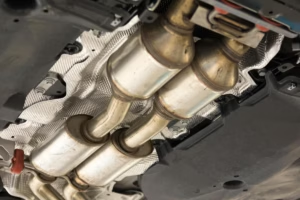
The catalytic converter is a metal housing in the exhaust system that contains a catalyst substrate (usually a ceramic or metallic honeycomb coated with precious metals like platinum, palladium, and rhodium). Its job is to convert harmful exhaust byproducts into less harmful compounds before they exit the tailpipe.
In a typical “three-way catalyst” system, the converter helps reduce:
- Hydrocarbons (HC) → converted into water (H₂O) and carbon dioxide (CO₂)
- Carbon monoxide (CO) → converted into CO₂
- Nitrogen oxides (NOx) → reduced to nitrogen (N₂) and oxygen (O₂)
In normal operation, the PCM keeps the air-fuel mixture close to stoichiometric so the converter can do its work efficiently. Oxygen sensors before and after the converter help the PCM maintain this balance and evaluate catalyst performance.
So how does a converter cause the CEL to come on?
1) Catalyst efficiency drops below threshold (the classic P0420/P0430 scenario)
When a converter ages or becomes contaminated, it loses the ability to store oxygen and catalyze chemical reactions effectively. The PCM detects this by comparing oxygen sensor patterns:
- Upstream O2 sensor (before the cat): should switch rapidly as the PCM adjusts mixture.
- Downstream O2 sensor (after the cat): should be smoother/steadier if the cat is storing oxygen and converting pollutants.
If the downstream sensor begins to mimic the upstream sensor too closely, the PCM interprets that as reduced catalyst efficiency and may set P0420/P0430, illuminating the CEL.
Important nuance: this same pattern can also happen if the downstream O2 sensor is faulty, if there’s an exhaust leak near the sensor, or if the engine is running abnormally rich/lean. That’s why proper diagnosis matters before replacing a converter.
2) The converter becomes restricted (clogged) and the engine can’t breathe
A converter can physically clog if its honeycomb substrate melts or collapses. This is often caused by excessive heat—frequently from unburned fuel entering the exhaust during misfires. A clogged converter increases exhaust backpressure, which reduces engine power and can create odd symptoms such as:
- Loss of power at higher RPM (feels like the engine “runs out of breath”)
- Engine revs but the car doesn’t accelerate proportionally
- Engine runs hotter because it’s working harder
- Sometimes a rattling noise (broken substrate)
Restriction doesn’t always trigger P0420 immediately. Sometimes it triggers fuel trim issues, airflow-related codes, or misfire codes because the engine’s breathing is compromised.
3) Misfires overheat the converter and the CEL flashes (the “act now” scenario)
A blinking CEL often indicates catalyst-damaging misfire. Misfires can happen for many reasons—ignition coil failure, worn plugs, injector issues, vacuum leaks, compression problems. When a cylinder misfires, some fuel may exit the combustion chamber unburned and enter the exhaust.
That unburned fuel can ignite in the catalytic converter, causing extreme temperature spikes that can melt the substrate. Over time (or quickly if severe), the converter becomes damaged or clogged.
This creates a dangerous feedback loop:
- Misfire sends unburned fuel into exhaust
- Converter overheats and degrades
- Converter becomes inefficient or restricted
- Engine performance worsens, misfires may increase
- CEL flashes, risk of converter fire hazard rises
In severe cases, an overheated converter can pose a fire risk—especially if the vehicle is parked over dry grass or debris. While this is not common, it is possible, and it’s a key reason you should not ignore a flashing CEL.
Why the Catalytic Converter Usually Isn’t the “First” Problem
Here’s the part many drivers find surprising: catalytic converters often fail as a victim, not as the original cause. In other words, converters are frequently damaged by upstream problems such as misfires, oil burning, coolant burning, or long-term fueling errors.
If you replace the converter without fixing the underlying cause, the replacement converter can fail prematurely. That’s why professional diagnosis emphasizes root cause.
Common converter-killing conditions include:
- Ignition coil failures: weak spark under load causes misfires and raw fuel in the exhaust.
- Worn spark plugs: increased gap and resistance causes misfires, especially under boost and high load.
- Oil consumption (blow-by): oil ash contaminates catalyst washcoat and reduces efficiency.
- Coolant burning: silicates and additives can poison catalyst surfaces.
- Rich running: excessive fuel can overheat the converter and accelerate degradation.
- Leaded fuel: lead can poison catalyst material (less common today but still relevant in some regions and misuse cases).
This is why the best repair plan is often: fix misfires and mixture problems first, then evaluate catalyst performance.
How to Diagnose a Catalytic Converter Problem (Without Guessing)
When the CEL is on and you suspect a catalytic converter, don’t start with “replace the cat.” Start with data. Here’s the professional diagnostic ladder—organized from easiest/cheapest to more advanced:
Step 1: Scan for codes and freeze-frame data
Use an OBD-II scanner to retrieve codes. If you see P0420 or P0430, you’re in catalyst efficiency territory—but you still need to determine whether the converter is truly failing or whether another issue is making it appear inefficient.
Freeze-frame data helps: it tells you engine load, coolant temperature, speed, and fuel trims when the code set. Catalyst efficiency codes often set under stable cruise conditions when the PCM runs catalyst monitoring. If the freeze frame shows cold engine temperature or abnormal fuel trims, you may have a different problem.
Step 2: Check for misfires first (especially if CEL flashes)
If there are misfire codes (P0300 random misfire or P0301–P0308 cylinder-specific), fix those first. A converter cannot survive long-term misfire, and a misfiring engine produces unreliable emissions data anyway.
Common misfire fixes include replacing spark plugs, ignition coils, addressing vacuum leaks, injector issues, or compression problems.
Step 3: Inspect for exhaust leaks near oxygen sensors
Exhaust leaks upstream of the downstream O2 sensor can draw in outside oxygen and mislead the sensor. This can cause false catalyst efficiency results. Check for soot marks, ticking noises on cold start, or loose flange joints.
A smoke test is the fastest professional method for locating subtle exhaust leaks.
Step 4: Analyze O2 sensor live data (upstream vs downstream)
On many vehicles, a healthy converter produces a downstream signal that is significantly smoother than upstream. If both signals look very similar, the PCM sees low oxygen storage and low conversion capacity.
However, a lazy downstream sensor can also create confusing signals. That’s why a scan tool with graphing capability is valuable. If you can’t graph data, many shops can do this quickly.
Step 5: Check for converter restriction (backpressure or vacuum test)
If you suspect clogging, technicians may use:
- Backpressure testing: measures exhaust pressure ahead of the converter. High pressure suggests restriction.
- Vacuum gauge behavior: a restricted exhaust can cause vacuum to drop as RPM increases.
- Infrared temperature comparison: comparing inlet and outlet temperatures under specific conditions can provide clues (not definitive alone, but helpful in context).
Restriction diagnosis is important because a clogged converter can damage the engine (excess heat and load) and create dangerous driving conditions (loss of power during merging).
How to avoid a Damaged Catalytic Converter
In many cases, a truly damaged catalytic converter must be replaced. But replacement should be paired with root-cause correction; otherwise the new converter can fail again. The best cure is prevention. Here are steps to reduce the risk of cat damage—organized by what most commonly kills converters in real life.
Ensure engine tune-up
Regular engine tune-ups are converter insurance. Keep ignition components healthy, ensure proper air-fuel mixture, and replace worn parts before they cause misfires. A converter is designed to handle normal exhaust—not repeated raw fuel events from misfires.
Practical tune-up items include:
- Correct spark plugs at the correct interval (and correct heat range/spec)
- Healthy ignition coils (replace weak coils before they strand you)
- Clean air filter and stable fuel delivery
- Addressing vacuum leaks early
Make sure your engine is operating within proper specifications to prevent the cat from failing.
Avoid excess fuel in the exhaust
Excess unburned fuel entering the exhaust system is one of the fastest ways to overheat a converter. Misfires, leaking injectors, rich running from faulty sensors, or failed fuel pressure regulators can all cause this.
Regular maintenance and timely diagnosis of drivability issues prevent the converter from becoming the “burn-off chamber” for raw fuel.
Avoid severe impacts and road hazards
Catalytic converters often contain a thin-walled substrate inside. While the housing is metal, internal components can crack if hit hard. Speed bumps, road debris, rocks, and rough terrain can damage the converter, especially in low-clearance vehicles. A cracked substrate can rattle and eventually collapse, creating restriction.
While you can’t avoid every pothole or debris strike, slow down on rough roads and be cautious with off-road terrain if your exhaust hangs low.
Replace bad oxygen sensor
Faulty oxygen sensors can cause rich or lean mixtures. Rich operation increases converter temperature and can accelerate catalyst degradation. Lean operation can increase NOx and cause drivability problems that lead to misfires under load.
Replace faulty O2 sensors promptly. And if a sensor failed because of oil or coolant contamination, address that root cause too—otherwise the new sensor may degrade quickly.
FAQs
Can a bad catalytic converter cause the check engine light to flash?
Yes, it can—though the more common cause of a flashing CEL is an active misfire that threatens the converter. A severely restricted or overheating converter can contribute to misfires and heat-related protective strategies. A flashing CEL means you should reduce engine load immediately and avoid high speed or long-distance driving until the vehicle is diagnosed. This situation calls for a scan and proper inspection as soon as possible.
If you continue driving with a flashing CEL, you risk melting the converter substrate, causing restriction, and turning a manageable repair (plugs/coils) into a major repair (converter replacement plus upstream fixes).
What are other reasons my check engine light will come on?
A defective catalytic converter can illuminate the CEL, but it’s far from the only cause. Here are other common reasons the CEL turns on (reordered from “easy and common” to “more involved”):
- Loose gas/fuel cap (often triggers EVAP leak codes)
- Malfunctioning oxygen sensor
- Damaged exhaust gas recirculation (EGR) valve
- Vacuum leaks (unmetered air)
- Bad Mass Air Flow (MAF) sensor
Also remember ignition faults and spark plug wear—these are frequent root causes that can damage converters if ignored.
Is it safe to drive with a P0420 code?
It depends on the symptoms. If the car drives normally and the CEL is steady (not flashing), you can often drive short distances while you plan diagnostics and repair. However, if you have misfires, power loss, overheating, or rotten egg smells, you should diagnose promptly. If the converter is restricted, continued driving can cause severe power loss and heat buildup.
Will a catalytic converter cleaner fix a check engine light?
Sometimes a cleaner can help marginal deposits, but it is not a reliable fix for a genuinely failing catalyst or a melted/restricted substrate. If a converter is failing because of misfires, oil burning, or coolant burning, a cleaner will not correct the root cause. Use caution with “quick fixes”—they can delay the diagnosis of the real problem.
Final Thoughts
As I often advise: don’t diagnose your vehicle by hearsay or guesswork. A check engine light can mean dozens of different things, and a catalytic converter is just one possible outcome—not always the original cause. Until you scan the vehicle and interpret data, you should not assume why the car is behaving a certain way.
A failing catalytic converter can absolutely illuminate the CEL—typically through catalyst efficiency codes like P0420/P0430, or indirectly by contributing to restriction and misfire conditions. But converters often fail because something else damaged them: misfires, rich running, oil consumption, coolant intrusion, or exhaust leaks.
The most cost-effective plan is always to diagnose correctly, fix root causes, and protect the converter from avoidable damage. If your CEL is flashing, treat it as urgent. If it’s steady, schedule diagnosis soon, scan codes, and avoid “parts darts.” The right diagnosis almost always costs less than the wrong replacement.