
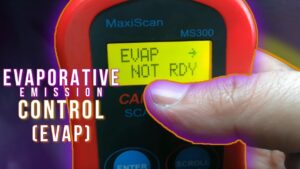

If your scan tool displays “EVAP Monitor Not Ready,” it’s easy to assume something is broken. After all, most drivers only think about the EVAP system when a check engine light comes on or when an emissions test is due. The truth is more nuanced: “EVAP System Monitor Incomplete” is often a status issue, not a failure—and understanding the difference can save you time, money, and unnecessary parts swapping.
In this article, I’ll explain what “EVAP Monitor Not Ready” actually means inside your car’s onboard diagnostics (OBD-II) logic, why it does not automatically indicate a defective component, and how to get the EVAP monitor to complete legitimately. I’ll also show you the most common reasons EVAP readiness stays incomplete, how to diagnose EVAP problems correctly (including when a smoke test makes sense), and how to run a complete drive cycle without guessing.
Table of Contents
By the end, you’ll be able to answer three critical questions with confidence:
- Is my car failing the EVAP system, or is the monitor simply not finished?
- What do I need to do to make the EVAP monitor go from “Not Ready” to “Ready”?
- What should I check first if the EVAP monitor refuses to complete?
EVAP System Monitor Incomplete: What it means
The Evaporative Emission Control System (EVAP) is a crucial emissions-control system found on modern gasoline vehicles (and many hybrids). Its job is simple in concept but complex in execution: capture fuel vapors from the fuel tank and fuel system, store them temporarily, and then route them into the engine to be burned—rather than allowing those vapors to vent into the atmosphere.
When your scan tool shows “EVAP Monitor Not Ready” (also shown as “EVAP System Monitor Incomplete” on some tools), it does not necessarily mean the EVAP system is leaking. It usually means the vehicle’s computer (PCM/ECM) has not completed the EVAP self-test sequence required to mark the monitor as “Ready.”
That distinction matters. There are two different “layers” of information here:
- Readiness status: whether the computer has completed its tests since the last reset event.
- Fault status: whether the computer detected an actual EVAP failure and stored a diagnostic trouble code (DTC) and/or turned on the MIL (check engine light).
In other words, “Not Ready” is often just the computer saying: “I haven’t finished my homework yet.” A stored DTC is the computer saying: “I finished the test, and something failed.”
“EVAP Monitor Not Ready” most commonly appears after certain reset-type events. Starting from the previous time you:
- Cleared all DTCs from the Power Control Module memory
- Disconnected or replaced your battery
- Ran your monitor
Clearing codes or disconnecting the battery resets readiness monitors. The vehicle must then experience certain operating conditions to re-run the EVAP self-check. Until it does, your scan tool will keep reporting “Not Ready,” even if nothing is broken.
Now let’s talk about how the EVAP system works in practical terms. Understanding the mechanics makes it much easier to understand why the monitor can be stubborn.
How the EVAP System Works (and What the Monitor Is Actually Testing)
EVAP is not a single part. It’s a network of components controlled by the PCM. The exact layout varies by manufacturer, but the building blocks are similar on most vehicles:
- Fuel tank and filler neck: where vapors originate and where leaks are common if the cap or neck seal is damaged.
- Charcoal canister: stores fuel vapors temporarily.
- Purge valve / purge solenoid: opens to allow engine vacuum to pull vapors from the canister into the intake manifold.
- Vent valve / vent solenoid: opens to allow fresh air into the canister and closes when the PCM wants to seal the system for leak testing.
- Fuel tank pressure sensor (FTP): provides feedback so the PCM can “see” vacuum/pressure changes in the EVAP system.
- Hoses and lines: connect everything; small cracks or loose connections can create real leaks.
In EVAP system monitoring, the charcoal canister stores fuel vapor and prevents it from polluting the atmosphere. When the engine is on, the PCM commands the purge valve to open under the right conditions. This allows intake vacuum to draw vapors from the canister into the engine, where they are burned during normal combustion.
The EVAP monitor is not one single test. Depending on vehicle design, the PCM may run multiple sub-tests, such as:
- Purge flow test: verifies vapors (or airflow) actually move when the purge valve is commanded.
- Leak test: verifies the system can hold vacuum/pressure; this is where gas caps, hoses, canisters, and vent valves commonly fail.
- Vent valve operation: verifies the vent valve closes when commanded (system must seal) and opens when needed (system must breathe).
- Pressure sensor plausibility: ensures the fuel tank pressure sensor readings behave logically under different conditions.
If the PCM does not detect expected airflow or pressure behavior when the purge valve is commanded, it may set a code and trigger the MIL. Or if it detects a leak equivalent to or larger than the threshold the vehicle is calibrated to catch, it will store a leak-related DTC and eventually turn on the check engine light.
However, if conditions are not right to run the test, it won’t run at all—and that’s when you get “EVAP Monitor Not Ready.”
Why EVAP “Not Ready” Does Not Automatically Mean You Have a Problem
EVAP is one of the last monitors to set on many vehicles because the self-test requires specific conditions that drivers don’t always naturally meet. For example, many EVAP leak tests run after a cold soak (vehicle sitting several hours) and are sensitive to fuel level, temperature, and even how the vehicle is driven. If you mostly drive short trips, sit in traffic, or rarely cruise steadily at highway speed, the monitor may remain incomplete even though the EVAP system is healthy.
Here are the most common “normal” scenarios where EVAP stays not ready without a true failure:
- You recently cleared codes to turn off a check engine light or after repairs.
- You disconnected/replaced the battery (or the battery went dead).
- You don’t drive in the right pattern (no highway cruising, no cold soak, or too many short stops).
- Fuel level is out of range for testing (too low or too full).
So, the first expert rule is this: Readiness status must be interpreted alongside codes and symptoms. If there is no check engine light, no stored EVAP codes, and the vehicle drives normally, EVAP “Not Ready” is often simply incomplete testing—not a defect.
Most Common Causes of EVAP Monitor Incomplete
When EVAP won’t set, the causes typically fall into two categories: (1) the monitor hasn’t been given the right conditions, or (2) the EVAP system has a fault preventing the test from completing successfully. The list below is arranged from “most common and easiest to fix” to “more diagnostic-intensive.”
- Recently reset ECU memory: If you recently reset your vehicle’s computer or changed/disconnected the battery, the monitor may not be ready yet. It needs time and the correct operating conditions to complete essential checks.
- Incomplete drive cycle: If the drive cycle isn’t complete, the EVAP monitor may remain incomplete. Your vehicle can only complete many emission tests after a full, valid drive cycle.
- Loose, damaged, or broken gas cap: A compromised gas cap can cause leaks that affect emissions. Even if the system is fine otherwise, the EVAP monitor may not complete if the system cannot hold pressure/vacuum as expected.
- Leaks in the EVAP system: Cracked hoses, loose clamps, damaged filler neck seals, or canister issues can prevent the system from sealing for leak testing.
- Faulty purge valve or vent valve: These valves are central to EVAP testing. If the purge valve sticks open, the system can’t build the correct vacuum. If the vent valve can’t close, the system can’t seal for leak testing.
- Faulty charcoal canister: If the canister is saturated with fuel or contaminated (common after overfilling the tank repeatedly), it can disrupt purge flow behavior and leak tests.
- Sensor problems: Issues with sensors controlling or reporting EVAP operation—especially the fuel tank pressure sensor—can cause the PCM to abort testing or fail to confirm results.
Expert reminder: A vehicle can have a real EVAP fault and still show “Not Ready” because the PCM may stop attempting the test if other related faults exist. That’s why scanning for pending codes is critical. Some problems won’t turn the MIL on immediately but will store “pending” DTCs that keep the monitor from completing.
How to Get Your EVAP System Monitor Ready
To make the EVAP monitor go from “Not Ready” to “Ready,” you need to follow an expert workflow: first confirm the system isn’t currently failing, then ensure the vehicle experiences the right conditions to run the EVAP test.
Start by performing targeted checks on the most failure-prone areas. Here’s an evidence-based checklist, arranged in an efficient diagnostic order:
- Scan all readiness monitors: With a scan tool, run an inspection and maintenance diagnosis to observe all monitors, not only EVAP. If multiple monitors are incomplete, you’re likely dealing with an incomplete drive cycle rather than a single EVAP issue.
- Check for stored and pending DTCs: If the PCM has pending EVAP codes, the monitor may not complete. Don’t ignore pending codes; they often become MIL codes later.
- Inspect the gas cap: Ensure it’s the correct cap, the seal isn’t torn, and it clicks tight. Replace if damaged. This is one of the cheapest EVAP fixes.
- Inspect vacuum hoses and EVAP lines: Check for cracking, disconnections, or abrasion damage. EVAP hoses can become brittle and split with age and heat exposure.
- Test/inspect purge valve and vent valve: If the purge valve is stuck open or the vent valve cannot close, the system won’t seal or flow correctly.
- Inspect the charcoal canister: Replace if saturated, cracked, or contaminated. This is more common when the fuel tank is repeatedly “topped off” after the pump clicks.
Practical tip: If you’ve recently replaced EVAP parts or fixed a leak, don’t clear codes “just because.” Scan first, confirm repairs, and clear only when you know you can complete a drive cycle afterward. Many failed emissions tests are caused by a well-intended code clear that resets readiness too close to the inspection appointment.
Tips to Run a Complete EVAP Monitor Drive Cycle
As mentioned earlier, an incomplete drive pattern is one of the most common reasons EVAP readiness stays incomplete. The correct solution is to run a complete drive cycle—but you must respect the conditions that make the EVAP test valid. Otherwise, you can drive for hours and still not set the monitor.
Below are the typical conditions that enable you to run a complete EVAP monitor drive cycle. I’ve rearranged them into a clean “preconditions” and “driving steps” format, which is how professional technicians approach readiness issues.
A) Preconditions (Set These Up Before You Drive)
- Fuel level: An EVAP self-check may become inaccurate if fuel is extremely low or completely full. Keep the fuel tank between ¼ and ¾ full.
- Cold soak: Allow the vehicle to rest for up to eight hours without starting. Many EVAP leak tests prefer a stable “cold soak” condition.
- Ambient temperature: The ambient temperature must typically fall between 30 and 95 degrees.
- Barometric pressure: Barometric pressure must be above 75 kPa.
- Ignition voltage: Ensure ignition voltage is between 11 and 18 volts. Weak batteries can cause modules to abort tests.
- MIL status: Ensure the malfunction indicator lamp (MIL) is OFF before starting the cycle. An active emissions fault may block EVAP readiness completion.
- Temperature sensor relationship: Intake Air Temp (IAT) and Engine Coolant Temp (ECT) should be within expected ranges: IAT around 7°C (45°F) and ECT around 29°C (85°F) in the conditions listed.
- Sensor consistency: IAT should not be -16°C (2°F) higher than ECT, and ECT should not be -11°C (12°F) higher than IAT. Large discrepancies can suggest sensor faults or prevent testing.
- Throttle position baseline: Throttle position sensor range should be approximately 0.09% to 0.3% at idle/closed-throttle conditions.
B) Driving Steps (Give the Monitor What It Needs)
Once the preconditions are met, follow a steady driving pattern. A common guideline for many vehicles is:
- Highway cruise: Drive the car for about 10 minutes at 45 to 65 mph on the highway (steady throttle, minimal rapid acceleration).
Many EVAP tests run during stable cruising or during deceleration events after cruising. That’s why stop-and-go city driving often does not set EVAP readiness efficiently.
Expert technique: If your route allows, include a few long, gentle deceleration periods (coast down from highway speed without heavy braking) because some systems use decel conditions to evaluate purge and tank pressure response. Do this safely and legally, of course.
If EVAP Still Won’t Set: Professional Diagnostics That Actually Work
If you’ve met the preconditions, driven a proper cycle, and EVAP remains “Not Ready,” stop repeating the same drive loop. At that point, you need data. Here’s the professional diagnostic approach, without guesswork:
1) Check Pending Codes and Freeze Frame Data
Even if the check engine light is off, your PCM may store pending EVAP codes that haven’t matured into an MIL yet. Pending codes often prevent the monitor from completing. Freeze frame data can show the conditions when the PCM detected a problem (fuel level, temperature, vehicle speed), which can point you directly to the fault.
2) Inspect the Gas Cap and Filler Neck Like a Technician
Don’t just tighten the cap. Inspect the seal for tears and hardening. Check the filler neck for deformation, rust, or dents (especially on older vehicles). A perfect EVAP system can’t pass a leak test if the sealing surface is compromised.
3) Consider an EVAP Smoke Test (Best Leak-Finding Method)
A smoke test pressurizes the EVAP system with a safe, visible vapor, allowing you to see where leaks are escaping. This is often faster and more accurate than replacing parts at random—especially for small leaks that trigger codes like “small leak detected.” Many shops can run this test quickly, and it often pays for itself by preventing unnecessary parts replacement.
4) Test Purge and Vent Control Operation
A purge valve stuck open can create a vacuum leak and can prevent the EVAP system from sealing for testing. A vent valve stuck open prevents the system from holding pressure. Both conditions can keep EVAP from setting readiness even if you “drive the perfect cycle.” A scan tool that can command purge/vent operations is extremely useful here.
Key idea: EVAP readiness isn’t only about driving—it’s about the system being physically capable of sealing, holding, and responding correctly.
FAQs
What does “EVAP Monitor Not Ready” mean?
Your vehicle’s computer cannot perform—or has not yet completed—a self-test to verify the EVAP system’s functionality. This is a readiness status, not automatically a fault code.
If my EVAP monitor is not ready, can I pass an emission test?
You can pass an emissions check if EVAP is the only unready monitor, depending on local rules and the number of monitors allowed to be incomplete. But if other readiness monitors are also incomplete, your car will not pass until all required OBD II readiness monitors are “ready.”
How long does it take for the EVAP monitor to become ready?
It depends on the vehicle. Some set within one or two well-matched drive cycles; others can take several days of mixed driving plus a cold-soak period. Your vehicle’s design, model year, and how you drive all influence the timeline.
Should I clear codes to make EVAP ready?
No—clearing codes resets readiness monitors and often makes the problem worse if you’re trying to pass an emissions test soon. Clear codes only after verified repairs and only when you have time to complete a drive cycle afterward.
Final Thoughts
“EVAP Monitor Not Ready” is your scan tool telling you the vehicle’s EVAP self-test sequence is incomplete. It does not automatically mean the EVAP system is faulty. In many cases, the monitor is incomplete because the vehicle recently had codes cleared, the battery was disconnected, or the correct driving conditions haven’t occurred yet.
However, if EVAP readiness remains incomplete after proper driving conditions—or if you have pending/stored EVAP codes—then it’s time to treat it as a diagnostic problem. Start with the simplest and most common issues (fuel level range, gas cap condition, hose inspection), then move into scan-tool testing and smoke testing for leaks if needed.
Remember that your car’s brand, model, and year will determine how many drive cycles the system needs to complete the EVAP monitor. Before you begin chasing readiness, ensure the supporting EVAP components (cap, purge, vent, lines, canister, sensors) are operating correctly. And if you do clear DTCs, do it intentionally: diagnose → repair → verify → complete drive cycle → confirm readiness.