
Buying a car is rarely a spontaneous act; especially for drivers who are stepping into ownership for the first time or upgrading to a vehicle that will represent their lifestyle for years. Beyond price and availability, most people carry a clear mental checklist: the “right” body style and dimensions, a cabin that matches personal expectations of comfort and ergonomics, engineering traits that align with the intended use case (city commuting, family travel, off-road, performance driving), and; yes; the subtle but real desire for a badge that reflects personal taste and social positioning. Because of that, making a confident purchase demands more than a test drive. It requires understanding how modern automakers are structured, what each brand stands for, which technologies they emphasize, how their design language evolved, and how consistent their quality and support have been over time. The most reliable approach is to study each manufacturer’s background, compare strengths and weaknesses across competing marques, and then cross-check those findings against professional reviews and long-term owner experience. Even if you already feel drawn to a particular nameplate, a structured comparison will either validate your preference; or reveal a better match you may not have considered.
What car brands start with the letter k?
The global automotive industry comprises numerous brands, and many marque names begin with the letter “M.” In practice, there is no single “quick” answer that does the topic justice: the list spans mass-market giants, boutique ateliers, motorsport specialists, historic names that disappeared decades ago, and contract manufacturers that build vehicles for other brands behind the scenes. In this selection you’ll encounter famous “Japanese” players such as Mitsubishi and Mazda, “German” icons such as Mercedes and the ultra-luxury Maybach, and even “Soviet” industrial legends such as MAZ. Some of these names ended their journeys in the early or mid-20th century, which explains why even dedicated enthusiasts may only recognize a portion of them today. With that in mind, the most useful way to respond is to present a curated overview; so you can quickly understand what each brand is (or was), why it matters, and where it fits in the broader market narrative.
Over roughly a century and a half; starting from the first self-propelled “carriages” that served as prototypes for the automobile as we know it; countless details about manufacturers, prototypes, and engineering milestones have been scattered or lost. That loss is not only a consequence of time; it is also the result of economic turbulence and the constant reshaping of the industry. Automotive history is full of brands that appeared with bold ideas, introduced genuinely innovative solutions, and then vanished due to funding gaps, political shifts, war, or poorly timed market entries. It is equally common to find companies whose lineage became difficult to follow because of mergers, acquisitions, licensing deals, trademark transfers, and rebranding strategies that essentially “repackaged” one firm into another. For collectors, researchers, marketers, and both professional and amateur drivers, this background is more than trivia; it helps explain why certain design philosophies persist, why some technologies spread across competing marques, and why a once-prominent badge may reappear decades later under new ownership. Understanding these connections also makes it easier to interpret current market moves and anticipate how brand identities might evolve.
Magna Steyr

When discussing Austrian automotive expertise, one of the most influential players is not a consumer-facing badge but a global contract manufacturing powerhouse: Magna Steyr AG, a subsidiary of Canada’s Magna International. Formed in Graz, Austria, in 2001 after the spin-off of Steyr-Daimler-Puch, the company occupies a unique position in the industry. Rather than competing with mainstream automakers, Magna Steyr designs, engineers, and assembles vehicles on behalf of other brands; often handling complex, low-volume, or highly specialized projects where flexibility and deep engineering experience matter most. In parallel with assembling complete vehicles to order, the company produces a wide range of automotive components, reinforcing its status as a major behind-the-scenes contributor to modern mobility. In recent years, one notable direction has been its participation in technology development connected with 4MATIC, highlighting how contract manufacturers can also play an active role in drivetrain evolution, not merely “building to spec.” For buyers and enthusiasts, Magna Steyr is a reminder that the badge on the hood doesn’t always tell the full story of who engineered and assembled the vehicle.
Mallett

Mallet Performance Cars represents a distinctly American tradition: taking already-capable performance platforms and pushing them toward the extreme through focused engineering. Founded in 1997 in Charlotte, North Carolina, by former racers Chuck and Lance Mallett, the company built its reputation by developing parts and producing some of the fastest variants of the C5 Corvette. That early focus on extracting more speed, sharper drivability, and stronger braking performance shaped the brand’s identity and attracted a community of enthusiasts who valued functional upgrades over cosmetic changes. As new platforms arrived, the company expanded its work to include C6 Corvettes, Cadillac V-Series models, the V8-powered Solstice and Sky, and even an SUV lineup; an evolution that signaled both technical ambition and an understanding of market demand. This progression eventually caught the attention of GM, which is often the turning point for smaller performance houses: recognition that their engineering has moved from niche experimentation into influential territory. In the broader context of performance tuning, Mallett illustrates how motorsport experience can translate into street-focused improvements when applied with discipline and clear objectives.
March

March Engineering is a name deeply woven into the fabric of British motorsport history. Established in 1969 in Newtownards, UK, by Max Mosley, Alan Rees, Graham Coaker, and Robin Herd, the brand entered the racing world with a clear mission: design and build competitive single-seaters. Its first Formula 3 car appeared in the same year; an early demonstration of urgency and technical readiness. In 1970, March stepped onto the Formula 1 stage with the March 701, and the effort quickly yielded a milestone victory at the Spanish Grand Prix. As motorsport regulations and economics shifted, the company adapted; by 1978, March redirected significant focus toward developing cars for Formula 2, including a contract with BMW to produce racing equipment. During the 1980s, the brand explored prototypes influenced by the BMW M1C, while the March FW07 and its derivatives became widely recognized. Ultimately, like many specialized racing constructors, March faced the harsh reality of sustainability in a competitive industry and closed in 1992. Its legacy remains a case study in how technical innovation, strategic partnerships, and racing results intersect; sometimes brilliantly, sometimes briefly.
Marcos Ltd
Marcos Engineering; later known as Marcos Ltd; embodies the classic British sports car spirit: compact dimensions, bold styling, and a persistent pursuit of driver involvement. Founded in 1959 in Kenilworth, England, by Jem Marsh and Frank Costin, the brand name itself was formed from the first letters of the founders’ surnames, giving it a personal, almost handcrafted identity from the outset. Based initially in Luton, Bedfordshire, the company relocated in 1963 to Bradford-on-Avon, Wiltshire, reflecting both growth ambitions and the practical realities of manufacturing. In 1964, Marcos launched the 1800 GT, a pivotal step that helped define the brand’s presence in the sports car scene. The construction of a new factory near Westbury further reinforced its production aspirations, and in 1971 the firm adopted the name Marcos Ltd. Notable later products included the Marcos V6 coupe launched in 1981. However, as is often the case with smaller independent manufacturers, financial pressures eventually outweighed passion and engineering capability, leading to the brand’s closure in 2007. Marcos remains significant for enthusiasts who value niche British performance and design character.
Marmon
Marmon Motor Company stands as an early American industrial story with an automotive chapter that still fascinates historians. Founded in 1851 in Indianapolis, Indiana, by Howard Carpenter Marmon, the company’s earliest focus was not cars at all, but flour milling equipment; an origin that underscores how many early automakers emerged from broader mechanical and manufacturing businesses. Marmon’s first experimental automobiles appeared in 1902, and over time the brand produced vehicles under the Marmon name until 1933, when it was merged with another company and renamed. Among its most recognized models are the 1923 Marmon 34B two-seat speedster, the 1929 Marmon Series 8-69 four-door sedan, and the 1933 Marmon Series 16 four-door sedan. These vehicles represent both the brand’s performance ambitions and its interest in building substantial, premium automobiles for the era. After Marmon’s automotive production ended, Marmon-Herrington became the brand’s successor, carrying forward aspects of the name and industrial heritage. For modern readers, Marmon is a useful reminder that automotive prestige and experimentation were not exclusive to today’s well-known giants; many early American manufacturers contributed important chapters before consolidation reshaped the market.
Marussia Motors

The Russian automobile brand Marussia Motors was founded in 2007 by Nikolai Fomenko, Anton Kolesnikov, and Efim Ostrovsky and was based in Moscow. In an industry where new manufacturers often struggle to move beyond concepts and press releases, Marussia drew attention by developing tangible prototype sports cars and pursuing a broader lineup strategy. Before its liquidation in 2014, the company produced 44 prototype sports cars and managed to establish mass production for four models, reflecting both ambition and the operational challenges of scaling a young automotive enterprise. The Marussia B1 and B2 became the best-known nameplates, while projects such as the Marussia F2 crossover concept and the Marussia E-Car hydromobile expanded public awareness of the brand’s creative range. The company was also associated with the Cortege project, which included four vehicle types: an SUV, two variants of a premium sedan, and a minivan. Even though its commercial life was short, Marussia remains an instructive example of how difficult it is to build a new car brand in the modern era; where engineering, supply chains, compliance requirements, and capital intensity all create steep barriers to long-term survival.
Maserati

Maserati S.p.A. is one of Italy’s most recognizable automotive names, founded in 1914 by Alfieri Maserati in Bologna and now headquartered in Modena. Across generations, Maserati has built its reputation on a blend of elegance, expressive styling, and performance that feels distinctly Italian; less clinical than some rivals, more emotional in both design and driving character. The brand has long functioned as a symbol of success and wealth, in part because its portfolio traditionally sits at the intersection of sports cars, business sedans, and luxury grand tourers. Today the marque is owned by Fiat Chrysler Automobiles, positioning it within a large global corporate structure while still trading heavily on heritage and brand personality. Among the iconic models frequently cited are the 1959 Maserati 200SI, the Birdcage, the racing-focused Maserati 250F, the 1959 Maserati 5000GT coupe, and later vehicles like the 1989 Shamal. Contemporary attention often goes to the Levante four-seat crossover and the Quattroporte four-door sports sedan. In evaluating Maserati, it helps to see it as a brand that sells not only transport, but identity; an engineered lifestyle narrative built on design, sound, and prestige.
Mastretta Cars

Mastretta Cars is both a Mexican car manufacturer and a design studio; an important pairing, because in emerging automotive markets, design competence and production capability often evolve together. Founded in 1987 by designer Daniel Mastretta and headquartered in Mexico City, the company developed experience over time through varied projects rather than immediately launching a mass-market lineup. During the 1990s, Mastretta produced several series of completed vehicles under the Tecnoidea and Unediseño names. These were based on the Volkswagen Sedan (VW Type 1) platform in 1995, and the company also worked with minibus chassis, illustrating a practical approach to building roadworthy products using established mechanical foundations. The brand’s most notable commercial milestone was the MXT, introduced in 2010 as the first mass-produced commercial vehicle associated with the company. For readers exploring global automotive diversity, Mastretta is an example of how regional brands can emerge by combining local design identity with pragmatic engineering choices; often leveraging widely known platforms while developing a distinct aesthetic and market purpose.
Matech Concepts

Matech Concepts was a Swiss specialist brand that focused on race car design and manufacturing, founded by Martin Bartek and based in Geneva, Switzerland. Its work illustrates how smaller, technically focused companies can influence high-performance development; especially when aligned with major motorsport programs. Through an agreement with Ford Racing, Matech participated in the development of the Ford GT, a project that demands both engineering discipline and an understanding of racing-derived performance targets. At the same time, the company distributed components for the Ford Mustang FR500, further positioning itself as a high-performance partner rather than a mass manufacturer. Matech’s identity was also represented on-track by the Matech GT Racing team, which achieved a major competitive result by winning the 2008 FIA GT3 championship. Although the company ceased operations in 2011, its story remains relevant: motorsport suppliers and boutique constructors often rise quickly on the strength of technical excellence and results, yet remain vulnerable to shifts in funding, sponsorship, and regulatory landscapes that can change the business environment almost overnight.
Matra

Matra was a French manufacturing company founded in 1964 by the Floriat family in Paris, France, and it is best understood as a diversified industrial group with a notable automotive footprint. The company’s production spanned telecommunications equipment, aviation and space technology, weapon systems, lightweight off-road rail vehicles, bicycles, and automobiles; an industrial breadth that shaped its engineering culture and willingness to explore unconventional designs. Matra’s move into sports and racing cars became more pronounced in 1965 after it acquired the Rene Bonnet brand, giving it a pathway into performance vehicle development. Its single-seat racing cars achieved success in Formula 1, reinforcing the credibility of its engineering approach. On the road-car side, seven model lines were produced, including the Matra Djet (1962), the Bagheera, the Murena (1980), and the Talbot Matra Rancho (1978). These projects reveal Matra’s tendency to combine practicality with experimentation, often producing vehicles that felt different from mainstream French offerings of the time. In 1996, Matra became part of the Lagardère Group, marking another chapter in its corporate evolution. For enthusiasts, Matra’s appeal lies in its blend of racing legitimacy and creative production cars that resisted conventional categories.
Maybach

Maybach is a German luxury automobile manufacturer whose name is inseparable from its founder, Wilhelm Maybach; an engineer whose influence extended beyond cars into early aviation, including engines designed for the Zeppelin company. The Maybach story begins in 1909 with the establishment of Luftfahrzeug-Motorenbau GmbH in Bissingen by Count Zeppelin, and the founder’s son headed the subsidiary Luftschiffbau Zeppelin GmbH. After World War I, the company was renamed Maybach-Motorenbau GmbH in 1918, and it moved into automobile production; a shift that introduced a new standard of refinement and mechanical excellence to the luxury segment. In 1919, the experimental Maybach W1 was unveiled, effectively setting the tone for a lineage associated with high quality, comfort, and prestige. Production under the Maybach name continued until the brand’s closure in 2013, but the significance of Maybach extends beyond a single corporate timeline. It symbolizes an approach to luxury where engineering, craftsmanship, and exclusivity are treated as the product itself, not merely features added to a vehicle.
Mazda
Mazda Motor Corporation traces its origins to 1920, when Jujiro Matsuda founded Toyo Cork Kogyo Ltd., a company initially focused on cork-wood products. That beginning reflects a familiar pattern in industrial history: firms often start with one specialty and later pivot into mobility as materials, machinery, and market opportunity align. By 1921, the company was producing motorcycles and engineering equipment, gradually building the mechanical foundation that would support later automotive development. In 1931, the company adopted the name Mazda; a shift that honored a deity and coincided with expanded production of three-wheeled motorcycles. The brand’s first automobile arrived in 1960 with the Mazda R360, a rear-engine, four-wheeled coupe that fit the postwar demand for efficient personal transportation. A major turning point came in 1979 when Ford Motor Company became involved as a strategic partner and shareholder, helping Mazda accelerate its global momentum and sharpen its competitiveness. Today, Mazda is often recognized for balancing accessible engineering with an enthusiast-friendly driving feel, and its history shows a steady progression from pragmatic manufacturing to globally respected automotive identity.
Mazel

Mazel Group Engineering is a Spanish automotive design studio based in Barcelona, Spain, known primarily for concept development rather than mass production. In the automotive world, design houses like Mazel play a critical role: they test ideas, challenge brand conventions, and sometimes produce one-off vehicles that demonstrate what is possible when commercial constraints are relaxed. Mazel entered brand lists largely due to a striking example of that work; the hand-designed and hand-built two-seat, rear-wheel-drive Mazda Identity i1 concept sports car. The concept debuted at the 2006 Geneva Motor Show, a venue where design credibility is often earned in a single reveal. Its sleek appearance attracted attention and highlighted how an independent studio can interpret an established manufacturer’s design language through a fresh lens. For enthusiasts, Mazel’s contribution is less about a model lineup and more about the value of creative exploration: concept cars like this act as rolling arguments for design direction, and they sometimes influence production styling across the industry even if the original prototype never reaches showrooms.
Mazzanti Automobili

Mazzanti Automobili is an Italian manufacturer recognized for high-quality, hand-built luxury cars with an exotic, boutique character. The company was founded in 2002 by Luca Mazzanti and Walter Faralli under the name Faralli & Mazzanti, with the first car assembled in a workshop in Pisa, Italy; an origin that signals craftsmanship and a small-team approach rather than industrial scale. The early period produced distinctive designs, including the F&M Antas model, and established the firm’s credibility in the niche world where design originality is a competitive advantage. In 2010, the company split into two directions: Mazzanti Automobili focused on new vehicles, while Faralli Restauri pursued restoration work. In 2011, Mazzanti Automobili introduced the Mazzanti Evantra, a model that reinforced the brand’s emphasis on bespoke styling and limited production. The Evantra was presented at Top Marques Monaco in 2013, placing it among premium and exotic peers in a setting that values exclusivity. With an expected production of five cars per year, the brand represents a deliberate refusal to chase mass sales; choosing instead to operate where rarity, personalization, and craftsmanship are central to the customer experience.
MCA
In 1983, engineer and former racing driver Fulvio Maria Ballabio founded a company in Monte Carlo (Monaco) dedicated to producing hand-built sports cars; an ambitious undertaking in a market dominated by large, well-funded performance brands. By 1989, the workshop began producing its first street car projects, including the Grand Tourer (GT) supercar and the Spider Beau Rivage convertible. Over time, the brand’s output remained deliberately limited; by 2016, approximately 60 cars and prototypes had emerged, reinforcing the boutique nature of the operation. The company’s history includes both racing and cruising-oriented designs such as the Monte Carlo ALA 50, the MCA Centenaire V12, and the Carlo Chiti MonzaCodaLunga; names that emphasize heritage and engineering personality. In 1995, France’s Aixam Mega acquired the brand, developed the MEGA Monte Carlo V12 model, and later returned rights to the founders, highlighting how small manufacturers often survive through changing ownership structures. In 2014, the Montecarlo Automobiles Rascasse model appeared, continuing the theme of limited-run, enthusiast-focused engineering. For collectors and niche performance fans, MCA illustrates how craftsmanship-driven production can persist despite the relentless financial pressures of the supercar segment.
McLaren
McLaren is a British performance brand founded in 1963 by Bruce McLaren, growing directly out of the Formula 1 racing team that carries the same name. Few modern supercar manufacturers have such a direct and credible motorsport lineage; from the beginning, the company existed to repair, refine, and improve racing cars while also developing sports models that reflected track-derived thinking. A defining moment arrived in 1992 with the introduction of the McLaren F1, a landmark vehicle that became the fastest mass-produced car in its category and remains an icon of engineering focus and uncompromising design priorities. Over time, McLaren maintained a strategy centered on limited-run and high-impact releases, including models such as the McLaren P1 Hybrid, McLaren 650S, McLaren Speedtail, and McLaren GT. Each of these vehicles contributes to the brand narrative: innovation is not presented as a marketing layer, but as a core product attribute, with performance serving as both proof and identity. For prospective buyers and enthusiasts, McLaren is best understood as a company that treats speed, lightweight engineering, and racing logic as foundational values rather than optional trim levels.
Melkus

The Melkus brand belongs to the German automobile company Heinz Melkus KG, founded in 1959 in Dresden (GDR) by the German racing driver and designer Pater Melkus. Unlike mainstream manufacturers, Melkus was rooted in competition culture; producing racing and sports cars intended for circuit use, where performance results and mechanical durability are the ultimate validation. The earliest Melkus-Wartburg-based car was assembled in a school workshop for the Junior racing formula, which speaks to the resourcefulness often required in constrained industrial environments. In 1960, small-scale production began for German sportsmen, and deliveries to the USSR followed, reflecting a regional motorsport ecosystem that operated differently from Western Europe. A notable milestone came in 1968 with the Melkus RS 1000 prototype. Over time, expanded possibilities emerged through German associations, yet the brand’s trajectory was tragically affected by the death of the founder’s son, contributing to the dissolution of the marque in 1986. Melkus remains a compelling example of how passion-driven engineering can flourish even under limitations; and how fragile such enterprises can be when personal and structural factors collide.
Mercedes

The globally recognized German brand Mercedes-Benz traces a key founding chapter to 1900, when engineer Wilhelm Maybach; who would later be associated with another premium German legacy; designed a gasoline-powered car for Consul Emil Jellinek. In a detail that has become one of the most famous naming stories in automotive history, the vehicle was named after the customer’s daughter’s favored name: Mercedes. The car was assembled at Daimler-Motoren-Gesellschaft, and the success of this project helped crystallize a brand identity that would become synonymous with engineering ambition and prestige. The Mercedes name was officially registered in 1902, and in 1926 it became Mercedes-Benz following the merger that formed Daimler-Benz. For consumers, the significance of this origin story is not merely historical; it demonstrates how Mercedes began by linking innovation with personal patronage and performance reputation, a pattern that continued as the brand expanded into luxury, motorsport, and advanced safety engineering. Even today, the Mercedes identity is shaped by the same core promise: refined vehicles built around serious technical competence.
Mercedes-AMG

Mercedes-AMG began as a performance-focused initiative with a clear mission: take the engineering base of Mercedes-Benz and amplify it for drivers who demand sharper responses, stronger power delivery, and a more aggressive character. Founded in 1967 in Affalterbach, Germany, by Hans-Werner Aufrecht and Erhard Melcher, the organization originally operated under the name AMG. Its responsibilities included developing and producing serial sports models, refining engines for higher performance, and creating sports cars that expressed its own design and technical priorities. The AMG name itself was built from the founders’ surnames and the town of Grossaspach, where the company’s office was originally located; an acronym that became one of the most valuable performance sub-brand identities in the modern market. AMG remained independent until 1990, and in 2005 Daimler-Benz acquired it, establishing the unified Mercedes-AMG structure. In practical terms, AMG represents the bridge between luxury and motorsport thinking: vehicles that retain premium finishes and brand stature, but are engineered to feel more direct, more powerful, and more emotionally engaging behind the wheel.
Mercedes-Benz

Mercedes-Benz is a German passenger car brand and the premium car company carrying the same name, formally formed in 1926 following a merger that created Daimler-Benz. From the beginning, the company positioned itself as an engineering-led automaker capable of shaping the luxury segment rather than merely participating in it. One early milestone was the Mercedes 24/100/140 PS, produced under the direction of the legendary Porsche; an association that highlights how foundational European automotive talent circulated across brands and projects. The model influenced the subsequent S-series lineup, building a legacy of flagship sedans designed to represent technology, comfort, and status. In 1928, the Mannheim 370 arrived, and in 1930 the imposing “Big Mercedes” (Mercedes-Benz 770 (W07)) further reinforced prestige. In 1931, the Mercedes 170 small car became a success, showing the brand’s ability to build appealing vehicles beyond the most exclusive tier. Today, the marque is described here as the second-largest manufacturer globally, and its modern influence reflects a long-running strategy: diversify the portfolio while maintaining an unmistakable premium identity rooted in engineering and historical continuity.
Mercer

Mercer was an American automobile brand founded in 1909 by Adrian Hatcher in New Britain, Connecticut, and despite its relatively short lifespan (ending in 1925), it made an outsized impact on performance-oriented automotive history. The company was run by the Roebling family, and its earliest standout was the 1910 Speedster Type-35R Raceabout, a scaled-down two-seat model that captured the raw, competitive energy of early motoring. Mercer’s identity was built around driving excitement, which is why the brand remains memorable even though it did not survive into the era of mass-market consolidation. Notable models included the 1916 Mercer 22/72 Universal, the 1916 Raceabout, and the 1917 Raceabout; vehicles that reflect the era when speed and mechanical daring were core selling points. A tragic turning point came in 1919 with the death of A. Roebling II in an accident. After the brand was sold to a Wall Street firm, mismanaged finances accelerated its decline, leading to collapse in 1925. Mercer’s story is a sharp reminder that early automotive greatness often hinged as much on leadership and stability as it did on engineering talent.
MG Motors

The MG Cars brand is notable not only for its vehicles, but also for the unusually complex chain of ownership that shaped its evolution. Founded in the early 1920s by Cecil Kimber, MG became a recognizable British name associated with sporty, accessible motoring; and later, with corporate transitions that reflected the shifting realities of the UK automotive sector. The brand belonged to Morris Garages Limited from 1924 to 1930, then MG Car Company Limited from 1930 to 1952, followed by British Motor Corporation (1952–1967) and British Motor Holdings (1967–1968). In 1968 it moved under British Leyland, then in 1990 transferred to Austin Rover, which became part of the Rover Group in 1992, and later passed to the MG Rover Group in 2000. Between 2006 and 2011 it was owned by Nanjing Automobile Group. Through these transitions, MG remained known for ultra-compact two-seat open-top sports cars as well as sedans and coupes. Signature models referenced here include the MG Midget, MG MGB, MG RV8, and MG XPower SV. For buyers and fans, MG’s appeal often lies in that mix of approachable sportiness and storied brand identity; even as corporate stewardship repeatedly redefined what “MG” meant in practice.
Minerva
Minerva was a Belgian automobile manufacturer founded in 1900 in Antwerp by Sylvain de Jong, initially beginning with motorcycle production. In 1903, de Jong established the anonymous Minerva Motors in Berchem, Antwerp, and by 1904 the first models appeared; an early entry into a rapidly developing European mobility market. During World War I, the company developed open-top vehicles intended to engage enemy forces, a reminder that wartime needs often accelerated mechanical development and production capability. By 1920, Minerva began producing civilian cars and military Land Rovers, broadening its role in both private and utility-oriented transportation. The 1930s brought structural change: Minerva was reorganized as Société Nouvelle Minerva and merged with Imperia in 1934. In 1937, the Imperia Minerva AP 22 CV limousine emerged as a flagship passenger car, suggesting that the brand aimed for prestige as well as practicality. Before World War II, Minerva was sold, and the brand ultimately closed in 1956. Today, Minerva is chiefly remembered as part of Belgium’s rich but often overlooked automotive heritage; an example of a national industry that once produced distinctive engineering before global consolidation narrowed the landscape.
Mitsubishi

Mitsubishi Motors Corporation is a Japanese automaker within the Mitsubishi Manufacturing Group, founded in 1970 as a division of Mitsubishi Heavy Industries and headquartered in Minato, Tokyo. Yet Mitsubishi’s automotive roots reach further back: the company’s history includes the 1917 Mitsubishi Model A, often cited as the first mass-produced automobile in Japan, and the 1918 development of the first truck by the Mitsubishi Shipbuilding Company founded by Yataro Iwasaki. In 1934, the brand was acquired by Mitsubishi Heavy Industries, which introduced additional developments, and in 1946 the holding company was split into 44 separate companies; an organizational shift that shaped the group’s postwar identity. By 1960, the company introduced key names that became familiar to global drivers: Colt, Galant, Lancer, Pajero, and Delica. Mitsubishi’s corporate story also includes major international partnerships: in 1971, Chrysler Corporation acquired part of the company (later reflected through DaimlerChrysler from 2000 to 2005), and in 2016 Nissan acquired shares of the brand. For consumers, Mitsubishi’s narrative is about resilience and reinvention; an automaker that repeatedly adjusted its strategy through collaboration, reorganization, and a portfolio spanning everyday cars to rugged utility vehicles.
Mitsuoka Motors

Mitsuoka Motors is a Japanese automobile company founded in 1968 in Toyama, Japan, best known for vehicles that deliberately look backward in time. Its signature approach is the development and production of retro-styled cars inspired by the 1950s and 1960s; particularly the character and proportions often associated with classic British design. This is not nostalgia for nostalgia’s sake; it is a distinct market positioning where uniqueness and emotional design outweigh the desire to blend in. The model range includes microcars such as the Mitsuoka MC-1 and Mitsuoka Convoy88, along with more expressive offerings such as the Mitsuoka Orochi sports car and even specialized vehicles such as a hearse. Ongoing or noted developments include the Mitsuoka Galue full-size sedan, the Mitsuoka Ryugi mid-size sedan, the Mitsuoka Viewt subcompact, the Mitsuoka Himiko roadster, and the Mitsuoka Like-T3 electric micro tricycle. For buyers attracted to individuality, Mitsuoka demonstrates how a small manufacturer can survive by embracing a design niche so clearly defined that it becomes the brand’s main technology; style as a differentiator.
Mobsteel
Mobsteel is a small automotive design-and-build company located in Detroit, Michigan; an appropriate home given the city’s deep manufacturing legacy and its modern revival as a hub for creative craftsmanship. The company’s core activity is aftermarket custom remodeling and vehicle creation, along with restoration of classics and automotive antiques using advanced modern technologies. In other words, Mobsteel operates where tradition meets innovation: preserving iconic forms while integrating contemporary methods that improve usability, reliability, and finish quality. The brand was founded by Adam Genay, who, together with his wife Pam Genay, shaped the business into something that feels personal rather than corporate. Like many respected custom houses, Mobsteel’s origin story begins as a garage hobby and evolves through reputation, consistent workmanship, and a recognizable style language. Over time, that craftsmanship helped the enterprise become known far beyond its local market. For enthusiasts, Mobsteel reflects the enduring appeal of custom culture: where a vehicle becomes a rolling expression of identity, built with the patience and precision that mass production rarely allows.
Monteverdi
Monteverdi is a Swiss car brand associated with Binningen and a personal origin story dating back to 1951, when founder Rosolino Monteverdi assembled his first car at his father Peter Monteverdi’s car factory. The brand was officially registered in 1967, initially operating as a seller of Rolls-Royce, BMW, and Lancia TM cars, and also functioning as an official Ferrari dealer; an important status marker in the premium automotive world. However, a fallout with Enzo Ferrari became the catalyst for Monteverdi to pursue its own vehicles, a classic example of conflict sparking creation. The Monteverdi GT 375 was produced in only four copies, emphasizing its exclusivity and the boutique scale of operations. In 1970, the brand developed the Monteverdi Hai 450 sports car, further demonstrating an ambition to compete in the high-performance conversation. Production eventually ceased in 1976. Monteverdi remains a fascinating case: a company born from dealership credibility and refined taste, transformed into a manufacturer by determination and the desire to control its own engineering destiny.
Moretti SpA
The Moretti Motor Company was an Italian automaker founded in 1925 by Giovanni Moretti in Turin, Italy, and it remained active until 1989. During its long existence, Moretti produced a wide variety of vehicles across multiple categories, which is one reason the brand holds a distinctive place in Italian automotive history. Its output included microliter and commercial vehicles, electric trucks, and five- and seven-seater cars; an eclectic mix that suggests a willingness to respond to market needs rather than follow a single rigid identity. After World War II, the company shifted toward producing conventional cars, including models such as the Moretti Cita and the Moretti 600. Among the most celebrated creations were the 1954 Moretti 750 Grand Sport Berlinetta and the Fiat Moretti Sportiva, which stand out for their style and enthusiast appeal. Moretti’s story illustrates a recurring theme in Italy’s automotive landscape: small and mid-sized firms often thrived by combining craftsmanship, flexible engineering, and a close relationship with popular platforms; creating vehicles with personality even when they were not produced at massive scale.
Morgan

Morgan Motor Company is a British manufacturer renowned for limited-edition luxury sports cars that refuse to follow mainstream design cycles. Founded in 1909 by Henry Frederick Stanley Morgan in Malvern, the company began with the Morgan Runabout, a three-wheeler that would become one of the marque’s most enduring signatures. The Morgan 3-Wheeler remains especially famous and has been produced in an updated form since 2011, demonstrating how the brand leverages heritage as a living product, not a museum piece. In 1915, the founder personally assembled a family four-seater based on the early design; still considered a sports car; illustrating Morgan’s long-standing habit of blending practicality with spirited dynamics. The first four-wheeled Morgan appeared in 1936. Over the years, the brand became known for models such as the Morgan 4 1974 two-seat roadster, the Morgan 4/4, the Morgan Aero Supersports, and the Morgan Eva GT 2012. Morgan appeals to drivers who prioritize character, craftsmanship, and a sense of mechanical authenticity; qualities that feel increasingly rare in an age of uniform, software-led vehicle design.
Morris
Morris Motors Limited was a British automobile manufacturer founded in 1912 by William Morris under the name WRM Motors Limited, originally to manufacture bicycles. The company moved quickly into automobiles: by 1913 it had established a factory where the two-seater Morris Oxford “Bullnose” was assembled using off-the-shelf components from various suppliers; a common approach in early automotive manufacturing when vertically integrated production was less common. In 1915, the four-seater Morris Cowley followed, broadening the brand’s appeal to families and everyday drivers. Morris expanded through the acquisition of component-supply companies, strengthening control over production and cost structure. By 1924, the company began producing sports cars, adding excitement to what might otherwise have been perceived as a purely practical lineup. After the war, civilian Morris Minors were produced, and in 1961 the Morris Oxford was released with a new design. The brand is described here as being closed in 1952, highlighting the complex corporate and identity shifts that often occur when manufacturers are absorbed into larger groups. For historians, Morris is crucial: it illustrates how early British industry scaled from bicycle craftsmanship to automotive production, shaping the country’s mobility culture for decades.
Mosler
Mosler Automotive occupies an intriguing corner of American performance history, representing the kind of bold, high-output experimentation that thrives outside the mainstream. Founded in 1985 by Warren Mosler as Consulier Industries and headquartered in Riviera Beach, Florida, the company set out to build high-performance vehicles with a focus on speed and capability. The first model, the Consulier GTP, was produced from 1985 through 1993. After Consulier Industries spun off a dedicated automobile manufacturing facility, Mosler Automotive, the vehicle was renamed the Mosler Intruder/Raptor, signaling a shift in brand identity while maintaining performance intent. Before production ended in 2013, Mosler also worked on several additional project models, including a six-wheel-drive Jeep concept, the TwinStar, and a twin-engine Cadillac Eldorado. For enthusiasts, Mosler is a reminder that the supercar idea is not limited to Europe. American boutique manufacturers have repeatedly attempted to carve out their own definition of extreme performance, often prioritizing raw engineering ambition over long-term corporate stability.
Mr. Norm’s

Mr. Norm’s is a well-known American name in the world of muscle car modification and performance culture, with roots reaching back to 1963. The story began when its founder, Norman Kraus, became the face behind the Grand Spaulding Dodge dealership located at the intersection of West Grand Avenue and North Spaulding Avenue in Chicago’s Humboldt Park neighborhood. That dealership became more than a retail point; it evolved into a performance landmark where horsepower, tuning knowledge, and street reputation intersected. In 1967, Kraus assembled the powerful GSS Dart, a build that cemented “Mr. Norm” as a legend among enthusiasts who valued factory muscle enhanced by smart, aggressive modifications. His work focused on Dodge muscle cars, transforming them into stronger, faster, and more competitive machines; cars designed not merely to look intimidating, but to win. In the larger history of American performance, Mr. Norm’s illustrates how dealership culture and local expertise could create vehicles that became iconic, often rivaling or surpassing special editions produced directly by manufacturers.
MTM
MTM; Motoren Technik Mayer; is a German automotive brand founded in 1990, primarily recognized for engine development and high-performance vehicle modifications. Based in Wettstetten, Germany, MTM illustrates a common German performance pathway: deep technical refinement, measured execution, and results that can be validated by numbers and track performance rather than marketing claims. Founder Roland Mayer began by modifying Audi vehicles, building a reputation in the Volkswagen Group ecosystem where platform sharing makes performance tuning both complex and highly rewarding. Over time, the company expanded its work beyond Audi to include Volkswagen, Seat, Skoda, Lamborghini, and Bentley, demonstrating both technical range and brand trust within related engineering architectures. MTM has produced attention-grabbing vehicles such as the MTM Bimoto and the 2009 MTM Audi RS6, showing that its output extends beyond incremental tuning into headline-level projects. A key early milestone was the 1992 MTM Audi S2 RSR Clubsport modification. For enthusiasts, MTM represents the disciplined side of aftermarket performance: a brand that builds credibility through engineering depth and consistent refinement rather than novelty alone.
Mullen Technologies

Mullen Technologies, Inc. is a small, privately owned electric vehicle manufacturer based in Brea, California, founded in 2012 by David Micheri. The company’s development reflects the broader EV era dynamic: new brands often begin with ambitious visions, then refine their strategy as technology, supply chains, and consumer demand evolve. Since 2014, Mullen has focused specifically on electric vehicle production, positioning itself within a crowded but rapidly expanding market where differentiation is essential. Micheri’s background includes ownership of a network of car dealerships in California and Arizona, which can provide practical insight into customer expectations and retail realities. Among the brand’s developments is the Dragonfly K50 (Qiantu K50) luxury sports car, demonstrating interest in the premium EV niche where performance and design can help a young company earn attention. In 2020, Micheri teamed with Net Element, Inc. to begin production of the Ottova electric SUV, targeting a category that continues to attract mainstream buyers. For readers tracking EV brand emergence, Mullen is an example of how modern automotive entrepreneurship combines product concepts, partnerships, and strategic positioning to navigate a complex industry transition.
Muntz

Muntz Car Company is one of those uniquely American stories where personality and product are inseparable. It was the creation of eccentric industrialist Earl Muntz, who first gained notoriety selling used cars. In 1951, he established his own automobile manufacturing venture by purchasing car-production rights to unreleased designs from Curtis Kraft. With design adjustments, Muntz created the Muntz Jet, a model that served as a prototype influence for large American cars and evolved into a four-seat luxury sports coupe; an unusual combination for its time, pairing size and comfort with sporty intent. The production story is also unusually detailed: 28 examples were produced in Glendale before the company relocated to Evanston, Illinois, where the car underwent a thorough redesign. In total, 199 examples were produced. For collectors, these numbers matter because rarity shapes desirability, preservation challenges, and market value. Muntz stands as a reminder that automotive history isn’t only shaped by big corporations; it is also built by bold individuals who manage, for a brief window, to turn vision into metal and motion.
Mini

Mini is a car brand whose identity is built on compact dimensions, efficient packaging, and a playful, instantly recognizable design language. The brand was first registered in the UK in 1959 under registration number D 1994E and later became associated with BMW ownership. It has been used as a trademark since 1969. Initially, Mini lived up to its name through a small two-door car known as the Mini-Minor; an approach that addressed the demand for practical city mobility while also creating an unexpectedly fun driving experience. Early models such as the Austin Seven and the Morris Mini-Minor were discontinued in 1969, but the Mini identity continued to evolve. From 1990 to 2000, the lineup expanded into SUVs and compact city cars, including concept-style developments such as the E1 and Z13, which explored electric and motorcycle-based powertrains. In 2000, the Mini Cooper S was introduced, reinforcing performance credibility within a compact format. The Mini Mark VII, released in the same year, is noted as the latest model here. For drivers, Mini remains a lesson in how a small car can become a cultural symbol; where design, packaging, and brand storytelling create loyalty far beyond the vehicle’s footprint.
Mercury

Mercury was an automobile brand created in 1938 as a division of Ford Motor Company to serve a strategic purpose: sell mid-priced cars positioned between mainstream Ford models and higher-end Lincoln offerings. This “bridge” role made Mercury important for decades because it allowed Ford to cover more of the market without forcing consumers to jump directly from entry-level to premium. Although Mercury was initially fully owned and guided by Ford, many of its products were later developed using Ford or Lincoln platforms, a practical approach that reduced costs and leveraged shared engineering. The brand was ultimately closed in 2010, reflecting shifting consumer preferences and the broader industry trend toward simplifying brand portfolios. Among Mercury’s most notable models are the 1954 Mercury Monterey, the Mercury Comet, the 1975 Mercury Monarch, the Mercury Cougar, and the 2004 Mercury Mariner. For enthusiasts and historians, Mercury represents the era when large automakers used multi-brand strategies to address price tiers and buyer identity; an approach that has become less common as global competition and operational efficiency pressures increased.
Mack Trucks
Mack Trucks is a foundational name in American heavy-duty transportation, established in 1900 as Mack Brothers Company in Greensboro, North Carolina. The firm produced buses, trolleybuses, and trucks, building its reputation in the sectors where durability and uptime matter more than style. The founders were the Mack Brothers, and the company’s early focus included heavy truck development beginning in 1900. In 1904, the TM Manhattan trademark was registered, and in 1911 the company merged with Saurer Motor Truck Company, illustrating how consolidation has long been a feature of the commercial vehicle industry. In 1914, the brand became Motor Truck Corporation, and in 1922 it adopted the name Mack Trucks, Inc. Bus production ended in 1960, enabling deeper concentration on trucks and heavy transport solutions. Ownership changes continued in later decades: Renault acquired the brand in 1990, and Volvo acquired it in 2000. Mack’s history shows how commercial vehicle brands can endure across generations by staying focused on core values; strength, reliability, and industrial relevance; while navigating changing ownership structures and global market realities.
Minsk Automobile Plant (MAZ)

Minsk Automobile Plant has produced vehicles since 1944, originating in the USSR and located in Minsk, now the capital of Belarus. MAZ is best known for trucks, heavy-duty and trailer buses, and trolleybuses; products that are essential to national infrastructure and logistics rather than personal transportation. Over time, MAZ vehicles gained recognition both domestically and internationally; trucks were purchased by more than 45 countries, a strong indicator of export capability and trust in the brand’s engineering. The economic challenges of the 1990s were addressed successfully, and the company is described as restoring its former prominence as the managing company of BelavtoMAZ Holding in the Republic of Belarus. Historically, early trucks such as the MAZ-200 and 205, produced in 1947 as replacements for GMC and Studebaker models, were among the first notable outputs. Later, the MAZ-504, 5432, and the dump truck MAZ-6501 helped cement the brand’s reputation. For observers of industrial automotive history, MAZ highlights the scale and importance of commercial vehicles; machines that quietly shape economies by keeping goods, people, and services moving.
MAN

MAN is a German automotive and industrial company associated with Munich, with origins dating back to 1758 and the metallurgical plant Saint Anthony in Oberhausen. The company adopted its modern identity after merging with the steel and engineering plant Klett & Comp, becoming Maschinenfabrik Augsburg-Nürnberg AG; shortened to M.A.N. By 1908, M.A.N. became the primary name, and in 1915 the company formed a truck-production enterprise together with Adolf Saurer’s automobile factories under the name Lastwagenwerke M.A.N.-Saurer. In 1986, acquisition by the GHH Group helped strengthen its position, and the brand became one of the country’s most influential industrial names. Today, MAN trucks are common on roads around the world, reflecting the brand’s deep specialization in heavy transport. In 2012, the company presented the Concept S, a new generation of MAN tractors, signaling continued innovation even in categories where design changes are typically evolutionary rather than revolutionary. MAN’s story shows how industrial legacy, engineering continuity, and strategic mergers can produce a brand that remains relevant across centuries of technological change.
Mahindra & Mahindra

Mahindra Group is a major Indian manufacturing conglomerate, and within its many divisions, Mahindra & Mahindra Limited is the unit focused on automobiles, logistics, components, and related fields. The company was founded in 1945 by Jagdish Chandra Mahindra and Ghulam Mohammed under the name Mahindra & Mohammed, and it became Mahindra & Mahindra after Mohammed’s departure in 1948. Today, it is headquartered in Mumbai, Maharashtra, reflecting its status as one of India’s most prominent industrial players. The first automobile referenced here is the Mahindra Thar, and the brand’s best-known model lines include the Mahindra Bolero and Scorpio, along with the Legend. Mahindra also pursued budget-oriented, subcompact mobility through the Verito, developed in collaboration with Renault, and expanded its offerings with models such as Axe and Major. More recent additions include the Mahindra KUV100 and TUV300. Mahindra’s broader significance is that it reflects the growth of domestic automotive capacity in emerging markets; where brands must build vehicles capable of handling diverse road conditions while remaining cost-effective and serviceable at scale.
Microcar
Microcar is a French brand founded in 1984 under the auspices of Bénéteau, a sailboat manufacturer; an origin that emphasizes how expertise in lightweight structures and manufacturing can migrate between industries. In 2000, the company relocated, and in 2008 a merger with Ligier Automobiles created what is described as Europe’s largest manufacturer of this type of car and ATV. Importantly, the brands retained the right to continue producing vehicles under their own names, allowing Microcar to preserve its identity while benefiting from larger-scale resources. In 2008, the M.Go Electric microcar debuted at the Paris Motor Show, signaling a commitment to compact electric mobility well before EV adoption became mainstream. Current production is focused on the M.GO-3 line. The brand’s attention to electric vehicles extends back to at least 1994 with projects such as Alco Electric. Microcar’s relevance is straightforward: it serves the urban mobility niche where small size, efficiency, and ease of parking are not compromises but the main advantages; especially in dense European cities.
Merkur
Merkur was one of the shortest-lived automobile brands in the American market, launched by Ford Motor Company in 1985 in Dearborn, Michigan. The concept was strategically timed: shifting consumer preferences in the 1980s created space for “lux” cars that felt more European in design and driving character than traditional domestic offerings. Merkur’s products were assembled from parts manufactured by Ford of Europe in Germany, essentially importing a European flavor under a distinct badge for the United States and Canada. For a brief period, that approach generated interest and led to franchise expansion, proving there was genuine demand for something positioned between mainstream Ford vehicles and higher-end luxury alternatives. However, the window was narrow; the division was closed in 1989. Merkur’s story is valuable because it shows how even a company as large as Ford can misjudge the durability of a niche; or struggle to sustain a brand identity when the product strategy depends heavily on changing tastes and cross-continental logistics.
Mills Extreme Vehicles (MEV)

Mills Extreme Vehicles (MEV) is a British company founded in 2003 with a focus on designing and manufacturing vehicle components, with a strong presence in the kit-car and lightweight performance world. Its most distinctive product is the 2016 Exocet, which uses an exoskeleton design and incorporates components from the Mazda MX-5 Mk1. This approach reflects a clever engineering philosophy common in kit vehicles: use proven donor mechanicals and wrap them in a radically different structure to achieve unique aesthetics and performance. The model was refined to meet the requirements of the 750 Motor Club and the MSA for UK racing, reinforcing that MEV’s products were not merely for display; they were built to participate. After establishment, MEV released an experimental single-seat tricycle with a convertible top, and in 2005 introduced the MEV Trek 4×4 donor kit based on the Range Rover Classic’s running gear. Other products include the MEV R2 electric car and R3 gasoline SUV, the 2007 budget Rocket, the more refined Sonic7, MEV Atomic cards, and the 2010 MEV Exocet. MEV’s catalog demonstrates how creativity thrives when builders are free to reimagine structure, weight, and form while relying on dependable mass-produced components.
MZMA
In 1930, the Moscow Motor Vehicle Assembly Plant KIM was established in the USSR, and an agreement was signed with Ford Motor Company to produce civilian cars there; an early example of how licensing and collaboration helped accelerate domestic automotive capability. From 1933 to 1933, Ford A and Ford AA models were produced; afterwards, GAZ-A and GAZ-AA models were assembled from their components alongside KIM models. After World War II, the plant was renamed the Small Car Plant (ZMA). Later, MZMA; the Moscow Small Cars Plant; began producing compact city cars under the name “Moskvich,” a brand that became familiar across the Soviet sphere. During the period when this name was in use (until 1968, when the brand received a new name, Lenin Komsomol Automobile Plant (AZLK)), several widely recognized Moskvich models were produced, including 400/401, 402, 407, estate 423, SUV 415, all-wheel drive 410, 408, and 412. This history matters because it illustrates how industrial plants can evolve through renaming and restructuring while continuing to produce vehicles that shape everyday mobility for millions. MZMA’s output remains a key chapter in the narrative of Soviet-era automotive development and the pursuit of practical, scalable personal transportation.
Mahindra Reva Electric Vehicles

Mahindra Electric is a division specializing in electric transportation, and its roots trace back to Reva; a company founded in Bangalore in 1994. From the beginning, the Reva project focused on practical urban electric cars, embracing the idea that the most effective early EVs would be compact, efficient, and designed around everyday city needs rather than long-distance touring. This early commitment helped the brand launch one of the first mass-produced electric models in India, positioning it as a pioneer in a market that would later become increasingly relevant for EV adoption due to city density and air-quality concerns. After integrating into the Mahindra Group in 2010, the division adopted a new name and began expanding its lineup with a broader view of everyday urban mobility. That shift reflects a natural progression in EV strategy: moving from proof-of-concept and early adoption into wider product planning, stronger distribution, and the pursuit of scale. In the context of India’s automotive landscape, Mahindra Reva’s story is significant because it demonstrates how local innovation can anticipate global trends and then mature through the support of a large industrial group.
The Mahindra Reva Electric logo is presented as a compact two-line inscription that prioritizes clarity and a modern, technology-forward feel. “Mahindra” appears on the top line in red, while “electric” is positioned below in blue. The letters are lowercase overall, yet the initial “M” rises taller than the rest, creating a subtle hierarchy and setting the cadence for the entire wordmark. The letterforms rely on straight strokes with rounded corners, giving the logo a neat, engineered look without feeling harsh. Visually, the type resembles techno-inspired, monospaced styles; an intentional choice that supports associations with electronics, systems thinking, and the precision expected from electric mobility. The red shade is close to carmine, while the blue leans toward ultramarine, producing a crisp contrast that feels both energetic and trustworthy. Together, the colors communicate modern technology while also anchoring the mark to the broader Mahindra identity and the electric-vehicle theme.
Maico
Maico’s story reflects a classic postwar trajectory: starting with bicycles and components and then shifting attention to motorcycles as demand and industrial capability changed. Over time, the brand’s sport-focused models earned recognition, and Maico became particularly respected in off-road disciplines where a motorcycle’s real value is measured in reliability, power delivery, and control under stress. Its motocross and enduro bikes gained a reputation for being able to withstand heavy use; an essential trait in environments where mechanical failures are both expensive and potentially dangerous. Riders valued the strong engines and the precise handling, while professional racers appreciated machines that could maintain performance through punishing conditions. In other words, Maico built credibility where marketing has limited power: on dirt tracks and rugged terrain. Even for enthusiasts who never raced competitively, Maico represented a straightforward promise; equipment engineered for demanding riding rather than casual display. That reputation is why the brand continues to attract interest among collectors and motorsport-minded riders.
The Maico logo carried the same sturdy, industrial confidence as the motorcycles themselves. It was structured around an elongated shield with softly rounded corners and a pointed lower edge, creating a classic badge silhouette that feels both protective and authoritative. The top section displayed the name “MAICO” in large black capital letters against a white background. The font is dense, upright, and sans-serif; similar in spirit to industrial typefaces such as Impact or Compacta; communicating strength and readability at a glance. Beneath the wordmark sits a large “M” that fills almost the entire shield, rendered as a three-dimensional form. The interplay of black, white, and gray surfaces gives the impression of heavy metallic depth, as if the letter were a machined component rather than a flat graphic. The result is an emblem that looks powerful and dependable, aligning naturally with the brand’s off-road identity: tough machines, built for real use, backed by a visual mark that suggests durability and engineering confidence.
Manic GT

Manic GT stands out as one of Canada’s most unconventional automotive experiments from the late 1960s into the early 1970s. Created by engineer and racer Jean Grette, the project aimed to deliver a lightweight sports coupé that captured a distinctly European visual spirit while being sensible for Canadian roads, weather, and buyer expectations. The underlying ambition was refreshingly direct: provide an attainable car that felt genuinely sporty; responsive steering, confident handling, and a driver-focused character; without drifting into the price territory reserved for imported exotics. In an era when many regional manufacturers struggled to scale beyond prototypes and boutique runs, Manic GT pushed toward real production, even if only for a short time. That brief manufacturing window is exactly what makes the Manic GT so intriguing today: it became a rare artifact of Canadian automotive ambition, remembered not for volume, but for the boldness of attempting a homegrown sports car formula tailored to local realities.
The Manic GT logo matched the car’s straightforward, enthusiast-led intent by keeping the design purely typographic. “MANIC GT” reads as one continuous unit; large, black, and instantly legible; prioritizing impact over ornament. The typeface is a compact sans serif with softened curves and angled stroke cuts, details that keep the lettering from feeling generic while still remaining clean and functional. A subtle rightward slant adds momentum, implying speed and forward motion even in a static mark. Visually, the styling sits in the same design neighborhood as custom variations of Eurostile Extended or Microgramma: modernist, technical, and sporty without becoming overly futuristic. In short, it’s a no-nonsense logo for a no-nonsense performance idea.
Mansory

The German tuning atelier Mansory has built its reputation in the highest tiers of luxury and performance, working with vehicles that already represent the peak of status; then pushing them into an even more exclusive, more polarizing realm. The company became widely recognized for comprehensive modifications of Rolls-Royce, Ferrari, Lamborghini, Bentley, Aston Martin, Mercedes-Benz, Porsche, Audi, and other premium and supercar marques. Clients who choose Mansory are rarely seeking subtle upgrades; they typically want their vehicle to feel unmistakably “theirs,” with an assertive appearance, heightened power delivery, and re-engineered details that go beyond factory options. In practical terms, this often means a visual language that is sharper, bolder, and more dramatic than OEM design; paired with performance and engineering refinement aimed at making the experience as distinctive as the exterior. Mansory’s position in the market is therefore less about “tuning” in the traditional sense and more about high-end personalization as a statement of individuality.
The Mansory logo reflects that premium posture with a restrained, confident composition centered on the brand name. “MANSORY” appears in large uppercase letters, set in a serif typeface that feels classical rather than trendy. The proportions are balanced and measured, while the thin, straight serifs give the wordmark a polished, luxury-leaning finish reminiscent of high-fashion editorial typography; often compared in spirit to Didot or Bodoni. Flanking the name are two identical stepped symbols composed of three horizontal lines, arranged so the top line is longest and the bottom shortest. Those geometric “wings” subtly evoke speed, airflow, and motion; an appropriate cue for a company associated with both performance and visual drama. Overall, the emblem communicates exclusivity without shouting, allowing the cars themselves to carry the loudest message.
Marauder
Marauder was a small but memorable British car initiative from the early 1950s, created by engineers with prior experience at Riley; an important clue to the project’s technical DNA. The goal was pragmatic and enthusiast-oriented: develop a lightweight sports coupé using proven mechanical foundations rather than reinventing every component from scratch. The Riley RMA served as the primary reference point, but the team reinforced the chassis and revised the body styling to give the vehicle a more dynamic, sporting personality. Early vehicles featured two-door bodies and inline engines offered in upgraded, more powerful specifications, reinforcing the idea that Marauder sought to deliver spirited driving rather than mere transportation. Like many postwar boutique ventures, the brand’s small scale is part of its identity: it represents a period when skilled engineers could still attempt a focused sports car project with limited resources, relying on clever adaptation and strong fundamentals.
The Marauder logo leaned into symbolism and craftsmanship through a torch motif; an emblematic choice that suggests ambition, energy, and forward progress. At the top, a stylized flame in deep red provides a dramatic focal point, while the silver “MARAUDER” wordmark sits against the flame in uppercase serif lettering, giving the name a formal and confident presence. Beneath it, the torch handle extends vertically, rendered with fluting that recalls classical columns; an elegant reference to tradition and solidity. Metallic textures, highlights, and reflections give the entire badge a three-dimensional, “finished” appearance, as if it were meant to be admired up close on a bonnet rather than merely read at a distance. The result is a mark that feels deliberate, premium, and proudly old-world.
Marendaz
The Marendaz name entered the UK automotive scene in the late 1920s under Captain Donald Marendaz, an engineer whose aviation background shaped both the brand’s identity and its approach to performance. At first, the company concentrated on improving existing vehicles by extracting more capability; typically through performance-oriented enhancements; before transitioning into building its own models. That progression from modification to manufacturing was common in the early industry: it allowed a brand to establish credibility through results before assuming the cost and complexity of full production. Marendaz vehicles drew attention for a sporty temperament and a willingness to pursue bold technical solutions, making the brand an interesting footnote in Britain’s performance lineage. While not a mass-market powerhouse, Marendaz reflects the era’s spirit of experimentation, when engineering confidence often mattered more than corporate scale.
The Marendaz logo clearly echoed the founder’s aviation roots. Its core shape is an elongated horizontal oval, extended by stylized wings formed from multiple parallel lines; a visual shorthand for speed, flight, and engineered precision. A crown positioned above the oval adds a strong signal of status and exclusivity, aligning with a design language frequently used by British marques of the period that wished to suggest prestige or aristocratic associations. Inside the oval, the brand name is arranged across two lines; “MARENDAZ” above and “SPECIAL” below; set in a crisp sans-serif style that keeps the interior readable and modern for its time. Notably, the initial “M” and “S” end with horizontal strokes that visually link the two words, tightening the composition and giving it a cohesive, balanced finish.
Markranstadter Automobilfabrik
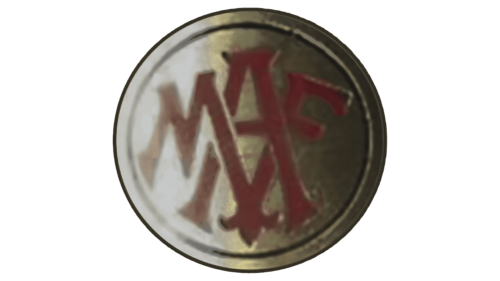
Vehicles sold under the MAF name were manufactured in Markranstädt, a Saxon town active in the first decades of the 20th-century German industrial expansion. Founded in 1909, the company initially assembled cars under license; an efficient way to enter the market during a time when automobile engineering was advancing quickly and “ready-made” proven designs offered a lower-risk path to production. After several years of experience, the plant moved toward its own engineering solutions and began producing cars with four- and six-cylinder engines. That transition from licensed assembly to proprietary design is significant: it marks the moment a firm stops being merely an industrial subcontractor and begins to build a distinct technical identity. While MAF is not widely remembered among mainstream drivers today, its history reflects the broader pattern of early European automotive development, driven by regional factories, licensing strategies, and gradual engineering independence.
The MAF logo was intentionally plain and disciplined, emphasizing industrial seriousness rather than decorative flourish. It consisted of three interlaced dark red letters; M, A, and F; stacked tightly to create a dense, compact monogram. The “M” sits in the foreground, the “A” appears behind it, and the “F” overlaps on the right, producing a layered construction that implies solidity and engineering structure. The letterforms reference German Gothic typography, showing echoes of styles like Eckmann or Fraktur, though interpreted in a more restrained and practical manner suitable for a manufacturing brand. The outcome feels like a stamp; firm, authoritative, and built for identification rather than ornament.
Marlei

Marlei emerged in Portugal around the middle of the 20th century, founded by businessman Manuel Lopes de Almeida with a clear objective: offer compact cars suited to the local market. The idea itself was straightforward; small vehicles, accessible to everyday drivers; but the industrial context made it challenging. Portugal did not have the kind of mature manufacturing ecosystem required for large-scale automotive production, so Marlei vehicles were assembled in limited batches rather than mass-produced. To make the project viable, the technical foundation had to be borrowed from established European manufacturers, most commonly Renault. The company focused mainly on light roadsters and small coupés, vehicles that were appreciated less for luxury and more for personality; cars intended to feel lively, approachable, and distinctive on the road. In this sense, Marlei belongs to a category of regional brands that relied on smart adaptation: using proven mechanical components while trying to express a local design and driving character.
The Marlei logo captured that light, spirited identity through a refined but expressive composition in black and gold-brown tones. At its center is an abstract horizontal symbol reminiscent of an elongated body with a wing; readable as either a stylized car profile or an aircraft-like form; both of which evoke speed, efficiency, and agility. This symbol passes through a ring formed by two concentric circles, adding a sense of completeness and mechanical precision. The brand name appears beneath, neatly integrated and set in italic serif lettering with thin, elegant strokes. The typographic mood recalls classical luxury fonts like Didot or Bodoni, giving the mark a tasteful, slightly aristocratic finish. The result is a logo that feels aspirational without being excessive; appropriate for a small maker aiming to deliver character rather than opulence.
Marlin

Marlin began in the UK in the late 1970s, founded by Paul Moor, a dedicated collector of 1930s classic sports cars. Rather than producing exact replicas, the brand set out to revive the atmosphere of that era; long-bonnet proportions, vintage cues, and a hands-on ownership experience; while still allowing for modern practicality and personal preference. Marlin built its reputation on a personalized approach, serving buyers who wanted a car shaped to their tastes through customization, options, and adjustments. The company operated in the niche world of retro-inspired and kit cars, where ownership is often as much about the building journey as it is about driving. Customers could assemble the vehicle themselves for maximum involvement or purchase a completed car for immediate enjoyment. In a market defined by passion rather than mass demand, Marlin’s value proposition was clear: individuality, nostalgia, and a sense of craftsmanship you can actually see and touch.
The logo communicates that bespoke, enthusiast-led personality in a deceptively simple way. “Marlin” is written in red like a handwritten signature, using smooth calligraphic strokes where the letters naturally connect as if penned in one continuous motion. A slight rightward lean suggests movement, reinforcing the sporty intentions behind the brand’s designs. The overall impression is personal and expressive; less like a corporate identity, more like a maker’s mark; perfect for a brand that thrives on tailored builds and driver individuality.
Martin
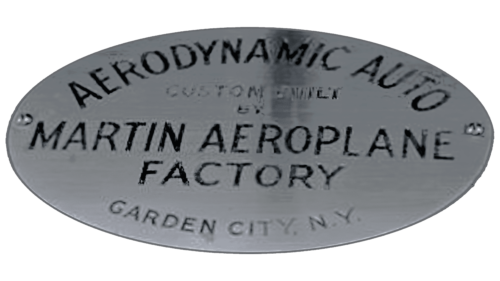
Founded by Glenn L. Martin; one of America’s aviation pioneers; the Martin company became a major aircraft producer in the first half of the 20th century, supplying critical designs for the U.S. Army and Navy. The brand’s name became strongly tied to aviation prestige and military engineering, which is why many people overlook a lesser-known chapter: an attempt to translate aircraft thinking into automobiles. In the late 1920s, Martin engineers explored an experimental vehicle known as the Martin 100 Aerodynamic. The intention was conceptually advanced for its day: apply aerodynamic principles, streamlined body shaping, and aircraft-derived technical ideas to improve a car’s efficiency and performance. For its era, this represented a bold and unusual cross-industry experiment, especially considering that car design at the time was often more about upright proportions than airflow management. Ultimately, the Martin 100 Aerodynamic remained a one-off project, but it stands as a fascinating example of how aviation innovation occasionally spilled into automotive design; sometimes decades ahead of mainstream acceptance.
The surviving factory metal badge is a compact historical document in its own right. The emblem is oval with a polished silver-gray metallic finish that catches light like machined hardware. At the top, “AERODYNAMIC AUTO” appears in large capital letters, slightly arched to match the oval contour and set in a clean style comparable to Futura Bold. Beneath that, a smaller line reads CUSTOM BUILT BY, followed by two lines stating MARTIN AEROPLANE FACTORY, using the same confident, dense typography to reinforce the project’s aviation origin. Along the bottom curve sits GARDEN CITY, N.Y., identifying the manufacturing location and completing the badge with consistent styling despite the reduced letter size. Overall, the badge feels precise, orderly, and proudly industrial; exactly what you would expect from an aircraft manufacturer’s approach to automotive identification.
Maruti Suzuki India

Maruti Suzuki took shape in India in the early 1980s as a joint venture between the Indian government and Japan’s Suzuki Motor Corporation, originally operating under the name Maruti Udyog Limited. Its mission was transformative: deliver affordable, dependable cars for everyday people in a market where private vehicle ownership had long been limited and relatively uncommon. The breakthrough came with the Maruti 800, effectively an adapted version of the Suzuki Alto, which quickly became a household favorite and played a defining role in normalizing personal transportation across India. As demand expanded and the brand’s footprint grew, Suzuki’s role increased in parallel. Over time, Suzuki raised its stake, and by 2007 the company’s identity was formalized as Maruti Suzuki India Limited. From an industry perspective, Maruti Suzuki’s impact goes beyond individual models; it helped build the foundation for mass passenger car culture in India by combining cost control, serviceability, and a product strategy aligned with real-world consumer needs.
The logo expresses that partnership and cross-cultural identity with clear, easy-to-read symbolism. On the left sits a blue “M” motif formed from two symmetrical upward elements, each segmented in a way that resembles wings; an image that suggests uplift, progress, and mobility. On the right is a red symbol associated with the letter “S,” referencing Suzuki and providing a visual counterbalance to the Maruti mark. Beneath the icons, the brand name appears in two lines in a plain sans serif font: MARUTI and SUZUKI in black uppercase letters. The design is intentionally straightforward, optimized for recognition across signage, print, and vehicle badging; appropriate for a market leader built on everyday trust and scale.
Matra Bonnet

Matra Sports rose in France during the 1960s, a decade defined by technological optimism and a willingness to challenge conventional design rules. The brand’s foundation came through a collaboration between racer and car designer Charles Bonnet and the industrial group Matra, which was better known at the time for aerospace work rather than road cars. Bonnet brought deep racing experience and a history of building sports cars under the Deutsch et Bonnet name, and he wanted to continue evolving his own vehicles. Matra, meanwhile, saw automobiles as a new arena where advanced engineering culture; lightweight thinking, structural experimentation, and aerodynamic awareness; could be applied in a consumer-facing product. The first major output of this partnership was the Djet model, a key step that signaled Matra’s move from aerospace-adjacent engineering into the performance car conversation. In hindsight, Matra Sports represents the moment when cross-industry expertise helped create French sports cars that felt modern and technically ambitious for their time.
The Matra Sports logo was understated yet distinctive, balancing text clarity with aviation-inspired symbolism. “MATRA” appears in dense, block-style letters that feel engineered and confident. Beneath it, “Sports” is written in italics with rounded strokes, softening the tone and hinting at speed and fluidity. The whole mark sits within a dark blue circle that contains a white graphic resembling an arrow or abstract aircraft silhouette, cutting diagonally across both the circle and the wording. This diagonal placement introduces motion and visually references Matra’s aerospace heritage without overcomplicating the design. The result is a logo that feels technical, dynamic, and purpose-driven; exactly the image Matra needed when translating aerospace credibility into automotive desirability.
Matra-Simca

The Matra-Simca identity emerged from the partnership of two companies whose strengths complemented one another in a very practical way. Matra brought an engineering mindset shaped by aerospace development; an environment where unconventional solutions and advanced materials were often part of the problem-solving toolkit. However, Matra also needed a pathway into broader automotive production. Simca, operating under Chrysler’s European division at the time, contributed what Matra lacked: established manufacturing capacity, a wide sales network, and extensive mass-production experience. Their late-1960s merger created a framework capable of producing cars that could be both imaginative and commercially viable; an important balance in an industry where innovation without manufacturing muscle rarely survives. The Matra-Simca chapter is therefore best understood as a strategic alignment: creativity paired with production infrastructure, enabling experimentation beyond typical mainstream limits.
The Matra-Simca logo echoed that rational, technical character through geometry and typographic discipline. The emblem is a circle split horizontally into two equal fields: MATRA in the upper half and SIMCA in the lower. Both names are rendered in a crisp, geometric typeface comparable to industrial standards such as Eurostile or Microgramma. Even the dividing line is carefully matched to the letter stroke weight, reinforcing the sense of engineered consistency. There is no decorative flourish here; just structured clarity; communicating that this was a brand formed by practical collaboration and technical intent rather than romance or nostalgia.
Matra-Talbot
Talbot-Matra formed in the early 1980s when Matra aligned with the Talbot brand. By that point, Matra had already earned recognition for bold engineering and an unconventional attitude toward vehicle design. Talbot, meanwhile, had been folded into PSA Peugeot Citroën after PSA acquired Chrysler’s European operations, giving the new partnership access to a larger commercial ecosystem. The intention was strategic: preserve Matra’s distinct spirit; often associated with innovation and unusual design solutions; while leveraging PSA’s broader dealership network and market reach. In effect, Talbot-Matra was positioned as a continuation of the distinctive, technologically minded cars previously introduced under the Matra-Simca banner, but with stronger sales infrastructure behind it. This kind of partnership is a recurring theme in automotive history: boutique innovation gains a chance to survive and scale when paired with a larger distribution machine.
The Talbot-Matra Murena logo was restrained, but its typography was carefully chosen to express the product’s dual nature. The mark uses two lines of text: TALBOT – MATRA appears on top in large block capitals, establishing a formal, technical tone. Beneath it sits the model name “Murena” in lowercase with bigger, softer letterforms and rounded strokes, creating a smoother, more approachable feel. This contrast mirrors the car’s character as described here: technical precision above, sporty elegance below. The full inscription sits on a dark turquoise rectangular background, which adds depth and provides a distinctive visual field without requiring additional symbols. It’s a design that communicates seriousness while still leaving room for personality.
Maudslay
Maudslay entered the UK automotive landscape through the descendants of famed engineer Henry Maudslay, earning a place in Britain’s early 20th-century vehicle industry. The company initially targeted affluent buyers with large, costly passenger cars designed to project comfort and prestige. These vehicles used powerful engines; including four- and six-cylinder units; reflecting the era’s expectation that luxury should be accompanied by effortless performance. However, Maudslay’s trajectory also illustrates how market forces reshape product strategy: by the early 1920s, the firm shifted its attention entirely toward trucks, buses, and industrial engines. That pivot makes sense from an engineering perspective; heavy-duty machinery often rewards robust design discipline and offers steadier commercial demand. As a result, Maudslay is frequently remembered less as a luxury car maker and more as an industrial-strength manufacturer that chose durability and utility as its long-term direction.
The Maudslay logo reinforced that engineering-first identity through a bold shield composition. The emblem is vertically elongated, with a rounded top and pointed base; classic heraldic structure used to suggest tradition and authority. The upper dark panel features MAUDSLAY in heavy uppercase letters with straight serifs and slightly rounded forms typical of early British industrial typography. The lower section introduces diagonal red-and-green stripes, creating visual density and a sense of strength. Over these stripes sits a large white “M,” styled consistently with the main lettering but scaled up to serve as the focal element. The overall result is structured and confident, visually aligned with a company associated with heavy machinery and mechanical seriousness.
MAVA
During the 1970s, the Greek company MAVA; best known as the country’s official Renault importer; decided that distribution alone was no longer enough. Market demand was rising for practical daily vehicles, particularly in smaller towns and rural regions where durability mattered more than style. That shift encouraged MAVA to pursue a production initiative of its own: the MAVA-Renault Farma project. The core priorities were clearly defined and intentionally pragmatic: utility, toughness, and suitability for real-world work rather than aesthetic sophistication. While the technology drew from Renault designs, the project represented a meaningful local attempt to create vehicles aligned with Greek operating conditions and practical needs. In the broader story of regional automotive efforts, MAVA is an example of how importers sometimes attempt to move up the value chain; leveraging established platforms to respond to domestic demand with locally organized production.
Even with Renault-based engineering, MAVA introduced a recognizable visual distinction. The logo uses the familiar Renault diamond structure as a foundation, but the mark is vertically oriented and rendered in chrome, giving it weight and an impression of physical volume. Compared with Renault’s standard emblem, MAVA’s version appears thicker and more substantial; almost as if designed for heavier-duty identity. A notable differentiator is the interior treatment: where Renault’s classic diamond typically has an open center, the MAVA version is described as filled, though alternative executions also existed. That small change matters in branding terms, because it signals independence and local specificity while still acknowledging the direct connection to Renault technology.
Maxwell
The Maxwell Motor Company was founded in the United States at the dawn of the 20th century, when automobiles were still perceived as expensive novelties for a small segment of society. Established by Jonathan Maxwell and Benjamin Briscoe, the brand helped make cars feel more approachable and attainable for everyday buyers; an important role in the industry’s early democratization. After starting as part of the United States Motor Company, Maxwell became independent when the group dissolved, and it gained popularity through a focus on vehicles that were relatively simple, dependable, and affordable. As the market matured, competitive pressure increased and technology expectations rose sharply in the early 1920s, demanding modernization and disciplined management. During that period, Walter Chrysler took control and reorganized the company with a structured approach to business and manufacturing. By 1925, Chrysler Corporation was established on the foundation of the Maxwell brand. In that transition, Maxwell effectively stopped existing as an independent marque; yet its legacy became far larger than its badge, serving as the cornerstone of a major American automotive empire.
The Maxwell logo carried a strong sense of heritage, using a heraldic shield with a pointed lower edge as its base. A diagonal ribbon cuts across the shield with the word Maxwell in decorative lettering reminiscent of Victorian typography; flowing lines, pronounced serifs, and a flourish on the “M” that adds personality and status. The upper and lower sections of the shield include the words “MOTOR” and “COMPANY,” respectively, set in a stricter typeface with straighter lines to contrast the ornate central script. These supporting words follow curved paths, enclosing the diagonal ribbon and reinforcing the badge-like feel. The top area includes a dark field with decorative scrolls and stylized leaves, adding refinement. The bottom section uses vertical stripes of varied thickness, injecting a technical, energetic rhythm into the composition. Overall, the emblem suggests tradition and respectability; exactly the tone early automakers used to reassure buyers that these new machines were worthy of trust.
MCC

In the mid-1990s, the European market saw the arrival of MCC; short for Micro Compact Car; a project that was clearly more than “just another automaker.” Its initiator was Nicolas Hayek, widely known for transforming the watch industry through Swatch by proving that simplicity, a striking identity, and accessible pricing could reshape consumer behavior. Hayek applied that same philosophy to urban mobility with a bold goal: create a city car that occupied minimal space, looked modern, and remained affordable. To make the concept viable in automotive terms, he needed a major manufacturing partner, and Daimler-Benz stepped in. For Daimler, MCC represented an opportunity to explore mobility beyond traditional luxury categories, and the collaboration between Swatch thinking and German engineering discipline gave the project both creativity and industrial credibility. The first public outcome arrived in 1997 with the Smart City-Coupé, a model that quickly became a symbol of compact urban design and a new way of thinking about city space.
The MCC visual identity reinforced that sense of novelty through stark contrast and geometric construction. The emblem relies on black-and-white interplay and combines letters with sharp, engineered forms. At the center is an “M” shaped like an upward-pointing element, creating a visual “keel” that anchors the design. From it, lines extend outward to suggest the “C,” forming a compact, interconnected structure that feels deliberate and technical. Even without shading, the optical arrangement creates depth, helping the mark feel more dimensional than a flat monogram. As branding, it communicates exactly what MCC wanted to be: compact, intelligent, and technologically forward; an identity built for dense modern cities.
McLaughlin Carriage Company
The McLaughlin Carriage Company was founded in 1867 in Oshawa, Canada, by Robert McLaughlin and initially built its reputation producing horse-drawn carriages. Quality and reliability made the company a market leader not only domestically but internationally, proving that Canadian manufacturing could compete on a broad stage. By the early 20th century, however, the transportation landscape was changing rapidly and it became clear that the era of carriages was fading. The crucial transition was guided by Sam McLaughlin, the founder’s son, who recognized the industry’s direction and steered the company into automobiles. In 1907, he arranged a partnership with the American manufacturer Buick. That collaboration provided access to proven engines and chassis already established in the U.S. market, allowing McLaughlin to combine Canadian production strengths with American technology. Vehicles produced under the McLaughlin-Buick name became a practical bridge from carriage craftsmanship to automotive manufacturing, marking a pivotal step in Canada’s industrial mobility story.
The McLaughlin-Buick logo expressed that partnership with a diamond-shaped badge featuring a double border in blue and white. Inside the emblem, the word “Buick” appears in flowing cursive, signature-like and elegant, complete with decorative flourishes and extended terminals that convey prestige. Above it, “McLaughlin” arcs along the upper interior edge of the diamond in a heavy sans-serif style with rigid geometry. This contrast is purposeful: Buick’s cursive suggests luxury and tradition, while McLaughlin’s bold sans serif adds industrial stability and balance. Together, the two typographic voices visually communicate the collaboration; distinct identities sharing a single frame.
MCV

MCV is among Egypt’s largest manufacturers of commercial vehicles, producing buses and trucks across facilities located in the industrial areas of Cairo and Sadat City. The company supplies vehicles for domestic use and export, positioning itself as both a national industrial asset and a regional player in transport solutions. A key driver of MCV’s development is its collaboration with Mercedes-Benz, with MCV operating as an official partner and drawing on German engineering know-how for vehicle design. This kind of relationship is especially valuable in the commercial segment, where reliability, parts standardization, and proven engineering architecture can determine long-term operating costs. MCV’s range includes city buses designed for everyday routes, tourist coaches oriented toward comfort and long-distance usability, and adaptable truck platforms for multiple applications. In short, MCV’s identity is built around practical mobility infrastructure; vehicles intended to work hard, operate consistently, and support economic movement at scale.
The MCV logo translates that industrial strength into a metallic monogram. The letters M, C, and V are merged into one polished chrome form, with gradients and highlights that simulate steel volume. The typography feels bold and exacting, combining geometric straight-line structure with serif-like details; it resembles styles such as Serpentine Bold or Bank Gothic, both often associated with engineering and machinery. A curved underline sits beneath the letters, beginning thin on the left and widening as it sweeps rightward and down; like a motion trail. This detail subtly reinforces transportation themes: movement, speed, and directional force, while the chrome finish ties the brand visually to heavy-duty engineering.
MDI

The French company MDI is known for taking a distinctly unconventional path in mobility: instead of relying on conventional fuels, it has promoted compressed air as an energy source for vehicles. The concept focuses on urban transportation; small cars designed to function without gasoline or diesel and to minimize harmful emissions in daily city operation. The brand’s most recognized project is the AirPod, a compact three-seater that uses a pneumatic engine and is engineered to remain lightweight, compact, and mechanically straightforward. The promise is compelling in principle: eliminate exhaust emissions while keeping the vehicle’s architecture relatively simple and aligned with short, frequent city trips. The AirPod is described as capable of speeds around 70 km/h, which positions it as adequate for typical urban travel where efficiency, maneuverability, and low environmental impact matter more than high-speed capability. MDI’s role in the broader mobility conversation is that of a challenger; an innovator exploring alternative propulsion ideas outside the mainstream battery-electric narrative.
MDI’s logo reinforces the clean-energy message by pairing a smooth wordmark with a nature-inspired symbol. The “MDi” inscription uses rounded corners and fluid lines, with M and D in uppercase and the i in lowercase, creating a friendly, approachable rhythm. The color is a deep graphite-like gray, suggesting modern materials and technical seriousness. Next to the text sits an eight-petal flower icon with a bright yellow center, shaded in cool blues, greens, and violets. Symbolically, the flower is a direct signal of environmental intent; clean, gentle, and sustainable; while the cool palette supports a “technology meets ecology” identity. In combination, the logo communicates MDI’s mission clearly: lightweight engineering aimed at cleaner urban movement.
Mega

The French brand Mega emerged in the early 1990s as a separate division within Aixam, a company already recognized for compact city cars and quadricycles designed for economical, low-stress driving. At a certain stage, Aixam sought to expand beyond the constraints of micro-vehicles, creating a sub-brand aimed at more powerful and versatile automobiles. That strategy led to Mega, which explored a surprisingly broad mix of products: small trucks, urban vans, off-road vehicles, and even rare sports-oriented projects. This variety shows that Mega was conceived as a platform for experimentation; a way to test new market categories while still leveraging the parent company’s experience. One of the most striking outcomes was the Mega Track, described here as among the boldest and most distinctive models of its time, notable even within a landscape of exotic cars. Mega therefore represents a brand identity built on unconventional ideas and category-crossing ambition rather than a single predictable vehicle formula.
The visual identity of Mega combined a strong emblem with a technical wordmark to match that ambitious positioning. The centerpiece is a dark blue circle with a soft gradient that lightens toward the edges, outlined in white and trimmed with a thin red border; colors that add energy without overwhelming the design. Inside the circle sits a large, three-dimensional metallic “M,” rendered with a 3D effect to suggest power and engineered substance. Horizontal bars cut through the middle and extend slightly beyond the letter’s edges, creating a sensation of force and momentum. Beneath the symbol, MEGA appears in a clean, structured typeface resembling Eurostile or Microgramma, reinforcing a technical, industrial mood. Overall, the logo looks engineered, confident, and slightly futuristic; appropriate for a brand designed to explore beyond the microcar world.
Mekong Auto
Mekong Auto was established in Vietnam as a joint initiative involving government organizations and overseas partners, reflecting a strategic effort to develop domestic automotive capability. Early participation included companies from South Korea, and later investors from Italy joined, indicating an evolving international structure aimed at bringing external expertise into local manufacturing. The objective was clear: build a homegrown automotive industry able to meet Vietnamese demand for affordable passenger and commercial vehicles. The factory was located near Ho Chi Minh City, and production was organized under license from major international brands, including Fiat and SsangYong. Importantly, the vehicles were adapted for local conditions and needs; a crucial step in markets where infrastructure, road quality, and usage patterns can differ significantly from the environments for which the original designs were developed. Mekong Auto’s production lineup included compact passenger cars, minivans, SUVs, and light trucks, illustrating a broad approach intended to serve households, businesses, and practical logistics.
The Mekong Auto logo communicated that collaborative, international foundation through interlocking forms. At the center are three yellow rings linked together and enclosed within a wide circular frame of the same color. The rings resemble chain links, a direct visual metaphor for cooperation between multiple entities in a single industrial project. The outer ring includes two arrow-like inward breaks, suggesting the flow of foreign technology and knowledge into local production systems. Beneath the emblem, the company name is set in a bold, clean typeface similar to Eurostile, but softened at the corners with more refined proportions; balancing technical seriousness with accessibility. The overall impression is cooperative, structured, and forward-looking.
Messerschmitt
Messerschmitt is a German name globally associated with aviation, particularly for military aircraft during World War II. After Germany’s defeat, strict postwar restrictions limited aviation activity, forcing the company to redirect its capabilities toward new industries beyond military aircraft. In 1953, working with engineer Fritz Fend, Messerschmitt introduced a compact three-wheeled vehicle called the Kabinenroller (KR). With its enclosed cabin and unusual appearance, it matched postwar Europe’s demand for affordable, simple, efficient transport; especially in a period when resources were constrained and practicality was essential. Although Messerschmitt’s automotive chapter was relatively short, the Kabinenroller became well known and is now prized as a collector’s item thanks to its distinctive design, its engineering story, and its place in the broader narrative of postwar industrial adaptation. Few examples illustrate “reinvention under constraint” as clearly as this transition from aircraft engineering culture to compact road mobility.
The Messerschmitt logo is a black-and-white circular emblem that blends national origin with brand identity. Along the top arc, “Made in Germany” emphasizes provenance; an important marker for quality perception and industrial pride. In the lower section, MESSERSCHMITT appears in large, bold letters with rounded geometry reminiscent of classic sans serif families such as Futura or Avant Garde Gothic, though with distinctive details of its own. At the center sits a stylized figure resembling a diving bird; its upper form suggests a head, conveying momentum and strength while keeping a clear link to aviation heritage. The logo’s clarity and symmetry make it memorable, and the bird-like central figure functions as a symbolic bridge between flight history and the brand’s brief automotive identity.
Micro Cars

Micro Cars was founded in 1995 in Sri Lanka by entrepreneur and engineer D. F. P. Lankeshara with the goal of establishing domestic vehicle production tailored to local conditions. The strategy focused on affordability and practical suitability; vehicles that could fit Sri Lankan roads, daily usage patterns, and ownership realities. The lineup included compact city cars, minivans, SUVs, and light commercial models, indicating an intent to serve both private mobility and small-business needs. Among the better-known vehicles were the Micro Panda, Micro BAIC X25, and Micro MX7. As described here, these cars were built for everyday usability, emphasizing reliability and straightforward operation rather than technical complexity. For markets where ease of maintenance and long-term durability can matter more than advanced features, this approach is often the most rational path to sustainable ownership and broader adoption.
The Micro logo anchors the brand in national symbolism through a lion placed inside a triangular shield with rounded sides. The lion is a strong reference to Sri Lanka’s national identity, immediately signaling origin and local pride. Rendered in black and white with simplified lines, the figure shows the lion’s head in profile with an open mouth, conveying energy and forward motion. White lines carved through the dark mane add depth and texture without making the design visually heavy. Beneath the emblem, MICRO appears in large uppercase letters set in a custom style reminiscent of Eurostile Rounded or Microgramma, but with unique proportions and wider spacing for clarity. A small red dot above the “I” provides the only color accent; simple, effective, and memorable; adding vibrancy to an otherwise strict, industrial look.
Minetti

Minetti Sports Cars is an Australian brand founded by a small engineering team with a clear enthusiast mission: build lightweight sports cars capable of performing on racing circuits while remaining usable on public roads. The emphasis on compact dimensions and precise handling signals a driver-first approach, where feedback and control are treated as core product values rather than optional extras. Minetti did not chase mass production; instead, it specialized in limited series aimed at a select community of motorsport-focused buyers. This is a common pattern among niche performance brands: by producing small batches, they can maintain tighter design intent and serve customers who prioritize mechanical honesty and track-day capability. Minetti cars appeal especially to club racing and amateur competition participants; drivers who want the balance of power, agility, and predictability that makes a car enjoyable at the limit as well as practical enough for real-world use.
The logo expresses that racing-oriented identity through clean geometry and dynamic accents. A circular form with an open black ring frames the composition, while two diagonal lines; red and blue; slice through the circle, slanting to the right and crossing at the center. The alternating colors and varying thickness introduce tension and rhythm, like stylized racing stripes. “Minetti” sits centered in bold italic lettering reminiscent of Arial Black Italic or Eurostile Bold Extended Italic, giving the wordmark density and speed. The double “t” shapes and the final “i” help stabilize the visual weight, preventing the mark from feeling overly aggressive. A red dot above the “i” adds a sharp accent. Beneath, SPORTS CARS appears in smaller, technically styled letters with wide spacing, clearly stating the company’s specialization while keeping the main focus on the bold brand name.
Mitchell
Mitchell Motor Car Company operated in Racine, Wisconsin, during the early era of American car manufacturing, when many transportation firms evolved from carriage and wagon production into automobiles. The brand’s roots extend back into the 19th century through Mitchell & Lewis, which built horse-drawn wagons and carriages before the market inevitably turned toward engines. In 1903, the company introduced its first automobile, representing a logical transition built on existing manufacturing expertise, craftsmanship, and knowledge of vehicle construction. Mitchell cars were aimed at middle- and upper-class customers who valued comfort, dependable operation, and refined styling; traits that mattered greatly in the early market, where buyers often needed reassurance that automobiles could be trustworthy long-term purchases. As with many early American makers, Mitchell’s significance lies in being part of the foundational wave that shaped public confidence in cars, helping transform the automobile from novelty into a practical ownership category.
The Mitchell logo reflects that period’s preference for ornate, prestige-leaning emblems. The badge is an elongated metallic oval with multiple internal details. At the center, “Mitchell” appears in right-leaning cursive script with a fluid, handwritten tone. The final “l” extends downward into a graceful swirl beneath the word, while the initial “M” is larger, providing clear brand emphasis. The lettering is dark blue and bordered by a thin metallic outline, adding depth and formality. Above the name sits RACINE, identifying the city of manufacture, and below are WISCONSIN and USA in smaller text. A decorative silver element at the bottom; resembling a laurel wreath or stylized ribbons; adds a traditional, award-like feel. Altogether, it’s a badge designed to communicate heritage, craftsmanship, and respectability.
MK Sportscars

MK is a British company rooted in kit-car culture, best known for vehicles inspired by the iconic Lotus Seven philosophy: low weight, mechanical simplicity, and direct driver engagement. The central idea behind MK is to combine efficiency-oriented design with extensive customization opportunities, allowing customers to tailor the final product to personal preferences and intended use. This flexibility makes MK cars appealing to two overlapping groups: enthusiasts who want an exciting road car for everyday enjoyment, and drivers who want a capable machine for amateur track days. One of the brand’s best-known models is the MK Indy, a classic open-body British roadster featuring rear-wheel drive and a tubular steel frame. In the kit-car world, that kind of architecture is valued because it offers strength-to-weight advantages, access to performance tuning, and a driving experience that feels mechanical, connected, and honest.
The MK emblem reflects this minimalist, technical outlook. The logo is built around a formal heraldic shield that widens at the top and tapers downward, outlined in black for clear definition. Inside sits a solid monogram made from interwoven “M” and “K” letters, integrated in a clean, balanced way that reads as one unit rather than two separate initials. Beneath the shield, SPORTSCARS appears in a monospaced, technical-looking font, reinforcing the brand’s functional engineering personality. The overall identity is restrained and purposeful; exactly what you would expect from a company that sells performance through lightweight structure and customization rather than luxury or ornament.
Mobius Motors

Mobius Motors was founded in Kenya by entrepreneur Joel Jackson with a sharply defined mission: create a vehicle genuinely suited to African operating conditions. That meant prioritizing function over fashion; strong performance on rough roads, endurance under heavy use, and ownership practicality in places where complex maintenance and extensive infrastructure cannot be taken for granted. The first model, Mobius I, served largely as a trial platform and was produced in very limited numbers, enabling the company to validate core design principles in real-world conditions. In 2014, Mobius introduced Mobius II, advancing the concept with a closed body, improved suspension, and a more everyday-focused design. The intended audience included farmers, small business owners, and delivery services; users who require durable, low-maintenance vehicles that can reliably support work. In mobility terms, Mobius represents “appropriate engineering”: designing to the realities of local use rather than importing assumptions from markets with different roads, service networks, and usage habits.
The Mobius logo aligns with this practical philosophy by relying on clean geometry rather than decorative complexity. Its abstract symbol resembles a three-dimensional crystal shaped like a downward-pointing triangle, built from diagonal lines with varying thickness. This linework creates depth and structure, suggesting engineering logic and deliberate construction. The restrained graphics communicate functionality, not luxury, and the angular geometry evokes strength and clarity; qualities central to Mobius vehicles. In effect, the logo looks “built,” echoing the company’s emphasis on structural simplicity, durability, and straightforward mechanical purpose.
Mohs
Mohs Motors was one of the most unusual American automotive experiments of the 1960s. Founded by industrialist and engineer Bruce Mohs in Madison, Wisconsin, the company operated as a small experimental workshop dedicated to vehicles that deliberately rejected mainstream design conventions. Mohs cars often looked more like futuristic show concepts than production automobiles, reflecting the founder’s radical approach to both technology and form. Importantly, these vehicles were never meant for mass-market adoption; they were niche creations designed to challenge expectations and explore unconventional solutions. The company’s most famous model, the Ostentatienne Opera Sedan introduced in 1967, surprised even seasoned observers with eccentric features such as entry through a large rear door and body details rarely seen on traditional cars. Mohs occupies a special place in automotive history because it demonstrates how far individual vision can push design when not constrained by standard production logic or broad consumer demand.
Interestingly, the Mohs emblem is far more restrained than the cars themselves. The badge is a shield with softly rounded top corners and a pointed lower edge, using warm ochre tones framed by a defined border. A large serif “M” dominates the center, styled in a way that evokes vintage typography and a sense of old-world formality. The company name is split into two lines; MOHS above and MOTORS below; rendered in a simple sans-serif font to keep readability strong and avoid visual clutter. The contrast between the classic badge and the wildly unconventional vehicles creates a memorable tension: traditional branding wrapped around radically non-traditional products.
Momo

The Italian brand MOMO began with Giampiero Moretti’s personal passion for motorsport, turning racing enthusiasm into a specialized business in the mid-1960s. The company’s early focus was the production of sports steering wheels; components where precision, grip, and ergonomics can directly influence performance and driver confidence. These products quickly earned credibility within the racing community for both quality and design. The name MOMO derives from “Moretti Monza,” referencing the founder and his connection to the famous Italian circuit, embedding motorsport heritage into the brand identity itself. Over time, MOMO became associated with a broader world of performance accessories and ambitious concepts, including the Momo Mirage concept car project in the 1990s developed in collaboration with American engineers. While that vehicle remained conceptual, it demonstrated that MOMO’s identity wasn’t limited to parts alone; the brand also expressed curiosity about complete automotive design and the broader performance lifestyle.
The MOMO logo is arranged in a clear two-tier structure that balances bold recognition with national branding. The top line features MOMO in large yellow letters outlined in black, forming a compact block with square, precise letter shapes that read strongly at a distance. Beneath it, ITALY appears in bright red using a simple sans-serif font with increased letter spacing, giving the lower line a lighter visual feel and ensuring it doesn’t compete with the heavy MOMO wordmark above. The color choices; yellow, black, and red; create a high-contrast, motorsport-friendly palette that signals energy, performance, and unmistakable Italian origin.
Monica
In the late 1960s, French industrialist Jean Tastevin; owner of a major metallurgical company; set out to pursue an exceptionally ambitious goal: develop a prestigious French car capable of competing with premium names such as Jaguar and Maserati. This was not intended as a simple “luxury sedan” project; Tastevin wanted a complete, domestically anchored design and production effort that could express French engineering and national identity at a high level. The car was named Monica after his wife, which underscored the personal nature of the venture and the emotional investment behind it. After years of development, the project culminated in the Monica 560, a vehicle noted for elegant styling, strong build quality, and engineering solutions aligned with contemporary expectations. Despite these strengths, the project did not reach large-scale production. As a result, Monica remains rare and exclusive; known primarily among collectors and enthusiasts who appreciate automotive history’s more daring “what if” stories.
The Monica logo reinforces the founder’s personal, premium intent through a signature-like handwritten script. Styled as an elegant inscription, it conveys individuality and refinement; more like a bespoke jeweler’s mark than a mass-market badge. The chrome finish adds a metallic sheen and elevates the perception of quality, aligning with the car’s prestige ambitions. The letters flow smoothly into one another in a continuous line, as if drawn in a single motion, which enhances the impression of craftsmanship and exclusivity. It’s a fitting identity for a rare vehicle conceived as a statement of French capability and personal pride.
Morattab

The Iranian automaker Morattab began operations in the late 1950s and, from the outset, focused on vehicles engineered for the demanding conditions common across the Middle East. Reliability and practical function were the essential product requirements; qualities that matter most where temperatures can be extreme, terrain can be challenging, and service networks may be limited. To achieve proven durability, production was based on licensed models from Land Rover, a British brand already respected for strength and off-road capability. Morattab’s vehicles gained traction in the domestic market because they delivered what buyers needed: robust construction, strong off-road performance, and mechanical simplicity that reduced dependence on complex or costly maintenance. This practicality made the cars especially valuable in regions where specialized repair resources might be scarce. The most famous model referenced here is the Pazhan, an adapted Land Rover Defender variant modified to better suit local conditions; an example of how licensed platforms can be reinterpreted for regional requirements.
The Morattab logo is built from two elongated rectangles crossing at an angle, visually linking into a central diamond where they intersect. The inner rectangle is gray, while the outer one is a deep, dark blue, creating a layered effect that suggests connection, structure, and engineered assembly. The design is simple but purposeful; more like a mechanical linkage than a decorative symbol; aligning well with a brand focused on practical utility and rugged reliability.
Moskvitch

Moskvitch emerged as a major Soviet automobile brand in the post–World War II period and became strongly associated with that era’s push toward practical mass mobility. Production began in 1946 at the Moscow Small Car Factory, later known as AZLK. Early models were based on German engineering derived from the Opel Kadett, reflecting how postwar industrial realities shaped early Soviet passenger vehicles. Over time, Soviet engineers developed their own solutions, producing cars designed to be sturdy, straightforward, and affordable. Moskvitch vehicles were valued for practicality and ease of maintenance; an essential advantage in a context where owners often relied on simple tools and accessible parts rather than specialized service networks. The cars were used under a wide variety of conditions, reinforcing their reputation as durable daily transportation. Moskvitch models were also exported to Eastern Europe and other markets, serving as a visible representation of Soviet automotive engineering abroad and contributing to the brand’s recognition beyond the USSR.
The Moskvitch emblem is instantly recognizable thanks to its bold red color and its clever fusion of letterforms. The symbol combines the outlines of the Latin letter “U” and the Cyrillic “M,” creating a vertically elongated shape with symmetrical, smooth curves at the top. These upper lines can evoke multiple interpretations; an open book, stylized horns, or simply an abstract industrial form; helping the mark remain memorable and distinct. The lower portion rounds into a semicircle, completing a stable, unified silhouette. It’s a simple emblem with strong visual identity, designed to work effectively as a vehicle badge and as a symbol of a widely distributed, practical brand.
MTX (Matalex)

The Czech brand MTX developed in the late 1960s as the motorsport division of Metalex. Initially, Metalex focused on race car development and technical support for teams across Eastern Europe, and MTX became a key name in circuit and formula racing among socialist countries. This positioning matters: motorsport in that environment often relied on specialized domestic engineering rather than broad access to Western racing infrastructure, which made capable constructors especially influential. Over time, MTX produced several successful competition cars that performed strongly in Czechoslovakia’s championships and also appeared at international events, helping the brand earn credibility through results. The best-known models cited here include MTX 1-01 and MTX 1-06, which competed in Formula 3 and the well-known Formula Easter series. Collectively, these cars established MTX as a serious and competent manufacturer within its niche; proof that engineering ambition and racing culture could thrive even under constrained industrial conditions.
The MTX logo reinforces the racing connection through bold typography and speed cues. The emblem appears as a horizontal rectangle with slanted sides, giving the frame a forward-leaning, dynamic feel. MTX is written in large, serifed letters with a classic typographic weight, colored dark blue with a white inner outline for crisp contrast. A slightly offset dark blue shadow adds depth and dimension, making the text appear raised. To the right, four red horizontal lines; slightly slanted, evenly spaced, and identical in thickness; act like motion marks, emphasizing speed, forward movement, and competitive purpose. It’s a disciplined design that communicates motorsport identity without unnecessary decoration.
Multicar

Multicar is a German brand founded in 1920 in Thuringia, initially producing agricultural machinery. Its broader recognition came later, especially in the postwar context of East Germany, where industrial and municipal systems required compact, versatile work vehicles. Urban operations, construction sites, and industrial zones needed machines that could maneuver in tight spaces while still carrying tools, materials, and payloads efficiently. Multicar responded by focusing on light commercial vehicles, becoming a practical staple in municipal fleets and industrial services. In many ways, Multicar’s story highlights a frequently overlooked side of automotive history: not the glamour of passenger cars, but the essential role of compact utility vehicles that keep cities functioning; maintaining roads, moving equipment, and supporting daily infrastructure work.
The Multicar logo reflects that functional identity through a straightforward wordmark. “multicar” appears in lowercase blue letters, using a thick-stroked sans serif typeface with softly rounded forms, similar to industrial styles such as Eurostile Rounded or Microgramma. The rounded geometry makes the brand feel approachable and practical rather than aggressive. Beneath the wordmark runs an orange line that begins under the first letter, stretches across the full length, and then angles upward at about forty-five degrees. That upward lift introduces optimism and motion; suggesting progress and productivity; while also functioning as a clean visual underline suitable for industrial branding and vehicle decals.
Mustang
The Mustang brand arrived in the mid-1960s and quickly became one of the most iconic names in American automotive history. In 1964, Ford introduced a model that effectively created a new vehicle category: compact, affordable sports cars later referred to as “pony cars.” The recipe was brilliantly effective; combine appealing styling, the availability of strong engines, and pricing that made performance feel attainable for a wide audience. This combination struck a cultural nerve and turned Mustang into more than a product; it became a symbol of youth, freedom, and the spirit of its era. Over time, Mustang’s identity grew into a performance legacy recognized far beyond the U.S., but the origin remains the same: democratized excitement packaged in a design that looked fast even when parked.
The logo is centered on a running horse, a fitting symbol for a vehicle defined by speed, strength, and freedom. The horse is shown in motion facing left, with smooth lines of varying thickness shaping the body and suggesting muscular energy. The black outline contrasts with a lighter interior, while shading adds a sense of volume and vitality. The emphasis is not on fine detail but on dynamic silhouette; an approach that improves instant recognition and aligns with Mustang’s bold character.
Behind the horse sits a vertically elongated rectangle filled with three equal-width stripes in red, white, and blue. This palette references the American flag and reinforces Mustang’s national identity and cultural roots. The rectangle is enclosed by a double border, giving the background a badge-like structure and framing the central horse symbol. The overall composition is patriotic, energetic, and unmistakably American; exactly what Mustang aims to represent.
MV Agusta

The Italian company MV Agusta was founded in 1945 as a subsidiary of Agusta, an aviation manufacturer known for aircraft and helicopter design. In the immediate postwar years, the company shifted into producing lightweight, affordable motorcycles for everyday transportation; an essential mobility need in a recovering Europe. Over time, MV Agusta increasingly focused on racing and high-performance engineering, achieving notable success in international competition and building a reputation for speed, technical sophistication, and unmistakable Italian style. The full name, Meccanica Verghera Agusta, reflects both engineering heritage and the location of the first factory in Verghera. MV Agusta’s broader appeal is the way it blends mechanical ambition with design elegance: it is a brand that treats performance not only as output, but as identity; engineering as artistry.
The MV Agusta logo expresses that engineering heritage through layered symbolism. A large gold gear forms the base, clearly referencing mechanical precision and technical foundation. Inside the gear sits a dark blue circle that improves contrast and provides a stable backdrop. Across the top, a curved dark blue banner with a gold outline resembles a gear segment; within it, AGUSTA is written in white uppercase letters using a strong, clean font. Overlapping these elements are the large letters MV in white, drawn with sharp pointed ends and a slight rightward tilt that suggests motion and speed. A thin black outline helps the MV letters stand out against the complex background. The composition is dense but coherent, balancing heritage (gear symbolism) with performance cues (tilted, pointed lettering).
MVS

MVS; short for Manufacture de Voitures de Sport; was founded in France in the early 1980s by engineer Daniel Gotto, driven by a desire to revive the nation’s tradition of producing its own sports cars. At the time, enthusiasm for compact sports cars in France had cooled, and the project was intended to restore momentum by offering a serious competitor to established European performance brands. The concept centered on a lightweight structure, carefully tuned chassis dynamics, and a distinctive exterior design; an approach that treats handling and balance as core product values. The first model, Venturi, introduced in 1985, became a major milestone. It featured a mid-engine layout and a composite body, reinforcing the brand’s technical intent and performance orientation. MVS is a reminder that sports-car revival projects often begin with engineers rather than marketers: a belief that the right platform and design can reignite national pride in performance manufacturing.
The MVS logo reflects that engineering seriousness through restraint and clarity. Three letters; MVS; sit inside an oval border of uniform thickness, creating a clean, controlled frame. The typography is bold, upright, and sans serif, visually close to Eurostile Bold Extended or Microgramma; fonts commonly associated with technology, precision, and industrial design. The emblem avoids ornament, relying instead on proportion and typographic confidence to convey professionalism. It’s a mark designed to look credible on a performance car: minimal, modern, and mechanically minded.
MZKT
The Minsk Wheel Tractor Plant is one of Belarus’s key producers of heavy-duty off-road machinery. Its origins trace to 1954, when it was established as a specialized division of the Minsk Automobile Plant with a clear mission: manufacture special tractors and off-road chassis primarily for military and industrial use. This specialization placed MZKT in a category where engineering priorities differ sharply from passenger vehicles; load capacity, ruggedness, off-road mobility, and structural durability dominate the design brief. In 1991, the enterprise gained independent status and officially adopted the abbreviation MZKT. In the broader industrial landscape, MZKT represents a crucial type of manufacturer: a heavy-equipment specialist whose products support national infrastructure and specialized operations, often working far from smooth roads and predictable conditions.
The brand’s identity is anchored by a bull symbol, a direct and effective metaphor for strength, traction, and forward drive. The stylized bull is vivid red and shown in motion, with simplified angular contours that give the mark a rugged, technical appearance. Inner cutouts define key features; horns, legs, joints; adding structure and mechanical clarity. Beneath the bull appears “volat” in lowercase bold italic sans serif letters, with smooth rounded forms that balance the sharp symbol above. A small ring inside the “o” resembles a wheel or mechanical component, reinforcing the plant’s industrial focus and linking the identity to heavy machinery and engineering. The result is energetic and memorable, communicating power without needing complex detail.
MSO
MSO is the personalization and special-operations division within McLaren, created as a dedicated branch of the brand to handle modifications and bespoke development. Its responsibilities extend beyond minor trim changes: MSO works on both existing and new McLaren sports models and also designs highly individualized customer orders. Unique MSO vehicles are defined by detail-level individuality, meeting exact customer requirements through customization; often involving specifications that go well beyond standard catalog choices. In practical terms, MSO exists to serve clients who want a McLaren that is not merely rare because of production numbers, but rare because of its one-off configuration. As described here, MSO offerings include the McLaren 50 12C, MSO 650S, and 650S Le Mans. In the performance-luxury space, such divisions play an important strategic role: they deepen brand prestige, build collector appeal, and allow a manufacturer to satisfy customers who view exclusivity as a key part of ownership.
Melling
Melling Sportscars was a short-lived but noteworthy British automaker founded in 2005 by the Alvin and Margaret Rose Melling family, with headquarters in Rochdale. The brand’s timeline was brief; ending in 2010 after Margaret’s death in 2009; and its plans to expand production in Portugal never materialized. Despite its limited duration, the company developed several promising models that remain of interest to enthusiasts who track niche British performance projects. These include the Melling Hellcat (2007), the TVR Griffith-based Melling Griffon (2008), and the Melling Wildcat (2008), a model with production limited to just seven cars. Melling’s story reflects a recurring reality in boutique performance manufacturing: strong ideas and compelling prototypes can still be vulnerable to personal, financial, and organizational disruptions that larger automakers are better positioned to absorb.
Metallurgique

Metallurgique was founded in Belgium in the late 19th century as an engineering and metallurgical enterprise; an origin that naturally shaped its later automotive identity. In the early 20th century, the company transitioned into car manufacturing and became one of the pioneers of Belgium’s automobile industry. Metallurgique established itself in the luxury segment and gained recognition among affluent buyers across Europe, thanks to a reputation for strong build quality and advanced technical standards for the period. Its vehicles were appreciated for sophisticated engines, chain-drive systems, dependable transmissions, and robust suspensions; components that, at the time, signaled both engineering competence and long-term durability. Metallurgique’s legacy is a reminder that early European automotive excellence was not confined to the most famous nations; Belgium also contributed brands capable of competing in refinement and mechanical seriousness during the industry’s formative decades.
The Metallurgique emblem visually connects to its industrial roots through a cast-like metallic appearance in golden-yellow tones, complete with texture and perceived volume. It looks less like a printed graphic and more like a physical part created by embossing or casting; an intentional aesthetic link to metallurgy and heavy engineering craftsmanship. At the center is a circle containing a six-pointed star, within which two “M” letters appear in matching line weight and style. Beneath the circle sits a smoothly curved semicircular base carrying the word “METALLURGIQUE” in elongated, narrow serif lettering. The combination of dimensional texture, structured geometry, and classical typography communicates a brand that wanted to be seen as both technically strong and premium; an identity consistent with its position in the early luxury market.

