
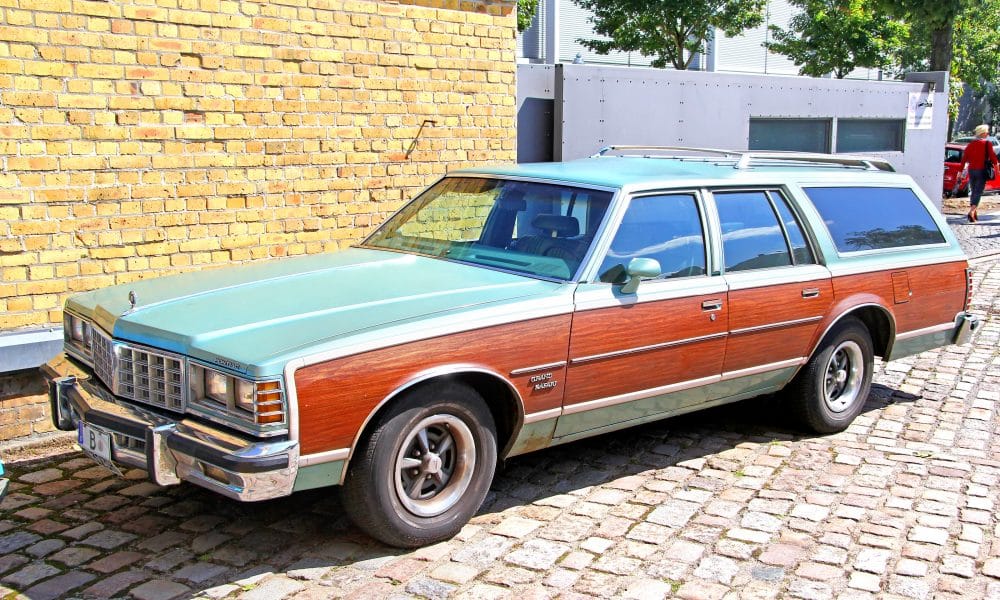
For much of the twentieth century, the American station wagon wasn’t merely a vehicle choice—it was a social setting on wheels. If you grew up in the United States, there’s a good chance you remember the wagon as the backdrop for family road trips, weekend errands, youth sports carpools, and those long summer drives where the journey mattered almost as much as the destination. And historically speaking, the majority of station wagons sold in the United States were manufactured in Detroit, where the Big Three refined the formula into a uniquely American blend of space, comfort, and long-distance practicality.
Those wagons became the default vacation companion during the warm summer months: coolers in the cargo area, kids in the back, and enough room for luggage that you didn’t have to negotiate with every suitcase. Yet despite the wagon’s enormous cultural footprint, the 1970s and 1980s marked a difficult era for the American wagon—an era in which economic pressure, regulatory changes, and shifting consumer expectations gradually pushed the body style to the margins. The downturn wasn’t just a matter of fashion; it was tied directly to the state of the economy, the aftermath of the oil crisis, and the industry’s strategic pivot toward vehicles that were easier to sell under new rules.
Fast-forward to the present and the situation has reached a striking conclusion: the manufacturing of traditional station wagons in the United States has largely come to a halt. The genre hasn’t vanished worldwide, but the American market—once wagon-central—has essentially given the wagon’s job description to crossovers and SUVs. That reality raises an obvious question. If Americans still need what wagons once provided—space, comfort, family readiness, and road-trip capability—then why did the wagon disappear, and what would it take for it to return?
That is the core purpose of this post: to explain, in clear and practical terms, why the American station wagon should make a comeback. Not as a nostalgia project, and not as a novelty, but as a genuinely smart, modern vehicle type that can meet today’s needs better than many of the taller, heavier alternatives now dominating the road.
Icon Of American History
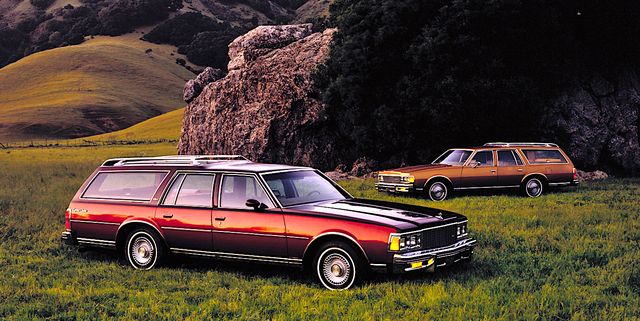
The cultural history of the United States is difficult to tell without mentioning the station wagon. While wagons existed in various forms before the mid-century boom, the 1950s effectively cemented the station wagon as a mass-market American institution. At the time, the wagon offered something that perfectly matched the postwar lifestyle: a vehicle large enough for growing families, practical enough for everyday errands, and comfortable enough to make long-distance travel feel normal rather than exhausting.
In that era, the station wagon was not viewed as an odd niche. It was the sensible upgrade—a car that promised freedom, mobility, and the ability to carry the accessories of modern life. It was an instant hit with American families who valued traveling in style, and it became extremely popular very quickly. Their notoriety became stronger with each passing day, partly because the wagon’s design communicated capability. It looked ready for anything: a week’s groceries, a family vacation, a move to a new apartment, or an impromptu trip to the beach.
Wagons also became cinematic and symbolic. They were photographed in suburban driveways, featured in advertisements as the “responsible” family choice, and associated with a certain kind of American optimism—the belief that the road always led somewhere better. Even the sound and feel of these vehicles became part of collective memory: tailgates, cargo-area carpets, roof racks, and those wide rear seats that practically begged you to bring friends along.
As a direct consequence of this cultural obsession, the U.S. became fixated on practical family transport to a degree that was, as some would argue, almost unhealthy. The station wagon was everywhere, and for decades it was the normal answer to normal family mobility. (The original text notes that “Ford decided to produce an armed variant of the Mustang automobile,” a detail that reflects how intense and sometimes unexpected the American vehicle conversation could become; when the market is emotionally invested in vehicle identity, manufacturers respond with bold, sometimes strange interpretations of demand.)
From an expert perspective, the station wagon’s strength was not a single feature—it was its balance. A well-designed wagon gave you sedan-like driving dynamics with more usable cargo volume. It offered a lower step-in height than most trucks, a stable center of gravity, and strong highway composure. In plain English, it drove like a car because it was a car—just stretched and optimized for hauling people and their stuff. That combination is still valuable today, which is exactly why the wagon’s disappearance feels less like evolution and more like a market detour.
So when we talk about “bringing the station wagon back,” we are not talking about reviving a relic. We’re talking about reintroducing a proven American solution that once dominated because it worked. The next question is the hard one: if it worked so well, what went wrong?
What Went Wrong?
The decline of the American station wagon was not caused by a single event. It was the result of a layered shift—political, social, and economic—concentrated in the late 1970s and extending through the 1980s. When enthusiasts speak about wagons disappearing, the conversation often turns sentimental. But the real explanation is structural: policy changed, energy prices changed, consumer psychology changed, and manufacturers found new ways to meet demand while also protecting profit margins.
The political, social, and economic conditions that prevailed in the latter half of the 1970s were major factors in the decline of the American station wagon. The automotive industry suffered after the oil crisis that occurred in 1973. Fuel became a national anxiety, and suddenly big, thirsty vehicles were treated with suspicion. The wagon was attacked as well—meaning it was swept into the same broad criticism aimed at large American vehicles, even though wagons were not always the worst offenders. Consumer attention shifted toward fuel economy and efficiency, and that shift influenced purchasing behavior quickly.
At the same time, regulation tightened. The text points out that stricter environmental regulations made the setback more difficult to overcome. That’s accurate. As emissions standards evolved, manufacturers had to invest heavily in compliance—new engine calibrations, catalytic converters, different fuel delivery approaches, and more. For automakers, the challenge wasn’t only meeting the rules; it was meeting them while preserving performance and reliability and keeping costs under control. Some companies managed this transition better than others. In many cases, the wagon—already viewed as a family appliance rather than a glamour product—did not receive the best engineering attention during the scramble to adapt.
As a direct consequence, the manufacturing of station wagons experienced a significant decrease in quality. When a segment loses its prestige and its margins are pressured, product planning often becomes conservative. Wagons started to feel less “aspirational” and more like leftovers—vehicles that existed because a catalog needed them, not because a brand was excited to build them. Once a vehicle becomes associated with compromise, it becomes easier for consumers to abandon it when a new alternative arrives.
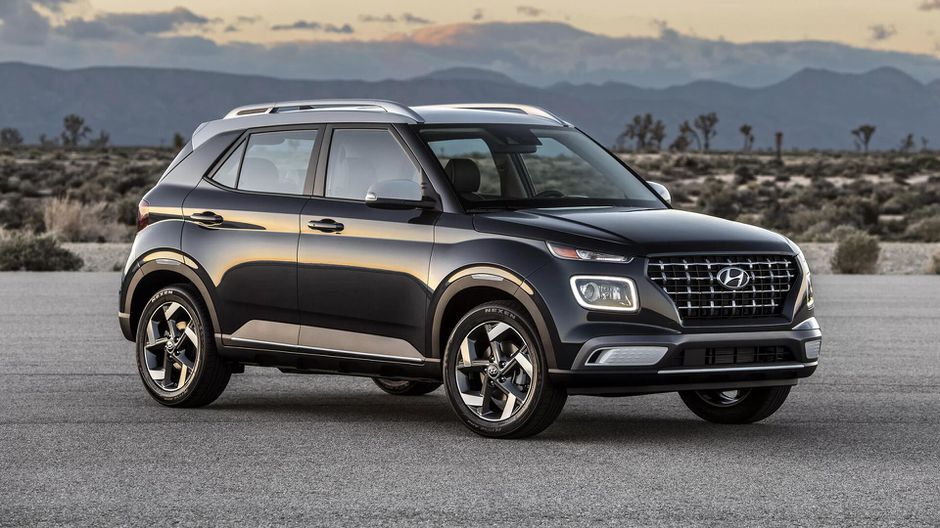
Then the 1980s delivered the decisive competitive blow: the rise of the minivan and the SUV. The text notes that the 1980s saw the introduction of both minivans and sport utility vehicles (SUVs), and that these categories exploited gaps in regulatory requirements. That point is central. In the United States, regulatory classification and fuel economy targets created incentives that favored “light trucks,” a category that included many SUVs and later crossovers. Automakers could build vehicles that served similar roles to wagons—family hauling, cargo capacity, road-trip comfort—while being regulated differently than passenger cars.
In plain terms, this created a strategic pathway. Companies could sell a tall, spacious vehicle with a truck-like classification and benefit from different regulatory treatment. The production of light trucks was made possible and expanded rapidly as a result, and these vehicles served functions comparable to those of family wagons. They offered roomy cabins, flexible cargo areas, and a sense of security that came with a higher seating position. They also delivered a lifestyle image that wagons had started to lose. The wagon was increasingly framed as a “family car,” while SUVs were framed as “adventure vehicles,” even if most never left pavement.
This contributed to the quickening of the decline of the American wagon as we knew it. Once a market begins to perceive one body style as old-fashioned and another as modern, the shift can become self-reinforcing. Dealerships stock what sells. Advertisers promote what dealerships stock. Consumers buy what appears to be culturally current. The wagon began to look like yesterday’s answer, even though the underlying problem—how do I carry people and cargo comfortably—had not changed at all.
From an industry expert’s viewpoint, this period also reveals how vehicle categories are often as much about narrative as they are about function. The wagon did not fail because it became useless. It faltered because the market was given a new story: “You don’t need a family wagon; you need a rugged SUV or a modern minivan.” And once that story took hold, wagon development slowed, which further reduced the segment’s competitiveness. It became a cycle: fewer wagon buyers meant fewer wagon innovations, which meant fewer reasons to buy wagons.
However, market cycles are not permanent. The same forces that pushed wagons out can now create conditions for their return—especially as drivers begin to question whether the dominant crossover/SUV format is always the best answer. That leads to the modern argument: not only can wagons come back, but they can come back as a smarter alternative.
Bring Back Our Station Wagons
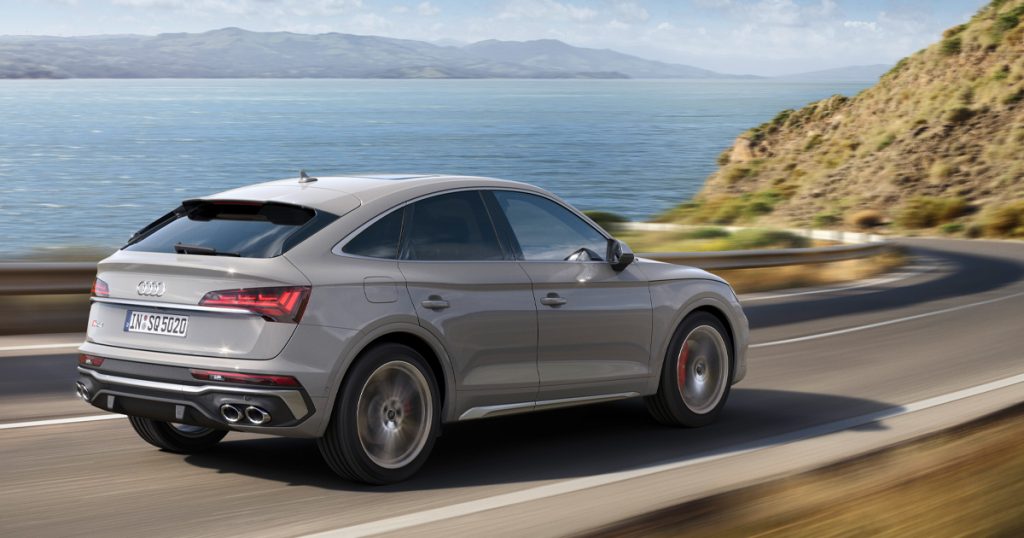
In a way, station wagons never completely disappeared—they were rebranded. Much of what wagons used to do has been absorbed by the crossover vehicles that dominate today’s roads. Station wagons have been reimagined as the crossovers we see today. The difference is that crossovers often carry more height, more mass, and more visual bulk than a traditional wagon, even when they offer similar interior volume. And crucially, they do not always deliver the same cool factor—or the same road manners—as a real station wagon.
When wagons were popular, consumers’ transportation needs changed significantly, and the market made room for alternatives. But the fundamental needs never went away: people still want cargo space, comfortable seating for family and friends, and a vehicle that makes travel easier rather than harder. What changed was how those needs were packaged and marketed. Because of this, crossover vehicles like the Audi Q5 and the Toyota RAV4 have become increasingly popular. They provide the “wagon job” in a new silhouette, with a higher ride height and a more SUV-like stance.
When contrasted with genuine station wagons, however, these versions fall far short of the cool factor. That might sound subjective, but it’s also rooted in design reality. The classic wagon shape communicates sleek practicality. It sits lower, looks longer, and often appears more athletic. Crossovers, by comparison, can look tall and generic, especially as the market converges around similar proportions. Many modern crossovers compete within a narrow design envelope: short hood, tall body, thick pillars, and a rear cargo area shaped as much for styling as for utility.
People desire crossovers to satisfy the requirement that wagons used to satisfy. That sentence is the most important takeaway in the entire debate. The market demand is still there—clearly, because crossovers sell in enormous numbers. The question is whether crossovers are the best way to meet that demand. For many drivers, a well-designed wagon would deliver the same everyday practicality with better driving dynamics, better aerodynamics, and often better efficiency.
For this reason alone, Detroit should have sufficient motivation to begin production of great American station wagons again. Wagons and other vehicles that provide a large amount of storage space are becoming increasingly popular among drivers. And as consumer preferences mature, many buyers are also beginning to value something crossovers don’t always provide: a lower, more stable ride, less body roll, and a driving feel closer to a sedan—without giving up the ability to carry gear.
To make the argument concrete, it helps to examine what a modern American wagon renaissance could actually solve. The station wagon is not merely a nostalgia product; it’s a practical design solution with measurable advantages:
1) Better driving dynamics without sacrificing utility. Traditional wagons generally have a lower center of gravity than crossovers and SUVs. That usually translates into more composed handling, less lean in corners, and a more confident feel at highway speeds. For anyone who drives long distances, stability and reduced wind sensitivity are not luxuries—they’re fatigue reducers.
2) Improved aerodynamics, often leading to better efficiency. A wagon’s roofline tends to be lower and cleaner through the air than a tall crossover profile. Aerodynamic drag increases quickly with speed, so even modest improvements can matter during highway travel—the very environment where family vehicles spend much of their time.
3) Cargo access that is easier for everyday life. A lower load floor can make groceries, strollers, sports equipment, and luggage easier to load and unload. Crossovers sometimes offer height that people interpret as “practical,” but that height can also mean lifting heavy items higher than necessary—especially for smaller drivers or older owners.
4) A distinct identity in a sea of look-alike crossovers. Part of the wagon’s “cool factor” is that it stands apart. In a market saturated with tall vehicles, a sleek, long-roof design reads as confident and intentional. It signals that the owner chose the car for function and style—not because it was the default option.
5) A pathway to modern electrification. As EV platforms become more common, the wagon shape can be especially efficient. Battery packs are typically mounted low in the floor, which naturally supports wagon-like proportions: low center of gravity, long wheelbase, and a practical cargo area. In other words, the future architecture of cars is compatible with the wagon’s strengths.
So why aren’t wagons already back? The answer is not that consumers would reject them; it’s that the modern American market has been trained to interpret “practical family vehicle” as “crossover.” That training came from decades of product planning, regulatory incentives, and marketing momentum. But trends can change quickly when a better alternative becomes visible and easy to buy.
Detroit, in particular, has an opportunity here because American automakers are already experts at building vehicles for broad demand. The station wagon could return as a modern, desirable product—quiet, safe, efficient, and technologically updated—without abandoning the things that made wagons beloved in the first place. Think of it as a “family performance car” in the most usable sense: room for real life, but driving feel that doesn’t punish you for choosing practicality.
Another reason the wagon comeback argument is strong is that the crossover market itself is beginning to fragment. Consumers who want a true off-road vehicle still choose specialized SUVs and trucks. Consumers who want maximum family convenience often choose minivans. That leaves a large middle group—drivers who simply want an efficient, comfortable, stylish people-and-gear hauler that drives like a car. That is precisely the space the wagon used to dominate.
In that middle space, the wagon can be positioned not as an “old-fashioned” body style, but as a premium practical alternative: the driver’s choice for people who refuse to surrender good road behavior just to gain cargo volume. And because wagons historically served as vacation vehicles, their return would also tap into an emotional theme Americans still love: the road trip. The station wagon is practically a symbol of American travel, and there is marketing power in bringing that symbol into a modern context.
Ultimately, the argument is simple. The station wagon helped Americans live their lives more easily for decades. It declined due to a combination of economic stress, regulatory shifts, and the rise of minivans and SUVs that exploited a favorable category classification. But the needs wagons served never disappeared. They merely migrated into a less efficient, less distinctive shape.
If automakers—particularly in Detroit—are willing to treat the wagon as a modern product rather than a retro punchline, the American station wagon can return not as a relic, but as an upgrade: a vehicle that gives families and drivers the storage space they want, the comfort they expect, and the driving experience they’ve been missing while settling for taller and heavier alternatives.
That is why the American station wagon should make a comeback.

