
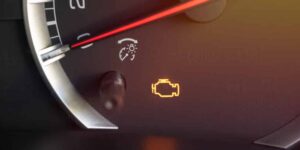

You’re driving along and your check engine light suddenly starts flashing. Your pulse picks up. You grip the steering wheel a little tighter. Then, after a few seconds or maybe a minute, the flashing stops and the light stays on solid. Still glowing, still staring at you from the dashboard, but no longer blinking with that urgent, alarming rhythm.
So what just happened? Is the crisis over because the flashing stopped? Or is the solid light telling you something equally important that you shouldn’t ignore?
Here’s the short version: what you just experienced was your engine misfiring badly enough to trigger a flashing warning, and then the misfire either subsided or became intermittent enough that the system downgraded its alert to a steady light. The flashing told you something was actively going wrong in real time. The solid light is telling you that the problem hasn’t gone away. It’s just not happening at that exact moment. Your engine’s computer has stored a trouble code, and that code is your roadmap to figuring out what’s broken.
This pattern of flashing-then-solid is actually one of the most common check engine light behaviors that drivers encounter, and it’s also one of the most misunderstood. A lot of people see the light stop flashing, breathe a sigh of relief, and assume the problem fixed itself. It didn’t. The underlying issue is still there, and if you ignore it, what started as a minor repair can escalate into a major one, sometimes costing thousands of dollars.
This guide covers exactly what the flashing and solid check engine light patterns mean, the most likely causes behind this specific behavior, what you should do immediately when it happens, how to diagnose the problem yourself or with a mechanic, what repairs typically cost, and how to prevent it from happening again. By the time you’re done reading, you’ll understand your check engine light better than most people who’ve been driving for decades.
Let’s get into it.
What the Check Engine Light Is Actually Telling You (Flashing vs. Solid)
Your check engine light (often abbreviated CEL, and formally known as the Malfunction Indicator Lamp or MIL) communicates with you in exactly two modes: flashing and solid. These aren’t random. They represent two distinct levels of urgency, and understanding the difference between them is the single most important thing you can learn about your dashboard warning lights.
A Flashing Check Engine Light: Your Engine Is Screaming for Help
A flashing check engine light means one thing: a severe engine misfire is happening right now, at this very moment, while you’re driving. This isn’t a stored code from something that happened last week. This isn’t a minor sensor glitch. This is your engine’s computer detecting that one or more cylinders are failing to properly burn fuel on their power strokes, and it’s happening frequently enough that the computer considers it an active, critical problem.
Why does the computer treat a misfire as such a big deal? Because a misfiring cylinder doesn’t just waste fuel. It dumps unburned fuel directly into the exhaust system. That raw fuel travels through the exhaust manifold, down the exhaust pipe, and into the catalytic converter, which is designed to process exhaust gases at extremely high temperatures. When unburned fuel hits the catalytic converter, it ignites inside the converter itself, raising its internal temperature far beyond the normal operating range.
A healthy catalytic converter operates at around 500 to 800 degrees Fahrenheit. A converter that’s being fed unburned fuel from a misfiring engine can reach 1,400 to 2,000 degrees or more. At those temperatures, the internal ceramic honeycomb structure of the converter begins to melt, break apart, and fail. And catalytic converters aren’t cheap. Depending on your vehicle, a replacement can cost anywhere from $1,000 to $3,000 or more for parts and labor. On some vehicles with multiple converters (many V6 and V8 engines have two or more), you could be looking at an even larger bill.
That’s why the light flashes. It’s not just saying “something is wrong.” It’s saying “something is actively causing expensive damage right now, and you need to stop driving immediately.” The flashing pattern was specifically chosen by automotive engineers because it’s attention-grabbing and impossible to ignore. A solid light might blend into the background of dashboard indicators. A flashing light demands a response.
A Solid Check Engine Light: The Problem Is Stored but Not Gone
When the check engine light transitions from flashing to solid, it means the active, severe misfire has stopped or reduced to a level below the threshold that triggers the flashing alert. The engine’s computer is no longer detecting a critical, real-time misfire condition. But it has stored a diagnostic trouble code (DTC) in its memory that records what happened.
Think of it this way. The flashing light is a fire alarm going off because there’s smoke in the building right now. The solid light is the alarm staying in alert mode because even though the smoke has cleared, the system knows something caused it and the source hasn’t been identified or fixed.
A solid check engine light is less urgent than a flashing one, but it’s not something to ignore. The code stored in the computer is a clue pointing to the root cause of the problem. If you don’t investigate and fix it, the conditions that caused the misfire will almost certainly recur. The next time, it might flash longer. Or it might not go solid at all, staying in the flashing state because the misfire has gotten worse.
The solid light can also indicate issues that aren’t misfire-related. A loose gas cap, a failing oxygen sensor, an emissions system leak, or any number of other problems can trigger a solid check engine light. But in the specific scenario we’re discussing, where the light flashed first and then went solid, the stored code is almost certainly misfire-related. The flash-to-solid sequence tells a very specific story about what your engine just experienced.
Why the Light Switches from Flashing to Solid
The transition from flashing to solid happens because the misfire condition changed. Several things can cause this:
The misfire was intermittent. Many misfires aren’t constant. They happen under specific conditions, such as a certain RPM range, a specific engine load, a particular temperature, or when a marginal component is stressed beyond its capability. You might hit a stretch of highway where you’re cruising at 3,000 RPM and the misfire fires off repeatedly. Then you slow down for a traffic light, the engine drops to idle, and the misfire stops because the conditions that triggered it are no longer present. The light stops flashing and goes solid.
The affected cylinder temporarily recovered. A spark plug that’s fouled with carbon deposits might misfire when it’s cold but work fine once it heats up. An ignition coil with an internal crack might fail under high electrical demand but work adequately at lower loads. A fuel injector that’s partially clogged might struggle at high RPM but deliver enough fuel at idle. In these cases, the component is failing but hasn’t completely died, and the misfire comes and goes as conditions change.
The engine’s computer adapted. Modern engine management systems have sophisticated adaptive capabilities. When a misfire is detected, the ECU (Engine Control Unit) may adjust fuel trim, ignition timing, or other parameters to compensate. These adjustments can reduce the severity of the misfire enough that it drops below the flashing threshold, even though the underlying problem remains. The computer is essentially masking the symptoms temporarily while the root cause persists.
Regardless of why the transition happened, the message is the same: a significant engine problem occurred, and it needs to be diagnosed and fixed before it causes further damage or returns in a more severe form.
The Most Likely Causes Behind the Flash-Then-Solid Pattern
When a check engine light flashes and then goes solid, the root cause is almost always related to a misfire. But “misfire” is a symptom, not a diagnosis. Something is causing the misfire, and identifying that something is the key to fixing the problem. Here are the most common culprits, arranged from most likely to least likely based on real-world repair data.
1. Ignition System Failures (Roughly 60% of Cases)
The ignition system is responsible for creating the spark that ignites the fuel-air mixture in each cylinder. When any component in this system fails, the affected cylinder can’t fire properly, and you get a misfire. This is by far the most common cause, accounting for approximately 60% of all misfire-related check engine light events.
Spark plugs are the most frequent offender. They’re wear items with a finite lifespan, and they degrade gradually over tens of thousands of miles. As a spark plug wears, the electrode gap widens, the electrode material erodes, and carbon deposits accumulate on the firing tip. Eventually, the plug can’t produce a strong enough spark to reliably ignite the fuel-air mixture, and misfires begin. They often start as occasional, intermittent events (the kind that might cause a brief flash of the CEL) before becoming constant as the plug continues to deteriorate.
Here’s a real-world example. Say you drive a four-cylinder Honda Civic with 95,000 miles, and the spark plugs have never been replaced. The manufacturer recommends replacement at 100,000 miles for iridium plugs. You’re close to that interval, and one plug has worn slightly faster than the others because of minor variation in cylinder conditions. On a cold morning, that plug can’t fire reliably for the first few minutes of driving. The engine misfires, the CEL flashes, and then as the engine warms up and the plug starts working again, the light goes solid. The fix? A set of spark plugs for $50 to $100. Ignore it, and the repeated misfires can destroy your catalytic converter, turning a simple maintenance item into a four-figure repair.
Ignition coils (or coil packs) are the next most common ignition system failure. These components generate the high-voltage electrical pulse that travels through the spark plug wire (or directly to the plug on coil-on-plug systems) to create the spark. Ignition coils can develop internal cracks, insulation breakdown, or winding failures that cause them to produce weak or inconsistent sparks. Like spark plugs, coil failures are often intermittent at first, producing misfires under specific conditions before progressing to constant failure.
Spark plug wires (on vehicles that still use them, which tend to be older models or certain engine designs) can crack, arc, or develop excessive resistance over time. A degraded wire might deliver enough spark at low RPM but fail at higher RPM when the electrical demand increases. This kind of load-dependent failure is a classic cause of intermittent misfires that produce the flash-then-solid CEL pattern.
The good news about ignition system failures is that they’re generally the most affordable misfires to fix. Spark plugs, coils, and wires are all accessible components on most engines, and the parts are reasonably priced. Many of these repairs are also within reach of a competent DIYer with basic tools.
2. Fuel Delivery Problems
If the ignition system is creating the spark, the fuel system is providing the fuel. When fuel delivery to a cylinder is inadequate, the fuel-air mixture is either too lean (not enough fuel) or improperly atomized (the fuel isn’t sprayed in the fine mist pattern needed for efficient combustion). Either condition can cause a misfire.
Clogged fuel injectors are the most common fuel-related misfire cause. Fuel injectors spray a precisely measured amount of fuel into each cylinder in a fine mist pattern. Over time, deposits from fuel additives, carbon, and other contaminants can build up on the injector tip, partially blocking the spray orifice. A partially clogged injector might deliver enough fuel at idle but fall short under higher load or RPM, creating an intermittent lean misfire.
Low fuel pressure from a weak fuel pump or a clogged fuel filter can starve all cylinders of adequate fuel, particularly during high-demand situations like hard acceleration or hill climbing. If the fuel pressure drops below the system’s design specification, the injectors can’t deliver enough fuel even when they’re operating correctly. The misfire might appear only when you accelerate hard or drive at highway speeds, then disappear when you return to gentle driving conditions.
A failing fuel pressure regulator can cause fuel pressure to fluctuate unpredictably, creating conditions where the engine runs rich sometimes and lean at other times. This kind of inconsistent fuel delivery is particularly tricky to diagnose because the symptoms change depending on driving conditions, temperature, and load.
Fuel delivery problems tend to be slightly more expensive to repair than ignition system issues because the components are often less accessible and the diagnostic process is more involved. A fuel injector cleaning service might cost $150 to $300, while a fuel pump replacement can run $500 to $1,000 or more depending on the vehicle.
3. Exhaust System Issues
Sometimes the exhaust system is both a victim and a cause of misfires. A failed oxygen sensor (O2 sensor) can send incorrect data to the ECU about the exhaust gas composition. If the sensor tells the ECU that the mixture is lean when it’s actually stoichiometric (correct), the ECU will command the injectors to add more fuel, creating an overly rich condition that can cause misfires and foul the spark plugs.
A damaged catalytic converter can also contribute to misfires, though this is usually a consequence rather than a cause. When a converter’s internal substrate breaks apart from overheating (caused by previous misfires), the fragments can create a partial blockage in the exhaust system. This backpressure prevents the engine from expelling exhaust gases efficiently, which disrupts the combustion cycle and can trigger new misfires. It’s a vicious cycle: misfires damage the converter, and the damaged converter causes more misfires.
If your check engine light has been flashing periodically and you’ve been ignoring it for weeks or months, the catalytic converter is at high risk. A converter that’s been subjected to repeated misfire-related overheating events may be internally melted, fractured, or collapsed. At that point, it’s not just a misfire repair you need. It’s a misfire repair plus a converter replacement, which is where the repair bill jumps from hundreds to thousands of dollars.
4. Vacuum Leaks
Your engine operates with a carefully controlled vacuum in the intake manifold. This vacuum is part of what draws the fuel-air mixture into the cylinders. When there’s an unmetered air leak in the intake system, extra air enters the combustion chamber that the ECU doesn’t account for. This creates a lean condition (too much air, not enough fuel relative to the air) that can cause misfires.
Common sources of vacuum leaks include cracked or deteriorated vacuum hoses, intake manifold gasket failures, brake booster hose leaks, and PCV (Positive Crankcase Ventilation) system leaks. These leaks can be frustratingly intermittent. A cracked hose might seal well enough when the engine is cold but open up as the rubber warms and expands. An intake gasket might leak only under certain vacuum conditions. This intermittent nature makes vacuum leaks a common cause of the flash-then-solid CEL behavior.
Vacuum leaks are often one of the more affordable repairs once they’re properly diagnosed. The tricky part is finding the leak in the first place. A smoke test, where pressurized smoke is introduced into the intake system and the mechanic watches for smoke escaping from unexpected places, is the most effective diagnostic method. The test itself typically costs $50 to $100, and the repair (usually a replacement hose or gasket) is often under $200.
5. Sensor or ECU Failures
This is the least common cause on the list, but it does happen. The engine’s computer relies on data from dozens of sensors to calculate the correct fuel-air mixture, ignition timing, and other parameters for each combustion cycle. If a critical sensor fails or sends incorrect data, the ECU’s calculations are wrong, and misfires can result.
The crankshaft position sensor is particularly important because it tells the ECU exactly where each piston is in its cycle, which determines when to fire the spark plug and when to inject fuel. If this sensor gives intermittent bad readings, the ECU can command the spark or fuel at the wrong moment, causing a misfire. The camshaft position sensor serves a similar function and can cause similar problems if it fails.
The mass airflow sensor (MAF) measures the amount of air entering the engine and is used to calculate how much fuel to inject. A contaminated or failing MAF can over-report or under-report air volume, causing the ECU to inject too much or too little fuel. This can create misfires, particularly during transitions between different driving conditions (acceleration, deceleration, cruise).
True ECU failures are rare but not unheard of. Power surges, moisture intrusion, or internal component degradation can cause the ECU to malfunction. When the ECU itself is the problem, symptoms can be widespread and confusing because the ECU controls everything. Multiple seemingly unrelated problems appearing simultaneously can be a clue that the ECU is at fault.
Sensor replacements range from $100 to $400 typically. ECU replacement is more expensive, often $500 to $1,500 or more including programming, but it’s also the least likely cause on this list. Always exhaust the more common possibilities before suspecting the ECU.
What You Should Do Right Now If This Just Happened to You
Your response to the flash-then-solid pattern should be calibrated to what the light is doing at this moment and what it was doing before. Here’s the practical guidance.
If the Light Was Flashing and Is Still Flashing
Stop driving as soon as you safely can. A continuously flashing check engine light means a severe misfire is active right now, and every mile you drive is potentially pumping unburned fuel into your catalytic converter. Pull over to a safe location, shut off the engine, and arrange for a tow to a mechanic. Yes, a tow truck costs money ($75 to $150 for a local tow is typical), but it’s a tiny fraction of the $1,000 to $3,000 catalytic converter replacement you might need if you keep driving.
Don’t try to “limp” the car to a shop 20 miles away. Don’t convince yourself that “it’s probably fine” because the engine still seems to be running. The flashing light exists specifically because the computer has determined that continued driving will cause damage. Trust the light.
If the Light Flashed but Is Now Solid
Drive cautiously and get the codes read as soon as possible. The immediate crisis has passed (the active severe misfire has stopped), but the underlying problem remains. You can likely drive the vehicle to a parts store or mechanic without causing additional damage, but keep a few things in mind:
- Drive gently. Avoid hard acceleration, high RPM, and heavy engine loads. These conditions are most likely to trigger the misfire again.
- Keep the trip short and direct. Don’t run errands around town for two hours with a solid check engine light. Go straight to where you’re getting the codes read.
- If the light starts flashing again at any point, pull over immediately. The misfire has returned, and you’re back to the “stop driving now” protocol.
- Pay attention to how the engine feels. Rough idle, hesitation, vibration, loss of power, or unusual sounds are all signs that the misfire is still occurring, even if it’s not severe enough to trigger the flashing light.
Many auto parts stores offer free OBD-II code scanning. Pull into one, ask them to scan the codes, and write down every code that comes up. You’ll typically get a code number (like P0300 or P0172) and a brief description. This information is your starting point for diagnosis, whether you’re fixing it yourself or taking it to a mechanic.
How to Diagnose the Problem: A Step-by-Step Approach
Once you have the trouble codes, the diagnostic process becomes much more focused. Instead of guessing at what might be wrong, you’re following a trail of evidence that the car’s computer has left for you. Here’s how to work through it systematically.
Step 1: Retrieve and Interpret the Trouble Codes
Connect an OBD-II scanner to the diagnostic port under your dashboard (it’s almost always located on the driver’s side, below the steering column, within reach of the driver’s seat). Turn the ignition to the “on” position without starting the engine. Follow your scanner’s instructions to retrieve all stored trouble codes.
You might get one code or several. Write them all down. For the flash-then-solid scenario, you’ll most likely see misfire-related codes, but there may be additional codes that provide context about what caused the misfire. Here are some of the most common codes you’ll encounter:
| Code | What It Means | Where to Start Looking |
|---|---|---|
| P0300 | Random/multiple cylinder misfire detected | Check spark plugs, coils, fuel system, vacuum leaks |
| P0301 through P0312 | Misfire detected in a specific cylinder (the last two digits identify which one) | Focus on the ignition coil, spark plug, and fuel injector for that specific cylinder |
| P0172 | System too rich (Bank 1) | Inspect oxygen sensors, MAF sensor, fuel pressure, check for leaking injectors |
| P0171 | System too lean (Bank 1) | Check for vacuum leaks, inspect MAF sensor, test fuel pressure |
| P0420 | Catalyst system efficiency below threshold | May indicate catalytic converter damage from prolonged misfires; also check O2 sensors |
| P0340 | Camshaft position sensor circuit malfunction | Test or replace camshaft position sensor, check wiring |
| P0335 | Crankshaft position sensor circuit malfunction | Test or replace crankshaft position sensor, check wiring |
The codes give you direction, but they’re not a final diagnosis. A P0302 (cylinder 2 misfire) tells you that cylinder 2 is the problem child, but it doesn’t tell you whether the spark plug, the coil, the injector, or something else in that cylinder is responsible. That’s where the next step comes in.
Step 2: Perform Targeted Tests Based on the Codes
Once you know which codes are stored, you can focus your testing on the most likely components. Here’s how to approach the most common scenarios.
For cylinder-specific misfire codes (P0301 through P0312):
Start with the simplest and cheapest components first. Remove the spark plug from the affected cylinder and inspect it. A healthy spark plug should have a light tan or gray electrode with a gap that matches the manufacturer’s specification. A fouled plug will be black (carbon fouling from a rich condition), white (overheating from a lean condition), or wet with fuel (not firing at all). A worn plug will have a rounded, eroded electrode and an enlarged gap.
If the plug looks questionable, replace it with a new one that matches the manufacturer’s specification. While you’re at it, inspect the ignition coil for the affected cylinder. Look for cracks, burn marks, or corrosion on the connector. You can test a coil’s resistance with a multimeter (compare the reading to the manufacturer’s specification), or you can perform a swap test: move the suspect coil to a different cylinder and see if the misfire follows it. If the misfire moves to the new cylinder, the coil is bad. If the misfire stays in the original cylinder, the coil is fine and you need to look elsewhere.
For random misfire codes (P0300):
A random misfire that affects multiple cylinders is less likely to be a single failed component and more likely to be a system-wide issue. Check all spark plugs (replace the full set if they’re near the end of their service life). Test fuel pressure at the fuel rail with a fuel pressure gauge (compare to the specification in your service manual). Check for vacuum leaks using a visual inspection of hoses and gaskets, or ideally a smoke test.
For fuel mixture codes (P0171 or P0172):
These codes indicate that the engine is running too lean (P0171) or too rich (P0172). A lean code alongside a misfire code points toward a vacuum leak or fuel delivery problem. A rich code alongside a misfire code suggests a leaking injector, a faulty fuel pressure regulator, or a bad oxygen sensor that’s causing the ECU to over-fuel the engine.
If misfires persist after addressing spark plugs, coils, and fuel system:
Perform a compression test. This test measures the compression pressure in each cylinder, which tells you about the mechanical health of the engine’s internals (pistons, rings, valves, head gasket). Low compression in one cylinder indicates a mechanical problem that no amount of spark plug or coil replacement will fix. Common causes of low compression include worn piston rings, a burned exhaust valve, or a blown head gasket. These are more serious and expensive repairs, but they’re also less common than ignition and fuel system issues.
Step 3: Address the Root Cause, Not Just the Symptom
This is where a lot of DIY repairs go sideways. Someone reads a P0302 code, replaces the cylinder 2 spark plug, clears the code, and calls it done. The light comes back two weeks later because the real problem was a cracked ignition coil that was causing the plug to foul. Or someone replaces all four spark plugs to fix a P0300 random misfire, but the actual issue was a vacuum leak that was creating a lean condition and causing all four cylinders to misfire intermittently.
Always ask yourself: why did this component fail? If a spark plug is carbon-fouled, why is there excess carbon? Is the engine running rich? Is there an oil leak past the valve seals? If an ignition coil failed, is it a one-off failure due to age, or is there an electrical problem causing premature coil death? Fixing the immediate symptom without understanding the root cause just postpones the next failure.
What Repairs Typically Cost (And Where You Can Save Money)
Let’s talk about what you can realistically expect to spend fixing the most common causes of a flashing-then-solid check engine light. Costs vary by vehicle, region, and whether you’re doing the work yourself or paying a shop, but these ranges give you a solid baseline for budgeting.
Common Repairs and Their Price Ranges
Spark plugs: $50 to $150 for a full set (four to eight plugs depending on engine type). This is one of the most DIY-friendly repairs out there. If you own a socket wrench set and a spark plug socket, you can do this in your driveway in 30 minutes to an hour on most four-cylinder engines. V6 and V8 engines can be trickier because some plugs are buried under intake manifold components, but it’s still doable with patience and a YouTube tutorial specific to your vehicle.
Ignition coil replacement: $150 to $300 per coil including parts and labor at a shop. If you’re buying the part yourself and doing the work, the coil alone is typically $30 to $80 depending on the vehicle. On coil-on-plug systems (which is most modern vehicles), replacing a coil is usually a matter of disconnecting an electrical connector, removing one or two bolts, and pulling the old coil off the spark plug. It’s a 15-minute job if you know which coil to replace.
Fuel injector cleaning: $150 to $300 for a professional cleaning service. This involves connecting a pressurized cleaning solution to the fuel rail and running it through the injectors. Some mechanics use on-car cleaning systems, while others remove the injectors and clean them on a bench. DIY fuel injector cleaner additives ($10 to $20 per bottle) can help with minor buildup but aren’t a substitute for professional cleaning when injectors are significantly clogged.
Fuel pump replacement: $500 to $1,000 including parts and labor. The fuel pump is typically located inside the fuel tank, which means the tank often needs to be dropped to access it. This is a labor-intensive job that most DIYers prefer to leave to a shop.
Oxygen sensor replacement: $200 to $400 per sensor including parts and labor. Most vehicles have two to four oxygen sensors. If only one has failed, you only need to replace that one. The sensor itself typically costs $50 to $150, and labor is usually under an hour.
Catalytic converter replacement: $1,000 to $3,000 or more depending on the vehicle and the number of converters. This is the big-ticket item that you’re trying to avoid by responding to the flashing check engine light promptly. On some vehicles (particularly those with multiple converters or California-emissions-spec converters), costs can exceed $3,000. It’s the most compelling financial argument for not ignoring a flashing CEL.
Vacuum leak repair: $100 to $300 for most hose or gasket replacements, plus $50 to $100 for the smoke test to locate the leak. Vacuum hoses are inexpensive parts (often under $20 each), but the labor to access and replace them varies by location on the engine. Intake manifold gasket replacement is more involved and can cost $300 to $600 depending on the engine design.
DIY vs. Professional Repair: Where to Draw the Line
Some of these repairs are well within reach of anyone who’s comfortable with basic hand tools and willing to watch a few instructional videos. Others require specialized tools, diagnostic equipment, or expertise that make professional service the smarter choice.
Good DIY candidates:
- Spark plug replacement (basic tools, straightforward on most engines)
- Ignition coil replacement (usually plug-and-play on coil-on-plug systems)
- Vacuum hose replacement (visual inspection and basic hand tools)
- OBD-II code reading and clearing (basic scanner costs $20 to $50 for a reliable unit)
Better left to a professional:
- Fuel system pressure testing and injector service
- Compression testing and internal engine diagnostics
- Catalytic converter replacement (often requires welding and exhaust work)
- ECU diagnosis and reprogramming
- Complex vacuum leak diagnosis (smoke testing requires specialized equipment)
- Any repair you’re not confident about, the cost of a mistake can exceed the cost of professional labor
How to Prevent This From Happening Again
The best misfire repair is the one you never need. Most misfire-related check engine light events are preventable through basic maintenance and sensible driving habits. Here’s what actually makes a difference.
Replace spark plugs at the manufacturer’s recommended interval. This is the single most effective preventive measure for misfire avoidance. Spark plug replacement intervals vary by vehicle and plug type. Conventional copper plugs might last 30,000 miles. Platinum plugs typically last 60,000 miles. Iridium and double-platinum plugs can last 80,000 to 100,000 miles. Check your owner’s manual for the specific recommendation for your vehicle and stick to it. Replacing plugs on schedule is cheap insurance against misfires and the expensive cascading damage they can cause.
Use quality fuel. Low-quality fuel with high contaminant levels can accelerate deposit buildup on fuel injectors, intake valves, and combustion chambers. You don’t need to buy premium fuel if your vehicle doesn’t require it, but sticking with name-brand fuel from reputable stations is a reasonable precaution. Discount fuel from no-name stations sometimes contains less effective detergent additives, which can lead to faster deposit accumulation.
Use a fuel system cleaner periodically. Adding a quality fuel injector cleaner to your tank every 5,000 to 10,000 miles can help prevent the gradual deposit buildup that leads to clogged injectors. Products from brands like Techron, Red Line, and Lucas are widely recognized as effective. A $10 bottle of injector cleaner every few months is a lot cheaper than a $300 professional injector cleaning service.
Don’t ignore a solid check engine light. This is the most important preventive habit. A solid check engine light that comes on and stays on is your car’s way of telling you that something needs attention. It might be minor. It might be a loose gas cap. But it also might be the early warning of a problem that, if left unaddressed, will eventually escalate to a flashing light and potential catalytic converter damage. Getting the codes read when the light first appears costs nothing (free at most auto parts stores) and takes five minutes. There’s no rational reason to ignore it.
Address minor issues before they become major ones. A rough idle that comes and goes. A brief hesitation during acceleration that you’ve learned to live with. A faint smell of fuel that appears occasionally. These are all early warning signs of developing problems. Each one is your car whispering to you before it starts shouting through the check engine light. Responding to the whisper is always cheaper and less stressful than responding to the shout.
Follow your vehicle’s maintenance schedule. Beyond spark plugs, regular maintenance items like air filter replacement, fuel filter replacement (on vehicles with serviceable fuel filters), and periodic inspection of ignition system components and vacuum hoses all contribute to reliable engine operation. The maintenance schedule in your owner’s manual isn’t a suggestion. It’s the manufacturer’s engineering-based estimate of when components need attention to prevent failures.
Your Quick-Reference Priority Checklist
If you’re dealing with a check engine light that flashed and then went solid, here’s your action plan in order of priority.
- If the light is currently flashing, stop driving immediately. Arrange a tow to a mechanic. Every mile driven with a flashing CEL risks catalytic converter damage that could cost $1,000 or more to repair.
- If the light has gone solid, get the trouble codes scanned as soon as possible. Drive gently and directly to an auto parts store or mechanic. Many stores offer free OBD-II scanning. Write down every code that appears.
- Prioritize misfire codes (P0300 through P0312) above all other codes. These codes are directly related to the flashing event and point to the root cause of the problem. Other codes may be present but are often secondary effects of the misfire.
- Start diagnosis with the ignition system. Inspect spark plugs and ignition coils first, as these are the most common causes and the cheapest to fix. If the spark plugs are near or past their replacement interval, replace the full set regardless of which cylinder is misfiring.
- Check the fuel system if ignition components are good. Test fuel pressure, inspect injectors, and check the fuel filter (if accessible and serviceable on your vehicle).
- Look for vacuum leaks if ignition and fuel systems check out. A smoke test is the most effective way to find leaks. Visually inspect all vacuum hoses for cracks, deterioration, or disconnected fittings.
- Consider sensors and ECU only after ruling out the more common causes. Crankshaft position sensors, camshaft position sensors, MAF sensors, and ECU issues are less likely but should be investigated if the common causes have been eliminated.
- Clear the codes after the repair and monitor. Drive the vehicle for a few days under normal conditions. If the check engine light stays off and the engine runs smoothly, the repair was successful. If the light returns, the root cause hasn’t been fully addressed and further diagnosis is needed.
Understanding the Real Cost of Ignoring This Warning
Let’s put the financial stakes in perspective with a real-world progression that plays out in repair shops every single day.
Stage 1: A single spark plug begins to fail. The check engine light comes on solid with a cylinder-specific misfire code. The repair at this point: a set of spark plugs for $50 to $150. Total cost: under $200 if you have a shop do it.
Stage 2: The driver ignores the light. The failing plug misfires more frequently, and the CEL starts flashing during certain driving conditions. The unburned fuel from the misfiring cylinder begins overheating the catalytic converter. The repair now includes the spark plugs plus potentially a new ignition coil (since the repeated misfires may have damaged it). Total cost: $200 to $400.
Stage 3: The driver continues to ignore the flashing light. The catalytic converter, subjected to weeks or months of overheating from unburned fuel, begins to fail internally. The ceramic substrate melts and collapses. The P0420 code (catalyst efficiency below threshold) appears alongside the misfire codes. The repair now includes spark plugs, possibly an ignition coil, and a catalytic converter replacement. Total cost: $1,500 to $3,500.
Stage 4: In severe cases, the collapsed catalytic converter creates exhaust backpressure that damages the engine further. The driver may experience significantly reduced power, overheating, or additional component failures. Total cost: potentially $3,000 to $5,000 or more, depending on the extent of the damage.
The difference between Stage 1 and Stage 3 is time and attention. One costs less than a decent pair of shoes. The other costs more than many people’s monthly mortgage payment. And the only thing separating the two outcomes is whether the driver took the check engine light seriously when it first appeared.
When It Flashes and Goes Solid, It’s Telling You Something Specific
The check engine light that flashes and then settles into a solid glow is your engine’s way of saying: “Something just went seriously wrong, and even though it’s calmed down for now, the problem is still here.” It’s not an invitation to relax. It’s a window of opportunity. The misfire that caused the flashing has temporarily subsided, giving you a chance to get the vehicle scanned, diagnosed, and repaired before the next episode causes real damage.
In most cases, the fix is straightforward and affordable. Spark plugs and ignition coils account for the majority of these events, and replacing them is among the simplest and cheapest repairs in automotive maintenance. The expensive outcomes only happen when drivers ignore the warning and let a $100 problem turn into a $2,000 problem through inaction.
So if your check engine light just did the flash-then-solid routine, don’t panic, but don’t shrug it off either. Get those codes read today, not next week. Your catalytic converter, your wallet, and your peace of mind will all thank you for it.