
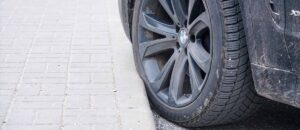

Every driver has had that moment. You’re pulling into a tight parking spot, turning a corner a little too sharply, or squeezing past a narrow lane in a crowded lot, and then you hear it. That sickening scrape of rubber and metal grinding against concrete. Your heart sinks because you already know what happened. You just curbed your wheel.
Curb scraping is one of the most common forms of vehicle damage out there, and it happens to everyone eventually. New drivers, experienced drivers, people who drive compact sedans, and people who drive full-size SUVs. Nobody is immune. But here’s the thing most people don’t realize: the damage from a curb strike can range from a barely noticeable cosmetic scratch all the way to a structurally compromised rim, a tire that’s one highway mile away from a blowout, or a suspension that’s been knocked out of alignment without you even knowing it.
Whether you just scraped a curb five minutes ago and you’re trying to figure out how bad it is, or you want to understand how to prevent it from happening again, this guide covers everything. We’ll break down exactly how curb scraping happens, what types of damage it causes to tires, rims, and suspension, how to assess the damage yourself, what repairs cost, and the smartest ways to avoid it in the future. There’s also a detailed material risk chart and a real-world case study to bring it all together.
Let’s get into the details.
Why Curb Scraping Happens: The Forces Behind Every Curb Strike
Curb scraping doesn’t happen because of bad luck. It happens because of a specific combination of factors, primarily speed, impact angle, and the physical geometry of your vehicle. Understanding these factors is the first step toward avoiding curb damage, and it’s also essential for understanding how serious the damage might be when it does occur.
The Most Common Reasons Drivers Hit Curbs
Some curb strikes are dramatic. You’re swerving to avoid something in the road and your front wheel catches the curb at speed. But most curb scraping incidents are far more mundane than that. They happen during routine, low-speed maneuvers where the driver simply misjudges the distance between the wheel and the curb.
- Misjudging road curvature: Tight turns in urban areas, narrow residential streets, parking garage ramps, and roundabouts are prime locations for curb strikes. When the turning radius of the road is tighter than the driver expects, the inside wheel tracks closer to the curb than intended. This is especially common when drivers are unfamiliar with the area or driving a vehicle they’re not used to, like a rental car or a new purchase with different dimensions than their previous vehicle.
- Low ground clearance: Vehicles that sit close to the ground are inherently more susceptible to curb damage. Sports cars like the Porsche 911, Chevrolet Corvette, and Mazda MX-5 have very low ride heights that put their wheels and body panels right in the strike zone. But it’s not just sports cars. Popular everyday vehicles like the Tesla Model 3, Honda Civic, and Toyota Camry have lower profiles than many drivers realize, especially when equipped with larger wheel packages. Lowered or modified vehicles face even greater risk because aftermarket suspension modifications reduce the already-slim margin between the wheel lip and the curb top.
- Parallel parking misjudgment: This is the number one scenario for curb scraping. Pulling into or out of a parallel parking space requires precise spatial awareness, and even experienced drivers occasionally get too close. The rear wheel typically takes the brunt of the damage because it follows a tighter arc than the front wheel during the parking maneuver.
- Sudden evasive maneuvers: When a driver swerves to avoid an obstacle, animal, pedestrian, or another vehicle, the evasive action can send the wheels directly into a curb. At speeds above 15 to 25 MPH, the impact force increases dramatically, and the damage shifts from cosmetic scratches to potential structural failures in the rim and tire.
- Distracted driving: Reaching for something in the passenger seat, checking a phone notification, adjusting the navigation screen, or simply daydreaming can cause the vehicle to drift toward the curb. Even a momentary lapse in attention at low speed is enough to scrape a wheel.
- Poor visibility conditions: Rain, fog, darkness, and glare from low sun angles all reduce the driver’s ability to judge curb distance. Snow-covered curbs are particularly treacherous because the curb is completely invisible under the snow, and drivers don’t know they’ve hit it until they hear and feel the impact.
How Different Rim Materials Respond to Curb Impact
Not all wheels handle curb impacts the same way. The material your rims are made from plays a huge role in determining whether a curb strike results in a surface scratch or a structural crack. Understanding these material differences helps you assess damage accurately and make better decisions about repair versus replacement.
- Steel rims are the toughest option in terms of raw impact resistance. They can absorb a significant hit without cracking. However, steel is heavy, which affects handling and fuel economy. It’s also prone to rust, especially in regions where road salt is used during winter. When a steel rim hits a curb, it typically dents or bends rather than cracking. That’s actually a good thing structurally, because a bent steel rim can often be straightened, whereas a cracked rim usually needs to be replaced.
- Cast aluminum rims are the most common type on modern passenger vehicles. They’re lighter than steel and allow for more attractive designs, which is why automakers favor them. But cast aluminum is more brittle than steel. Instead of bending on impact, it’s more likely to chip, gouge, or crack. Minor curb scrapes produce cosmetic damage on the outer face of the rim. Harder impacts can bend the rim lip or even fracture the spoke structure.
- Forged aluminum rims are roughly 30% stronger than cast aluminum because the forging process compresses the metal grain structure, eliminating the microscopic air pockets and inconsistencies that weaken cast rims. Forged wheels are popular on high-performance vehicles and light-duty trucks where strength-to-weight ratio matters. They’re more expensive, but they hold up better to curb impacts. A hit that would crack a cast rim might only scratch or slightly dent a forged one.
- Composite materials (carbon fiber and advanced polymer blends) are an emerging category, primarily found on electric vehicles and high-end performance cars. These materials offer excellent corrosion resistance and vibration dampening properties. However, composite rims respond differently to impact than metal rims. They don’t bend; they either absorb the impact or they fracture. And composite rim repairs are more complex and expensive than metal rim repairs, often requiring specialist shops or outright replacement.
The takeaway here is that the severity of curb damage depends not just on how hard you hit the curb, but on what your wheels are made of. A moderate curb strike that barely marks a forged aluminum wheel could crack a cast aluminum one in the same spot. Knowing your wheel material helps you set realistic expectations for both damage assessment and repair costs.
How Bad Is the Damage? Understanding the Different Levels of Curb Scraping Injury
After a curb strike, the first question everyone asks is, “How bad is it?” The answer depends on which component took the hit and how severe the impact was. Curb damage generally falls into three categories: tire damage, rim damage, and suspension/alignment damage. Let’s break each one down.
Tire Damage: From Surface Scuffs to Blowout Risks
Tires are often the first point of contact during a curb strike, and they can absorb a surprising amount of punishment. But they also have limits, and the damage isn’t always visible from the outside.
- Sidewall bulges: A bulge on the sidewall of your tire is one of the most serious forms of curb damage. It indicates that the inner structural cords (the nylon or polyester plies that give the tire its shape and strength) have been ruptured. The rubber is intact on the outside, but the internal reinforcement has failed, and the air pressure inside the tire is pushing the unsupported rubber outward into a visible bump. Any sidewall bulge larger than about 1/4 inch is a blowout risk and the tire should be replaced immediately. Don’t drive on a bulging tire any longer than absolutely necessary. A blowout at highway speed can result in loss of vehicle control.
- Bead separation: The bead is the inner edge of the tire that seats against the rim. It’s reinforced with steel wire to maintain a tight seal. A hard curb impact can unseat or damage the bead, causing an immediate or gradual loss of air pressure. Tires with higher aspect ratios (taller sidewalls relative to width) are more susceptible to bead damage because the taller sidewall provides less protection to the bead area during a side impact. Low-profile tires, ironically, can also suffer bead issues because there’s less rubber between the rim and the curb to absorb the hit.
- Tread cuts: Curb scraping can slice into the tread face or the tread shoulder of the tire. Shallow cuts that only affect the surface rubber are typically cosmetic and don’t compromise the tire’s performance. But cuts that penetrate more than 50% of the tread depth can expose the steel belts underneath. Exposed steel belts will rust and deteriorate, weakening the tire structure and creating a potential failure point. If you can see metal cords in a tread cut, the tire needs to be replaced.
- Sidewall scuffing: The most common and least severe form of tire curb damage. The outer layer of rubber on the sidewall gets abraded, leaving a rough, lighter-colored patch. In most cases, sidewall scuffs are cosmetic only and don’t affect tire performance or safety. But if the scuff is deep enough to expose the cords beneath the rubber, it becomes a structural concern.
Here’s a good rule of thumb for tire damage assessment. If you can see cords (fabric or steel), if there’s a bulge, or if the tire is losing air, don’t mess around with it. Replace the tire. If it’s just rubber scuffing on the surface with no visible cord damage and no air loss, you’re likely fine to keep driving.
Rim Damage: Scratches, Bends, and Hidden Cracks
Rim damage is what most people think of when they hear “curb rash.” That ugly scrape on the face of your once-pristine wheel. But rim damage from curb strikes goes well beyond cosmetics, and some of the most dangerous damage isn’t visible to the naked eye.
- Cosmetic scratches and gouges: The most common form of curb damage. The curb scrapes away the paint, clear coat, or machined finish on the outer face of the rim, leaving behind an ugly rough patch. It looks terrible, but it doesn’t affect the structural integrity of the wheel. Cosmetic damage can be repaired with touch-up paint, professional refinishing, or DIY rim repair kits. The fix is purely aesthetic.
- Minor rim bends: A curb strike with moderate force can bend the rim lip, which is the outer edge of the wheel where the tire bead seats. A minor bend might be visually imperceptible when looking at the wheel on the car, but you’ll feel it. At speeds above 55 MPH, a bent rim creates a vibration that you can feel through the steering wheel (front wheels) or through the seat and floor (rear wheels). Minor bends can often be fixed using a hydraulic wheel straightening machine, which applies controlled force to reshape the rim without cracking it.
- Spoke cracks: This is where curb damage starts to get dangerous. The spokes of a wheel are structural load-bearing elements. A curb impact can crack a spoke, especially at high-stress transition zones where the spoke meets the hub or the outer barrel. Any visible crack in a spoke, even one that’s only 1/8 inch long, means the wheel should be replaced. Cracks propagate over time under the cyclic loading of normal driving. What starts as a hairline crack today can become a catastrophic wheel failure next month.
- Hidden structural damage in the hub area: The most insidious form of rim damage is a fracture in the structural hub or the inner barrel of the wheel that you can’t see from the outside. These hidden fractures occur in the area around the lug bolt holes or in the inner mounting surface. They’re virtually undetectable without specialized testing, typically ultrasonic testing or dye penetrant inspection. If a curb strike was hard enough to cause visible damage to the outer rim face, it’s worth having the wheel professionally inspected for hidden structural issues, especially on cast aluminum wheels.
The important distinction with rim damage is the line between cosmetic and structural. Cosmetic damage is ugly but harmless. Structural damage is dangerous and demands immediate attention. When in doubt, have a professional wheel shop inspect the rim. The cost of an inspection is trivial compared to the cost of a wheel failure at highway speed.
Suspension and Alignment Damage: The Problems You Can’t See Right Away
The damage from a curb strike doesn’t always stop at the wheel and tire. The impact force travels through the wheel into the suspension components, and depending on the severity, it can knock things out of alignment or damage parts that are hidden behind the wheel.
- Steering drift: After a curb strike, you might notice the vehicle pulling to one side. This is especially common in smaller vehicles like subcompact cars, compact sedans, and crossovers with lighter suspension components. An asymmetric curb strike (hitting with just one wheel) creates unequal load distribution across the front suspension, which can shift the alignment angles enough to cause a noticeable pull. If your car didn’t pull before the curb strike and it does afterward, the alignment has been affected.
- Uneven tire wear: Curb-caused misalignment accelerates tire wear dramatically. Depending on how much the toe and camber angles have shifted, uneven wear can progress 20% to 300% faster than normal. You might not notice it for a few hundred miles, but within a few thousand miles, the tread wear pattern will tell the story. If one edge of the tire is wearing faster than the other, or if the tread is wearing in a scalloped or feathered pattern, your alignment is off.
- Braking vibrations: A hard curb impact can warp the brake rotor or bend the caliper bracket, both of which cause vibrations when braking. These vibrations are sometimes masked by the ABS system until the warp exceeds about 0.002 inches of lateral runout. At that point, you’ll feel a pulsation through the brake pedal or a shimmy in the steering wheel when applying the brakes at moderate to high speeds.
- Damaged suspension components: Tie rods, ball joints, control arm bushings, and strut mounts can all be damaged or stressed by a curb impact. These parts might not fail immediately, but the impact can accelerate wear and lead to premature failure down the road. A clicking sound when turning, a clunking noise over bumps, or loose-feeling steering after a curb strike are all indicators of potential suspension component damage.
Suspension and alignment issues are the sneaky consequences of curb scraping. You might fix the cosmetic damage to your rim, replace the tire, and think everything is fine, only to discover weeks later that the car is eating through a new set of tires because the alignment was knocked off. Always consider getting an alignment check after a significant curb strike, even if the wheels and tires look okay.
How to Assess Curb Damage Yourself: A Step-by-Step Inspection
You don’t need to be a mechanic to do a preliminary assessment of curb damage. With a few simple tools and some careful observation, you can determine whether the damage is cosmetic, needs professional repair, or requires immediate component replacement. Here’s the process.
- Inspect the tire under good lighting. Position a bright light horizontally at wheel height. This angle highlights bulges, cuts, and bead distortion that you might miss under normal lighting. Run your hand over the sidewall and tread, feeling for any bumps, soft spots, or raised areas. A bulge feels like a soft, squishy spot in the sidewall compared to the firm, uniform surface around it. If you find one, don’t drive on that tire.
- Check cold tire pressure. Before driving the vehicle (or after it’s been parked for at least three hours), check the tire pressure with a reliable gauge. Compare the reading to your vehicle’s recommended pressure, which is listed on the placard inside the driver’s door jamb. A sudden pressure drop of 10 to 20 percent from the recommended value suggests an internal rupture, a bead separation, or a slow leak from rim damage. For example, if your recommended pressure is 35 PSI and you’re reading 28 to 31 PSI on the affected tire, something is compromised.
- Examine and measure rim deformation:
- If you have the ability to safely lift the vehicle and remove the wheel, you can spin it by hand and watch for visual wobble. Even spinning it slowly at roughly 100 RPM equivalent will reveal significant bends or warps. Watch the rim lip from the side as it spins. It should trace a perfectly smooth circle. Any wobble or wave in the path indicates a bend.
- For precise measurement, a dial indicator gauge can measure radial and lateral runout. The maximum acceptable radial runout for most passenger vehicle wheels is about 0.030 inches (roughly 0.75mm). Anything beyond that will produce noticeable vibration. Lateral runout (side-to-side wobble) limits are similar. If you don’t have a dial gauge, a professional tire shop can measure this for you quickly and usually inexpensively.
- Test the suspension:
- Bounce test: Push down firmly on the corner of the vehicle above the affected wheel and release. Count how many times the vehicle bounces before settling. A healthy shock absorber should control the bounce in 1 to 2 oscillations. If the vehicle bounces 3 or more times, the shock absorber may have been damaged or was already weak before the curb strike. This is a standard assessment method used across ASE-certified shops.
- Alignment check: A quick visual alignment check can be done by looking at the front wheels from directly in front of the vehicle. Both wheels should appear to be pointing straight ahead and tilted at the same angle. If one wheel looks like it’s leaning inward or outward compared to the other, the camber has been affected. Any camber deviation greater than about 0.5 degrees from the specification is enough to cause uneven tire wear. For a precise measurement, you’ll need a professional alignment rack.
- Drive test at various speeds. After the visual inspection, take the vehicle for a careful test drive. Pay attention to steering pull (does the car drift to one side when you let go of the wheel briefly on a straight, flat road?), vibrations at different speeds (especially above 55 MPH), and any unusual noises during turns or over bumps. These symptoms point to alignment, rim, or suspension issues that need professional attention.
This self-assessment process won’t catch everything, particularly hidden rim cracks or internal tire damage. But it will tell you whether you’re dealing with something cosmetic that can wait, or something structural that needs immediate action. When in doubt, get a professional inspection. Most tire shops will do a basic wheel and tire inspection for free or for a minimal fee.
What Will It Cost to Fix? Realistic Repair Price Ranges
Repair costs for curb damage span a wide range depending on what’s damaged and how severely. Here’s what you can realistically expect to pay for the most common curb damage repairs.
- Tire repairs and replacement:
- Low-cost fix: If the curb impact caused a small puncture (less than 1/4 inch in the tread area, not the sidewall), a plug or plug-patch repair typically costs between $10 and $25. This is only appropriate for small, clean punctures in the tread. Sidewall damage can’t be safely plugged.
- Replacement: If the tire has a sidewall bulge, cord damage, bead separation, or a deep tread cut, replacement is the only safe option. New tires for most passenger vehicles start around $100 to $150 each for budget brands and run $200 or more for premium brands. Performance tires and larger sizes can easily exceed $300 per tire. Don’t forget to factor in mounting, balancing, and disposal fees, which typically add $20 to $40 per tire.
- Rim repairs and replacement:
- Cosmetic repair: Surface scratches and scuffs can be fixed through sanding, filling, and refinishing. Professional cosmetic rim repair typically costs between $50 and $150 per wheel, depending on the extent of the damage and the finish type (painted, machined, polished, or chrome). Mobile rim repair services are widely available and can often do the work in your driveway.
- Structural repair (straightening): A bent rim that hasn’t cracked can often be straightened using a hydraulic wheel press. This service typically costs $75 to $200 per wheel. Not all bends are repairable, though. If the bend is severe or if the rim has started to crack at the bend point, replacement is the safer option.
- Replacement: New OEM aluminum alloy rims for popular vehicles like a Toyota RAV4, Honda CR-V, or Ford Escape typically cost between $300 and $700 per wheel. Performance and luxury vehicle rims can cost considerably more. Aftermarket wheels are often available at lower prices but vary widely in quality.
- Wheel alignment: A four-wheel alignment typically costs between $100 and $200 at most shops. It’s worth the investment after any curb strike that caused a noticeable pull or vibration. A quick way to check if you need an alignment is the straight-line test: on a flat, straight road with no crown, the vehicle should track straight when you momentarily release the steering wheel. If it drifts more than about 3 feet over 60 feet of travel, the alignment is likely off.
- Suspension component repair: If the curb strike damaged a tie rod, ball joint, control arm, or strut, repair costs escalate quickly. Individual component replacement can range from $150 to $500 or more per part including labor. If multiple components were affected, the total bill can easily exceed $1,000.
The key financial lesson here is that catching damage early and addressing it promptly is always cheaper than ignoring it. A $100 alignment check that catches a camber shift can save you from chewing through a $600 set of tires in 15,000 miles instead of 50,000. A $150 cosmetic rim repair prevents moisture from getting into raw aluminum and causing corrosion that eventually requires a $500 replacement. The math always favors early intervention.
Smart Prevention: How to Avoid Curb Damage Before It Happens
The best curb damage repair is the one you never need. While you can’t eliminate all risk of curb scraping (tight parking spots and unexpected obstacles will always exist), you can significantly reduce the likelihood with a combination of driving awareness and vehicle preparation.
Driving Techniques That Protect Your Wheels
- Slow down during tight maneuvers. Reduce speed to under 5 to 10 MPH during any low-visibility maneuver, including parallel parking, pulling into tight spots, navigating parking garage turns, and approaching driveway transitions. The slower you go, the less force there is if you do make contact, and the more time you have to correct your steering before impact.
- Use your mirrors actively. Your side mirrors show you the position of your wheels relative to the curb. Before and during parking maneuvers, tilt your passenger side mirror downward slightly to see the curb line. Many drivers never adjust their mirrors for parking and rely entirely on guesswork, which is a recipe for curb rash.
- Leverage parking sensors and cameras. If your vehicle is equipped with proximity sensors or a 360-degree camera system, use them. These systems are common in vehicles with Euro-spec trim packages and are increasingly standard on many domestic and Asian-market vehicles as well. The visual and audible alerts can warn you before the wheel reaches the curb. If your vehicle doesn’t have parking sensors, aftermarket systems are available for a few hundred dollars and can pay for themselves after preventing just one curb strike.
- Know your vehicle’s dimensions. If you’ve recently switched vehicles, take some time to familiarize yourself with the new car’s width, turning radius, and ground clearance. What worked in your old compact car might not translate to your new midsize SUV, or vice versa. Practice parking in an empty lot until you’ve developed a feel for where the wheels are.
- Approach curbs at a shallow angle. When pulling alongside a curb for parallel parking, approach at a gradual angle rather than cutting in sharply. A shallow approach gives you more visual reference points and more time to stop before the wheel reaches the curb face.
Vehicle Modifications That Reduce Curb Damage Risk
- Rim protector strips: These are adhesive or clip-on strips that attach to the outer lip of your rims. They act as a sacrificial barrier, absorbing the scrape instead of the rim itself. They’re available in various colors to match your wheels and cost between $20 and $60 for a set. They won’t prevent damage from hard impacts, but they’re effective against low-speed curb scuffs.
- Tires with rim protection ridges: Some tire models (particularly from brands like Continental, Michelin, and Pirelli) include a raised rubber ridge on the sidewall near the rim. This ridge is designed to make contact with the curb before the rim does, absorbing minor scrapes. If you’re shopping for new tires and curb protection is a priority, look for models that include this feature.
- Run-flat tires: While run-flat tires aren’t specifically designed to prevent curb damage, their reinforced sidewall construction provides better protection against sidewall failures from curb impacts compared to standard tires. If you do strike a curb hard enough to damage a run-flat tire, you can typically drive to a shop at reduced speed without the tire collapsing, which gives you a safety margin that standard tires don’t offer.
- Adjustable air suspension: Vehicles equipped with adjustable air suspension (common on many luxury SUVs and some performance vehicles) can raise their ride height at the touch of a button. Increasing ground clearance by even half an inch before entering a tight parking situation can make the difference between clearing the curb and scraping it.
Infrastructure Solutions Worth Knowing About
- Angled driveway cutouts: If you regularly scrape your wheels on your own driveway curb, a 30-degree slanted cutout can eliminate the problem. Instead of a sharp vertical curb face, the angled transition gives your wheels a gradual ramp to ride over. Many municipalities allow homeowners to request or install driveway curb modifications, and some cities will do it for you at low or no cost.
- Parking guides and wheel stops: For your home garage or designated parking spot, simple rubber parking guides with 1-inch clearance markers can prevent you from pulling in too close to walls, posts, or curbs. They’re inexpensive (usually under $30) and easy to install with adhesive or bolts.
- Curb-height awareness: Not all curbs are created equal. Standard curb heights in the U.S. range from about 4 inches to 8 inches, with some older urban areas having curbs as high as 10 inches. Steep, tall curbs pose more risk to low-profile vehicles. Being aware of curb height in your regular driving areas helps you judge how much clearance you need.
Material Risk Chart: Damage Probability, Repair Odds, and Costs by Wheel and Tire Type
This chart provides a quick reference for how different wheel and tire materials respond to curb strikes, along with realistic repair probabilities and cost ranges.
| RIM/TIRE TYPE | DAMAGE SCENARIO | REPAIR ODDS | COSTS |
|---|---|---|---|
| Steel Rims | Low-speed curb scuff (75% common in sedans) | 90% repairable for under $100 | $250 to $400 replacement |
| Cast Aluminum | High-speed bend (60% risk in SUVs and crossovers at 30+ MPH) | 65% repairable for $150 to $300 | $400 to $600 replacement |
| Forged Aluminum | Severe impact crack (10% probability) | 70% repairable for $200 to $400 | $600+ replacement |
| Composite Rims | Moderate blow (15% repairable without specialist tools) | 80% salvageable for $300 to $500 | $1,000+ replacement |
| All-Season Tires | Steep curb scrape (40% chance of sidewall bulge) | 30% patchable ($25 to $50) | $200 to $300 new |
| Michelin CrossClimate 2 | Moderate curb impact (25% tread cut risk) | 45% repairable ($30 to $60) | $250+ replacement |
| Bridgestone Turanza | Low-angle curb contact (35% rubber tear risk) | 35% fixable ($20 to $50) | $220 to $350 new |
A few things to notice in this chart. Steel rims have the highest repairability rate because they bend rather than crack. Cast aluminum sits in the middle, with moderate repairability but a higher risk of cracking under high-speed impacts. Composite rims, while excellent in many performance metrics, are the most expensive to replace and the hardest to repair when they do fail. And for tires, the repairability rates are lower across the board because tire damage from curb strikes tends to affect the sidewall, which is a non-repairable zone on any tire.
Real-World Example: 2019 Toyota RAV4 with Aluminum Alloy Rims
To make all of this more concrete, let’s look at a specific example that represents a common real-world scenario.
The 2019 Toyota RAV4 is one of the best-selling crossover SUVs in the United States, and it comes standard with cast aluminum alloy wheels on most trim levels. It’s a vehicle that millions of people drive daily, and its combination of relatively low ground clearance (for an SUV) and urban-oriented use makes it a frequent candidate for curb encounters.
- Aluminum bending threshold: The cast aluminum rims on the RAV4 begin to deform at impact forces around 2,000 PSI, which is a level of force that’s easily generated during a curb strike at moderate speed or when there’s a height mismatch between the tire and the curb face. Even a low-speed parallel parking contact against a tall curb can generate enough localized pressure to dent or bend the rim lip if the impact angle concentrates the force on a small area.
- Tire vulnerability: The RAV4’s standard all-season tires (such as Bridgestone Alenza or similar OEM fitments) are designed for comfort and longevity, not impact resistance. At impact speeds around 30 MPH, the sidewall is highly susceptible to point loading, where the curb edge concentrates all the impact force on a tiny area of the sidewall. This concentration of force can rupture the internal cords even when the outer rubber appears undamaged, creating a dangerous hidden bulge.
- Practical prevention for RAV4 owners: If your RAV4 is equipped with the available adjustable ride height feature (on certain Limited and Adventure trims with adaptive suspension), raising the suspension by even 0.5 inches before entering tight parking situations provides additional clearance between the rim and curb top. For RAV4 models without adjustable suspension, installing rim protector strips and choosing replacement tires with integrated rim protection ridges are cost-effective ways to reduce curb damage risk.
This example illustrates that curb damage isn’t just a sports car problem. Even popular, practical, family-oriented vehicles are vulnerable, and the same assessment and prevention principles apply regardless of what you drive.
When to DIY and When to Call a Professional
Not every curb scrape needs a trip to the shop. But some absolutely do. Here’s a practical guide for deciding which repairs you can handle yourself and which ones warrant professional attention.
DIY-friendly repairs:
- Cosmetic rim scratches and scuffs (using touch-up paint, sandpaper, and clear coat from a rim repair kit)
- Checking and adjusting tire pressure after a curb strike
- Visual inspection of tires for bulges, cuts, and sidewall damage
- Installing rim protector strips or parking guides
Professional repairs:
- Rim straightening (requires hydraulic equipment and expertise)
- Crack inspection and testing (requires ultrasonic or dye penetrant testing equipment)
- Tire replacement and mounting/balancing
- Wheel alignment
- Suspension component inspection and replacement
- Professional rim refinishing for machined or chrome finishes
A good rule to follow: if the damage is only skin deep and you can see that it’s limited to the surface finish, DIY repair is fine. If there’s any possibility that the damage goes deeper than the surface, or if the tire or rim is showing signs of structural compromise, bring in a professional. The cost of a professional inspection is always less than the cost of a wheel failure on the highway.
Insurance and Curb Damage: What’s Covered and What Isn’t
A common question after a curb strike is whether insurance will cover the repair. The answer depends on your policy and the circumstances.
Standard liability insurance doesn’t cover damage to your own vehicle. You’d need collision coverage for curb damage to be potentially covered. Curb strikes are typically classified as a collision (your vehicle collided with a stationary object), so if you carry collision coverage and your deductible is lower than the repair cost, you can file a claim.
But here’s where the math gets tricky. Most collision deductibles are $500 to $1,000. If your curb damage is limited to a cosmetic rim repair ($100 to $150) or a single tire replacement ($200 to $300), the repair cost is less than your deductible, and filing a claim doesn’t make financial sense. Filing a claim for a minor repair also goes on your insurance record and can potentially increase your premiums at renewal.
Insurance becomes relevant when the damage is extensive. If a curb strike damaged two wheels, two tires, bent a suspension component, and knocked the alignment out, the total repair bill could easily exceed $1,500 to $2,000. In that scenario, filing a collision claim after paying your deductible makes more sense.
Some drivers also purchase tire and wheel protection plans through their dealer or a third-party provider. These plans specifically cover curb damage, often with lower or no deductibles. If you drive in urban areas with tight parking, have expensive wheels, or know you’re prone to curb encounters, these plans can be worth the investment. Just read the fine print carefully. Some plans only cover cosmetic damage, while others cover structural damage and tire replacement as well.
The Long-Term Perspective: Why Curb Damage Matters More Than You Think
It’s tempting to dismiss curb damage as purely cosmetic. And in many cases, it is. A scuffed rim doesn’t affect how the car drives. But there’s a cumulative effect that a lot of people overlook.
Every curb strike weakens the rim slightly, even if it doesn’t cause a visible crack. Cast aluminum develops micro-fractures under impact that aren’t detectable without specialized testing. After multiple curb strikes on the same wheel over the course of several years, those micro-fractures can accumulate to the point where the rim fails under normal driving loads. It’s not common, but it happens. And when a rim fails at highway speed, the consequences are severe.
Curb damage also affects resale value. When a potential buyer walks around your vehicle and sees scuffed, gouged rims, it sends a message about how the car has been cared for. Rim condition is one of the first things that sharp-eyed buyers and used car inspectors notice. A set of clean, undamaged wheels can add hundreds of dollars to your car’s perceived and actual value. A set of curbed wheels does the opposite.
If you’re leasing, curb damage becomes even more important. Most lease agreements include excess wear and tear charges at lease return, and curbed wheels almost always qualify. Charges of $100 to $250 per damaged wheel are typical, and if all four wheels are scuffed, that’s $400 to $1,000 in lease-end charges. Repairing the damage before returning the vehicle is almost always cheaper than paying the dealer’s excess wear penalty.
The bottom line is that curb damage is common, often minor, and usually repairable. But it shouldn’t be ignored. Whether it’s a cosmetic touch-up, a tire inspection, or a full alignment check, addressing curb damage promptly protects your safety, your wallet, and the long-term value of your vehicle. The real question isn’t whether you’ll ever scrape a curb. It’s whether you’ll handle it properly when you do.