

You just bought a white car. Or maybe you are thinking about buying one. Either way, someone has already told you that white cars are a nightmare to keep clean. Your neighbor, your coworker, that random guy at the gas station who has an opinion about everything. Everyone seems to have a hot take on white paint and how much time you will spend washing it.
But is any of that actually true? Or is it one of those car myths that gets repeated so often that people just accept it as fact?
Table of Contents
The answer is not as straightforward as you might hope. White cars do have some quirks when it comes to staying clean, but they also have genuine advantages that darker colors cannot match. The real question is not whether white is “hard” to maintain. It is whether the specific types of dirt and damage that show up on white paint bother you enough to matter.
Let us break the whole thing down so you can stop guessing and start making decisions based on what actually happens to white paint in the real world.
Why So Many People Choose White in the First Place
White has been one of the most popular car colors on the planet for over a decade. It is not a trend. It is a default. Walk through any dealership lot and you will see more white cars than any other color. Drive through a parking garage and count. White dominates.
There are some solid reasons for this. White gives a car a clean, modern, sleek appearance that works on everything from a compact hatchback to a full-size SUV. It does not look dated after five years the way some trendy colors do. A white car from 2015 looks just as current as one from 2024. That timelessness is a big selling point, especially if you plan to resell the car down the road.
But here is the thing most people find really appealing about white: it hides everyday dust and light road grime better than dark colors. If you have ever parked a black car next to a white one after a week without washing, the black car looks filthy while the white one still looks presentable. That thin layer of highway dust that coats every car? It barely shows on white.
White also reflects sunlight instead of absorbing it. This means the paint is less likely to fade over time from UV exposure. Dark colors, especially black and deep reds, tend to oxidize and lose their luster faster because they soak up more heat and radiation. White paint stays more stable, keeping that showroom shine longer with less effort.
On hot summer days, there is a practical benefit too. A white car sitting in a parking lot will have a noticeably cooler interior than a black one because the exterior is reflecting heat instead of absorbing it. Your air conditioning does not have to work as hard, and you do not burn your hands on the steering wheel when you get back in.
So why, with all these advantages, do people still claim white cars are harder to keep clean? Because white paint has a different set of weaknesses. And those weaknesses are real.
What White Paint Hides (and What It Absolutely Does Not)
Here is where the conversation gets interesting. White paint is excellent at hiding certain types of dirt, but it is terrible at hiding others. Understanding this distinction is the key to knowing whether a white car will drive you crazy or keep you happy.
What White Hides Well
Light dust and road film. The kind of grime that accumulates from normal driving, highway dust, light pollen, a thin film of road salt, all of this blends into white paint and becomes nearly invisible from a few feet away. A black car wearing the same layer of dust looks neglected. A white car looks fine.
Minor water spots. After a light rain, white cars tend to look cleaner than they did before because the rain washes away surface dust. The water spots that remain are much less visible on white than on dark metallic or gloss black finishes.
Fine surface scratches. Wait, did we not just say scratches are a problem on white? We did. But there is a nuance here. Very fine scratches, the kind you can only see under direct sunlight at certain angles, are less dramatic on white paint than on black. On a black car, those micro-scratches create a spiderweb effect that makes the whole panel look hazy. On white, they are much subtler.
What White Makes Painfully Obvious
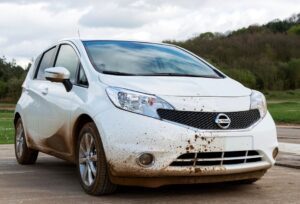
Mud and road splash. Dark-colored mud, dirt, and road splash look absolutely terrible on white paint. After driving through a construction zone or down a muddy back road, a white car looks like it has been through a war. A dark gray or brown car wearing the same mud? You can barely tell.
Bird droppings. This is the white car owner’s nemesis. Bird droppings are usually dark, sometimes purple, green, or brown depending on what the bird ate. On a white surface, they stand out like graffiti on a blank wall. You cannot miss them. And if you leave them too long, the acid in the droppings can etch into the clear coat and leave a permanent mark.
Tree sap. If you park under trees regularly, sap drips are going to be a problem. On darker cars, sap blends in somewhat. On white paint, it looks like someone dripped amber glue all over your hood. It is sticky, it is visible, and it takes real effort to remove without damaging the paint.
Rust stains and iron fallout. If you live near railroad tracks, industrial areas, or drive on roads treated with certain chemicals, tiny iron particles can land on your paint and leave orange-brown rust spots. On a dark car, these are nearly invisible. On white paint, they look like someone flicked a rusty paintbrush at your car.
Deeper scratches. While fine scratches are less visible on white, any scratch deep enough to expose the primer or bare metal becomes highly visible. The contrast between white paint and the gray or dark primer underneath creates a mark you can see from across a parking lot.
How White Stacks Up Against Other Popular Car Colors
Every car color has its own set of strengths and weaknesses when it comes to maintenance. No color is perfect. Here is an honest comparison so you can see how white measures up against the competition:
| Color | Hides Dust | Hides Mud/Stains | Shows Scratches | Fade Resistance | Overall Maintenance |
|---|---|---|---|---|---|
| White | Excellent | Poor | Moderate | Excellent | Moderate |
| Black | Poor | Moderate | Very High | Poor | High |
| Silver/Gray | Excellent | Good | Low | Good | Low |
| Red | Moderate | Moderate | Moderate | Poor | Moderate |
| Blue | Moderate | Moderate | Moderate | Moderate | Moderate |
Notice something? Silver and gray are actually the lowest-maintenance colors overall. They hide dust, they hide dirt, they hide scratches, and they resist fading reasonably well. If your only goal is to minimize time spent cleaning your car, silver is the smart pick. But not many people get excited about silver.
White is a strong middle ground. It is not the hardest color to maintain (that honor goes to black, which shows absolutely everything), and it is not the easiest. It has specific vulnerabilities, but it also has genuine advantages that make daily life easier.
The Science Behind Why White Paint Behaves the Way It Does
If you are wondering why white paint hides some things and exposes others, it comes down to contrast. Your eye is drawn to things that stand out against their background. White is the lightest possible background, so anything dark placed on it jumps out immediately.
Dust particles are usually light gray or tan. On a white background, there is very little contrast, so your eye does not register the dust easily. But a splatter of dark mud? Maximum contrast. Your brain locks onto it instantly.
The same principle applies to scratches. A scratch in clear coat appears as a white or translucent line. On white paint, that line blends in. On black paint, it stands out starkly because you are seeing a light mark against a dark background. But if a scratch goes through the white paint and exposes dark primer, now you have the opposite situation, a dark mark on a light background, and it becomes very visible.
This contrast effect also explains why swirl marks are more of a mixed bag on white. Swirl marks are thousands of tiny circular scratches in the clear coat, usually caused by improper washing or drying techniques. On a black car, swirl marks create a noticeable haze that ruins the mirror-like finish. On a white car, they are much less visible in normal light but can still show up under direct sunlight or under the fluorescent lights of a parking garage.
Understanding contrast helps you predict what will and will not be a problem. If the contaminant is dark, it will show on white. If it is light, it will not. Simple as that.
Scratches and Swirl Marks: The White Car Owner’s Constant Battle
Let us spend a little more time on scratches because this is where a lot of the “white cars are hard to maintain” complaints originate. And there is some truth to it, but it needs context.
White paint does show swirl marks and light scratches, especially in certain lighting conditions. If you wash your car at an automatic car wash with those big spinning brushes, you are going to create swirl marks. Those brushes trap dirt and grit in their bristles, and they drag that grit across your paint thousands of times during each wash. On a white car, the resulting swirl marks might not be immediately obvious, but park under a bright light and you will see them.
The bigger issue is deeper scratches. White cars tend to use a white primer underneath the white paint, which helps a little. But if the scratch goes deep enough to hit the base primer or bare metal, the contrast between the white surface and the exposed layer underneath becomes very noticeable. A shopping cart scrape in a parking lot, a key scratch from a careless passerby, or a branch dragging across a panel, these all leave marks that are hard to ignore on white.
On a silver car, a similar scratch might blend in because silver and gray primers are close in shade. On white, there is often enough color difference to make the damage stand out.
The good news? Surface-level swirl marks and light scratches on white paint are relatively easy to fix with a good polishing compound. Because the paint is not trying to match a complex metallic or pearl finish, touch-up work on white tends to look better than on other colors. A bottle of touch-up paint from your dealer and a steady hand can make minor chips and scratches nearly disappear.
Stains That Love White Paint (and How to Deal With Them)
Staining is the area where white cars genuinely require more attention than their darker counterparts. Certain substances can discolor white paint if they are left on the surface too long, and those discolorations are much more visible on white than on other colors.
Here are the most common culprits:
Bird Droppings
Bird droppings are acidic. The longer they sit on your paint, the more damage they do. On any color car, bird droppings can etch into the clear coat if left for days. But on a white car, the stain itself is immediately visible, which means you are more likely to notice it and clean it off. That is actually a hidden advantage. You catch the problem early because you can see it.
The best approach is to keep a small spray bottle of quick detailer and a microfiber cloth in your car. When you spot a dropping, spray it, let it soak for 30 seconds, and gently wipe it away. Do not rub aggressively. Bird droppings often contain seeds and grit that can scratch the paint if you grind them into the surface.
Tree Sap
Tree sap is sticky, stubborn, and ugly on white paint. It tends to dry into hard, amber-colored droplets that will not come off with a normal car wash. If you try to scrape it off, you risk scratching the paint underneath.
The trick is to soften the sap first. Rubbing alcohol or a dedicated sap remover applied to a microfiber cloth will dissolve the sap without damaging the clear coat. Soak the spot, let it sit for a minute, and then gently lift the sap away. Follow up with a wash and wax to restore the surface protection.
If you park under trees regularly, consider a car cover or finding a different parking spot. Prevention beats treatment every time.
Industrial Fallout and Brake Dust
If you live near factories, railroads, or heavy industrial areas, tiny metallic particles can settle on your paint. These particles oxidize over time and leave orange or brown rust spots on the surface. On a dark car, you might not notice them for weeks. On a white car, they show up almost immediately.
Iron remover sprays are your best friend here. These products are specifically formulated to dissolve iron particles on contact. You spray them on, watch the solution turn purple as it reacts with the iron, and then rinse it off. It is oddly satisfying to watch, and it works remarkably well.
Brake dust from your own wheels can also cause similar staining on white paint near the wheel arches. Regular washing of the lower panels and wheel wells helps prevent this buildup from becoming a permanent problem.
Pollen and Organic Matter
During spring, pollen can coat your car in a fine yellow-green layer. On white, pollen is visible but not dramatically so. The bigger concern is that pollen mixed with moisture can leave a slightly yellow tint on white paint if left to bake in the sun over several days. A quick rinse with water is usually enough to prevent this from happening.
Fallen leaves, flower petals, and other organic debris can also leave tannin stains on white paint. These are brownish marks that appear after the organic material sits on the paint in wet conditions. They can usually be removed with a clay bar or a mild polish, but they require more effort than a regular wash.
The Honest Answer: Is a White Car Actually Harder to Maintain?
Now that we have looked at all the ways white paint can get dirty and stained, let us answer the original question honestly.
White cars are not universally harder to keep clean. They are harder to keep clean in specific ways, and easier in others. The overall maintenance effort depends entirely on your environment, your parking situation, and how much certain types of dirt bother you.
If you park in a garage, drive mostly on paved roads, and live in a dry climate, a white car is one of the easiest colors to own. It hides dust beautifully, it does not fade, and it looks good even when it is a little dirty.
If you park under trees, drive through mud regularly, or live in an area with heavy industrial pollution, white paint will show those specific contaminants more than a darker color would. You will need to wash more frequently and pay more attention to spot cleaning.
Compared to black, white is significantly easier to maintain. Black shows every speck of dust, every water spot, every swirl mark, and every fingerprint. Keeping a black car looking truly clean is a full-time job. White forgives a lot more neglect in daily driving conditions.
Compared to silver or gray, white requires slightly more attention because of the staining issue. Silver is the true low-maintenance champion. But white still beats most other colors for practical, everyday upkeep.
Smart Ways to Keep Your White Car Looking Fresh
If you already own a white car or have decided to get one, here are practical, proven strategies to keep it looking its best without spending your entire weekend in the driveway with a bucket and sponge.
1. Wash It More Often Than You Think You Need To
This applies to any car color, but it is especially important for white. The stuff that stains white paint, bird droppings, sap, bug splatter, iron particles, does more damage the longer it sits. Washing every one to two weeks prevents contaminants from bonding to the surface and becoming permanent.
You do not need a full detail every time. A quick wash with a proper car shampoo and a rinse is enough to remove surface grime and keep the paint protected. Save the deep cleaning for once a month.
2. Use the Right Soap (Not Dish Detergent)
This is a mistake a surprising number of car owners make. Dish soap is designed to cut grease, which means it also strips away any wax or sealant on your paint. Every time you wash with dish soap, you are removing the protective layer that keeps your paint looking good and makes it easier to clean next time.
Use a pH-neutral car shampoo instead. These are formulated to clean the paint without stripping protective coatings. They cost a few dollars more than dish soap, but a single bottle lasts months. The investment pays for itself in paint protection alone.
3. Dry Properly to Avoid Water Spots and Swirls
How you dry your car matters almost as much as how you wash it. Using an old bath towel or a chamois that has been sitting in your garage collecting dust is a recipe for swirl marks. Those materials can trap grit and drag it across the paint.
Use a clean, high-quality microfiber drying towel. These towels are designed to absorb water quickly without scratching. Pat the surface dry rather than dragging the towel in long strokes. If you want to take it a step further, a filtered water rinse or a quick pass with a leaf blower (yes, really) can eliminate water spots altogether by removing the water before minerals in it have a chance to dry on the paint.
4. Wax or Seal the Paint Regularly
Wax does more than make your car shiny. It creates a barrier between your paint and the outside world. That barrier repels water, makes dirt slide off more easily, and protects the clear coat from UV damage. On a white car, a good wax job also makes contaminants like bird droppings and sap easier to remove because they sit on the wax layer instead of bonding directly to the paint.
Traditional carnauba wax gives a warm, deep glow and typically lasts about four to six weeks. Synthetic paint sealants last longer, sometimes three to six months, and offer excellent protection with less effort. Ceramic coatings take it a step further, providing years of protection in a single application, but they cost significantly more and often require professional installation.
For most white car owners, a synthetic sealant applied every three months is the sweet spot between protection and convenience.
5. Park Smart
This sounds obvious, but where you park has a massive impact on how clean your car stays. Parking under trees invites sap, bird droppings, and pollen. Parking near construction sites exposes your paint to concrete dust and metal particles. Parking in direct sunlight accelerates UV damage and bakes contaminants into the paint.
Whenever possible, park in a garage or under a covered structure. If that is not an option, try to find spots away from trees and away from areas where birds congregate (like light poles and power lines). A car cover is another option for outdoor parking, though it takes a few minutes to put on and take off each time.
6. Address Stains Immediately
The single most effective thing you can do for a white car is deal with stains the moment you spot them. Bird droppings, bug splatter, sap, mystery liquids from parking garages. Whatever it is, the faster you clean it off, the less likely it is to leave a permanent mark.
Keep a small bottle of quick detailer and a couple of microfiber cloths in your trunk. It takes 30 seconds to spray and wipe a bird dropping. It could take hours of polishing to fix the etching it leaves behind if you ignore it for a week.
7. Skip the Automatic Car Wash (Most of the Time)
Those drive-through car washes with the big spinning brushes are convenient. They are also one of the fastest ways to put swirl marks all over your paint. The brushes pick up dirt and grit from every car that goes through before yours, and they grind that debris into your clear coat.
Touchless car washes are a better option if you need a quick clean. They use high-pressure water and chemicals instead of physical contact, which eliminates the swirl mark risk. But touchless washes also tend to use harsher chemicals that can strip wax and sealant faster.
The best option, whenever you have the time, is a hand wash using the two-bucket method. One bucket has soapy water, the other has clean rinse water. You dip your wash mitt in the soapy bucket, wash a section of the car, then rinse the mitt in the clean water before going back to the soapy bucket. This prevents you from dragging dirty water across the paint.
Products That Make a Real Difference on White Paint
Not all car care products are created equal, and some work particularly well on white paint. Here is a quick rundown of the product categories worth investing in:
- pH-neutral car shampoo: Gentle on paint and sealant. Cleans effectively without stripping protection. Look for one that produces good lubrication to reduce the risk of swirl marks during washing.
- Iron remover spray: Dissolves embedded iron particles that cause orange staining on white paint. Use it once a month or as needed, depending on your driving environment.
- Clay bar kit: Removes bonded contaminants that washing alone cannot touch. After claying, your paint should feel glass-smooth when you run your hand across it. Do this before applying wax or sealant for best results.
- Quick detailer spray: Perfect for spot cleaning between washes. Spray it on, wipe it off with a microfiber cloth, and you are done. Essential for dealing with bird droppings and bug splatter on the go.
- Synthetic paint sealant or ceramic coating: Long-lasting protection that makes your white paint easier to clean and more resistant to staining. Worth the money for any white car owner who wants to reduce maintenance effort over time.
- High-quality microfiber towels: Use dedicated towels for different tasks. One set for washing, one for drying, one for applying products. Never use the same towel for everything, and wash your microfiber towels separately from regular laundry to keep them clean and scratch-free.
Common Mistakes That Make White Cars Look Worse
Even well-intentioned car owners sometimes make their white paint look worse instead of better. Here are the most common mistakes and how to avoid them:
Using a single bucket for washing. One bucket means you are putting your dirty wash mitt back into dirty water and then rubbing that dirty water onto your paint. You are essentially giving your car a dirt massage. Always use two buckets, or better yet, a grit guard insert at the bottom of each bucket to trap debris.
Washing in direct sunlight. When the sun heats your paint, soap and water dry before you can rinse them off. This leaves water spots and soap residue that can be surprisingly hard to remove. Wash in the shade, early in the morning, or in the evening when the sun is low.
Ignoring the wheels and lower panels. The dirtiest parts of your car are the wheels and the rocker panels along the bottom. Brake dust, road grime, and splash-up accumulate here and can spray onto your white paint if you neglect them. Clean your wheels first, using a separate set of tools from what you use on the body, and then work your way up.
Applying too much pressure when drying or polishing. White paint does not need aggressive rubbing. Let the products do the work. Light, even pressure with a clean microfiber towel is all you need. Pressing hard just increases the risk of creating swirl marks.
Skipping the protection step. Washing without applying wax or sealant is like showering without putting on clean clothes. You are clean for about five minutes before everything starts sticking to you again. Protect the paint after every wash, or at minimum after every third or fourth wash, to keep contaminants from bonding to the surface.
Seasonal Challenges for White Car Owners
Different times of year bring different threats to your white paint. Knowing what to expect helps you stay ahead of the problem.
Spring: Pollen is the main enemy. It coats everything in a fine yellow-green film. On white paint, it is less visible than on dark colors, but it can leave a yellowish tint if it gets wet and bakes in the sun. Wash weekly during peak pollen season.
Summer: Bug splatter and bird droppings are at their worst. Both are acidic and can damage your paint quickly in hot weather because the heat accelerates the chemical reaction. Quick detailer and a microfiber cloth should be within arm’s reach at all times.
Fall: Fallen leaves and tree debris are the concern. Wet leaves left on your paint can leave tannin stains, and decomposing organic matter can be surprisingly corrosive. Keep your car clear of leaf piles and wash off any debris promptly.
Winter: Road salt is the big one. Salt is incredibly corrosive, and it creates a gritty, gray film on white paint that looks awful. Worse, it can eat into the clear coat and even the metal underneath if left unchecked. Wash your car regularly during winter months, paying special attention to the undercarriage, wheel wells, and lower body panels where salt spray accumulates.
White Paint Types: Not All Whites Are Equal
Here is something a lot of people do not realize. There are different types of white paint, and each one behaves slightly differently when it comes to maintenance.
Solid white is the most basic and most common. It is a single layer of white paint under a clear coat. It is the easiest to touch up if you get a chip or scratch because matching a flat white is straightforward. It also tends to be the least expensive option at the dealership.
Pearl white contains tiny mica flakes mixed into the paint that give it a subtle shimmer and depth. It looks more luxurious than solid white, but it is harder to touch up because matching the pearl effect requires more precision. Pearl white also tends to show swirl marks a bit more than solid white because the mica flakes catch and reflect light at different angles.
Metallic white is similar to pearl but uses metallic flakes instead of mica. It has a slightly cooler, more silver-tinted appearance. Like pearl, it is harder to match for touch-up work and shows swirl marks more readily than solid white.
If ease of maintenance is your top priority, solid white is the way to go. It is the most forgiving, the easiest to repair, and the least likely to show imperfections. Pearl and metallic whites look stunning when they are clean and polished, but they demand a bit more care to keep looking their best.
The Ceramic Coating Question: Is It Worth It for White Cars?
Ceramic coatings have exploded in popularity over the past few years, and for good reason. A quality ceramic coating bonds to your paint at a molecular level, creating a semi-permanent protective layer that is harder and more durable than any wax or sealant. Water beads up and rolls off. Dirt has a harder time sticking. Bird droppings and bug splatter wipe away with minimal effort.
For a white car, a ceramic coating can be a game-changer. It dramatically reduces the effort required to keep the paint clean and stain-free. The hydrophobic (water-repelling) properties mean that rain actually helps clean the car instead of leaving dirty water spots behind.
The downside is cost. Professional ceramic coating applications typically run between $500 and $2,000 depending on the product and the size of the vehicle. DIY ceramic coatings are cheaper (usually $50 to $150 for a kit), but they require careful preparation and application to work properly.
Is it worth the money? If you plan to keep your white car for several years and you want to minimize cleaning effort, yes. The coating pays for itself in time saved and paint protection over the long run. If you are leasing or plan to trade in within a year or two, it is probably not worth the investment.
What About Paint Protection Film?
Paint protection film (PPF) is a clear, thermoplastic urethane film that is applied to vulnerable areas of your car, like the front bumper, hood, fenders, and mirrors. It absorbs rock chips, bug impacts, and minor abrasions that would otherwise damage your paint.
On a white car, PPF is particularly valuable for the front end, which takes the brunt of road debris. Rock chips on white paint expose the darker primer underneath, creating visible spots that are hard to ignore. PPF prevents those chips from reaching the paint in the first place.
Modern PPF products also have self-healing properties. Light scratches in the film disappear when exposed to heat, either from the sun or from pouring warm water over the surface. It sounds like science fiction, but it actually works.
PPF is expensive, typically $1,000 to $5,000 or more depending on how much of the car you cover. But for white car owners who want the best possible protection, it is the gold standard. Combine PPF on the high-impact areas with a ceramic coating on the rest of the car, and you have a white car that practically cleans itself and resists damage like armor.
The Verdict on White Cars and Cleanliness
White cars are not the maintenance nightmares some people make them out to be. They are also not the effortless, always-clean dream machines that others claim. The truth sits somewhere in between.
White hides everyday dust and light grime better than almost any other color. It resists fading, it keeps your car cooler in summer, and it looks clean even when it is not perfectly clean. These are real, practical advantages that matter in daily life.
On the flip side, white exposes dark stains, organic contaminants, and deep scratches more than darker colors. It demands prompt attention when something lands on the paint, and it rewards owners who stay on top of washing and protection.
The key is understanding what you are signing up for. If you treat your white car well, wash it regularly, protect the paint, and deal with stains quickly, it will reward you with a clean, sharp appearance that lasts for years. Neglect it, and those tree sap spots and bird dropping etchings will turn your pristine white finish into a spotted mess.
Every car color demands some level of care. White just asks for a slightly different kind of attention than black or silver. And honestly, given how much easier white is to live with day to day compared to black, most owners find it is a trade-off they are very happy to make.
So if you are on the fence about buying a white car because someone told you it is too hard to keep clean, go ahead and buy it. Just keep a bottle of quick detailer in your trunk and learn to love your microfiber towels. Your white car will thank you for it.