
Most people have heard of anti-lock brakes. Most people know what airbags do. And by now, a lot of drivers are at least somewhat familiar with forward collision warning systems and automatic emergency braking. These are the safety features that get talked about in commercials and car reviews.
But there is another system hiding in many modern vehicles that rarely gets mentioned until something goes wrong with it. It is called the secondary collision brake system, and its job is to protect you during the chaotic moments after an initial crash. Not before the crash. After it.
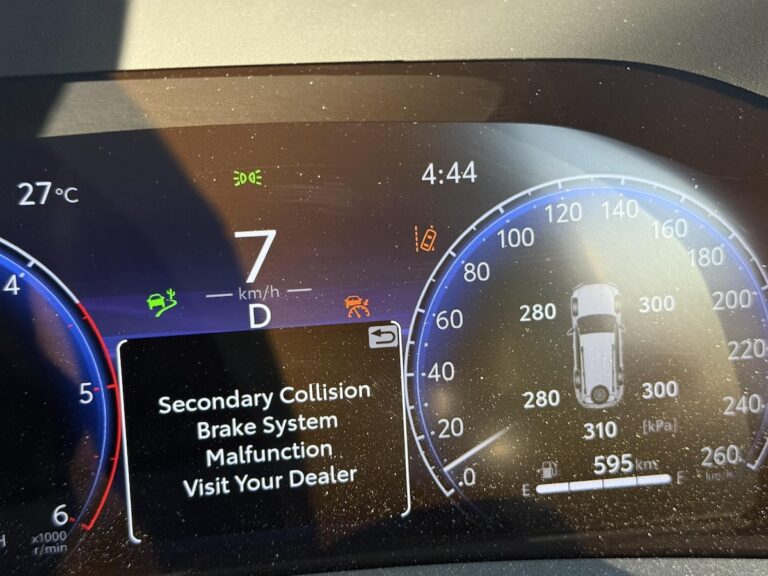
If you have ever seen a warning message on your dashboard that says something like “Secondary Collision Brake System Malfunction” or “Pre-Collision System Malfunction,” you know how unsettling it can be. The message pops up, you have no idea what it means, and suddenly you are wondering whether your car is safe to drive.
This is not one of those systems you can afford to ignore. When it works properly, it can be the difference between a single-impact fender bender and a multi-vehicle chain reaction. When it fails, you lose a layer of protection that you did not even realize you had. And the causes of that failure range from simple wiring issues to complex sensor calibration problems that require professional equipment to diagnose.
Let us break down exactly what this system does, why it fails, how to fix it, and what it will cost you. Whether you drive a Toyota, Hyundai, Kia, Lexus, or any other vehicle equipped with this technology, this guide covers the information you need.
What the Secondary Collision Brake System Actually Does
To understand why this system matters, you need to think about what happens during a real-world car accident. Not the sanitized version from crash test videos, but what actually occurs on the road when two vehicles collide.
The initial impact is just the beginning. After the first collision, the vehicle does not simply stop. Depending on the speed, the angle of impact, and road conditions, the vehicle can bounce off the first object and continue moving. It might roll into oncoming traffic. It might slide across an intersection. It might rear-end the car in front of it. It might spin and collide with a guardrail, a pole, or another vehicle.
These follow-up impacts are called secondary collisions, and statistically, they cause a significant percentage of serious injuries and fatalities in multi-vehicle accidents. The initial crash gets all the attention, but it is often the second, third, or fourth impact that does the most damage to the occupants.
How the System Steps In After the First Impact
The secondary collision brake system is designed to minimize or prevent these follow-up impacts. Here is how it works in a simplified sequence:
- The vehicle is involved in an initial collision. The airbag sensors detect the impact and deploy the airbags.
- The same sensors (or closely related ones) communicate with the braking system and recognize that a collision has just occurred.
- The system automatically applies the brakes at maximum force, independent of whether the driver is pressing the brake pedal. After a significant crash, the driver may be disoriented, unconscious, or physically unable to reach the pedal. The system does not wait for the driver.
- By applying the brakes immediately after the initial collision, the system slows or stops the vehicle as quickly as possible, reducing the speed at which any secondary collision occurs, or preventing it entirely.
Think about it this way. You are driving through an intersection and someone runs a red light and T-bones your vehicle on the driver side. The initial impact spins your car. Without the secondary collision brake system, your car continues to spin or slide across the intersection, potentially into other lanes of traffic, into pedestrians, or into a building. With the system active, the brakes clamp down automatically within milliseconds of the first impact, dramatically reducing how far the vehicle travels after the initial collision.
That is the value of this system. It is a last-resort safety net that kicks in during the worst moments, when the driver is least able to respond.
Which Vehicles Have This System?
Secondary collision braking (sometimes called post-collision braking, multi-collision braking, or secondary collision mitigation) is found on a growing number of vehicles. It is most commonly associated with:
- Toyota and Lexus vehicles equipped with Toyota Safety Sense (TSS).
- Hyundai and Kia vehicles with SmartSense safety packages.
- Volkswagen vehicles with the Multi-Collision Brake system.
- Various European manufacturers including BMW, Mercedes-Benz, and Audi, which integrate similar functionality into their advanced driver assistance suites.
If your vehicle was manufactured after 2015 and came with an advanced safety package that includes automatic emergency braking, there is a good chance it also has some form of secondary collision braking. Check your owner’s manual under the safety systems section to confirm.
The Three Most Common Reasons This System Fails
When the secondary collision brake system triggers a malfunction warning, it is telling you that one or more of its components cannot be trusted to work properly in an emergency. The system self-checks regularly, and when it detects a problem, it disables itself and alerts you rather than risk a false activation or a failure during a real crash.
There are numerous things that can cause this malfunction, but in practice, three causes account for the vast majority of cases.
Damaged or Misaligned Radar Sensors and Cameras
Modern vehicles with collision-related safety systems rely heavily on forward-facing radar sensors and cameras mounted at the front of the vehicle. These sensors are typically located behind the front grille, in the bumper cover, or near the top of the windshield (in the case of cameras).
These sensors do double duty. They serve the pre-collision warning and automatic emergency braking system (the system that warns you before a crash), and they also feed data to the secondary collision brake system (the system that acts after a crash). If the front-facing sensors are compromised, both systems can be affected simultaneously.
Here is what makes these sensors so vulnerable. They are mounted at the very front of the vehicle, which is the area most likely to sustain damage in even minor collisions. A low-speed parking lot bump, a rear-ending at a stoplight, even a shopping cart impact can be enough to misalign or damage a radar sensor or camera.
And it does not take much misalignment to cause a problem. These sensors are calibrated to extremely precise angles. The radar unit might need to be aimed within a fraction of a degree to function properly. If the sensor shifts by even a tiny amount due to an impact, the system detects that its readings are no longer reliable and triggers a malfunction warning.
Beyond physical impacts, these sensors can also be affected by:
- Dirt, mud, ice, or snow buildup on the sensor face or camera lens. A thick layer of road grime can block the radar signal or obscure the camera’s view, causing the system to report a malfunction.
- Aftermarket bumper or grille modifications that change the position or exposure of the sensor. If you installed a custom grille or bull bar and covered or relocated the sensor, the system may not function correctly.
- Windshield replacement. On vehicles where the camera is mounted behind the windshield, replacing the windshield without properly recalibrating the camera can trigger a malfunction. This is one of the most common causes of post-repair system warnings, and it is frequently overlooked by windshield replacement companies.
- Extreme temperature changes. Some sensors can temporarily malfunction in very cold or very hot conditions, though this usually resolves once the temperature normalizes.
A real-world scenario that happens more often than you would think. Someone gets a small dent in their front bumper from a parking lot incident. They have the bumper repaired and repainted at a body shop. The car looks perfect. But the radar sensor behind the bumper was nudged by 2 degrees during the impact, and no one recalibrated it during the repair. A week later, the owner sees “Secondary Collision Brake System Malfunction” on their dashboard and has no idea why.
The radar sensor was never inspected or recalibrated after the bumper work. That is all it takes.
Airbag Sensor and Control Module Problems
The secondary collision brake system is deeply intertwined with the airbag system. This makes sense when you think about it. Both systems need to know the same things: Was there an impact? How severe was it? How fast was the vehicle going? What direction did the force come from?
The airbag sensors are the ones that detect the actual collision event. They measure the deceleration forces acting on the vehicle during an impact and determine whether the crash is severe enough to warrant airbag deployment. That same sensor data is used by the secondary collision brake system to decide whether to apply the brakes.
If the airbag sensors or the airbag control module (ACM) have a problem, the secondary collision brake system loses its ability to accurately assess crash events. Without reliable crash data, the system cannot function, so it disables itself and sets a malfunction warning.
Airbag sensor and module problems can arise from several sources:
- A previous collision that was repaired but not fully resolved electronically. After a crash where the airbags deployed, the airbag control module stores crash data in its memory. Even after the physical damage is repaired and new airbags are installed, the control module may still have stored crash codes that prevent the system from resetting. If the crash data is not cleared (or the module is not replaced), the secondary collision brake system will remain in a malfunction state.
- A faulty airbag sensor. The sensors themselves can fail due to age, vibration, moisture intrusion, or electrical issues. A sensor that provides delayed or inaccurate readings will compromise the entire system.
- Wiring issues in the airbag circuit. The airbag sensors, control module, and related components are connected by a network of wires. Damage to any of these wires (from corrosion, rodent chewing, or physical impact) can break the communication chain and trigger a malfunction.
- Low battery voltage. The airbag system is sensitive to voltage. If your battery is weak or your charging system is not maintaining proper voltage, the airbag control module may not receive the stable power supply it needs, which can cause it to report errors that cascade into the secondary collision brake system.
The timing aspect of airbag sensors is especially important. The secondary collision brake system relies on the sensors to provide data within a very specific time window. The sequence is: impact occurs, sensors detect it, data is sent to the control module, control module sends a signal to the brake system, brakes are applied. All of this happens in milliseconds. If any step in that chain is delayed, even by a fraction of a second, the system may interpret the delay as a malfunction.
This is why the malfunction warning sometimes appears even when there has been no crash. The system runs self-tests periodically, and if it detects that the communication speed between the airbag sensors and the brake system is slower than the required threshold, it flags itself as faulty.
Broken, Corroded, or Damaged Wiring
This is the cause that sounds the simplest but can be the hardest to track down. Modern vehicles are held together by an incredibly complex network of wiring. There are literally miles of wire running through your car, connecting every sensor, module, motor, and switch to every other component that needs to communicate with it.
The secondary collision brake system depends on wiring that connects the radar sensors, the airbag sensors, the airbag control module, the brake control module, and potentially several other modules on the vehicle’s CAN bus network. A problem with the wiring at any point in this chain can cause a malfunction.
The most common wiring-related causes include:
- Rodent damage. Mice, rats, squirrels, and other rodents love to chew on automotive wiring. Many modern vehicles use soy-based wire insulation that is apparently quite tasty to rodents. A single chewed wire in the wrong harness can take down the entire secondary collision brake system. This is especially common in vehicles that are parked in garages, near fields, or in wooded areas.
- Corrosion at connectors. The electrical connectors that join different sections of the wiring harness can corrode over time, especially in humid climates or in areas that use road salt in the winter. Corrosion increases resistance in the circuit, which can weaken signals to the point where the control module interprets them as faulty.
- Physical damage from a previous repair. If a technician was working on an unrelated system (like the HVAC system, the dashboard, or the steering column) and accidentally pinched, cut, or disconnected a wire in the secondary collision brake system harness, the malfunction might not appear immediately. It could take days or weeks for the system’s self-test to detect the problem.
- Wires that have chafed through their insulation. Wiring harnesses are routed through tight spaces in the vehicle. Over time, vibration can cause wires to rub against metal brackets, bolt heads, or other components. Eventually, the insulation wears through, exposing the copper conductor. This can cause intermittent shorts or open circuits that trigger malfunction warnings.
- Water intrusion. If water gets into a connector or a control module housing (from a leaking windshield seal, a clogged sunroof drain, or flood damage), it can cause shorts and corrosion that affect multiple systems simultaneously. Water damage is particularly devastating to the delicate electronics in the airbag and collision systems.
A common frustration with wiring-related malfunctions is their intermittent nature. The warning might appear one day, disappear the next, and come back a week later. This happens because a damaged wire might only lose contact when the vehicle hits a certain bump, reaches a certain temperature, or when vibration moves the wire into a position where the break opens up. Then the wire shifts back, contact is restored, and the warning clears itself. These intermittent faults are notoriously difficult to diagnose because the problem might not be present when the technician is looking for it.
Other Factors That Can Trigger the Malfunction Warning
While the three causes above account for most cases, there are several additional factors that can trigger a secondary collision brake system malfunction. These are less common but worth knowing about, especially if the primary causes have been ruled out.
Software Glitches and Module Communication Errors
The secondary collision brake system relies on multiple electronic modules communicating with each other over the vehicle’s CAN bus network. If any module on that network has a software glitch, a corrupted memory state, or a communication error, it can affect the secondary collision system even if the problem is not directly related to it.
For example, a software bug in the brake control module might cause it to fail a self-test, which then sets a malfunction code for the secondary collision system. Or a communication timeout between the airbag control module and the body control module might cause the system to flag itself as non-operational.
Manufacturers periodically release software updates (Technical Service Bulletins) to address known bugs and communication issues. If your vehicle is showing a secondary collision brake malfunction and no hardware problem can be found, a software update at the dealership might be the fix.
Weak or Failing Battery
A battery that is losing its ability to hold a charge can cause all sorts of strange electronic behavior. The secondary collision brake system, like the airbag system, requires a stable voltage supply to function correctly. If the battery voltage drops below a certain threshold during startup or during operation, the system may report a fault.
This is especially common in cold weather, when battery performance drops significantly. The malfunction warning might appear on cold mornings and clear itself once the engine has been running for a while and the alternator has brought the voltage back up. If this pattern sounds familiar, get your battery tested.
Aftermarket Modifications
Certain aftermarket modifications can interfere with the secondary collision brake system:
- Aftermarket bumpers (especially on trucks and SUVs) that relocate or obstruct the front radar sensor.
- Lift kits that change the angle of the front sensors relative to the road surface. The sensors are calibrated to a specific vehicle height. Lifting the vehicle changes that angle and can cause the system to lose its calibration.
- Aftermarket lighting mounted near the radar sensor or camera that reflects radar signals or creates glare on the camera lens.
- Window tint applied to the windshield in the area where the forward-facing camera is mounted. Even a light tint can affect the camera’s ability to function properly.
- Dash cameras or other devices mounted near the factory camera. These can sometimes interfere with the camera’s field of view or create reflections that confuse the system.
If your secondary collision brake system started malfunctioning shortly after an aftermarket modification was installed, the modification is the likely culprit.
How to Fix a Secondary Collision Brake System Malfunction
The repair depends entirely on what caused the malfunction. There is no single fix that covers all cases. Here is what the repair process looks like for each of the major causes.
Fixing Damaged or Misaligned Radar Sensors and Cameras
If the malfunction is caused by a damaged or misaligned front radar sensor or camera, the repair process typically involves several steps:
- Diagnostic scan. The technician connects a professional scan tool to the vehicle’s OBD2 port and reads the fault codes stored in the system. The codes will point to the specific sensor or camera that is reporting the problem.
- Visual inspection. The technician inspects the sensor or camera for visible damage, misalignment, obstruction (dirt, ice, aftermarket parts blocking the view), or loose mounting.
- Cleaning. If the issue is simply dirt or debris blocking the sensor, a thorough cleaning of the sensor face or camera lens may resolve the warning. This is the best-case scenario and costs almost nothing.
- Repair or replacement. If the sensor or camera is physically damaged, it needs to be replaced. Radar sensors are precision instruments and cannot typically be repaired. They are replaced as a unit.
- Recalibration. This is the step that many shops and body repair facilities miss, and it is absolutely essential. After any repair, replacement, or even bumper removal and reinstallation, the radar sensor and/or camera must be recalibrated. This process uses specialized equipment (a target board positioned at a precise distance and angle in front of the vehicle) to aim the sensor and verify its accuracy. Without recalibration, the sensor might be physically present and electrically functional but aimed incorrectly, which means the system will either malfunction or provide inaccurate data during a real collision.
Recalibration comes in two types:
- Static calibration is performed in a controlled indoor environment using a target board. The vehicle must be on a perfectly level surface, and the target must be positioned at a manufacturer-specified distance and height. This is the most precise method and is required by many manufacturers after sensor replacement.
- Dynamic calibration is performed by driving the vehicle on a straight road at a specific speed for a specified distance while the system recalibrates itself using road markings and other reference points. Some vehicles support dynamic calibration, others require static, and some require both.
If you recently had your windshield replaced and the malfunction appeared afterward, ask the windshield company whether they recalibrated the forward-facing camera. Many windshield replacement services do not include calibration in their standard service, and some are not even equipped to do it. You may need to take the vehicle to a dealership or an ADAS (Advanced Driver Assistance System) calibration specialist for this step.
Fixing Airbag Sensor and Control Module Issues
Airbag system repairs are not something most DIYers should attempt. The airbag system involves explosive charges (the inflators that deploy the airbags), and working on these components without proper training and tools can be genuinely dangerous. That said, here is what the repair process involves so you know what to expect when you take the vehicle to a professional.
If the problem is a stored crash event in the airbag control module:
After a collision where the airbags deployed, the airbag control module records the crash data and enters a “crashed” state. In many vehicles, the module does not need to be replaced. It can be reset by a qualified technician using specialized software. The reset clears the stored crash data and returns the module to its pre-crash operational state.
This reset service is widely available from airbag module specialists and typically costs significantly less than a full module replacement. Many shops offer this as a mail-in service where you remove the module, ship it to them, they reset it, and ship it back.
Not all modules can be reset. Some manufacturers design their modules to be single-use after a deployment event, requiring full replacement. Your technician can determine whether your specific module is resettable or needs to be replaced.
If the problem is a faulty airbag sensor:
A failed airbag sensor needs to be replaced. The technician will identify which sensor has failed using the diagnostic fault codes, replace the sensor, and clear the codes. After replacement, the system should self-test and return to normal operation.
Airbag sensors are located in various positions around the vehicle depending on the make and model. Common locations include the front bumper area, the B-pillars (the pillars between the front and rear doors), the center console, and under the front seats. The labor cost for replacement varies depending on how accessible the sensor location is.
If the problem is a wiring issue in the airbag circuit:
This requires tracing the wiring from the sensor to the control module, finding the damaged section, and repairing or replacing it. On some vehicles, the wiring runs through the steering column (for the driver’s front airbag), under the carpet (for seat-mounted sensors), or behind interior panels (for side airbag sensors). Accessing these wires can involve significant disassembly of interior trim, which drives up labor costs.
Fixing Broken or Damaged Wiring
Wiring repairs for the secondary collision brake system follow the same general process as any automotive wiring repair, but with one important caveat: these are safety-critical circuits. The quality of the repair matters more here than in almost any other wiring repair on the vehicle.
- Identify the damaged section. This is often the hardest part. The technician uses the fault codes to narrow down which circuit is affected, then physically traces the wiring to find the damage. This can involve removing interior panels, underbody shields, bumper covers, or other components to access the harness.
- Repair or replace the damaged wire. For a clean break, the wire can be soldered and sealed with heat-shrink tubing. For corroded connectors, the connector can be cleaned, or the terminal can be replaced. For extensive damage (like a section chewed by rodents), the entire damaged section of the harness may need to be replaced.
- Test the circuit. After the repair, the technician tests the circuit for continuity, proper resistance, and correct voltage to verify the repair is solid.
- Clear the codes and verify. The fault codes are cleared with a scan tool, and the system is allowed to run its self-test to confirm the malfunction has been resolved.
For rodent damage specifically, it is worth taking preventive measures after the repair. Rodent-deterrent tape (available from Honda and other manufacturers), peppermint oil sachets placed in the engine bay, and electronic rodent repellers are all commonly used to discourage repeat visits. None of these methods are 100 percent effective, but they can reduce the likelihood of a repeat chewing incident.
What These Repairs Typically Cost
Repair costs for secondary collision brake system malfunctions vary widely depending on the root cause, the vehicle make and model, and the shop doing the work. Here is a breakdown of typical cost ranges for the most common repairs.
| Repair Type | Estimated Parts Cost | Estimated Labor Cost | Total Estimate |
|---|---|---|---|
| Sensor cleaning (dirt/ice obstruction) | $0 | $0 to $50 | $0 to $50 |
| Radar sensor replacement and recalibration | $400 to $1,200 | $200 to $500 | $600 to $1,700 |
| Front camera replacement and recalibration | $300 to $800 | $150 to $400 | $450 to $1,200 |
| ADAS calibration only (after bumper repair or windshield replacement) | $0 (no parts) | $150 to $400 | $150 to $400 |
| Airbag control module reset | $0 (no parts) | $49 to $150 | $49 to $150 |
| Airbag control module replacement | $400 to $1,000 | $150 to $300 | $550 to $1,300 |
| Airbag sensor replacement | $100 to $350 | $100 to $250 | $200 to $600 |
| Wiring repair (minor, accessible location) | $10 to $50 | $100 to $200 | $110 to $250 |
| Wiring harness replacement (major damage) | $200 to $800 | $300 to $600 | $500 to $1,400 |
| Software update/reflash at dealership | $0 (no parts) | $100 to $200 | $100 to $200 |
A few notes on these costs. The radar sensor replacement is often the most expensive repair because the parts are costly and the recalibration requires specialized equipment that not every shop has. Dealerships are typically the most expensive option for this work, but they also have the manufacturer-specific calibration tools and software that the job requires. Independent shops that specialize in ADAS calibration can sometimes do the work for less.
The airbag control module reset is one of the most affordable fixes in this category. If your vehicle was in a collision, the airbags deployed, and the vehicle was repaired, but the secondary collision brake system is still showing a malfunction, the ACM reset is the first thing to try. At $49 to $150, it is a fraction of the cost of a full module replacement ($550 to $1,300).
Insurance coverage is worth mentioning here. If the malfunction was caused by a collision (either the one you are repairing or a previous one), the repair costs may be covered under your collision insurance or the other driver’s liability insurance. Sensor recalibration after a bumper repair or windshield replacement should arguably be included as part of the collision or comprehensive claim, though some insurers push back on this. Make sure the calibration cost is included in the repair estimate before you approve the work.
Can You Drive With a Secondary Collision Brake System Malfunction?
This is the question everyone wants answered first, and the honest answer is: yes, you can drive, but you should not ignore it.
When the secondary collision brake system is in a malfunction state, it is disabled. It will not activate in the event of a crash. Your vehicle’s other systems (regular brakes, ABS, airbags, seatbelts) still function normally. The car is not “unsafe” in the traditional sense. You are simply missing one layer of protection.
Think of it as driving without a backup parachute. Your primary parachute (your other safety systems) still works. But if something goes wrong with the primary, you do not have the backup. Most of the time, that will not matter. But in the one situation where it does matter, it matters enormously.
The malfunction should be diagnosed and repaired as soon as is reasonably practical. It is not the kind of warning that requires you to pull over immediately and call a tow truck (unless other warning lights are also on, particularly the airbag warning light or the ABS warning light). But it is also not something you should put off for months while you “get around to it.”
A few practical points about driving with this warning active:
- If the airbag warning light is also on, get the vehicle checked immediately. This could indicate a problem that affects airbag deployment, which is a much more serious safety concern.
- If the pre-collision system (forward collision warning and automatic emergency braking) is also disabled, you have lost your front-facing crash avoidance system in addition to the post-crash braking system. Drive with extra following distance and heightened awareness.
- If the warning appeared after a minor fender bender or bumper tap, the cause is very likely sensor misalignment. The fix may be as simple as a recalibration, which is relatively quick and inexpensive.
- If the warning appeared randomly with no apparent cause, it could be a wiring issue, a software glitch, or a weak battery. Get the codes read to narrow it down.
How to Diagnose the Problem Yourself (Before Going to a Shop)
While most secondary collision brake system repairs require professional equipment, there are some diagnostic steps you can take at home to narrow down the cause and potentially save yourself money.
Step 1: Check for Obvious Sensor Obstructions
Walk to the front of your vehicle and look at the area where the radar sensor and/or camera are mounted. On many vehicles, the radar sensor is behind the manufacturer’s badge on the grille (like the Toyota emblem) or behind a plastic cover in the lower bumper area. The camera is usually mounted behind the rearview mirror inside the windshield.
Look for dirt, mud, ice, snow, or any aftermarket accessories that might be blocking the sensor or camera. Clean the area thoroughly. If the warning appeared on a cold, slushy day, clearing the ice and slush from the sensor area might be all it takes.
Step 2: Check Your Battery
If the warning appeared during cold weather, after the vehicle sat for an extended period, or if you have noticed slow cranking when starting the engine, get your battery tested. Most auto parts stores will test your battery for free. A weak battery can cause all sorts of electronic system warnings, including this one.
Step 3: Look for Recent Changes
Think about what happened shortly before the warning appeared. Did you:
- Have the windshield replaced?
- Have bumper work done?
- Install an aftermarket accessory near the front of the vehicle?
- Have any collision, even a minor one?
- Get a new battery installed?
- Notice signs of rodent activity (droppings, chewed materials)?
Any of these events could be connected to the malfunction. Knowing the trigger helps the technician diagnose the problem faster, which saves you labor costs.
Step 4: Try a System Reset
On some vehicles, disconnecting the battery for 15 to 30 minutes and then reconnecting it can clear temporary software glitches in the control modules. This is not a guaranteed fix, and if the underlying problem is hardware-related, the warning will return. But for a transient software error, it is worth trying before spending money on a shop visit.
- Turn off the vehicle completely.
- Disconnect the negative battery terminal.
- Wait 20 to 30 minutes.
- Reconnect the terminal.
- Start the vehicle and let it idle for a few minutes.
- Drive the vehicle for at least 10 to 15 minutes at varying speeds to allow the system to complete its self-tests.
If the warning does not return after driving for a day or two, the issue may have been a temporary glitch. If it comes back, you need professional diagnosis.
Step 5: Get the Codes Read
If the warning persists, the next step is getting the diagnostic trouble codes read. A basic OBD2 code reader from an auto parts store can read engine and transmission codes, but it usually cannot access the advanced safety system modules where secondary collision brake codes are stored.
You will need either a professional-grade scan tool that can access the specific safety modules in your vehicle, or you will need to take the vehicle to a dealership or a shop that specializes in ADAS systems. The codes will point directly to the component or circuit that is causing the malfunction, which eliminates guesswork and prevents unnecessary parts replacement.
Why This System is Worth Fixing (Even If It Seems Optional)
Some drivers see the malfunction warning and think, “I have been driving for 20 years without a secondary collision brake system. I will be fine without it.” And on a day-to-day basis, that is probably true. The system only activates during a crash, which (hopefully) is an extremely rare event in your driving life.
But consider this. The whole point of safety systems is that you do not need them until you desperately need them. Airbags sit dormant for 99.99 percent of the vehicle’s life. Seatbelt pretensioners never fire. The secondary collision brake system never activates. Until the one moment when everything goes wrong, and then it is the difference between a single impact and a multi-vehicle catastrophe.
There is also a practical consideration. On many vehicles, the secondary collision brake system shares sensors and modules with the pre-collision braking system (the system that applies the brakes before a crash to reduce its severity). When the secondary system is in malfunction mode, the pre-collision system is often disabled too. That means you are losing not just the post-crash braking, but also the pre-crash automatic braking. That is a significant reduction in your vehicle’s active safety capability.
And there is the resale value angle. A vehicle with an active safety system malfunction warning on the dashboard is worth less than one with all systems functioning. Any buyer who plugs in a scan tool during a pre-purchase inspection (and savvy buyers do) will see the stored fault codes and either walk away or demand a significant price reduction.
Preventing Future Malfunctions
Once you have resolved the malfunction, there are practical steps you can take to reduce the likelihood of it happening again.
- Keep radar sensors and cameras clean. Make it a habit to wipe down the sensor area and camera lens when you wash your car or clean your windshield. In winter, clear snow and ice from the sensor area before driving.
- Insist on ADAS recalibration after any front-end work. If you have bumper work, grille replacement, headlight replacement, or windshield replacement done, ask the shop whether they performed sensor and camera recalibration. If they did not, either have them do it or take the vehicle to a specialist. Do not assume it will be fine without calibration.
- Maintain your battery. Get it tested annually, more often if you live in a climate with extreme temperatures. Replace it before it gets too weak to reliably power the vehicle’s electronic systems.
- Address rodent issues proactively. If you have had rodent damage to wiring, take steps to prevent it from happening again. Rodent-deterrent tape, electronic repellers, and removing food sources from your parking area can all help.
- Do not install aftermarket accessories that obstruct sensors. Before installing a new grille, bumper guard, light bar, or any accessory near the front of the vehicle, verify that it will not block or interfere with the radar sensor or camera.
- Check for recalls and TSBs. Manufacturers occasionally issue recalls or technical service bulletins for known issues with collision safety systems. Check the NHTSA website (nhtsa.gov) with your VIN to see if any apply to your vehicle.
This System Exists Because Seconds After a Crash Are the Most Dangerous
The secondary collision brake system is not a luxury feature. It is not a marketing gimmick. It is an engineering response to a real and well-documented problem: secondary collisions cause severe injuries and fatalities at a rate that is disproportionate to the initial crash.
When this system works, it applies the brakes in the chaotic milliseconds after an impact, when the driver is incapacitated, disoriented, or physically unable to respond. It slows or stops the vehicle before it can careen into another car, a pedestrian, a utility pole, or oncoming traffic. It turns what could be a multi-impact disaster into a single-impact event.
When the system is in a malfunction state, that protection disappears. Your vehicle becomes no different from one built 15 years ago, before this technology existed. You still have your other safety systems, and those are valuable. But you have lost the one system specifically designed to protect you in the moments when you are least capable of protecting yourself.
If that warning light is sitting on your dashboard right now, do not let it stay there. Get the codes read, identify the cause, and fix it. The repair might cost you $50 for a module reset or $1,500 for a sensor replacement and calibration. Either way, it is a small price for a system that could save your life in the three seconds after everything goes wrong.